Parshat Ki Tisa6 min read

Samael Lowed Like an Ox and Heaven Learned to Whisper

While Moses learns the blueprint of a holy life on Sinai, Samael lows like an ox in the camp below and turns Israel's fear into gold.

Curated by Arthur · Told by Maggid ·
Table of Contents
  1. The Fortieth Day on the Mountain
  2. The Words Handed Down in Code
  3. Samael Lowed Like an Ox
  4. The Calf That Could Not Face Heaven
  5. Not My People, Said the Voice
  6. Moses Held the Words and Answered
Samael Lowed Like an Ox and Heaven Learned to Whisper Click for full size

The Fortieth Day on the Mountain

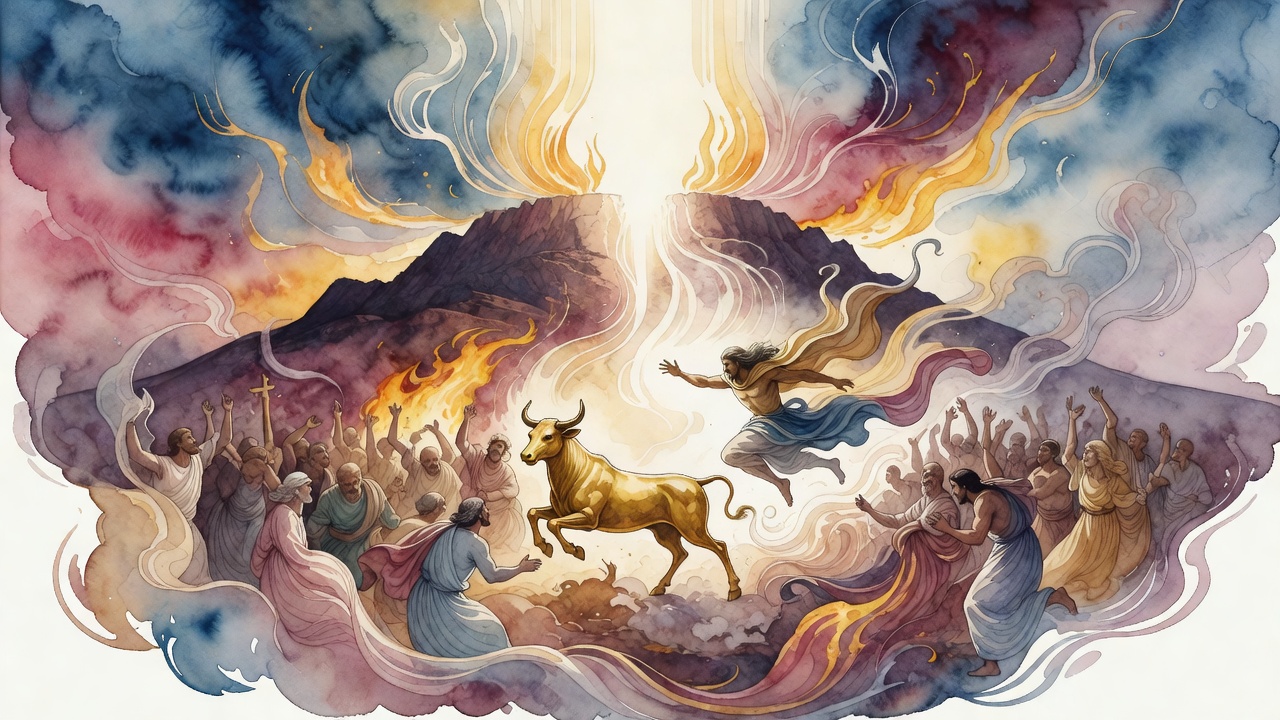
Thirty-nine days the mountain had burned, and the smoke had not lifted. Israel counted the mornings on the valley floor while Moses stood somewhere inside the fire above them, out of sight, out of reach. On the fortieth day the counting turned to fear. Where was the man who had split the sea? What if he did not come down at all?

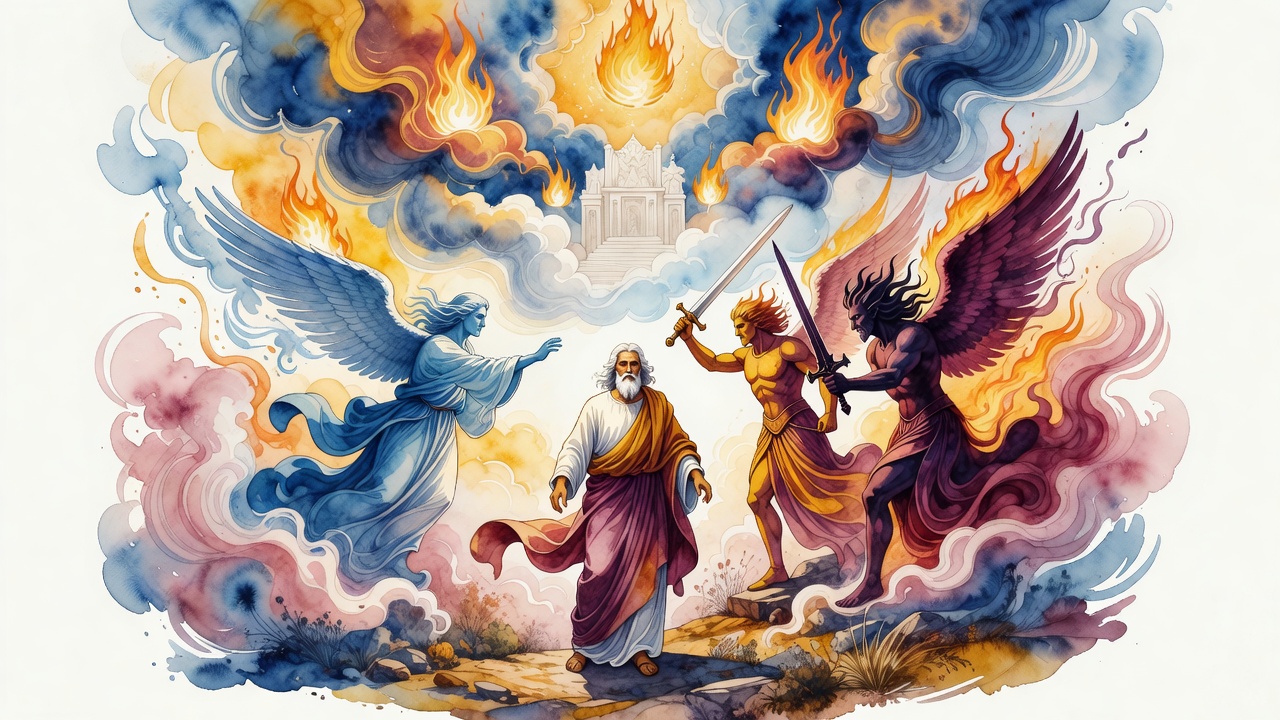
High on the peak the fire was not destroying anything. It was teaching. Word by word the Holy One was handing Moses the shape of a holy life, the laws and the measures and the hidden order beneath them, the blueprint by which a scattered people might become a sanctuary. Below, the camp saw only smoke. Between the two, moving along the base of the mountain where the cloud met the sand, went Samael.

The Words Handed Down in Code

Not everything Moses received was given plainly. Some of it came wrapped, folded into hint and cipher, formless words on which the world quietly rests, handed over in secret for one reason. The accuser was standing at the foot of the mountain, and he was listening.

A mortal king can walk into his own storeroom and never know what waits in the next chamber. The Holy One is not such a king. Nothing in the low world hides from Him, not the demon pacing the border of the camp, not the thought forming behind his eyes, though no eye below can find the One who watches. So the deepest words, the ones that hold up the foundations, were given to Moses in code. Speak the foundation aloud where Samael can hear it, and he will learn exactly where to push.

Samael Lowed Like an Ox

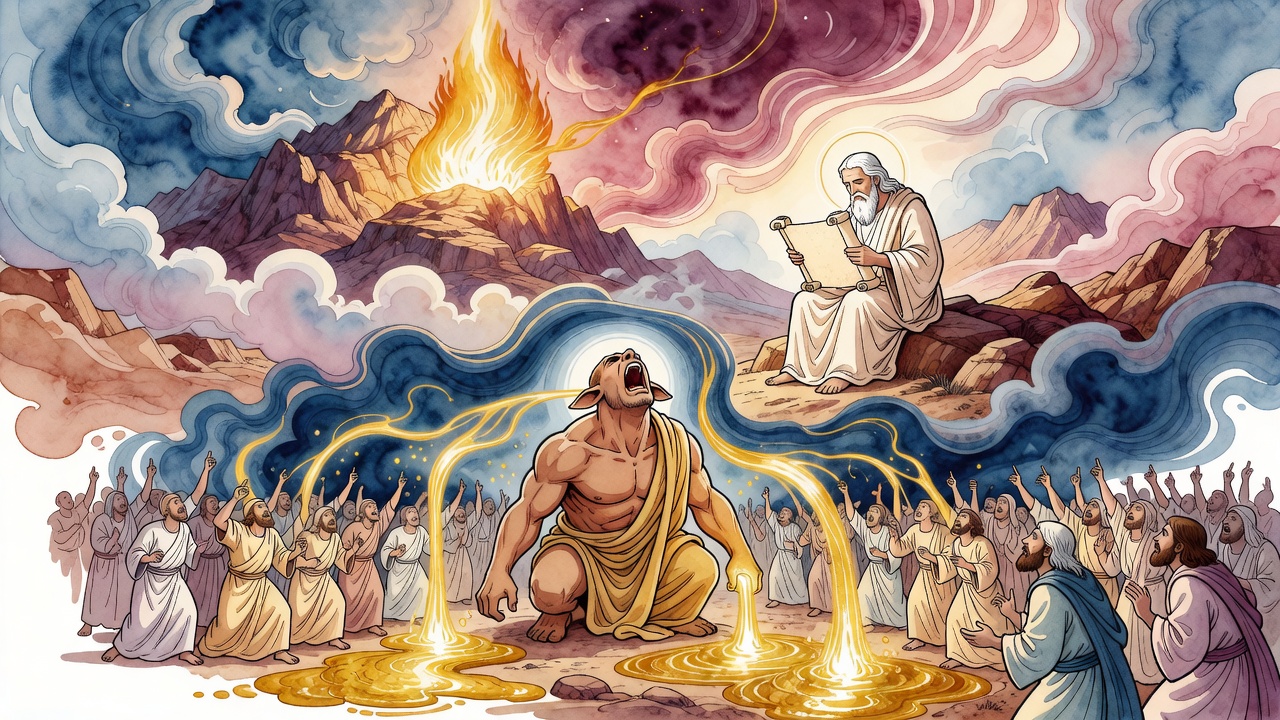
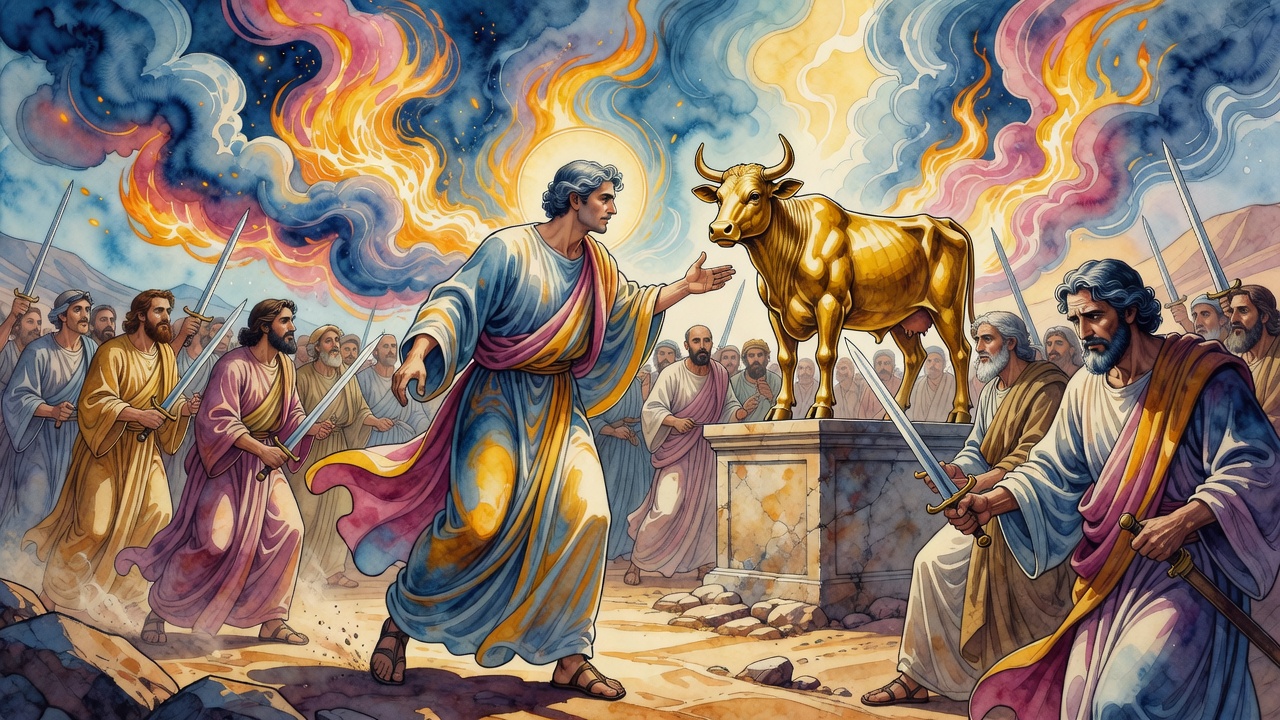
What Samael could not steal from heaven he decided to counterfeit on earth. He came down into the camp, and he did not argue and he did not tempt with words. He opened his mouth and he lowed.

It was the sound of an ox that knows its owner, the low animal certainty the people had lost the moment Moses vanished into the cloud. It moved through the tents like a promise. Here was a god you could hear. Here was a god with a body, a god that would not climb a mountain and leave you counting days. The panic that had been rising all morning found a shape to pour itself into.

"Make us a god who will go before us," they said, "for this Moses, the man who brought us up out of Egypt, we do not know what has become of him." They wanted something they could see. Something they could touch. Something that would stay.

The Calf That Could Not Face Heaven

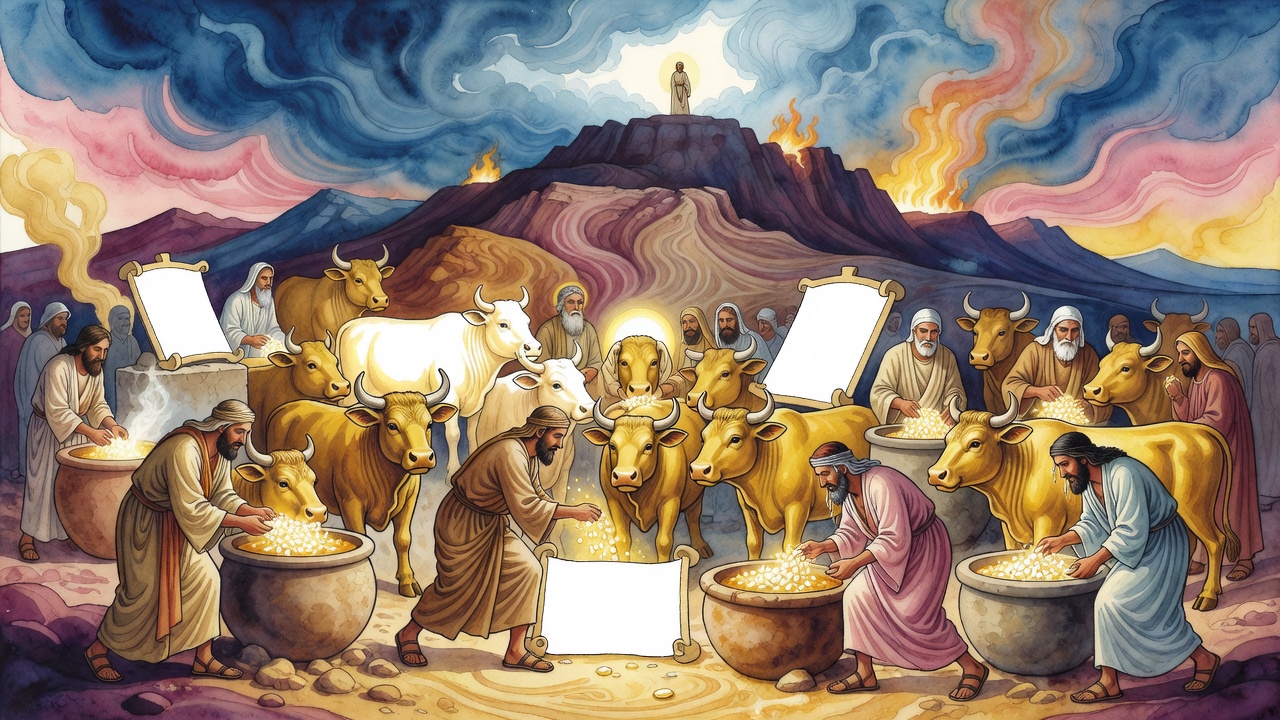
The gold came off their ears and their wives' necks and their daughters' hands, and it went into the fire, and out of the fire came the calf. Samael's lowing had done its work, and the metal seemed to answer him. The people bowed. They cried, "This is your god, O Israel, who brought you up out of the land of Egypt."

Far above, in the true order Moses was still receiving, a throne stands on the mount of God's own habitation, and a house below is meant to rise directly beneath it, aligned pillar to pillar, so that heaven and earth face each other and hold. The calf was the mockery of that alignment. A throne with no one on it. A body with no breath. It faced nothing, and it held nothing up, and the foundations Samael had been forbidden to hear about trembled anyway, because the people themselves had become the crack he was looking for.

Not My People, Said the Voice

The teaching on the mountain stopped. The Holy One spoke, and the warmth was gone from the words. "Go, get down from your greatness," He told Moses. "Israel has forgotten the might I worked for them in Egypt and at the sea, and they have made themselves an idol." Then came the sentence that landed like a door closing. "Go down, for your people have corrupted themselves."

Your people. Not My people. An hour before they had been His portion, His inheritance, the nation He had carried out of Egypt on the strength of His own arm. Now, in a single pronoun, He had set them at arm's length and handed them to the man who led them. This was the toppled foundation David would one day cry over, the fear that when the wicked pull down the righteous the whole world goes dark. Samael, at the base of the mountain, had never heard the coded words. He had not needed to. He had made Israel say them for him.

Moses Held the Words and Answered

Moses did not go down. Not yet. He held the words he had just been given, the ones meant to build a people, and he turned them back toward the One who had given them. "Master of all the worlds," he said. "While Israel had not yet sinned before You, You called them 'My people.' Now that they have sinned, You say to me that my people have corrupted themselves. They are Your people. They are Your inheritance."

He would not accept the pronoun. He stood in the smoke and argued, the only man in creation who had heard the shape of return spoken aloud, and he refused to let the accuser at the foot of the mountain keep the last word. The calf still stood in the valley below him, lowing in a voice that was not its own. Moses opened his hand, held the words the foundations rest on, and kept talking until the door that had closed began, very slightly, to open.


← All myths
From the tradition

Sources

2 sources

The texts behind this telling. Some cards carry a translation of the source; others are our own retelling of it, and each card says which. Every card links out to the original.

Pirkei DeRabbi Eliezer 45:7Pirkei DeRabbi Eliezer

Retold in our words. Read the original at the link below.Pirke de Rabbi Eliezer, trans. Rabbi Gerald Friedlander, London (1916) · CC-BY

A story found woven into the ancient text of Pirkei DeRabbi Eliezer.

The scene: Mount Sinai. Moses is up there receiving the Torah, the ultimate gift, the very blueprint for a just and holy life. Meanwhile, down below… things are falling apart.

Pirkei DeRabbi Eliezer, a fascinating non-canonical Midrash (rabbinic interpretive commentary), tells us that Sammael – often considered the accuser, or even a representation of the dark forces – slithered his way into the chaos. His goal? To mislead Israel. And how did he do it? Rabbi Jehudah says he did so by "lowing to mislead Israel, as it is said, "The ox knoweth his owner" (Isa. 1:3). Sammael, the force of chaos, is mimicking the sound of an ox. Why? To lure the Israelites to the very thing they should reject: idol worship.

The Israelites, feeling abandoned by Moses' long absence and perhaps overwhelmed by the sheer magnitude of their newfound freedom, succumb to the pressure. They demand a god they can see. A god they can touch. A god they can control. And so, the Golden Calf is born.

This act of blatant idolatry, this betrayal of the covenant they had just entered into with God, doesn't go unnoticed. As Pirkei DeRabbi Eliezer continues, God sees what's happening and says to Moses, "Israel has forgotten the might of My power, which I wrought for them in Egypt and at the Reed Sea, and they have made an idol for themselves." Can you hear the divine disappointment in those words? After all God had done for them, they turned their backs so quickly.

And then comes the really painful part. God essentially disowns them, telling Moses, "Go, get thee down from thy greatness." And this is the key moment. God says, "Go… for thy people have corrupted themselves." Not My people anymore.

But Moses, that steadfast advocate, refuses to let go. He argues with God, pleading for mercy. He reminds God that they are His people, His inheritance. As Pirkei DeRabbi Eliezer records, "Moses spake before the Holy One, blessed be He: Sovereign of all the worlds! Whilst Israel had not yet sinned before Thee, Thou didst call them 'My people,' as it is said, 'And I will bring forth my hosts, my people' (Ex. 7:4). Now that they have sinned before Thee, Thou sayest unto me, 'Go, get thee down, for thy people have corrupted themselves' (Ex. 32:7). They are Thy people, and Thine inheritance, as it is said, 'Yet they are thy people and thine inheritance' (Deut. 9:29)."

Moses's powerful intervention, his unwavering belief in the potential for redemption, is evidence of the enduring bond between leader and people, and between God and Israel. It reminds us that even in moments of profound failure, the possibility of return, of teshuvah (repentance), always remains.

The story of the Golden Calf isn't just a historical account. It's a timeless reminder of the constant struggle between faith and temptation, between remembering our commitments and succumbing to our immediate desires. And perhaps most importantly, it highlights the crucial role of leadership in guiding us back to the right path, even when we've strayed far, far away.

Full source
Yalkut Shimoni on Nach 653:3Yalkut Shimoni on Nach

Retold in our words. Read the original at the link below.Sefaria Community Translation · CC-BY

One intriguing explanation offered in the Yalkut Shimoni on Nach 653 suggests that certain aspects of divine knowledge were given "in secret due to the accuser" – that is, Satan. Not everything is laid bare; some truths are veiled, perhaps to protect us, or perhaps to challenge us to seek them out.

Then, we have the idea of "formless words on which the world rests." What could that possibly mean? It evokes an image of something primordial, a raw potential that shapes reality itself. These aren't just empty sounds; they are the very building blocks of existence, whispered into being before form took hold.

The text then shifts to a powerful plea from King David. Imagine him standing before the Holy One, questioning divine justice: "If you have left and abandoned Ya’akov (Jacob), who is the foundation of the world… what acts have You done for the ones who keep the commandments?" David, in his raw honesty, points to the vulnerability of the righteous. He worries that if the wicked destroy the foundations – those righteous individuals upholding the world – chaos will ensue. As (Proverbs 10:25) states, "the righteous is the foundation of the world."

R’ Yannai offers a striking analogy. He compares a human king, limited in his knowledge, to the Holy One. A king might enter a storeroom and remain ignorant of what lies in the bed chamber. But not the Holy One! As (Psalm 11:4) declares, "The Lord is in His Holy Temple. The Lord-His throne is in Heaven… Looking out and gazing upon all the dwellers of the earth – but no eye sees Him." This verse paints a picture of divine omnipresence, a God who sees all, even though unseen.

This leads to another profound idea: the alignment of the earthly and heavenly thrones. The text cites (Exodus 15:17), "You shall bring them and plant them on the mount of Your heritage, directed toward Your habitation…". And similarly, I (Kings 8:13) states, "I have surely built You a house to dwell in…" These verses suggest a mirroring, a resonance between the divine and the earthly realms. When the throne below aligns with the throne above, a powerful connection is forged. It’s a moment of unity, a glimpse into the divine plan.

So, what do we take away from this brief exploration of Yalkut Shimoni? Perhaps it's a reminder that there's more to the world than meets the eye. There are hidden secrets, foundational words, and a constant interplay between the earthly and the divine. It invites us to look deeper, to question, and to seek out the truths that lie just beneath the surface. Are we brave enough to uncover them?

Full source