Translation of the source text.Pesikta Rabbati, ed. Meir Friedmann (Ish-Shalom), Vienna 1880 · Public Domain
"On the eighth day, the prince of the children of Manasseh" (Numbers 7:54). Let our master teach us: if oil is left over from a Chanukah lamp, what must one do with it? [Our masters] taught us: if oil is left over from the Chanukah lamp on the first day, one adds oil to it and lights it on the second day. If it is left over on the second day, one adds to it and lights it on the third day, and so for all the other days. But if it is left over on the eighth day, one makes a separate fire for it and burns it by itself. Why? Because once it has been set aside for a commandment, it is forbidden to make use of it.
Let no person say, "I do not keep the commandments of the elders, since they are not from the Torah." The Holy One, blessed be He, says to him: No, my son. Rather, everything they decree upon you, keep, as it is said, "according to the Torah which they shall teach you" (Deuteronomy 17:11). Why? Because they decree even upon Me, as it is said, "You shall decree a thing, and it shall be established for you" (Job 22:28). Know this from Jacob. What does it say when he blessed Ephraim and Manasseh? "He set Ephraim before Manasseh" (Genesis 48:20). He put the younger before the elder, and his decree was fulfilled. When? In the offerings of the princes. The tribe of Ephraim offered first, as it is said, "on the seventh day, the prince of the children of Ephraim" (Numbers 7:48), and then, "on the eighth day, the prince of the children of Manasseh" (Numbers 7:54).
Another interpretation of "on the eighth day," and so on: you find that Ephraim offered first, while Manasseh, the firstborn and elder, offered afterward. And so Rabbi Tanchuma bar Abba opened: "The words of the wise are as goads" (Ecclesiastes 12:11). What means "as goads"? Just as this goad directs the cow to plow in its furrow, so the words of the sages direct this person to the ways of the Holy One, blessed be He. Thus Solomon spoke well: "The words of the wise are as goads."
Another interpretation: the Mishnah calls it a mardea, a cattle goad; Scripture calls it a dorban, a goad, and a malmad, an ox-goad, as it is written, "with an ox-goad" (Judges 3:31), and also, "to set the goads" (1 Samuel 13:21). Rabbi Natan said: Why is it called mardea? Because it teaches knowledge, moreh deah, to the cow. Why is it called dorban? Because it drives understanding into the cow. It is called malmad because it teaches the cow to plow in its furrow. So too the words of the sages make understanding dwell in human beings, [teach knowledge in them], and teach them the ways of the Holy One, blessed be He. Thus: "The words of the wise are as goads."
Another interpretation: what means "as goads"? Rabbi Berekhiah said: like a girls' ball, like this ball of children with which they play catch. One throws it here and another throws it there. So the sages enter the study and occupy themselves with Torah. This one states his reason, and that one states his reason; [this one states one reason], and that one states another reason. Yet the words of both these and those were all given from Moses the shepherd, from what he received from the Unique One of the world. "They are given from one shepherd" (Ecclesiastes 12:11). Since this one states one reason and that one states another reason, perhaps their words fly away? Scripture therefore teaches: "and as nails planted are the masters of assemblies" (Ecclesiastes 12:11). It does not say "as nails fixed," but "planted." Why? Because if He had made them fixed nails, a nail that has a rosette-head is easy to pull out. Therefore it says, "as nails planted." The roots of a planted tree are hard to uproot, but they do not have the strength of iron; an iron nail has strength. He gave the words of Torah the strength of iron and the rootedness of a tree's planted roots.
Another interpretation: just as the roots of a tree are planted out into every place, so words of Torah enter and are planted throughout the whole body. "The words of the wise are as goads" and ["as nails planted are the masters of assemblies"] (Ecclesiastes 12:11). When are they planted in this person like nails? When a master of Torah enters the study, and people assemble to hear him.
Another interpretation: since the goad is moved from place to place, one might think that the words of the sages are also so. Scripture therefore teaches, "and as nails planted." What means "masters of assemblies"? When are they planted in this person? When their masters are gathered away from them. As long as one's teacher is alive, one delays, saying whenever he needs something, "My teacher is before me, and I will ask him." Once his teacher dies, he labors day and night to preserve his learning. A person [knows] he has no one to ask. Thus, when are they planted in this person? When their masters are gathered away from them. ["They are given from one shepherd"] (Ecclesiastes 12:11): these and those were given from the Unique One of the world.
"And further, by these, my son, be warned" (Ecclesiastes 12:12). What means "further"? More than the words of Torah, be careful with the words of the scribes. Why? Because if their words were to be written down, there would be no end to books: "of making many books there is no end" (Ecclesiastes 12:12). Rabbi Abba Serungla said: if a person [says] to write still more books for their words, [then, "further, by these, my son"], what is "by these, my son"? Confusion, mehumah, enters you.
Rabbi Berekhiah the priest said: we read masmerot, "nails," with a samekh, but it is written mishmarot, "watches." Just as the priestly watches are twenty-four, so the books of Scripture are twenty-four. Anyone who reads in a book outside the twenty-four is as though he reads in the external books, concerning which the Torah said, "And further, by these, my son, be warned" (Ecclesiastes 12:12). Rabbi said: be more careful with the words of the scribes than with the words of Torah. Why? Because they are as goads.
Rabbi Yohanan would bless on the first festival day of Sukkot: Blessed are You, the Lord our God, King of the universe, who sanctified us with His commandments and commanded us concerning the commandment of lulav. On all the other days he would bless: concerning the commandment of the elders. Rabbi Joshua ben Levi [would bless every day concerning taking the lulav, and Rabbi Joshua ben Levi] taught Rabbi Yohanan that the first festival day is from the Torah, as it is said, "And you shall take for yourselves on the first day" (Leviticus 23:40), while all the other days are from their words. Rabbi Shimon ben Chalafta said in the name of Rabbi Achai: because Scripture wrote, "The words of the wise are as goads" and so on, "they are given from one shepherd" (Ecclesiastes 12:11), the words of Torah and their words were both given.
Another interpretation of "the words of the wise," and so on: Rabbi Hiyya bar Abba entered the [synagogue] and heard them reading, "And Abraham journeyed from there" (Genesis 20:1). He said: the sages taught well, "Be careful with their coal, lest you be burned; for their bite is the bite of a fox, their sting is the sting of a scorpion, and their hiss is the hiss of a fiery serpent" (Pirkei Avot 2:10). Why did he say this? Because just above it is written, "Thus were both the daughters of Lot with child by their father" (Genesis 19:36).
You find that when Abraham came to the land, Lot came with him. Because Lot clung to Abraham, he became wealthy just as Abraham became wealthy, as it is said, "Abram went up out of Egypt, he and Lot with him, into the south. And Abram was very rich," and so on, and "Lot also," and so on (Genesis 13:1-5). See how wealthy they became, until the land could not carry them both together: "and the land was not able to bear them" (Genesis 13:6). If you wonder about this, that the land could not carry them, it was not because their property was great, but because of the legal disputes between the shepherds, as it is written, "there was a quarrel between the shepherds," and so on (Genesis 13:7).
Why were these disputing with those? When a person is righteous, the members of his household are righteous like him, and so is anyone who clings to him. When a person is wicked, the members of his household are wicked like him. Abraham's shepherds would bring out his animals [muzzled so that] they would not rob other people. Lot's shepherds did not muzzle his animals. Abraham's shepherds began disputing with Lot's shepherds, saying to them: Why do you give Lot a bad name by bringing out his animals unmuzzled? Lot's shepherds answered them: We are the ones who should protest against you, because you muzzle the animals. Since you know that Abraham's animals will eventually return to Lot, because Abraham has no children, you do not feed them properly. You know that Abraham has no son, and tomorrow he will die and Lot will inherit him. You make yourselves exceedingly righteous with another person's animals. When his animal grazes, is it stealing? Is it not grazing from its own land? Did not the Holy One, blessed be He, say to Abraham, "To your seed I will give this land" (Genesis 12:7)? Tomorrow he will die without children, and Lot, his brother's son, will inherit him.
Who tells you that they were disputing over these matters? Rabbi Yehudah bar Simon said: read the end of the verse, "and the Canaanite and the Perizzite then dwelled in the land" (Genesis 13:7). What is this matter? Because they were disputing over that, as it is said, "there was a quarrel between the shepherds," and so on, the Holy One, blessed be He, said to them: the Canaanite and the Perizzite are then dwelling in the land. Granted, I said to Abraham that I would give the land to his children, but to his children, not to this wicked man whom you imagine. Even what I said to Abraham, that I would give the land to his children, when will that be? When I drive the Canaanite and the Perizzite out of it. I have not yet given Abraham children, and the Canaanite and the Perizzite are still owners in it, and you speak this way?
Rabbi Azariah said: just as there was contention between the shepherds, so there was contention between Abraham and Lot. From where? For it is written, "Let there be no quarrel, I pray you, between me and you" (Genesis 13:8). ["Is not the whole land before you? Separate yourself, I pray you, from me"] (Genesis 13:9). It is not written here, "divide yourself from me," but "separate yourself," hipared. Rabbi Chelbo said: just as this mule, peredah, does not conceive or receive an embryo, so my seed shall not mingle with your seed. Immediately, "Lot lifted up his eyes" (Genesis 13:10), for he set his eyes on sexual immorality, as it is said, "his master's wife lifted up [her eyes to Joseph]" and so on (Genesis 39:7). ["He saw"] "all the plain" (Genesis 13:10), as it is written, "for by means of a harlot a man is brought to a loaf of bread" (Proverbs 6:26). "For it was all watered" (Genesis 13:10): they were all sexually immoral and fit to be tested like suspected adulteresses. So Rabbi Shimon bar Yochai expounded.
Rabbi Elazar ben Pedat said in the name of Rabbi Yose ben Zimra: see how much wicked Lot deprived righteous Abraham of the divine word. As long as Lot was attached to him, the Holy One, blessed be He, did not converse with Abraham. Once Lot separated from him, the divine word leapt upon Abraham, as it is said, "And the Lord said to Abram, after Lot had separated from him" (Genesis 13:14).
Therefore, when the angels were overturning Sodom and saving Lot by Abraham's merit, what did they say to him? "Escape to the mountain, lest you be swept away" (Genesis 19:17). That is, by the merit of that great mountain, Abraham, escape to him. He said to them: I cannot, for he already said to me, "Separate yourself." "I cannot escape to the mountain," and so on (Genesis 19:19). Another interpretation: "lest the evil cling to me" (Genesis 19:19). All the days I was in Sodom, the Holy One, blessed be He, counted my deeds with their deeds, and I stood, because I was righteous beside them. If I go to righteous Abraham, the Holy One, blessed be He, will weigh my deeds against his deeds. I cannot. Why? "Lest the evil cling to me."
Rabbi Yohanan said: two people said this thing. The woman of Zarephath said, "Have you come to me to bring my sin to remembrance and to slay my son?" (1 Kings 17:18). She said to Elijah: before you came to me, the Holy One, blessed be He, weighed my deeds with the people of my place, and I stood, because I was fit beside them. Now that you have come to me, because you are righteous, the Holy One, blessed be He, weighed my deeds with your deeds, and you brought my sins to remembrance, and my son died. For the matter we need: "The words of the wise are as goads."
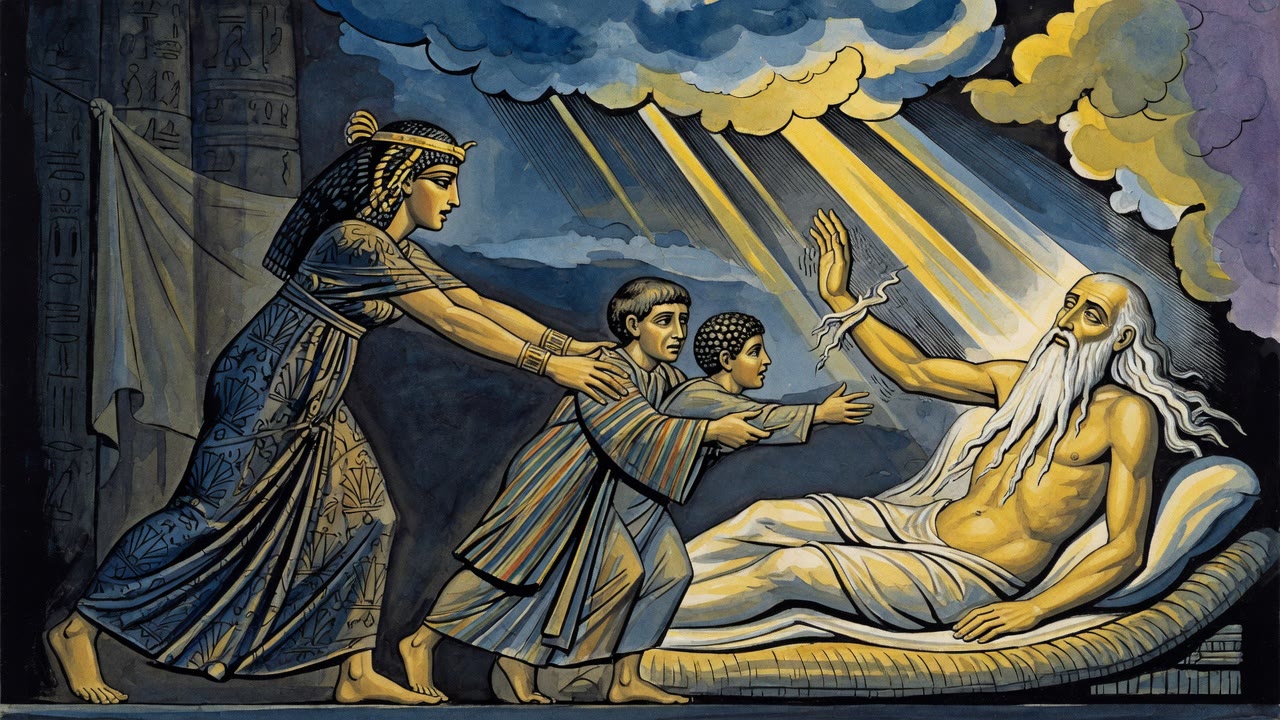
So too Jacob. When his time to die arrived, and Joseph heard that he was ill, Joseph began turning matters over in his heart. Rabbi Eliezer says Joseph thought three things in his heart; Rabbi Shmuel bar Nachman says five: my sons were born in Egypt. Perhaps he will bless them. Perhaps he will make them tribes. Perhaps he will make me firstborn. Perhaps he will remove Reuben from the birthright. And why was Rachel not brought into burial? Therefore, when Joseph went to him, he took his two sons with him, like a priest who goes to the threshing floor and takes his two sons with him, to make known to all that they are his sons and have a portion like him.
"And one told Joseph, Behold, your father is sick" (Genesis 48:1). Who told him that his father was sick? Some say he saw it through the holy spirit. Some say Bilhah told him, for she had been serving Jacob, and when he fell sick she came and told Joseph. Some say Benjamin informed him. Some say Joseph had set couriers in the palaces, and when they sensed that Jacob was ill, they came and told Joseph. And this is all Joseph's praise: he was so careful with his father's honor that he did not enter before him at every hour. If others had not come and told him that his father was sick, he would not have known. This teaches his righteousness. He did not want to be alone with his father, lest his father say to him, "What did your brothers do to you?" and curse them. Joseph said: I know my father's righteousness. All his words are decrees. He said to Laban, "With whomever you find your gods, he shall not live" (Genesis 31:32), and my mother died. If I come to tell him and he curses them, he will curse them, and I will be found destroying the whole world, for the world was created only for the sake of the tribes. Therefore Joseph did not go to his father at every hour.
"Behold, your son Joseph is coming to you" (Genesis 48:2). Immediately, "Israel strengthened himself and sat upon the bed" (Genesis 48:2). Why did he strengthen himself? Rabbi Joshua ben Levi said: he showed him the act of standing. The Holy One, blessed be He, said: I made Joseph ruler over the world, and shall I not show him honor? Therefore, "Israel strengthened himself." Another interpretation: why did he strengthen himself? So the tribes would see how his father regarded Joseph, that even in his illness he stood before him, and they would show Joseph honor. Another interpretation: why did he strengthen himself, stand, and sit for him? Rabbi Acha said: so that he would not bless them while reclining, and they would say, "His blessings were gifts of a dying man, and he did not know what he was doing." Therefore he strengthened himself, stood, and sat, so they would know that his gifts were the gifts of a healthy man.
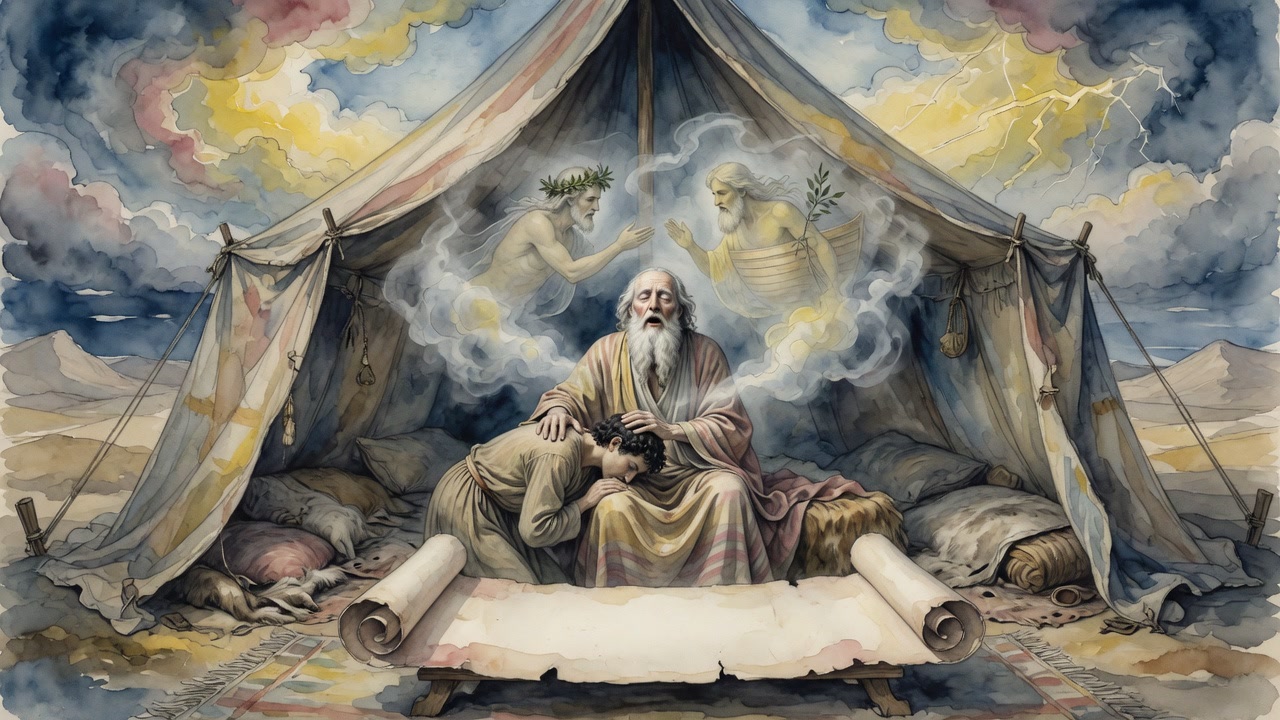
Another interpretation of "he strengthened himself": Rabbi Pinchas ben Chama said in the name of Rabbi Acha: he strengthened himself in prayer. He said: when I come to bless them, let the holy spirit rest upon me, so that I may bless them properly. When he saw Joseph's sons with him, he said to him: for seventeen years you would ask after my welfare, and they would not come; only now have they come with you. I know what is in your heart. If I bless them, I do not carry out the word of the Holy One, blessed be He, who told me, "I will establish twelve tribes from you." If I do not bless them, it will be bad for you. I will bless them. But do not think that I bless them because you fed me. He already told me, while I was at Bethel, to bless them, as He said to me, "God Almighty appeared to me at Luz and said to me: Behold, I will make you fruitful and multiply you, and I will give you for a congregation of peoples" (Genesis 48:4).
One matter was precious to Jacob here: he did not say, "I will give you for a nation and a congregation of peoples." For we find that when God appeared to him at Bethel, when he came from Paddan Aram, and so on, He said to him, "I am God Almighty. Be fruitful and multiply. A nation and a congregation of nations shall come from you" (Genesis 35:11). Jacob should have said to Joseph, "Behold, I will make you fruitful and multiply you and give you for a nation and a congregation of peoples." Why did he say only, "for a congregation of peoples"? Jacob said: when the Holy One, blessed be He, told me this matter, I had eleven tribes. Once Benjamin was born, I said, "This is what He meant by a nation." That is why Jacob says to Joseph, "Your two sons, born to you in the land of Egypt before I came to you in Egypt, are mine" (Genesis 48:5). He said to him: they are not yours, but mine. God said to me, "a nation and a congregation of nations," and He gave me only Benjamin. Therefore these are not yours, but mine. Ephraim and Manasseh are tribes, like Reuben and Simeon. Those whom you beget after them shall be called yours, but these shall be called by my name, as it is said, "Your offspring whom you beget after them shall be yours" (Genesis 48:6).
Thus Joseph was informed of two things: that the divine word blessed his two sons, as it says, "The angel who redeemed me from all evil, bless the lads" (Genesis 48:16), and that Jacob made them tribes, as it says, "Ephraim and Manasseh shall be mine, like Reuben and Simeon" (Genesis 48:5), even though the wording had already put Ephraim before Manasseh. What he said, "He appeared to me at Luz" (Genesis 48:3), means Bethel, as it is written, "to Luz," and so on, "that is Bethel" (Genesis 35:6). Rabbi Berekhiah the priest said in the name of Rabbi Levi in the name of Rabbi Shmuel ben Nachman: Jacob expounded in order to make Ephraim and Manasseh tribes. He said: the Holy One, blessed be He, appeared to me and said, "I am God Almighty," and so on, and "kings shall come out of your loins" (Genesis 35:11). If He had said to me, "kings shall come out of you," I would have said He spoke about the tribes. But He said only, "out of your loins," meaning my children's children. He spoke about Ephraim and Manasseh. Rabbi Yehudah Halevi son of Rabbi Shalom said: if you do not learn from here that they are a congregation of nations, learn it from the passage, "He said to me: Behold, I will make you fruitful and multiply you, and I will give you for a congregation of peoples" (Genesis 48:4).
Another interpretation: "a nation and a congregation of nations" (Genesis 35:11). "A nation" is Benjamin. "A congregation of nations" is Ephraim and Manasseh. "Kings shall come out of your loins" refers to King Saul, who arose from Benjamin as the first of the kings, as it is said, "There was a man of Benjamin, and his name was Kish son of Abiel" (1 Samuel 9:1).
Once Jacob blessed them and made them tribes, he began to speak about Rachel. Joseph was deeply distressed over this matter, and Jacob said to him: Why was your mother not brought into the ancestral burial with me? He began answering him about her. It is not written, "when I came from Paddan," but "and I, when I came from Paddan" (Genesis 48:7). What means "and I"? He said to him: by your life, just as you wanted your mother to be brought into burial, so I wanted it. This is what is written, "Rachel died upon me" (Genesis 48:7). What means "upon me"? Her burden was upon me.
Another interpretation of "upon me": I was diminished by losing her. I had no settled comfort, but she died upon me, and I was diminished. Joseph said to him: perhaps you did not bring her into burial because it was the rainy season. Jacob said to him: no, for Scripture says, "when there was still a stretch of land to come to Ephrath" (Genesis 48:7). It was between Pesach and Shavuot, when the land is sifted and open, like a sieve, so people can walk. Joseph said to him: decree now, and I will raise her and bury her. Jacob said to him: you cannot, my son. I buried her there only by the divine word. I too sought to raise her and bury her, but the Holy One, blessed be He, did not allow me, as it is said, "and I buried her there" (Genesis 48:7). What means "there"? By the divine word.
Why? Because it was revealed and known before Him that the Temple would one day be destroyed, and His children would go out into exile. They would go to the patriarchs and ask them to pray for them, and they would not help them. But when they go on the road, they will come and embrace Rachel's grave. She will stand and ask mercy from the Holy One, blessed be He, and say before Him: Master of the universe, listen to the sound of my weeping and have mercy on my children, or give me my legal claim. Immediately the Holy One, blessed be He, hears the sound of her prayer. From where? For it is written, "A voice was heard in Ramah, lamentation and bitter weeping; Rachel weeping for her children" (Jeremiah 31:15), and it is written, "There is hope for your end, [says the Lord], and your children shall return to their border" (Jeremiah 31:17). Thus Jacob appeased Joseph about why his mother was not brought into burial.
Jacob made Joseph's sons tribes, and Joseph began bringing his sons near to his father so that he would bless them, as it is said, "Joseph took them both, Ephraim in his right hand" (Genesis 48:13). Why did Joseph do this? Because once he saw that Jacob had mentioned Ephraim first, "Ephraim and Manasseh shall be mine, like Reuben and Simeon" (Genesis 48:5), he was afraid that Manasseh might be pushed aside from the birthright. Therefore he brought them near to Jacob, placing Manasseh at Jacob's right and Ephraim at his left.
The Holy One, blessed be He, said: Shall I not inform Jacob what is destined to arise from these? Jeroboam son of Nebat from Ephraim, [and Manasseh, who put an image in the Sanctuary]. Rabbi Chama said: the Holy One, blessed be He, foresaw that Jeroboam son of Nebat would arise from Ephraim and make two calves. What means, "Who are these?" (Genesis 48:8). It alludes to, "These are your gods, O Israel" (Exodus 32:4), and, "the king took counsel and made two calves of gold" (1 Kings 12:28). Immediately the Holy One, blessed be He, withdrew the holy spirit from Jacob.
"Now the eyes of Israel were heavy from age" (Genesis 48:10). Rabbi Yehudah said: as the plain meaning of the verse says, the lashes of his eyes were heavy from age and stuck to one another, and when he wanted to see he would lift them. Rav Nachman said to him: Heaven forbid. What means, "he could not see"? That the holy spirit had departed from him. Jacob began saying to Joseph, "Who are these?" They had lived with him for seventeen years, and he says to him, "Who are these?" Rather, he foresaw Jeroboam's two calves, with which he would lead Israel astray, saying to them, "These are your gods, O Israel."
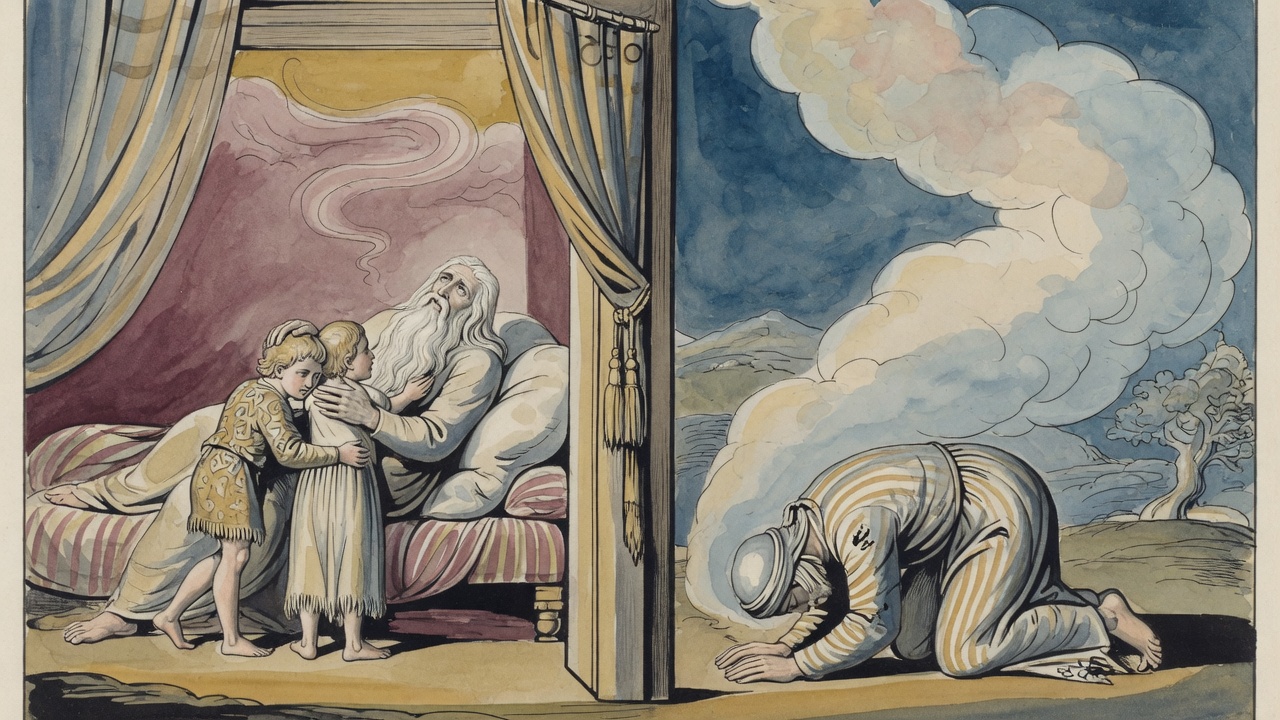
Another interpretation: what means "who," mi? He foresaw that fifty myriads of his descendants were destined to fall: mem is forty and yod is ten, making fifty myriads, five hundred thousand, who went from Israel in war. Joseph began pleading and said to him: Father, my sons are righteous like me. "They are my sons, [whom God has given me with this]" (Genesis 48:9). What means "with this"? He brought Asenath their mother before his father and said to him: Father, please, even for the sake of this righteous woman. Jacob said to him, "Bring them, I pray you, to me, and I will bless them" (Genesis 48:9). He brought them to him. Jacob began embracing them and kissing them, and rejoiced in them. He said: perhaps through joy the holy spirit will rest upon me, and I will bless them. But the holy spirit did not return to him.
When Joseph saw his distress, he took them and went outside. He fell on his face, set them down on their faces, and asked for mercy. Rabbi said: immediately the Holy One, blessed be He, said to the holy spirit: how long shall Joseph suffer? Reveal yourself quickly and enter Jacob, so that he may bless them, for the Holy One, blessed be He, cannot bear to see the tribe fallen on its face. Joshua, Joseph's descendant, also fell on his face, and immediately the divine word leapt upon him and said, "Get up. Why do you fall on your face?" (Joshua 7:10). This is what the prophet says, "I taught Ephraim to walk; He took them on His arms" (Hosea 11:3). I sought and trained through the holy spirit to bless Ephraim. When? "He took them on His arms," when Jacob said to Joseph, "Bring them, I pray you, to me, and I will bless them." By whose merit? "I drew them with cords of a man" (Hosea 11:4), by Joseph's merit. "And they did not know that I healed them" (Hosea 11:3).
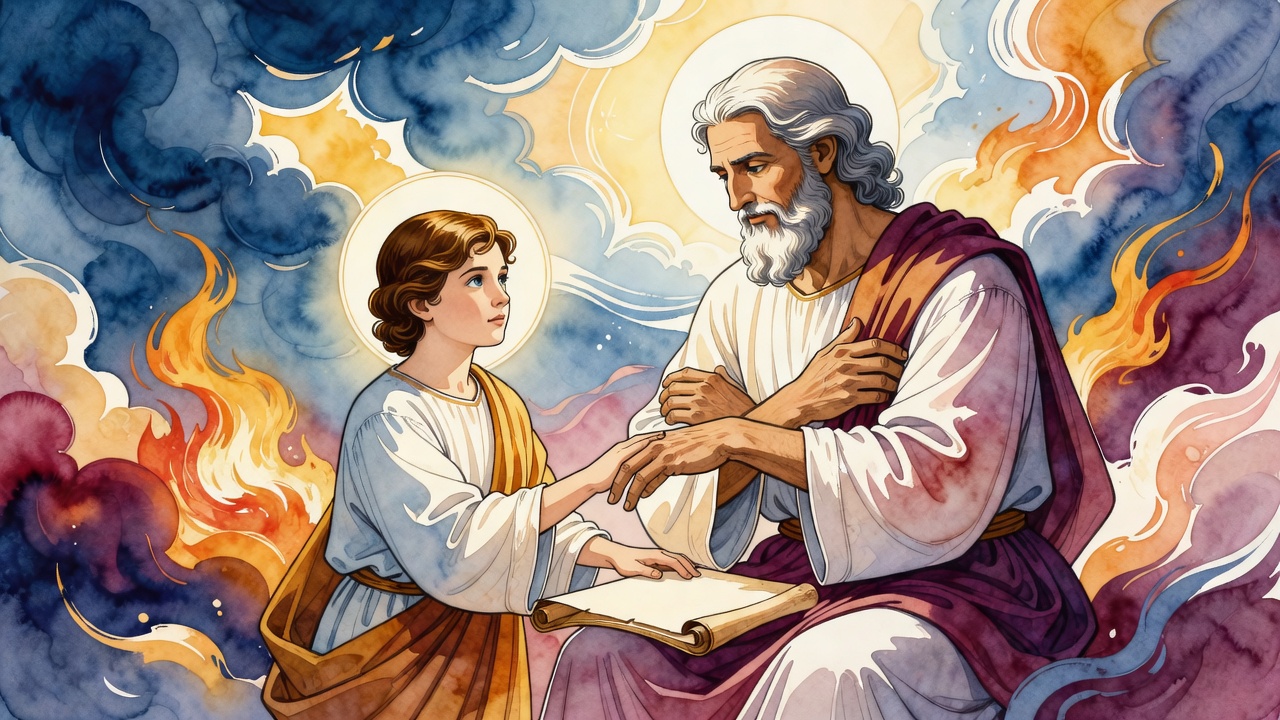
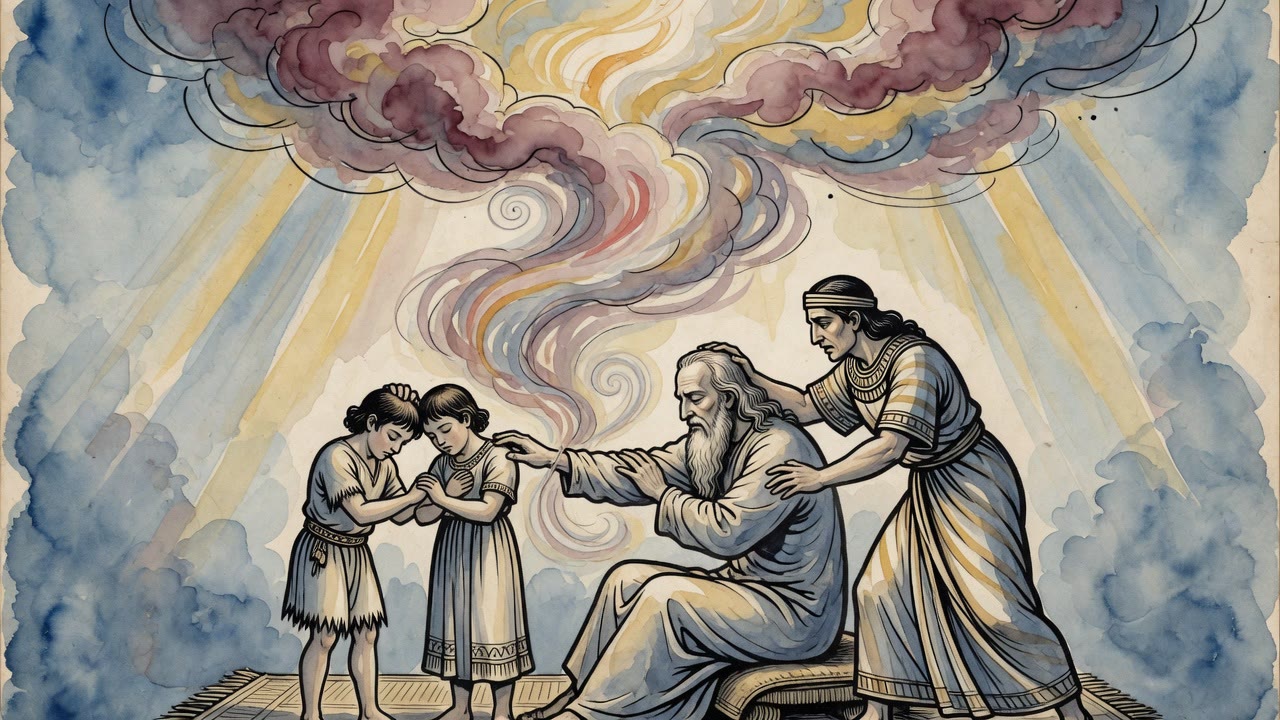
When Joseph had set Ephraim at Jacob's left and Manasseh at his right, [what] did Jacob do? "He guided his hands knowingly" (Genesis 48:14). What means sikkel, "guided knowingly"? Rabbi said: it was certainly sekel, wisdom. Rabbi Yehudah said: Jacob's hands acted with wisdom regarding Manasseh's birthright. Rabbi Nechemiah said: Jacob's hand was made wise by the holy spirit, as it is written, "A maskil of Ethan the Ezrahite" (Psalms 89:1). When Joseph saw this, he was distressed. Immediately he held his father's hand to move it from Ephraim's head and place it on Manasseh's head. Jacob said to Joseph: do you seek to move my hand against my will? [Rabbi Berekhiah son of Rabbi] said: an angel has a third of the world within him. How did this hand seize the prince of the heavenly army, and do you think you can move it against my will? "His father refused" (Genesis 48:19). Rather, what did you say? "This one is the firstborn." I know. And what do you think? Because I used to ask you all the time what your brothers did to you, and you would not tell me, do you think I did not know? "I know, my son, I know" (Genesis 48:19). He began blessing them: "And he blessed them that day, saying," and so on, "and he set Ephraim before Manasseh" (Genesis 48:20).
The Holy One, blessed be He, said: since Jacob decreed that Ephraim should be first, when the princes come to offer their offerings, Ephraim shall offer before Manasseh. "On the seventh day, the prince of the children of Ephraim," and afterward, "on the eighth day, the prince of the children of Manasseh."
Another interpretation of "on the [eighth] day," and so on: you find that in everything Ephraim comes before Manasseh: in judges, in standards, in kings, and in offerings. In judges: Joshua, and afterward Gideon son of Joash from the tribe of Manasseh. In standards: "the standard of the camp of Ephraim" (Numbers 2:18), and afterward, "and by him the tribe of Manasseh" (Numbers 2:20). In kings: Jeroboam son of Nebat from Ephraim, and afterward Jehu son of [Nimshi] from the tribe of Manasseh. Why did Ephraim merit this? Because he made himself small. The Holy One, blessed be He, loves everyone who lowers himself, as it is said, "Though the Lord is high, He regards the lowly" (Psalms 138:6). Who tells you that Ephraim lowered himself? For it is said, "upon the head of Ephraim, who was the younger" (Genesis 48:14): he made himself small. But Manasseh would go out and attend to his father's business. The Holy One, blessed be He, said: since Ephraim made himself small, he shall merit this honor. If a younger one who made himself small merited this honor, how much more so an elder who makes himself small. "On the eighth day, the prince of the children of Manasseh."

 Click for full size