5 min read

Joshua Watched Judah's Breastplate Stone Go Dark

After Ai's dead, Joshua tore his clothes before the Ark. Judah's stone dimmed on the breastplate, lots fell, and Achan's theft met the valley.

Curated by Arthur · Told by Maggid ·
Table of Contents
  1. The Stone of Judah Lost Its Light
  2. Two Deaths for One Theft
  3. Blood That Still Speaks on the Tenth Day
  4. After the Valley

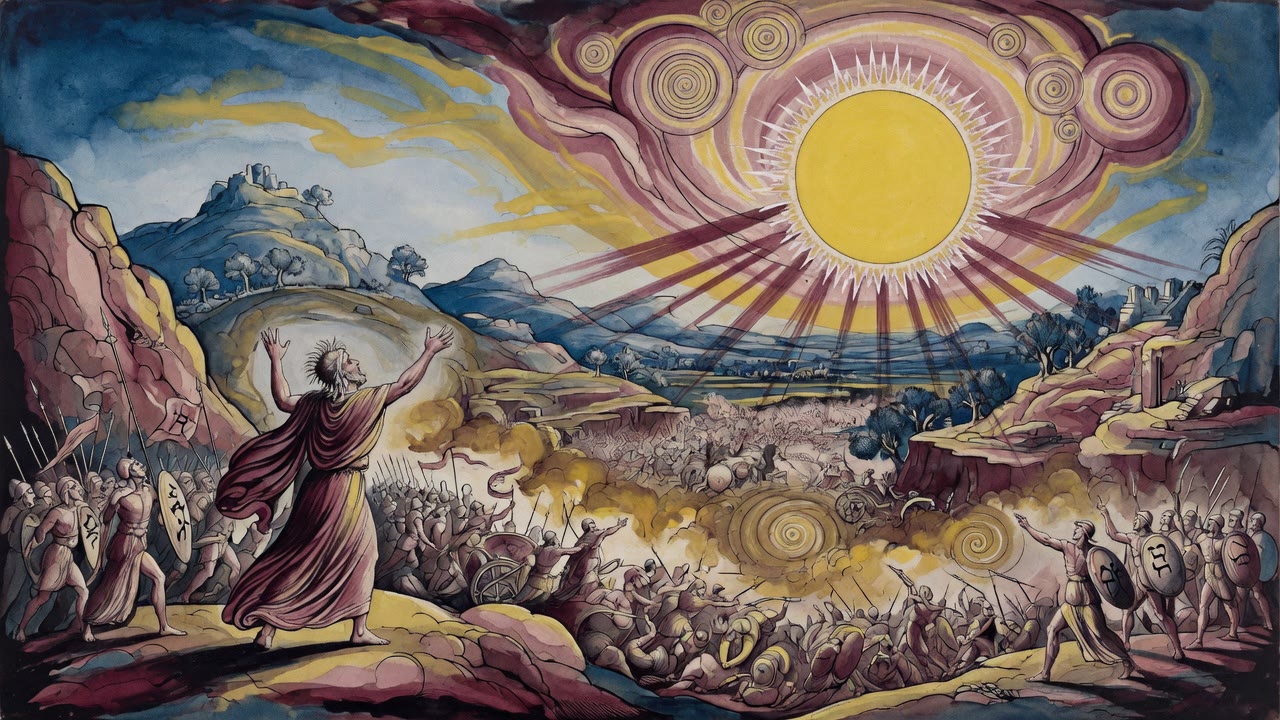
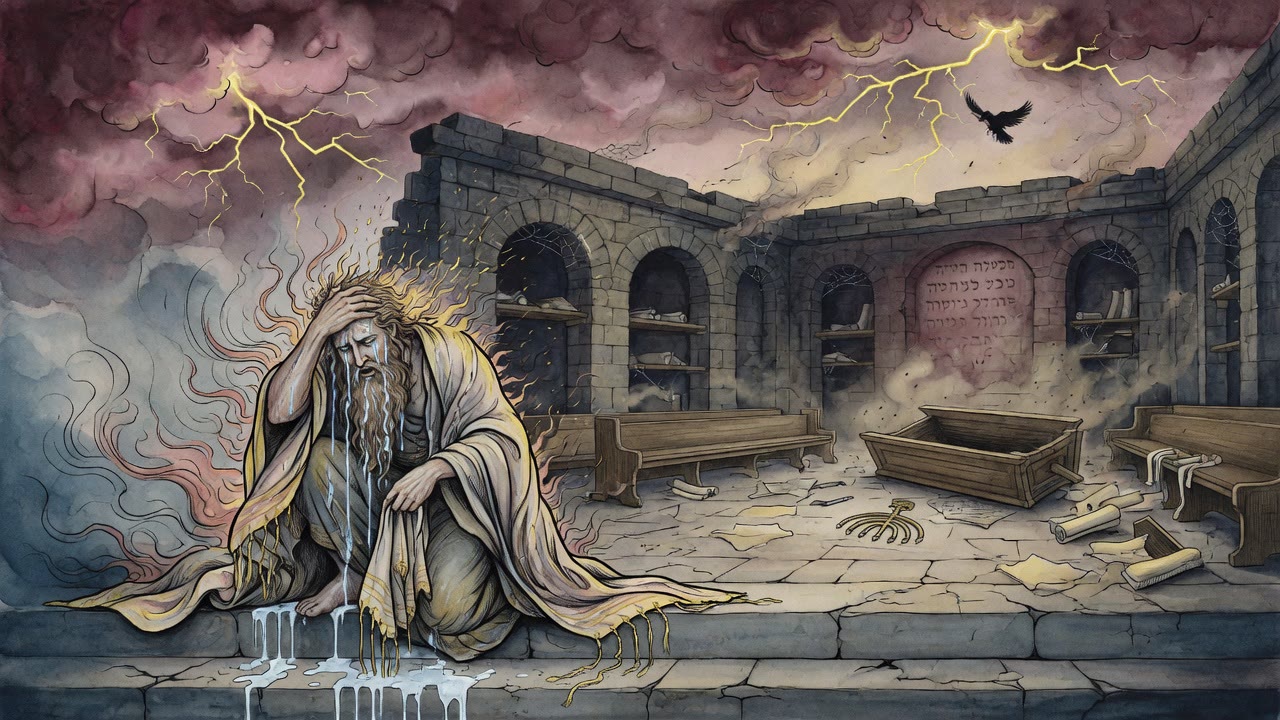
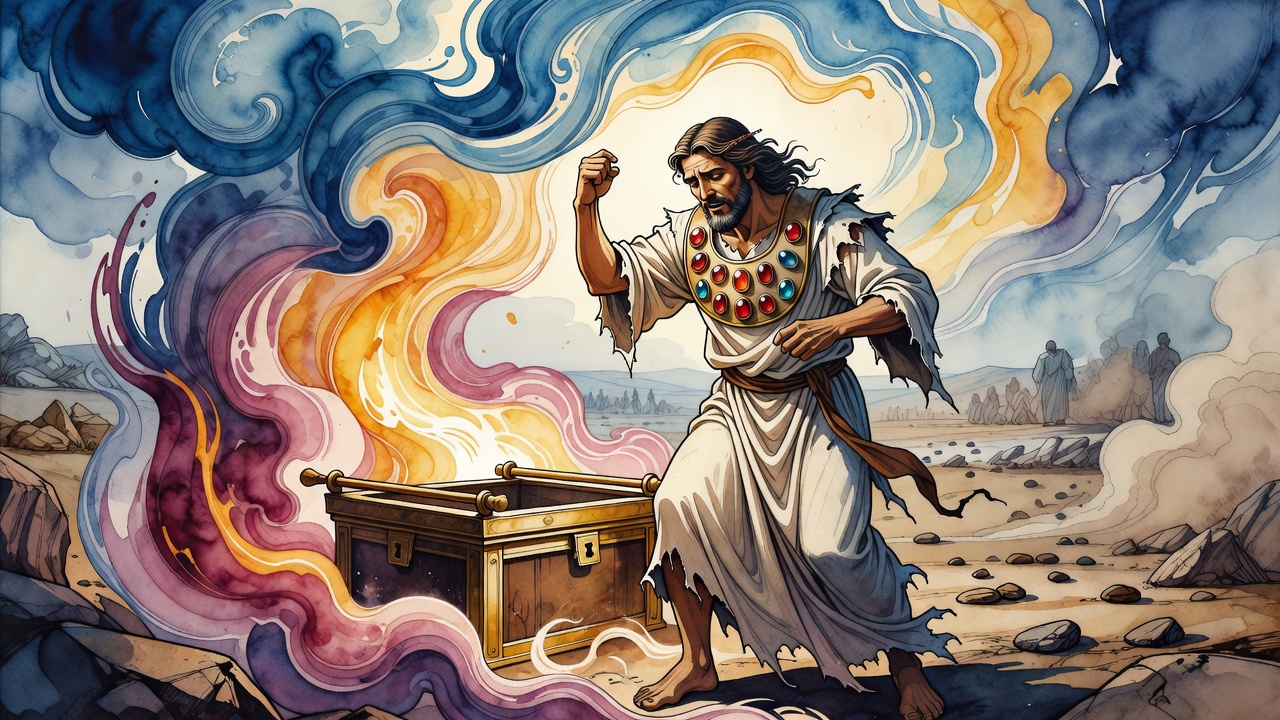
Joshua tore his clothes until the fabric hung in strips and fell on his face before the Ark of the Covenant. Thirty-six men of Israel lay dead outside Ai. The walls of Jericho had fallen only days before. Now the next fight had chewed the camp and spat out corpses.
Joshua Watched Judah's Breastplate Stone Go Dark Click for full size

He wanted atonement the way a man wants air after a sprint. He wanted the Name to explain how victory had turned into an ambush. The Holy One answered with a hard clarity. Israel had trespassed in the matter of the devoted things. Someone had taken what was under ban from Jericho.

Joshua pressed his forehead to the ground until dust filled his mouth. The Ark did not move. The camp waited behind him with the smell of defeat still on their gear.

The Stone of Judah Lost Its Light

Joshua turned to the high priest's breastplate, the choshen with twelve stones for twelve tribes. When a tribe sinned, the matching stone dimmed. He watched the row until one light failed. Judahs stone went dark while the others still held their fire.

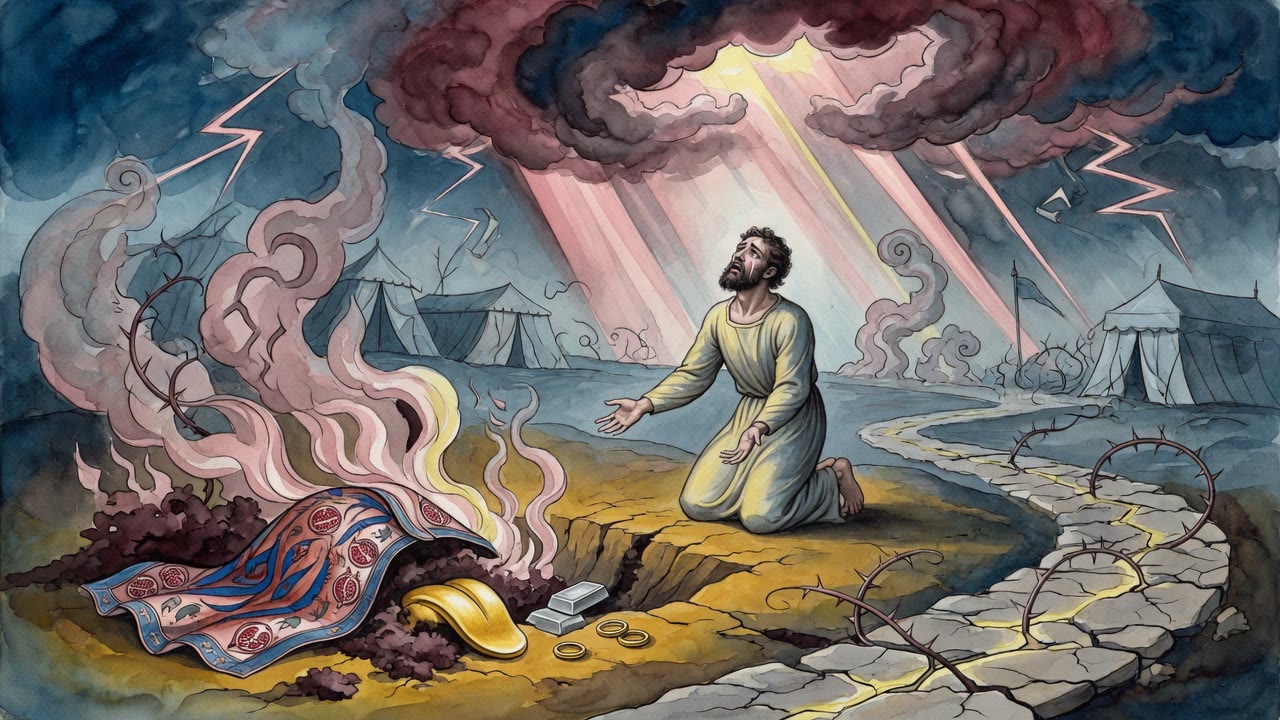
Lots narrowed the camp. Clan by clan, household by household, the net closed on Achan son of Carmi. Under pressure he gave up what his hands had buried: silver, a fine mantle, a tongue of gold. The devoted spoil of Jericho had sat under his tent while men died at Ai for a sin they had not personally touched.

Joshua marched Achan, the goods, and the household that had known and stayed silent down toward the valley of Achor. The name would remember trouble. The ground would take fire and stones. The dim tribal light had already done half the work of judgment before any rock was lifted.

Two Deaths for One Theft

They stoned and they burned. The double sentence needs its own accounting in the midrash's logic. Stoning answered the silence of a family that knew and did not report. Burning answered the blood of the thirty-six who fell because the ban was broken. "And the men of Ai smote of them about thirty and six men" (Joshua 7:5).

Achan's body became a public seal on a rule the conquest could not bend. Devoted things stay devoted. A mantle under a tent floor can kill men who never saw the cloth. Joshua's torn clothes at the Ark had been the first visible cost. The valley took the rest.

The camp learned to fear a dim stone as much as an enemy wall. Leadership meant reading light on a priest's chest when scouts brought back only failure. Joshua wiped dust from his mouth and ordered the next march with a ban still ringing in every ear.

Blood That Still Speaks on the Tenth Day

Long before Ai, Abraham had shed covenant blood at midday heat on a date the midrash ties to the tenth of the month, the day later named for atonement. "In the selfsame day was Abraham circumcised, and Ishmael his son" (Genesis 17:26). The same phrase, "selfsame day," marks the day when no work is done because atonement is made (Leviticus 23:28).

Each year, the teaching says, the Holy One sees the blood of Abraham's circumcision and forgives Israel. The place of that cut becomes, in the same chain of memory, ground under the later altar. Blood at the base of sacrifice (Leviticus 4:30) answers blood that first marked a man into the covenant. "In thy blood, live" (Ezekiel 16:6) sounds twice, life spoken over the cut.

Joshua face-down before the Ark is not Abraham under the knife, yet both scenes put a body between the people and wrath. One offers covenant blood that keeps speaking on the tenth day. The other hunts stolen metal and cloth until the camp can stand clean again. Atonement has more than one shape: yearly memory of a cut, and a valley that closes a theft.

After the Valley

When the fire cooled and the stones settled, Joshua could lift his face from the Ark without the same shame pressing his mouth into the dust. Ai would fall on the second attempt. The breastplate stones would hold their light a little longer.

Achan's mantle did not warm anyone worth naming. It bought a valley name and a warning hung on every tent peg in the camp. Joshua kept the torn clothes in memory even after he put on whole ones. A leader who has read a dim tribal stone does not forget how fast victory rots.

Somewhere behind the conquest calendar, Abraham's midday blood still stands in the year's tenth day as a claim God answers with forgiveness. Joshua's generation needed a harsher scrub. They got the valley of Achor and a ban made visible in dead men and recovered gold. The Ark received a man who had torn his clothes, and the camp received a rule written in ash.


← All myths
From the tradition

Sources

2 sources

The texts behind this telling. Some cards carry a translation of the source; others are our own retelling of it, and each card says which. Every card links out to the original.

Pirkei DeRabbi Eliezer 38:16Pirkei DeRabbi Eliezer

Retold in our words. Read the original at the link below.Pirke de Rabbi Eliezer, trans. Rabbi Gerald Friedlander, London (1916) · CC-BY

Pirkei DeRabbi Eliezer turns to Joshua, The Ark of the Covenant.

The story, as we find it in Pirkei DeRabbi Eliezer, chapter 38, begins with Joshua in anguish. He tears his clothes, falls to the ground before the Ark of the Covenant, desperately seeking atonement. The leader of a nation, humbled and pleading for forgiveness. Thankfully, the Holy One, blessed be He, responds, revealing the truth: "Israel has trespassed the sin of trespass in the matter of the devoted things." In other words, someone has broken a sacred vow regarding spoils of war.

How did Joshua figure out who was responsible? Pirkei DeRabbi Eliezer tells us that Joshua looked to the Choshen, the breastplate of the High Priest. This breastplate was adorned with twelve precious stones, each representing a tribe of Israel. When a tribe sinned, the corresponding stone would dim. Joshua noticed the stone of Judah had lost its luster, indicating wrongdoing within that tribe.

Through a process of casting lots, Achan, son of Carmi, was identified as the culprit. He had taken forbidden items from the conquered city of Jericho – silver, a mantle, and a tongue of gold. Joshua, then took Achan, his family, and his possessions to the valley of Achor.

This is where things get complex and, frankly, disturbing. They were stoned and burned. This raises an immediate question: why both? If there was stoning, why burning? If burning, why stoning? Pirkei DeRabbi Eliezer explains that the stoning was because Achan's family knew about his transgression and failed to report it. The burning, however, was because Achan's actions led to the death of thirty-six righteous men at Ai. As the verse states, "And the men of Ai smote of them about thirty and six men" (Joshua 7:5).

This seems to contradict the Torah's teaching in (Deuteronomy 24:16), "The fathers shall not be put to death for the children, neither shall the children be put to death for the fathers." The text addresses this by emphasizing that they were complicit, aware of Achan's sin and choosing to remain silent.

This story from Pirkei DeRabbi Eliezer leaves us with a lot to consider. What does it mean to be responsible not only for our own actions but also for the actions of those around us? How far does that responsibility extend? And how do we reconcile the idea of collective punishment with the principles of individual justice? Perhaps the story isn’t meant to be taken literally, but rather as a powerful reminder of the interconnectedness of community and the devastating consequences of even a single act of betrayal.

Full source
Pirkei DeRabbi Eliezer 29:2Pirkei DeRabbi Eliezer

Retold in our words. Read the original at the link below.Pirke de Rabbi Eliezer, trans. Rabbi Gerald Friedlander, London (1916) · CC-BY

Pirkei DeRabbi Eliezer turns to Day of Atonement of Kippur.

How do we get there? Well, Rabban Gamaliel points to the verse in (Genesis 17:26): "In the selfsame day was Abraham circumcised, and Ishmael his son." He then connects this to (Leviticus 23:28), which, in describing Yom Kippur, says, "Ye shall do no manner of work on that selfsame day, for it is a day of atonement." The repetition of "selfsame day" is no coincidence, he argues. It's a deliberate parallel, linking these two pivotal events. According to this reading, Abraham underwent circumcision in the "might of the sun at midday" specifically on the tenth day of the month, Yom Kippur.

The connection goes even deeper. Pirkei DeRabbi Eliezer suggests that the blood of Abraham's circumcision holds a powerful, ongoing significance. The text claims that every year, the Holy One, blessed be He, sees the blood of Abraham's circumcision and forgives the sins of Israel. We find echoes of this idea in (Leviticus 16:30), "For on this day shall atonement be made for you, to cleanse you." The text implies that this atonement is tied, in some mystical way, to Abraham’s act of devotion.

Where did this happen? The passage continues, noting that the very place where Abraham was circumcised, where his blood remained, is where the altar was later built. This detail further solidifies the connection between Abraham's sacrifice and the sacrificial system in the Temple. We see this reflected in (Leviticus 4:30), "And all the blood thereof shall he pour out at the base of the altar." There's a direct line drawn between the blood of the covenant and the blood offered for atonement.

Finally, the passage quotes (Ezekiel 16:6): "I said unto thee, In thy blood, live; yea, I said unto thee, In thy blood, live." This powerful verse, spoken by God, reinforces the life-giving, redemptive power associated with blood, particularly in the context of covenant and sacrifice.

So, what does it all mean? Pirkei DeRabbi Eliezer invites us to consider the profound connections between historical events, divine decrees, and the ongoing relationship between God and the Jewish people. It suggests that Abraham's act of circumcision, performed on Yom Kippur, continues to resonate, its effects rippling through time to offer atonement and renewal each year. It’s a potent reminder that the stories we tell are not just historical accounts, but living narratives that shape our understanding of ourselves and our place in the world.

Full source