6 min read

Caleb and Phinehas Spied on Jericho With Demons at Their Side

Joshua sent Caleb and Phinehas into Jericho with two demons whose terrible faces froze the city, toward a woman who had waited forty years.

Curated by Arthur · Told by Maggid ·
Table of Contents
  1. Joshua Counts the Men He Can Trust
  2. The Two Who Offered to Come Along
  3. Joshua Turns the Demons Into Terror
  4. The Woman Who Had Waited Forty Years
  5. Rahab Chooses Her Side Before the Horns

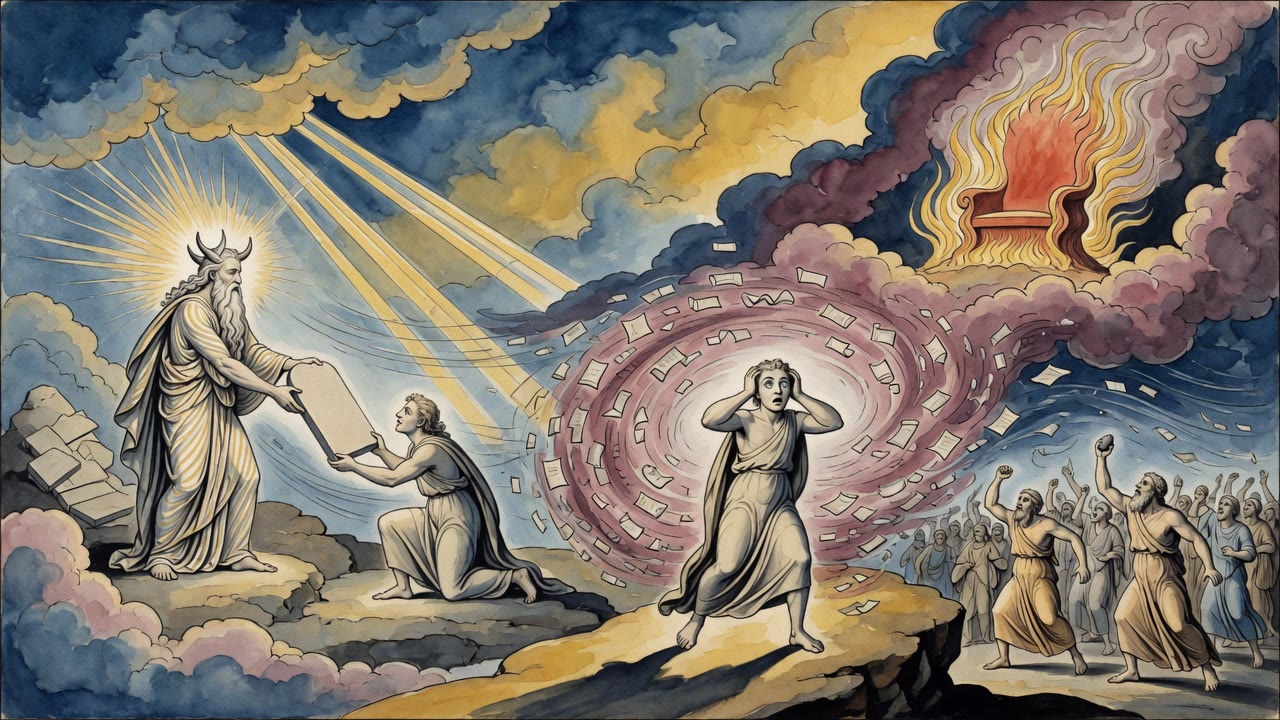
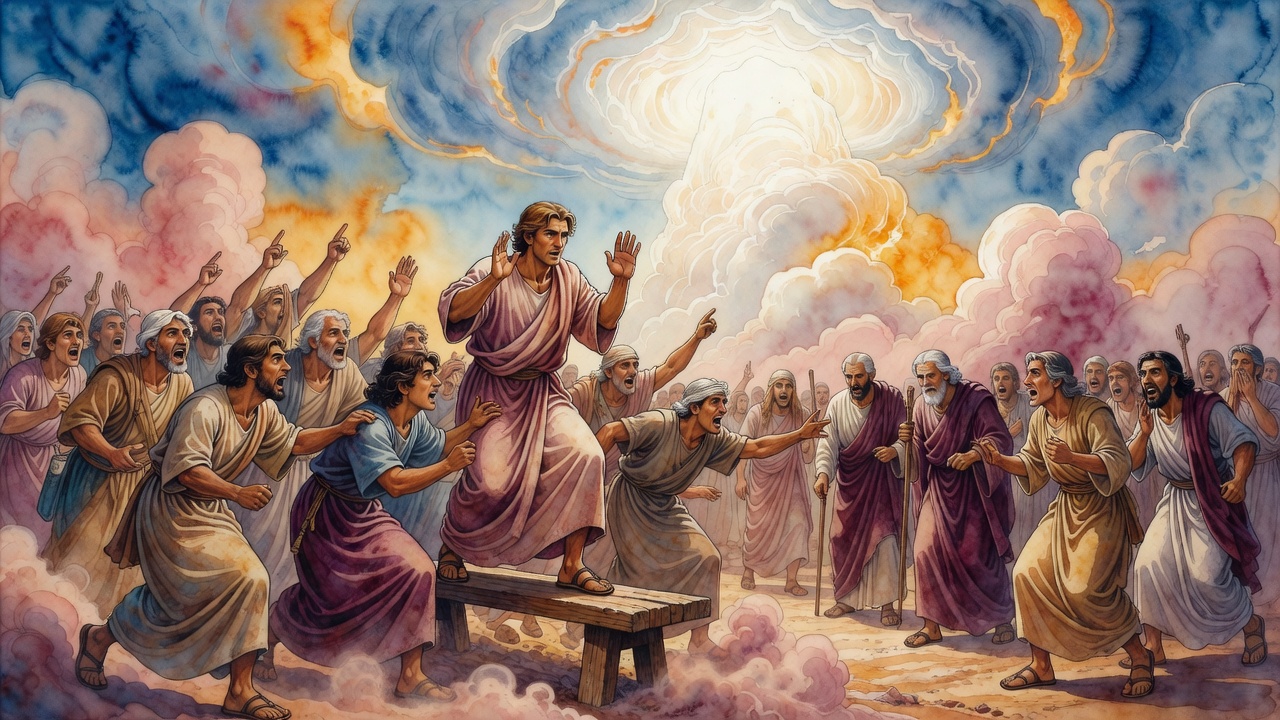
Joshua stood at the edge of the Jordan and counted the men he could trust, and the number came out small. He had watched it happen once already. A generation back, twelve had gone into Canaan to look at the land, and ten had come back trembling, and their trembling had spread like a fever through the whole camp until a nation lay down in the dust and refused to move. Forty years that fear had cost them. Forty years of walking in circles until the frightened generation died off in the sand. He would not spend a coin of that price twice.
Joshua Counts the Men He Can Trust

So he would not send twelve. He would send two, and he would name them with his own mouth, and they would be men who had stood at the mountain and never once flinched. Caleb he knew from the old mission, the one who had come back from Canaan with his spine intact while the others wept. Phinehas he knew for the hardness that had stopped a plague when the camp went soft. Two men, then. Two who did not break. He told them to go look at Jericho and bring back the truth of it, and he watched them go down toward the river.

They did not go alone. That was the part Joshua had not arranged and could not quite prevent.

The Two Who Offered to Come Along

Out of the dark places that crowd the edges of every road, two of them came forward and offered their service. They were no minor things. They were the husbands of Lilith and of Mahlah, those two she-demons whose names mothers whisper to ward off the night, and now their husbands wanted to march down to Jericho as scouts for Israel. They volunteered. They wanted in.

Joshua had been a fool in his youth, by some reckoning, before service to Moses sharpened him into something else. He was not a fool now. He looked at the two creatures and said no. He would not take their word back as intelligence, would not let what crept out of the night decide what a city held or did not hold. A spy who lies is worse than no spy at all, and he had learned in the worst possible way what a false report does to a people.

But he did not simply send them away.

Joshua Turns the Demons Into Terror

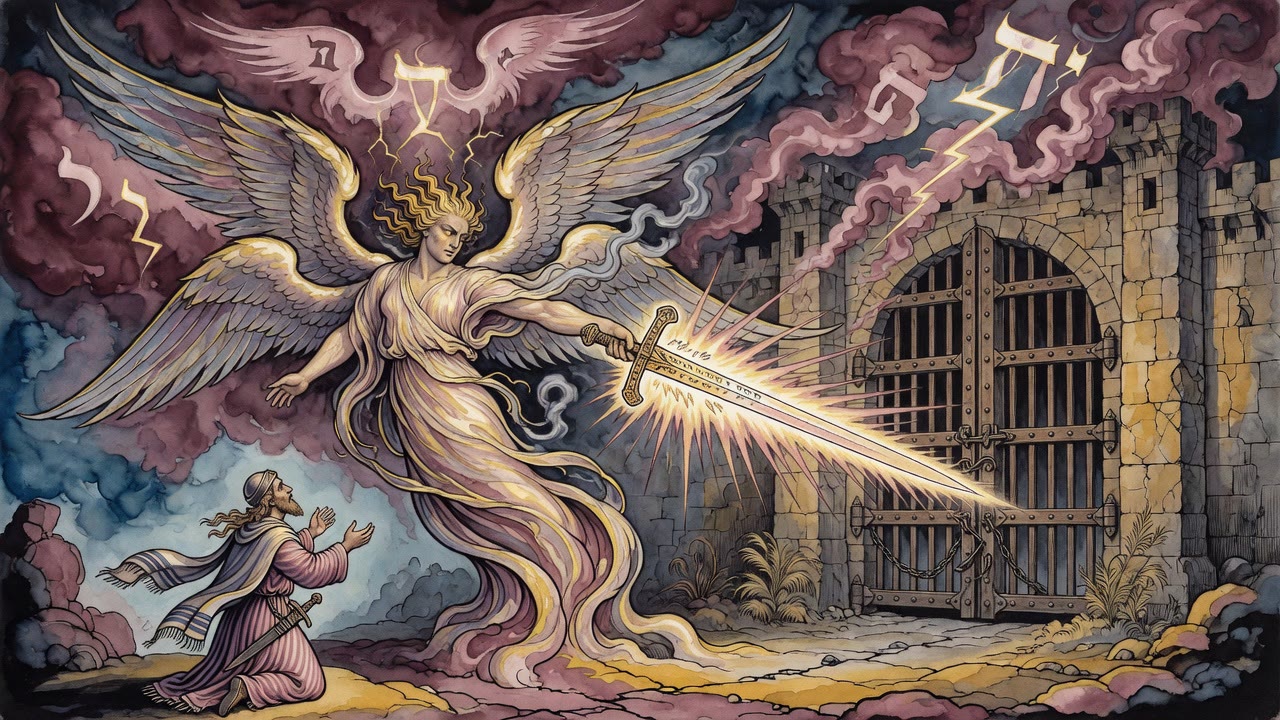
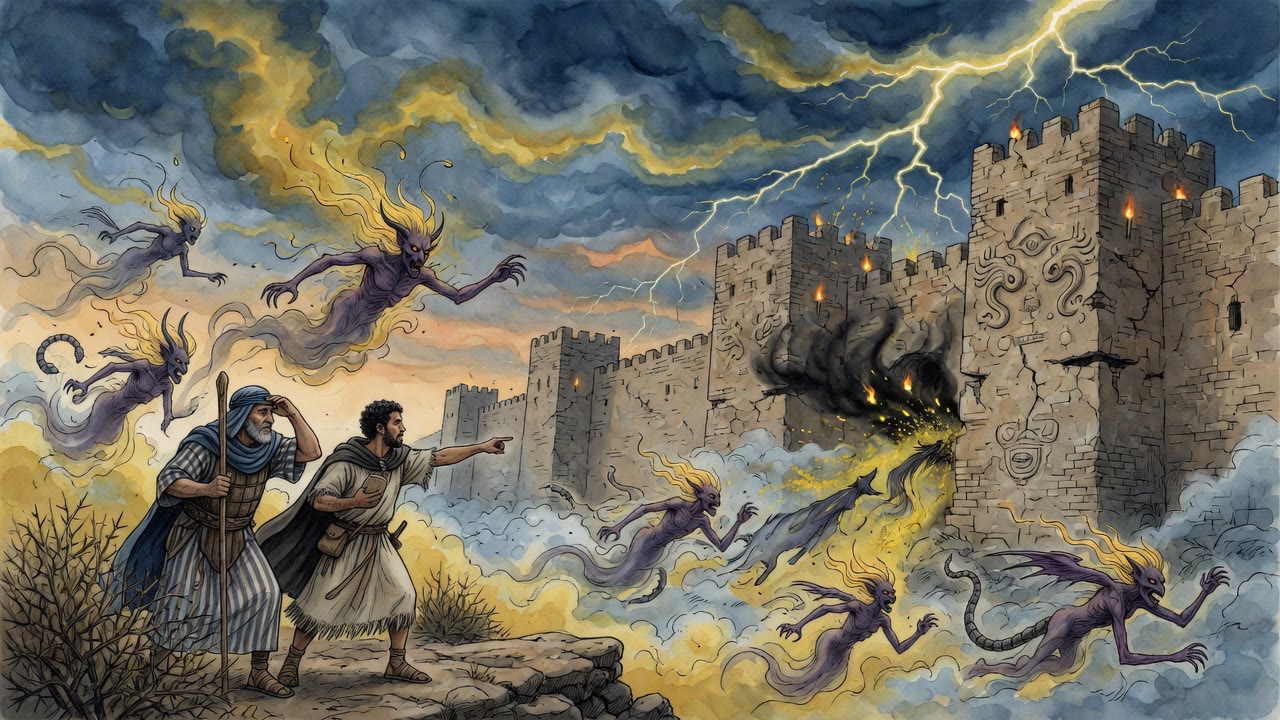
He took them and he changed them. He worked their faces over until the sight of them was unbearable, until anything with eyes would shrink and shudder to look. Then he sent them on ahead, not as informants but as a weapon, two horrors walking the streets of Jericho before the spies ever arrived. Let the city feel the dread first. Let the men on the walls go pale and weak in the knees from something they could not name, so that by the time Caleb and Phinehas slipped through the gate, the place was already half conquered in its own heart.

And it worked. The inhabitants of the city were struck with terror at the demons' presence. The faces in the streets had already gone gray. Fear had done its march. The walls still stood, tall and thick and proud, but inside them the people had begun to melt.

The Woman Who Had Waited Forty Years

Into that frightened city the two men went, and they came to a woman named Rahab. She kept a house on the wall, and she had kept it a long time. Forty years she had lived in Jericho, and the years had not been gentle ones, and the city knew exactly what she was and what her house was for. She was the kind of woman whose name the respectable used to spit.

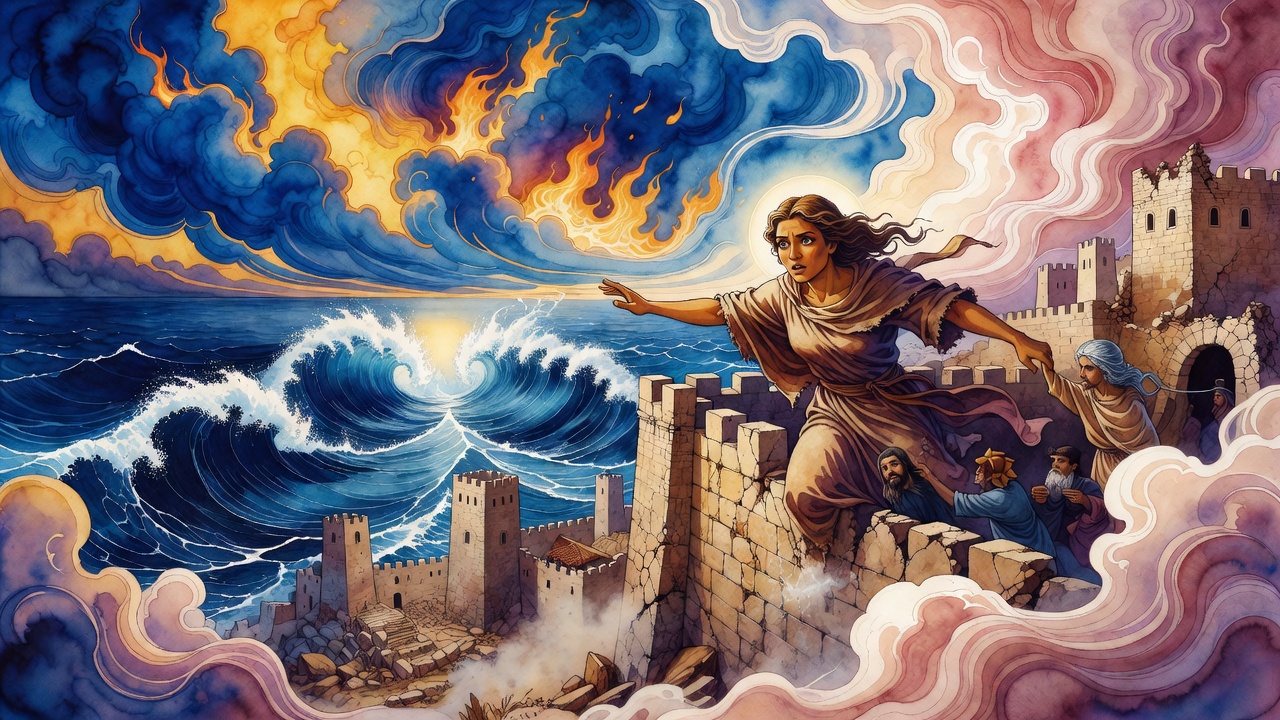
She had been there as long as Israel had been in the wilderness. The same forty years that the frightened generation had spent dying in the sand, she had spent inside these walls, watching the road, hearing the rumors come up from the south. She had heard what happened at the sea, when the water stood up like walls and then fell. She had heard what happened to the kings who stood in Israel's way. By the time the two strangers came to her door, she had already done her arithmetic. The God who split the water and broke the kings was a God she did not intend to stand against.

Rahab Chooses Her Side Before the Horns

So when soldiers came hunting the two strangers, Rahab did not give them up. She hid them, and she lied to the men at her door, and she sent the hunters off on a false trail. Then she came to the two she had saved and asked for the only thing she wanted. When the city falls, and she said when, not if, spare me and the ones I love. She had chosen her side before a single horn was raised.

The men gave her their word and went back over the wall and down to the river, back to Joshua with a true report at last. No fever of fear this time. No nation frozen in the dust. The city was ripe. Its people had already lost their courage to two terrible faces in the street, and a woman on the wall was holding a door open from the inside.

What everyone keeps is the end of it, the horns and the shout and the great walls coming down flat. What came first, the demons remade into terror and the woman who had waited four decades for the men at her door, slipped almost entirely out of memory. The walls fell on a city that was already broken open from within.


← All myths
From the tradition

Sources

4 sources

The texts this telling draws on, in full. Open a card to read inline, or expand it for a wider, quieter read.

Legends of the Jews 1:6Legends of the Jews

The story of Joshua preparing to conquer Jericho, as told in Legends of the Jews (Ginzberg), throws us headfirst into that shadowy world.

Before a single soldier marched, Joshua needed intel. But after what happened to Moses and the disastrous report of the original spies, Joshua couldn't afford another mistake. He needed reliability, loyalty. So, who did he choose? Caleb and Phinehas – two men he knew he could trust implicitly.

In legends, Caleb and Phinehas weren't entirely alone. They were accompanied by two demons, the husbands of the infamous she-demons Lilith and Mahlah. Demons? Spying for the Israelites? It sounds wild. The story goes that these demons actually volunteered for the reconnaissance mission. Joshua, wisely perhaps, turned down their initial offer. Instead, he altered their appearance to be so frightening that the inhabitants of Jericho were terrified just by the demons' presence.

Then there's Rahab. Her story is one of the most fascinating in the entire narrative. For forty years, she lived, shall we say, a less than pious life. But the arrival of the Israelites changed everything. She recognized the truth, embraced the one God, and became a convert. In a twist that could only happen in a legend, she eventually married Joshua and became the ancestress of eight prophets and the prophetess Huldah! Her house became a place of miracles, a evidence of her transformation. this former… well, let’s call her a "woman of the night". becomes a pillar of the Israelite nation. The ultimate redemption story, perhaps?

Now, when the king’s men came knocking, suspecting she was harboring spies, Rahab needed to act fast. That's when Phinehas, cool as a cucumber, reportedly told her, "I am a priest, and priests are like angels, visible when they wish to be seen, invisible when they do not wish to be seen." Talk about a divine get-out-of-jail-free card!

This whole episode is a reminder that the world is far more complex than we often perceive. Divine intervention, demonic influence, human fallibility, and the possibility of redemption – they're all woven together in the tradition of the Joshua's conquest. It makes you wonder, doesn't it? How many unseen forces are at play in our own lives, shaping our destinies in ways we can't even imagine?

Full source
Legends of the Jews 1:4Legends of the Jews

Take Joshua, for example. Initially, he wasn't exactly known for his brilliance. In fact, some called him a fool! But he served Moses faithfully. And as we read in Legends of the Jews, God rewarded that service in a profound way: by making Joshua the successor to Moses.

The story goes that Joshua's leadership potential was first revealed during the war against the Amalekites. At Moses' bidding, Joshua led the charge. And God's protection was evident throughout the campaign. A pretty dramatic illustration of divine guidance. Yet, even with God's help, there was a significant difference between Moses and Joshua. Think of it like the sun and the moon. Both are sources of light, but one shines with an unmatched intensity. While God didn't abandon Joshua, the closeness He shared with Moses was unique. This became clear the moment Moses passed away.

This scene: Moses, on the verge of his journey to the great beyond, calls Joshua to his side. He tells him, "Ask me anything. Anything you're unsure about." But Joshua, confident in his own diligence, replies that he has no questions. He'd studied Moses' teachings so thoroughly, he thought he knew everything. Because immediately, he forgot three hundred Halakot (Jewish laws), and he had doubts about seven hundred more!

Suddenly, the people were furious. They threatened Joshua's life because he couldn't answer their questions about the law. It’s a stark reminder that leadership isn't just about military prowess; it's about knowledge and wisdom, too. And what's perhaps even more interesting is that turning to God for answers wasn't an option at this point. The Torah, once revealed, was now subject to human interpretation, not divine intervention.

So, what did God do? According to Legends of the Jews, He commanded Joshua to go to war immediately after Moses' death, so the people might forget its grievance against him. But let's not reduce Joshua to just a military figure. When God appeared to him to give him instructions about the war, He found him with the Book of Deuteronomy in his hand. What does God say? "Be strong and of good courage; the book of the law shall not depart out of thy mouth." In other words, strength comes not just from the battlefield, but from the constant study of the Torah.

Joshua's story is a powerful reminder that even those who start out feeling inadequate can rise to greatness through dedication, service, and a commitment to learning. And it highlights the delicate balance between divine guidance and human responsibility in interpreting sacred texts. So, the next time you feel uncertain, remember Joshua. Embrace your own learning journey, and find your strength in the wisdom of the past.

Full source
Yalkut Shimoni on Nach 7:4Yalkut Shimoni on Nach

"And Joshua son of Nun sent" (Joshua 2:1). This is what Scripture says: "The stouthearted were despoiled" (Psalms 76:6) - these are Moses and Aaron, who sent spies and they spoke slander about the Land, and they did not know what to do; even Moses and Aaron, their hands grew slack. Caleb stood up and silenced all those multitudes. But these whom Joshua sent - our rabbis taught they were Phinehas and Caleb - went and gave up their lives and succeeded in their mission. What is the meaning of "secretly [cheresh], saying" (Joshua 2:1)? Rabbi Yehuda says, they had carpenters' tools in their hands like carpenters. Rabbi Nechemiah says, they made themselves potters and were calling out and saying: here are pots, whoever wishes, let him come and buy - so that no one would notice them. Rabbi Shimon says, cheresh is to be understood as it sounds: he said to them, make yourselves like deaf men, that you may stand upon their secret plans.

Full source
Midrash Tanchuma Buber, Sh'lach 1:1Midrash Tanchuma Buber, Sh'lach

(Numbers 13:1–2:) "And the LORD spoke : Send men for yourself, that they may scout the land of Canaan." Thus did Rabbi Tanhuma bar Abba expound. Let our master teach us: What is the law concerning setting sail on the Great Sea (the Mediterranean) within the three days before the Sabbath? Thus have our masters taught: One does not set sail in a ship upon the Great Sea within the three days before the Sabbath, when one wishes to travel to a distant place. But if one seeks to set sail, as for example from Tyre to Sidon, one is permitted to set sail even on the eve of the Sabbath, for it is a known thing that one is able to go while it is still day. And these words apply to agents of permitted (optional) matters; but in the case of agents of a commandment, one is permitted to set sail on whatever day he wishes, because he is an agent of a commandment, and an agent of a commandment overrides the Sabbath.

And so too you find concerning the Sukkah, for we have learned: Agents of a commandment are exempt from the Sukkah. For you have none so beloved before the Holy One, blessed be He, as an agent who is sent to perform a commandment and gives his soul (risks his life) to make it succeed. And you have no man who was sent to perform a commandment and gave his soul to succeed in his mission like those two whom Joshua son of Nun sent, [as it is said: "And he sent…"] "two men as spies secretly, saying" (Joshua 2:1). Who were they? Our masters taught: These were Phinehas and Caleb, and they went and gave their souls and succeeded in their mission.

What is the meaning of "secretly" (heresh)? That they made themselves out to be potters, and they would cry out: "Here are pots! Whoever wishes, let him come and buy", so that no man would take notice of them. Read it as "earthenware" (heres), so that people would not say that they were spies. "And they went and came into the house of a harlot woman" (ibid.). She arose and received them. The king of Jericho became aware of them and heard that they had come to dig out (explore) the land, as it is said: "And it was said to the king of Jericho [etc.]" (ibid. 2). When they went to seek them, what did Rahab do? She took them to hide them. Phinehas said to her: I am a priest, and the priests are comparable to angels, as it is said: "For the lips of a priest preserve knowledge, and Torah they seek from his mouth, for he is a messenger (angel) of the LORD of Hosts" (Malachi 2:7). And an angel who seeks to be seen is seen, and who seeks not to be seen is not seen.

And from where do we know that the prophets were called angels? As it is said: "And He sent a messenger (angel) and brought us out of Egypt" (Numbers 20:16), and was it not Moses? From here that the prophets are likened to angels. And from where do we know that she hid only Caleb? As it is said: "And [the woman] took the two men and concealed him" (Joshua 2:4), to teach you how much these two righteous men gave themselves to perform their mission. But the agents whom Moses sent were wicked, [as we know] from what they read on the matter: "Send men for yourself" (Numbers 13:2).

Full source