Jubilees Slowed the Stolen Blessing Into a Ritual of Touch
Genesis gives you the deception in a handful of verses. Jubilees holds the camera on the goatskins, the meat, and the breath of a blind old man.
Table of Contents
Isaac had already called Jacob his first-born son once, out loud, with the family standing there, years before his eyes gave out. "May the Lord God be a father to thee," he said over the boy, "and thou the first-born son, and to the people alway. Go in peace, my son."
 Click for full size
Then he went on loving Esau much more than Jacob, though Rebecca loved Jacob with all her heart and all her soul, much more than Esau. Two parents, two sons, and the affection in that tent running crosswise.
The Last Time They All Stood in One Place
In the forty-second jubilee, in the first year of the seventh week, Abraham sent word out and they all came in: Ishmael with his twelve sons, the six sons of Keturah with their sons behind them, and Isaac with his two, so that the whole line of Abraham stood in one place for the last time it would ever manage it.
Then the twelve princes rode back to their own country and Keturah's line went back to theirs, and Isaac was left in the tents of Canaan with two boys, a wife who had picked one of them, and eyes that were getting worse every season. He went blind and kept living. Because he could not watch them come in, he learned the house by touch and learned to tell his two sons apart by the sound of a step outside the flap.
Rebecca Hears It Through the Wall
When he thought he was dying he called for Esau. "Take thy hunting weapons, thy quiver and thy bow, and go out to the field, and hunt and catch me venison, my son, and make me savoury meat, such as my soul loveth, and bring it to me that I may eat, and that my soul may bless thee before I die."
Rebecca heard him say it. Esau went out to the field early, the way a man goes out when there is a reason to be back by dark, so from the moment his shadow cleared the camp she had exactly as long as a hunt takes and not one hour more. She called Jacob in and told him what she had heard his father say to his brother.
Goatskin on the Hands and the Neck
Esau's good clothes were not in Esau's tent. They were in the house with his mother, where she could put her hand on them, so that is where she went first. She dressed her younger son in the elder one's raiment while the meat cooked.
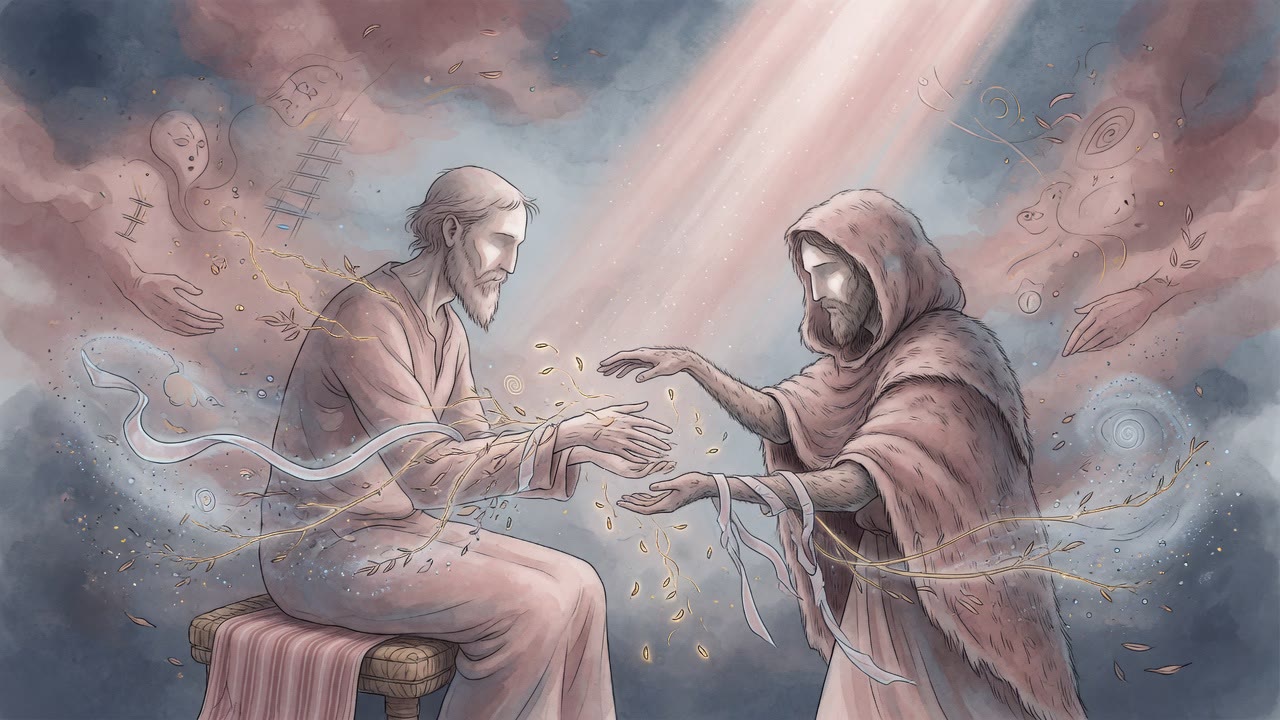
Then she took the skins of the kids and tied them onto his hands and onto the exposed parts of his neck, because a blind man reaches. He takes a wrist to pull it toward him and the throat and jaw to hold a face still, and those are the places she covered, one at a time, working around a young man who stood there and let her do it. Last, she put the meat and the bread she had made into his hands, so that everything Isaac would touch that morning had come out of her kitchen or off her floor.
I Am Thy Son
Jacob stopped at the entrance with the dish going cold against his fingers. Inside, an old man was sitting up and waiting for a son to come back from a field, and the hair on the back of Jacob's neck was hair off an animal his mother had cooked an hour ago. He could still walk out. Nobody in the tent had spoken yet, so nothing had happened yet, and one step backward would leave the whole morning as something the two of them had thought about doing.
He went in.
"I am thy son," he said. "I have done according as thou badest me. Arise and sit and eat of that which I have caught, father, that thy soul may bless me."
Isaac put out his hand toward the voice, and the hand came down on hair.
← All myths