5 min read

Laban Changed Jacob's Wages a Hundred Times

Every deal Laban spoke began with yes and slid into fog. Jacob worked under shifting speckled terms until God blocked the cheat, then delayed a vow of his own.

Curated by Arthur · Told by Maggid ·
Table of Contents
  1. The Face That Changed
  2. Yes, If Only
  3. The Flocks Answered Anyway
  4. Four Vows, Two Outcomes
  5. Leaving With the Herds
Laban Changed Jacob's Wages a Hundred Times Click for full size

The Face That Changed

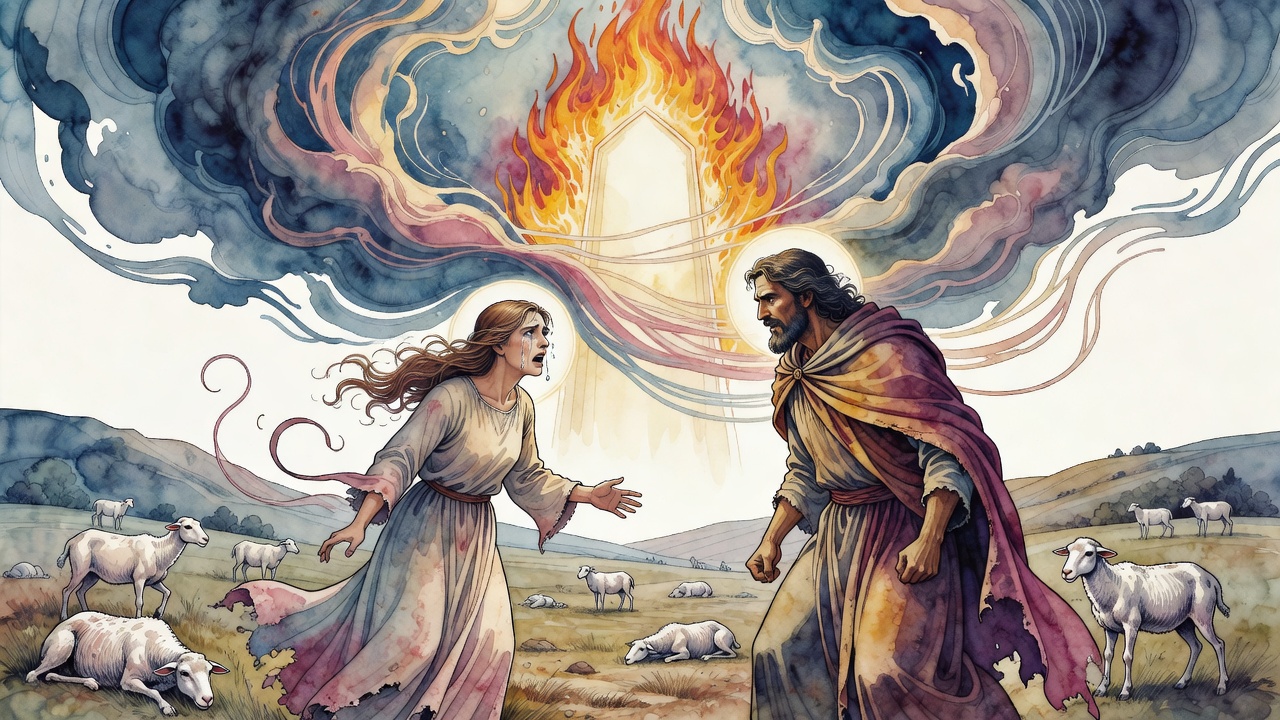
Jacob saw it in Laban's face before he heard it in a contract. Your father's countenance is not toward me as before, he told Rachel and Leah. I worked with all my strength. Your father cheated me and changed my wages ten times, but God did not allow him to harm me (Genesis 31:7).

Ten times is already a life of renegotiation. Heat by day. Frost by night. Sleep that fled from his eyes. The midrash will not stop at ten. It wants the full weight of a father-in-law who could smile while moving the floor.

Rachel and Leah listened. They knew their father's house. They knew the face.

Yes, If Only

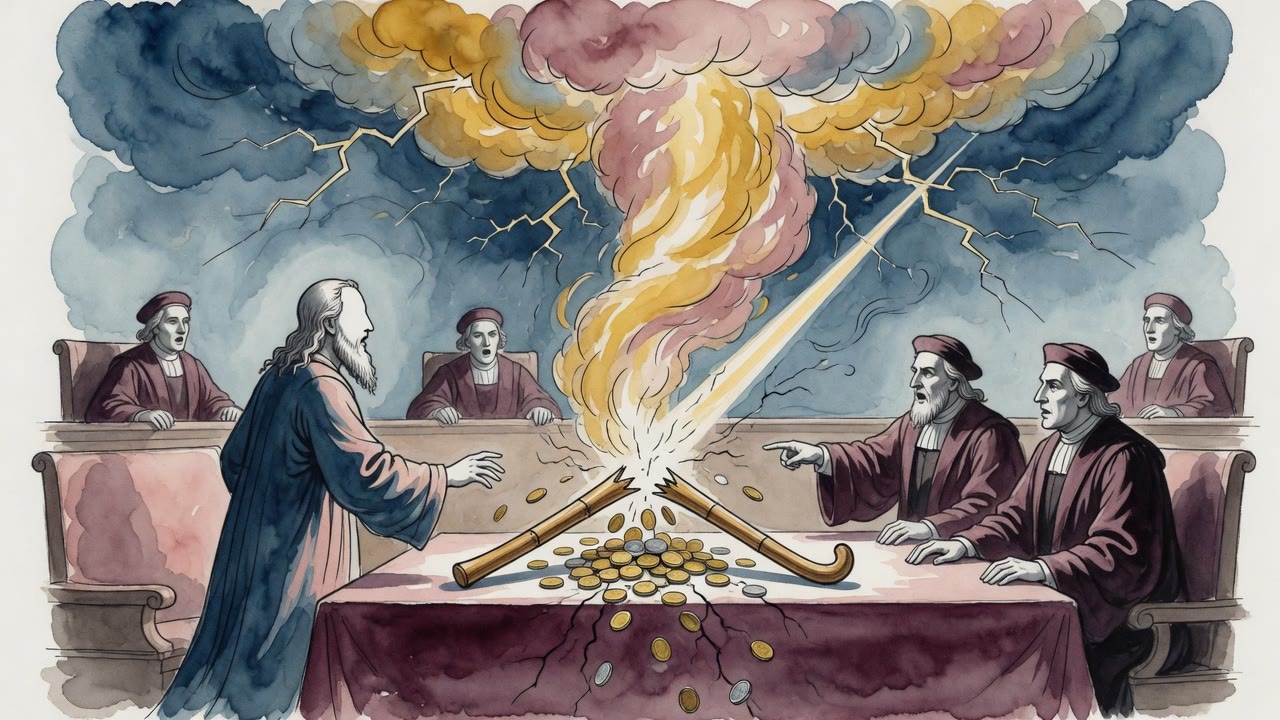
When the speckled-and-spotted deal was struck, Laban said hen lu, yes if only it will be as you say. Rabbi Hiyya hears the fracture inside the courtesy. Hen means yes. Lu means uncertainty, a soft maybe that is already a lie in training. Every agreement Laban made, he retroactively broke, ten times over.

Then the rabbis push monim. Ten times monim. A minyan is ten. Ten tens. One hundred revisions of a shepherd's pay. Speckled today, brown tomorrow, spotted when the flocks already wore the wrong coats. Jacob's honesty would speak on a future day, he had boasted over the goats. Rabbi Yehuda bar Simon hears Proverbs answer: do not glory in a future day. Overconfidence walks toward trouble. Dina's later violation sits in that shadow for the midrash like a bill arriving late.

Laban's mouth made weather. Jacob's back took the rain.

The Flocks Answered Anyway

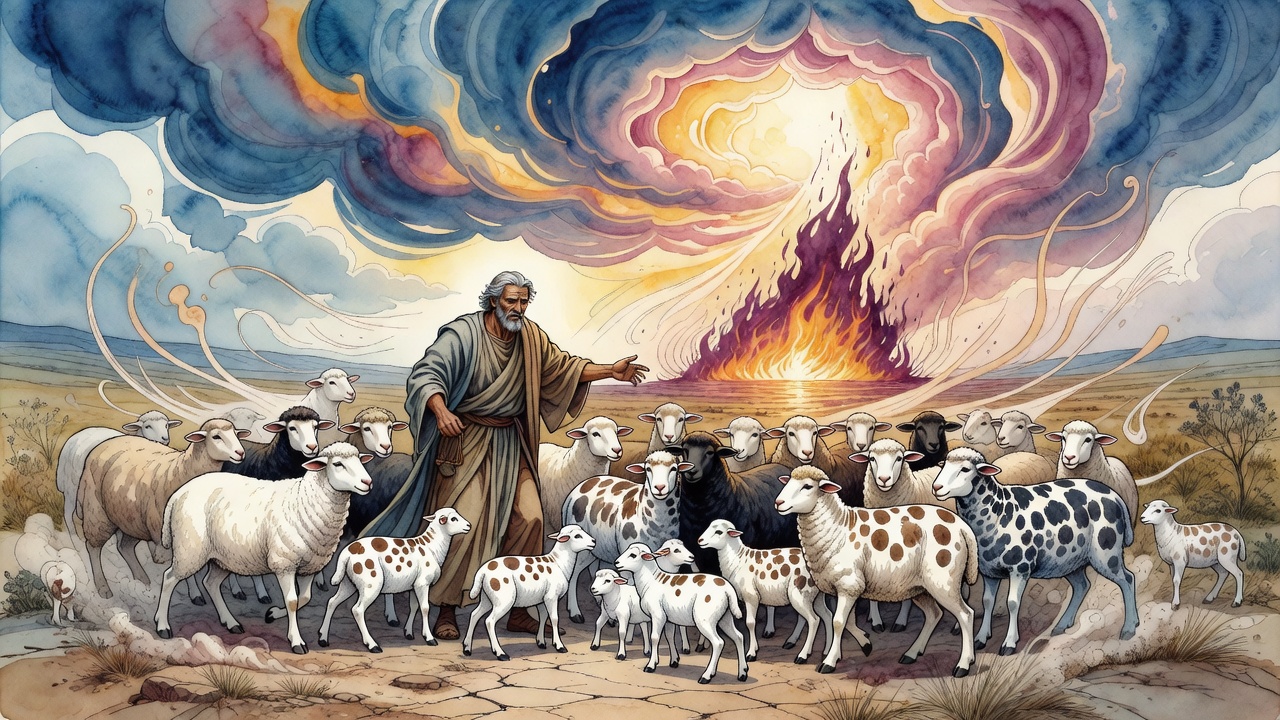
If Laban said the speckled will be your wages, the flocks bore speckled. If he switched the terms, the births switched with them. God did not allow the cheat to land. The rods Jacob set by the troughs were theater beside a deeper rerouting of unborn lambs. Laban's mouth moved. Heaven moved faster.

Jacob still felt the years in his bones. A hundred changes of wage is not a joke in a study hall. It is a man counting how many times a relative praised fairness while emptying the bargain. My honesty will speak on my behalf on a future day, he had said. The future day kept getting postponed by monim, until God made the sheep themselves into witnesses.

Peel after peel of agreement fell away. The lambs kept choosing Jacob's side of the ledger.

Four Vows, Two Outcomes

Jacob had made his own vow years earlier at Bethel. If God would guard him, give bread and clothing, and return him in peace, then the Lord would be his God and a tenth would be holy. The midrash places him among four vow-makers. Jacob delayed fulfillment, and tradition links that delay to Rachel's early death, a cost that turns a sacred bargain into grief. Yiftach vowed the first thing out of his door and met his daughter. Hannah vowed a son to service and received Samuel. Israel vowed destruction of Canaanite cities if God delivered them, and won the war.

Two gained. Two learned in blood and loss. Jacob the wage-slave of Laban was also Jacob the vow-debtor of Bethel. Integrity on the future day cut both ways. Surviving a cheat does not cancel a promise left unpaid.

He had been honest under Laban's fog. He had been slow under his own stone-pillow oath. Both truths stand in the same man.

Leaving With the Herds

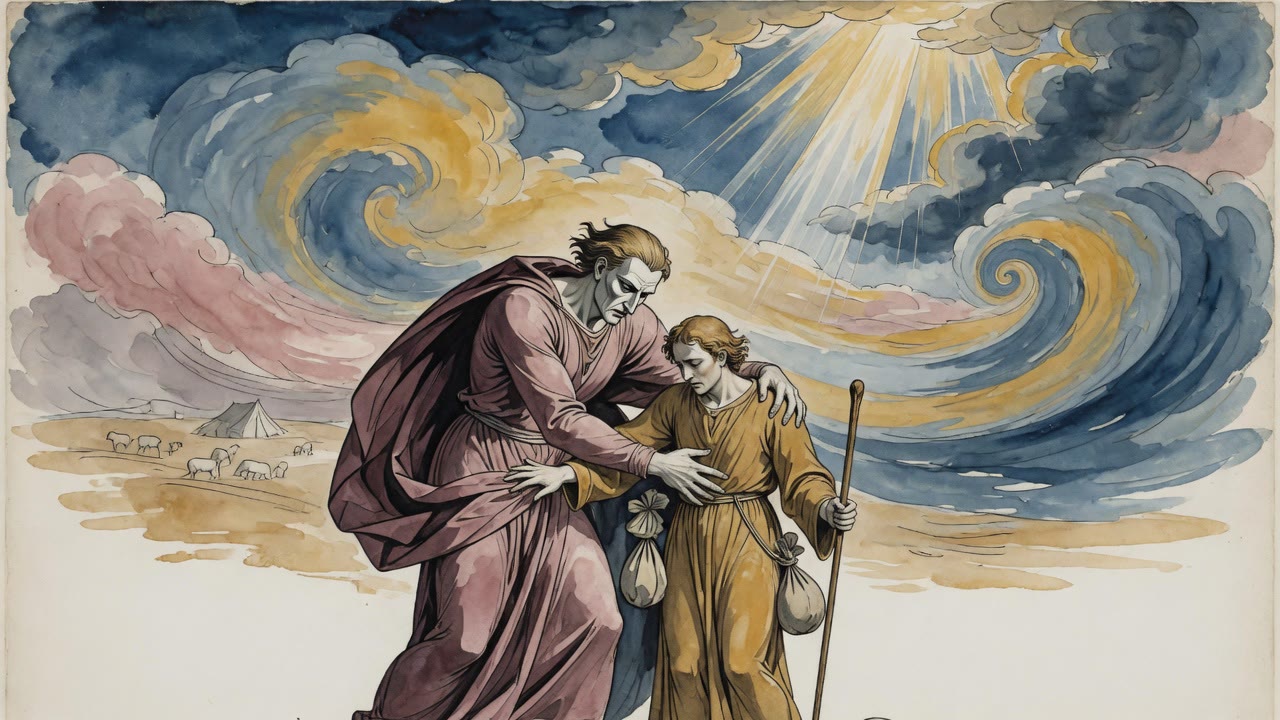
He rose, put children and wives on camels, and drove the livestock he had won under a hundred broken promises. Laban hunted him across the distance. Household gods vanished into a saddle. The God of Abraham and the god of Nahor would be called to judge between them, and the midrash hears two different thrones in that double oath, not one blurred deity.

Jacob had survived monim. He still had to survive the vow he had spoken when the stone was his pillow. Laban's changing face taught him human fraud. Bethel's open sky taught him that heaven keeps books too. Between Aram and Canaan he walked with speckled flocks and an unpaid promise, a rich man and a debtor in the same sandals.

When he finally faced Laban in the hill country, he listed the heat, the frost, the torn animals he had borne, the ten times and more. The speech was not only anger. It was a ledger read aloud so that heaven and the daughters and the cheated years would all hear the count. Then he turned toward the land of his fathers with the wages God had not let Laban steal, and with a vow still waiting for its tenth.

On the hundredth change Jacob did not shout. He set the rods again and watched the animals drink. Laban inspected the new terms with a merchant's sweetness. Yes, if only. The phrase had become a weather report. Jacob answered by working. God answered by birth-marks on lambs Laban had not approved in advance.

When Rachel stole the terafim and sat on them in the saddle, the house gods of a cheat rode out of Aram under a daughter's body. Jacob, not knowing, offered death to whoever held them. The wage war and the vow debt and the household theft braided into one flight. He was done being paid in fog. He was not yet done paying heaven what he had promised at Bethel when he was younger and poorer and more afraid.


← All myths
From the tradition

Sources

3 sources

The texts behind this telling. Some cards carry a translation of the source; others are our own retelling of it, and each card says which. Every card links out to the original.

Bereshit Rabbah 74:3Bereshit Rabbah

Retold in our words. Read the original at the link below.The Sefaria Midrash Rabbah, 2022 · CC-BY

Jacob, our patriarch, knew that feeling all too well. He was working for his father-in-law, Laban, and things were…complicated.

In Genesis 31, we hear Jacob expressing his frustration. "I see your father's countenance, and it is not toward me as in the past, and the God of my father was with me," he tells Rachel and Leah (Genesis 31:5). He acknowledges his hard work, saying "you know that I worked for your father with all of my strength" (Genesis 31:6). But then comes the kicker: "But your father has cheated me, and changed my wages ten times; but God did not allow him to harm me" (Genesis 31:7).

Ten times? Was Laban really that difficult? According to Rabbi Ḥiyya Rabba, it was even more nuanced than that. He suggests that for every agreement Laban made with Jacob, he’d retroactively renege on it – not just once, but ten times! He bases this on the verse "Hen lu" (Genesis 30:34), explaining that “Hen” means yes, but “lu” indicates uncertainty. It's like saying "yes...but maybe not really." It was the first step toward breaking his word.

Wait, it gets wilder. The Rabbis, in Bereshit Rabbah, suggest it was actually one hundred times! They derive this from the word "monim" (Genesis 31:7) in the phrase "changed my wages ten times [monim]." Because a minyan, the quorum needed for communal prayer, is no fewer than ten, they see the word "monim" as representing a much larger number. The endless back-and-forth?

The text continues, "If he said this: The speckled will be your wages, then all the flocks bore speckled, and if he said that: The streaked will be your wages, all the flocks bore streaked” (Genesis 31:8). It seemed like Laban had control over the genetics of the flock, changing the terms whenever it suited him.

But did he, really? Rabbi Berekhya, citing Rabbi Ḥanina, offers a fascinating perspective. The Holy One, blessed be He, foresaw what Laban was going to do. Before Laban even voiced his changing demands, God shaped the outcome to match Laban's final position. It wasn't about Laban's power, but about God's foresight and protection of Jacob. The text emphasizes that "Im ko yomar – amar" isn't written, but rather "yomar" (Genesis 31:8). Amar is past tense, but yomar is future. This indicates that God knew what Laban would do.

Rabbi Yudan and Rabbi Aivu add another layer. They point out that the text doesn't say "For I have seen everything that Laban did to you," but "everything that Laban is doing to you" (Genesis 31:12). The implication? God's awareness is constant, ongoing.

And what about the breeding process itself? How did the flocks consistently produce the patterns Laban dictated (or tried to)? Rabbi Huna of Beit Ḥoron says that it doesn't say "olim" – that the males were merely mounting the flock – but "haolim" (Genesis 31:12) – that they mounted involuntarily. It was as if the angels themselves were ensuring the right pairings! Rabbi Tanḥuma suggests it was torrential rain that transported the males from Laban’s flock, while other Rabbis attribute it to clouds of glory.

Ultimately, "God has diverted the livestock of your father, and given it to me" (Genesis 31:9), as Jacob says. It's described as "like one who saves items from refuse." God rescued Jacob from Laban's deceit.

Rabbi Elazar ben Yaakov brings it all home: "The angel of God said to me in the dream…" (Genesis 31:11) – this was not just to Jacob, but to his generations. "There is no generation that does not have one like Abraham. There is no generation that does not have one like Jacob. There is no generation that does not have one like Samuel."

So, what does this all mean for us? Perhaps it's a reminder that even when we feel cheated or taken advantage of, we're not alone. God sees, God knows, and God acts – sometimes in ways we can't even imagine. And maybe, just maybe, it's a lesson to be a little more mindful of our own "hen lu" moments, and strive for honesty and integrity in our dealings with others.

Full source
Bereshit Rabbah 73:9Bereshit Rabbah

Retold in our words. Read the original at the link below.The Sefaria Midrash Rabbah, 2022 · CC-BY

Bereshit Rabbah turns to Jacob's Honest Wage Agreement Over Speckled Sheep.

In (Genesis 30:33), Jacob declares, "My honesty will speak on my behalf on a future day, when you will review my wages before you: every one among the goats that is not speckled and spotted, or brown, among the sheep, was stolen by me.” Bold words. But Rabbi Yehuda bar Simon, as quoted in Bereshit Rabbah, throws a curveball. He connects this statement to (Proverbs 27:1), "Do not glory in a future day." The implication? Hubris has a way of biting back. The text suggests that Jacob's confidence might be misplaced, foreshadowing future troubles, specifically the violation of his daughter Dina (Genesis 34:1). It's a stark warning about the dangers of overconfidence.

Then there's Laban, Jacob's father-in-law. Oh, Laban. In (Genesis 30:34), Laban says, "Indeed, if only it will be in accordance with your statement.” But what does he really mean? Rabbi Ḥiyya bar Rabba suggests that Laban's words, "hen lu" – "indeed, if only" – were far from sincere. According to Rabbi Ḥiyya, every agreement Laban made with Jacob, he retroactively reneged upon it ten times. The phrase "hen lu," with hen meaning yes, and lu indicating uncertainty, represents the first step toward breaking his word.

The Rabbis take it even further. They claim Laban changed Jacob's wages one hundred times. How do they arrive at that figure? They cite (Genesis 31:7): "But your father has cheated me, and changed my wages ten times [monim]." They interpret monim, "times," as implying ten times ten, because a minyan, a quorum, is no fewer than ten. So, ten groups of ten. Laban's slipperiness isn't just annoying; it's practically a defining characteristic.

And what about the sheep? (Genesis 30:36) tells us, "He established a distance of three days’ journey between himself and Jacob. Jacob herded the remaining flock of Laban.” Reish Lakish offers a less-than-flattering description of the "remaining" flock – notarot in Hebrew. These weren't the prime cuts. Reish Lakish explains that notarot meant the poor-quality sheep, the barren ones, and the sick ones. He even connects the word to nateret, referencing a passage in Chullin 59b about an emperor whose front and back teeth fell out, further emphasizing the low quality of what Jacob was left with.

So, what do we take away from this tangled tale of sheep, daughters, and broken promises? Perhaps it’s a reminder that honesty, while the best policy, isn't always reciprocated. It also shows us how easily agreements can unravel when trust is absent. And maybe, just maybe, it’s a cautionary tale about the long-term consequences of short-sighted greed. Laban's dishonesty ultimately poisoned his relationship with Jacob and set the stage for future conflicts.

Full source
Bereshit Rabbah 70:3Bereshit Rabbah

Retold in our words. Read the original at the link below.The Sefaria Midrash Rabbah, 2022 · CC-BY

Bereshit Rabbah, that incredible collection of rabbinic interpretations on the book of Genesis, presents us with a stark contrast: four individuals who made vows, or nedarim, but with dramatically different outcomes. Two gained, and two… well, let’s just say they learned a hard lesson.

First up: Jacob. Our patriarch, wrestling with destiny at Bethel, makes a deal. As we read in (Genesis 28:20-22), he vows that if God protects him on his journey, provides food and clothing, and brings him back safely, then God will be his God, and he will give a tenth of everything to Him. Sounds reasonable. A classic "if you do this for me, I'll do that for you" scenario.

In rabbis, Jacob was tardy in fulfilling that vow. And the price? A heavy one. The Talmud in Shabbat 32b suggests that Rachel’s untimely death was a direct consequence of Jacob's delay. A powerful, sobering thought! Could a broken promise really have such devastating repercussions?

Then there’s Yiftach. Oh, Yiftach. His story in (Judges 11:30-34) is a tragic one. Desperate for victory against the Ammonites, he makes a rash vow: whatever comes out of the door of his house to meet him upon his return, he will offer as a burnt offering to God. You know where this is going, don't you? It's his daughter. The irreversible nature of that promise? A vow made in haste, repented at leisure, as they say.

So, those are the cautionary tales. But what about the success stories?

Enter Hannah. Barren and heartbroken, she pours out her soul to God at the Mishkan, the Tabernacle. As we see in I (Samuel 1:11), she vows that if God grants her a son, she will dedicate him to God's service. And God answers her prayer. She gives birth to Samuel, who becomes one of the greatest prophets in Israel's history. A vow fulfilled, a life dedicated, and a nation blessed.

Finally, there’s Israel itself. In (Numbers 21:2), we read that Israel made a vow to God: If God delivers the Canaanites into their hands, they will utterly destroy their cities. And guess what? God delivers, and Israel triumphs. A collective vow, a collective victory.

What are we to make of all this?

The rabbis, in their infinite wisdom, aren't simply giving us a history lesson. They're offering a profound reflection on the nature of promises, the power of words, and the delicate dance between humanity and the Divine. These stories remind us that vows aren't to be taken lightly. They carry weight. They have consequences.

Sometimes, a carefully considered promise, made with pure intention, can bring forth blessings beyond measure. And sometimes, a hasty, ill-conceived vow can lead to unimaginable pain. Think before you speak. And always, always strive to fulfill your promises. Because, ultimately, our words shape our world.

Full source