5 min read

Jacob Demanded His Wages and the Flock Turned Spotted

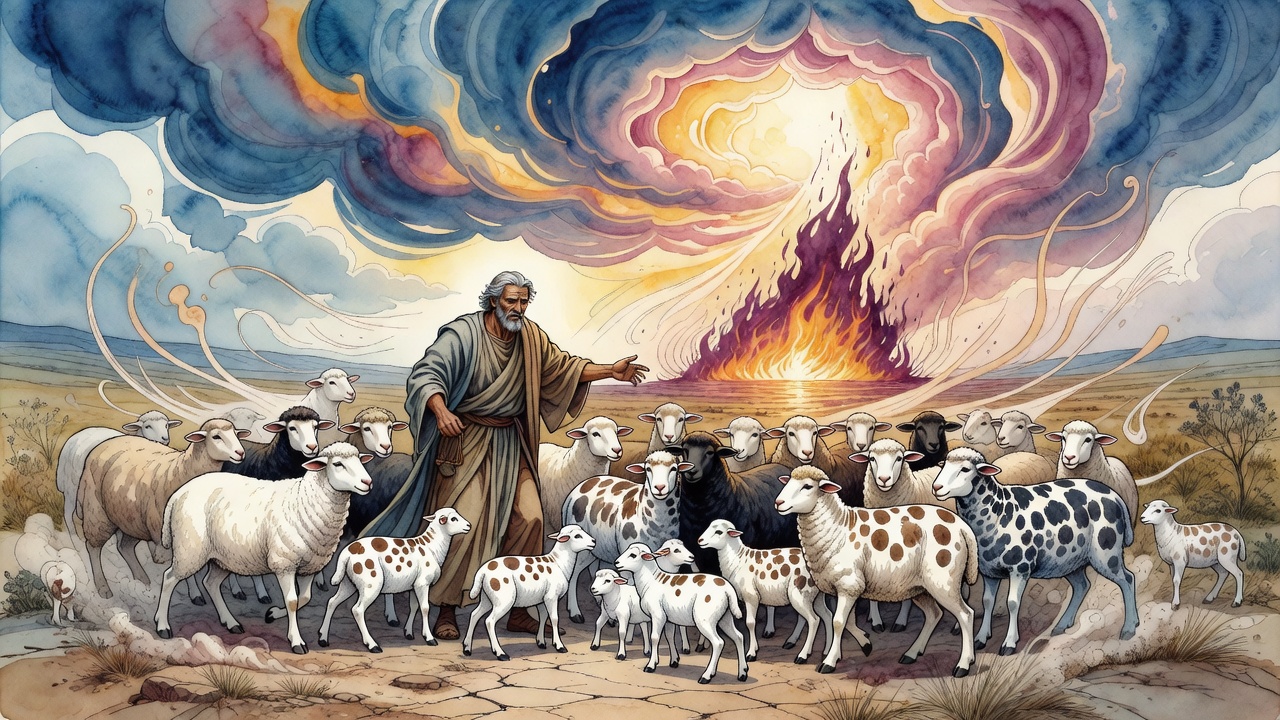
Laban expected the deal to cost him little: Jacob would be paid only in lambs born black or spotted. Then the ewes kept giving birth to spotted lambs.

Curated by Arthur · Told by Maggid ·
Table of Contents
  1. The Bargain That Reverse-Bled
  2. While Edom Crowns Its Kings
  3. A Later Fear, a Double Call
  4. What the Marks Kept Saying

Fourteen years had sanded Jacob's hands to the shape of Laban's work. Wives, sons, flocks that fattened another man's name. When he finally said he would leave, Laban's face did the arithmetic of loss in public.

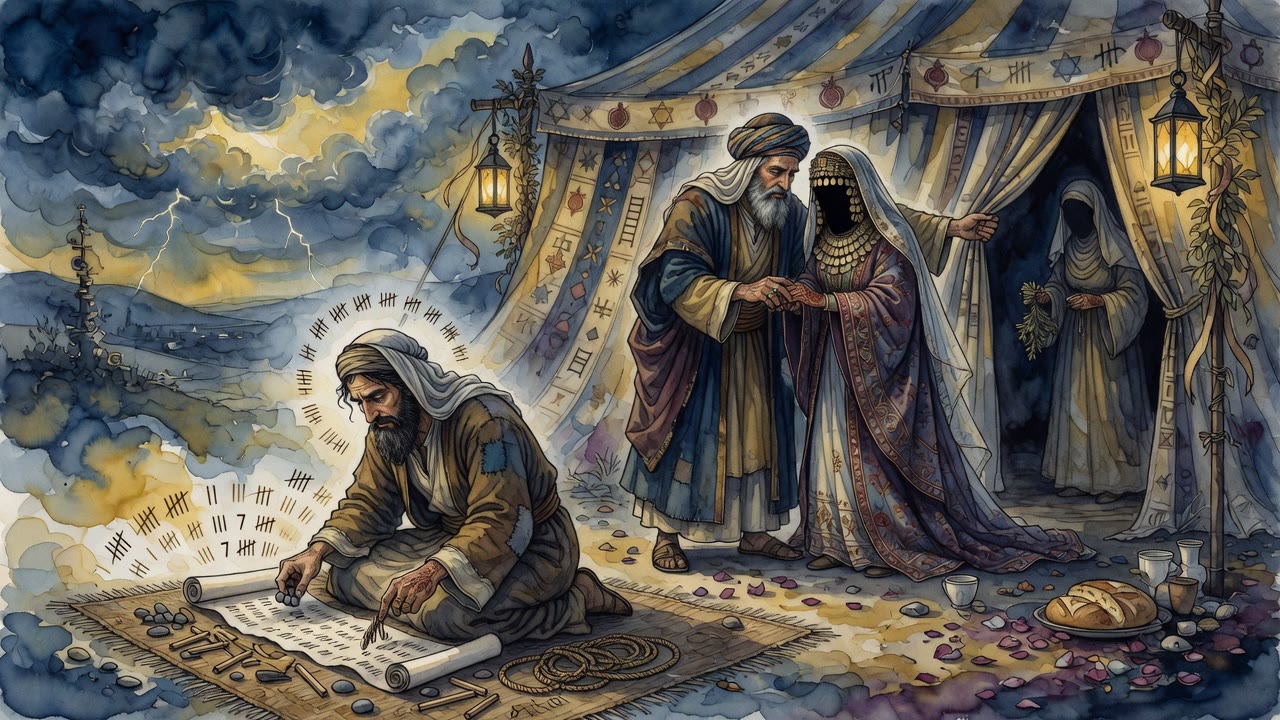
Jacob Demanded His Wages and the Flock Turned Spotted Click for full size

"Tarry with me for thy wages," Laban said. "Pasture my flock again. Take thy wages."

They haggled until the deal looked like daylight theft. Jacob would take only the lambs and kids born black, spotted, or oddly marked. Most sheep, everyone knew, came ordinary. Laban smiled the smile of a man who has sold a well and kept the water.

Then the ewes began to deliver as if they had heard a different contract.

The Bargain That Reverse-Bled

Spotted. Speckled. Black. Variously marked. The young came like themselves again in the next round, and the marked ones were Jacob's while the plain remained Laban's. Jubilees keeps the wonder without apology. The flock under Jacob's staff answered a promise older than Laban's cleverness. What looked like robbery flipped into transfer.

Jacob did not need to preach. He counted. Each marked birth was a quiet verdict on fourteen years of being used. Laban walked the pens and found his own terms turned into someone else's wealth. The staff that had blessed Laban's house now drew a line through it.

Night noises of the flock sounded like coins dropping into a jar Laban could no longer close.

While Edom Crowns Its Kings

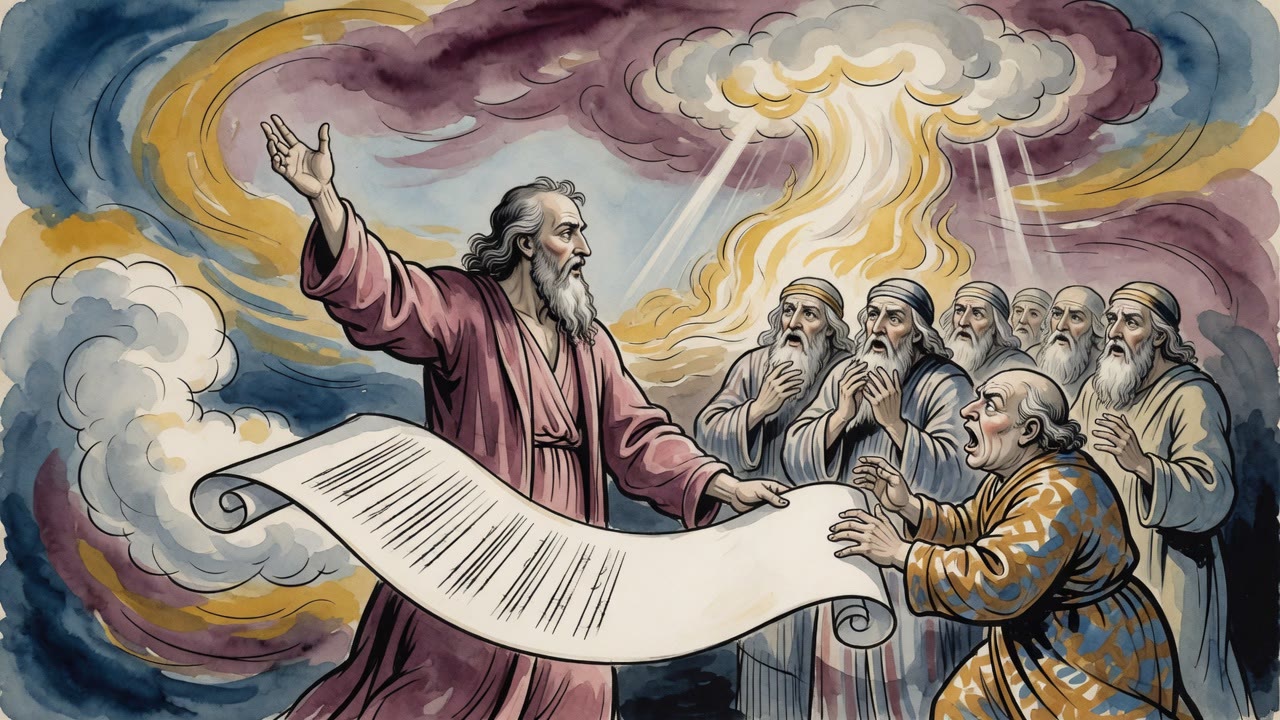
Far from those pens, Edom ran through its own ledger of names. Adath died. Salman reigned. Saul of Raaboth by the river. Baelunan son of Achbor. Another Adath, with a wife whose lineage the book refuses to blur. "These are the kings who reigned in the land of Edom." Meanwhile Jacob still sojourned in the land of his father's wanderings in Canaan, not yet a king, not yet finished being a hired man in another story.

The contrast is a pressure, not a footnote. Esau's line collects thrones. Jacob's line still collects spotted lambs and deferred promises. Legitimacy on one side looks like crowns. On the other it looks like a covenant that moves slowly through wages, wives, and roads.

Jacob, counting marks in wool, was still the sojourner. That was the point.

A Later Fear, a Double Call

Years fold. Joseph is lost and then found under Egypt's power. Famine presses the old man toward a border he dreads. On the sixteenth of the month the Lord appears and calls "Jacob, Jacob." "Here am I." The God of Abraham and Isaac tells him not to fear the descent. A nation will be made there. The Presence will go down and will bring him up.

The man who once demanded wages from Laban now receives a wage of courage. Leaving Padan-aram had required a bargain and a miracle of birth. Entering Egypt required a voice that named him twice. Both exits and entrances are supervised. Neither is casual.

Jacob packs for Egypt with the memory of spotted lambs still somewhere in the family's wealth. God's bookkeeping has more than one column.

What the Marks Kept Saying

Laban's deal was meant to be a cage made of probability. Jacob's God treated probability as a servant. The midrashic chronology of Jubilees will not call that luck. It calls it the outworking of a promise that Laban never signed and could not void.

When Jacob finally turned his face from those fields, he left a father-in-law staring at ordinary sheep that had become the minority. The sojourner had been paid in the currency the cheater chose. That is a kind of joke Heaven sometimes allows.

Dust rose behind the departing flocks. In Edom, another king's name waited on a list. In Canaan, and later on the road to Egypt, Jacob kept walking inside a slower crown.

Laban ordered the marked animals separated at once, as if speed could reverse a womb. Servants ran. Ewes still labored. Jacob stood still enough to anger a lesser man into a mistake. He had learned stillness in fourteen years of being paid late, paid wrong, paid in wives he had not contracted for first. Stillness was now a weapon.

Rachel laughed once under her breath when a black lamb stood on shaking legs. Leah did not laugh. She watched Laban's face and measured the road home by the number of pens that no longer belonged to him. Children of the camp would later say the flocks chose Jacob. The book says the births answered a promise Laban never read.

On the last morning before departure Jacob walked the edge of the pens and touched only the animals that wore his mark. Laban's men watched for theft and found accounting instead. A speckled ram butted a plain one and both moved like a small parable neither owner fully controlled. Jacob breathed the wool smell and allowed himself one private sentence of thanks without naming the Name aloud where Laban could tax it.

Leah loaded a saddle with more care than anger. Rachel checked a bridle twice. The road would not be kind, but it would be theirs. Fourteen years of another man's arithmetic had ended in a flock that voted with its births.


← All myths

From the tradition

Sources

3 sources

The texts behind this telling. Some cards carry a translation of the source; others are our own retelling of it, and each card says which. Every card links out to the original.

Book of Jubilees 28:37Book of Jubilees

Retold in our words. Read the original at the link below.Sefaria Community Translation · CC-BY

Book of Jubilees turns to Jacob Demands to Leave After Fourteen Years.

Laban, seeing how much Jacob has benefited his household (shall we say!), isn't so keen to let him go. He pleads with Jacob to stay. "Tarry with me for thy wages, and pasture my flock for me again, and take thy wages."

Laban wasn’t exactly known for his generosity, was he? He's looking to strike a bargain that heavily favors him. So they haggle, and they finally come to an agreement, a deal seemingly so skewed that Jacob couldn't possibly profit.

The deal is this: Jacob will receive as his wages only the lambs and kids that are born black, spotted, or white. Seems fair enough. Except, the vast majority of sheep and goats are… well, neither black, spotted, nor white! Laban probably thought he was getting away with daylight robbery.

But here's where things get interesting. According to Jubilees 28, "all the sheep brought forth spotted and speckled and black, variously marked, and they brought forth again lambs like themselves, and all that were spotted were Jacob's and those which were not were Laban's."

Suddenly, Laban's flock is popping out black, spotted, and speckled lambs and kids left and right! What are the odds? Seems like someone. Or something, was looking out for Jacob. Talk about divine intervention, or perhaps just a little bit of cosmic justice.

Now, some might say this is just a clever story about outsmarting a deceitful man. Others might see it as evidence of Jacob's own cunning and skill, a reward for his years of hard work. But the Book of Jubilees, with its detailed chronology and emphasis on divine covenants, frames it as something more: a demonstration of God's promise to protect and prosper Jacob, despite the obstacles thrown in his path.

What do we take away from this? Is it simply a tale of shrewd bargaining and unexpected fortune? Or does it hint at a deeper truth about fairness, divine justice, and the enduring power of promises? Perhaps it's a little of both.

Full source
Book of Jubilees 44:8Book of Jubilees

Retold in our words. Read the original at the link below.Sefaria Community Translation · CC-BY

The story It's considered apocryphal by some, meaning it's not included in the standard Hebrew Bible canon, but it offers incredible insight into the beliefs and interpretations of ancient Jewish communities. It fills in so many gaps, and provides a much deeper level of understanding than we could get just from reading the Torah.

Jacob, a man who's already lived a life filled with blessings and struggles, is now facing a daunting decision. Should he leave the familiar land of Canaan and venture down into Egypt? Egypt, at this time, was a powerful, foreign place. A place of immense risk for a family and tribe of his size.

Things were dire. A severe famine had gripped the land, and word had reached Jacob that his long-lost son, Joseph, was not only alive but also a powerful official in Egypt. A lifeline, maybe, but a leap of faith nonetheless.

It's at this pivotal moment, on the sixteenth of the month, that something extraordinary happens. "The Lord appeared unto him," the Book of Jubilees (44:1-3) tells us. God calls out, "Jacob, Jacob," a double calling, a sign of great importance, perhaps even urgency. And Jacob, ever faithful, replies, "Here am I." Hineni in Hebrew. A simple statement but one loaded with meaning. It's an affirmation of presence, of readiness to listen, to serve.

And then, God speaks words that must have resonated deep within Jacob's soul. "I am the God of thy fathers, the God of Abraham and Isaac; fear not to go down into Egypt, for I will there make of thee a great nation." What a promise! What reassurance!

He continues, "I shall go down with thee, and I shall bring thee up (again), and in this land wilt thou be buried, and Joseph will put his hands upon thy eyes. Fear not; go down into Egypt."

These words are so powerful. God isn't just promising protection; He's promising presence. "I shall go down with thee." God will accompany Jacob in this journey. And not just that, He promises a future return, a redemption. And the comforting image of Joseph, his beloved son, being there at the very end.

What a relief this must have been! The fear, the uncertainty...all washed away by the divine promise.

And so, Jacob's sons and grandsons, filled with newfound hope, prepared for the journey. "And his sons rose up, and his sons' sons, and they placed their father and their possessions upon wagons" (Jubilees 44:4). They packed their belongings, helped Jacob onto a wagon, and set off toward Egypt.

This passage, though short, is so rich with meaning. It's a story of faith, of trust in the face of the unknown. It’s a reminder that even when we're facing difficult decisions, when we're feeling scared and uncertain, we are not alone. Just as God promised to be with Jacob, the tradition teaches that He is with us, guiding us, and offering us reassurance, even when we can't see the path ahead.

So, the next time you find yourself at a crossroads, remember Jacob's story. Remember the promise. Remember that even in the darkest of times, there is always hope, and you are never truly alone. What crossroads are you facing right now, and how can this ancient story give you strength?

Full source
Book of Jubilees 39:1Book of Jubilees

Retold in our words. Read the original at the link below.Sefaria Community Translation · CC-BY

We've all been there. Sometimes even the most ancient texts can feel a little… dry.

The Book of Jubilees, a fascinating text considered preserved in Ethiopian manuscript tradition but relegated to apocryphal status by many others. It's a bit of a royal roll call.

The verse reads, "And ’Adâth died, and Salman, from ’Amâsêqâ, reigned in his stead." Okay, we’re off to the races! Salman kicks the bucket, and then "Saul of Râ’abôth (by the) river, reigned in his stead."

These guys are kings of Edom, by the way. Edom, you might recall, was the land settled by Esau, Jacob's twin brother. Remember that whole birthright kerfuffle? Yeah, that Esau.

So, Saul goes, and "Ba’êlûnân, the son of Achbor, reigned in his stead." Ba’êlûnân also shuffles off this mortal coil, and then "'Adâth reigned in his stead, and the name of his wife was Maiṭabîth, the daughter of Mâṭarat, the daughter of Mêtabêdzâ’ab."

Now, why all these names? Well, genealogies were super important in the ancient world. They established lineage, legitimacy, and your place in the grand scheme of things. Knowing who your ancestors were was a big deal. It connected you to the past and gave you a claim on the future.

The Book of Jubilees is particularly interested in establishing the correct chronology of events, often disagreeing with other biblical accounts. It wants to set the record straight, as it were. And for that, you need names, dates, and a clear line of succession.

"These are the kings who reigned in the land of Edom." The text declares, bringing this mini-dynastic history to a close.

Then, almost as an afterthought, it adds: "And Jacob dwelt in the land of his father's sojournings in the land of Canaan."

A seemingly simple sentence, but it sets the stage for the next part of the narrative. While Edom has its kings, Jacob is still just sojourning, a temporary resident. He's in the land promised to his ancestors, but the promise is not yet fully realized. There's a sense of anticipation, of waiting for something more.

So, what do we take away from this brief glimpse into the Edomite monarchy? Perhaps it's a reminder that history isn't just about the big, dramatic events. It's also about the everyday lives of people, the passing of time, and the slow, steady march of generations. And sometimes, it's just about a list of names that connect us to a distant past. A past that shapes who we are today, even if we don't always remember every single name.

Full source