6 min read

Laban Emptied the Flock Before Heaven Paid Jacob

Before dark on the day they shook hands, every spotted goat was walking north with Laban's sons. Jacob was left a flock the color of dust.

Curated by Arthur · Told by Maggid ·
Table of Contents
  1. Three Days of Road
  2. The Peeled Rods in the Water Troughs
  3. The Wage Changed Ten Times
  4. The Argument Over Full Bellies
  5. The Heap of Stones on the Hill

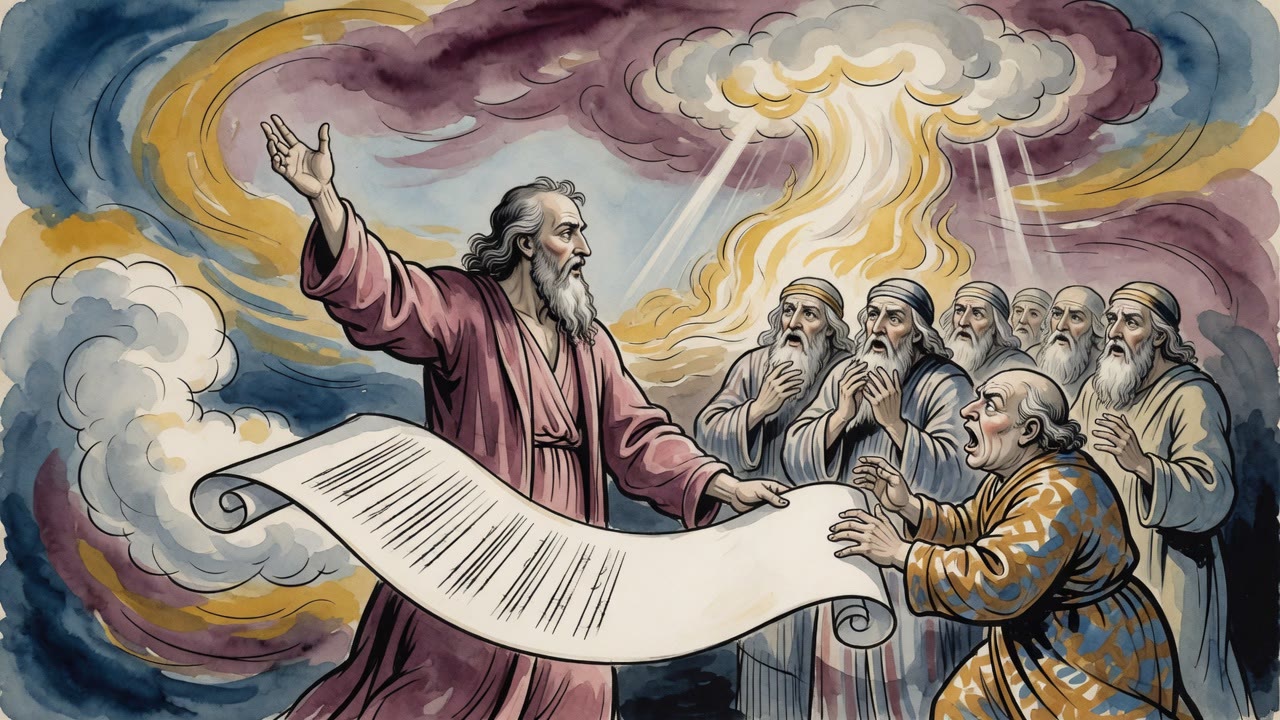
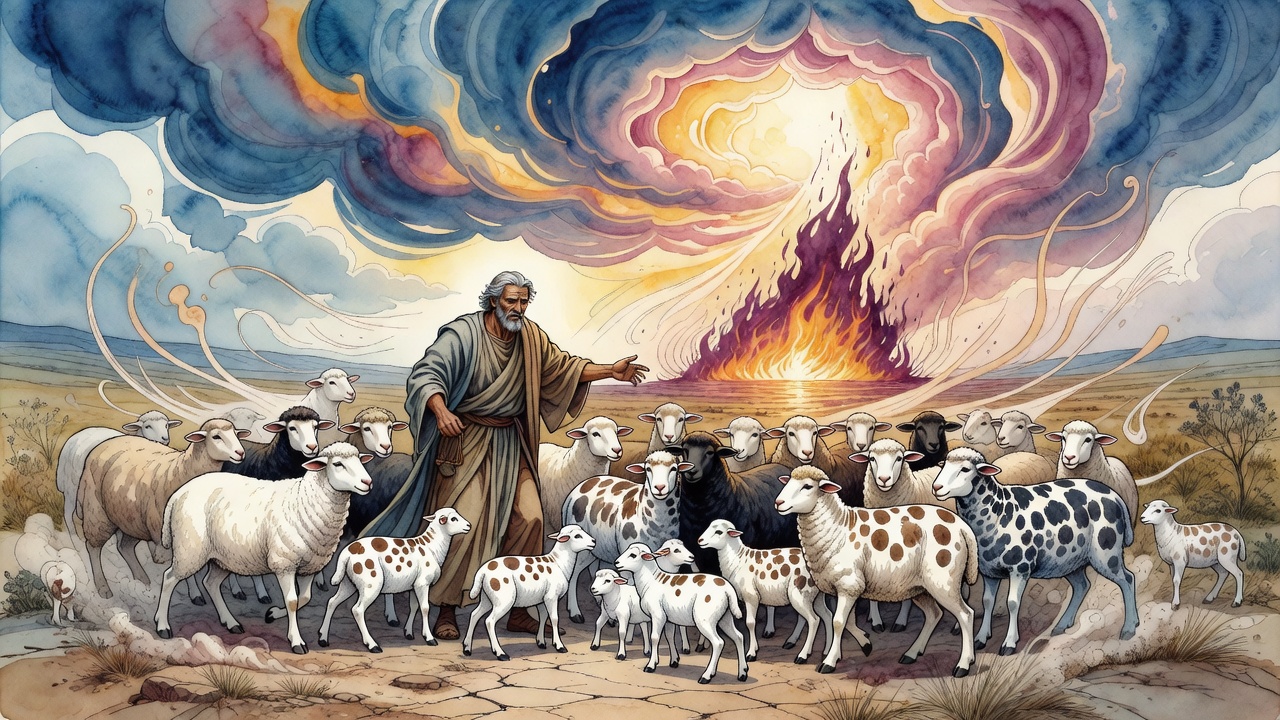
Laban did not wait for morning. The words of the agreement were still hanging over the pens and his hands were already in among the animals, pulling out every goat marked on its feet, every speckled hide, every streaked one, every black lamb in the flock.
Laban Emptied the Flock Before Heaven Paid Jacob Click for full size

He handed them to his own sons and sent them off. By dark there were three days of road between the marked animals and the plain ones Jacob would be walking out at dawn.

The arrangement had been Jacob's idea. Leave me the odd-colored ones, he had said, and take the rest, and come through the flock any day you like, and if you find a clean animal in my hands you can call me a thief in front of witnesses. Laban had agreed fast, the way a man agrees when he has just heard something he already intends to break.

Three Days of Road

Jacob came into the fold the next morning and heard the difference before he saw it. The pens were quieter. Every animal left in them was the color of dust, plain as a wall, and the wage he had negotiated had been driven north in the night by four of his brothers-in-law.

Fourteen years he had already spent in these fields, seven of them for a wife he had not been given and seven more for the one he had wanted at the start. This was the first arrangement in his adult life in which anything was supposed to end up his.

Laban went home and did the arithmetic. No marked animals in the breeding stock meant no marked lambs at the birthing, and no marked lambs meant no wage owed, indefinitely, at no cost to anybody. He found the sum clean.

The Peeled Rods in the Water Troughs

Jacob cut rods from poplar, almond, and plane, and peeled white stripes down the green bark until the wood underneath showed through in bands. He stood them in the gutters and the drinking troughs where the flocks came in thirsty, and the animals conceived in front of the peeled wood.

The lambs came out streaked. Then spotted. Then streaked again.

He set the marked ones apart for himself and would not let them mix back into Laban's stock. He put the rods out for the strong animals and left them out of the troughs for the weak, so that the feeble young went to Laban and the sturdy ones went to Jacob.

Laban came back to count, and the count would not sit still. His face changed the way a merchant's face changes when the ledger and the storeroom stop agreeing. He walked the pens looking for the door he had not drawn on his own map, and it opened again every time a ewe lay down.

The Wage Changed Ten Times

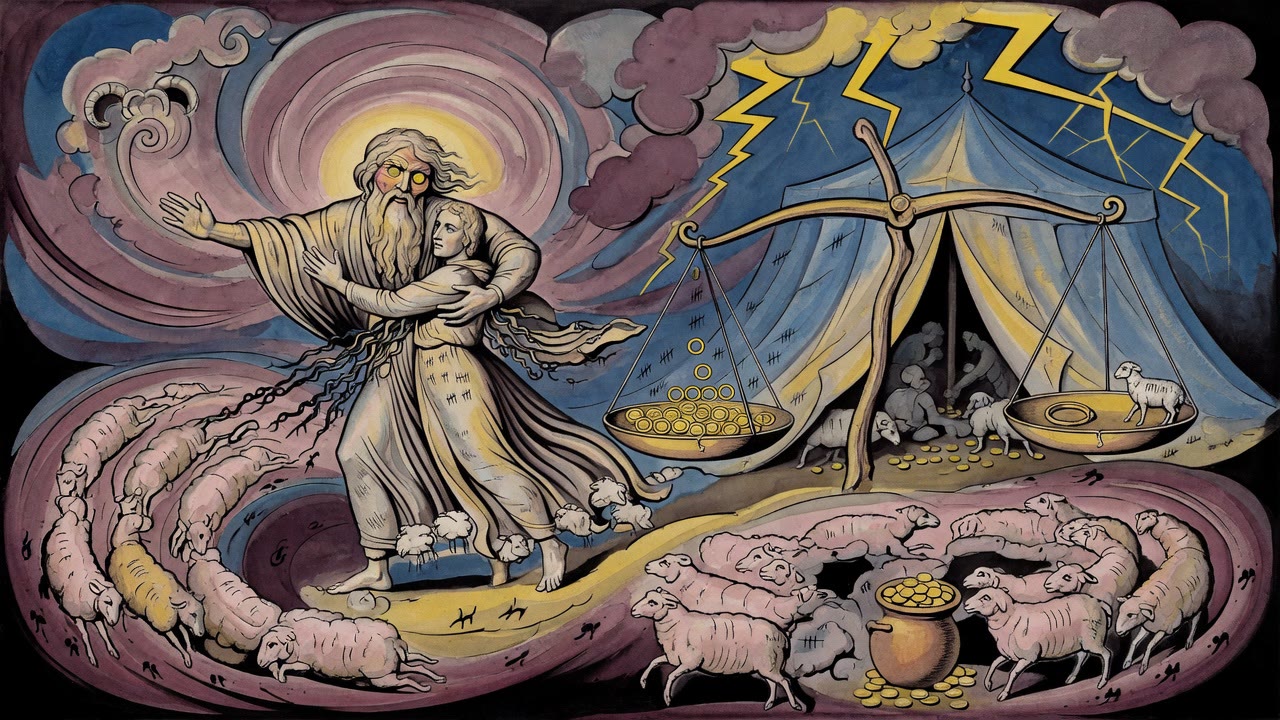
So he rewrote the terms. Speckled shall be your wage, he said, and the whole flock bore speckled. Streaked, then, he said, and the whole flock bore streaked. Ten times he changed the agreement, and ten times the animals answered the new wording inside a season.

Jacob slept and saw the rams that mounted the flock, and every one of them was streaked and speckled and grizzled, and a voice in the dream told him it had watched everything Laban was doing to him.

He woke up rich and knew whose doing it was. He kept working anyway. Six more years, with the sons of Laban standing at the edge of the field saying out loud that Jacob had taken everything their father had, and Laban's face toward him no longer what it had been the year before.

The Argument Over Full Bellies

When it finally broke, and Laban had chased him seven days into the hill country of Gilead over a set of missing household gods, Jacob stopped running and made his own accounting out loud in front of both households.

Twenty years in your house. Your ewes and your she-goats never miscarried. I never once ate a ram out of your flock. Whatever was torn by animals I did not bring to you to look at, I made it good out of my own hand, whether it went missing by day or by night. The heat ate me in the daytime and the frost at night and sleep left my eyes.

It was the line about the ewes that carried the weight. A man's blessing shows up first in the bodies of his animals, in ribs nobody can count from ten paces off and in ewes that carry to term. Whoever is righteous knows the appetite of his beast, and a well-fed ox puts a harvest in the barn. Laban's flocks under Jacob's hands had thickened and bred and dropped healthy young for twenty years, and in all that time he had never once had to go looking for the reason.

The Heap of Stones on the Hill

They piled stones on the ridge and ate a meal on top of the pile, which is what men do when they have run out of ways to hurt each other and are not sorry.

Laban named the heap in Aramaic and Jacob named it in Hebrew and both names meant the same thing, a pile that watches. Let the Lord keep watch between you and me when we are out of each other's sight. Neither of them was talking about affection.

In the morning Laban kissed his daughters and his grandchildren and went home. Jacob went on toward the river with wives, children, servants, camels, and a slow moving weather of livestock that had been, on a certain afternoon twenty years and one contract earlier, a fold full of plain animals nobody thought was worth guarding.

Esau was coming the other way with four hundred men.


← All myths
From the tradition

Sources

3 sources

The texts behind this telling. Some cards carry a translation of the source; others are our own retelling of it, and each card says which. Every card links out to the original.

Targum Pseudo-Jonathan on Genesis 30:35Targum Pseudo-Jonathan on Genesis

Retold in our words. Read the original at the link below.The Targum of Jonathan ben Uzziel, trans. J. W. Etheridge, London, 1862 · Public Domain

The moment the deal was struck, Laban moved fast. Targum Pseudo-Jonathan describes him that same day separating out every goat marked on its feet, every spotted one, every one with even a patch of white on its coat, and every black lamb. And handing them all over into the keeping of his sons (Genesis 30:35).

Read the verse slowly. The agreement said Jakob would take the streaked and spotted animals as wages. Laban's response was to remove all of them before Jakob could lay hands on them. Not into Jakob's flock. Into his own sons' custody, three days' distance away.

It was the deception of a man who had already counted his winnings. Laban believed that if there were no marked animals in the flock Jakob tended, no marked animals could ever be born. He was, in his way, a closed-system thinker, unwilling to

The Maggid teaches: a cheat always plans against the world he can see. He never plans against the One who made it. Laban stripped the flock bare, then handed Jakob what looked like nothing. And heaven used that nothing as a seedbed.

Full source
Shir HaShirim Rabbah 4:5Shir HaShirim Rabbah

Retold in our words. Read the original at the link below.The Sefaria Midrash Rabbah, 2022 · CC-BY

Song of Songs is already pretty heady stuff – love, longing, metaphor piled upon metaphor. But the Rabbah, the commentary, takes it to a whole new level, interpreting the poem as an allegory for the relationship between God and Israel. And in this section? We find a surprising connection to the Temple service.

The verse What on earth do goats have to do with… well, anything spiritual?

It makes a play on words. Shegaleshu, "that streams down," is linked to shegelashten, "that you took away." The verse, according to this interpretation, is actually about something taken from Mount Gilad. And what is that? According to Shir HaShirim Rabbah, it's a memorial for the nations of the world – the priestly watches.

Wait, goats, hair, priestly watches…what's the connection?

The Rabbah continues, unpacking the next verse, (Song of Songs 4:2): "Your teeth are like a flock of ordered ewes." These "teeth," we're told, represent defined matters: the twenty-four priestly watches, the twenty-four Levite watches, and twelve divisions. These were divisions of men who would come for a month at a time to perform whatever tasks the king – that is, God – would assign them. As the Etz Yosef explains, these divisions of men would each serve for a month.

"That have come up from bathing," the verse continues, referring to those who protect Israel.

"That are all paired" – this alludes to the fact that, as we learn in Sukkah 55b, at three times during the year – during the pilgrimage festivals – all the priestly watches were equal. Everyone had a role to play, side by side.

"And there is none missing among them," the verse concludes. This echoes the passage in Tamid 31a, “The first, the head and the hind leg…” meaning that each priest had a specific role, and there were always enough priests to fulfill every task. A system of perfect order and completeness.

But the Rabbah doesn’t stop there. It continues, drawing connections between other verses in Song of Songs and the Temple service. "Your lips are like a scarlet thread" (Song of Songs 4:2) – this, we learn, refers to the High Priest pouring the libation, the deputy waving the cloths, and ben Arza striking the cymbals, as described in Tamid 33b. This was the signal for the Levites to begin their song in the Temple.

And what was that song? "Your speech is lovely" (Song of Songs 4:2) – this is the song. The specific psalm the Levites would recite depended on the day of the week. On Sunday, it was "The earth is the Lord’s and all it contains" (Psalms 24:1). Monday: "Great is the Lord and highly to be praised in the city of God…" (Psalms 48:2). And so on, through the week, each day marked by a specific psalm, as we find in Midrash Rabbah.

Finally, on Shabbat, they would recite "A psalm, a song for the Shabbat day" (Psalms 92:1) – a psalm not just for that day, but for the future, "for the day that will be entirely Shabbat and rest for everlasting life."

So, what does it all mean?

The Rabbah is doing something profound here. It's taking a love poem, a celebration of earthly beauty and desire, and revealing its hidden depths. It's showing us that the mundane – the daily rituals of the Temple, the work of the priests and Levites – is actually a reflection of a deeper, more profound love between God and Israel. And perhaps, that's the most beautiful love song of all.

Full source
Sifrei Devarim 43:6Sifrei Devarim

Retold in our words. Read the original at the link below.Sifrei by Rabbi Shraga Silverstein · CC-BY

That’s right. to a fascinating passage from Sifrei Devarim 43, a collection of legal interpretations on the Book of Deuteronomy. It starts with the seemingly straightforward phrase, "and you will eat and be sated." But what does it really mean?

The text offers a surprising, earthy interpretation: "It is a good sign for a man when his beast eats and is sated." Wait, what? Our own contentment is tied to the well-being of our animals? The passage then quotes (Proverbs 12:10): "The righteous one knows the spirit of his beast." A righteous person, a tzaddik (a righteous person), isn't just concerned with their own needs. They're attuned to the needs of all living creatures under their care. This isn't just about animal welfare; it's about recognizing our interconnectedness with the world around us. It’s a reflection of our character.

When your animals are well-fed and content, they're able to do their work with vigor. As (Proverbs 14:4) says, "There is much produce in the power of the ox." A strong, healthy animal contributes to the bounty of the land, which in turn benefits everyone. It’s a cycle of blessing, a reciprocal relationship.

The Sifrei Devarim offers another, slightly different, take on "and you will eat and be sated." This time, it's connected to offspring, to the next generation. While it admits there’s no explicit proof, it hints at a connection with (Jeremiah 31:12): "And they shall come and sing in the height of Zion, and they shall stream together to the goodness of the L-rd, for corn, and for wine, and for oil, and for the young of the flock and of the herd."

What’s the link? Perhaps it's suggesting that true satisfaction comes not just from immediate gratification, but also from investing in the future. The "young of the flock and of the herd" represent hope, continuity, and the promise of a bountiful tomorrow.

It's more than just a lesson in animal husbandry or agricultural economics. It's about broadening our definition of satisfaction. It's about recognizing that our own well-being is inextricably linked to the well-being of others – both human and animal – and to the prospects of future generations.

Maybe, just maybe, true contentment lies not just in a full stomach, but in a full heart, one that extends compassion and care to all of creation. And maybe, just maybe, that’s a taste of the goodness of the L-rd.

Full source