Parshat Vayetzei5 min read

Laban Sold Hospitality and Cheated Everyone

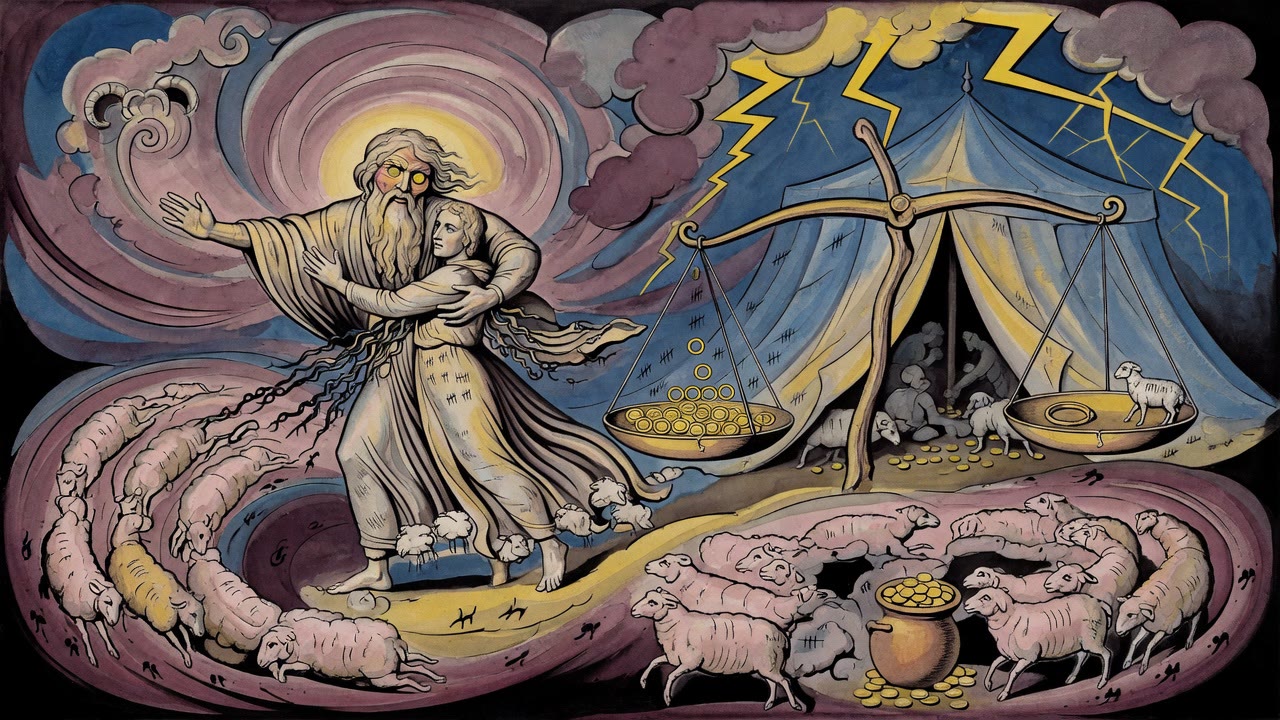
Laban ran to greet Jacob like a host, but he was hunting for gold. His welcome became twenty years of wages, switches, and traps.

Curated by Arthur · Told by Maggid ·
Table of Contents
  1. The Embrace Looking for Gifts
  2. Seven Years for the Wrong Bride
  3. The Feast Bought With the Dowry
  4. Twenty Years Under a Moving Contract
  5. The Pact That Was Not a Blessing

Laban ran like a man full of love.

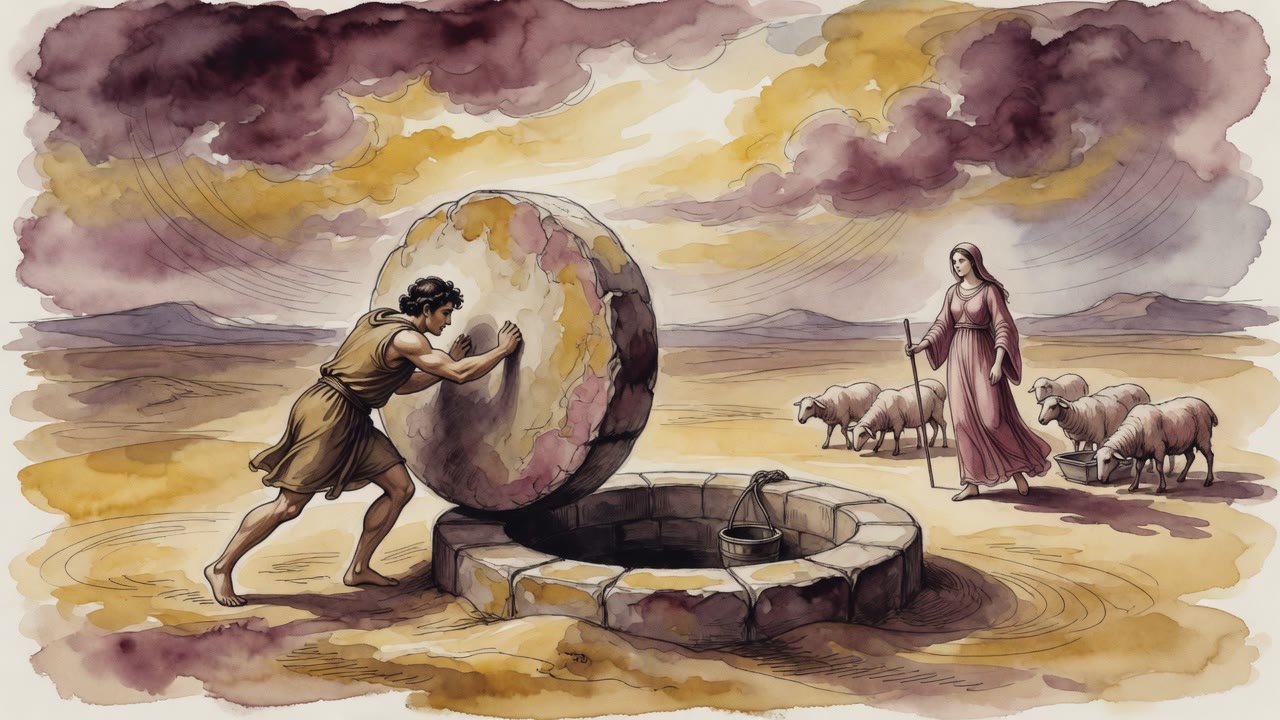
Rachel had brought the news. Jacob, her cousin, had arrived at the well. Laban hurried out, embraced him, kissed him, and brought him home. From the outside, it looked like family joy, the old hospitality of the patriarchal tents.

Then Laban's arms found no gold.

The Embrace Looking for Gifts

Laban remembered another arrival.

Years earlier, Abraham's servant had come for Rebekah with camels, jewelry, silver, gold, garments, and proof that the match would enrich the house. Laban had learned what a visitor from that family was supposed to bring. So when Jacob arrived, Laban ran toward expectation.

Jacob had nothing. No camels. No gifts. No bride price. He had fled Esau with his life and a promise, not a caravan. Laban embraced him and searched the embrace. Nothing.

The welcome cooled before the meal was over. Hospitality had met poverty, and Laban did the arithmetic quickly.

Seven Years for the Wrong Bride

Jacob offered labor in place of wealth.

Seven years for Rachel. The bargain was clear enough for a man who wanted clarity. Jacob worked, waited, counted seasons, and let love make the years feel short. At the end, Laban prepared the feast.

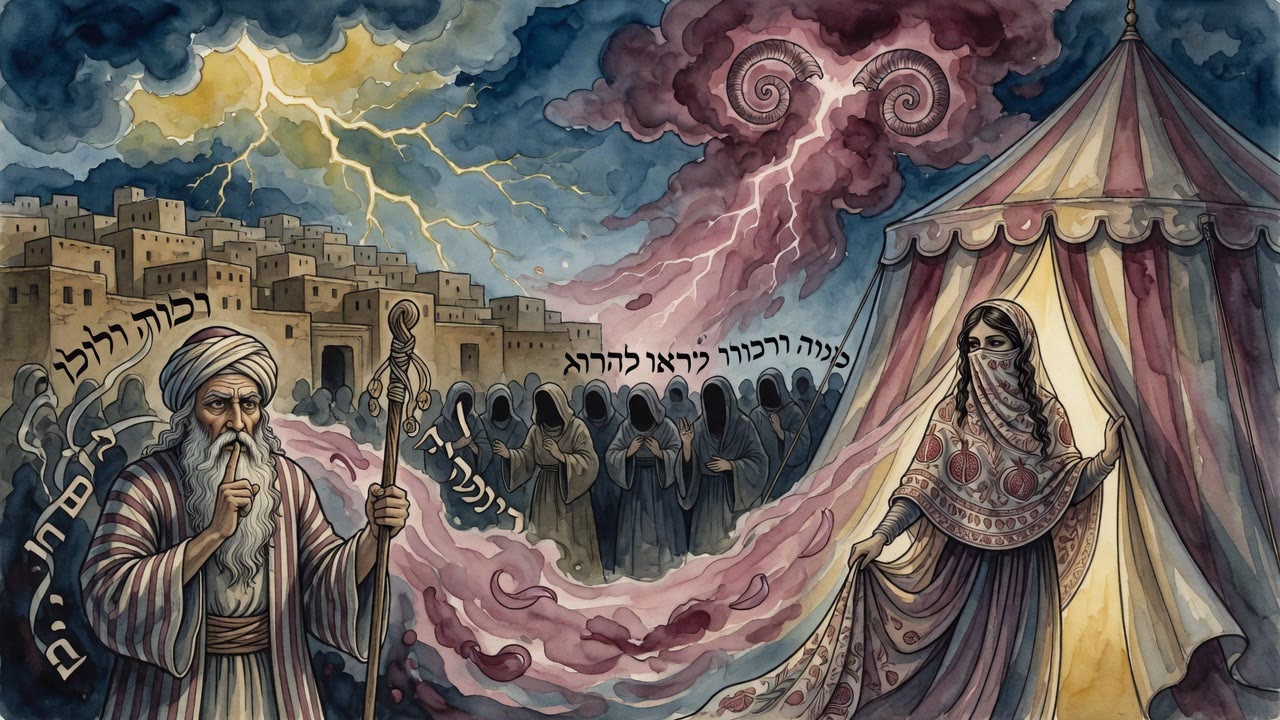
Night did the rest. The bride was veiled. The tent was dark. In the morning Jacob saw Leah.

Laban had an answer ready. In this place, the younger is not given before the firstborn. Custom became a weapon after the fraud was complete. The man who had cheated his blind father was now cheated by a veiled bride. But Laban's trick was not moral correction. It was theft wearing local law as a cloak.

The Feast Bought With the Dowry

Laban even made the celebration pay for itself.

The pledges that should have secured his daughters' future became wine, oil, meat, and noise for the wedding feast. He fed guests with what belonged to the women he was using. He sold Jacob one bride, delivered another, demanded seven more years for the first, and called the whole thing household order.

That was Laban's genius. He knew how to make exploitation sound like custom, how to turn family language into leverage, how to wrap a trap in a feast so that everyone had eaten from it before they saw the bars.

Twenty Years Under a Moving Contract

Jacob stayed twenty years.

Fourteen for the wives. Six for the flocks. Laban changed the wages again and again, always looking for the angle that would leave Jacob poorer and himself innocent. But Jacob had learned to survive among moving targets. The flocks multiplied. The house grew. The man who had arrived empty became too large for Laban's control.

So Jacob fled.

Laban pursued, full of injury and ownership. These daughters are mine. These children are mine. These flocks are mine. Every sentence tried to pull Jacob's life back into Laban's account book. But a dream had already warned Laban not to harm him.

The warning mattered because Laban still wanted to control the ending. He wanted the last word to sound like ownership. Heaven forced him to settle for a boundary instead. For the first time in the long struggle, Laban met a limit he could not renegotiate, flatter, invoice, or disguise as family custom. The man who had turned every room into a marketplace had to stand before a heap of stones and admit that some lines could not be sold back to the person who crossed them. Jacob had finally reached the edge of Laban's price list.

The Pact That Was Not a Blessing

They built a boundary at Mizpah.

Later ears would make its words sound tender: may God watch between us when we are absent from one another. In that scene, the words were not tender. They were surveillance. Two men who did not trust each other called God to stand guard because neither expected the other to behave without a witness.

Laban went back to Haran. Jacob went forward carrying wives, children, flocks, scars, and the knowledge that he had survived twenty years in a house where every welcome had a hook in it.

Laban sold hospitality and cheated everyone. Jacob left with the future anyway.


← All myths

From the tradition

Sources

4 sources

The texts this telling draws on, in full. Open a card to read inline, or expand it for a wider, quieter read.

Legends of the Jews 6:115Legends of the Jews

It all starts when Rachel, upon hearing that Jacob, her cousin, has arrived, races home to tell her father, Laban. Sadly, the Torah tells us that Rachel’s mother had already passed on.

Laban, he's a character. He rushes out to greet Jacob, but his motives aren't exactly pure, are they? The Midrash (rabbinic interpretive commentary), particularly in texts like Midrash Rabbah, paints a picture of Laban sizing Jacob up, thinking, "If Eliezer, Abraham’s servant, came with ten camels laden with gifts, imagine what the favorite son of the family will bring!" You can almost see the dollar signs in his eyes!

When Laban sees that Jacob arrives empty-handed, he doesn't give up so easily. He figures maybe Jacob is hiding something. Ginzberg, in Legends of the Jews, recounts how Laban throws his arms around Jacob's waist, hoping to feel a money belt. Disappointed, he then considers the possibility that Jacob has concealed precious stones in his mouth, and kisses him in an attempt to find out whether he had guessed aright.

Can you imagine? It’s almost comical.

Jacob, sensing Laban's… enthusiasm, sets the record straight. "Thou thinkest I have money," he says, according to the traditional texts, "Nay, thou art mistaken, I have but words." And then he explains how he came to be empty-handed. It's quite a story.

He tells Laban that his father, Isaac, had indeed sent him off with gold, silver, and money. But along the way, he encountered Eliphaz, the son of Esau, who threatened his life. Jacob, ever the quick thinker, appeals to Eliphaz's sense of… well, destiny.

According to Jacob's account, he tells Eliphaz, "Know that the descendants of Abraham have an obligation to meet; they will have to serve four hundred years in a land that is not theirs. If thou slayest me, then you, the seed of Esau, will have to pay the debt. It were better, therefore, to take all I have, and spare my life, so that what is owing may be paid by me."

So, there you have it. Jacob, ever resourceful, talks his way out of a potentially deadly situation, sacrificing his wealth to preserve his life. "Hence," Jacob concludes to Laban, "I stand before thee bare of all the substance carried off by Eliphaz."

What's fascinating about this encounter is the clash of personalities: Laban's materialistic nature versus Jacob's cunning and his connection to a larger, almost karmic destiny. It makes you wonder, doesn't it? How much of our lives are shaped by our own choices, and how much is already written in the stars, or perhaps, in the ancient texts?

Full source
Legends of the Jews 6:122Legends of the Jews

The ancient rabbis certainly knew the type. "It profits not if a villain is cast into a sawmill," they said. Neither force nor gentle words can sway a true rascal. And according to the Legends of the Jews, Laban was just such a person. He wasn't content just to deceive Jacob; he even tricked his own wedding guests!: Jacob had already served Laban for seven long years. Finally, he approached his uncle with a heartfelt plea. "The Lord destined me to be the father of twelve tribes," Jacob said. "I am now eighty-four years old, and if I do not take thought of the matter now, when can I?" He's thinking about his legacy, his destiny, the future of his people. He's not getting any younger!

Laban, eventually, agreed to let Jacob marry Rachel. The wedding took place forty-four years after Esau's own marriage.

The rabbis teach that the Lord often delays the happiness of the righteous, while allowing the wicked to quickly fulfill their desires. Why? It's a question that has plagued theologians for centuries. But in this story, it sets up a fascinating comparison.

Esau had deliberately chosen his fortieth year to marry. He wanted to appear to be following in the footsteps of his father, Isaac, who also married at that age. But the comparison was superficial, even deceitful.

The text compares Esau to a swine that stretches out its feet to appear cloven-hoofed, like a kosher animal, while still being unclean. Until his fortieth year, Esau had a reputation for violating the wives of other men. Then, at his marriage, he pretended to emulate his pious father. What a contrast!

And, God himself acknowledged the darkness inherent in Esau's choice: "This one, who is designed for stubble, to be burnt by fire, shall take unto wife one of a people also destined for utter destruction."

The woman he married, Judith, a daughter of Heth, was of his own ilk. As the saying goes, "Not for naught does the raven consort with the crow; they are birds of a feather." Like attracts like.

So, what are we to make of this tale? Is it simply a story of deceit and delayed gratification? Perhaps. But it also serves as a powerful reminder that appearances can be deceiving. That true piety isn't about mimicking the righteous, but about living a life of genuine integrity. And that, ultimately, our choices shape our destiny.

Full source
Legends of the Jews 6:126Legends of the Jews

The story, as told in Ginzberg's Legends of the Jews, is a doozy. Laban, remember, is not exactly winning any awards for honesty. He's got a scheme brewing, and it involves a little... switcheroo.

Laban uses the pledges that were supposed to be used for the dowry of his daughters to buy wine, oil, and meat for the wedding feast. So the wedding was essentially paid for by Jacob's future father-in-law. It's this act of deceit, this profiting from deception, that earns Laban a rather unflattering nickname: Arami, "the deceiver." Ouch.

The feast itself? It's a day-long affair, stretching late into the night. Jacob, bless his heart, is actually impressed by the hospitality. He assumes these people are just really, really happy to have him around. They tell him, "Through thy piety thou didst a great service of lovingkindness unto us, our supply of water was increased unto abundance, and we desire to show our gratitude therefor."

Here's where it gets truly cringe-worthy. The wedding guests, it turns out, are trying to warn Jacob. They know what Laban is up to! In the marriage ode they sang, they kept repeating the refrain "Halia." The hope? That Jacob would catch on, realize it was a play on words, and understand it as "Ha Leah" – "This is Leah!"

Can you imagine? A room full of people singing a not-so-subtle hint, and the groom is completely oblivious. Poor Jacob. He's so trusting, so caught up in the moment, that the warning sails right over his head. He's totally unsuspicious and notices nothing!

It makes you wonder, doesn't it? How often do we miss the signs, the subtle clues that the universe (or, you know, a room full of wedding guests) is trying to tell us something? How often are we so focused on what we want to see that we completely miss what's actually there? Maybe Jacob's story is a reminder to open our eyes, to listen closely, and to be a little less trusting – especially when dealing with someone named "the deceiver."

Full source
Book of Jubilees 29:1Book of Jubilees

That feeling, that very human emotion, is at the heart of our story today, straight from the Book of Jubilees.

Remember Jacob? He of the ladder dream and the trickster uncle? Well, things are starting to look up for him. In fact, they're looking really good. The Book of Jubilees tells us that Jacob’s possessions "multiplied exceedingly." The text specifies oxen, sheep, asses, camels, menservants, and maidservants. Jacob is becoming a man of substance, a force to be reckoned with.

Who's noticing? His uncle, Laban. And Laban isn't exactly thrilled.

The Book of Jubilees is blunt: "Laban and his sons envied Jacob." Envy, that green-eyed monster, rears its ugly head. It’s a feeling that festers, and in Laban's case, it leads to action. "Laban took back his sheep from him," the text says, a clear power move, a way of diminishing Jacob's growing wealth and influence. And the Book of Jubilees adds a chilling detail: "he observed him with evil intent." Laban isn't just passively disliking Jacob's success; he's actively plotting. This isn't just business; it's personal.

Now, timing is everything, isn't it? And right at this moment, a significant event occurs: Rachel gives birth to Joseph. Another son for Jacob, another blessing. But Laban? He’s got shearing on his mind – sheep shearing, that is. "It came to pass when Rachel had borne Joseph, that Laban went to shear his sheep; for they were distant from him a three days' journey."

Why does the text emphasize the distance? Three days' journey… that’s significant. It creates separation, a window of opportunity. While Laban is away, supposedly focused on his own business, what is he really planning? What kind of mischief is brewing during those three days of distance?

The Book of Jubilees leaves us hanging, doesn't it? It sets the stage for conflict, for potential betrayal. It reminds us that even within families, even amidst apparent prosperity, envy and ill intentions can lurk just beneath the surface.

And that, perhaps, is a timeless lesson worth remembering. When things are going well, and even when they aren't, be mindful of who is truly happy for you and who might be watching with a tinge of green. Because sometimes, the greatest threats come from those closest to us.

Full source