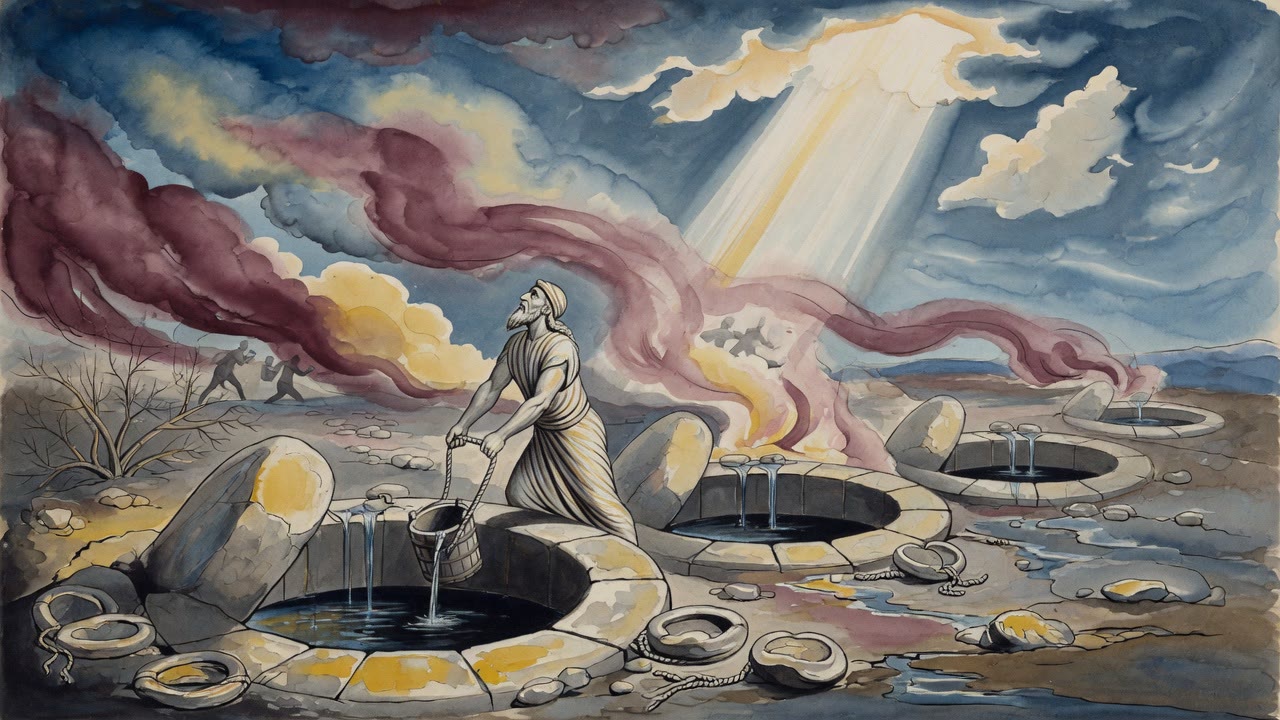
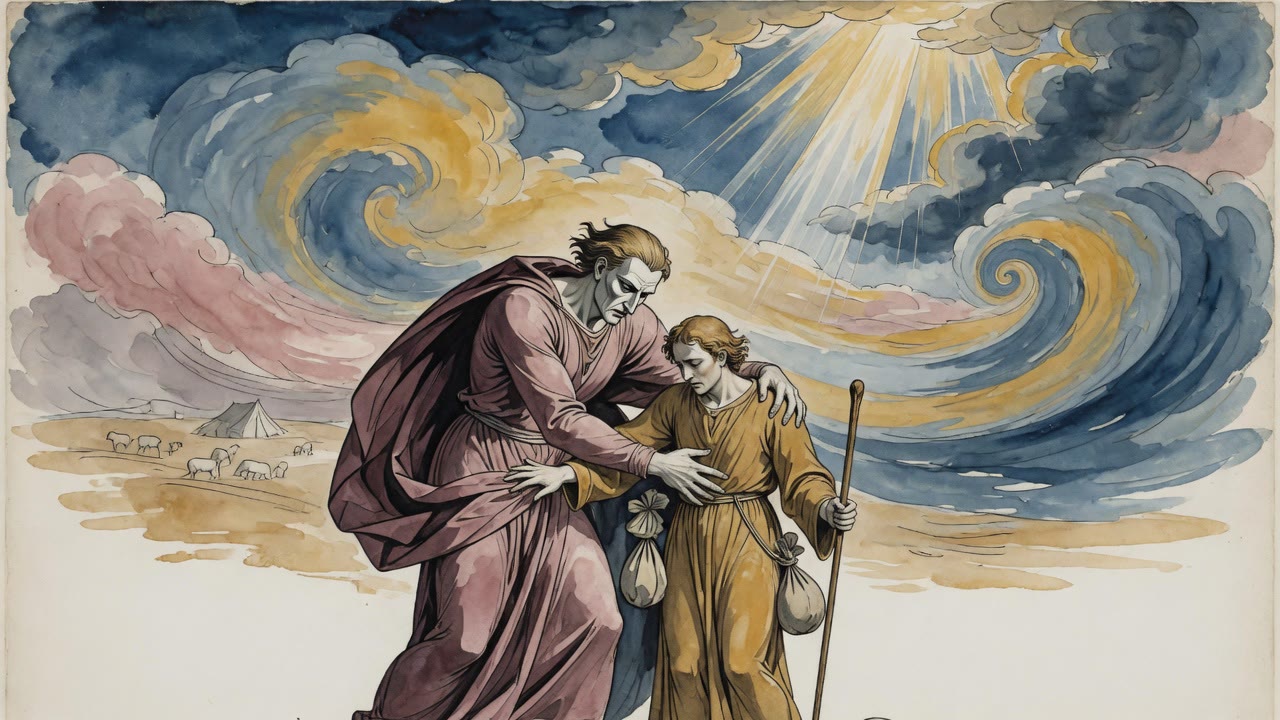
Laban Embraced Jacob to Search Him for Hidden Gold
Ten camels had come with Eliezer a generation earlier. Laban ran out expecting the same weight. His hands found a staff.
Table of Contents
 Click for full size
He Ran Toward a Fortune
Laban heard that his sister's son was at the well, and he ran. Not because a nephew had walked hundreds of miles from Beer Sheba. He ran because he remembered Eliezer.
A generation earlier, Abraham's servant had arrived in Haran with ten camels loaded with gifts, seeking a bride for Isaac. If a servant came that heavy, Laban told himself, the beloved grandson would come heavier still. He reached the road already counting.
Jacob stood there with a staff. No camels. No rings. The men of the east had already hissed at him for kissing Rachel at the well. Since the Flood, they said, a man kept his hands to himself. Jacob had wept for that, and for a harder sum. Eliezer had brought ten loads when he came asking for a wife. Jacob had arrived with nothing to offer the woman he had just met (Genesis 29:13).
The Hug That Felt for Coin
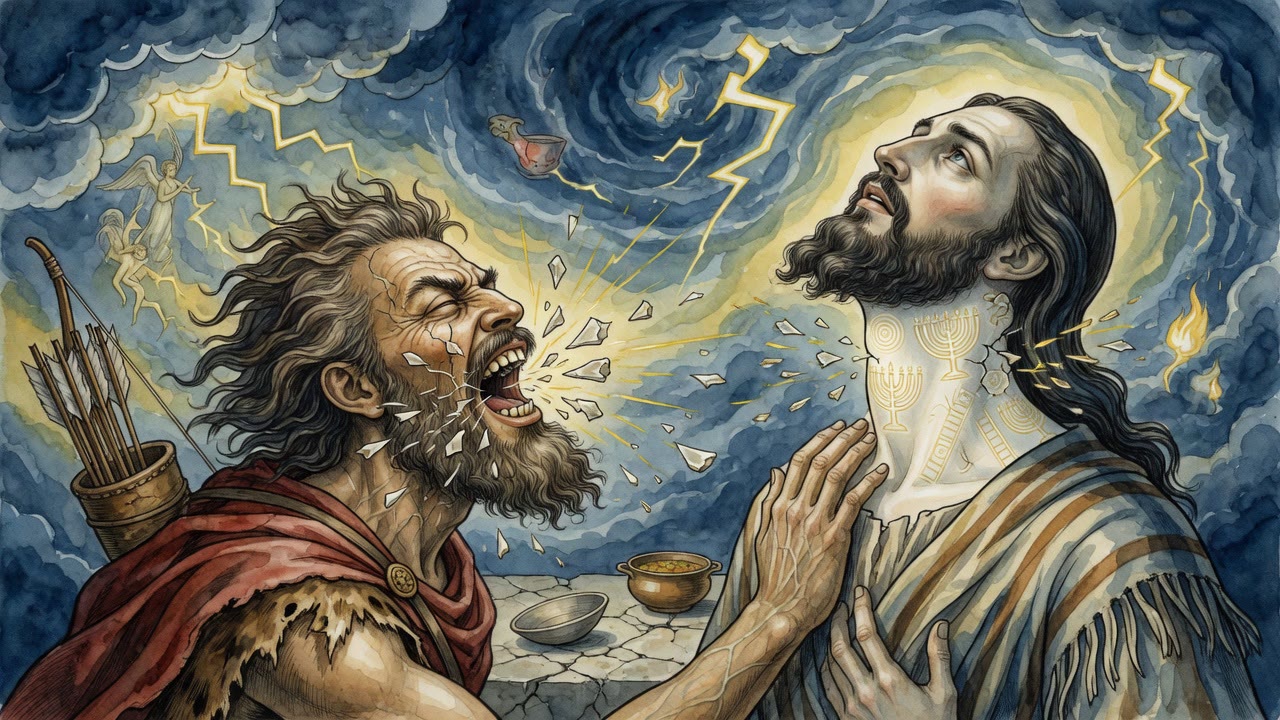
Laban embraced him. The arms went around Jacob's back like welcome. The hands did other work. They moved over the chest, along the belt, into the folds of the cloak, feeling for hidden gold, for dinars sewn against the ribs. He found cloth and bone.
A new thought took him. Pearls. A young man running from a brother might hide a fortune in his mouth. Laban kissed him. He searched the lips. Empty.
He walked Jacob through the outer chamber of the house, still patting, still not believing a grandson of Abraham could be this poor. Only then did Jacob speak. Eliphaz, Esau's son, had overtaken him on the road and stripped him of everything he carried. Jacob had talked him out of the killing. Better to lose the wealth, he had said, than the life the four hundred years still needed (Genesis 15:13).
Laban's mouth went hard. "I thought I would make you a king over me," he said. "You came with nothing. You are my bone and my flesh." He meant it the way a man means a bone he is about to crush.
The Teraphim Spoke
He did not send Jacob away. He went to his teraphim (תרפים), the household idols he asked when a decision had money in it.
"What," he had already muttered, "shall I feed this fellow a month, a year, empty-handed as he is?"
The teraphim answered. Do not send him out. His mazal (מזל), his star, is so lucky that whatever he touches will turn. The blessing of the Lord will sit on the house and the field because of him.
Laban heard gold, not a nephew. He would house him. He would wait for the luck to arrive and stand where it would spill.
A Wife Is His Wage
A month passed. That is as long as a man is bound to keep a kinsman before he starts charging him. Laban went back to the teraphim. How do I hold him?
"A wife is his wage," they said. "He will ask nothing else. It is his nature. Whenever he threatens to leave, offer him another wife, and he will not go."
Jacob asked for Rachel. He had been smitten at the well, and he named no silver. Laban took the answer as the idols had promised. Rachel, who knew her father's hands, warned Jacob he was no match for them. Jacob stayed anyway. The road behind him still belonged to Esau, and the luck the idols had named was supposed to come in through this door.
The Elder Before the Younger
Seven years later the feast was set. Laban put Leah in the dark and called her Rachel. In the morning Jacob had the elder sister, and Laban had another seven years of pasture work lined up behind a second wedding.
"Let the seven days of this one's feast pass," Laban said, "and I will give you Rachel, and you will serve me another seven years."
The house knew the order. The younger does not go before the elder. It is a wicked thing. Laban had smashed it in the dark and called the smash a father's right. Jacob would work. The luck the teraphim had smelled would fill Laban's folds first.
Jacob had seen it the day of the hug. He had arrived with a staff. The hands on his ribs had told him how the house worked. He stayed because Rachel was in it.
← All myths