Parshat Vayetzei5 min read

Laban Chased Jacob to Gilead and God Got There First

Laban chased Jacob with murder close behind him. Before he reached the tents, God entered his dream and shut his mouth for good.

Curated by Arthur · Told by Maggid ·
Table of Contents
  1. Rachel Stole the Speaking Head
  2. The Blessing Left Haran With Jacob
  3. Michael Entered the Dream First
  4. Jacob Was Praising God on the Mountain
  5. The Pile of Stones Remembered

Jacob left before Laban could count what he had lost.

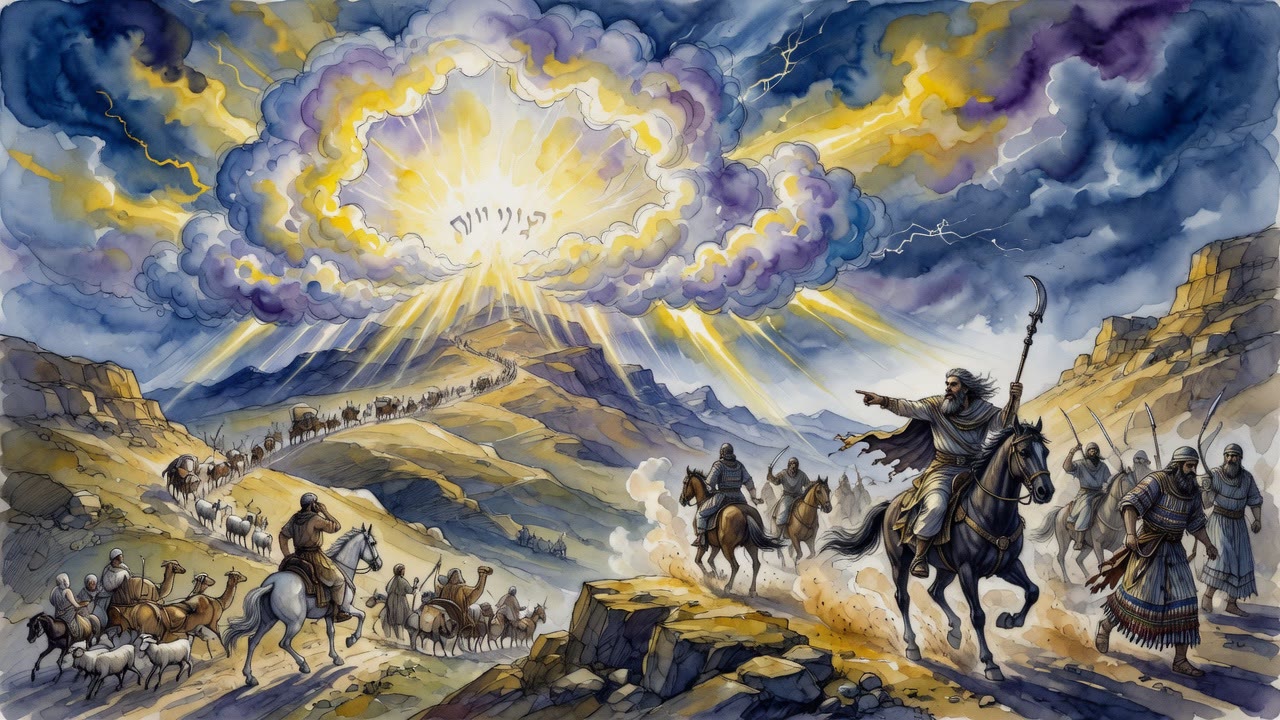
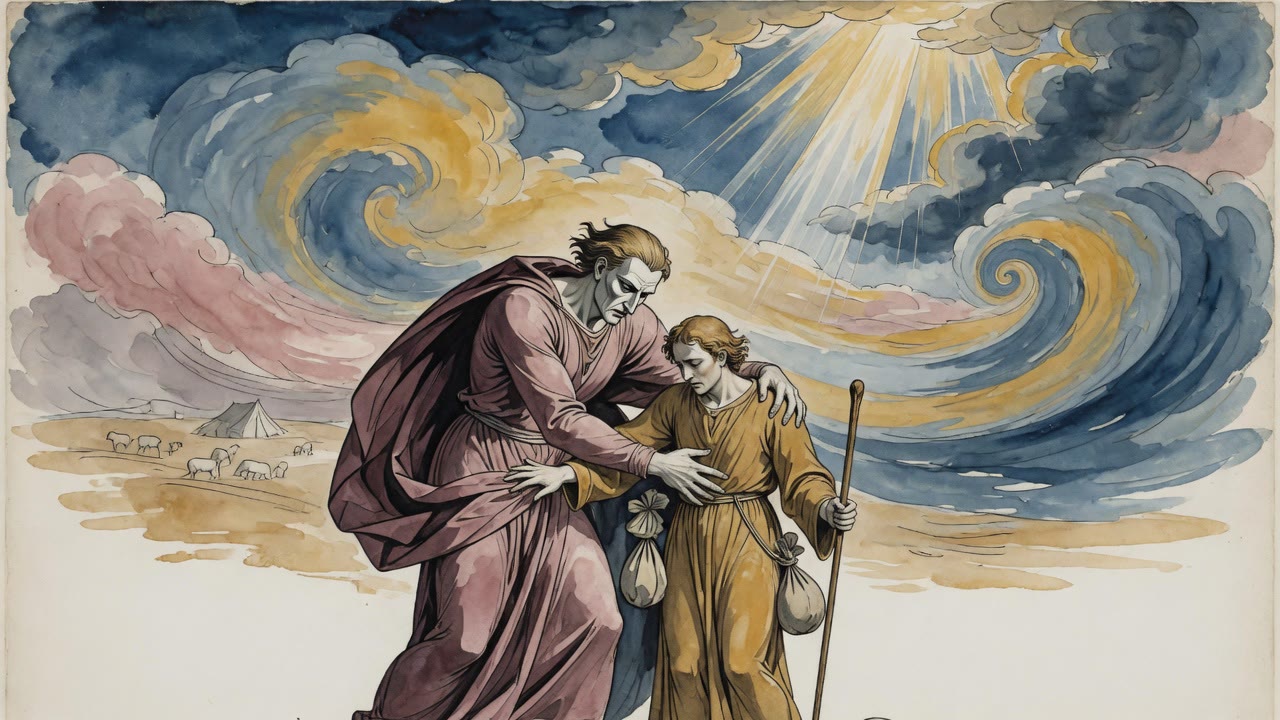
The tents moved. The children moved. The flocks moved. Rachel carried a secret from her father's house, and the road out of Haran filled with dust. For twenty years Jacob had built another man's wealth with his own hands. Now he crossed the Euphrates and aimed himself toward Gilead.

Behind him, the well began to fail.

Rachel Stole the Speaking Head

Laban's household gods were not harmless little images.

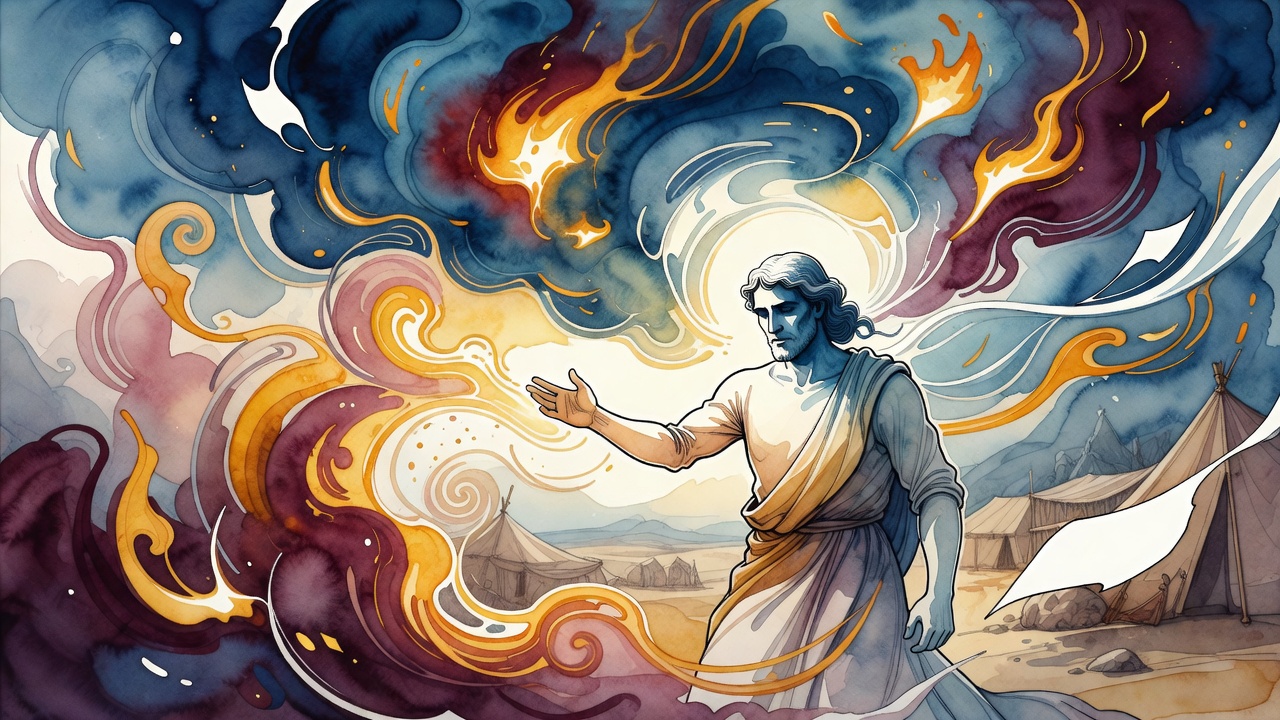
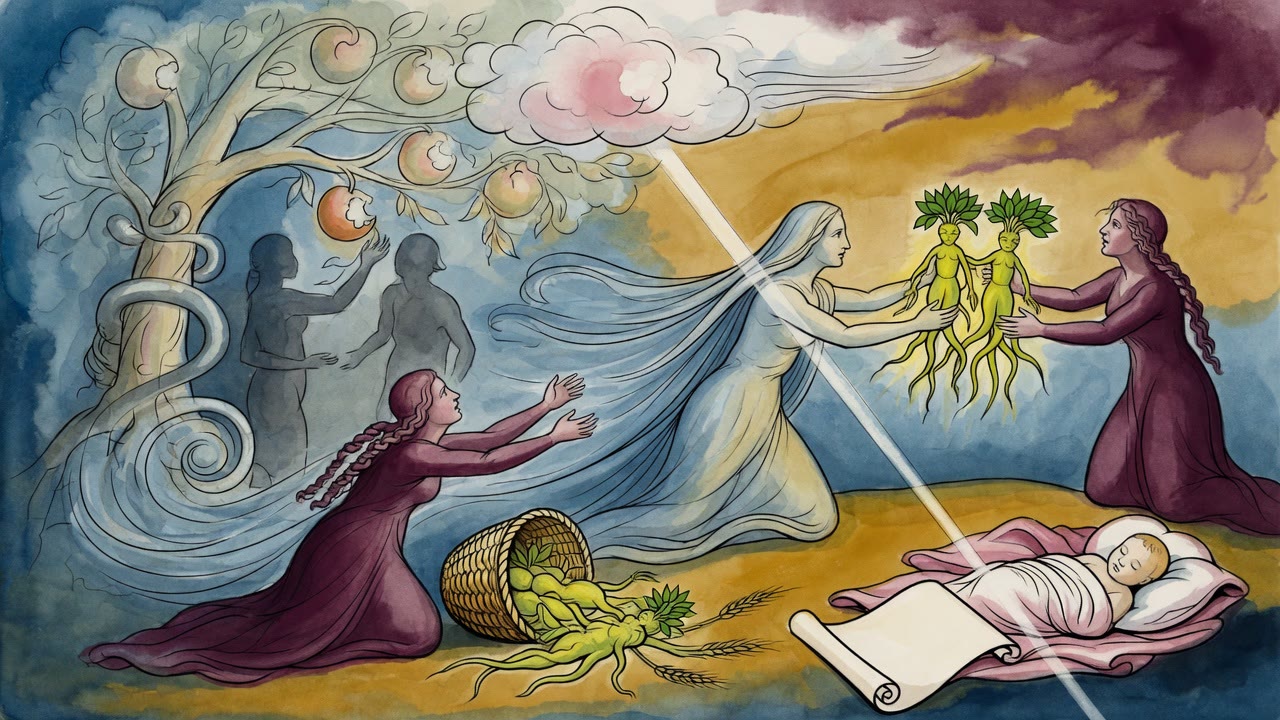
In the Aramaic telling, they were made from horror: the severed head of a firstborn man, salted with spices, fixed with a gold plate beneath the tongue, and mounted where it could speak. Rachel took it because she knew what kind of house she was escaping. If the head could speak, it could tell Laban where they had gone.

So she stole the voice before the voice could betray them.

The Blessing Left Haran With Jacob

The shepherds understood before Laban did.

The water that had flowed freely while Jacob lived among them was gone. The blessing had packed itself with the fugitive. Haran's abundance had not belonged to Laban's cunning. It had been standing under Jacob's merit the whole time. When Jacob left, the place felt the departure in its throat.

Laban heard and gathered men.

The chase was not a family errand. The Passover confession would later name it without softness: an Aramean sought to destroy my father. Laban wanted more than an explanation. He wanted to reach Jacob before God did.

Michael Entered the Dream First

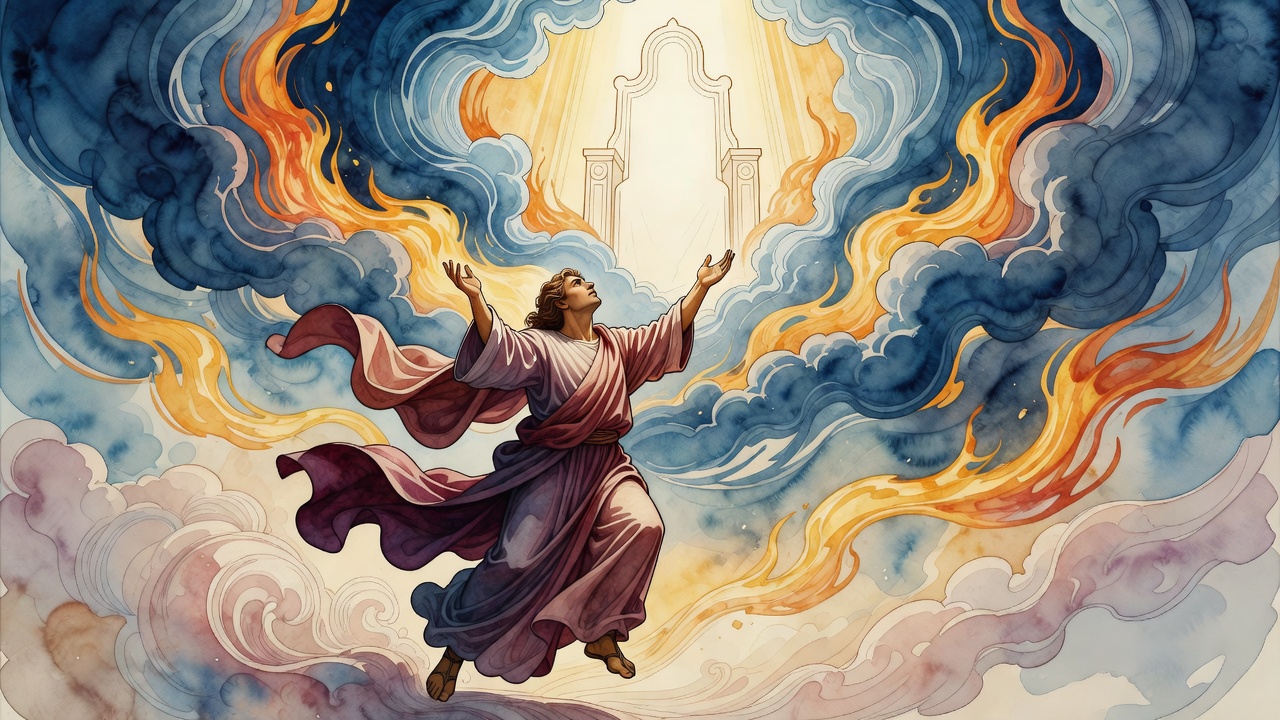
God reached him in the dark.

Laban covered in one day what Jacob had taken seven days to travel. Speed was on his side. Anger was on his side. Men were on his side. Then night fell, and the archangel Michael entered the dream like a drawn boundary. Do not speak to Jacob either good or bad. Do not touch him with blessing as a trap. Do not touch him with curse as a weapon.

By morning Laban still had his men, but his mouth had been fenced.

Jacob Was Praising God on the Mountain

Laban found Jacob at Mount Gilead.

Jacob was not sharpening blades. He was praising God. The man being hunted stood on the mountain with prayer in his mouth, while the man hunting him arrived already defeated by a warning he could not ignore. Laban could accuse. He could complain about stolen gods and stolen daughters. He could say that power was in his hand.

Then he had to admit the sentence that ruined him: the God of your father spoke to me last night.

The Pile of Stones Remembered

The two men made a boundary out of stones.

Laban called it one name. Jacob called it another. The pile stood between them and listened. Neither man was to cross it for harm. The father-in-law who had changed wages, swapped daughters, pursued grandchildren, and came with destruction in his heart now had to leave a witness behind him.

Jacob survived because heaven arrived before the pursuer's hand could close.

The strange mercy is that Laban was not stopped far away. He was allowed to reach the mountain, see the camp, speak the accusation, and feel the power he no longer had. God did not erase the chase. God let Jacob watch the danger come near enough to prove who had blocked it.

Rachel's stolen head could not speak. Laban's own mouth could not do what it wanted. The stones spoke longer than both of them.

Jacob left Gilead with the boundary behind him and Esau still ahead of him. The road was not safe. It was guarded.

The pursuit also exposes what kind of power Laban had always used. He controlled wages, daughters, idols, information, and delay. Jacob had survived him by patience. Rachel survived him by theft. God answered him by placing a command where Laban's freedom had been. The deceiver reached the camp and discovered that the night had already deceived his violence.

Even the stolen teraphim become part of the reversal. Laban searches for the voice that might restore control, while Jacob stands unaware of what Rachel has hidden. Heaven protects both the one who knows and the one who does not.


← All myths

From the tradition

Sources

5 sources

The texts this telling draws on, in full. Open a card to read inline, or expand it for a wider, quieter read.

Legends of the Jews, VI. Jacob, The Covenant With LabanLegends of the Jews

The Bible is full of them, but sometimes the stories between the lines are even more fascinating. to the tale of Jacob and his father-in-law, Laban, a story ripe with tension, accusations, and a very strange covenant.

So, Jacob is on the run. According to Legends of the Jews, as retold by Ginzberg, he leaves Haran and crosses the Euphrates, heading towards Gilead. Why Gilead? Well, the Holy Spirit revealed to him that God would eventually help his children there in the days of Jephthah. It's like a little prophetic breadcrumb dropped into the narrative.

His departure doesn't go unnoticed. The shepherds of Haran realize the well that had been overflowing since Jacob's arrival has suddenly run dry. They tell Laban, who immediately understands that Jacob has left. He knows the blessing upon Haran was because of Jacob's merit.

Laban, none too pleased, gathers the city and pursues Jacob, intending to... well, let's just say he wasn't planning a friendly reunion. But hold on! The archangel Michael intervenes, appearing to Laban in a dream and warning him not to harm Jacob. Now, isn't that interesting? Midrash Rabbah tells us that when God needs to reveal Himself to non-Jews, He does it in the dark, almost secretively, while He reveals Himself to Jewish prophets openly, in daylight. It's a fascinating distinction.

Laban, who covered in one day the distance that took Jacob seven, catches up to him at Mount Gilead. He finds Jacob praying and praising God. Then the accusations start flying. Laban confronts Jacob, complaining that he stole away secretly. He even says, "It is in the power of my hand to do thee hurt, but the God of thy father spake unto me yesternight, saying, Take heed to thyself that thou speak not to Jacob either good or bad." As the text points out, that's how the wicked are: they boast of the evil they could do.

Then comes the kicker: "Wherefore hast thou stolen my gods?" Oh boy.

The term used here, teraphim, refers to household idols. Laban is clearly upset about their disappearance. His own grandchildren, according to the story, are even embarrassed that he's so concerned about his "gods."

Laban searches all the tents, including Rachel's. But Rachel, you see, did steal the teraphim, hoping to turn her father away from idolatry. A little light theft for a good cause, perhaps? She hides them under her saddle and sits on them, claiming she can't get up. According to some accounts, a miracle even occurred, transforming the teraphim into ordinary drinking vessels to further conceal them!

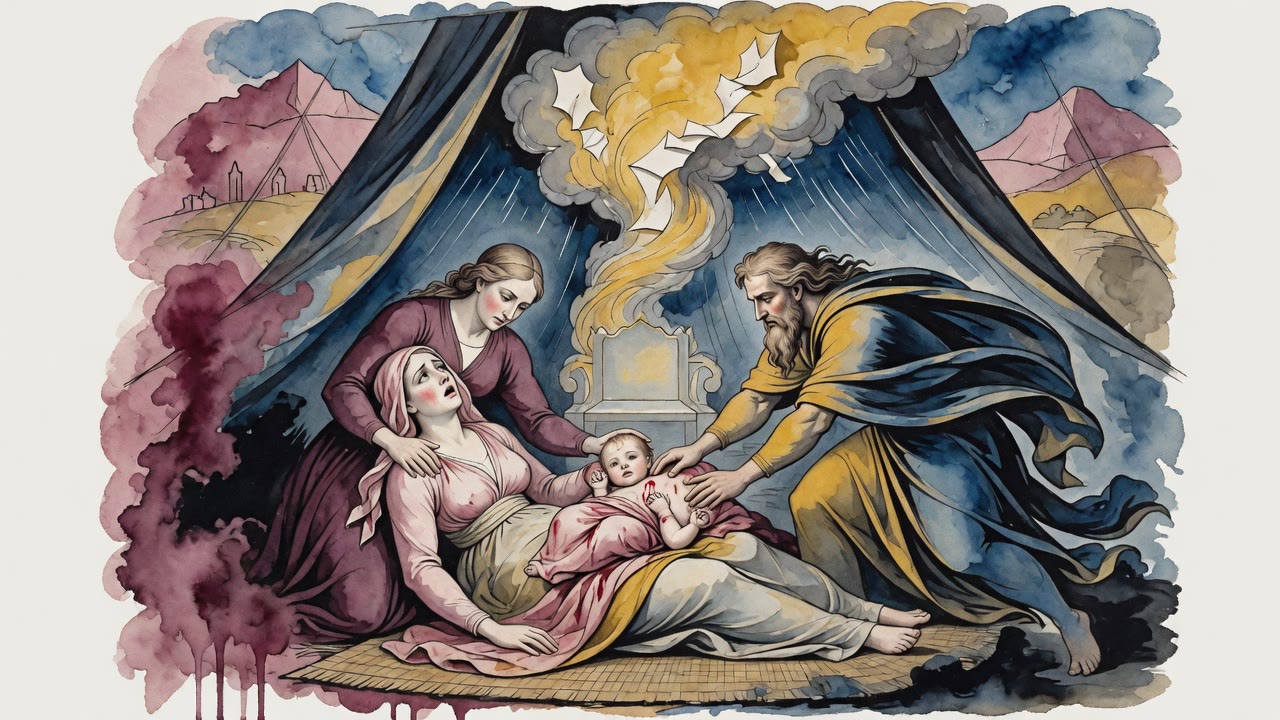
Jacob, unaware of Rachel's actions, is furious with Laban's accusations and launches into a passionate defense. He reminds Laban of his years of loyal service, how he protected the flocks and dealt honestly with him. "With whomsoever thou findest thy gods," Jacob declares, "he shall not live!" Uh oh. That's a curse, and as the story hints, it contributes to Rachel's eventual death in childbirth.

Finally, they decide to make a treaty. Jacob, with his "gigantic strength," sets up a huge rock as a memorial, and a heap of stones as a sign of their covenant. He follows the example of his ancestors, who also made covenants with non-Jewish nations.

Jacob gathers his sons, calls them "brethren," acknowledging their piety and strength, and they pile up stones. Jacob swears he won't take any more wives besides Laban's daughters, and Laban swears he won't cross the boundary with hostile intent. Laban swears by the God of Abraham and the God of Nahor, while Jacob invokes "the Fear of Isaac."

Why "the Fear of Isaac" and not "the God of Isaac"? The text explains that God doesn't usually associate His name with a living person, because we can't fully trust someone until they've lived their entire life. However, in Jacob’s vision at Beth-el, God did call himself the God of Isaac. Why the exception? Because Isaac, being blind and living a secluded life, was no longer subject to the same temptations. Jacob, however, still couldn't bring himself to associate God's name with a living man, so he swore by "the Fear of Isaac."

The next morning, Laban kisses his grandchildren and daughters, blesses them, but it's all a bit hollow. He regrets that Jacob got away. He immediately sends a message to Esau, painting Jacob in the worst possible light, hoping Esau will attack him.

But Jacob has nothing to fear, not really. He's accompanied by not one, but two angel hosts, each consisting of six hundred thousand angels! One host escorted him from Haran, and another, the angels of Palestine, greeted him at the border of the Holy Land. Jacob calls the place Mahanaim, "Double-Host," recognizing the divine protection surrounding him.

So, what do we make of this whole tangled mess? It's a story about family, ambition, deception, and divine intervention. It's a reminder that even our most revered ancestors navigated complex relationships, made mistakes, and relied on something bigger than themselves. And perhaps it prompts us to consider the covenants we make in our own lives, the promises we keep, and the forces that guide us, whether we call them angels, intuition, or simply the enduring power of faith.

Full source
Targum Jonathan on Genesis 31Targum Jonathan

The standard Bible tells you Rachel stole her father's household gods when Jacob fled Laban's house. The Targum Jonathan, an ancient Aramaic translation from roughly the 1st-2nd century CE, tells you exactly what those gods were. And it is far stranger than any idol on a shelf.

In Targum (Genesis 31:19), Laban's household images were made from a slaughtered firstborn man. They cut off his head, salted it with salt and balsams, inscribed incantations on a plate of gold, placed the plate under the severed tongue, and mounted the head on a wall. The head spoke to them. This is what Rachel stole, a necromantic oracle, a talking skull that her father worshipped and consulted for guidance.

The Targum also transforms Jacob's escape into something far more dramatic than a quiet departure. When Jacob left, the well that had miraculously overflowed for twenty years, sustained by his righteousness alone, suddenly went dry (Genesis 31:22). The shepherds waited three days, hoping it would return. It did not. Only then did they report to Laban that Jacob had fled. The Targum is making a theological claim here: Jacob's mere presence generated blessing for everyone around him, and they only noticed when it vanished.

Two more additions stand out. First, the Targum identifies the messenger Jacob sent ahead as Naphtali, specifically described as a swift runner, a detail absent from the Hebrew Bible but preserved in other rabbinic traditions about Naphtali's legendary speed. Second, when God warned Laban not to harm Jacob, the Targum specifies that an angel appeared with a drawn sword in Laban's dream, transforming a verbal warning into armed divine enforcement.

Jacob's destination gets a prophetic upgrade too. He headed toward Mount Gilead not just for practical reasons, but because he foresaw through the Holy Spirit that his descendants would one day find deliverance there, in the days of Jephthah the Gileadite (Judges 11). The Targum constantly ties Jacob's physical journey to Israel's future history, collapsing centuries into a single act of prophetic navigation.

Full source
Targum Pseudo-Jonathan on Genesis 31:23Targum Pseudo-Jonathan on Genesis

Laban gathered his kinsmen and chased for seven days until he caught up at Mount Gilead. Targum Pseudo-Jonathan paints the arrival as a contrast too sharp to ignore. Laban had ridden hard, seven days of rage under the sun, hoping to overtake the son-in-law who had slipped from his grip.

What did he find? Not a camp in fearful disarray. Not a man cowering behind his flock. Laban found Jakob offering praise and praying before his God (Genesis 31:23).

The chased man was worshiping. The pursuer was out of breath. That image alone reveals the spiritual geography of the whole scene. One of these men spent seven days stoking his anger; the other spent the same days deepening his communion. When they finally stood face to face, the posture difference was the whole story.

The Maggid teaches: the one who prays while he is being pursued already has more ground beneath him than the pursuer. Seven days of praise is armor no galloping cousin can penetrate. Jakob was not hiding on that mountain. He was standing on it.

Full source
Midrash Tanchuma, Vayetzei 13Midrash Tanchuma

Take heed to thyself that thout speak not to Jacob either good or bad (Gen. 31:24). From this episode we learn that the merit acquired from labor may be helpful even when the influence of one’s ancestors is not. It is written: Except the God of my father, the God of Abraham, and the Fear of Isaac, had been on my side (Gen. 31:42). This implies that the merit of Jacob’s ancestors saved him financially, but it is followed by: God hath seen mine affliction and the labor of my hands, and gave judgment yesternight (ibid.), which indicates that He warned him not to harm Jacob because of the merit of the work he had performed.

This teaches that a man must not say: “I will eat and drink and enjoy the good things of life, but I will not work, for heaven will protect me.” It is said: Thou hast blessed the work of his hands (Job 1:10). Hence, a man must work and labor with both hands before the Holy One, blessed be He, will send his blessing.

And Jacob was wroth, and strove with Laban. And Jacob answered and said to Laban: “What is my trespass? What is my sin?” (Gen. 31:36). These verses teach us: The fury of the patriarchs is preferable to the gentleness of their descendants. Though it is written: And Jacob was wroth and strove with Laban, notice that he said to him at the height of his anger: What is my trespass? What is my sin? But concerning David, who was so gentle that he would not turn his hand against Saul, it is written: Nay, but the Lord shall smite him; or his day shall come to die; or he shall go down into battle, and be swept away (I Sam. 26:10).

This heap is witness between me and thee (Gen. 31:48). Scripture states elsewhere in reference to this verse: And crushed Balaam’s foot against the wall (Num. 22:25). The heap alluded to in our text was the very wall at which Balaam violated the promise he had made to Jacob, as it is said: I will not pass over this heap to harm you (Gen. 31:52). Balaam and Laban were one and the same, for it is said of him: An Aramean was destroying my father (Deut. 26:5). Balaam was called an Aramean, because he desired to annihilate Israel, as is said: Come, execrate Israel (Num. 23:7). Hence, it was the very wall that had borne witness to the oath that he had made that called him to account, as is written: The hand of the witness shall be first upon him (Deut. 17:7). And Jacob swore by the Fear of his father, Isaac (Gen. 31:53). This righteous man did not swear by the name of the king, but rather on the life of his father. He did it just as a man who desires to prove the truth of this remarks says: “I swear by the life of my father.” He swore this oath only out of respect, as is written: A son shall honor his father (Mal. 1:6).

Full source
Targum Jonathan on Deuteronomy 26Targum Jonathan

The first-fruits ceremony in (Deuteronomy 26) is beautiful in the Torah. Targum Jonathan makes it lavish. Where the Hebrew says simply to bring produce in a basket, the Targum adds: "you shall put crowns upon the baskets, hampers, and paper cases." The first-fruits arrive at the Temple decorated like royalty. The priest does not merely accept the offering, he must "receive, take, bring, uplift, and lower it, and afterward lay it down before the altar." Five distinct ritual motions for a single basket of figs.

The famous declaration "a wandering Aramean was my father" undergoes a radical reinterpretation. Instead of describing Jacob as a wandering Aramean, the Targum says: "Our father Jakob went down into Aram Naharia at the beginning, and Laban sought to destroy him; but the Word of the Lord saved him out of his hands." The Aramean is not Jacob, it is Laban, and he is not wandering but attempting murder. This completely reverses the subject of the sentence, following the rabbinic reading preserved in the Passover Haggadah (non-legal rabbinic narrative).

The tithing confession becomes more elaborate. The Israelite must account for three separate tithes: "the first tenth to the Levites, the second tenth, which is the tythe of the poor, to the stranger, the orphan, and widow," and a third tenth to "bring up and eat before the Lord thy God." The confession includes: "I have not eaten of it in the days of my mourning, nor separated from it for the unclean, neither have I given of it a covering for the soul of the dead." That last phrase, using tithe money for burial shrouds, is the Targum's specification of an otherwise cryptic Hebrew phrase.

The chapter closes with the Shema woven into the covenant declaration: "Hear, O Israel: The Lord our God is one Lord." The Targum calls this "one confession in the world", the singular declaration that binds God to Israel and Israel to God, a mutual acknowledgment ratified on this day.

Full source