5 min read

Levites Became God's Palace Guard After the Calf

When Israel broke at the Golden Calf, the Levites took sword against kin. God made them palace guards of the Mishkan with death for trespassers.

Curated by Arthur · Told by Maggid ·
Table of Contents
  1. The Line Through the Camp
  2. Firstborns Lose the Watch
  3. Dismantling What Burns
  4. Cloud and Fire Over Their March
  5. The Buffer That Remains

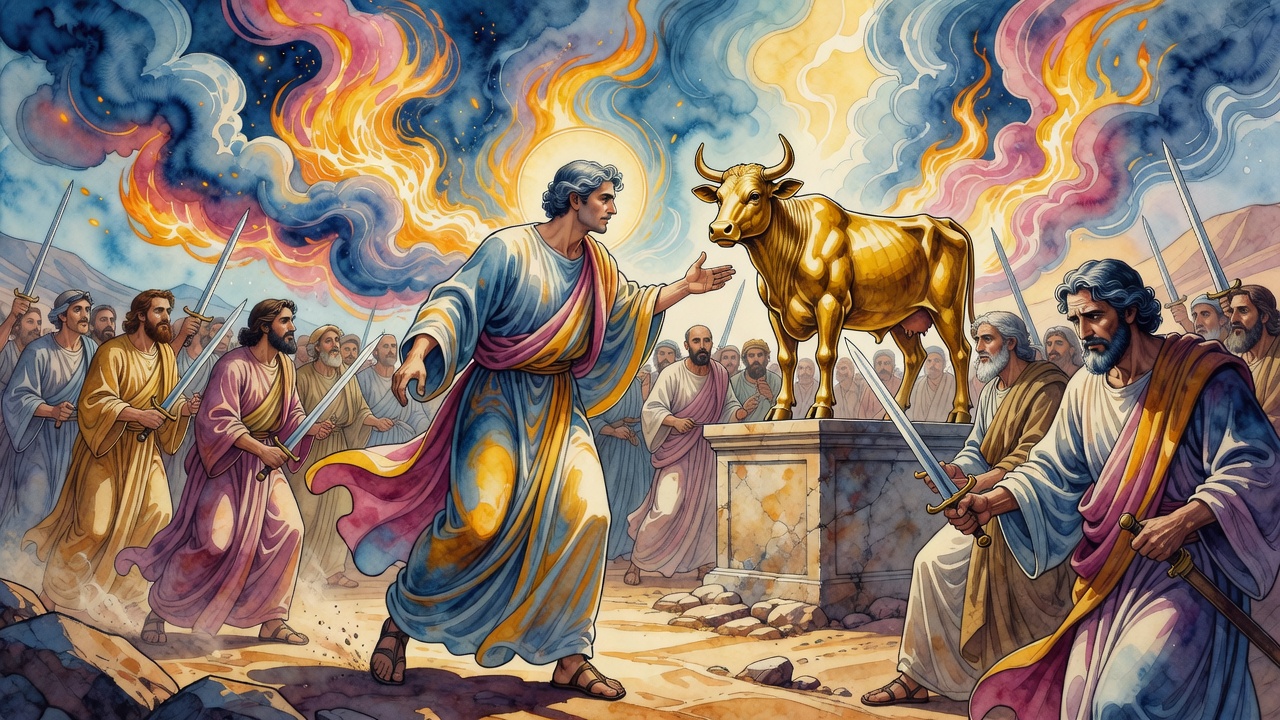
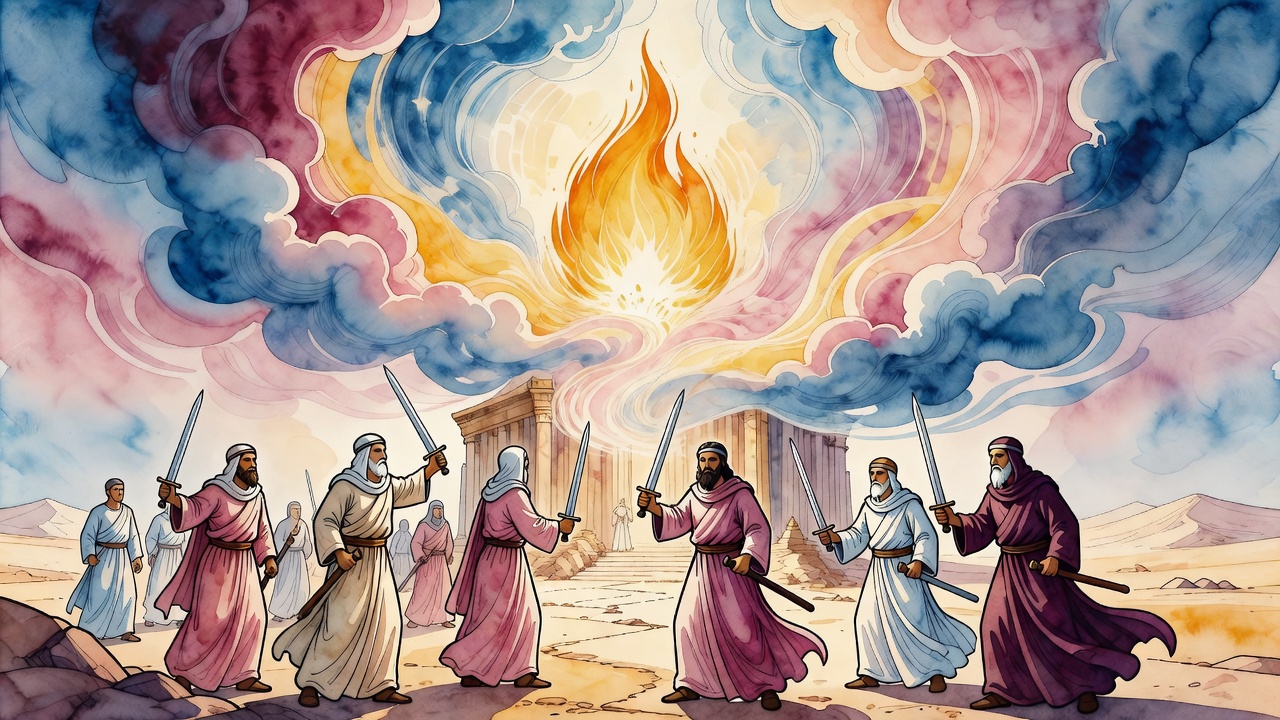
The night the calf shone, Moses stood in the camp and drew a line no family wanted. Who is for the Lord? The tribe of Levi stepped across it with swords already finding their thighs.
Levites Became God's Palace Guard After the Calf Click for full size

They did not spare brother, neighbor, or relative when the order cut through blood. The camp learned what loyalty costs when the alternative is a gold animal and a roaring crowd.

The Line Through the Camp

Scripture keeps the scene hard. Each man placed his sword on his thigh. Each man moved through the people who had danced and the people who had watched. The Levites acted according to Moses' word while other tribes hesitated. Later poetry remembered them as those who said of father and mother that they did not see them, who did not recognize brothers, who did not know their children, because they observed the saying and upheld the covenant (Exodus 32:27-28) (Deuteronomy 33:9).

That is not a soft vocation story. It is a tribe choosing the Throne over the table.

Firstborns Lose the Watch

Before the calf, the firstborn of Israel held a nearness that felt natural. After the calf, that nearness cracked. The firstborn had failed the test of loyalty when the metal animal rose. The Levites had passed it at a price measured in kin.

God drew a different circle. The Levites would come near as palace guards. Sanctity and the function of the house would rest on their shoulders. The stranger who approached the work would die. The fence was not etiquette. It was survival for a people who had already proven they could break holy things.

Dismantling What Burns

When the Tabernacle traveled, the Levites dismantled it. When it encamped, they erected it (Numbers 1:51). Ordinary hands did not touch the boards and coverings as if furniture were neutral. Fury against the congregation was the risk if the wrong person crossed the line. The Levites stood between Israel and the consequences of curiosity.

They protected the watch of the Tent of Testimony. Day and night the sacred weight needed bodies willing to carry it and refuse others. Gate and altar were not career choices. They were posts on a border between life and ash.

Cloud and Fire Over Their March

The pillars did not only guide the nation. Traditions of the desert keep fire and cloud close to the tribe that served the movable house. The Levites moved under signs that other tribes only watched from farther back. Age and qualification mattered. Not every man of Levi entered every task at every year of life. The service had thresholds. The house demanded readiness, not only ancestry.

A royal guard parable sits under the arrangement. Kings do not hand the palace key to the man who cheered the riot. They hand it to the man who bled for the crown when the crown was least popular.

The Buffer That Remains

Israel learned to live with a tribe that had once raised swords inside the family. That memory did not vanish because decades of marching sanded it down. Every time a Levite lifted a board or barred a gate, the camp felt the old choice again. Nearness to God is not a mood. It is a post with death written on the wrong side of the threshold.

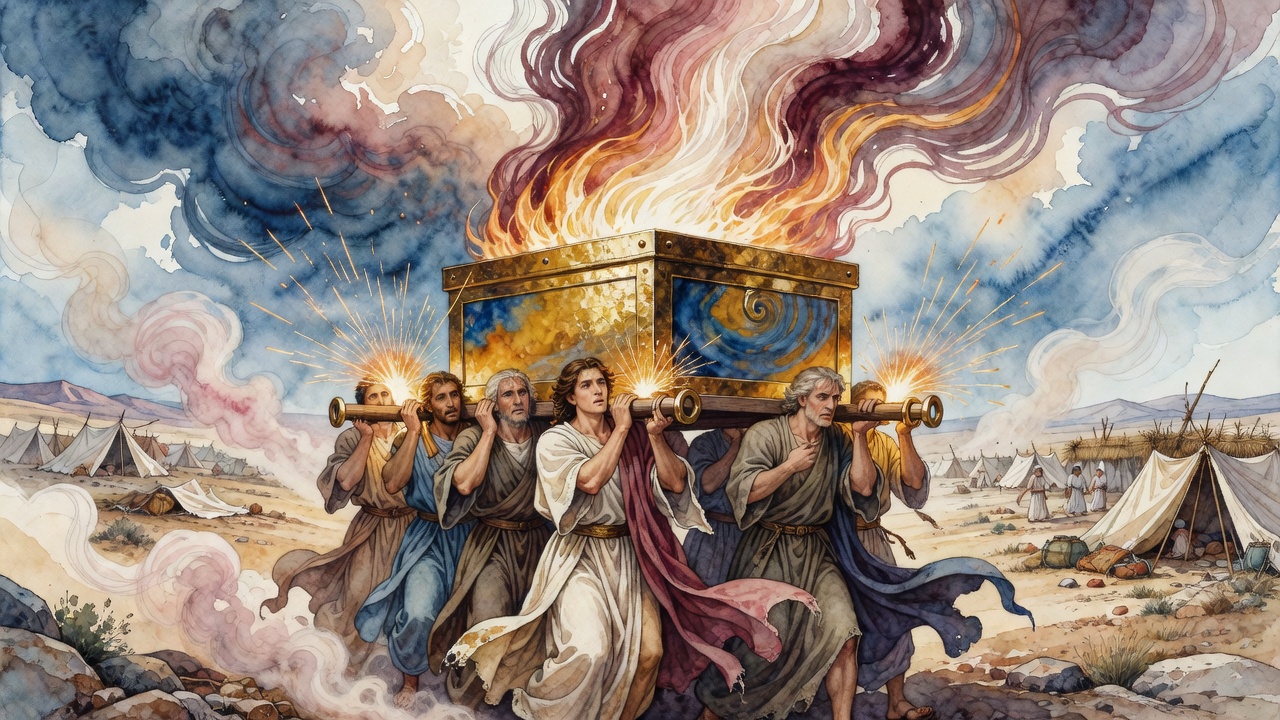
The Mishkan (the Tabernacle, the portable sanctuary they carried) moved. The people moved. The Levites moved between them like a living wall, still answering the question Moses shouted while gold still gleamed.

In later camps the Levites still tasted that first night when they answered Moses. Children of Levi learned the boards of the Mishkan the way other children learned family names. A stranger's hand near the holy furniture was not a misunderstanding. It was a capital border. The people who had once danced around gold now lived with a tribe licensed to stop them at the threshold.

Gate duty is quieter than sword duty, yet the same spine runs through both. The palace guard exists because the palace was once almost lost from inside.

Numbers sets the stakes without soft music. When the Tabernacle travels, the Levites dismantle it. When it encamps, they raise it. The stranger who approaches dies. Fury against the congregation is the risk if the wrong hands cross the line. That sentence is not bureaucratic. It is the memory of a night when wrong hands built a calf and called it festival.

Other tribes could fight wars on the borders. Levi fought the border inside holiness itself. Age brackets and service rolls later sorted who carried what, but the original appointment was blood-tested. God does not staff a palace guard from the choir that sang to gold. He staffs it from the men who stopped the song.


← All myths
From the tradition

Sources

4 sources

The texts behind this telling. Some cards carry a translation of the source; others are our own retelling of it, and each card says which. Every card links out to the original.

Bamidbar Rabbah 1:12Bamidbar Rabbah

Retold in our words. Read the original at the link below.The Sefaria Midrash Rabbah, 2022 · CC-BY

In the book of Numbers, Bamidbar, we find a census being taken. But there's a twist. "However, the tribe of Levi you shall not count" (Numbers 1:49). Why this exclusion? Bamidbar Rabbah, a classical Midrashic (rabbinic interpretive commentary) text, offers some truly insightful explanations.

One explanation paints a vivid picture: Imagine a king reviewing his legions. He instructs his chief of staff to count them all. except for the royal guard, those closest to him. Counting them amongst the regular troops just wouldn't be fitting. Similarly, God tells Moses not to count the Levites with the rest of Israel. They are to be counted separately, a distinct and honored group. "Among the children of Israel you shall not count them, but by themselves, count them," the text emphasizes. It’s about honor, about recognizing their unique role.

What is that unique role? We learn that "you, appoint the Levites over the Tabernacle of the Testimony." (Numbers 1:50). They are the guardians, the keepers of the sacred space.

Put yourself in Moses' sandals for a moment. Bamidbar Rabbah tells us that Moses grew afraid, wondering if there was some flaw in his tribe that caused God to exclude them. What if there was a disqualification?

But God reassures him. The exclusion isn't a punishment, but a protection! "I said so to you only to exclude them from the decree, so that they will not die with them." God is setting them apart to save them. "And you shall not take a census of them [ve’et rosham lo tisa] among the children of Israel" (Numbers 1:49). Why? Because "The Levites shall be Mine" (Numbers 3:12, 45).

The text beautifully elaborates: "As, anyone who draws Me near, I draw him near." Remember the Golden Calf incident? "Moses…said: Whoever is for the Lord, come to me; and all the sons of Levi gathered to him" (Exodus 32:26). They chose loyalty to God, even when it was difficult. Because they drew near to God, God draws near to them.

The Levites proved their devotion. "You shall have no other gods…" (Exodus 20:3). They upheld this commandment, and therefore, they are worthy to be the trustees of My house." “And you, appoint the Levites [over the Tabernacle of the Testimony…and they shall encamp around the Tabernacle]" echoing the sentiment found in (Psalms 101:6): “My eyes are on the faithful of the land; they will dwell with Me.”

The Midrash then highlights a recurring theme: those who are tested and prove faithful are forever cherished. Think of Joshua, tested with Amalek, and how he fulfilled the command. "Joshua weakened [Amalek and its people by sword]" (Exodus 17:13). Because of this, God promised that "From Ephraim came those who uprooted Amalek" (Judges 5:14) – a descendant of Joshua would forever avenge Amalek.

Conversely, consider Saul, who failed his test with Amalek. "Saul and the people spared [Agag…and all that was good, and would not utterly destroy them]" (I Samuel 15:9). As a result, he "fell back [le’aḥorav]", losing his kingdom.

The Levites, too, were tested. They proved their loyalty during the Golden Calf incident, even at the cost of family ties. "Each man, place his sword upon his thigh…[and each slay his brother, each his neighbor, each his relative]. The sons of Levi acted in accordance with the word of Moses…" (Exodus 32:27–28). (Deuteronomy 33:9) further describes them as those "Who said of his father, and of his mother: [I did not see him, and his brothers he did not recognize, and his children he did not know, because they observed Your saying, and Your covenant they upheld]."

Because of this unwavering devotion, God says, "Here, too, I will draw them near and make them My palace guard, and I entrust My sanctity and the function of My house to them."

And this responsibility extended to the very fabric of the Mishkan, the Tabernacle. "And when the Tabernacle travels, [the Levites shall dismantle it, and when the Tabernacle encamps, the Levites shall erect it]" (Numbers 1:51). Only the Levites could handle this sacred task. The text emphasizes the exclusivity: "And the stranger who approaches shall be put to death" (Numbers 1:51).

Why all this caution? To prevent "fury against the congregation of the children of Israel" (Numbers 1:53). The Levites acted as a buffer, protecting the people from the potential consequences of approaching the sacred space unworthily. They "will protect the watch of the Tabernacle of the Testimony" (Numbers 1:53).

It’s not simply a historical account of ancient roles and responsibilities. It speaks to the enduring themes of loyalty, devotion, and the consequences of our choices. And perhaps, on a deeper level, it challenges us to consider: what are we doing to draw closer to the Divine, and how can we prove ourselves worthy of trust and responsibility?

Full source
Sifrei Bamidbar 67:1Sifrei Bamidbar

Retold in our words. Read the original at the link below.Sifrei by Rabbi Shraga Silverstein · CC-BY

Seems like a prime opportunity for spiritual growth. But Sifrei Bamidbar, a collection of legal interpretations on the Book of Numbers, pulls no punches. It points out a rather glaring fact about the Pesach, the Passover sacrifice. We read in (Numbers 9:5), "And they offered the Pesach in the first (month) on the fourteenth day of the month." Then the text curtly observes that, essentially, this was it. This was the only Passover sacrifice offered during the entire forty-year sojourn. Ouch.

The text goes on to say that Scripture speaks "in disparagement of Israel." It’s as if the Torah itself is a disappointed parent. Did they really only manage one Pesach in all that time? (Amos 5:25) echoes this sentiment, asking, "Did you bring sacrifices and meal-offerings to Me for forty years in the desert?" It's a rhetorical question dripping with… well, you get the idea.

Wait! Before we write off the entire generation as spiritually lazy, Rabbi Shimon b. Yochai offers a fascinating counterpoint. He suggests that it wasn't all the Israelites who were slacking. He argues that the tribe of Levi were the exception.

How so? Well, Rabbi Shimon points to (Deuteronomy 33:10): "They shall place incense before You and a burnt-offering upon Your altar." This verse, he says, indicates that the Levites did continue to perform sacrifices. While the rest of Israel may have stumbled, the Levites remained dedicated to their sacred duties. This is because, according to Rabbi Shimon, the rest of Israel served idolatry, while the Levites did not. (Deuteronomy 33:9) says, "For they kept Your commandment ('You shall have no other gods')." This connects back to (Exodus 32:26), after the Golden Calf incident: "And Moses stood in the gate of the camp, and he said 'Whoever is for the L-rd, (let him come) to me!' And there gathered unto him all the sons of Levi."

It's a powerful image: the Levites standing firm in their faith while others falter. They didn't give in to the temptations around them.

And it doesn't stop there. According to the Sifrei Bamidbar, Israel also neglected the practice of circumcision. (Joshua 5:5) states that "all the people who were born in the desert … were not circumcised." Yet, (Deuteronomy 33:10) states that the Levites kept "Your covenant (of circumcision)." This reinforces the image of the Levites as the upholders of tradition in a challenging environment.

So, are we left with a completely negative view of Israel in the desert? Not entirely. The Sifrei Bamidbar includes a final, almost apologetic, statement. Regarding (Numbers 9:5) ("According to all that the L-rd had commanded Moses"), the text declares that this is "to declare the praise of Israel." Despite their shortcomings, they did follow Moses' instructions when it came to that one Passover sacrifice. "Just as Moses told them, 'thus did they do.'"

It's a small, but significant, detail. Even with their struggles, even with their lapses in faith, they still managed to obey at least once. Perhaps this is a reminder that even when we fall short, even when we feel like we're wandering in our own personal wilderness, there's always an opportunity to reconnect, to recommit, and to follow the path laid out before us. Maybe that’s the ultimate lesson of the desert: it’s not about perfection, but about the journey, the striving, and the occasional, hard-won victory.

Full source
Sifrei Devarim 61:1Sifrei Devarim

Retold in our words. Read the original at the link below.Sifrei by Rabbi Shraga Silverstein · CC-BY

On "And you shall raze their altars" (Deuteronomy 12:3), the midrash says: this is an altar that was built originally for idolatry.

The gloss defines which altar falls under the command. Gate service and Levitical posts are not in this line.

Full source
Sifrei Bamidbar 62:1Sifrei Bamidbar

Retold in our words. Read the original at the link below.Sifrei by Rabbi Shraga Silverstein · CC-BY

Sometimes, digging into the details reveals a surprisingly beautiful logic. a little puzzle from the Book of Numbers – Bamidbar – and see what we can uncover.

Our focus is on the Levites, that special tribe dedicated to serving in the Mishkan, the Tabernacle. Specifically,

The text says, in Bamidbar 3:24, "This is what applies to the Levites. From the age of twenty-five, etc." Okay, sounds straightforward enough. But then it throws a curveball: years disqualify them from service, but blemishes do not. Wait, what? Why?

Think of it this way: with the Cohanim, the priests, blemishes do disqualify them. But age doesn't matter as much. So, you might assume if age isn't a big deal for priests, but blemishes are, then shouldn't it be the other way around for Levites? Shouldn't blemishes matter even more since age does disqualify them?

That’s where the Torah clarifies: "This is what applies to the Levites… Years disqualify the Levites, but not blemishes." The text itself anticipates the logical leap we might make and then gently corrects us.

But why? Why this distinction? The text doesn't explicitly say. Maybe it highlights the nature of the Levites' service, which was perhaps more physical and communal than the priestly duties. Perhaps it's a reminder that outward imperfections don't necessarily diminish one’s ability to serve.

Now, let's add another layer. We have two verses about age. Bamidbar 8:24 says, "From the age of twenty-five and up..." But then, in Bamidbar 4:23, it says, "From thirty years and up." So, which is it? Twenty-five or thirty?

The answer is both. The text resolves the apparent contradiction by explaining that at twenty-five, the Levites began learning the intricacies of their service. It was a period of apprenticeship, of preparation. Only at thirty were they considered fully ready to actually perform the service itself.

Think of it like this: you might start studying a craft at a certain age, but you don't necessarily become a master overnight. There's a period of learning, of honing your skills, before you're truly ready to take on the full responsibility.

So, what’s the takeaway from this little textual puzzle? It's a reminder that even the seemingly minor details in sacred texts can hold profound meaning. It encourages us to look beyond the surface, to ask questions, and to appreciate the nuance and complexity of tradition. And maybe, just maybe, it reminds us that preparation and learning are essential parts of any meaningful service, whether it’s in the Beit Hamikdash, the Temple, or in our everyday lives.

Full source