5 min read

Mice Climbed From the Deep and Ate Ashdod Alive

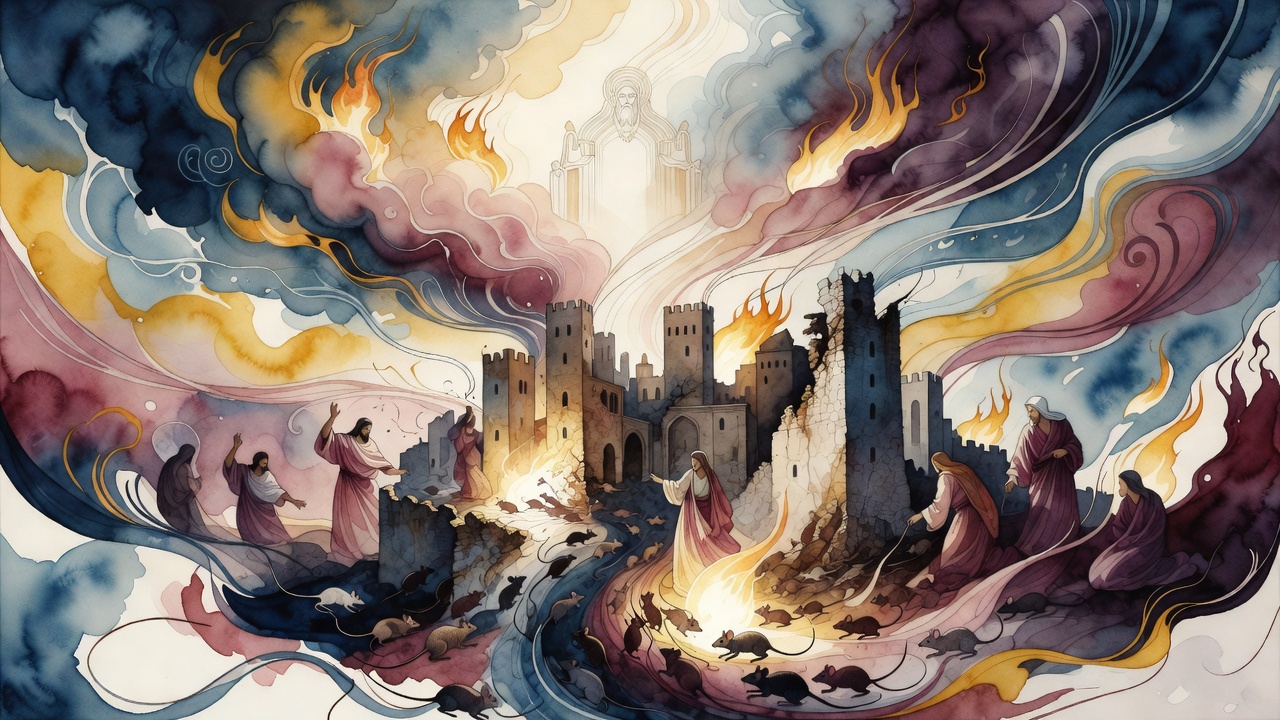
Philistines sneer that God's quiver is empty. A mouse climbs from under a man, drags out his bowels, and benches built for safety split open on command.

Curated by Arthur · Told by Maggid ·
Table of Contents
  1. The Camp Splits on One Shout
  2. A Mouse From the Deep
  3. Hidden Places of the Body
  4. Two Voices in One Passage
  5. The Ark Does Not Stay Captive Cleanly
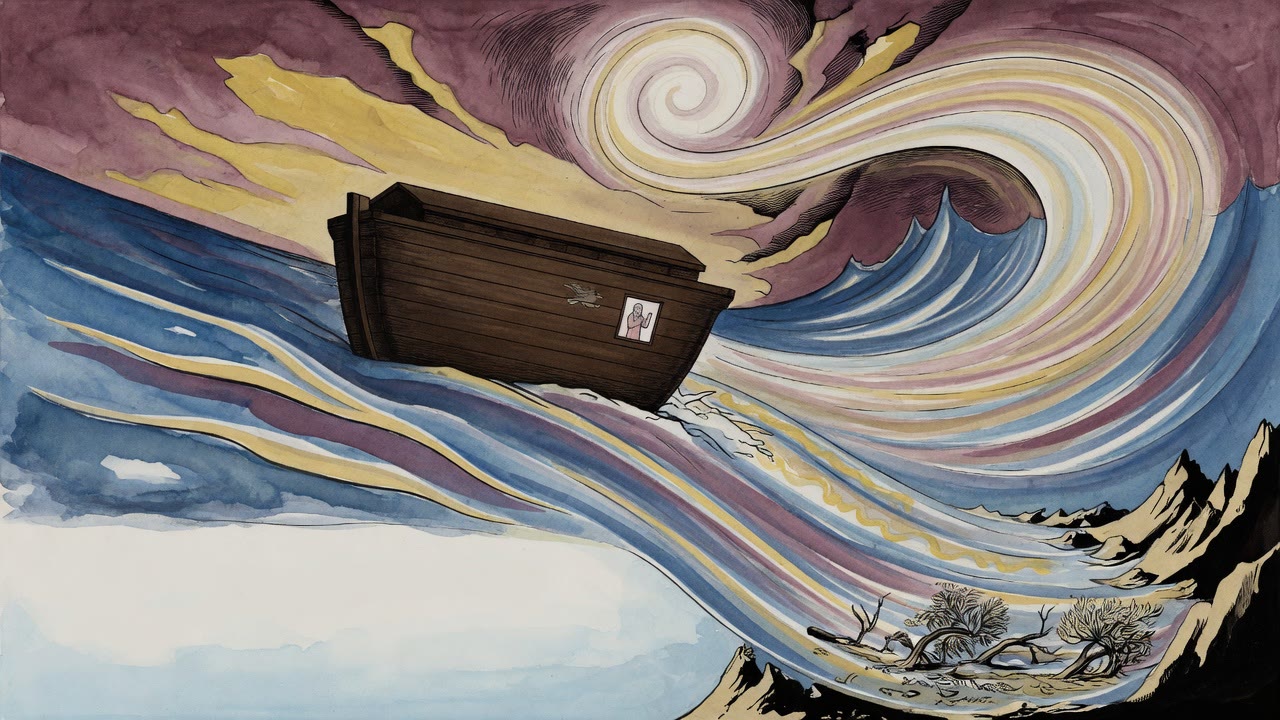
Mice Climbed From the Deep and Ate Ashdod Alive Click for full size

The Camp Splits on One Shout

When the Ark came into the Philistine camp and the earth shook with Israel's shout, the camp split in two. The worthy among them cried, "Woe to us! Who will save us from these mighty Gods?" The wicked sneered with the confidence of men who think history is a ledger already closed. He spent His plagues on the sea. The rest He spent in the wilderness. His quiver is empty now.

The sneer did not travel far before an answer rose from under their own feet. By your lives, the Holy One said, I will bring a blow never seen since the world began. Old plagues were not required. A new one was waiting in the dirt.

A Mouse From the Deep

A man sat down, and a mouse climbed up from the depths of the earth, seized his very bowels, snatched them away, and slipped back down into the dark. The plague of tumors at Ashdod was not a polite swelling a physician could name and soothe. It was a theft of the body's hidden parts. A man sat upon his own affliction and felt the ground claim him from below while his hands still held the pride of capture.

They built benches to sit on, safe above the earth. Height seemed like strategy. Wood seemed like a shield between flesh and soil. The mouse spoke to the bench. I am the messenger of Him who spoke and the world came to be, and you are His creature. Give honor to your Maker. The bench split open as if wood remembered its first order. The mouse rose again from the deep, and the safety of furniture became a joke told by a plague.

Hidden Places of the Body

Scripture says the hand of the LORD pressed heavy upon the men of Ashdod and smote them with tumors. The word that says the tumors "broke out" also tastes of concealment. One teaching says the outer bowels were hidden away. Another says the inner bowels were hidden. These were afflictions wrought in darkness, things taken from the hidden places of the body while the city still tried to keep its pride upright in the market and the temple of Dagon.

To measure the force of such a stroke, other verses come to mind like witnesses. A stone sinks into Goliath's forehead as into soft dough. Bones in a lions' den are ground thin as wafers. The God who softens a giant's skull and crushes a den's bones does not need a full quiver of old plagues. One new blow is enough when the target has already decided Heaven is spent.

Two Voices in One Passage

What one Philistine said, the other did not say. The camp's terror and the camp's mockery sit side by side in the same scene, and the sages later hear in that braid a key to all Scripture. A single passage may mingle two voices. Judah and Tamar. Caleb and the spies. Israel's complaint over the manna. The mother of Sisera at her window. Read carefully and you hear who truly speaks each line, and who only stands nearby while another mouth ruins the hour.

In Ashdod the mingled words were simple. Fear and scorn. The scorn received the answer first because scorn had counted Heaven empty. The fear had already known the truth and was only waiting for the ground to prove it.

The Ark Does Not Stay Captive Cleanly

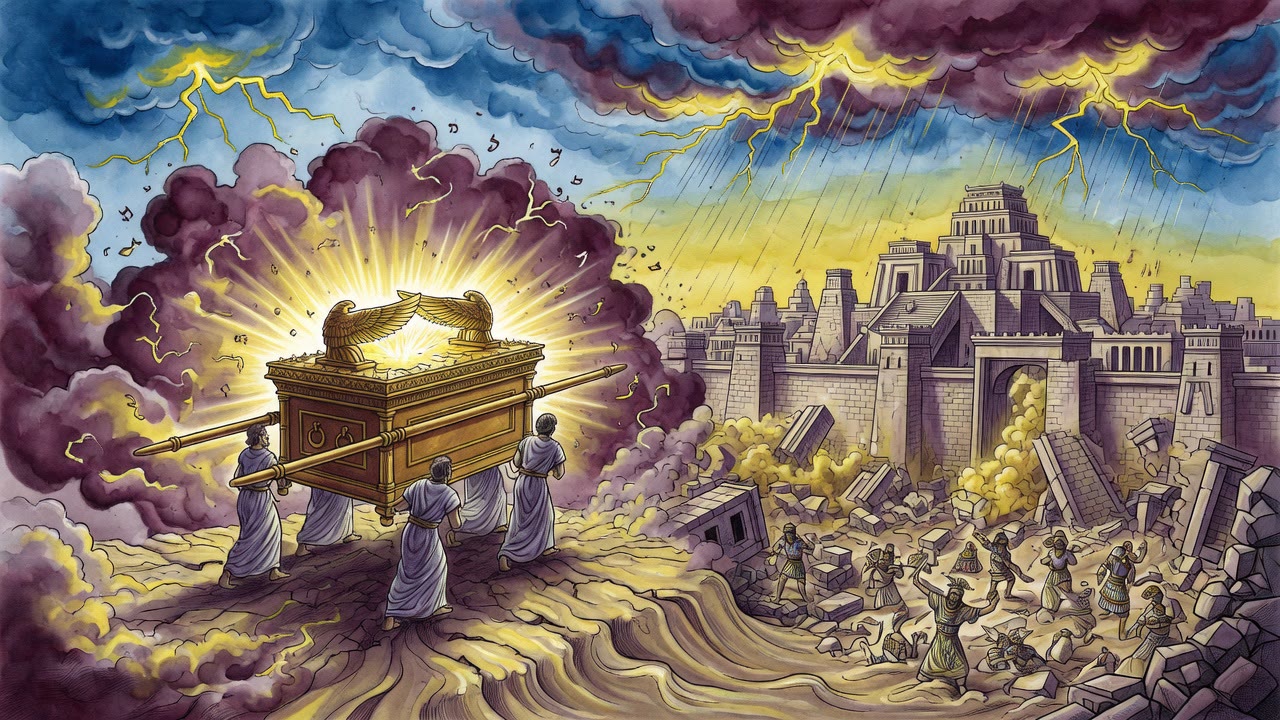
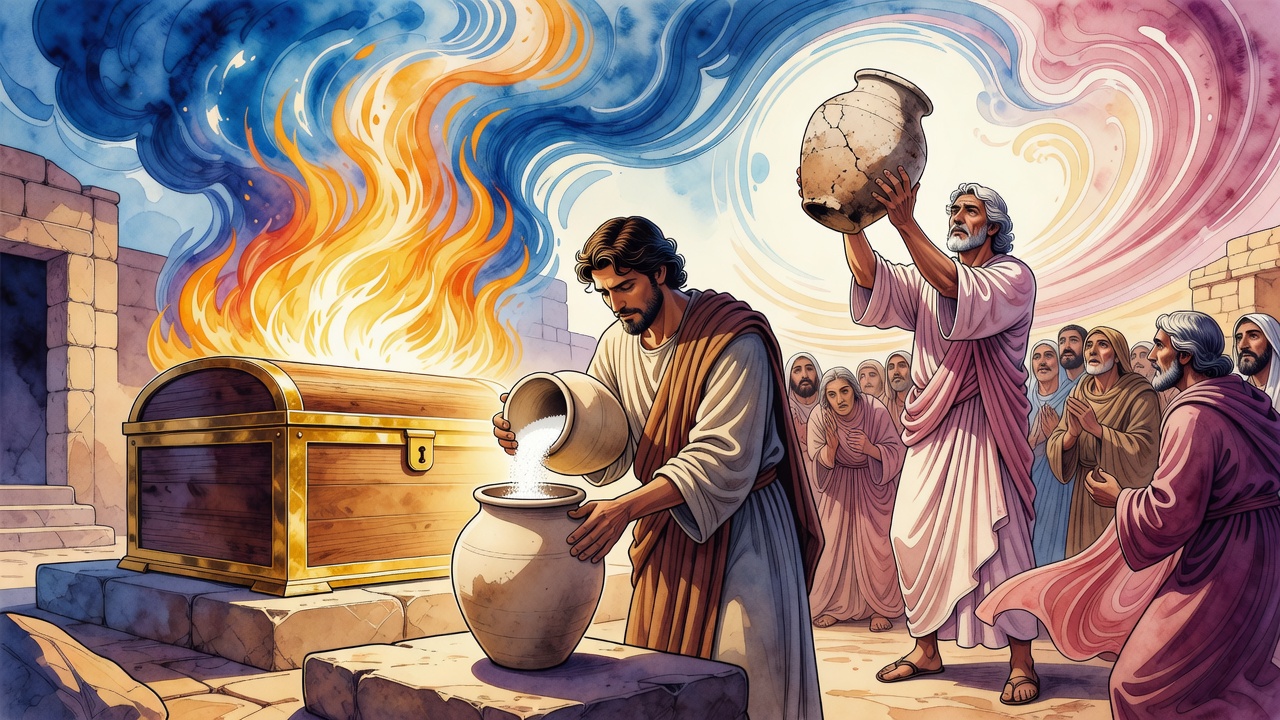
They had seized the Ark as spoil, a chest that had walked before Israel and now sat among strangers as if power could be relocated by carts and victory songs. Spoil answered them as plague. Dagon would fall in his own house. Cities would pass the Ark like a burning coal from hand to hand. Golden tumors and golden mice would be sent back as a confession in metal. But before the diplomacy of guilt, there was the mouse under the bench and the man who could not sit without being opened.

The wicked had counted God's spent arrows on the sea and in the wilderness. They had not counted the creatures still loyal to the Maker under the floorboards of Philistia. A bench is only wood. A mouse is only small. Together they unmake a sneer that thought the desert had emptied Heaven's hand. Capture writes itself in entrails, and the writing begins the moment a man sits down.

In the streets men stopped sitting without checking the ground. In the temples of Philistia the captured Ark made every stool a risk. Victory songs thinned into medical talk and muttered bargains. A people that had counted Heaven empty began to count its own dead from below, and the count made mockery expensive.


← All myths
From the tradition

Sources

2 sources

The texts behind this telling. Some cards carry a translation of the source; others are our own retelling of it, and each card says which. Every card links out to the original.

Midrash Shmuel 10:4Midrash Shmuel

Translation of the source text.Midrash Shmuel, Krakow 1893, Public Domain, on Sefaria · CC-BY-SA

"And when the Philistines heard the noise of the shout… 'Woe unto us! Who shall deliver us out of the hand of these mighty Gods?'" (1 Samuel 4:8). Up to here spoke the worthy ones among them; but the wicked ones among them said, "These are the Gods that smote, etc." (ibid.). They said: He brought ten plagues upon the sea, and the rest of the plagues He spent upon His people in the wilderness; they said, He has no plague left from now on. [Said the Holy One:] By your lives, I will bring upon you a plague that has never been seen and never been, as it is written, "And the hand of the Lord was heavy upon the Ashdodites, and He smote them with hemorrhoids" (1 Samuel 5:6). How so? A man would be sitting with a hemorrhoid, and a mouse would come up from the deep and pull out his entrails, and go down again to the deep. This is what is written, "And the hand of the Lord was heavy upon the Ashdodites, and He set them, etc." They went back and made themselves benches. The mouse would say to the bench: I am the messenger of Him who spoke and the world came to be, and you are His creature, give honor to the One who created you. And the bench would split, and the mouse would come up from the deep, and pull out his entrails, and go down again to the deep. This is what is written, "And the hand of the Lord was heavy, etc."

The whole section is mingled words (eruvei devarim): what this one said, the other did not say, and what the other said, this one did not say. And likewise: "And Judah acknowledged them, and said, 'She is more righteous than I'" (Genesis 38:26), and the Holy One, blessed be He, writes concerning him, "and he knew her again no more", that once he knew that she was his daughter-in-law, "he knew her again no more" (ibid.), and so the whole section. And likewise: "We came unto the land whither thou sentest us, etc." (Numbers 13:27), up to here spoke Caleb; the whole section is mingled words: what this one said, the other did not say, and what the other said, this one did not say. And likewise: "But now our soul is dried away; there is nothing at all; we have nought save this manna to look to. And the manna was as coriander seed" (Numbers 11:6–7). You might suppose [it is one speaker]; [know that] what this one said, the other did not say. What does it say? "But now our soul is dried away; there is nothing at all" (ibid. 11:6), and the Holy One, blessed be He, conciliates all who come into the world and says to them: Come and see over what My children murmur against Me, "And the manna was as coriander seed, etc." (ibid. 11:7). The whole section is mingled words: what this one said, the other did not say.

And likewise: "Why is his chariot so long in coming?" (Judges 5:28), up to here spoke the mother of Sisera; "why tarry the wheels of his chariots?" (ibid.), up to here spoke his wife; "the wise among her princesses answer her" (ibid. 5:29), up to here spoke her daughters-in-law; "Have they not found, are they not dividing the spoil?" (ibid. 5:30), the words that the mother of Sisera spoke were revealed to Deborah by the Holy Spirit, and Deborah sent word to her: Wait no longer for your son Sisera from now on, "so let all thine enemies perish, O Lord" (ibid. 5:31). And likewise: "Micah the Morashtite prophesied in the days of Hezekiah king of Judah, etc.… Did Hezekiah king of Judah put him to death?" (Jeremiah 26:18–19), up to here spoke the worthy ones among them; but the wicked ones said, "And there was also a man that prophesied in the name of the Lord, Uriah the son of Shemaiah, etc.… And when the king Jehoiakim, with all his mighty men… heard… and the king Jehoiakim sent men into Egypt… and they fetched forth Uriah out of Egypt, and brought him unto the king" (ibid. 26:20–23). They said: Just as Uriah prophesied, so did Jeremiah prophesy; and just as Uriah was slain, so was Jeremiah to be slain. "Nevertheless the hand of Ahikam the son of Shaphan, etc." (ibid. 26:24). The whole section is mingled words: what this one said, the other did not say, and what the other said, this one did not say.

And likewise: "Set me as a seal upon thine arm, etc." (Song of Songs 8:6). "Set me as a seal upon thy heart, as a seal upon thine arm", up to here spoke the Assembly of Israel; "for love is strong as death, jealousy is cruel as the grave" (ibid.), up to here spoke the nations of the world; and the Holy Spirit says, "the coals thereof are coals of fire, a most vehement flame, etc." (ibid.). Behold, the whole section is mingled words: what this one said, the other did not say.

Full source
Midrash Shmuel 11:6Midrash Shmuel

Translation of the source text.Midrash Shmuel, Krakow 1893, Public Domain, on Sefaria · CC-BY-SA

"And the hand of the LORD was heavy upon the Ashdodites, and He smote them with tumors" (1 Samuel 5:6). How so? A man would be sitting upon the tumor, and a mouse would come up from the deep and snatch away his bowels and go back down to the deep.

And similar to this: "and the stone sank into his forehead" (1 Samuel 17:49). Yehuda b'Rabbi said: like into dough. And similar to this: "all their bones they crushed" (Daniel 6:25). Yehuda bar Rabbi said: like these wafers.

"And tumors broke out for them" (1 Samuel 5:9). Rabbi Shimon ben Lakish said: the outer part of their bowels was concealed. Rabbi Shmuel bar Nachman said: the inner part of their bowels was concealed. "And tumors broke out for them", things that are in concealment.

Full source