Parshat Noach5 min read

A Breath Drove the Floodwaters Off the Earth

Noah waited in a sealed ark while the world drowned. Then a breath moved, wind or spirit, and the waters began to walk backward.

Curated by Arthur · Told by Maggid ·
Table of Contents
  1. The Ark That Had to Be Enough
  2. What He Packed for a World After
  3. The Breath That Turned the Tide
  4. Blessing on Wet Ground
  5. Ten Generations of Waiting
A Breath Drove the Floodwaters Off the Earth Click for full size

The Ark That Had to Be Enough

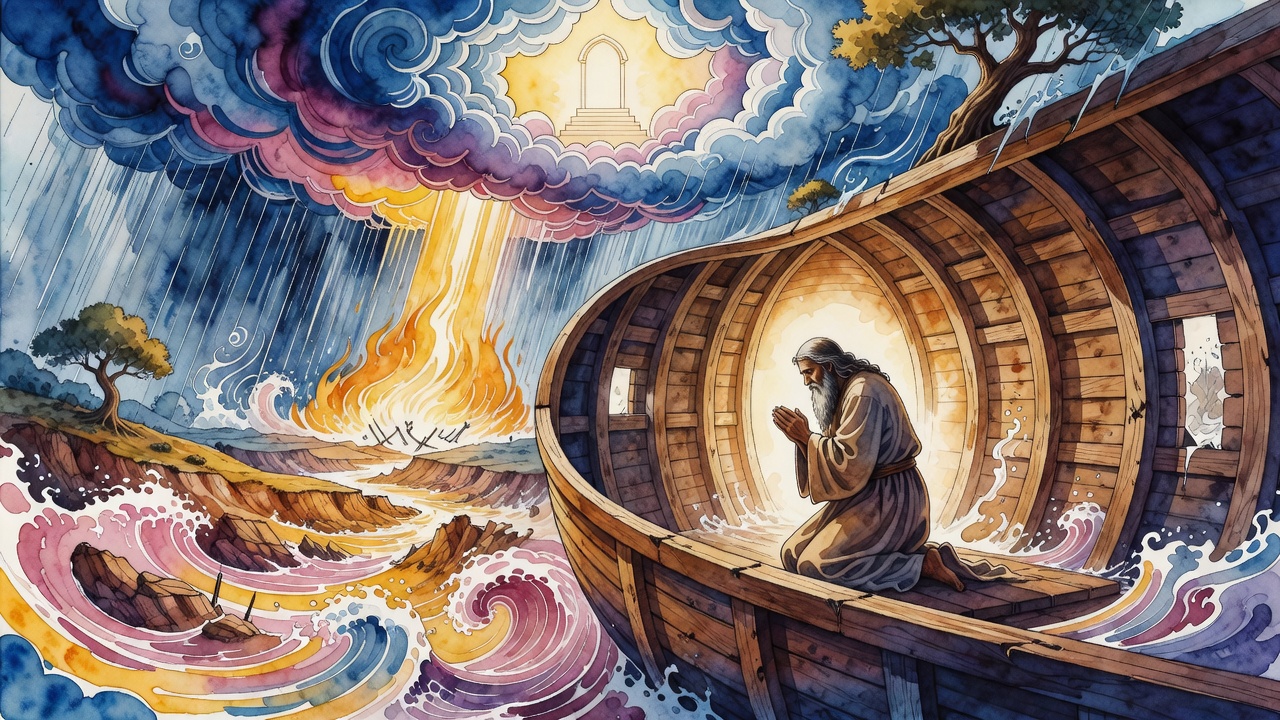
Noah sealed the pitch and listened to rain that did not know how to stop. Outside, the world he had warned became water. Markets, fields, doorways, arguments: all of it went under. Inside, animals breathed in stacked dark, and the man who had found favor wondered how justice could drown children with their parents and still be called justice.

The old philosophical midrash does not dodge the ache. Innocent lives were bound up with guilty ones. The flood was not tidy. It was total. Noah's obedience did not make the arithmetic easy. It only kept one family breathing while the arithmetic ran its course against a generation that would not turn.

Pitch smell. Animal heat. The long noise of water rewriting the map.

What He Packed for a World After

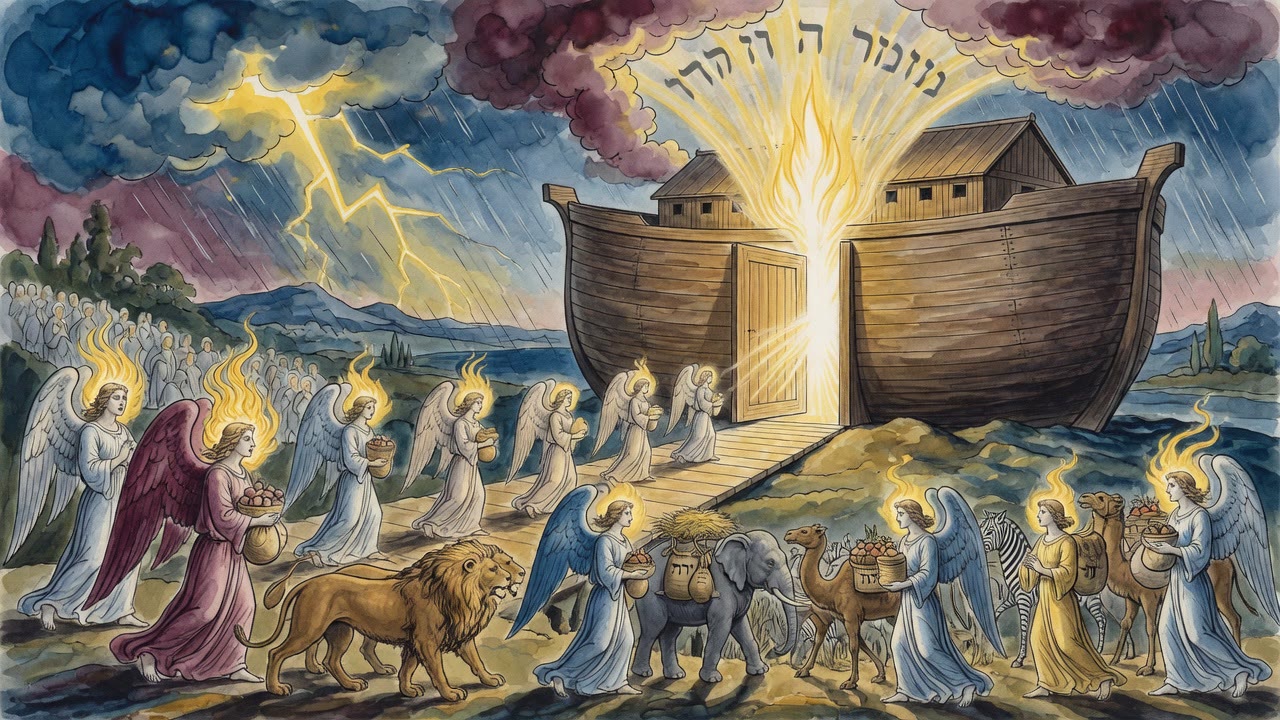
God told him to take food for himself and for them. Some sages hear a hierarchy of care: feed the human mouth first, then the beasts, without abandoning either. Need is ordered, not erased. Rabbi Abba bar Kahana adds a quieter genius. Noah packed vine branches, fig branches, olive branches, living future wood for a ground that did not yet exist again under sun.

He was not only surviving. He was smuggling orchards through judgment. "And Noah did; according to everything that God commanded him, so he did" (Genesis 6:22). The verse is almost plain. The packing makes it intimate. Somewhere in the dark a man counted cuttings the way other men count gold.

The Breath That Turned the Tide

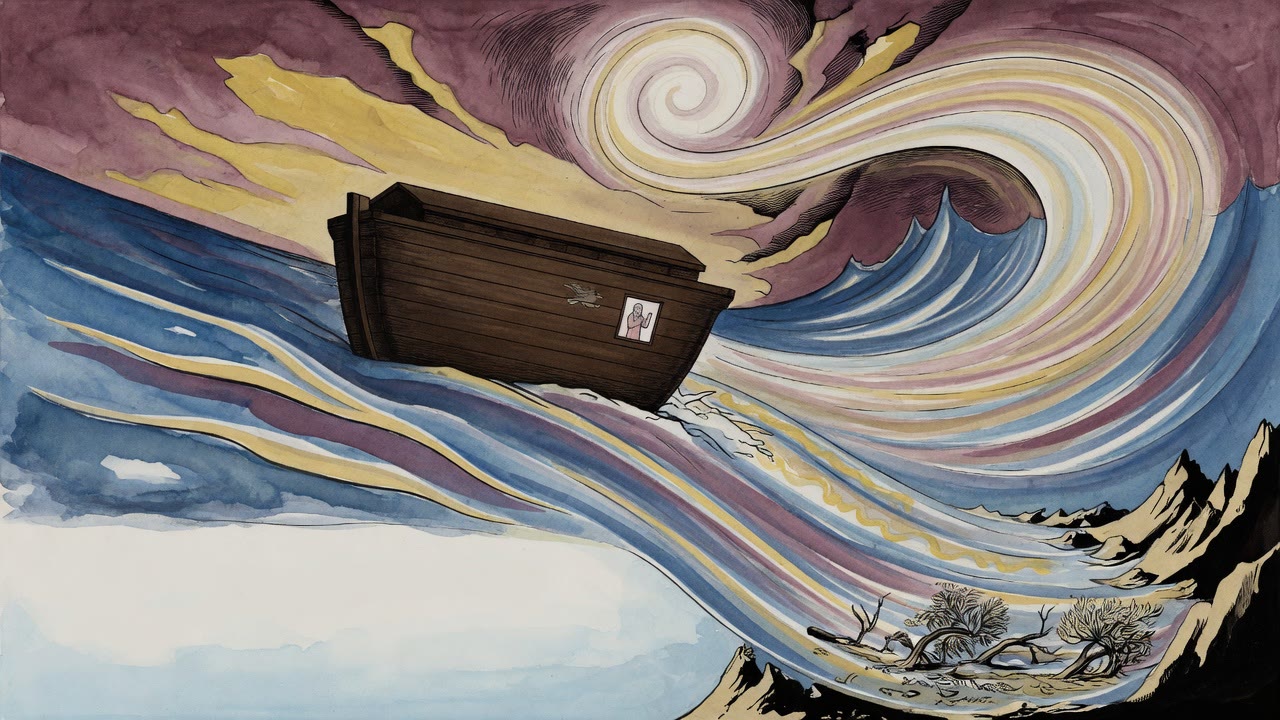
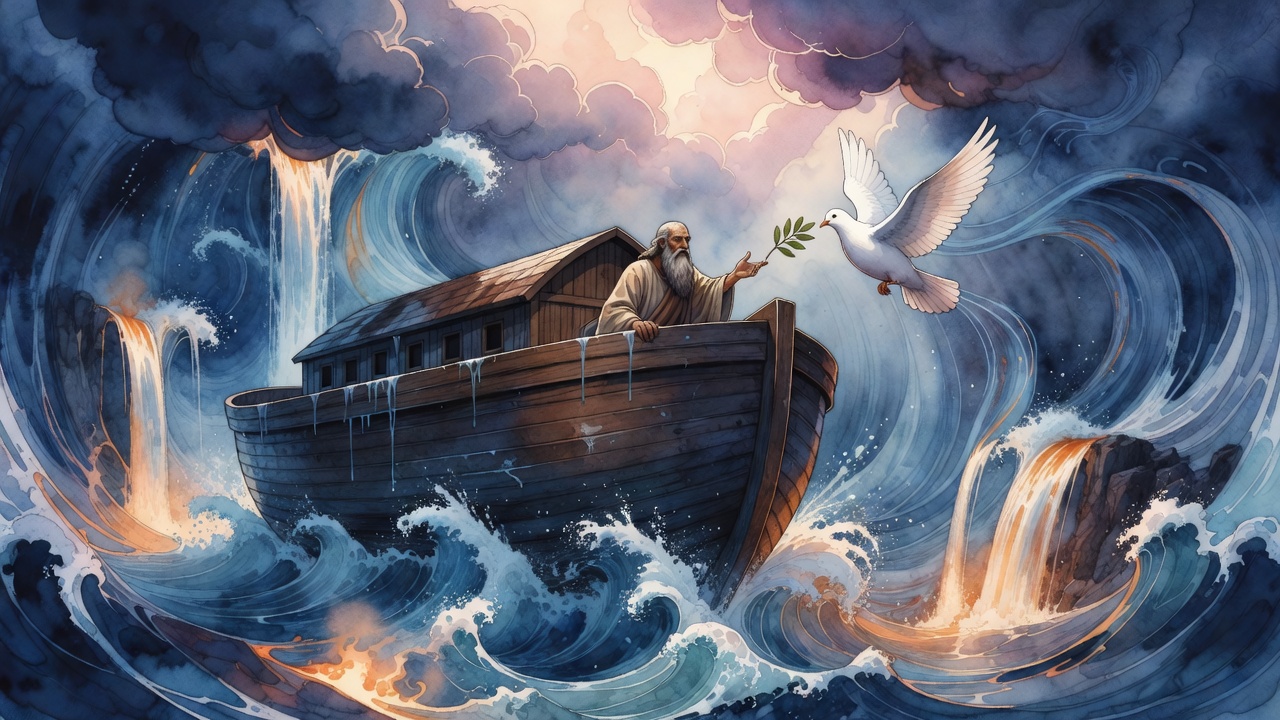
When the time came to end the drowning, God caused a breath to pass over the earth, and the waters subsided (Genesis 8:1). Was it wind, plain and physical, shoving waves toward their old basins? Was it spirit, the same ruach that hovered at the beginning when the deep first waited for speech and light?

Philo's line of reading refuses to choose cheaply. A breath that ends a flood can be weather and more than weather. The same God who opened the windows of heaven now opens a path for water to remember its borders. Creation's first wind returns as the flood's last. Chaos is told, again, where to stop.

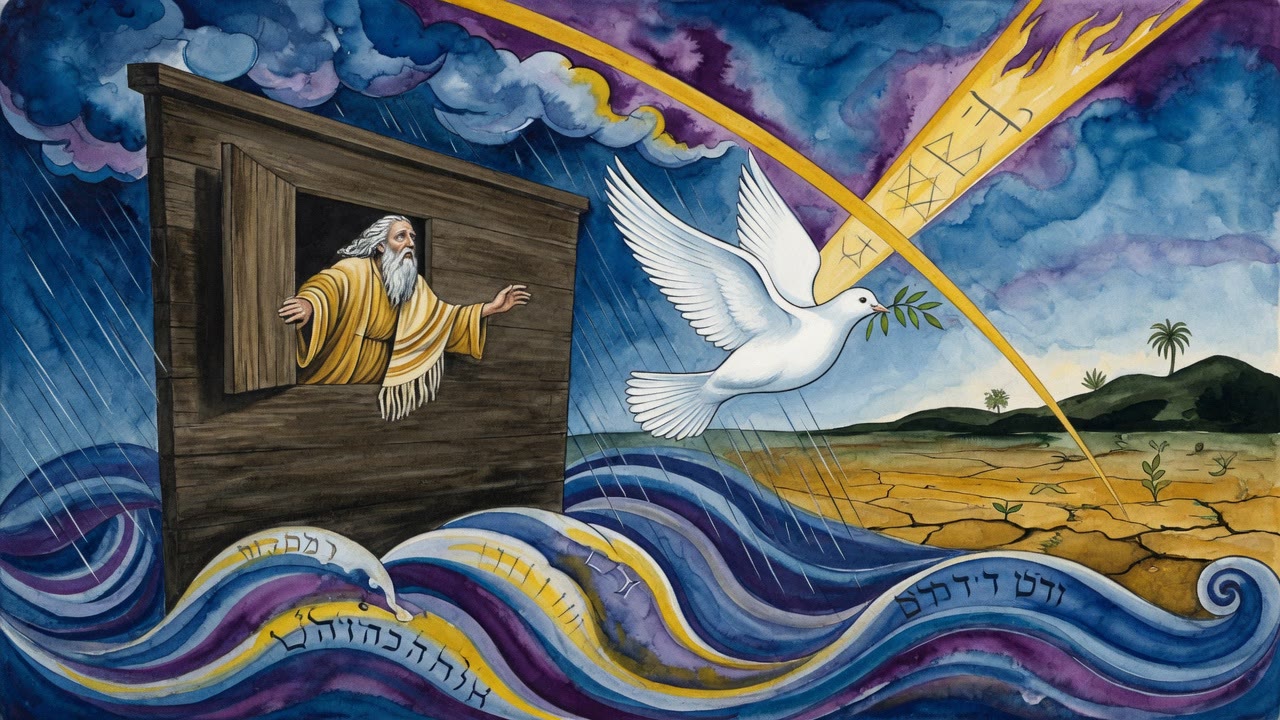
Noah feels the ark settle differently. The pitch still smells. The dark still presses. But the endless rocking begins to tire. A mountain peak becomes a rumor under the hull. The breath keeps working until rumor becomes land. The dove's later leaf would prove what the breath began. First the wind-spirit shoved the deep back into its banks. Then peaks showed. Then the window opened and the birds flew their small missions over a world still half sea. Noah waited through each stage with the patience of a man who has already waited through rain.

Blessing on Wet Ground

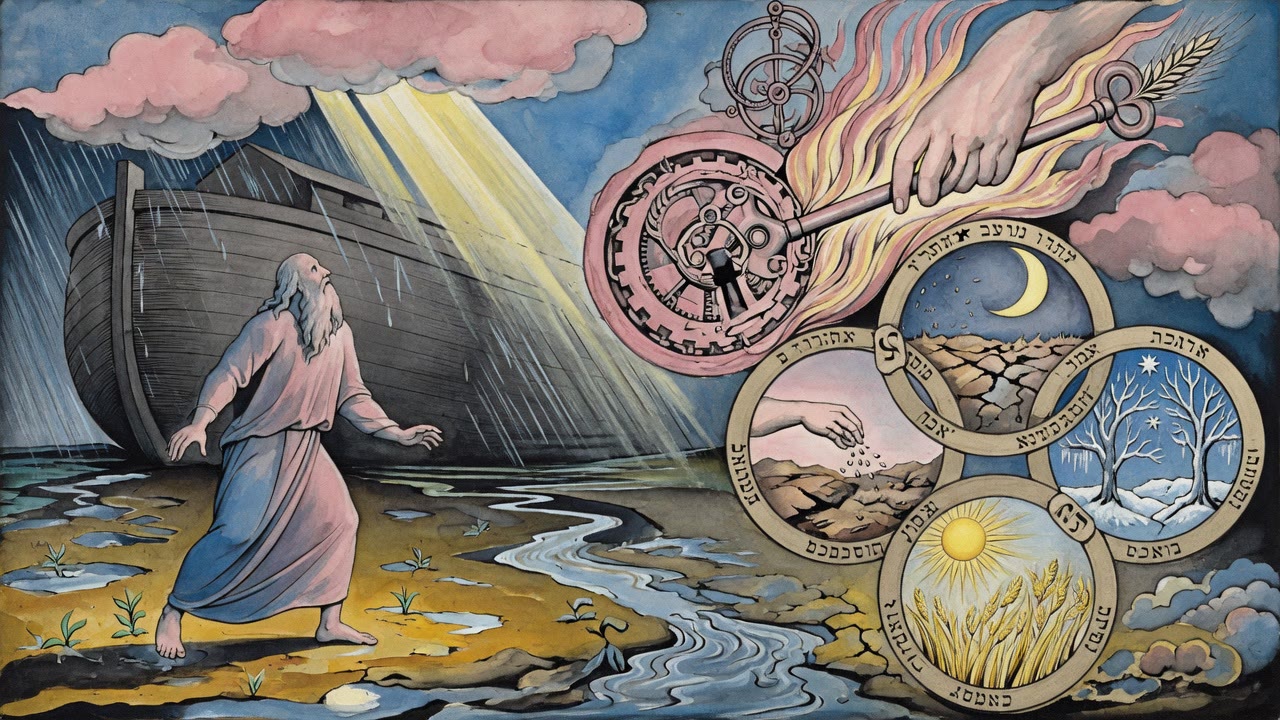
When he steps out, the world is washed and raw. Mud holds the shape of a former world without its noise. God blesses Noah and his sons: be fruitful, multiply, fill the earth again. The first human command after mass death is more life. Blood will have laws now. Animals will fear the human hand. The covenant will take a bow in the cloud so that water never again gets to finish this sentence against all flesh.

Noah plants a vineyard from the branches he carried through the dark. The future he packed becomes wine, and wine becomes its own danger on a later night, but that is later. First there is mud, altar smoke, clean and unclean animals sorted by memory, and a sky learning a new sign for mercy. The man who built while neighbors laughed now stands in a silence almost as loud as the rain.

Ten Generations of Waiting

From Noah to Abram the midrash counts ten generations. Wisdom, the sages say, fortifies more than ten rulers in a city. God could have spoken to any of them. He spoke to the one who was ready to walk when the word lekh lekha finally arrived.

The flood was a reset that did not finish healing the human heart. Babel would still rise with bricks and a name-hunger. Enosh's generation had already thinned the Name. Abraham's going would be the first full yes after a chain of partial recoveries. Noah's breath-story sits at the hinge: judgment that almost erased, breath that restored, blessing that insisted on children anyway.

Somewhere in that washed world a man who built with pitch looks up and feels air move that is more than weather. The waters walk backward. The work of filling the earth begins again with dirty hands and a remembered command, while olive wood waits in the soil for a leaf a dove will one day carry as proof.


← All myths
From the tradition

Sources

4 sources

The texts behind this telling. Some cards carry a translation of the source; others are our own retelling of it, and each card says which. Every card links out to the original.

The Midrash of Philo 13:1The Midrash of Philo

Retold in our words. Read the original at the link below.The Works of Philo Judaeus, trans. C. D. Yonge, London, H. G. Bohn, 1854-1890 · Public Domain

The Midrash of Philo asks: What is the meaning of "All the time of man has come against me, because the earth is filled with iniquity"? (Genesis 6:13).

The source holds the question on the verse. Flood logistics are not added here.

Full source
The Midrash of Philo 1:10The Midrash of Philo

Retold in our words. Read the original at the link below.The Works of Philo Judaeus, trans. C. D. Yonge, London, H. G. Bohn, 1854-1890 · Public Domain

The familiar story is this: Noah, the ark, the animals, and the rain that just wouldn't stop. But what about that crucial moment when the waters finally receded? (Genesis 8:2) simply states, "He brought a breath over the earth, and the water ceased." Simple. But what is this "breath"? That's what the ancient sage Philo of Alexandria grappled with.

Some scholars, Philo explains, interpret this "breath" – the Hebrew word is ruach – as merely the wind. The wind picked up, pushing the waters back. But Philo, ever the keen observer, had a problem with this explanation. "I am not aware that water is diminished by wind," he argues. Wind stirs up waves, agitates the water, but does it actually remove it? If wind alone could dry up vast bodies of water, wouldn't the oceans have vanished long ago?

Philo, writing in the first century CE, was deeply influenced by Greek philosophy and sought to reconcile it with Jewish scripture. His interpretations often looked beyond the literal, searching for deeper, allegorical meanings. In this case, he proposed a far more profound interpretation of the ruach.

He believed that the "breath" was not just any wind, but the very Breath of the Deity.

Think about the magnitude of the Flood. This wasn't just a local rainstorm; it was a cataclysmic event that submerged the entire world. "An immense and boundless overflow, extending almost beyond the pillars of Hercules and the great Mediterranean Sea," Philo emphasizes. The Pillars of Hercules, known today as the Strait of Gibraltar, marked the edge of the known world for the ancients. The flood, in Philo's understanding, stretched even beyond that. Could a mere wind possibly clear such a vast expanse of water?

Philo argues that only "some invisible and divine virtue" could accomplish such a feat. This Breath of God, this ruach Elohim, is not just a force, but an active, creative power. It's the same breath that, according to (Genesis 1:2), hovered over the waters at the dawn of creation, bringing order out of chaos.

So, the receding of the Flood wasn't just a natural phenomenon, but a divine act of restoration. It was God's ruach, his life-giving breath, that brought security back to the universe, and to all living things.

Perhaps it suggests that even in the face of overwhelming challenges – floods, metaphorical or literal – there is always the potential for renewal, for the Breath of God to bring order back to chaos. Perhaps it encourages us to look beyond the surface, to seek the deeper meaning, the divine spark, within the seemingly ordinary events of our lives. Just as Philo did, wrestling with the simple words of scripture to uncover a profound truth.

Full source
The Midrash of Philo 1:1The Midrash of Philo

Retold in our words. Read the original at the link below.The Works of Philo Judaeus, trans. C. D. Yonge, London, H. G. Bohn, 1854-1890 · Public Domain

The Midrash of Philo turns to God Blesses Noah to Increase and Multiply After the Flood.

God, in his infinite wisdom, tells them: "Increase, and multiply, and replenish the earth, and rule over it; and let your fear and the dread of you be upon all beasts, and upon flying fowls, and upon reptiles, and upon the fishes which I have placed under your hand" (Genesis 9:2).

Why this specific blessing? Why instill fear?: The world had just been cleansed. Humanity was given a second chance. God's blessing wasn't just about repopulating the earth; it was about establishing a new order, a new relationship between humankind and the animal kingdom. This wasn't simply a grant of dominion, but a charge to steward the earth responsibly.

The Midrash of Philo seems to be prompting us to ask: What does it truly mean to "rule"? Is it through brute force, or through understanding and responsible care? After all, the Hebrew word for "rule," redu, implies not just authority but also a sense of responsibility. And the Midrash (rabbinic interpretive commentary) guides us to consider the weight of that responsibility.

Full source
Bereshit Rabbah 31:14Bereshit Rabbah

Retold in our words. Read the original at the link below.The Sefaria Midrash Rabbah, 2022 · CC-BY

The familiar story is this: the flood, the ark, two of every animal… but the logistics! How did he feed them all? What did he eat?

The Torah tells us, "And you, take for you from all food that is eaten, and gather it to you, and it shall be for you and for them for food" (Genesis 6:21). Simple enough. But what does that mean?

Well, the rabbis of the Midrash (rabbinic interpretive commentary), those ancient interpreters of scripture, wrestled with this very question. In Bereshit Rabbah, a collection of rabbinic teachings on the Book of Genesis, we find some fascinating ideas.

Rabbi Abba bar Kahana had a very practical suggestion. He believed Noah took cakes of pressed figs. Why figs? Because, he argued, they’re nourishing for both humans and animals. A sort of universal, all-purpose food! Efficient. According to Rabbi Abba bar Kahana’s understanding, the phrase "It shall be for you and for them" implies a food that works for everyone on board.

But not everyone agreed. Rabbi Nehemya thought that most of what Noah took was, fig cakes. But Rabbi Levi saw things a bit differently. He imagined Noah packing a diverse menu: branches for the elephants, wild onions for the gazelles, even glass for the ostriches! (Apparently, ostriches have a thing for shiny objects, which aid in their digestion).

Rabbi Levi’s point? Noah wouldn't have relied on a single food source. Instead, he catered to the specific dietary needs of each creature. He reads "It shall be for you and for them" as meaning humans first, then the animals – a hierarchy of needs, if you will. Your food takes precedence, but they still get fed.

And Rabbi Abba bar Kahana had another thought: Noah also took vine branches for planting vines, fig branches for planting fig trees, and olive branches for planting olive trees after the Flood. Talk about planning ahead!

These interpretations highlight a key debate: Was Noah’s ark a model of efficiency, or a carefully curated ecosystem? Did he prioritize simplicity, or diversity?

There's a practical lesson embedded in this discussion, too. The text continues, “Take for you from all food that is eaten, and gather it to you” – implying, according to the rabbis, that we shouldn’t hoard what we don’t need. It's a subtle reminder about balance and moderation, even in the face of a global catastrophe.

Finally, the text concludes with the simple statement: "And Noah did; according to everything that God commanded him, so he did" (Genesis 6:22). This, the rabbis say, refers to the actual construction of the ark itself.

So, what can we take away from this exploration of Bereshit Rabbah 31? Perhaps it’s that even the most familiar stories contain layers of meaning, waiting to be uncovered. Perhaps it’s a reminder that even in times of crisis, careful planning, consideration for others, and a little foresight can go a long way. And maybe, just maybe, it’s a good excuse to go bake a batch of fig cakes.

Full source