6 min read

The Dove Finds No Rest Until the Waters Close

The raven went out over the drowned world and never came back. The dove could not find one dry stone to stand on, so she came home.

Curated by Arthur · Told by Maggid ·
Table of Contents
  1. Forty Days, Then a Hundred and Fifty More
  2. The Bird That Liked It Out There
  3. The Dove Came Back With Nothing
  4. The Day Both Mouths Were Shut
  5. Blood Left in the Grass

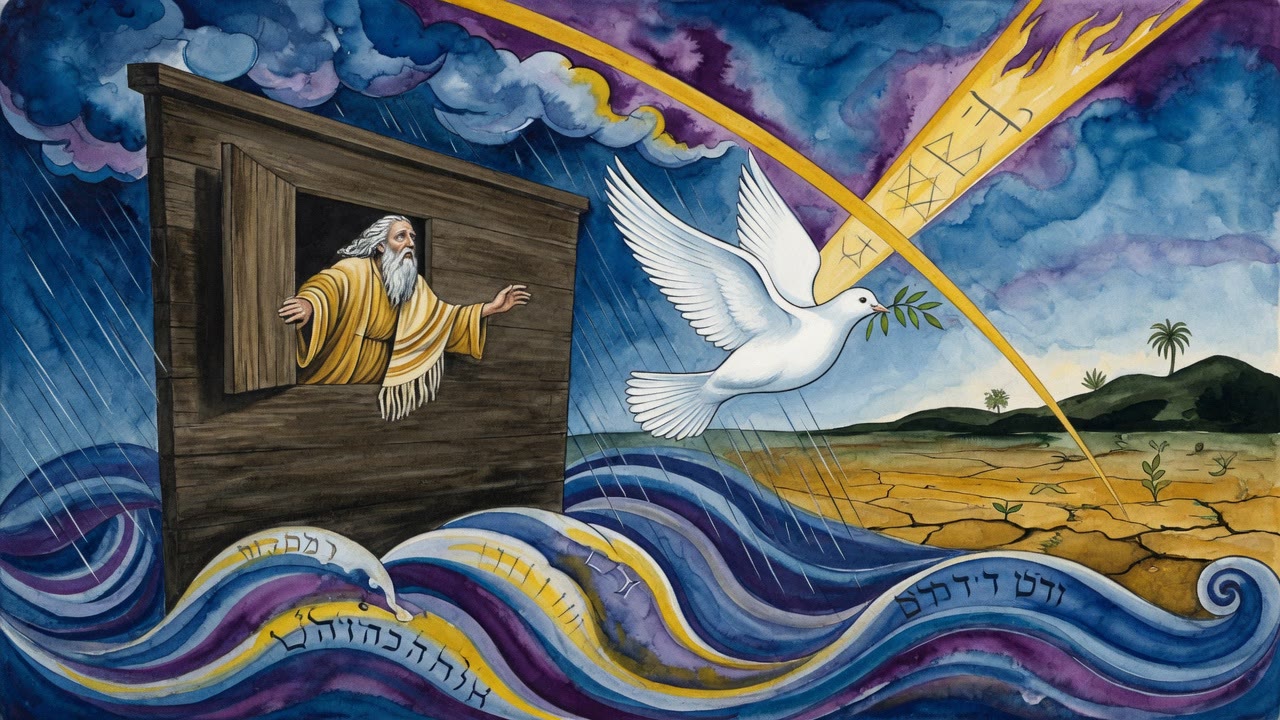
The raven went out through the window first and did not come back.
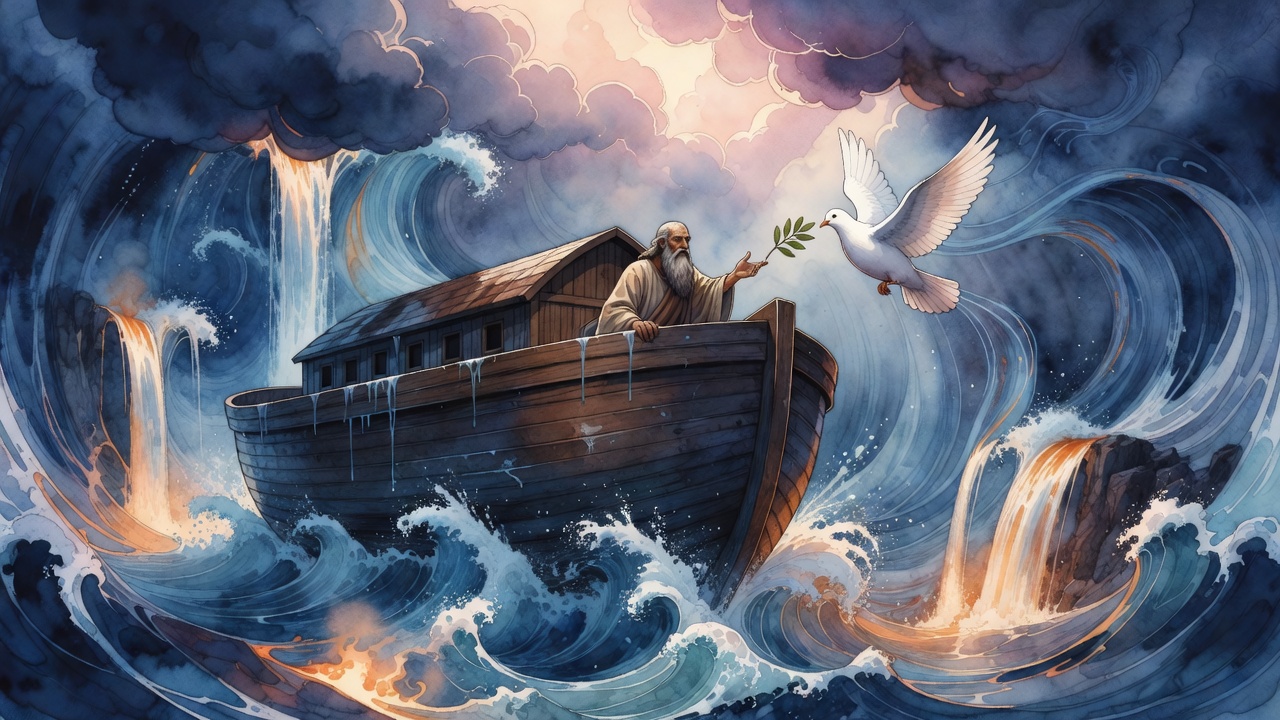
The Dove Finds No Rest Until the Waters Close Click for full size

Noah stood at the opening with his hand still raised from the throw and watched the black shape shrink over water that had no edge anywhere. It did not circle. It did not hunt for the ark. It went out over the drowned world the way a man walks into a room he has been waiting all year to enter.

Forty Days, Then a Hundred and Fifty More

The counting had started long before that. For forty days the waters of punishment came down without a pause, the lowest fountains of the earth split open from beneath and the cataracts of heaven torn open above, until flat country and mountain country lay under the same lid.

Then the pouring changed. It did not stop. For a hundred and fifty days after that the streams kept running and the springs kept bursting upward, gently now, not adding a finger's height to the flood, only holding it where it stood. A flood does not keep itself. It has to be fed. Under the hull the veins of the earth went on quietly feeding it, and over the roof the sky went on doing the same, and between the two of them the water stayed exactly as deep as it had been made.

Noah scraped troughs and hauled fodder and cut days into a board with a nail. The ark rocked. Nothing outside changed.

The Bird That Liked It Out There

A raven is not a swan. It is not an ibis. It has no oil in its feathers for a life on open water and no long legs for wading, and every instinct it owns should have driven it back to the only roof left in the world.

It never came. Noah waited at that window through a run of days for a bird that had gone out while the calamity was still at its height and had found the calamity comfortable. Wickedness goes out of doors into the whirlpool and finds friends there. It settles in among the vices as though it were meeting relations it had not seen in years, and it does not look back at the door it left open.

"He is not coming," Noah's wife said. Noah shut the window.

The Dove Came Back With Nothing

He sent the dove after. She went out low over the gray and was gone a long time, and then there was a small commotion at the sill and she was there, shaking, with nothing in her mouth.

The dove found no rest for the sole of her foot, and she returned unto him into the ark (Genesis 8:9). Noah put out his hand and she stepped into it. Her feet were dry. She had not stood anywhere.

That is the harder fact of the two birds. If the dove, sent last, after the water had already begun to obey, could not find one dry stone to put a foot on, then the raven who left earlier had nowhere either. It simply did not mind. Virtue turns away from the whirlpool at first sight of it and springs straight back, scarcely finding rest for its feet, finding no ground anywhere in the world worth standing on. And nothing is worse than that: a soul so flooded that goodness cannot find in it one small place to sit down.

Noah held the bird against his chest until she stopped shaking.

The Day Both Mouths Were Shut

Then the hundred and fiftieth day came, and the fountains of the deep were closed, and the cataracts of heaven were restrained (Genesis 8:2). Both reservoirs at once. The one under the earth and the one over the sky, shut in the same hour, because a flood still fed from two directions will never drain no matter how long a man waits at a window.

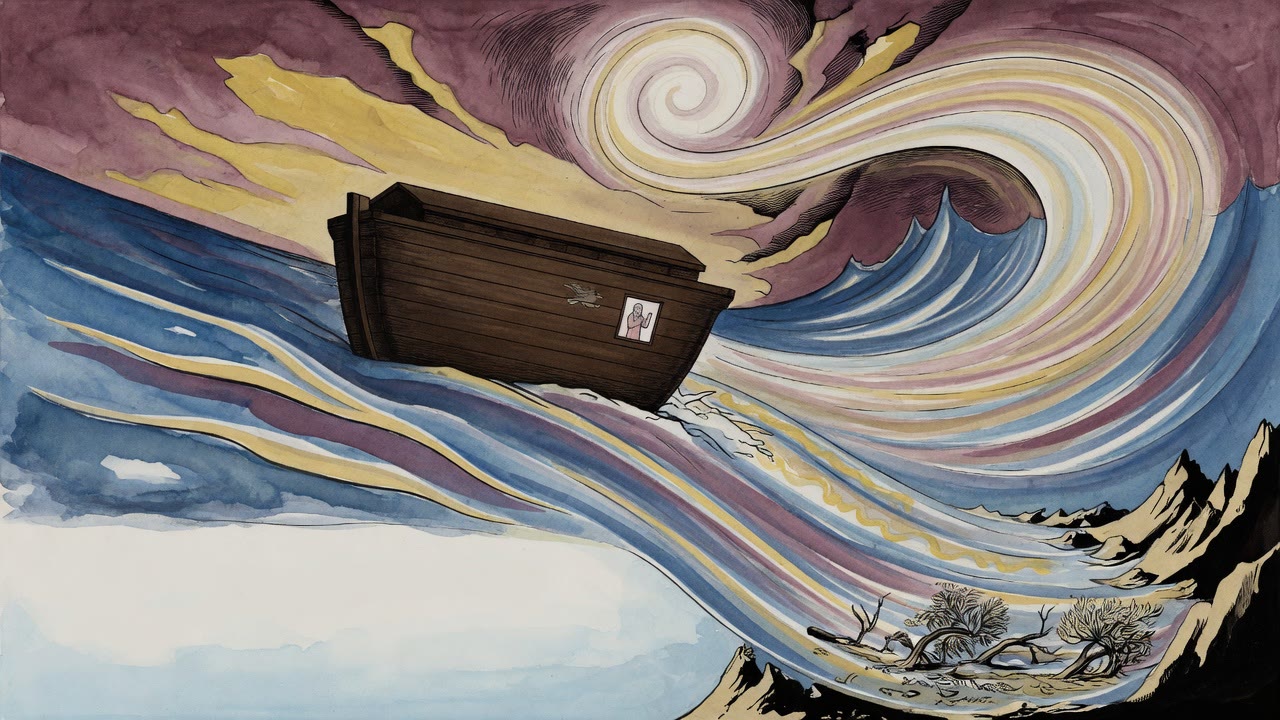
Cut off from its sources, the water began to eat itself. Noah felt the change in the hull before he saw it anywhere else, a heavier and slower roll, and then one morning a jolt that put every animal on its feet at once as the ark took the top of a mountain and stopped moving.

Blood Left in the Grass

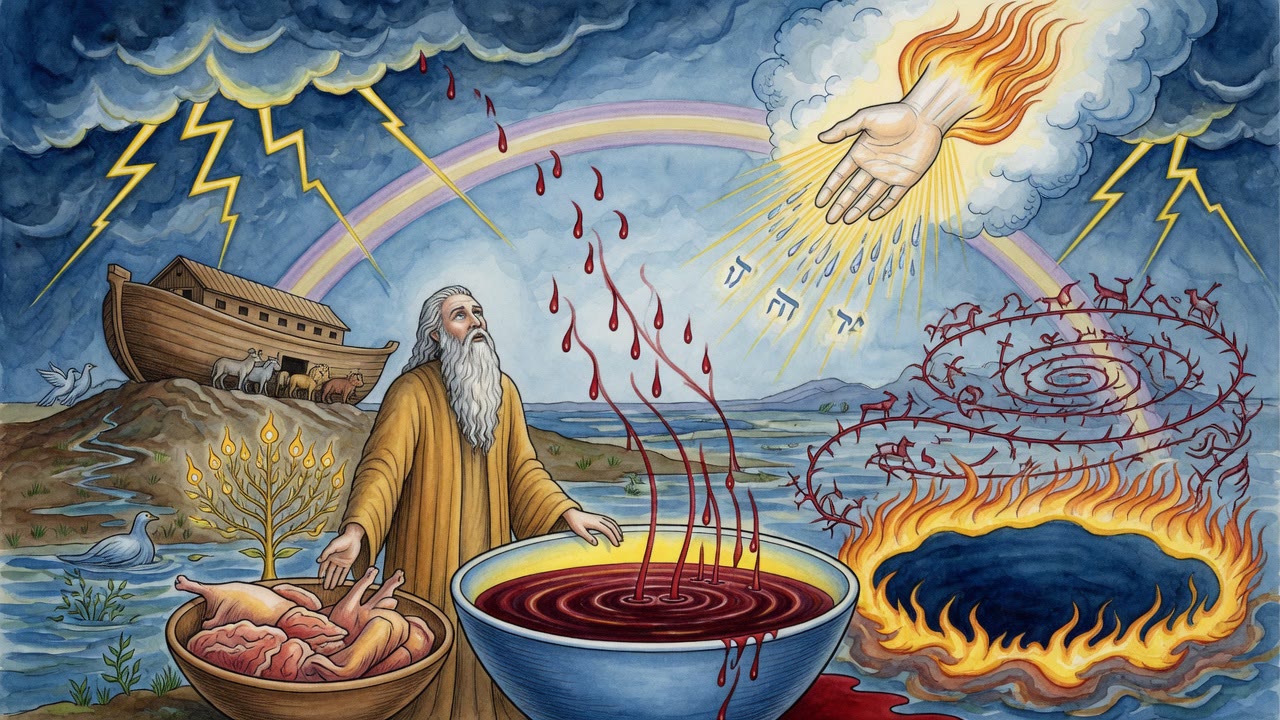
When they came out onto ground that was still soft, God gave them meat, and then took something back out of the gift. Flesh with its life in it, which is its blood, they were not to eat (Genesis 9:4).

Blood is the substance of a soul. Not the whole of one. A man has a part that feeds him, a part that sees and hears and wants, and a part that reasons, and only the last of those came into Adam when God breathed into his face the breath of life. The blood carries the middle part, the one that craves, which is why flesh holds senses and appetites and no thoughts at all. Spirit and blood are two different things, and even so the spirit does not sit apart in some private chamber of the body. It runs mingled through the blood, more of it in one vessel and less in another, out to the ends of a man.

So Noah drained the animal into the grass while his sons watched, and what soaked away was not waste. "Let it go," he said. "That was never ours to swallow."

He had spent a year inside a sealed hull watching what water does when nothing shuts it off. He knew the shape of an appetite with no door on it. A man who lets the belly govern him ends flat against the ground licking up earth like a creeping thing, and closes his life without ever tasting the food that comes from above.

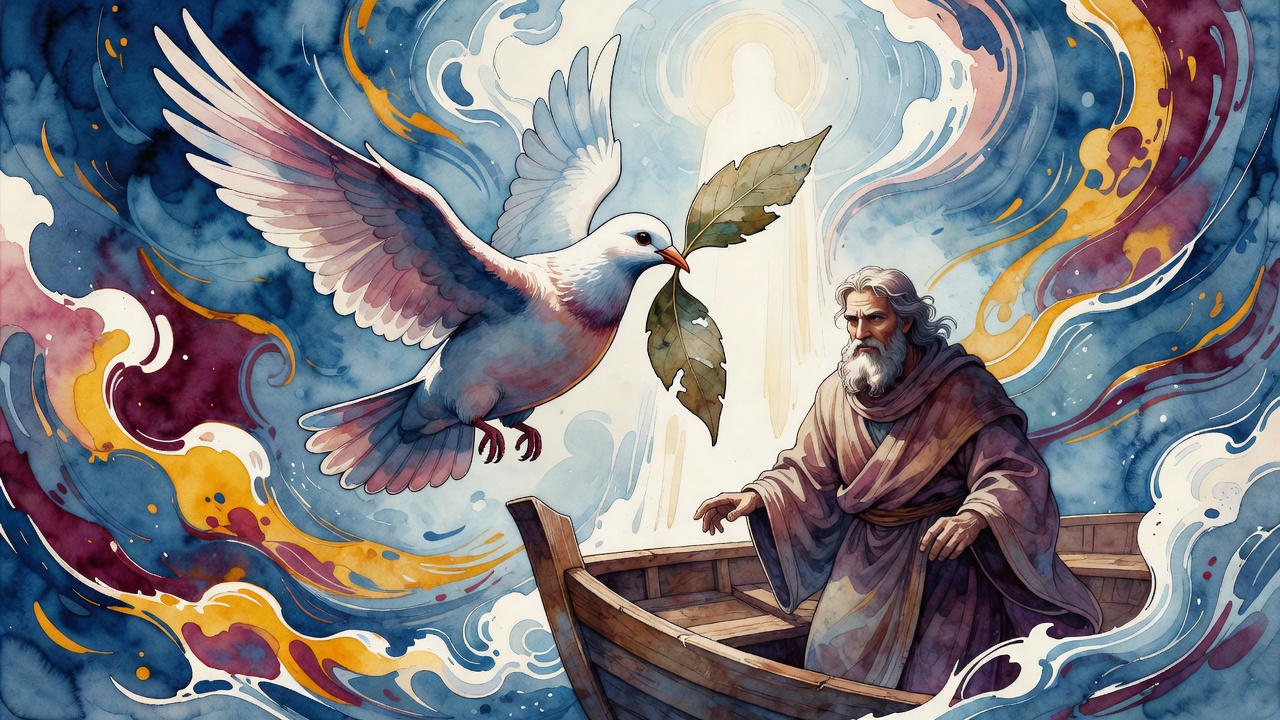
The dove went out a second time and came back with an olive leaf in her beak. The third time she did not come back at all, and now it was because she finally had somewhere to stand.


← All myths
From the tradition

Sources

6 sources

The texts behind this telling. Some cards carry a translation of the source; others are our own retelling of it, and each card says which. Every card links out to the original.

The Midrash of Philo 2:1The Midrash of Philo

Retold in our words. Read the original at the link below.The Works of Philo Judaeus, trans. C. D. Yonge, London, H. G. Bohn, 1854-1890 · Public Domain

The Midrash of Philo asks: What is the meaning of "The fountains of the deep were closed, and the cataracts of heaven"? (Genesis 8:2).

The source holds the question on the closing of waters. Further flood logistics are not in this line.

Full source
The Midrash of Philo 2:2The Midrash of Philo

Retold in our words. Read the original at the link below.The Works of Philo Judaeus, trans. C. D. Yonge, London, H. G. Bohn, 1854-1890 · Public Domain

Philo, a Jewish philosopher who lived in Alexandria in the first century CE, delved into these questions. He wrote extensively on the Torah, often offering allegorical interpretations alongside the literal readings. And in his writings, he gives us a fascinating breakdown of the flood's timeline and sources.

In Philo, the deluge wasn't just a simple rainstorm. It was a carefully orchestrated event with two distinct phases. First, for forty days, the "waters of punishment" fell relentlessly. The lowest fountains of the earth burst open, and the "cataracts of heaven" poured down (Gen 7:11). It was a complete and utter inundation, covering everything, from the plains to the mountains.

Then came a second phase, lasting a full 150 days. The waters continued to flow, but at a reduced rate. They weren't adding to the flood's height, but rather sustaining it. Philo says these waters ensured "the duration of the existence of the deluge." Then, after those 150 days, the fountains and cataracts were closed up.

Where did all that water originate? Philo points to a "double reservoir" – one source from the earth and another from the heavens. He saw these as the primary suppliers of the deluge. The idea of these massive, almost unimaginable, reservoirs being unleashed.

Philo doesn't stop at the literal interpretation, though. He was a master of allegory, finding deeper meanings within the biblical text. He suggests that the flood also represents a "deluge of the mind." This internal flood arises from two sources: our intellect ("counsel, as if from heaven") and our physical desires and senses ("the body and from sense, as if from earth"). Vices fuel passions, and passions fuel vices, creating a destructive cycle.

So, what's the solution? Just as God closed the earthly and heavenly reservoirs, the "divine physician" – God's word – must intervene to prevent future overflows of the mind. This divine intervention stems the tide of our negative inclinations. Philo equates this to a doctor treating a disease by removing its cause. The goal is to eliminate the source of the problem, not just treat the symptoms.

He even draws a parallel to the laws concerning leprosy. When leprosy is contained, the leper's movements are restricted to a specific place. Philo sees this "stationary" state as representing cleanliness, because "that which is moved contrary to nature is unclean." In other words, by controlling our impulses and staying true to our nature, we can achieve a state of inner purity.

Philo’s interpretation invites us to consider the flood not just as a historical event, but as a metaphor for our own internal struggles. Are there "reservoirs" within us that need to be managed? What steps can we take to prevent our own "deluges of the mind"?

Full source
The Midrash of Philo 9:1The Midrash of Philo

Retold in our words. Read the original at the link below.The Works of Philo Judaeus, trans. C. D. Yonge, London, H. G. Bohn, 1854-1890 · Public Domain

The Midrash of Philo asks: Why did the dove, when it found no rest for its feet, return to Noah? (Genesis 8:9).

The source is the question. Flood theology and the Shechinah are not asserted in this line.

Full source
The Midrash of Philo 9:2The Midrash of Philo

Retold in our words. Read the original at the link below.The Works of Philo Judaeus, trans. C. D. Yonge, London, H. G. Bohn, 1854-1890 · Public Domain

The Midrash of Philo turns to The Raven That Never Returned From Noah's Ark.

The Midrash of Philo, a collection of interpretations and elaborations on the Hebrew Bible attributed to the Jewish philosopher Philo of Alexandria, offers a fascinating perspective. It's not just a simple weather report from Noah! It’s a symbolic tale of virtue and wickedness, played out by birds.

The Midrash The dove, sent out last, can't find rest. So how could the raven, who left earlier, when the flood was still raging, possibly find a place to settle?

The passage points out that the raven isn't a swan or an ibis, aquatic birds suited for a watery world. So what's going on?

The Midrash explains, in a somewhat cryptic way, that wickedness, once unleashed into the chaotic whirlpool of vices and passions that overwhelm the soul, welcomes them with open arms. It makes itself at home, as if surrounded by its closest friends. But virtue? Virtue recoils at the very sight of such corruption. It immediately retreats, unable to find any solid ground, any place worthy of itself.

Wickedness thrives in chaos, while virtue seeks stability and purity. The raven, representing wickedness, finds fertile ground in the destructive floodwaters of our base desires. It’s comfortable in the muck.

The dove, on the other hand, representing virtue, can’t find a foothold. It needs solid ground, a place of peace and order.

The Midrash then asks a chilling question: What greater evil could there be than virtue being unable to find even the smallest space within the soul to rest and abide? It's a stark reminder that if we don't cultivate a space for virtue within ourselves, wickedness will gladly take over.

So, the next time you hear the story of Noah and the Ark, remember the raven and the dove. They're not just birds. They're powerful symbols of the constant battle raging within each of us. The choice, ultimately, is ours: will we offer a haven for virtue, or let wickedness run rampant? What kind of bird are we feeding today?

Full source
The Midrash of Philo 4:1The Midrash of Philo

Retold in our words. Read the original at the link below.The Works of Philo Judaeus, trans. C. D. Yonge, London, H. G. Bohn, 1854-1890 · Public Domain

The Midrash of Philo preserves this as a question on Scripture, not a finished ruling:

What is the meaning of the expression, "You shall not eat flesh in the blood of its life?" (Genesis 9:4).

The entry records the question Philo poses. It does not supply an answer the source does not give.

Source: The Midrash of Philo 4:1.

Full source
The Midrash of Philo 4:2The Midrash of Philo

Retold in our words. Read the original at the link below.The Works of Philo Judaeus, trans. C. D. Yonge, London, H. G. Bohn, 1854-1890 · Public Domain

A fascinating corner of this exploration, guided by the writings of Philo of Alexandria, a Jewish philosopher who lived in the first century CE. He offers a unique perspective on the nature of the soul, drawing on both Jewish scripture and Greek philosophical thought.

Philo grapples with the question of where exactly the soul resides, and what it's made of. He suggests that God, in His commands, hints that blood is the substance of the soul – but only a certain kind of soul. Specifically, the soul connected to our senses and our vitality. What about the rational, intellectual soul? That, according to Philo, is something else entirely.

He posits that we humans actually have a tripartite soul – three parts! There's the nutritive part, concerned with basic survival; the part connected to our senses; and then, the highest part, the one that dwells in reason. It’s this rational part that, according to Philo, echoing the sacred writer Moses, is "the substance of the divine spirit." Remember the creation story? "God breathed into his face the breath of life" (Genesis 2:7). That breath, Philo suggests, is what constitutes our rational life.

What about the blood? Well, according to Philo, "The blood exists in every breath of flesh." (Deuteronomy 12:23). He emphasizes that blood is the "breath of all flesh" precisely because our flesh is where we experience senses and passions, but not intellect or higher thought.

And here's where it gets even more interesting. Philo distinguishes between the spirit and the blood, saying that "the spirit of blood" intimates that they are two distinct things. The essence of the soul, he argues, is truly spirit. However, this spirit isn't separate from the body. It's interwoven and mingled with the blood. It's all connected!

He uses the analogy of veins and "breathing channels" – perhaps he means arteries and veins – to illustrate this. These vessels carry both air and blood, each in different proportions, a carefully balanced mixture. Philo's description sounds remarkably like an ancient, philosophical take on the circulatory system!

But then, Philo takes a turn towards the metaphorical. He suggests that the "blood of the soul" can also be seen as that warm, fiery virtue we call courage. Someone filled with this courage, this wisdom, will despise fleeting pleasures, focusing instead on higher pursuits.

Conversely, someone who lives a profligate life, wandering aimlessly and indulging in laziness, is simply "fall[ing] upon his belly, as a reptile creeping upon the earth, and greedily licking up earthly things." Such a person, Philo argues, closes their life without ever tasting that "heavenly food" that souls desirous of wisdom receive.

He paints a picture of humanity as complex beings, with different layers to our souls. He urges us to strive for the highest part, the rational part connected to the divine, rather than being consumed by earthly desires. It's a call to live a life of purpose, guided by reason and a thirst for wisdom. It's a reminder that we are more than just flesh and blood; we are also vessels of the divine breath.

Full source