5 min read

Noah's Dove Found an Olive Leaf Where the World Survived

The dove returned to Noah with a torn olive leaf, proof that somewhere beyond the flood a living world had refused to drown.

Curated by Arthur · Told by Maggid ·
Table of Contents
  1. The Dove Came Back Empty
  2. Seven More Days Passed
  3. A Leaf Torn From Life
  4. The Light Returned at Evening
  5. The Bird Found a World

The raven found the drowned world useful.

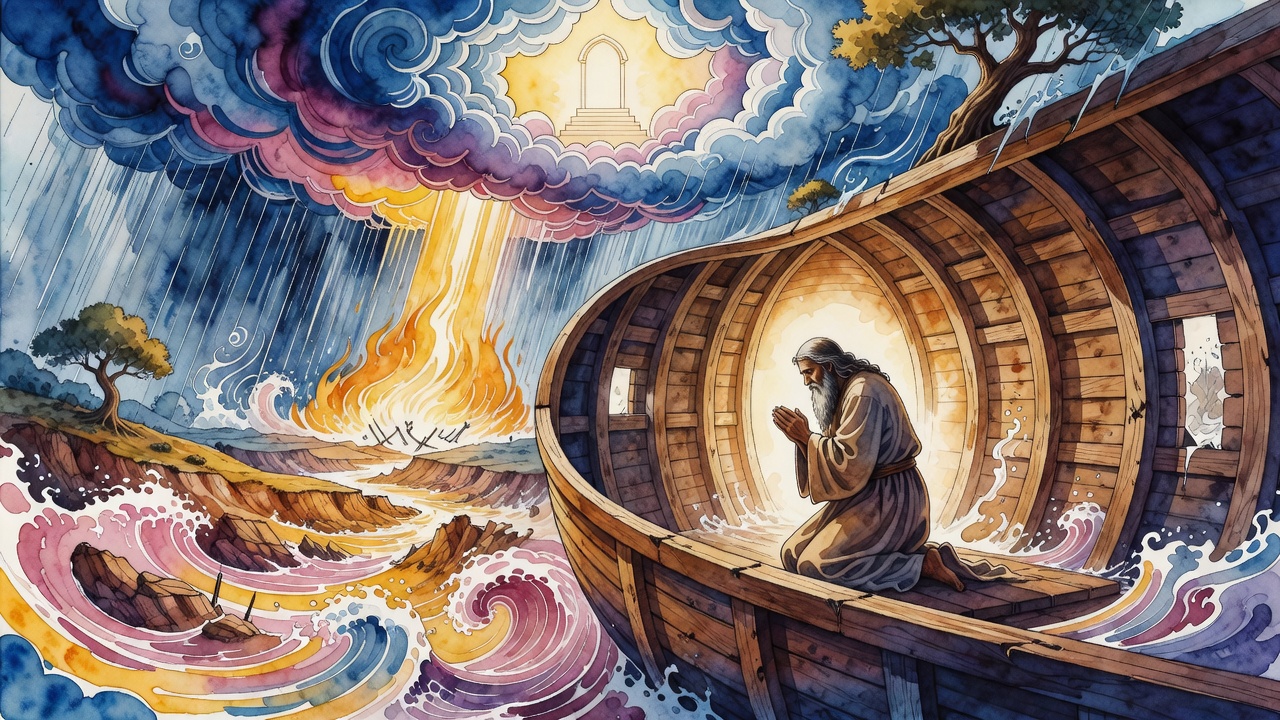
Noah opened the window after the waters had begun to fall and sent it out first. The bird circled over the ruined earth, going and returning, never really accepting the errand. There was food everywhere for a raven. Death floated on the surface. The mission asked for news of life, but the raven had found a feast among the dead.

Noah waited. Then he sent the dove.

The Dove Came Back Empty

The first flight ended with exhaustion. The dove crossed the gray water and found no place for her foot. No branch. No roof. No stone warmed by sun. Nothing solid enough to receive the weight of a living creature.

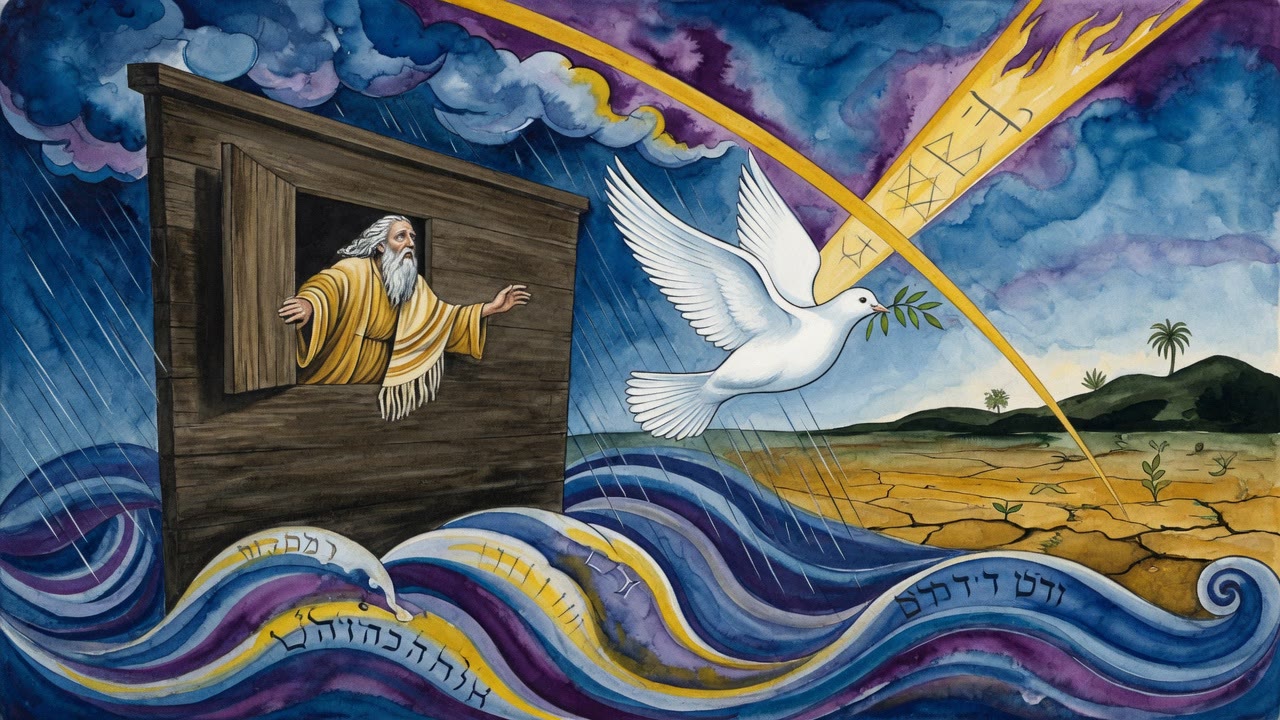
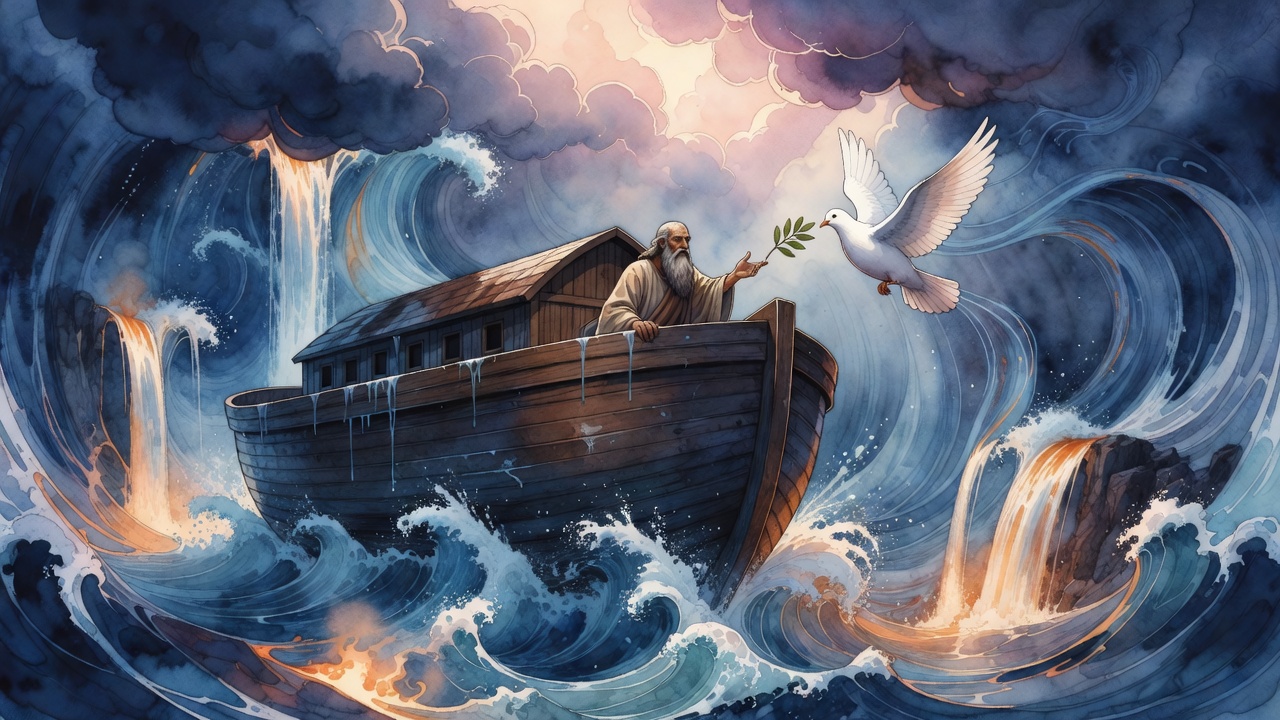
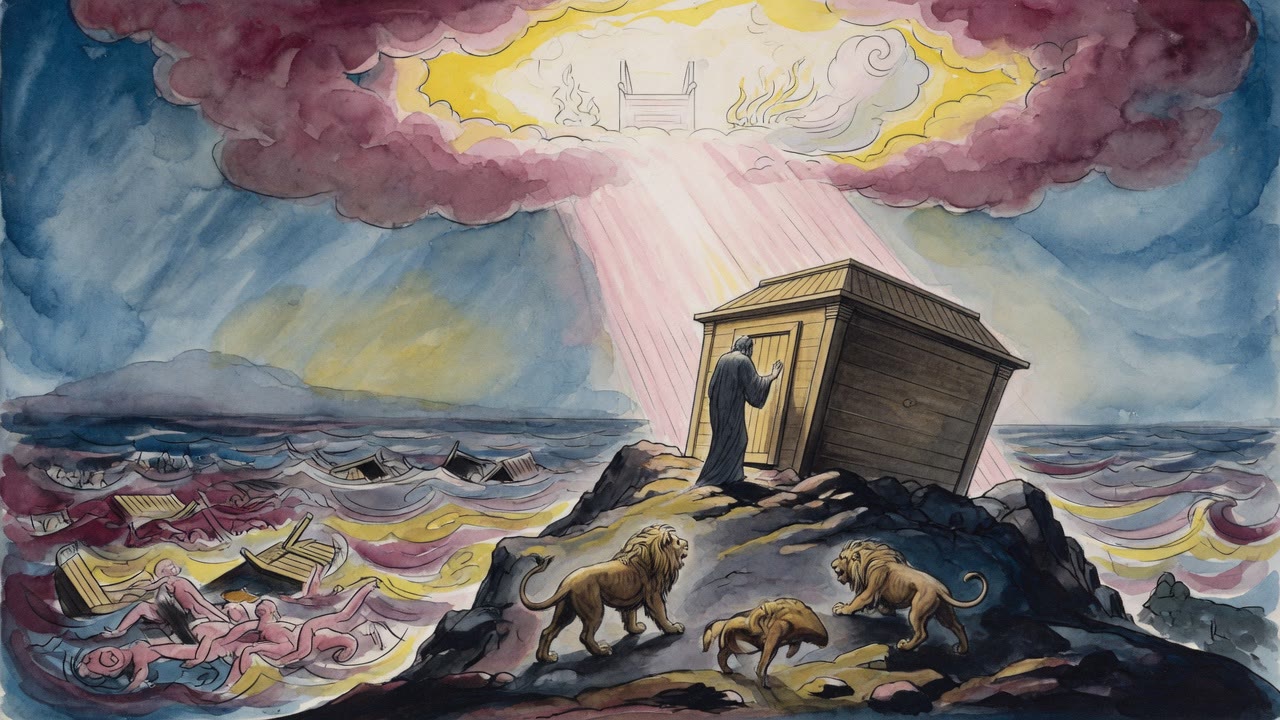
She returned to the ark, and Noah stretched out his hand. That gesture mattered. A man who had watched the world vanish did not merely take back a bird. He received the failure of the first hope and kept it alive. The dove had not found rest. So she came home.

If she had found rest, the sages said, she would not have returned.

Seven More Days Passed

Noah waited another seven days. Time inside the ark did not move like ordinary time. Every week was measured by breath, boards, animal hunger, and the question pressing against the sealed door. Was the world still outside, or had the ark become the whole world?

He opened the window again.

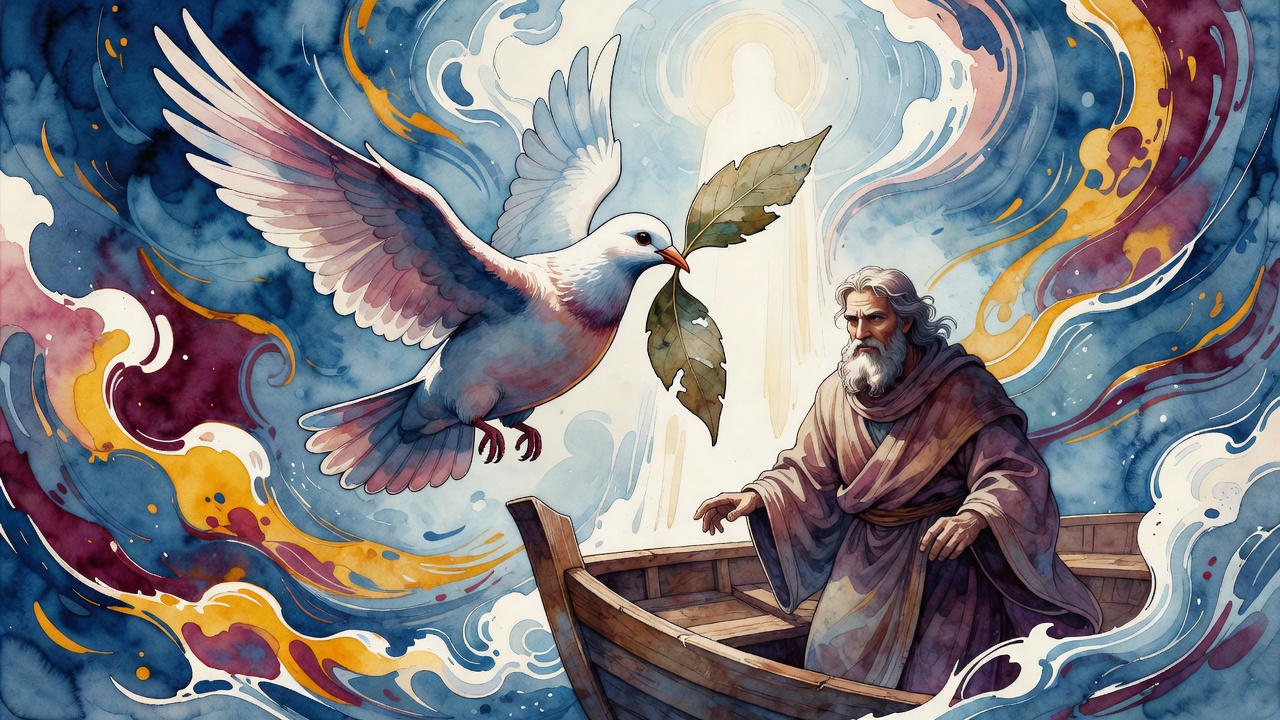
The dove went out into evening light and came back carrying an olive leaf in her mouth. Not a vague green thing. An olive leaf. Torn. Fresh. Wet with the world that had survived beyond Noah's reach.

The ark changed when she entered. The animals still shifted in their stalls. The wood still smelled of confinement. But now a branch of the future was inside.

A Leaf Torn From Life

The word for the leaf is sharp. It can mean plucked. It can sound like torn flesh, like Jacob's cry when he believed Joseph had been mauled. The dove did not bring a painting of peace. She brought a wound from a living tree.

The rabbis argued over where she found it. Some said the Land of Israel had not been swallowed like the rest. Some said she reached the Garden of Eden. Another tradition placed the leaf on the Mount of the Messiah. Each answer guarded the same claim: somewhere, under judgment, life had remained attached to its root.

The dove killed a small future to announce a larger one.

The Light Returned at Evening

The dove came at evening, and the sages heard light in that hour. A dove had brought light back to the world. Israel too could be called a dove, carrying a sample of light into places still dark from their own floodwaters.

Noah understood. The waters had abated. The earth was not ready for dancing, planting, and children all at once, but it was no longer only a grave. One leaf had crossed the distance between destruction and return.

Seven days later, Noah sent the dove again. This time she did not come back.

The leaf also answered the ark's worst fear. A vessel can preserve life, but it cannot prove that life has anywhere to go. The ark had become a crowded mercy, full of breathing creatures with no visible future. The olive leaf entered as a small contradiction to despair. It said that roots had held somewhere. It said the ground was not finished speaking.

Noah could not yet step out. Obedience kept him inside. But hope had already flown farther than obedience allowed.

The Bird Found a World

Her absence was the final message. The first return had meant no rest. The second return had meant hope. The third non-return meant the world could hold life without the ark's hand drawing it back through the window.

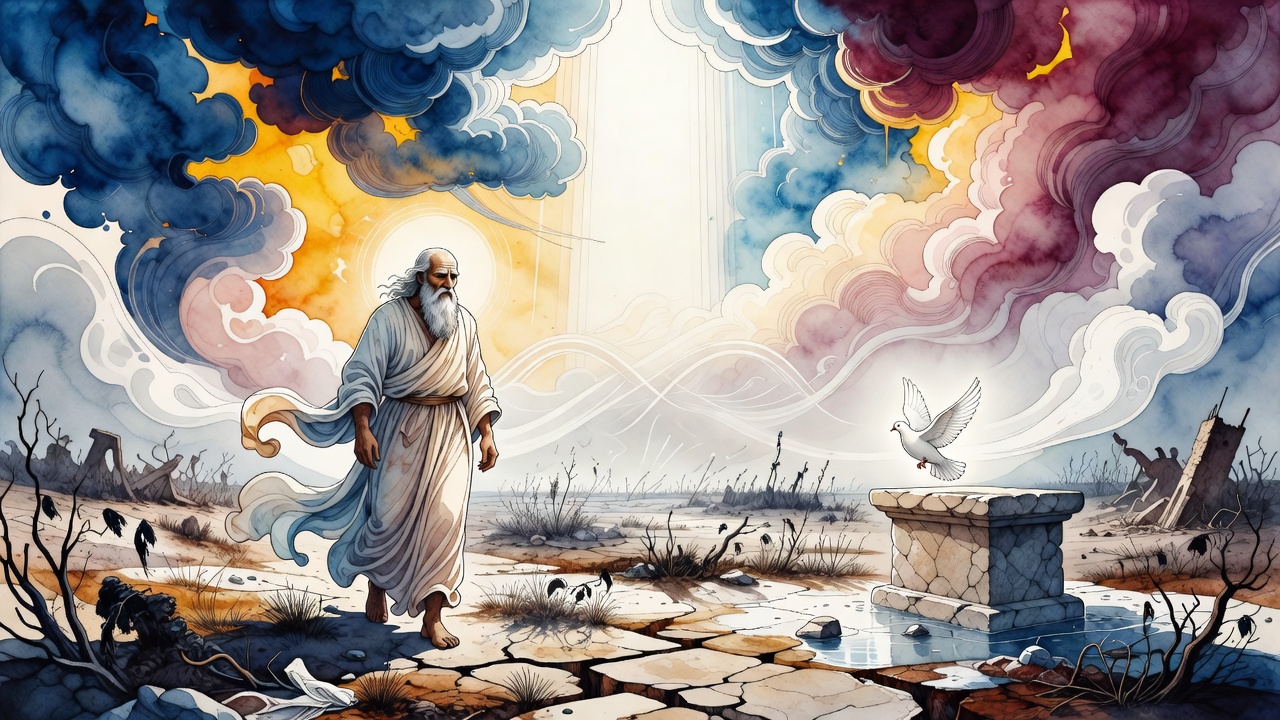
Noah remained inside until God told him to leave. The dove had already crossed the threshold he could not cross on his own. She had flown over graves and found a tree. She had carried one torn leaf through evening. Then she vanished into the living world and made her silence speak.

The ark had protected bodies. The dove brought back geography. After months of water, one leaf was enough to prove that earth could become home again.


← All myths

From the tradition

Sources

8 sources

The texts this telling draws on, in full. Open a card to read inline, or expand it for a wider, quieter read.

Bereshit Rabbah 33:6Bereshit Rabbah

The story of Noah's Ark and the dove, as told in Genesis, is layered with meaning, and the Rabbis of the Midrash (rabbinic interpretive commentary) find deep lessons in even the smallest details. The Torah tells us, "He sent the dove from him, to see if the water abated from upon the surface of the ground" (Genesis 8:8). But the dove, "did not find rest for its foot, and it returned to him to the ark" (Genesis 8:9). Now, Bereshit Rabbah, a classic collection of Rabbinic interpretations of Genesis, picks up on this. Rabbi Yehuda bar Naḥman, quoting Rabbi Shimon, makes a powerful connection: "Had it found rest, it would not have returned." It's not just about a bird and a flood. It's about the human condition. Rabbi Shimon extends the analogy to the Jewish people in exile. "It dwells among the nations, finding no rest" (Lamentations 1:3) – because, had it found rest, it would never have returned [from exile]! Similarly, (Deuteronomy 28:65) says, "and among these nations you will not be calm, and there will be no rest.." But, had they found rest, they would never have returned.

It’s a bittersweet idea, isn’t it? That perhaps a little bit of discomfort, a little bit of yearning, is what keeps us connected to our true home, to our purpose.

Then, the story continues. "He waited yet another seven days and again sent the dove from the ark. The dove came to him at evening time, and behold, it had a plucked olive leaf in its mouth; and Noah knew that the water had abated from upon the earth" (Genesis 8:10-11).

Rabbi Yosei points out a detail easily missed: there were actually three sets of seven days involved in sending out the dove. And then there's that olive leaf. The Torah says it was taraf (Genesis 8:11), which literally means "plucked." What does that mean? Some say it means "killed," like in (Genesis 37:33), when Jacob cries out "Joseph had been mauled [tarof toraf]!" The plucking of the leaf led to the tree’s death.

But where did the dove even find an olive leaf after a devastating flood? The Rabbis offer several fascinating possibilities. Some say it came from the Land of Israel, which, according to Rabbi Levi, wasn't entirely inundated. He specifies the Mount of Olives as the source. After all, God says to Ezekiel (22:24): "It is a land that has not been purified, that was not rained upon on the day of fury."

Rav Beivai goes even further, suggesting the gates of the Garden of Eden opened for the dove!

Rabbi Abbahu, however, raises a skeptical eyebrow. If it came from Eden, wouldn’t the dove bring back something more impressive, like cinnamon or balsam? So, he offers a different interpretation: the dove is teaching Noah a lesson. "Better this bitter item, and not something sweet dependent upon your hand." In other words, it's better to work for your own sustenance, even if it's meager, than to rely on handouts.

Isn't that a powerful message?

Finally, "He waited yet another seven days and sent the dove, and it did not return again to him anymore" (Genesis 8:12). Again, Rabbi Yosei bar Ḥanina’s point about the three sets of seven days is reinforced. The dove found its place. Its mission was complete.

So, what does it all mean? The story of Noah's dove is more than just a children's tale. It's a reminder that sometimes, a little bit of "unrest" can be a good thing. It can keep us connected to what truly matters. And it's a lesson in self-reliance, finding value in even the "bitter" things we earn ourselves. Next time you see a dove, remember this ancient story and the wisdom it holds. What "olive leaf" are you striving for?

Full source
Shir HaShirim Rabbah 15:4Shir HaShirim Rabbah

We see it everywhere, from synagogue art to holiday decorations. But have you ever stopped to consider why?

Well, the source enters a fascinating passage from Shir HaShirim Rabbah – the classic Rabbinic commentary on the Song of Songs. It all starts with the verse, “Your eyes are like doves.” The Rabbis ask, what's so special about doves?

The text explains: "Just as the dove brought light to the world, you, too, bring light to the world, as it is stated: 'The nations will walk by your light' (Isaiah 60:3)." The dove, a simple bird, is associated with bringing light to the entire world! How? By being the bearer of good news after the Flood.

When did the dove bring this light, this hope? During the time of Noah, of course. Remember the story? The dove returns to the ark "at evening time and behold, there was an olive leaf plucked [taraf] in its mouth” (Genesis 8:11).

But here's where it gets interesting. The text explores the meaning of that word, taraf. The root tet-resh-pei, it points out, can mean both "food" and "killing." It’s a little unsettling. The text then references the verse where Jacob exclaims “Joseph was mauled [tarof taraf]” (Genesis 37:33).

Rabbi Berekhya even suggests that the dove killed the branch! But why? “Had it not killed it," he says, "it would have become a great tree." Talk about a dramatic interpretation! The idea is that the dove brought a leaf from a living tree, a symbol of hope and renewal.

So where did this precious olive branch come from? Rabbi Levi has an answer: it came from the Land of Israel. He points out that the Land of Israel was spared from the devastation of the Flood. As people say, "The Land of Israel was not stricken with the flood waters." (Ezekiel 22:24) seems to support this, referring to a land "that has not been cleansed, that has not been rained upon on the day of fury."

Rabbi Yoḥanan, however, paints a more devastating picture, stating that "Even the lower millstones were dissolved in the water." So, if any tree survived, it had to be from the Land of Israel!

But wait, there's another theory! Rabbi Taryi suggests the dove brought the olive branch from… the Garden of Eden itself!

Now, Rabbi Aivu isn't buying it. He argues, if the dove was coming from Gan Eden (the Garden of Eden, paradise), shouldn't it have brought back something a bit more… impressive? Cinnamon? Balsam? Something really special?

Instead, Rabbi Aivu suggests the dove was sending a message to Noah: "My master, Noah: [It is preferable to have something] bitter from this [tree] from the hand of the Holy One blessed be He, and not [something] sweet from your hand."

Wow. Even something simple, even something "bitter," that comes from God is better than something wonderful that comes from anywhere else. The dove, in its simple act, teaches us a profound lesson about faith, acceptance, and finding light even in the darkest of times. It's a reminder that even the smallest of gestures can carry immense meaning, and that true hope comes from connection to something greater than ourselves. What "olive branch" are you holding out to the world?

Full source
Yalkut Shimoni on Torah 375:6Yalkut Shimoni on Torah

Another explanation: "Your eyes are doves." The Holy One, blessed be He, said to her: Your likeness resembles a dove. One who wishes to buy wheat says to his fellow, show me a sample of them; so too you, your sample resembles a dove. How so? When Noah was in the ark, what is written? "And the dove came in to him at the time of evening, and behold an olive leaf [was in its mouth]" (Genesis 8:11). The Holy One, blessed be He, said to her: Just as the dove brought light into the world, so you, who are likened to a dove, bring olive oil and kindle it before Me, as it is said, "And you shall command" and so forth (Exodus 27:20).

Full source
Midrash Aggadah, Genesis 8:9Midrash Aggadah

"And he sent out his hand" (Genesis 8:9). In the future the Holy One, blessed be He, is destined to send forth a hand and bring them to Him, as it is said, "And it shall come to pass on that day that the Lord shall set His hand again the second time to recover the remnant of His people" (Isaiah 11:11). And just as Noah waited seven days and again sent out the dove from the ark, so shall Israel pass through seven chastisements and be redeemed, as it is said, "then I, even I, will chastise you seven times for your sins" (Leviticus 26:28). And just as Noah waited, so does Israel wait hopefully for the Creator, blessed be His name, as it is said, "Let Israel hope in the Lord" (Psalms 130:7). And just as the dove came at evening time, so Israel, as it is said, "And it shall come to pass that at evening time there shall be light" (Zechariah 14:7).

Another interpretation: "And lo, in her mouth an olive leaf freshly plucked" (Genesis 8:11). Those nations who are set above them, as it is said, "The stranger that is in your midst shall mount up above you higher and higher" (Deuteronomy 28:43), and Israel, bitter as an olive, are destined to be torn in their mouths, as it is said, "Behold, a day comes for the Lord, and your spoil shall be divided in your midst" (Zechariah 14:1).

Full source
Targum Jonathan on Genesis 8Targum Jonathan

When the Flood ended, the Hebrew Bible says God sent a wind to dry the earth (Genesis 8:1). The Targum Jonathan says God sent "the wind of mercies." One word changes the theology. The Hebrew wind is neutral, functional. The Targum's wind carries divine compassion. Even the weather is moral in this translation.

The geography gets specific too. The Hebrew says the ark rested on "the mountains of Ararat." The Targum replaces this with "the mountains of Qadron" and names both peaks: Qardania and Irmenia. Then it adds that "there was builded the city of Armenia in the land of the east." The translators were mapping mythic geography onto the real world they knew, placing the ark's landing in territory familiar to Aramaic-speaking Jews.

The most remarkable addition is the olive leaf. In the Hebrew, Noah's dove returns with an olive leaf in its mouth (Genesis 8:11). That is all. The Targum says the dove "brought in her mouth" a leaf "which she had taken from the Mount of the Meshiha", the Mount of the Messiah. This tiny insertion links the end of the Flood to messianic hope. The first sign of new life on earth came from the mountain of the future Redeemer. The translators wove eschatology into a nature scene.

The Targum also rebuilds the altar. The Hebrew says Noah built an altar and offered sacrifices (Genesis 8:20). The Targum says he rebuilt Adam's original altar, "that altar which Adam had builded in the time when he was cast forth from the garden of Eden." Cain and Abel had offered their famous sacrifices on the same altar. The Flood destroyed it, and Noah restored it. This creates an unbroken chain of worship from the first human to the first survivor, all at a single sacred site.

The seasonal promise at the chapter's end gets the Targum's calendar treatment: "sowing in the season of Tishri, and harvest in the season of Nisan, and coldness in the season of Tebeth, and warmth in the season of Tammuz." The Hebrew mentions seasons generically. The Targum pins them to Jewish months, as if the post-Flood world was designed around the Hebrew calendar from the start.

Full source
Yalkut Shimoni on Torah 59:1Yalkut Shimoni on Torah

"And the dove found no resting place" (Genesis 8:9). Had she found a resting place, she would not have returned. And similarly, "She dwells among the nations, she found no rest" (Lamentations 1:3)? had they found rest, they would not have returned. And similarly, "And among those nations you shall have no repose, and there shall be no resting place for the sole of your foot" (Deuteronomy 28:65)? had they found a resting place, they would not have returned.

"And he waited yet another seven days" (Genesis 8:10): three weeks of days in all. "And behold, in her mouth was an olive leaf, plucked off [taraf]" (Genesis 8:11). What is taraf? Killed, as you say, "Joseph is surely torn in pieces [tarof toraf]" (Genesis 37:33). She said to him: had I not killed it [the branch], it would have become a great tree. From where did she bring it? Rabbi Levi says: she brought it from the young shoots in the Land of Israel. This is what people say: the Land of Israel was not submerged in the waters of the Flood. This is what is written, "You are a land not cleansed, not rained upon on the day of wrath" (Ezekiel 22:24). Rav Bibi said: the gates of the Garden of Eden were opened to her, and from there she brought it. But could she not have brought something choice, such as cinnamon or balsam? Rather, she gave him a hint, saying to him: My master, better is bitterness from under the hand of the Holy One, blessed be He, than sweetness from under your hand.

"And he waited yet again" (Genesis 8:12): this supports the one who says three weeks. "And it came to pass in the six hundred and first year" (Genesis 8:13). We learned: the judgment of the generation of the Flood was twelve months. How so? "In the six hundredth year of Noah's life" and so on, and it is written, "And the rain was upon the earth forty days and forty nights" (Genesis 7:12)? this is Marheshvan and Kislev. "And the waters prevailed" and so on (Genesis 7:24)? that is Tevet, Shevat, Adar, Nisan, and Iyar. "And the ark rested in the seventh month" (Genesis 8:4)? this is Sivan, which is the seventh from the descent of the rains. On the sixteenth day [the waters] had decreased four cubits, at the rate of one cubit per four days, a handbreadth and a half each day. You then find that the ark was submerged in the water eleven cubits, and all of them decreased in sixty days. This is what is written, "And the waters went on decreasing until the tenth month" (Genesis 8:5)? this is Av, which is the tenth from the descent of the rains. "And it came to pass in the six hundred and first year" and so on: it became like a thick mash. "And in the second month, on the twenty-seventh day of the month" (Genesis 8:14): it became like dry crust, and they sowed it, but it did not sprout. Why? Because it was a sign of curse, and a sign of curse does not turn to blessing. So they waited until the rains came down, and then they sowed.

And Scripture need only have said the sixteenth day of the month; why does it say the twenty-seventh day? Rather, these are the eleven days by which the days of the solar year exceed the days of the lunar year. Rabban Shimon ben Gamliel said: one who wishes to know that the days of the sun exceed [by eleven days], let him scratch a single mark on a wall on the first day of the season of Tammuz, and the next year at that same time the sun does not reach there until eleven days later.

Full source
Targum Pseudo-Jonathan on Genesis 8:11Targum Pseudo-Jonathan on Genesis

Targum Pseudo-Jonathan on (Genesis 8:11) takes a verse every child knows and slips a piece of mystical geography into it. The dove returns at evening. She carries a fresh-plucked olive leaf in her beak. And then the Targum adds a detail the Hebrew never says: she had taken it from the Mount of the Meshiha, the Mount of the Messiah.

Which mountain is that? Jewish tradition identifies it with the Mount of Olives east of Jerusalem, the place later prophets would say the future King would one day stand. The Targum is reaching across thousands of years. It is saying that the first green thing to reappear after the Flood, the first sign that the earth would live again, was a leaf plucked from the very mountain where redemption will one day arrive.

This is Aramaic midrash at its most tender. The dove is not random. The olive branch is not random. The whole Flood was quietly pointing toward a future healing. Every olive tree in Israel, the Targum whispers, is a descendant of that one leaf. The takeaway: when the world is starting again after ruin, listen to what the dove brings. She is carrying the first green word of the geulah, the redemption still being written.

Full source
Targum Pseudo-Jonathan on Genesis 8:9Targum Pseudo-Jonathan on Genesis

Targum Pseudo-Jonathan on (Genesis 8:9) tells one of the most delicate scenes in all of Torah. Noah sends out a dove, a yonah, to see whether the earth is ready. The Targum says she found no rest for the sole of her foot, and so she returned to the ark. And then, in a gesture the Aramaic lingers on, Noah reached out his hand, and took and brought her unto him into the ark.

Picture Noah's hand at the hatch. He does not scold the bird. He does not throw her back out. He reaches, he catches her, he carries her in. The verse is a portrait of tenderness across species. The man who survived the end of the world has not hardened. If anything, the Flood has made him more careful with small things.

Jewish tradition has long read the dove as a symbol of Knesset Yisrael, the soul of the community, sent out into a world that offers no resting place. The takeaway the Maggid leaves on this verse: when the dove comes back, receive her. Do not mistake exhaustion for failure. Noah understood that a bird who flies home is telling the truth, and he opened his hand.

Full source