7 min read

God Locked Seedtime and Harvest in Place After the Flood

Noah steps onto wet ground and cannot trust a clear sky. What he gets is not another hull but a year with both of its ends fastened together.

Curated by Arthur · Told by Maggid ·
Table of Contents
  1. What They Called the Fountain
  2. The Smoke and the Answer
  3. Seedtime Fastened to Harvest
  4. Opposites Held in Tune
  5. The Furrow and the Cloud

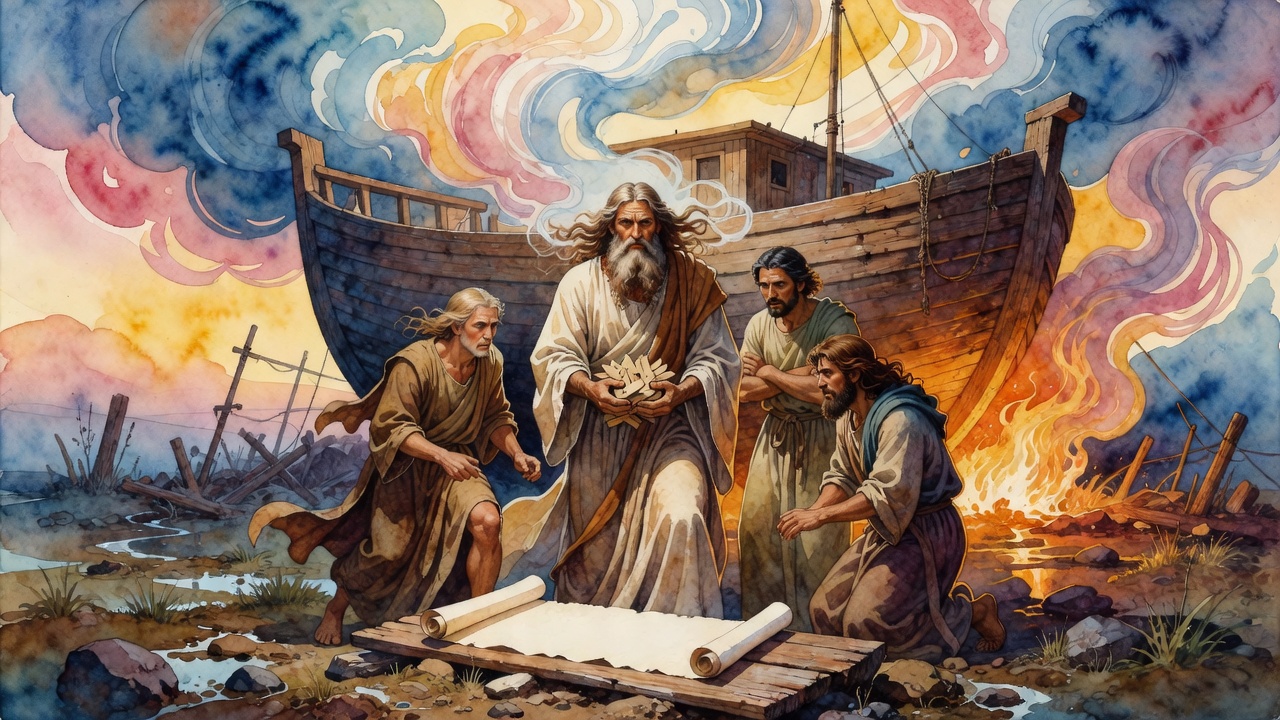
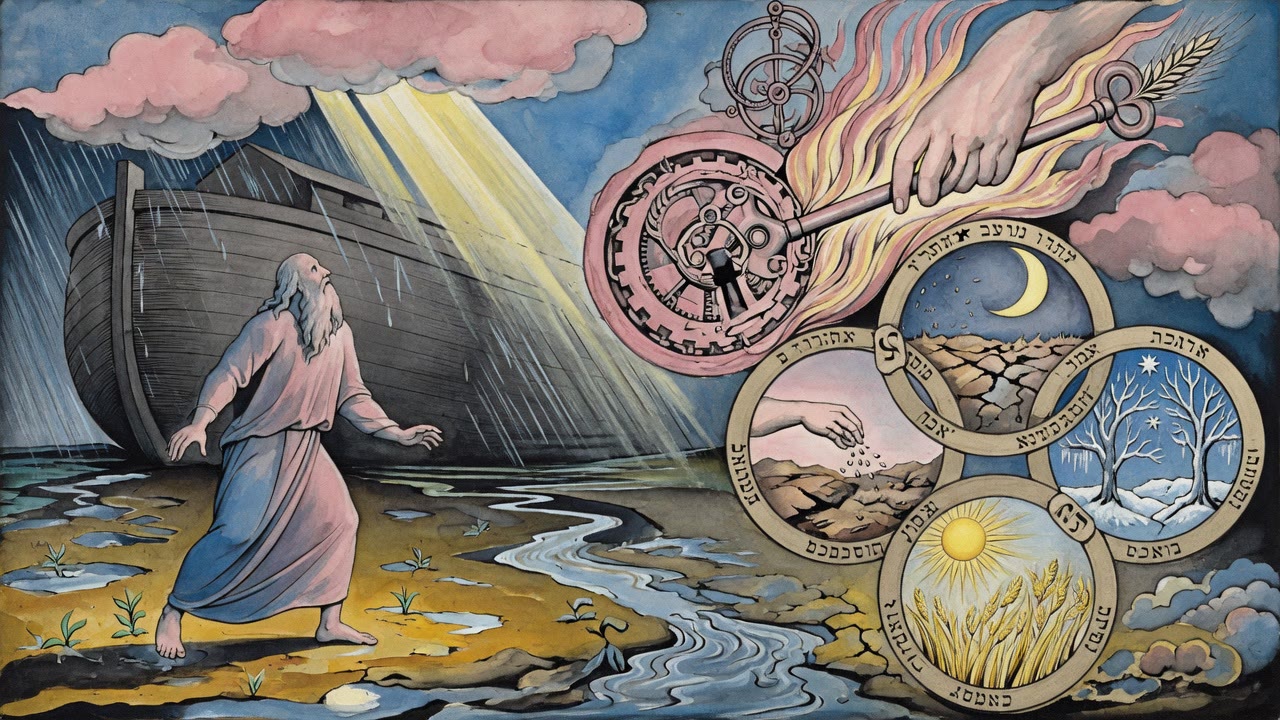
Noah put his foot on ground that had been the floor of the sea a year before, and it took his weight, and he did not trust it. Mud came up around his ankle and let go with a sound. Behind him the hull sat where it had grounded, black at the seams, the animals already spilling down toward the grass, and he stood looking at a clear sky the way a man looks at a roof that has fallen on him once.
God Locked Seedtime and Harvest in Place After the Flood Click for full size

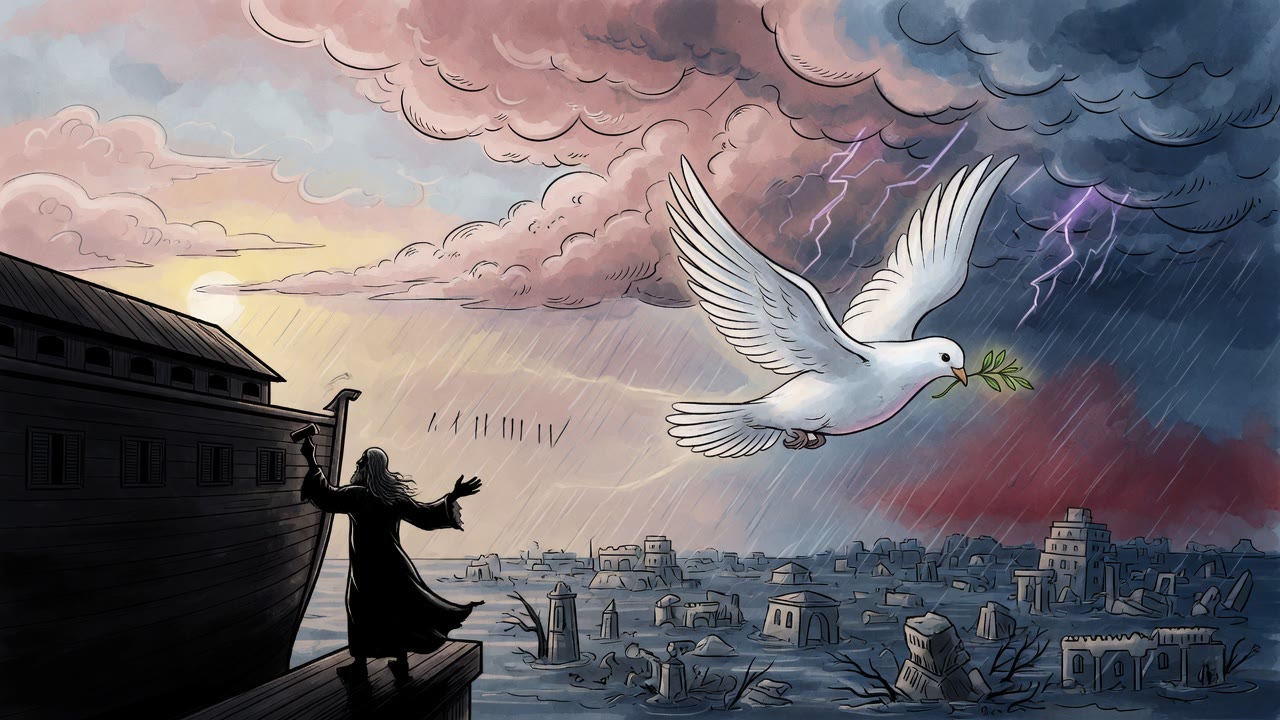
Rain had been the instrument. Every cloud that came over the hills from now on would have the shape of the beginning of it.

What They Called the Fountain

In the first age nobody had watched the sky at all. A fountain went up out of the ground and watered the whole face of the earth (Genesis 2:6), and the drink came from underneath, and a man could live out his years without once reading the weather to learn whether he would eat.

One fountain for the whole earth, though. Not possible, not for a world that size, not with mountains standing over plains and plains lying under mountains. Unless the word was doing what words do when a king musters. Call out the entire force of a king's cavalry, thousands of animals spread over miles of open country, and men will still say the king brought up the horse. One word, and every rider on the field underneath it. So with the fountain. Every vein of drinkable water threaded under the ground, all of them pushing upward at once, and the tongue folds the lot of them into a single name because they all come up the same way.

And it did not water the earth. It watered the face of the earth, which is a smaller thing and the only thing worth watering. The face is the part that can be good and fertile and hand something back. In a living body the springs go to the governing part first. In the world they go there too, and the rest of the rock can wait.

Noah was standing on the face of it now, and the face was mud.

The Smoke and the Answer

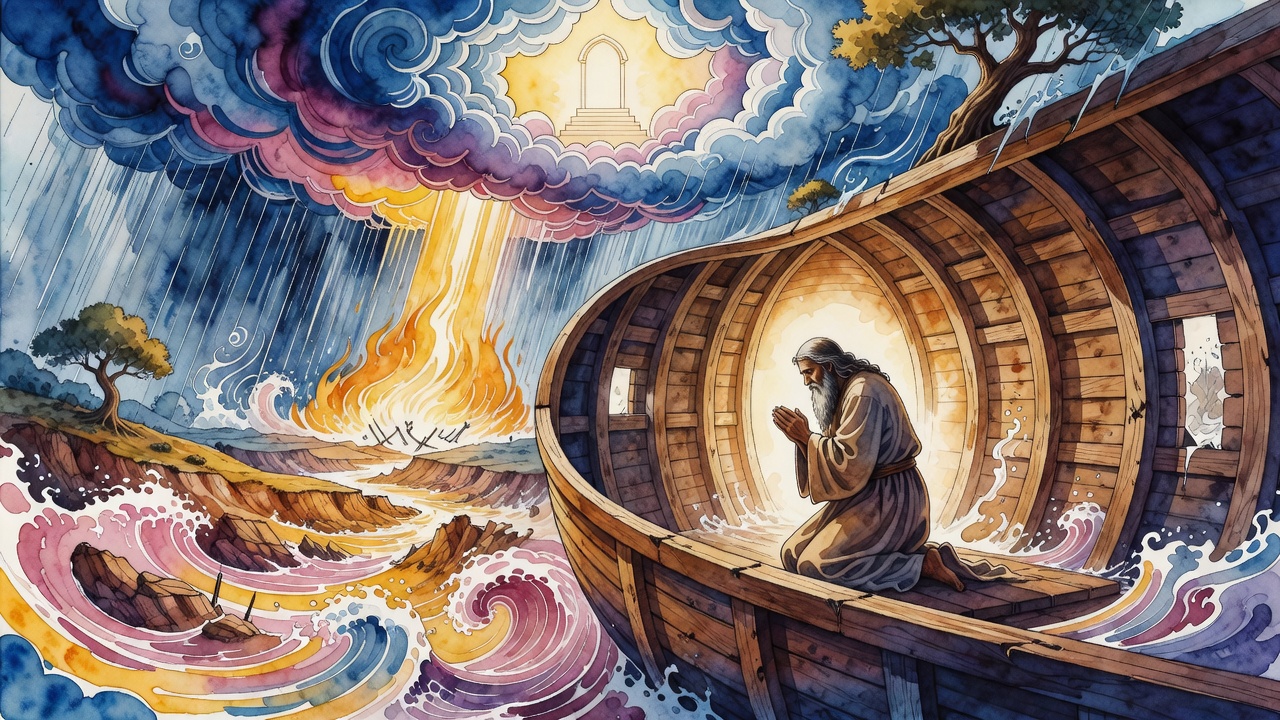
He built an altar out of stones the water had left in a heap and offered from the clean animals that had spent the dark months a few paces from his family. The smoke went up into the same air the rain had come out of, which was rather the point, since he had nothing else to send in that direction.

The answer came back aimed at the fear rather than at the offering. The ground would not be cursed again for the sake of man, though the bent of a man's heart would stay bent from his youth. So the promise was not a compliment about anybody improving. It was a decision made in spite of what the water had already proved.

That was worth something. It was not yet worth a furrow.

Seedtime Fastened to Harvest

Then came the rest of it. Seedtime and harvest, cold and heat, summer and winter, day and night: while the earth remained, none of these would cease (Genesis 8:22).

The words locked the seasons in place after the flood the way the cubits had once fixed the ark. They arrived in pairs, and the pairing was the whole gift. Seedtime is a beginning and harvest is an end, and neither is any use alone. A beginning with nothing fastened to the far side of it is a man flinging grain into dirt for the pleasure of flinging. An end with no beginning behind it is a barn that fills itself, which is nothing at all. Put the two together and you have the only arrangement under which anyone is safe. The start leans forward toward its finish, the finish leans back toward its start, and a household can plan.

Cold would come. Heat would follow and undo it. Autumn burns, but only enough to take the fire out of summer as the year comes round.

Opposites Held in Tune

Nature is assembled the way a tune is assembled, out of notes that disagree. Flat against sharp, and the disagreement is the music. Cold against heat, wet against dry, each holding its own ground and none of them permitted to swallow the others. Let them keep that order and nothing on the earth is destroyed. Let them run together into confusion and everything perishes, which is what the flood had been.

Noah carried two more of those opposites inside him and needed nobody to explain them. Cold is what fear does, the trembling and the wanting to be indoors. Heat is what anger does, since a man in a rage burns like something set on a fire. Made things hold both, and always will, and the year outside a man swings the way the weather inside him swings.

Spring finishes the seed. Summer finishes the fruit on the trees, and trees give more than a body needs, which is the surplus that keeps a household in something beyond bread. What a man owns serves his body. His body serves his mind. And his mind serves God, and the chain does not run any further than that.

Day and night keep the count. One of them is clear wisdom. The other is the folly a man cannot see his own hands in.

The Furrow and the Cloud

He went out later and opened a furrow and set a vine into it, because a man handed a year has to test whether the year is real.

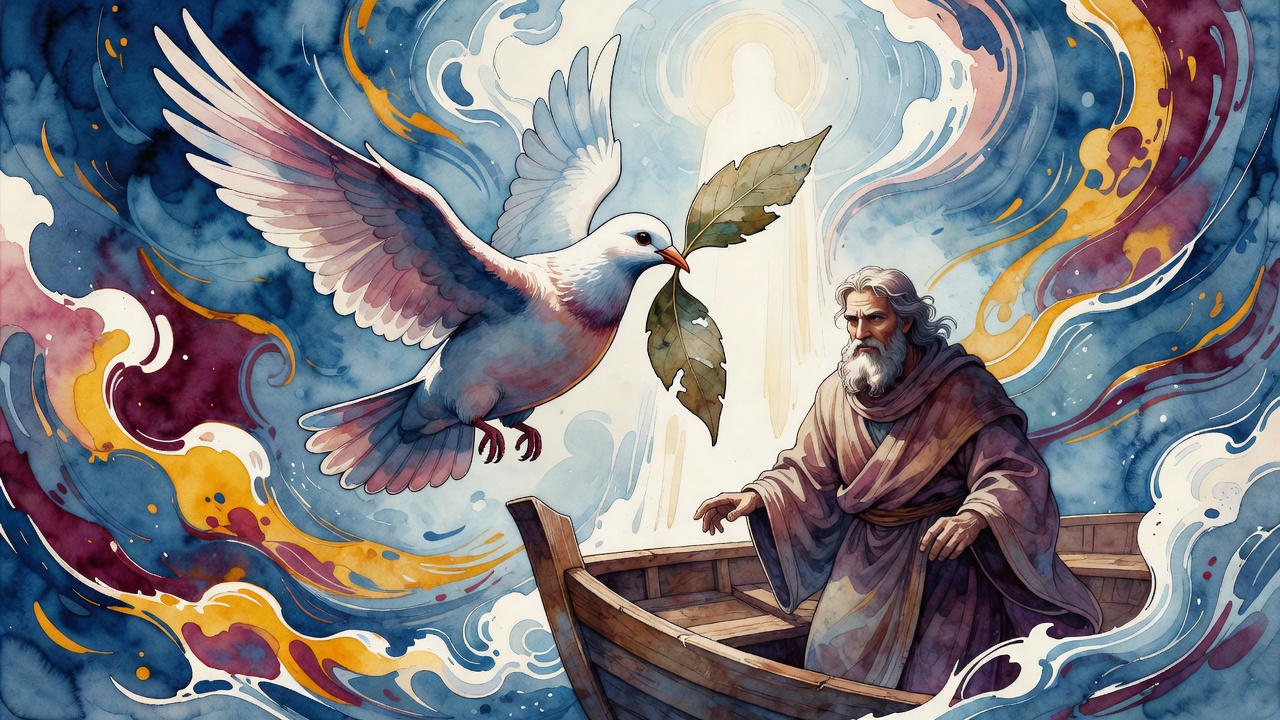
While his hand was still down in the dirt a cloud came over the hill behind him. His whole body knew that shape. His shoulders came up, his eyes went to the ark and measured the distance to the door, and the entire count ran through him in under two seconds. Forty days. The deep opened. The door shut from outside. Then the first drops hit the leaves around him and stopped being a flood, because they were only rain, and rain in this world was a thing that ended.

He stayed in the dirt and finished the row. The water went down through the soil and found the roots the way water once found them from below, and he slept that night on dry ground with one ear still open, listening for a storm that had been bound to a calendar.


← All myths
From the tradition

Sources

4 sources

The texts behind this telling. Some cards carry a translation of the source; others are our own retelling of it, and each card says which. Every card links out to the original.

The Midrash of Philo 6:1The Midrash of Philo

Retold in our words. Read the original at the link below.The Works of Philo Judaeus, trans. C. D. Yonge, London, H. G. Bohn, 1854-1890 · Public Domain

In the Midrash of Philo, we find a truly intriguing answer.

"A fountain went up from the earth, and watered all the face of the earth." Simple enough The first reading. But a fountain big enough to water the entire Earth? That's not your average backyard sprinkler system. So, what's going on here?

Philo's midrash – a way of interpreting scripture by filling in gaps and drawing out deeper meanings – digs into that very question. It's not just about irrigation, you see. It's about the source of all life and sustenance.

In this tradition, the fountain represents something far more profound than just a water source. It's a symbol. A symbol of the divine flow, the continuous outpouring of God's blessing and provision. We're talking about a cosmic fountain!: water is essential for life. Without it, nothing can grow, nothing can thrive. So, the image of a fountain welling up from the Earth suggests that life itself originates from a hidden, inexhaustible source. A source that is both earthly, rising from the ground, and divinely ordained.

It's a beautiful image, really. This idea of a constant, upward flow, nourishing everything around it. How everything depends on something else for its survival.

That we, too, are sustained by this divine fountain. We are, in a way, part of that eternal flow.

So, next time you read (Genesis 2:6), don't just picture a simple spring. And consider your place within it. What does that image evoke for you? What does it mean to be watered by that source?

Full source
The Midrash of Philo 6:2The Midrash of Philo

Retold in our words. Read the original at the link below.The Works of Philo Judaeus, trans. C. D. Yonge, London, H. G. Bohn, 1854-1890 · Public Domain

This is precisely the puzzle posed in The Midrash of Philo. It's a beautiful, thought-provoking exploration of the early chapters of Genesis, attributed to Philo of Alexandria, a Jewish philosopher who lived in Egypt during the Roman era.

The passage grapples with the seeming impossibility of the biblical description. It's not just the sheer size of the planet, but also the uneven terrain. How could one fountain possibly work through the ups and downs, the peaks and valleys, to nourish every corner of the Earth?

Philo offers a fascinating analogy: just as an entire cavalry force might be referred to as "the horse," perhaps all the veins of the earth, all the channels that carry fresh water, are collectively called "the fountain." It’s a metaphor for unity, suggesting that while there are countless individual streams, they all originate from a single, interconnected source. They all "bubble up like a fountain" together.

Here's where it gets really interesting. The text doesn't say the fountain watered the whole earth, but rather its "face." Why this distinction?

Philo sees this as a key point. Think of a living being. What part do you nourish the most? The face! The mind! It's the "chief and predominant part." Similarly, the text suggests that the most important part of the earth is that which can be "good and fertile and productive." That's the part that truly needs the nourishment of fountains. It's not about reaching every barren rock, but about nurturing the potential for life and growth.

It reframes our understanding of both the Earth and our role within it. It's not about quantity – watering every single inch. It's about quality – nourishing the parts that matter most, the parts that can flourish and create.

This passage from The Midrash of Philo reminds us that even in the face of seemingly impossible narratives, there's often a deeper, metaphorical truth waiting to be uncovered. It encourages us to look beyond the literal and seek the underlying wisdom, the message that resonates with our own lives and our own understanding of the world. What parts of your life are you nourishing? What "face" are you tending to?

Full source
The Midrash of Philo 22:1The Midrash of Philo

Retold in our words. Read the original at the link below.The Works of Philo Judaeus, trans. C. D. Yonge, London, H. G. Bohn, 1854-1890 · Public Domain

The Midrash of Philo asks: What is the meaning of "Sowing-time and harvest, cold and heat, summer and spring, shall not cease day nor night"? (Genesis 8:22).

The source holds the question on the post-flood seasons. No longer covenant scene is written here.

Full source
The Midrash of Philo 22:2The Midrash of Philo

Retold in our words. Read the original at the link below.The Works of Philo Judaeus, trans. C. D. Yonge, London, H. G. Bohn, 1854-1890 · Public Domain

We take them for granted, this endless cycle of planting and harvesting, warmth and cold. But what if it all stopped? What if spring never came, or winter just kept going and going?

Philo, in his unique way, dives deep into the meaning of the seasons. He wasn't just talking about the weather when he explored the verse about seedtime and harvest. He saw something much bigger, a profound connection to the balance of the world and even the workings of the human mind.

On a literal level, Philo explains, this promise – that seedtime and harvest, cold and heat, summer and winter, day and night, would never cease (Genesis 8:22) – ensures the continuation of life. The right temperature, the right conditions, are essential for plants and animals to thrive. If the weather went haywire, everything would be destroyed! It’s a comforting thought, this promise of stability.

Philo, ever the allegorist, pushes us further. He urges us to consider the "inward sense" of the passage. Seedtime becomes the beginning, harvest the end, and both are essential for wholeness. "For either thing alone is by itself imperfect," Philo writes, "because the beginning requires an end, and the end has a natural inclination for the beginning." – nothing is complete on its own. We need the full cycle, the full story.

And what about cold and heat? Philo links them to winter and autumn, but then he takes another leap. Symbolically, he says, cold represents fear, that icy grip of terror. Heat, on the other hand, becomes anger, a fiery and passionate emotion. These emotions, like the seasons, are always with us, part of the human condition.

Philo sees spring and summer as representing what is "necessary" and what is "superfluous". Spring brings the seeds, the basics, like virtues for the soul. Summer offers the abundance, the extras – the fruits of our labor, the external advantages that, ultimately, serve the body, which in turn serves the mind, which in turn serves God. It’s a beautiful chain of being, each element connected and serving a higher purpose.

Finally, day and night. These are the measures of time and number, the constant rhythm of existence. But again, Philo sees more. Day represents "lucid wisdom," that clear, bright understanding. Night becomes "obscure folly," the darkness of ignorance. We need both, of course, but the goal is always to strive for the light.

So, what does it all mean? Philo is reminding us that everything is connected. The natural world, our emotions, our intellect, our very souls – all are intertwined in a delicate dance of balance. The promise of the seasons isn't just about the weather; it's a promise of continuity, of growth, of the enduring presence of the Divine in every aspect of our lives. And maybe, just maybe, by understanding these connections, we can find a little more balance within ourselves.

Full source