5 min read

Noah Keeps the Ark Celibate While Earth Drowns

For twelve months Noah prays in a sealed wooden world. God forbids love on board while He tears the old earth down outside.

Curated by Arthur · Told by Maggid ·
Table of Contents
  1. The Door That Would Not Open
  2. Love Put on Hold
  3. Daylight Entry
  4. Light on the Water
  5. Go Forth, Husband and Wife
Noah Keeps the Ark Celibate While Earth Drowns Click for full size

The Door That Would Not Open

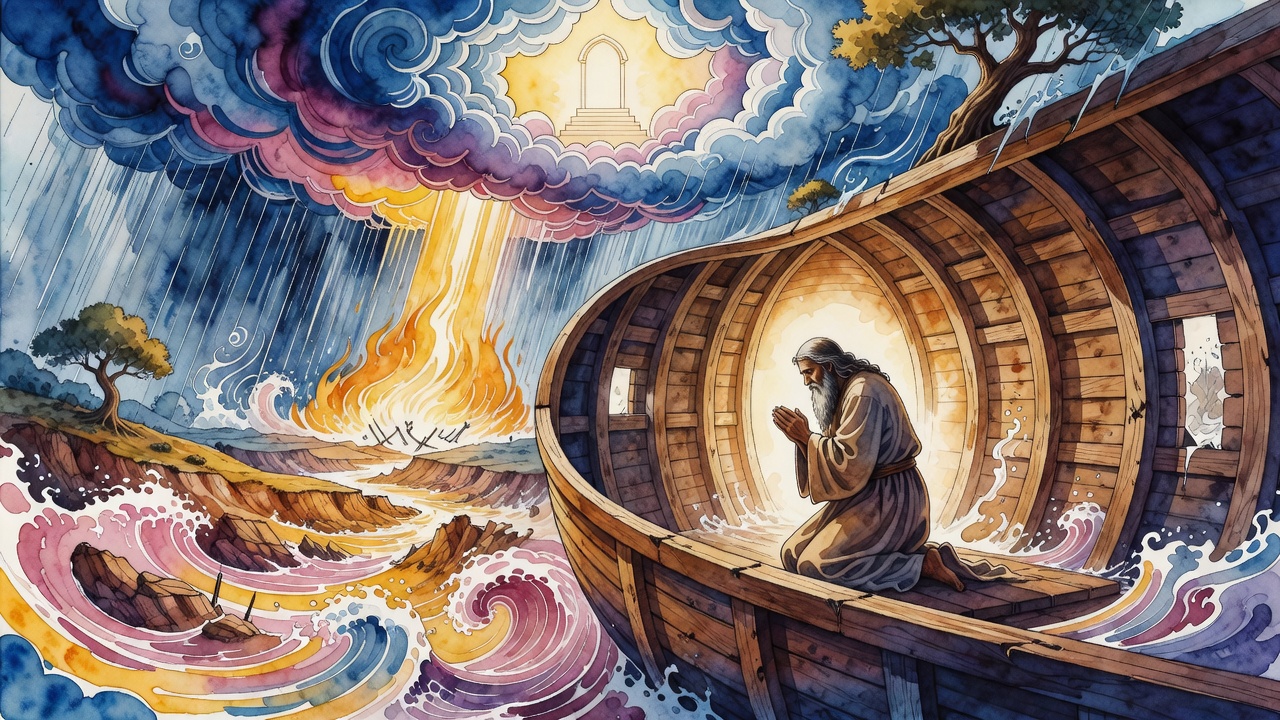
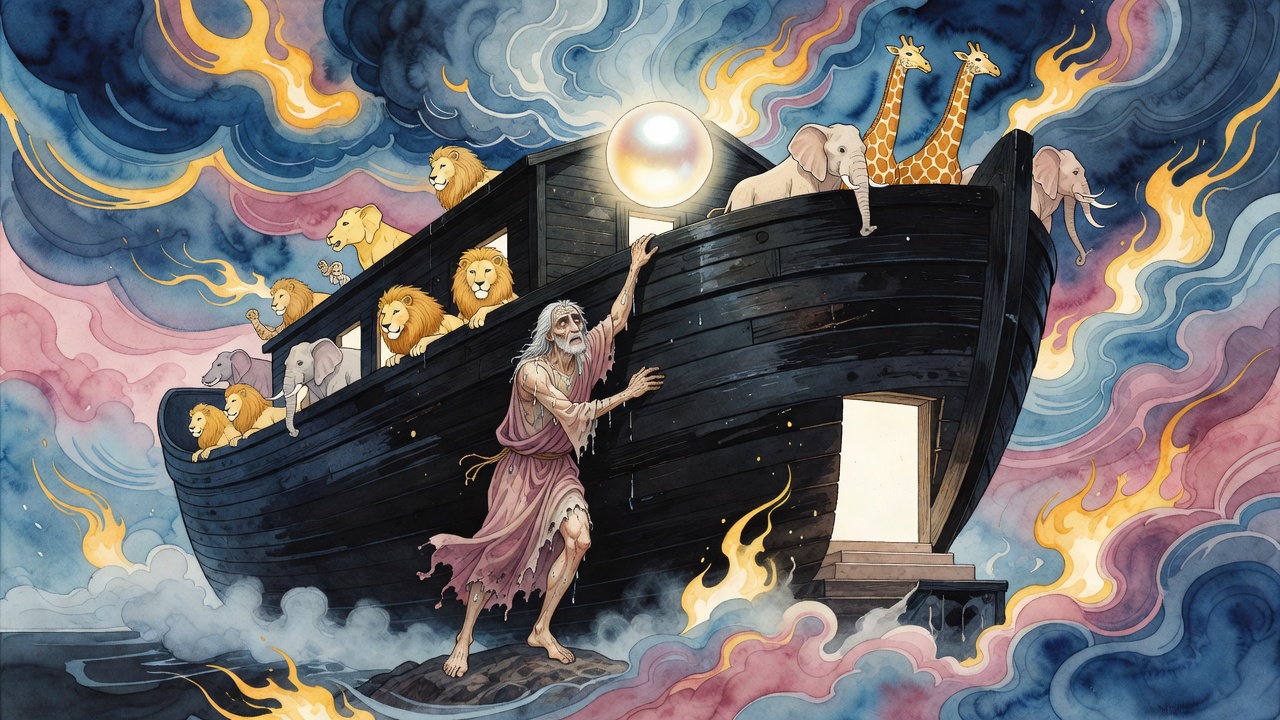
Noah stood inside pitch-dark wood and prayed without stopping. "Bring my soul out of prison." Outside, the world was water and screaming. Inside, the ark rolled and stank and held every living kind in stalls that never quite dried. Hay soured. Beasts kicked. The air was a thick animal weather of its own.

The Holy One had set twelve months. Until those months filled, the door would not open. Noah's prayer rose against a sealed decree. He was saved and still imprisoned. Righteousness had bought him a floating cage, not a free sky. His sons moved like men who had outlived everyone they knew and did not yet know how to speak about it.

Night after night the hull answered the waves. Noah pressed his palm to the pitch and felt the river testing every seam. Hold, the wood seemed to say. Hold. A bird shrieked in the dark and then went quiet, as if even panic had a schedule on this boat.

Love Put on Hold

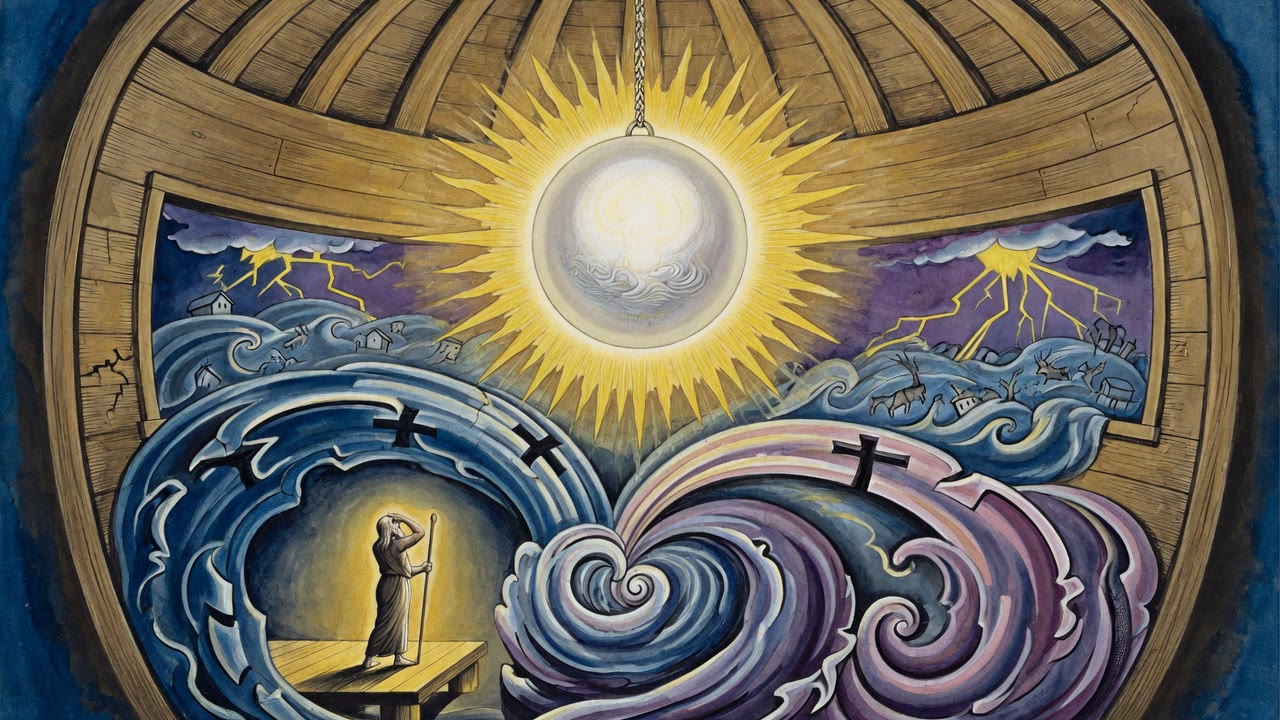
Males and females had boarded apart. Cattle, beasts, birds, sons, and wives kept the same law. No one came together as husband and wife while the flood ran. "Is it possible," said the Holy One, "that I should be tearing the world down in My anger while you build it up?"

So they waited. Desire itself became a forbidden act of rebuilding. Every night the ark creaked. Every night the command held. The old world died of water. The new world was not allowed to begin in secret under the same roof. A calf that might have been conceived in the dark would have been a joke against the Judge still drowning cities.

Noah looked at his wife across the aisle of animals and saw a stranger bound by the same mercy that refused them. Closeness without union is its own kind of flood. Shem turned his face to the wall. Ham counted knots in a rope. Japheth slept in snatches and woke to the same law still standing.

Daylight Entry

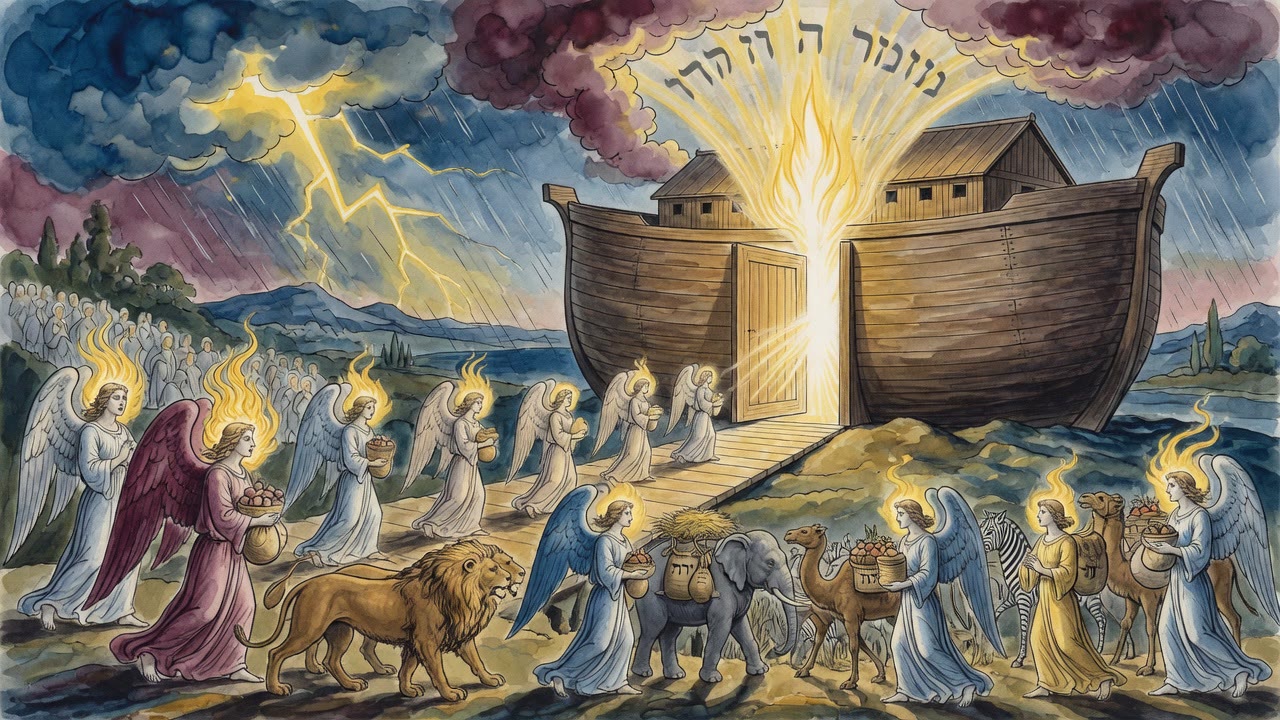
They had not slipped aboard at midnight. "On that very day" Noah and his household entered the ark (Genesis 7:13). Rabbi Yochanan hears the timing as a public challenge. If Noah had vanished in darkness, his generation could have cried ignorance. "We did not know. Had we known, we would have stopped him."

Broad daylight left no alibi. Neighbors watched the righteous man walk into wood with animals filing behind him. Children pointed. Mockers laughed until the first real rain made laughter sound thin. God was not only saving a family. He was making refusal visible. Speak now, or the waters will answer for you.

The door shut on faces still watching. That is the last look the generation of the flood ever gave the man who tried to warn them. Some of those faces would still be pressed to memory when the windows of heaven opened wider than any human roof.

Light on the Water

When later teachers read "These are the offspring of Noah" (Genesis 6:9) against Job's line about one who is light upon the surface of the water, they hear Noah floating above the decree that drowned everyone else. Survival is not a clean crown. The same reading ties broken oaths to the flood's curse. The generation that would not stand by its word left a legal shadow on every later court that curses a man who reneges.

Noah's offspring begin under that shadow. He is the light on the water and the father of a world that still remembers how contracts fail. Shem, Ham, and Japheth sleep in a boat that is also a courtroom exhibit. Their father is both hero and exhibit A. The ledger of the flood does not close when the rain stops. It travels in the blood of everyone who steps off the plank onto mud.

Go Forth, Husband and Wife

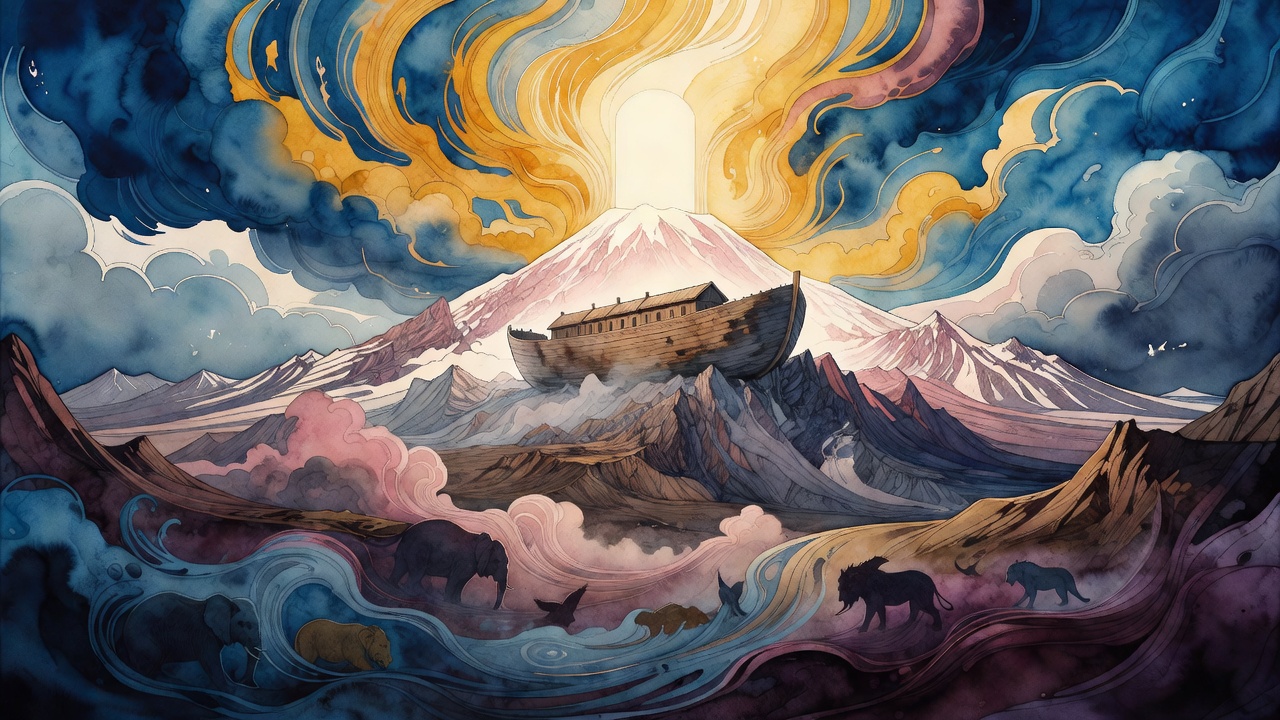
When the earth dried, the word changed. "Go forth from the ark, you and your wife." The pairing returned in the grammar itself. Beasts and birds received the same release. Fruitfulness was no longer rebellion against a wrath still in motion. It was obedience to a world that needed bodies again.

Noah trembled and asked whether flood would return. The Holy One swore, by the covenant that would run through Abraham, that the waters of Noah would never again pass over the earth. Later teachers say a yearly mark of those waters lingered until Solomon's Temple rose in the month of Bul and cut the scar away. One kept oath becomes proof that other oaths to Zion can hold.

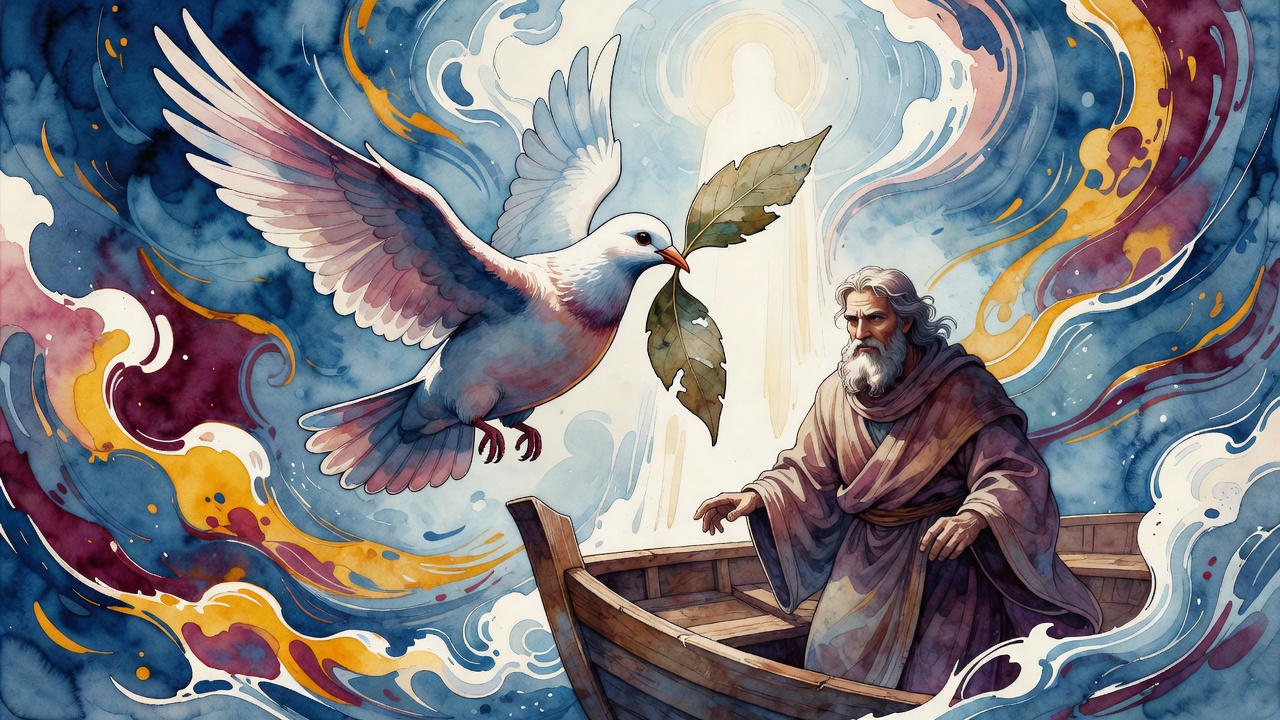
Noah stepped onto mud that had been a street. His wife stepped beside him, no longer forbidden. The animals poured out into a quiet that hurt the ears. Olive leaves would come later on a dove's beak. First came the awkward miracle of permission. Hands that had only fed and cleaned for a year were allowed to reach for each other without insulting Heaven.

Inside the ark, for twelve months, love had waited while judgment finished its work. Outside, the old earth ended. The door opened only when building life would no longer mock the One who had been tearing life down.


← All myths
From the tradition

Sources

3 sources

The texts behind this telling. Some cards carry a translation of the source; others are our own retelling of it, and each card says which. Every card links out to the original.

Midrash Tanchuma Buber, Noach 17:1Midrash Tanchuma Buber, Noach

Translation of the source text.Midrash Tanchuma (Buber), Public Domain, on Sefaria · CC-BY-SA

Another interpretation of "Go forth from the ark" (Genesis 8:16): David said before the Holy One, blessed be He: Master of the World, "Bring my soul out of prison" (Psalms 142:8). When Noah was inside the ark, he prayed continually, as it is said, "Therefore let every pious one pray to You at a time of finding; surely when the great waters overflow, they shall not reach him" (Psalms 32:6). And what did he pray? "Bring my soul out of prison." The Holy One, blessed be He, said to him: It is a decree from before Me that twelve months be completed; if they are not completed, you do not go forth. And likewise Isaiah said, "In a time of favor I have answered you [and in a day of salvation I have helped you]… saying to the prisoners, Go forth" (Isaiah 49:8-9). This refers to Noah and his sons, who were bound from sexual relations.

And so Joseph did: when he saw that two years of famine were destined to come, he attended to being fruitful and multiplying before they came, as it is said, "And to Joseph were born two sons [before the year of famine came]" (Genesis 41:50). And so did Noah and his sons; and the cattle, the beasts, and the birds did not attend to being fruitful and multiplying when they entered the ark, for thus the Holy One, blessed be He, commanded them when they entered the ark. From where? "And Noah went in, and his sons" (Genesis 7:7), the males by themselves; "and his wife and his sons' wives" (ibid.), the females by themselves. Thus all the days that Noah was in the ark, Noah and his sons and all who were with him were bound from sexual relations. The Holy One, blessed be He, said to them: Is it possible that I should be angry and destroying the world while you are building it up? Rather, when the flood passes, you shall attend to being fruitful and multiplying, as it is said, "saying to the prisoners, Go forth" (Isaiah 49:9).

And when the earth had dried, the Holy One, blessed be He, said to him, "Go forth from the ark, [you and your wife]" (Genesis 8:16), and He permitted them to be fruitful and multiply; and He also permitted the cattle, the beasts, and the birds, as it is said, "and let them swarm in the earth and be fruitful and multiply" (Genesis 8:17). Noah said to Him: Master of the World, perhaps You will bring a flood upon the world. He said to him: Thus I have sworn, that I will not again bring a flood, as it is said, "And the Lord smelled the pleasing aroma, [and the Lord said in His heart: I will not again curse the ground any more…]" (Genesis 8:21). How did He swear to him? Our Rabbis say: He swore to him by the covenant of Abraham, as it is said, "And You made with him the covenant" (Nehemiah 9:8). And so Isaiah said, "For this is to Me as the waters of Noah, [concerning which I swore that the waters of Noah would no more pass over the earth]" (Isaiah 54:9).

You find that nevertheless, forty days in every year those waters used to make a mark upon the world, until Solomon arose and built the Temple, and those forty days ceased, as it is said, "And in the eleventh year, in the month of Bul, [was the house finished]" (I Kings 6:38). What is "in the month of Bul"? In the month of ears of grain (shibbolim) for the cattle from the house. Another interpretation: "in the month of Bul", at the time when the earth makes clods upon clods (bulim bulim). Another interpretation: "in the month of Bul", lacking [the letter] mem, corresponding to the forty days that were cut off from the world. And if to Noah the Holy One, blessed be He, swore by the covenant of our father Abraham and fulfilled it, then to Zion, to whom He swore three oaths, how much more so will He fulfill them. And these are the three oaths: [He swore by the covenant of our father Abraham, as it is said, "For this is to Me as the waters of Noah."] He swore by His own soul, as it were, as it is said, "The Lord God has sworn by His soul" (Amos 6:8); and He swore by the Sabbath, as it is said, "and on the seventh day He ceased and was refreshed" (Exodus 31:17); [and He swore by the Torah, as it is said,] "The Lord has sworn by His right hand" (Isaiah 62:8), this is the Torah, as it is said, "from His right hand a fiery law for them" (Deuteronomy 33:2).

And what did He swear to Jerusalem? That He would build it, as it is said, "The Lord builds Jerusalem" (Psalms 147:2). Rabbi Samuel bar Nahmani said: It is a tradition of aggadah that Jerusalem will not be built until all the exiles are gathered in. If a person says to you that all the exiles have been gathered in but Jerusalem is not built, do not believe him, as it is said, "The Lord builds Jerusalem," and afterward, "He gathers in the dispersed of Israel" (ibid.). Israel said before the Holy One, blessed be He: Master of the World, was not Jerusalem already built and destroyed? He said to them: Because of iniquities it was destroyed, and you were exiled from within it; but now I am building it, and I will not destroy it forever, as it is said, "For the Lord has built Zion; He has appeared in His glory" (Psalms 102:17).

Full source
Bereshit Rabbah 32:8Bereshit Rabbah

Retold in our words. Read the original at the link below.The Sefaria Midrash Rabbah, 2022 · CC-BY

Sometimes, it's in the details, in the seemingly small phrases, that we find the biggest insights. Take the story of Noah, for instance. The familiar version gives us the basics: flood, ark, animals two-by-two. But have you ever stopped to consider the timing of it all?

(Genesis 7:13) states plainly, "On that very day, Noah, and Shem and Ham and Yefet, the sons of Noah, and Noah’s wife, and the three wives of his sons with them, entered into the ark."

That phrase, "on that very day," might seem like just a throwaway detail. But according to Rabbi Yoḥanan in Bereshit Rabbah, it's anything but.

The Holy One, blessed be He, made sure Noah entered the ark in broad daylight. Why? Because if Noah had snuck in under the cover of darkness, his generation could have claimed ignorance. "We didn't know! Had we known, we would have stopped him!" By entering "on that very day," in full view, everyone had the chance to object. It was a divine challenge: speak now or forever hold your peace. A public declaration. God wasn't just saving Noah; He was making a statement.

Then there's the verse describing the animals: "They, and every beast according to its kind, and every animal according to its kind, and every crawling creature that crawls upon the earth according to its kind, and every flying thing according to its kind, every bird, every winged creature" (Genesis 7:14).

"They, and every beast" – meaning Noah and his family are primary, and the animals secondary, teaching us about the sanctity of human life.

And what about that phrase, "every bird, every winged creature"? Rabbi Eliezer, in the name of Rabbi Asi, points out that this excludes birds with clipped wings or severed legs – those unfit as offerings for Noahides, descendants of Noah. These seemingly small details define what is considered whole and acceptable.

But the really fascinating part is how the animals got there in the first place. Noah didn't exactly have a zoo membership card. "And they that came, male and female from all flesh came, as God commanded him, and the Lord shut it for him” (Genesis 7:16).

Noah, understandably, was a little concerned. Am I supposed to be a hunter now? But God reassures him, "They that will be brought is not written here, but rather, they that came – they came of their own accord." According to Rabbi Asi, this excludes animals with extra or missing limbs, again defining what is acceptable before God.

They just…showed up.

Rabbi Yoḥanan takes it even further, referencing (Isaiah 34:16), saying, "Examine the book of the Lord and read it." If these animals willingly entered the ark to be shut up for twelve months, imagine how much more willingly they'll come to feast on the flesh of the mighty in the future!

He connects it to (Ezekiel 39:17-18), a rather graphic prophecy about a great feast where birds and beasts will gorge themselves on the flesh of the fallen. A chilling image, and a powerful reminder of divine justice.

Finally, "And the Lord shut it for him." Rabbi Levi offers a powerful analogy: a prince who issues a decree of annihilation but takes his friend and locks him in prison, sealing it shut. It seems cruel, but it's an act of salvation. "And the Lord shut it for him" – to protect him. And the verse says, when people tried to overturn the ark, God surrounded it with lions, so they would not touch it.

So, what does it all mean? This small section from Bereshit Rabbah invites us to look closer at the familiar story of Noah. To see the layers of meaning, the subtle hints of divine intervention, and the profound questions about justice, salvation, and the very nature of existence.

Full source
Bereshit Rabbah 30:2Bereshit Rabbah

Retold in our words. Read the original at the link below.The Sefaria Midrash Rabbah, 2022 · CC-BY

The Torah portion Noah grapples with just that, the world after the flood. But even in this story of renewal, shadows of the past linger. The Rabbis in Bereshit Rabbah, that magnificent collection of rabbinic interpretations on Genesis, dive deep into the implications of Noah's survival. They see more than just a new beginning; they see a warning.

Our verse is "These are the offspring of Noah" (Genesis 6:9). Seems straightforward. But the Rabbis, masters of drash (interpretation), never let a verse lie flat. They connect it to a seemingly unrelated verse from the Book of Job: "He will be light upon the surface of the water; their portion in the land is cursed; no one turns aside from the vineyards" (Job 24:18). What’s the connection?

The Rabbis see Noah in the first part of the verse: "He will be light upon the surface of the water." This, they say, refers to Noah's salvation from the flood. He was spared from the decree that wiped out the rest of humanity. But what about the rest of the verse?

“Their portion in the land is cursed” – this, according to the Rabbis, is connected to the curse invoked upon those who break their word. You know, the kind of curse where the court proclaims, "He who exacted retribution from the generation of the Flood, He will exact retribution from one who does not stand by his word" (Bava Metzia 44a). It's a serious thing! Why such a harsh comparison to the generation of the Flood?

The answer, the Rabbis suggest, lies in the final part of the verse: "No one turns aside from the vineyards." This, they explain, reveals the true flaw of the generation of the Flood. Their sole purpose, their entire focus, was on material gain – planting vineyards, accumulating wealth. They were so consumed by earthly pursuits that they lost sight of anything higher, anything more meaningful.

Now, contrast that with Noah. According to Bereshit Rabbah, Noah's intention was different. His focus wasn't on personal enrichment, but on repopulating the world, on rebuilding, on fulfilling the divine command to "be fruitful and multiply." As the verse says, "These are the offspring of Noah." His legacy wasn't vineyards and riches, but children, a future.

So, what's the takeaway? It’s not just about surviving a disaster. It's about how we survive, and what we choose to prioritize in the aftermath. Do we cling to the pursuit of wealth and self-interest, like the generation of the Flood? Or do we embrace a higher purpose, focusing on family, community, and rebuilding a better world, like Noah? The Rabbis of Bereshit Rabbah challenge us to consider what truly constitutes a legacy. What will our "offspring" be? What kind of world will we leave behind?

Full source