Parshat Noach5 min read

Noah Watched the Flood Scour the Earth's Face

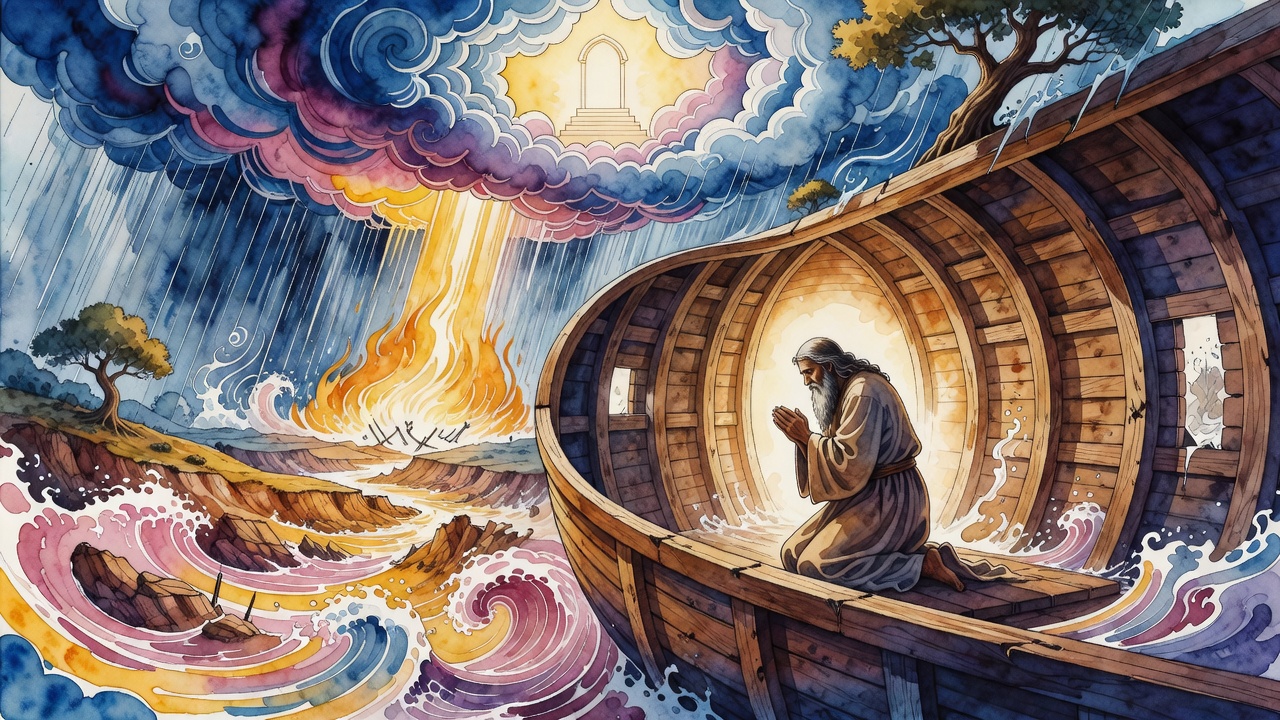
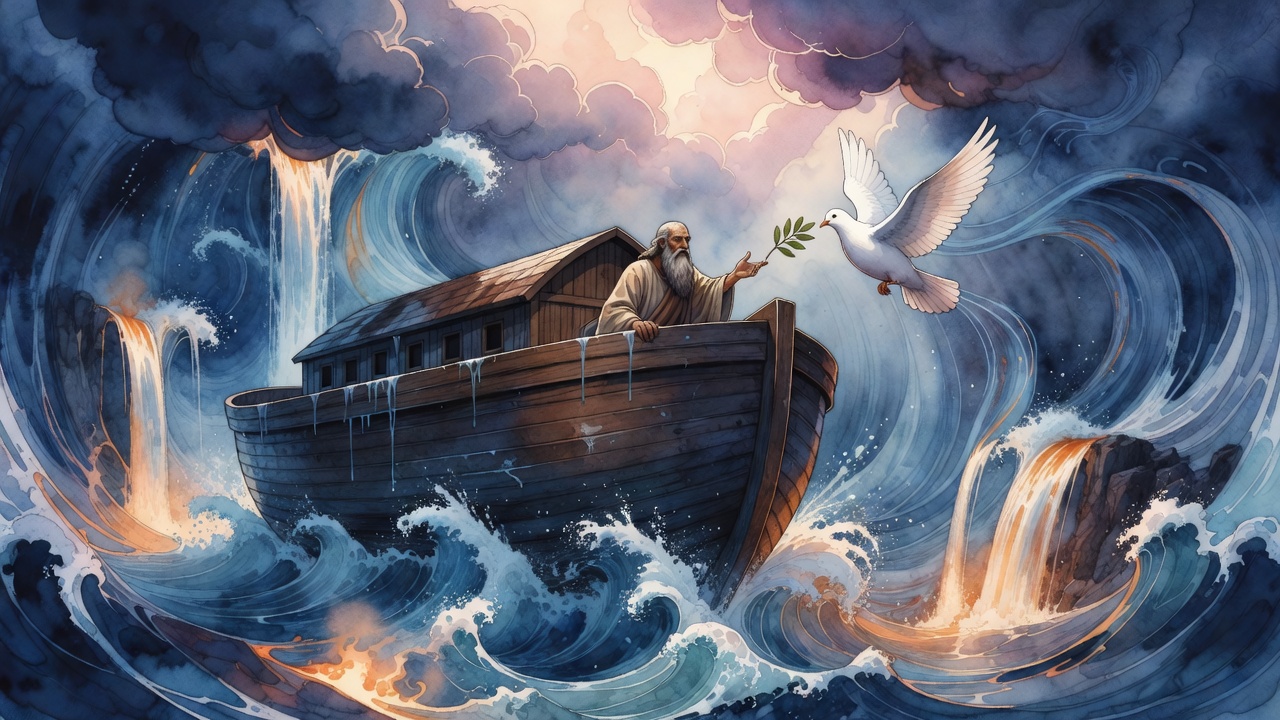
Noah rode a sealed ark while rain matched the measure of human making. God stripped the earth's face and left living seed buried for a spring return.

Curated by Arthur · Told by Maggid ·
Table of Contents
  1. Forty for the Making, Forty for the Unmaking
  2. The Word Was Face
  3. It Came at the Fullest Hour
  4. The Door and the Green

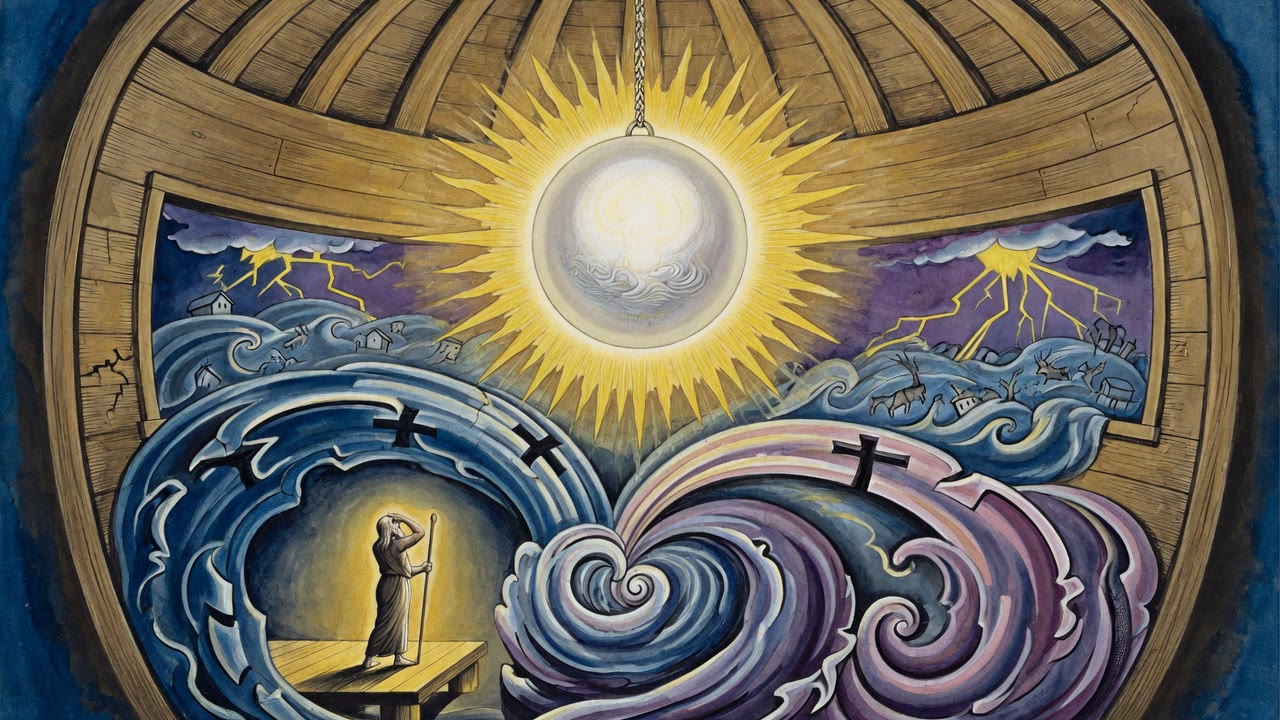
Noah heard the sentence before he heard any rain, and it was the wording of it that he kept turning over for the next year. Every living substance would be destroyed from off the face of the earth (Genesis 7:4). Not from the earth. From its face.
Noah Watched the Flood Scour the Earth's Face Click for full size

He had a year sealed inside a wooden box to decide whether that was mercy or only a way of speaking.

Forty for the Making, Forty for the Unmaking

The rain arrived with a number already attached to it, and the number was longer than it sounds. Forty days and forty nights, because the word day can mean the stretch from the sun coming up in the east to the sun going down in the west, and it can also mean the whole turn of light and dark together. The decree used it the second way, so the dark was counted too. Nothing was going to be left unwatched.

Forty is also the span the physicians gave for the forming of a human being, and the sacred law had it before the physicians did. Since destruction was about to come down on every man and woman everywhere, the Judge of all thought it fitting to allot the unmaking exactly the time the making had taken. What had been assembled over forty came apart over forty. Noah lay in the dark listening to that count go by on the pitch he had smeared into the seams three days before the first drop.

The Word Was Face

The water took the surface, and it took everything standing on it: the houses, the herds, the men who had filled the ground with quarrelling and iniquity, everything that moved about on top of the world. It did not reach the roots.

Under the scoured mud the vital force in every seed sat unhurt and free of injury, because the Creator had not forgotten His original design. He destroyed only what came into His way, and He left what lay in the depth alone, in order to produce the generation of other causes later on. Letters can be lifted off a tablet without harming the tablet, and the tablet stays ready for whatever gets written next.

None of which Noah could see. He had the phrase and nothing else, no window he was permitted to open and no way of testing it, only two words in the middle of a death sentence and the sound of a world coming apart against the hull.

It Came at the Fullest Hour

The water started in the six hundredth year of Noah's life, in the seventh month, on the twenty-seventh day, which is not a random place on a calendar. That is the vernal equinox, the hinge where the birth and increase of everything begins, living creatures and plants alike.

The wheat was standing and the barley was standing. The trees had set their fruit and were carrying it. All nature was holding out its productions at once, in the greatest abundance, and the people who lived off those productions had spent them on corrupting themselves, so the punishment came down in the middle of the plenty instead of after it. Had the flood fallen at the autumn equinox, with the fields already cut and the crops shut in their storehouses, it would have rinsed the plains and the mountains and looked like a favor. Coming when it came, it could not be mistaken for anything but a reproof.

Noah had loaded the pairs past standing grain. Then the grain went under.

The Door and the Green

The count closed where it had opened. The seventh month, the twenty-seventh day, the vernal equinox again, a full year measured out to the day, so that the remedy came to exactly the length of the harm. The ark had grounded on the mountains months earlier at the other equinox, at the autumn hinge, but the drying, the evil of the water gone off entirely, waited for spring to come back around.

Then Noah opened the door.

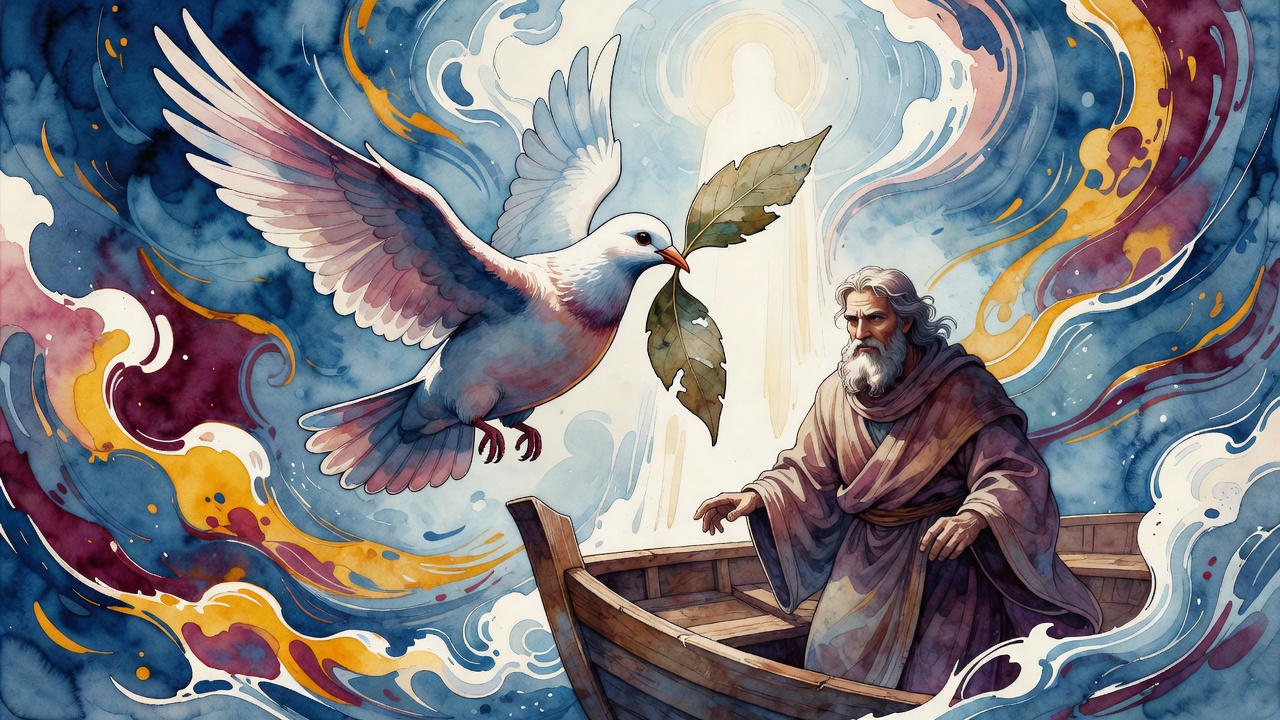
He had spent a year braced for the smell of mud and rot, and what came in was neither. The earth had paid what it owed to nature. Grain stood, and herbs, and plants, and the fruit trees were already carrying, all of it complete and excellent and entirely sudden, brought up in a single day the way the whole generation of plants had been brought up in a single day at the beginning. Spring had not been skipped. It had been sitting under the water the whole year, in the one place the sentence was never aimed.

Noah went down into barley that reached his knee, on ground that had drowned every person he had ever known, and it was green.


← All myths
From the tradition

Sources

4 sources

The texts behind this telling. Some cards carry a translation of the source; others are our own retelling of it, and each card says which. Every card links out to the original.

The Midrash of Philo 4:8The Midrash of Philo

Retold in our words. Read the original at the link below.The Works of Philo Judaeus, trans. C. D. Yonge, London, H. G. Bohn, 1854-1890 · Public Domain

(Genesis 7:4) tells us that the rain fell for this specific duration, but why this particular number?

Philo, in his Midrash (rabbinic interpretive commentary), explores this very question, and his answer is surprisingly complex. He starts by pointing out something fundamental about the word "day" itself. We use it in two ways. Sometimes "day" means just the period from sunrise to sunset. But other times, "day" refers to the whole 24-hour cycle, including night. So, when we read about "forty days," it actually implies forty days and forty nights. Got it?

That's just the beginning. Philo suggests the number isn't just about simple counting. He proposes that the duration of the Flood – forty days and nights – mirrors the very creation of humanity. He argues that forty and eighty (forty plus forty) were considered key numbers in human generation, a concept supported by medical science of the time, and, crucially, by the sacred Law itself, which, to Philo, was also a foundational text of natural science!: The Flood was an act of destruction, wiping out humanity because of their wickedness. So, according to Philo, it makes sense that the Judge of all would allot a period of destruction equal to the time it took to create humankind in the first place. It’s a cosmic balancing act, a sort of divine "measure for measure."

Here’s where it gets really interesting. Philo gets into some fascinating ideas about gender and numbers. He argues that the male is associated with pure light and unity, while the female embodies a mixture of night and darkness, of duality. Therefore, the male is linked to square numbers (equal sides, representing equality and light), and the female to "long numbers" (unequal sides, symbolizing inequality, and thus, darkness).

Whoa, heavy stuff. Philo suggests that in creating the world, God honored the male with pure light, and the female with the inclusion of night. This difference, he implies, plays into the numerical symbolism of creation and destruction. It’s a complex thought, and one that reflects the philosophical and scientific understanding of Philo's time. We might interpret it differently today, but it’s important to understand the context in which he was writing.

Finally, Philo reminds us that the number forty itself is significant. He says it's "the produce of many virtues," and is often used in legal judgments – both for those deserving praise and those facing punishment. The number forty represents a period of testing, of judgment, of transformation. As we find in texts like Midrash Rabbah, forty is a number linked to significant events.

So, the next time you read about the forty days and forty nights of the Flood, remember it’s not just a random number. According to Philo, it's a carefully chosen duration, reflecting the balance between creation and destruction, the interplay of light and darkness, and the very essence of divine justice. It’s a powerful reminder that even in moments of utter devastation, there is a deeper meaning at play, a cosmic order underlying the chaos.

Full source
The Midrash of Philo 4:18The Midrash of Philo

Retold in our words. Read the original at the link below.The Works of Philo Judaeus, trans. C. D. Yonge, London, H. G. Bohn, 1854-1890 · Public Domain

Take, for instance, the verse in (Genesis 7:4): "I will destroy every living substance that I have made from off the face of the earth." (Genesis 7:4)

Doesn't that phrasing strike you? "From off the face of the earth." Not just from the earth, but specifically from the face. Why that distinction?

Well, Philo of Alexandria, a Jewish philosopher who lived way back in the first century, has a fascinating interpretation in his Midrash of Philo. He suggests that this careful wording is intentional. God, in his infinite wisdom, isn't aiming for total annihilation. He's not going to wipe the slate completely clean. Instead, He's removing what's on the surface – the corruption, the wickedness – while preserving the potential for renewal deep within.

Think of it like this: the flood washes away the visible signs of sin, but the "vital efficacy of all seeds" remains "unhurt" deep down. (Midrash of Philo) The roots are still there, ready to sprout anew. This is, according to Philo, because the "Creator was not forgetful of his original design." He's destroying only those "who come in his way..The first reading of the earth, but leaves the roots in the depth, in order to produce the generation of other causes." (Midrash of Philo)

It speaks to God's enduring hope for humanity, even in the face of profound disappointment.

Philo goes even further, diving into the very letters of the Hebrew text itself. He finds a hidden message within the phrase "I will destroy." (Midrash of Philo) He suggests that by removing certain letters, the "table for the reception of letters remains the same." (Midrash of Philo) Now, this kind of letter-based interpretation, where the very letters themselves hold symbolic meaning, is something we see in Jewish mystical traditions like Kabbalah, too.

What's Philo getting at? He believes God is saying that while He will destroy the "fickle generation on account of their impiety," (Midrash of Philo) the very essence of humanity, its capacity for goodness and connection with the divine, "he will preserve for ever and ever to be the seed of future generations." (Midrash of Philo)

This idea of preservation amidst destruction extends to the very nature of existence. Philo argues that the flood represents a "spiritual dissolution." (Midrash of Philo) It's not just about physical water washing away physical things. It's about a cleansing of the soul, a shedding of "sensible and corporeal qualities by which the intellect was infected as by swelling sores." (Midrash of Philo) Through this "deluge," we can rid ourselves of the "muddy slime" and allow "sweet waters and wholesome fountains" to emerge. (Midrash of Philo)

So, what does it all mean? Maybe the story of the Flood isn't just a cautionary tale about divine punishment. Maybe it's also a story about hope, resilience, and the enduring power of the human spirit to be reborn, even after the most devastating of events. Maybe, just maybe, within the destruction, lies the seed of a brighter future for all of us.

Full source
The Midrash of Philo 11:2The Midrash of Philo

Retold in our words. Read the original at the link below.The Works of Philo Judaeus, trans. C. D. Yonge, London, H. G. Bohn, 1854-1890 · Public Domain

Sometimes, the smallest detail holds a hidden universe. Take the timing of the great flood. It wasn't just any time. The Torah is very specific, telling us the deluge began "in the six hundredth year of Noah’s life, in the second month, on the seventeenth day of the month" (Genesis 7:11). But the Midrash (rabbinic interpretive commentary), that incredible pattern of interpretation and commentary, dives even deeper.

The Midrash of Philo, a collection of interpretations attributed to the Jewish philosopher Philo of Alexandria, offers a fascinating perspective. It suggests that the flood actually began during the vernal equinox – a time of rebirth and renewal. Why this specific time?

Well, Philo argues that the sacred historian, meaning the author of Genesis, was meticulously accurate in fixing the day and month when the deluge began, pointing us to the twenty-seventh day of the seventh month, which he connects to the vernal equinox. This is the time when life bursts forth, when seeds sprout and plants grow. It's a period of abundance and fertility.

So, why unleash destruction at such a promising time? According to Philo, it's precisely because of this abundance that the punishment is so severe. Imagine: nature is at its peak, offering its bounty, and humanity is simultaneously corrupting these gifts. It's a stark contrast, a profound betrayal of the divine purpose. Philo puts it powerfully, saying that God is essentially telling humanity, "behold..all nature contains its own productions within itself..but you, like mortals, corrupt its mercies."

Now, consider the alternative. What if the flood had occurred during the autumnal equinox, after the harvest, when the fields are bare? Philo suggests it wouldn't have been seen as such a harsh punishment. It might even have been viewed as beneficial, a cleansing of the land.

The timing is also linked to the creation of Adam. Just as Adam, the first human, was created during the vernal equinox, so too does the "new beginning" after the flood, with Noah, coincide with this time of renewal. Noah, in a way, becomes a second Adam, a fresh start for humanity. As Philo says, "the first beginning of the generation of our race, after the destruction caused by the deluge, commenced with Noah, men being again sown and procreated, therefore he also is recognised as resembling the first man born of the earth."

And what about the number 600, Noah's age when the flood began? Philo connects this to the number six, the number associated with creation itself. He sees it as a divine rebuke: God created the world through the number six, yet humanity's wickedness was so extreme that He had to destroy it, essentially undoing His creation. Philo states that "the world was created under the number six, therefore, by this same number does he reprove the wicked."

So, the next time you read the story of Noah's flood, remember that it's not just a tale of destruction. It's a story about timing, about the contrast between divine gifts and human corruption, and about the possibility of renewal, even after utter devastation. The Midrash of Philo invites us to contemplate the deeper meanings woven into the narrative, revealing layers of wisdom that speak to us even today. What does it mean to corrupt the divine gifts in our own time?

Full source
The Midrash of Philo 14:2The Midrash of Philo

Retold in our words. Read the original at the link below.The Works of Philo Judaeus, trans. C. D. Yonge, London, H. G. Bohn, 1854-1890 · Public Domain

Did you catch that detail in the biblical text about the months? The Midrash of Philo points out something curious. Scripture sometimes refers to a month as both the "seventh" and the "first." How can that be? The key, it suggests, lies in understanding the relationship between time and nature. The seventh month, in terms of counting, is like the first in the natural cycle, specifically, the beginning of the equinox.

Consider this: The Midrash of Philo emphasizes that the flood began on the twenty-seventh day of the seventh month – and ended on the same day of the same month. Why is this significant? Because the flood and its removal both coincide with the equinox, marking a shift in the natural world. The text explains that the seventh month is synonymous with the equinox. Then the ark rested on the mountains also on the twenty seventh day.

So, according to this midrash, at the equinoxes there is power of selection for seven months and twenty seven days. The flood began in the seventh month, coinciding with the vernal equinox – seventh in time, but first in nature. The cessation of the flood, a display of mercy, also occurs in the seventh month, but this time during the autumnal equinox – seventh in nature, but first in time.

The Midrash of Philo goes on to say that the complete drying up of the evil (the floodwaters) happens again in the seventh month, on the twenty-seventh day of the vernal season. The beginning and the end find their boundary at the same season.

What's remarkable is the precise timing. The deluge, calculated meticulously, lasted exactly one year. It began in Noah's six hundredth year, on the twenty-seventh day of the seventh month, and concluded at the same point in the vernal equinox a year later.

The Midrash of Philo draws a powerful image: After the destruction, the earth, cleansed of evil, was once again teeming with seeds and fruit-bearing trees, mirroring the abundance of spring. It aligns with the idea that the earth, having undergone the flood, was restored to its pre-deluge state.

And here's a kicker: The Midrash of Philo asks us not to be surprised that the earth brought forth everything – seeds, trees, herbs, grains, and fruits – in a single day, through divine power. After all, during creation, God perfected the plant kingdom in one of the six days. It suggests that just as the earth was created swiftly, so too was it restored after the flood. These fruits were suitable and corresponding to the season of spring. After all, all things are possible to God, who scarcely requires time to effect anything.

What does this tell us? Perhaps the flood story isn't just about punishment and destruction. It's also about renewal, the cyclical nature of time, and the power of God to restore and create anew. It's a reminder that even after the most devastating events, life finds a way, and the earth can once again blossom with abundance.

Full source