Parshat Noach5 min read

Noah Saw Demons Courting His Sons After Flood

Shem, Ham, and Japheth stood in a half-circle while their father laid down a rule: whoever sheds blood or eats it leaves no seed under heaven.

Curated by Arthur · Told by Maggid ·
Table of Contents
  1. A Father's Ban on Blood
  2. Why the Waters Rose at Peak Green
  3. Clean Beasts on a Second-Chance Altar
  4. Seduction Versus Smoke

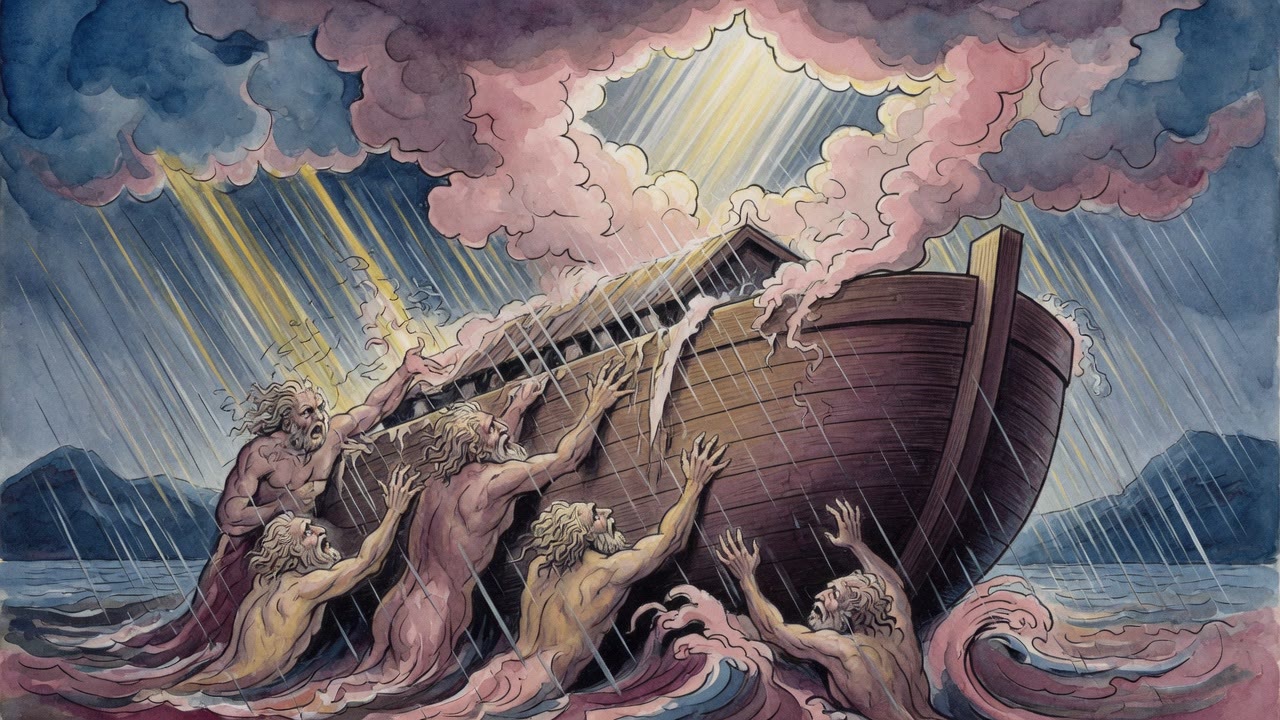
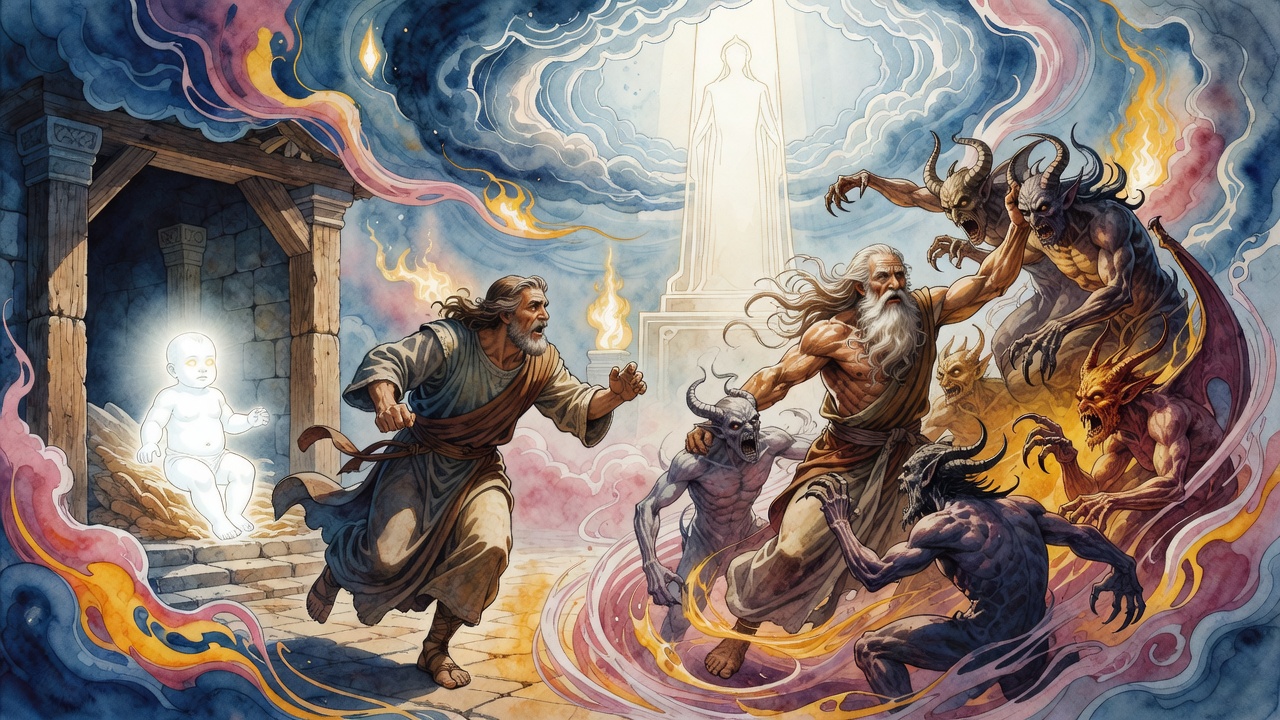
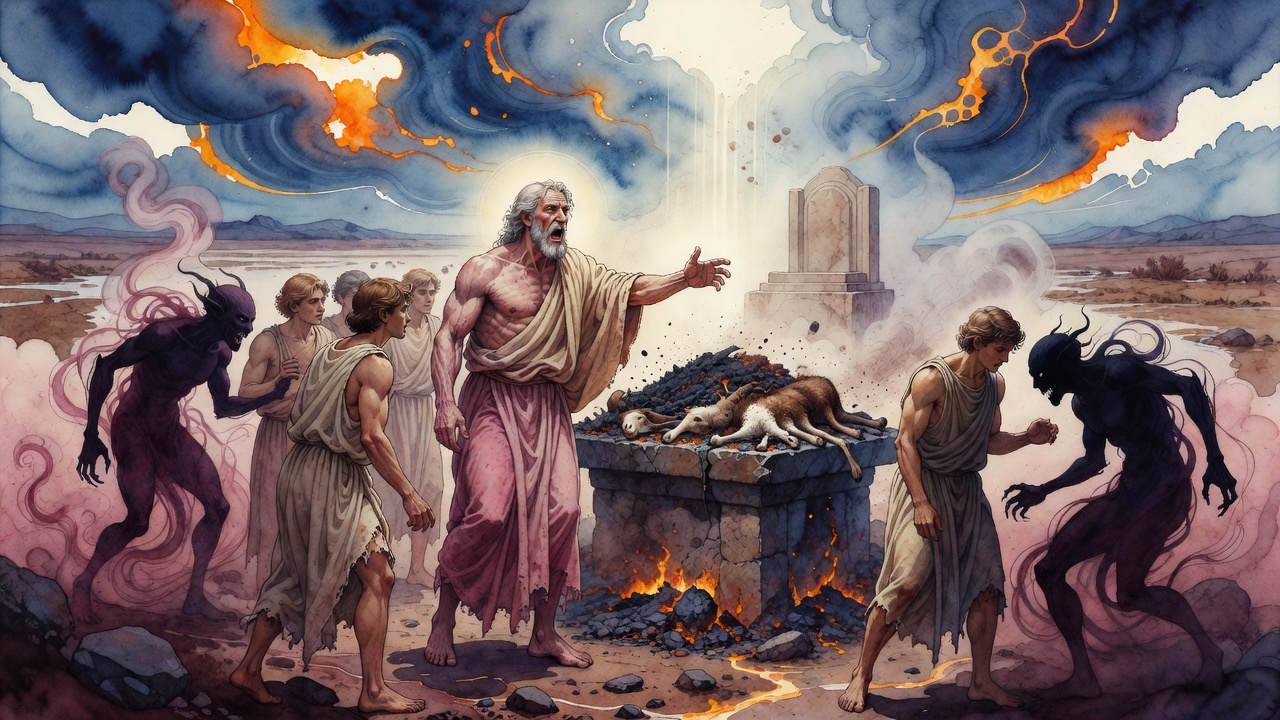
Noah stood on drying ground and watched his children the way a man watches a fire that has already burned his city once. The water was gone. The fear was not. "I see, and behold the demons have begun their seductions against you and against your children," he said, and the new world flinched.
Noah Saw Demons Courting His Sons After Flood Click for full size

Ark-wood still creaked in memory. Fresh soil smelled clean. The old man smelled blood waiting to be spilled again.

A Father's Ban on Blood

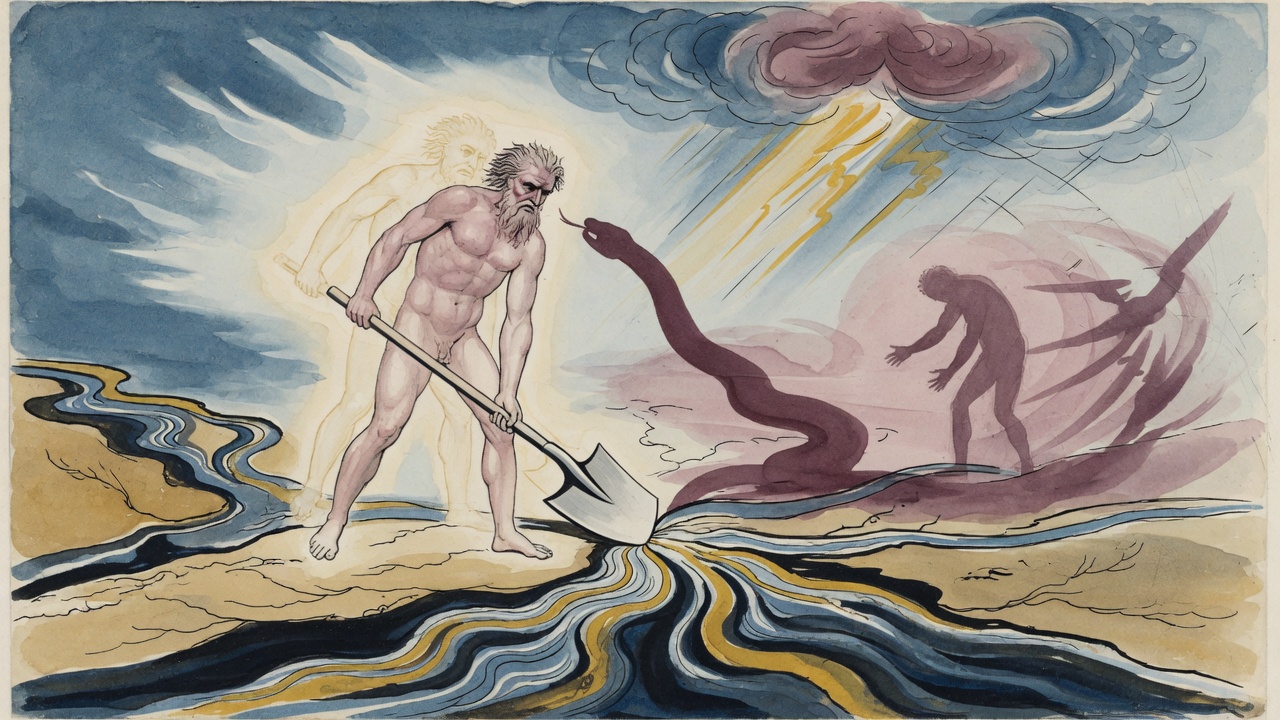
His dread took legal shape. After my death, he warned, you will shed human blood and be wiped from the earth. Whoever sheds man's blood, whoever eats the blood of flesh, will be destroyed. No seed left under heaven for the eater of blood or the spiller of it. The connection is deliberate. Violence outside and violence taken in are one poison with two mouths.

Jubilees lets Noah speak as survivor and legislator at once. He has seen a planet opened. He will not pretend demons drowned with the wicked. Seductions restart as soon as feet find mud. The Flood was water. The next ruin, he knows, can be chosen cup by cup and knife by knife.

Sons who watched the world die now hear that the world can die again by their own hands. The warning is love with a blade in it. Shem, Ham, and Japheth stand in a half-circle while their father points at temptations they would rather call weather or chance. He names agents. He names consequences. He leaves them no fog to hide in.

Why the Waters Rose at Peak Green

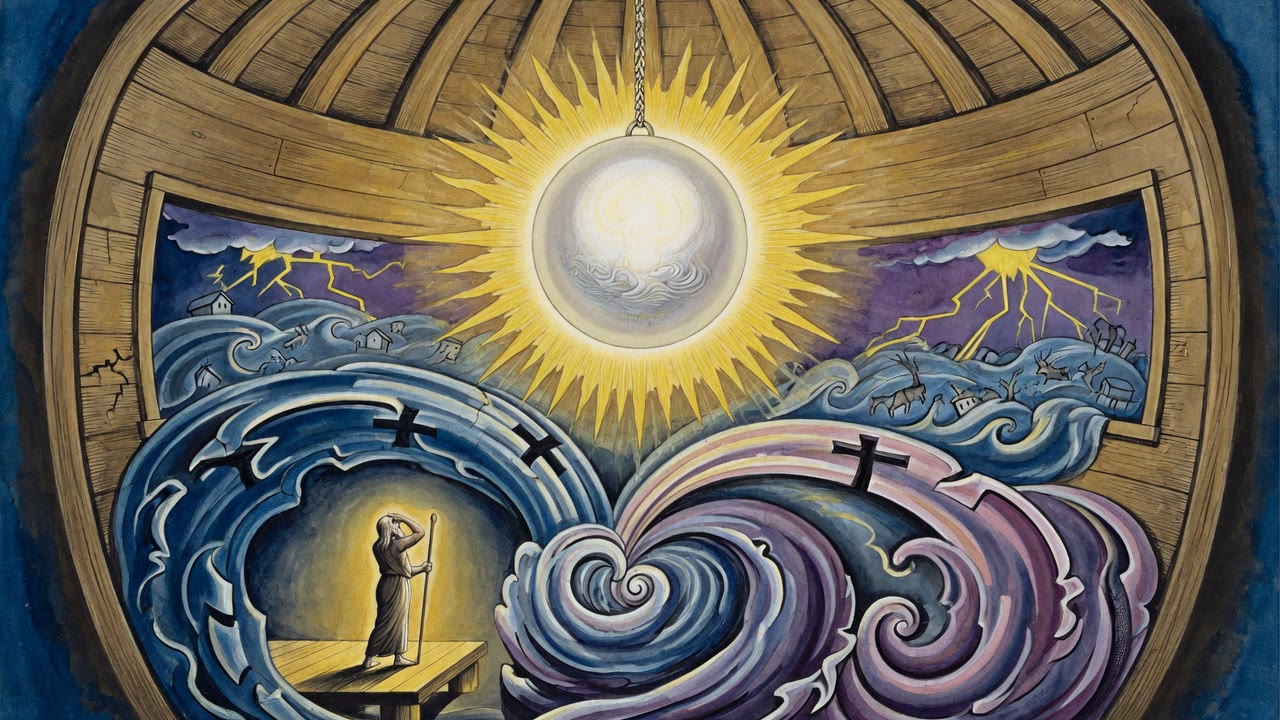
The Torah fixes the start: the six hundredth year of Noah's life, second month, seventeenth day (Genesis 7:11). Philo's midrash presses the timing toward the vernal equinox, when earth is thick with growth. Punishment at the season of rebirth is sharper than punishment after harvest. Nature offers its mercies; mortals corrupt them. If the deluge had fallen when fields were already bare, the blow might have looked like ordinary clearing. Instead Heaven floods the world at the hour of sprouting, so no one can call judgment a favor to agriculture.

Noah, building the altar in that same ordered cosmos of months, remembers that precision. The God who schedules catastrophe also schedules memory. "God remembered Noah and every living thing" (Genesis 8:1) names the man and the animals aloud. The household around him is held inside that remembrance even when the verse's list is spare. Survival was never random drift. It was a date, a door shut, a door opened, a name recalled.

He looks at green returning to the hills and does not trust green alone. Green was thick when the windows of heaven opened. Mercy and judgment share a calendar. That knowledge keeps his joy from turning stupid.

Clean Beasts on a Second-Chance Altar

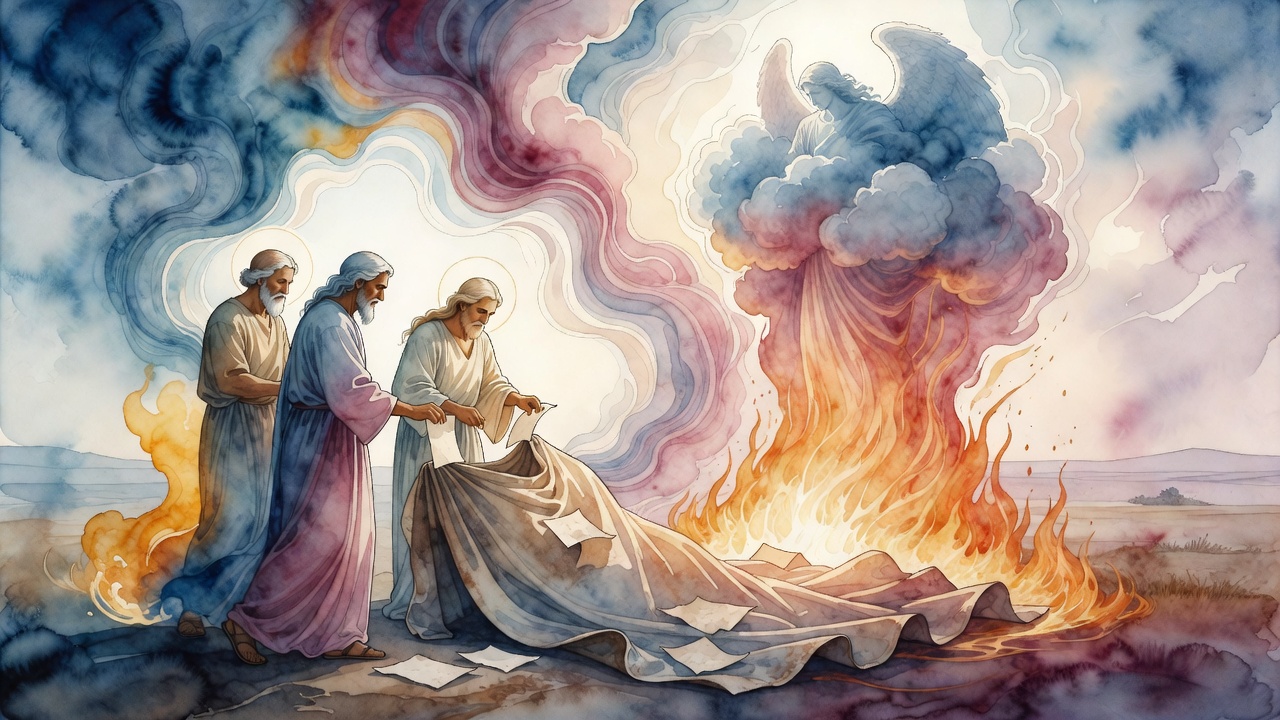
He took of the clean cattle and clean birds and offered whole burnt offerings (Genesis 8:20). Everything on that altar had already been gift. He returns first fruits of a spared menagerie. Philo reads the clean beasts as senses and the clean birds as intellect, the wise man's outer and inner powers lifted whole to the Father. Whether one stays with the smoke of actual animals or hears the allegory, the posture is the same. After demons and blood-bans, worship is the counter-seduction.

The altar is how Noah fights the future he fears. Not with another hull of gopher wood, but with fire that says the new ground is claimed for gratitude before it can be claimed for murder. The children watch. The demons, in his vision, watch too. The smoke goes up as a boundary marker: this family will at least begin by giving back.

Ash settles on his beard. The clean animals' cost is real. So is the claim that thought and sense can be offered without rot. Noah's hands, which once sealed pitch into seams, now seal a covenant gesture into the first post-Flood air.

Seduction Versus Smoke

Hold the morning together. A prophet of the Flood naming spirits that court his line. A calendar that drowned the world at greentide. A remembrance that pulls ark-life back into covenant. An offering that spends clean life to answer unclean hunger. Noah cannot police centuries. He can plant a law against blood and a habit of fire.

When later ages spill what he forbade, they walk out of his warning with open eyes. When they refuse the cup of blood and keep the altar's logic of return, they walk inside it. The demons of Jubilees do not get the last narration. The old man on the mudflat does: fear spoken, ban spoken, thanks burned, while the earth still soft from judgment tries to learn how to be ground again.

Rainbow light, if it already stands, does not cancel his speech. Promise from Heaven and vigilance from Noah are meant to share the same sky. The children step carefully around the altar stones. Somewhere a demon, in his telling, learns that this family has been warned in public, and that public warnings are harder to unwind than private fears.


← All myths

From the tradition

Sources

4 sources

The texts behind this telling. Some cards carry a translation of the source; others are our own retelling of it, and each card says which. Every card links out to the original.

Book of Jubilees 7:38Book of Jubilees

Retold in our words. Read the original at the link below.Sefaria Community Translation · CC-BY

The Book of Jubilees, a text considered canonical by some but not included in the standard Hebrew Bible, gives us a peek into Noah's anxieties about the future. Specifically, Jubilees 7. And it’s heavy stuff.

Noah, having witnessed the utter devastation of the flood, is deeply concerned about the future of humanity. He's not just worried about another flood, but about something far more insidious: the influence of demons. The world is starting over, but are the spiritual dangers truly gone?

“For I see, and behold the demons have begun (their) seductions against you and against your children," Noah laments. He's witnessing the subtle, creeping influence of these entities, and it scares him, profoundly.

His big fear? That humanity will succumb to violence. He warns his children: "…now I fear on your behalf, that after my death ye will shed the blood of men upon the earth, and that ye, too, will be destroyed from the face of the earth."

This isn't just a vague prophecy. It’s a direct warning against bloodshed.

The text gets even more specific, laying down a very clear prohibition: "For whoso sheddeth man's blood, and whoso eateth the blood of any flesh, will all be destroyed from the earth."

It's not just about the act of killing, but also about the potential for internalizing violence, for absorbing its essence. It speaks to the idea that violence corrupts, not just the victim, but also the perpetrator.

And the consequences? Utter annihilation. "And there will not be left any man that eateth blood. Or that sheddeth the blood of man on the earth, Nor will there be left to him any seed or descendants living under heaven." A stark and terrifying vision of a future wiped clean.

Noah’s words are a powerful reminder. Are we vigilant against the forces that might lead us towards violence and destruction? Are we mindful of the subtle ways that negativity can seep into our lives and the lives of our children? It’s a question worth pondering, even thousands of years after Noah voiced his concerns.

Full source
The Midrash of Philo 11:2The Midrash of Philo

Retold in our words. Read the original at the link below.The Works of Philo Judaeus, trans. C. D. Yonge, London, H. G. Bohn, 1854-1890 · Public Domain

Sometimes, the smallest detail holds a hidden universe. Take the timing of the great flood. It wasn't just any time. The Torah is very specific, telling us the deluge began "in the six hundredth year of Noah’s life, in the second month, on the seventeenth day of the month" (Genesis 7:11). But the Midrash (rabbinic interpretive commentary), that incredible pattern of interpretation and commentary, dives even deeper.

The Midrash of Philo, a collection of interpretations attributed to the Jewish philosopher Philo of Alexandria, offers a fascinating perspective. It suggests that the flood actually began during the vernal equinox – a time of rebirth and renewal. Why this specific time?

Well, Philo argues that the sacred historian, meaning the author of Genesis, was meticulously accurate in fixing the day and month when the deluge began, pointing us to the twenty-seventh day of the seventh month, which he connects to the vernal equinox. This is the time when life bursts forth, when seeds sprout and plants grow. It's a period of abundance and fertility.

So, why unleash destruction at such a promising time? According to Philo, it's precisely because of this abundance that the punishment is so severe. Imagine: nature is at its peak, offering its bounty, and humanity is simultaneously corrupting these gifts. It's a stark contrast, a profound betrayal of the divine purpose. Philo puts it powerfully, saying that God is essentially telling humanity, "behold..all nature contains its own productions within itself..but you, like mortals, corrupt its mercies."

Now, consider the alternative. What if the flood had occurred during the autumnal equinox, after the harvest, when the fields are bare? Philo suggests it wouldn't have been seen as such a harsh punishment. It might even have been viewed as beneficial, a cleansing of the land.

The timing is also linked to the creation of Adam. Just as Adam, the first human, was created during the vernal equinox, so too does the "new beginning" after the flood, with Noah, coincide with this time of renewal. Noah, in a way, becomes a second Adam, a fresh start for humanity. As Philo says, "the first beginning of the generation of our race, after the destruction caused by the deluge, commenced with Noah, men being again sown and procreated, therefore he also is recognised as resembling the first man born of the earth."

And what about the number 600, Noah's age when the flood began? Philo connects this to the number six, the number associated with creation itself. He sees it as a divine rebuke: God created the world through the number six, yet humanity's wickedness was so extreme that He had to destroy it, essentially undoing His creation. Philo states that "the world was created under the number six, therefore, by this same number does he reprove the wicked."

So, the next time you read the story of Noah's flood, remember that it's not just a tale of destruction. It's a story about timing, about the contrast between divine gifts and human corruption, and about the possibility of renewal, even after utter devastation. The Midrash of Philo invites us to contemplate the deeper meanings woven into the narrative, revealing layers of wisdom that speak to us even today. What does it mean to corrupt the divine gifts in our own time?

Full source
The Midrash of Philo 20:9The Midrash of Philo

Retold in our words. Read the original at the link below.The Works of Philo Judaeus, trans. C. D. Yonge, London, H. G. Bohn, 1854-1890 · Public Domain

He sacrifices some animals. End of story. But what if there was a deeper meaning hidden within those verses?

That's what the Midrash of Philo explores when it asks about (Genesis 8:20): "He took of the cattle and of the flying animals, and he offered whole burnt offerings on the altar." Philo, a Jewish philosopher from Alexandria, writing in the first century, wasn't just interested in the literal act. He wanted to understand the inner significance.

He starts by reminding us that everything Noah offered came from God in the first place. It was a gift, freely given. And Noah chose the clean animals, the ones deemed pure and acceptable. He burned them as "entire and pure first fruits."

Here’s where it gets interesting. Philo argues that these animals also represent something else entirely.

He suggests that the "clean cattle" and "clean birds" symbolize the outward senses and the intellect of a wise person.: our senses – sight, hearing, touch – connect us to the world, like cattle grazing in a field. And our intellect, soaring like a bird, allows us to reason and understand.

These animals, then, become metaphors for our thoughts, the very contents of our minds. And Philo argues that a truly wise person offers these in their integrity, as a perfect, unpolluted offering to God. It's about dedicating our minds, our thoughts, and our senses to something higher, offering them as a display of gratitude to the Father.

It transforms a simple act of sacrifice into a profound spiritual exercise. It's not just about burning animals on an altar. It's about purifying our thoughts and dedicating our minds to the divine. It's about offering the best of ourselves, not just the best of our livestock.

So, next time you read about Noah’s sacrifice, remember Philo’s interpretation. Consider what you are offering to the world, what thoughts and intentions you are dedicating to something greater than yourself. What are your "clean cattle" and "clean birds," and how can you offer them as a pure and unblemished sacrifice? Perhaps that is the truest offering of all.

Full source
The Midrash of Philo 1:1The Midrash of Philo

Retold in our words. Read the original at the link below.The Works of Philo Judaeus, trans. C. D. Yonge, London, H. G. Bohn, 1854-1890 · Public Domain

They weren't afraid to ask the tough questions.

Take this one, for example, posed in The Midrash of Philo: Why does the Torah specifically mention that God remembered Noah, the animals, and the livestock after the flood subsided (Genesis 8:1), but conspicuously leaves out his wife and children? Did God forget about them? Did they not matter as much?

Ouch.

It seems a bit harsh. After all, Noah's family was right there with him, enduring the same trials and tribulations. They helped care for the animals, kept the Ark afloat, and basically ensured the survival of humanity. Shouldn't they get a shout-out from the Torah, too?

The question itself highlights a fascinating aspect of rabbinic thought. They weren't afraid to confront the text, to question its nuances, and to seek deeper meaning beyond the literal words. This wasn't about finding fault, but about unlocking hidden truths. They saw the Torah as a living document, constantly speaking to new generations.

So, what’s the answer? Why the apparent omission? The Midrash of Philo doesn't explicitly offer a solution here, leaving room for interpretation and further discussion. Perhaps the omission was intentional, prompting us to reflect on the often-unseen contributions of women in biblical narratives.

Or perhaps, by mentioning Noah, the text implicitly includes his entire family. After all, he wouldn’t be Noah without them, would he?

Whatever the reason, this seemingly simple question opens up a rich and complex conversation about memory, recognition, and the value of every individual, both great and small. And that, my friends, is the magic of Midrash (rabbinic interpretive commentary). It invites us to think, to question, and to find ourselves within the ancient stories.

Full source