Parshat Noach6 min read

The Pearl That Never Set and the Year Noah Never Slept

A single glowing pearl is Noah's only clock while he climbs a black ark for a year, feeding every beast on its own hour until the work nearly kills him.

Curated by Arthur · Told by Maggid ·
Table of Contents
  1. A Schedule With No Morning
  2. The Worm Bred for a Single Mouth
  3. The Lion That Burned With Fever
  4. The Bird That Would Not Wake Him

Outside, the world was drowning. Inside, there was no sun to prove that morning had ever existed.
The Pearl That Never Set and the Year Noah Never Slept Click for full size

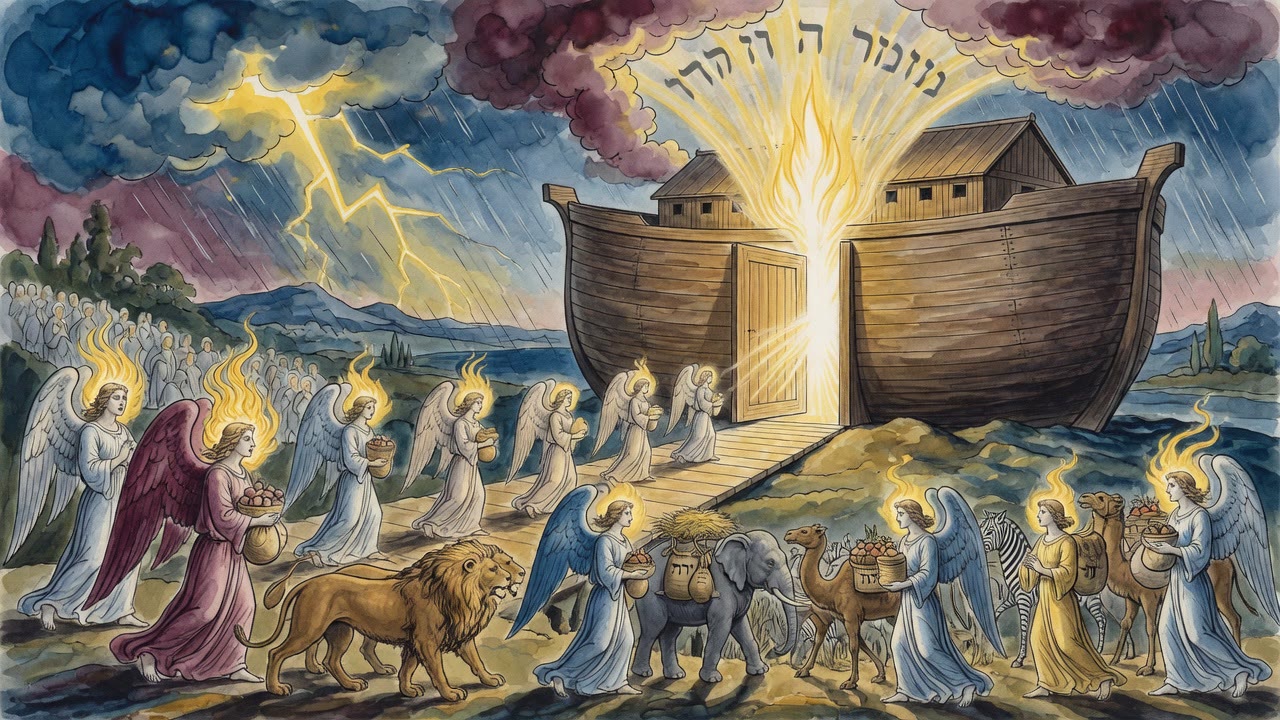
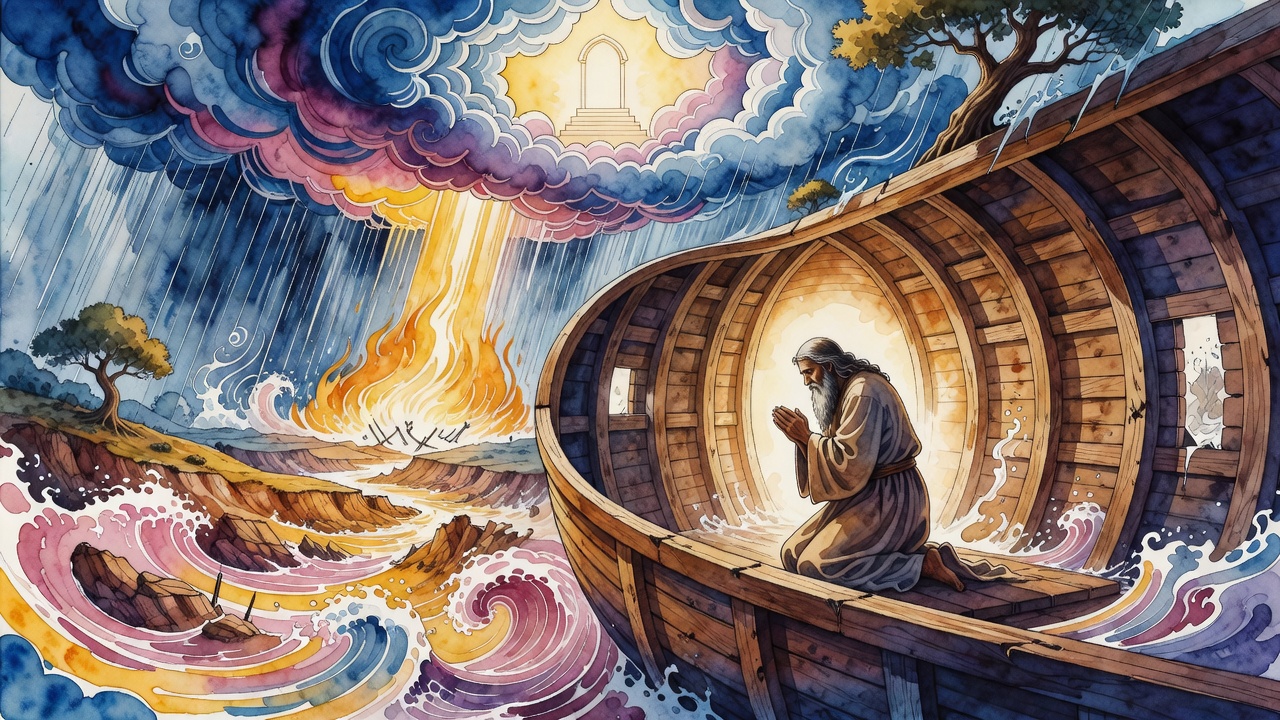
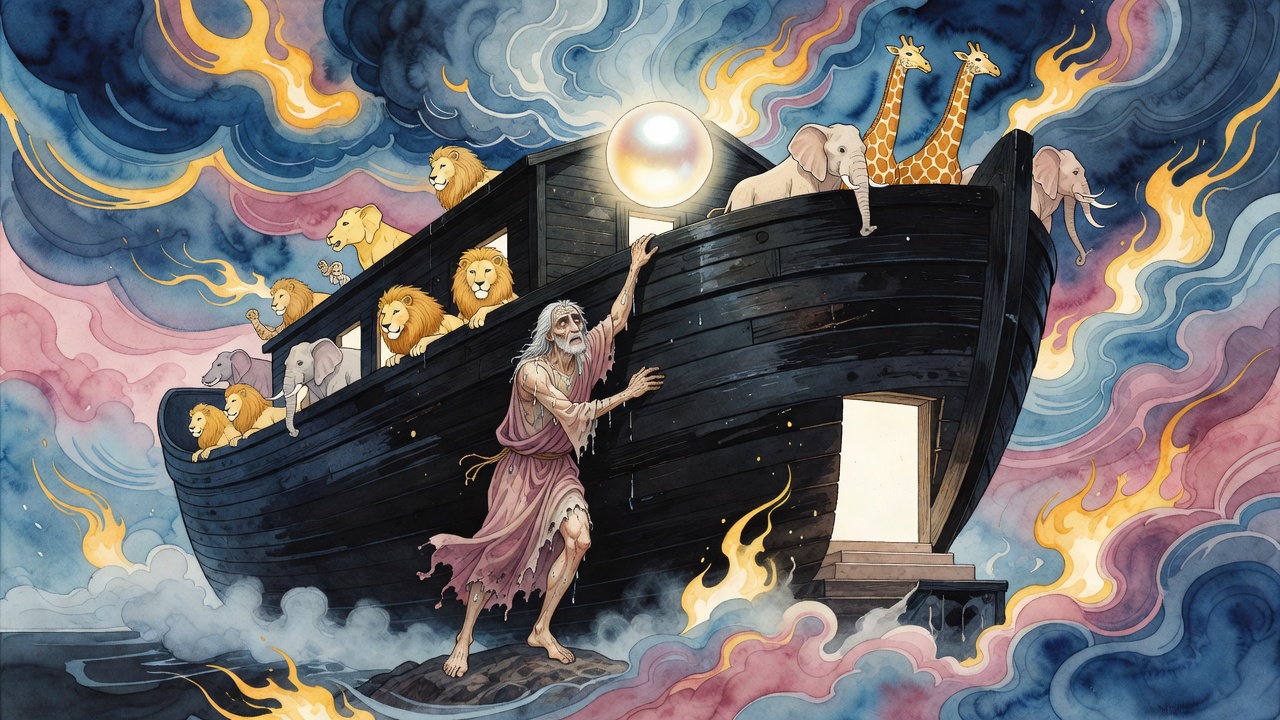
Noah had sealed the last door on the seventeenth day of Marcheshvan, seven days after the animals filed in two by two, and when the pitch dried over the final seam the ark went black. No window opened on anything but rising water. No lamp could be lit near so much straw and fur and terror. For a year and more, the only thing that told him whether it was day or night was a pearl.

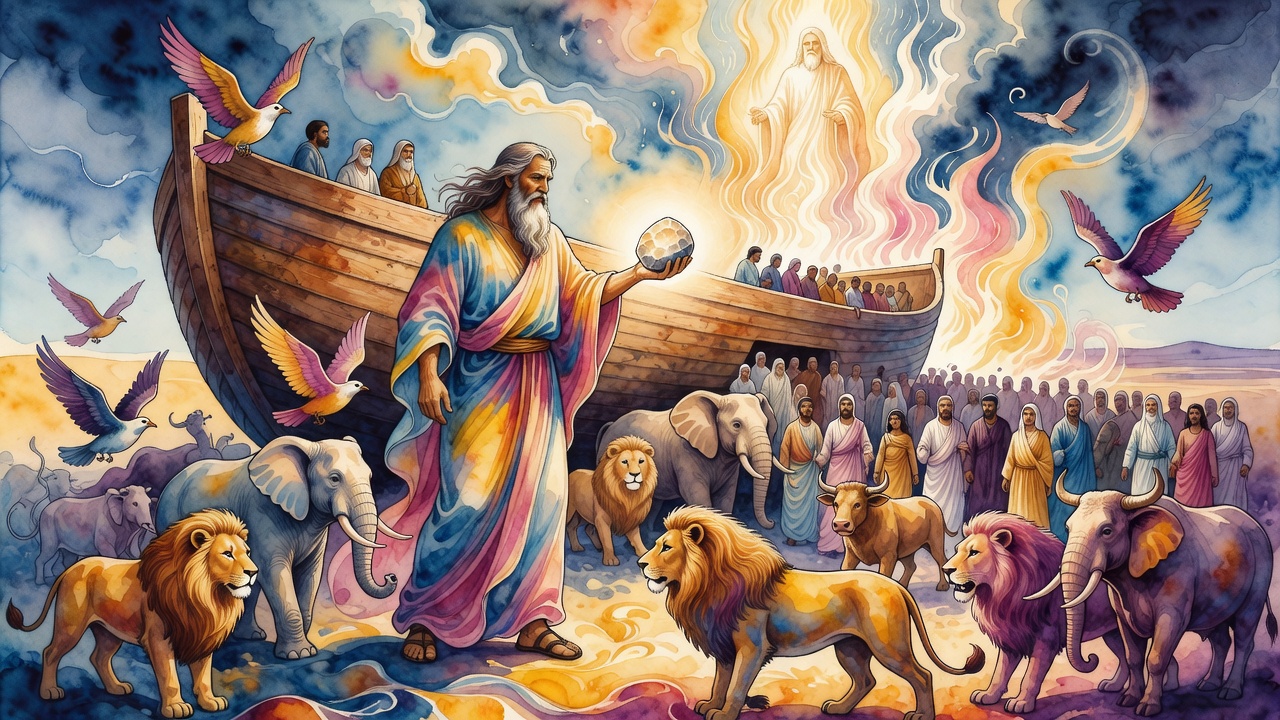
It hung from the roof of the ark, a single stone the size of a fist, and it glowed. Not the sour flicker of an oil wick but a clean, steady light, like a small sun trapped under the beams. When it burned bright, Noah knew the sun stood somewhere above the drowned sky. When it dimmed to a low ember, night had come to a world with no one left to see it. That pearl was his clock, his calendar, and his one companion that never asked to be fed.

Everything else asked to be fed.

A Schedule With No Morning

Under the pearl's light Noah learned a thing no man had ever needed to know. Every creature ate on its own hour. The beasts of the day woke when the pearl brightened and cried for their food. The beasts of the night stirred when it dimmed, and cried for theirs. There was no hour that belonged to Noah. He climbed between the tiers of cages with baskets on his back, and by the time he reached the last of the day animals the pearl was already fading, and the owls and bats and pale night-crawlers were waking hungry beneath him.

He had penned the males on one side of the ark and the females on the other, so that in the ruin of the world nothing would breed and multiply what he could barely keep alive. It kept a kind of order. It did not lighten the work. It doubled the distance he walked.

Many years after, his son Shem would try to explain it to a traveler named Eliezer, servant of Abraham, and the old man could find only one phrase plain enough for it. "We had sore troubles in the ark," he said.

The Worm Bred for a Single Mouth

There was a small creature the household called the zikta, and it nearly broke him. Noah brought it grain and it turned away. He brought it fruit and it turned away. At last he split a pomegranate and set it down, and as the red seeds spilled a worm dropped out of the fruit, and the zikta struck and swallowed it whole. So that was its hunger. Not the fruit. The worm.

From that hour Noah kept bran in a corner and bred worms in it, so that one small animal would not starve while the earth was being scrubbed clean of every other living thing. He fed the zikta by the pearl's light and moved on, because a hundred other mouths were already calling.

The Lion That Burned With Fever

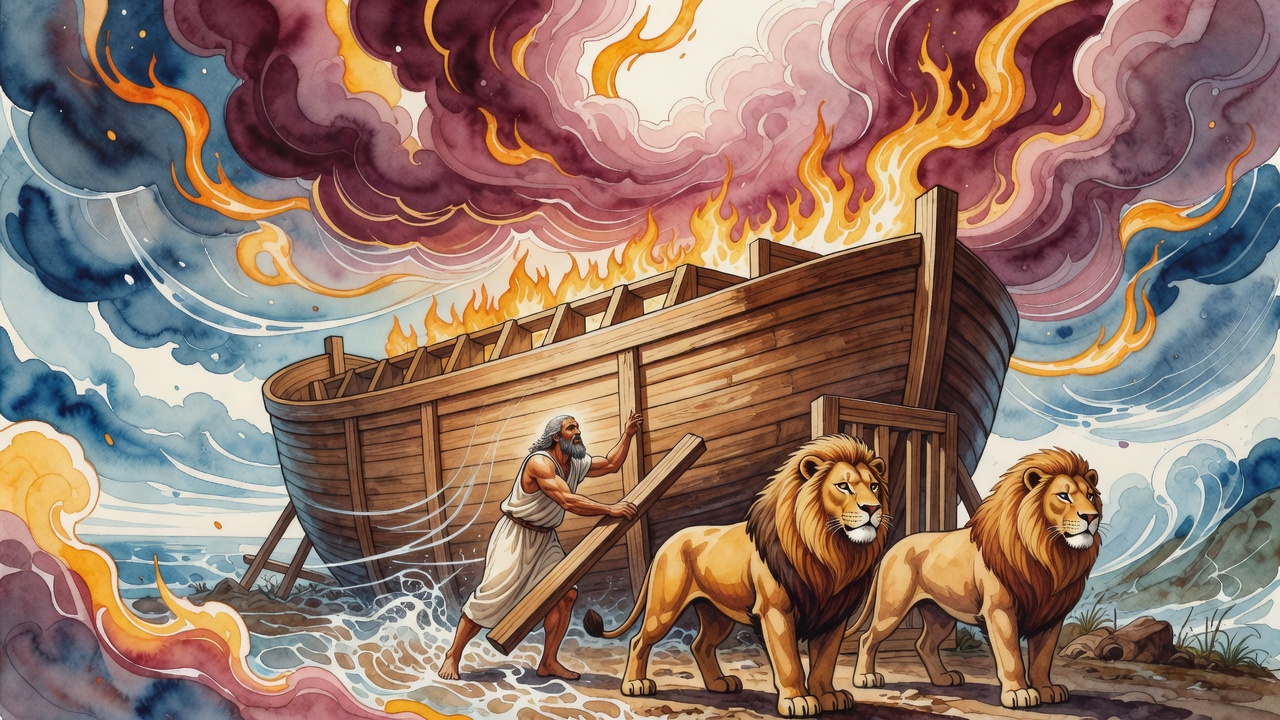
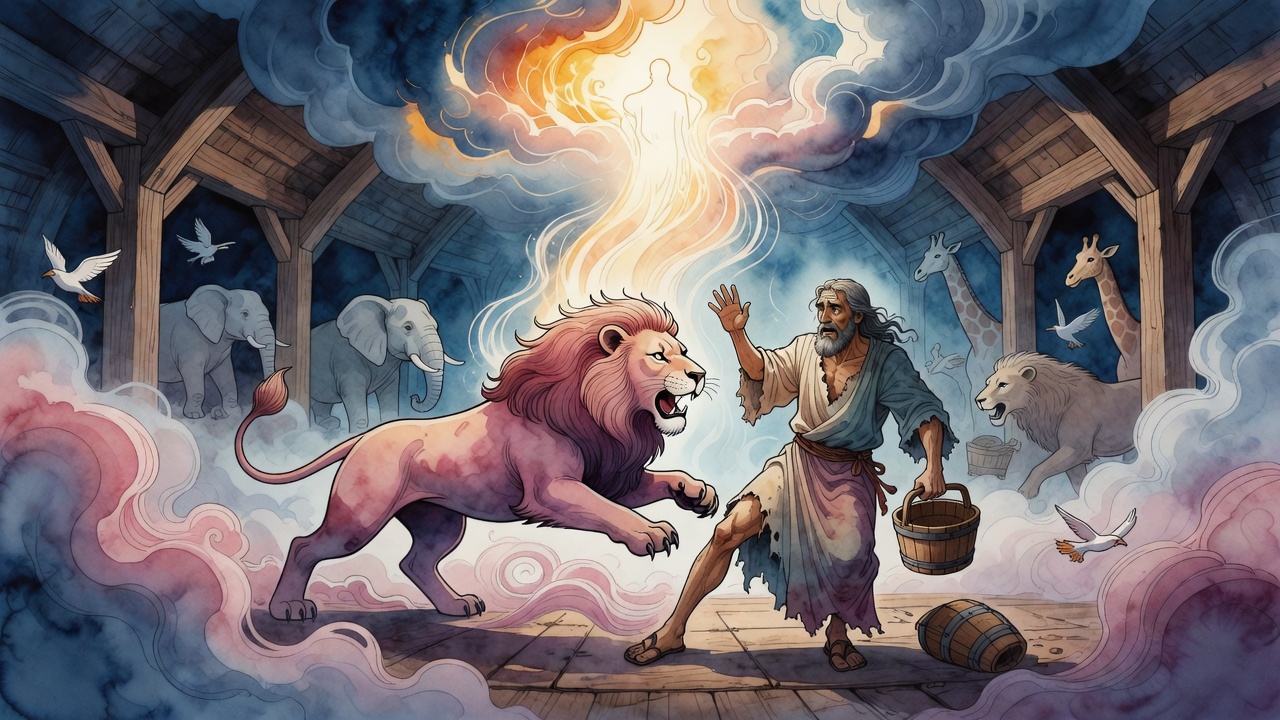
The animal he feared most gave him the least trouble. The lion lay in its pen and would not rise. Its eyes ran, its breath came hot and shallow, and a fever burned in it the whole voyage long. A well lion in that dark would have been a horror, roaring for meat it smelled in every neighboring cage. This lion only shivered and dozed and let its food sit untouched, too sick to be a king. Noah tended it and did not curse the sickness. A quiet predator was the one mercy the ark offered him, and he took it.

The Bird That Would Not Wake Him

Somewhere in the second half of that endless year, the work began to kill him. His hands blistered and split. He could barely tell one dimming of the pearl from the next. He walked the rows in a daze, terrified that some small breathing thing would go silent in the dark before he reached it. Every creature that would ever live again on the earth was locked in this hull, and all of it hung on whether one failing old man could stay on his feet.

One turn of the pearl toward darkness, he came to a corner and found a bird he had never fed. The urshana lay folded in the shadow, so still he thought the thing he dreaded had finally happened. He knelt and asked it, quietly, why it had never called for food like all the rest. Did it want nothing to eat?

The bird lifted its head. "I saw how much labor you carry," it said, "and I did not want to add to it."

Noah wept over a bird. He had not wept over the drowned world, but he wept over this one creature that had chosen to go hungry rather than cost him another climb through the dark. He laid his hand over it and spoke a blessing, the only wage he had left to give. "May it be the will of the Lord," he said, "to keep you alive forever." And the blessing held. Death was loosed on everything under heaven that season, and it never once came for the urshana.

The rain had stopped long before, but the water held the ark aloft for months more, and Noah kept climbing. Day by the bright pearl, night by the dim one. Grain, worms, water, up and down the sundered rows of males and females, until the day the hull ground against something solid and the light of a real sun, almost forgotten, cracked in through the opening seam.


← All myths
From the tradition

Sources

3 sources

The texts behind this telling. Some cards carry a translation of the source; others are our own retelling of it, and each card says which. Every card links out to the original.

Pirkei DeRabbi Eliezer 23:7Pirkei DeRabbi Eliezer

Retold in our words. Read the original at the link below.Pirke de Rabbi Eliezer, trans. Rabbi Gerald Friedlander, London (1916) · CC-BY

Some fascinating details emerge from Jewish tradition. Rabbi Meir, in Pirkei DeRabbi Eliezer, offers a striking image. He says there was a single pearl suspended within the Ark. But this wasn’t just any pearl; it radiated light, illuminating the entire space. Like a lamp within a house, he says, or even like the sun itself! He finds support for this idea in the verse "A light shalt thou make to the ark" (Genesis 6:16). a single, luminous pearl, a tiny sun, providing light and, perhaps, a little bit of hope in the midst of unimaginable darkness.

When did this all happen? When did the animals actually enter the Ark, and when did the flood begin?

Rabbi Zadok, also in Pirkei DeRabbi Eliezer, gives us specific dates. He says that on the 10th of Marcheshvan – that's the second month in the Jewish calendar – all the creatures entered the ark. Seven days later, on the 17th of Marcheshvan, the heavens opened, and the flood began. But Rabbi Zadok adds another layer, a distinctly mystical one: he describes two types of water joining together.

He calls the rain that descended from the heavens waters "endowed with the male principle." These waters joined with waters that rose from the depths, "endowed with the female principle." These waters then combined, and the deluge intensified until it "prevailed exceedingly upon the earth" (Genesis 7:19).

It speaks to a deeper understanding of the natural world, one where everything has a spiritual dimension. It's easy to imagine the flood as simply a random act of destruction. But the Rabbis see something more profound: a cosmic merging, a divine act with complex underlying forces. The Pirkei DeRabbi Eliezer shows us that the flood wasn't just about water; it was about the joining of energies, the collision of the heavens and the earth.

So, the next time you think about Noah's Ark, remember the radiant pearl, the precise dates, and the mystical waters. It's more than just a children's story; it's a glimpse into a world where the physical and spiritual are intertwined, and where even in the face of devastation, there's a light shining in the darkness.

Full source
Legends of the Jews 4:48Legends of the Jews

Retold in our words. Read the original at the link below.The Legends of the Jews by Louis Ginzberg (1909) · Public Domain

The familiar story is this: the flood, the animals two-by-two… but imagine the sheer logistics! It wasn't just about getting them all on board. It was about keeping them alive, and well-fed, for over a year!

The traditional telling often glosses over this monumental task. But according to the ancient stories, the real challenge wasn't rounding up the creatures, but caring for them. Shem, Noah's son, recounts some of these challenges to Eliezer, Abraham's servant, many years later. This is preserved in texts like Ginzberg's Legends of the Jews.

The scene: Day animals need feeding during the day, night animals at night. And Noah had to figure out what each creature needed. Shem says they had "sore troubles in the ark"– an understatement, I'm sure!

Take the story of the little zikta. We don’t know for sure what kind of animal this was, but it had very particular tastes. Noah tried feeding it pomegranate. Then, a worm fell out, and the zikta devoured it! Necessity is the mother of invention. From then on, Noah would actually breed worms in bran just to feed this one creature. I mean,

And then there's the lion. You'd think the king of the jungle would be a major problem, but in the story, the lion was constantly sick with a fever. Poor thing! This meant he didn't have much of an appetite and wasn't bothering the other animals. Sometimes, a little illness can be a blessing in disguise. Perhaps the most heartwarming tale is about the urshana. Again, the specific animal isn't clear, but the story is beautiful. Noah found the urshana sleeping in a corner and asked if it needed anything to eat. The urshana replied that it saw how busy Noah was and didn't want to add to his burdens! Touched by this selfless act, Noah blessed the creature, saying, "May it be the will of the Lord to keep thee alive forever," and the blessing was realized.

What does this tell us? It's not just a cute anecdote. It reveals a profound understanding of compassion, sacrifice, and the interconnectedness of all living things. Even in the face of world-ending disaster, kindness and consideration mattered. Perhaps that's the real message of the Ark story: not just survival, but how we treat each other along the way.

Full source
Pirkei DeRabbi Eliezer 23:11Pirkei DeRabbi Eliezer

Retold in our words. Read the original at the link below.Pirke de Rabbi Eliezer, trans. Rabbi Gerald Friedlander, London (1916) · CC-BY

The familiar story centers on Noah, the flood, and the animals saved two-by-two. But have you ever stopped to consider the logistics? How did Noah manage all those creatures for over a year?

Well, according to Pirkei DeRabbi Eliezer, a fascinating early collection of Biblical stories and interpretations, it was even more complicated than we might think.

Rabbi Levitas of Jamnia, a town known for its rabbinic wisdom, offers a fascinating detail about the animals’ arrangement within the ark. He says that when they entered, Noah separated the males from the females.! It wasn't just a free-for-all. The verse "And Noah went in, and his sons, and his wife, and his sons' wives" (Genesis 7:7) implies a deliberate order and separation. Rabbi Levitas takes this to mean the males were on one side, the females on the other.

Why? Was it about preventing chaos? Maintaining some semblance of order in a floating zoo?

Then, when they finally left the ark, everything changed. The verse "Go forth of the ark, thou, and thy wife, and thy sons, and thy sons' wives with thee" (Genesis 8:16) tells us something crucial. According to Rabbi Levitas, this signifies that God reunited the male and female animals. The text emphasizes, "Verily a man with his wife (went forth)." The focus shifted to pairing and procreation.

Pirkei DeRabbi Eliezer connects this directly to God's blessing: "And God blessed Noah and his sons, and said unto them, Be fruitful, and multiply, and replenish the earth" (Genesis 9:1). The separation was temporary, a measure for survival. The reunion was for the future, for rebuilding the world.

And the story doesn’t end there. The text goes on to say the sons of Noah were fruitful and multiplied, and they begat sons "with their twins with them." What does this mean? Were all of Noah's grandchildren twins? Perhaps it's a symbolic way of saying that the potential for new life and new beginnings was inherent in every generation that followed the flood. The world was starting anew, and the blessing of fertility was paramount.

It's more than just a children's story about animals and a big boat. It's a story about order and chaos, separation and reunion, survival and rebirth. And sometimes, a little organization can go a long way.

Full source