Parshat Noach6 min read

The Lion That Bit Noah Inside the Ark and Left Him Lame

For twelve months Noah feeds every beast on its own clock, never sleeping, until the night he comes late and the lion mauls him in the dark.

Curated by Arthur · Told by Maggid ·
Table of Contents
  1. Every Creature on Its Own Clock
  2. The Lion in the Middle Story
  3. The Night He Was Late
  4. What Clung to the Hull

For twelve months the ark never held still, and neither did Noah. The water had no floor and no shore. The vessel rolled in the black, pitched up some long invisible slope, then dropped, and somewhere below in the dark the animals slid and screamed and were sick. Three stories of cargo groaned around him. The bottom held the refuse, a reeking swamp of dung that had to be raked toward the trap in the hull. The middle held the beasts. The top held the eight humans who were now the only people left in the world.
Every Creature on Its Own Clock

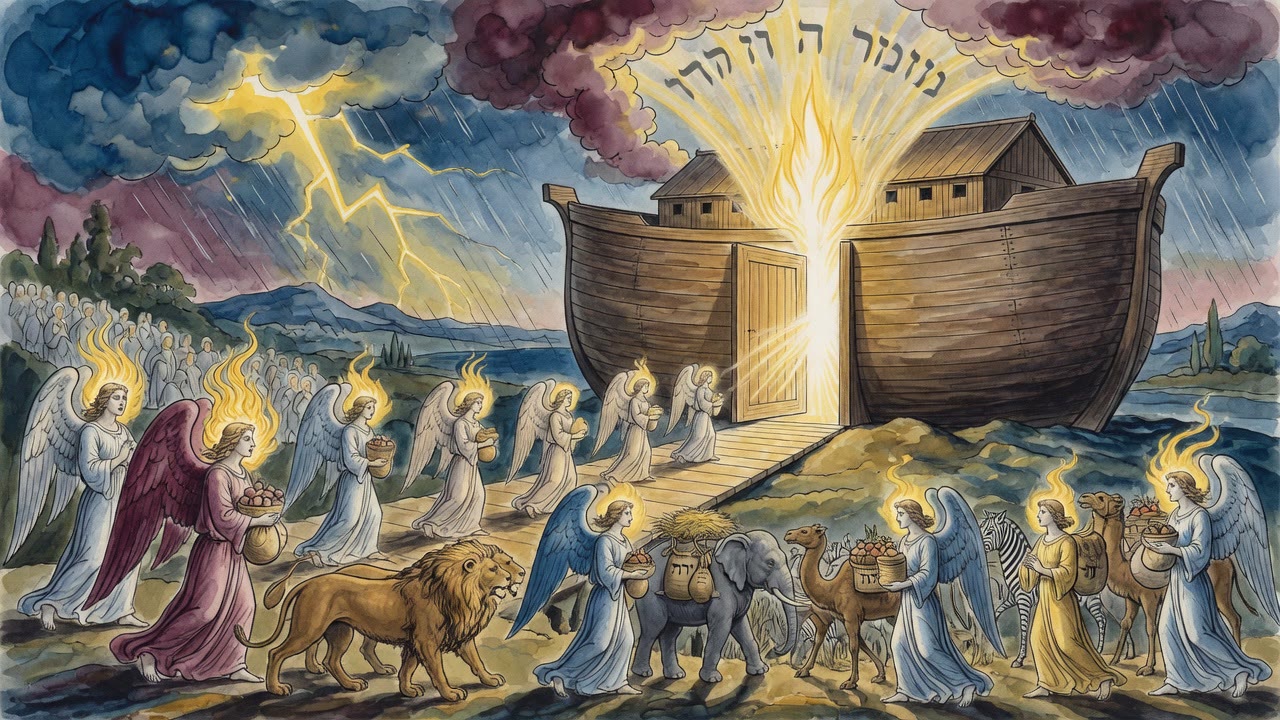
There was no day. There was no night. The sun had been pulled out of its order so that it rose where it should have set, and the only calendar left was hunger. Noah learned the animals the way a jailer learns prisoners, which is to say by their demands. Some fed when the light should have been up. Some fed when it should have been down. So he and his sons and their wives split the dark between them and never truly slept, climbing the ladders with armfuls of grain and flesh and leaves, one creature at a time, on each creature's own clock.

The chameleon nearly died on him before he understood it. It ate nothing he offered. Then one watch he sat peeling a pomegranate, half-asleep, and a worm dropped from the fruit, and the small thing struck and swallowed. After that he kneaded bran with water and let it rot until the worms came, and carried the writhing mess up the ladder like a delicacy. In a compartment along the side he found the phoenix lying still, and his heart dropped, because he thought it was dead. "Do you not want food?" he asked it. The bird answered him. "I saw that you were busy," it said, "and I did not want to trouble you." Noah wept over it and blessed it that it would never die.

The Lion in the Middle Story

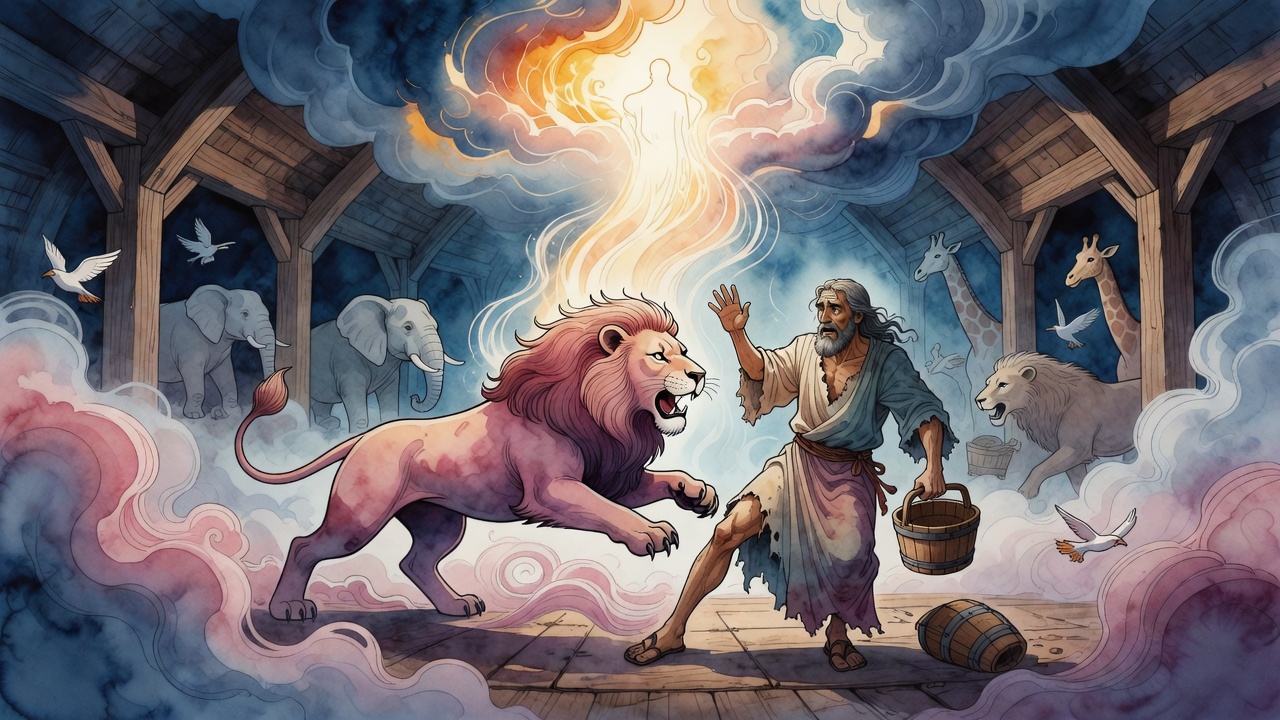
The lion was different. The lion did not negotiate.

For long stretches a fever burned in it, and while the fever held it needed nothing, and Noah was grateful for that mercy because the lion frightened him in a way the leviathan-bound deep did not. When the fever broke the hunger came back enormous, and the great cat would pace its compartment and watch the ladder, and Noah would feel its yellow attention on him from across the middle story. He fed it on its own time. He told himself he always fed it on its own time.

Above all of it, hour upon hour, was the smell. Not the dung, though that was its own punishment. It was the lions, the rank animal reek of the great predators soaked into the timbers and into his clothes and into his skin until he could not remember the smell of a field. His soul went thin inside him. One watch he stood in the dark and lifted his face and cried out to the Holy One. "Sovereign of all worlds," he prayed, "bring me forth from this prison, for my soul is faint because of the stench of lions." He did not get an answer. He got another watch, and then another.

The Night He Was Late

It came on a night that was indistinguishable from every other night, which was the whole horror of it. The ark heaved. Noah was below, knee-deep in filth, dragging the refuse toward the hull-trap, his back screaming, when the lion's hour came and went. He was late. Only a little late. He hauled himself up the ladder with the meat, breathing hard, telling the beast in his mind that he was coming, that it was nothing, that one missed hour in twelve months of perfect service was nothing.

The lion did not reason that way.

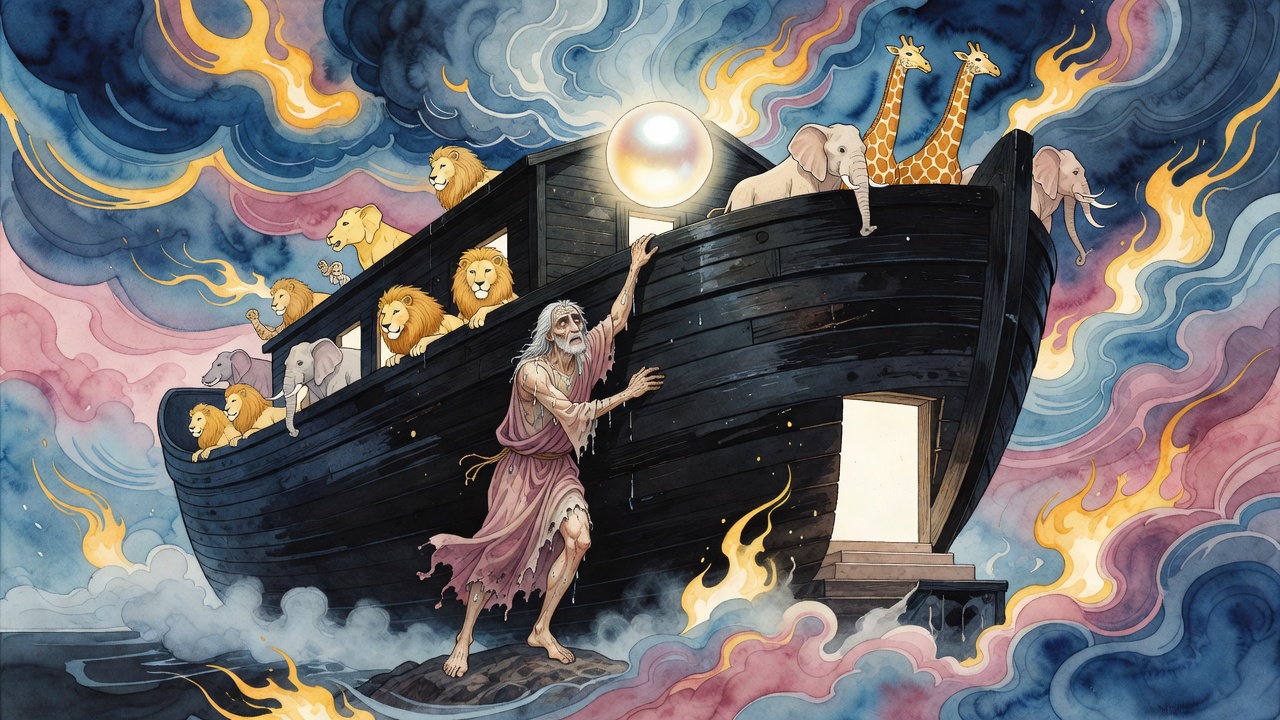
It met him as he came over the lip of the middle story. There was no roar, only weight, a sudden mountain of muscle, and then the teeth. It struck him and bore him down and bit, and Noah went under it screaming with the meat scattered and useless beside him, and his sons came shouting with poles and fire and drove it back into the dark. When they pulled him up he was torn and coughing blood, and one leg would not hold him. The man who had built the box that saved every living thing lay in his own filth in the belly of it, mauled half to death by one of the creatures he had carried up the ladder a thousand times.

He limped after that. For the rest of his long life he limped, and he coughed, and the leg never came right.

What Clung to the Hull

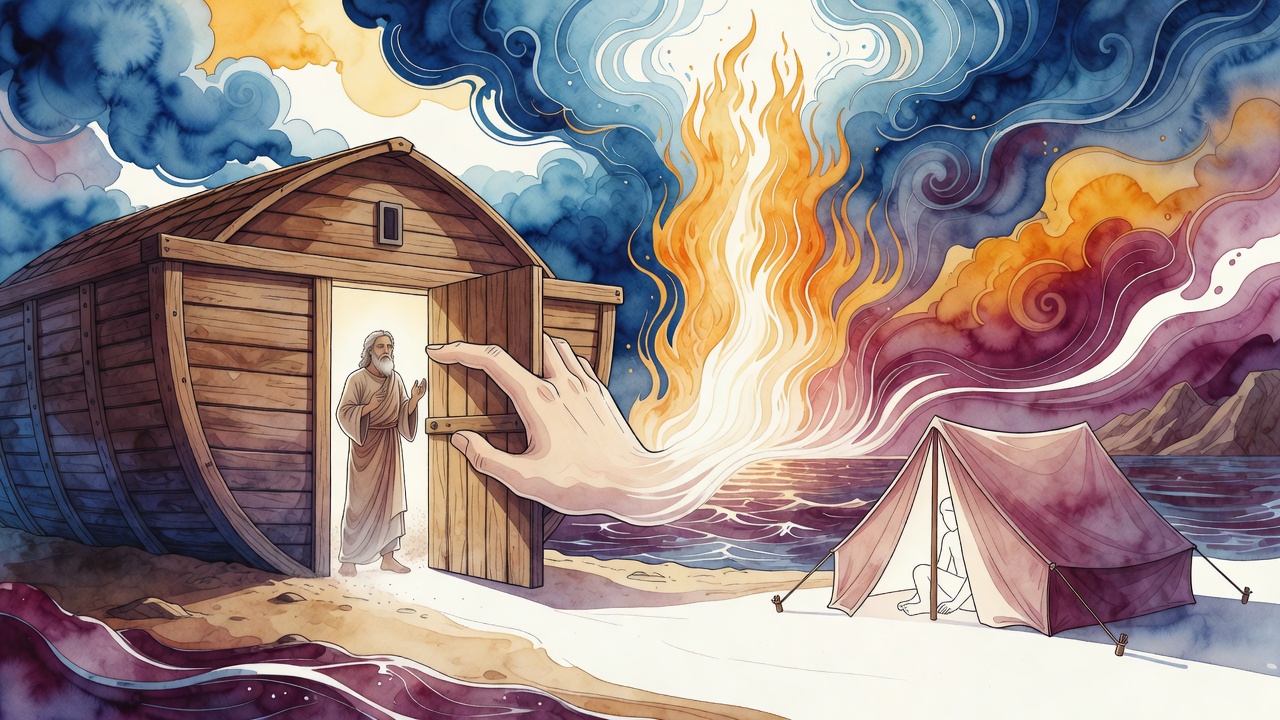
And the work did not stop. He still climbed. Bandaged and broken he still climbed the ladders, because the chameleon still wanted its worms and the night-creatures still woke in the false dark and the lion, healing in its corner, still had its hour. There was a hole in the hull besides the refuse-trap, low near the waterline, and through it twice a day Noah passed food to a hand the size of a roof-beam. Og, the giant, who had not been let aboard and could not be drowned, rode the storm clinging to a timber under the gutter of the ark, and had sworn himself and all his seed into servitude in exchange for bread. So the limping man fed the giant on the outside and the lion on the inside, and the months ground on.

When at last the raven and then the dove went out, and the olive leaf came back bitter in a beak, and the door finally opened on a scoured and silent world, eight people came down into the light. The animals came after them, "after their kinds," because some of those that had climbed aboard had died in the dark of that year, and it was their young who walked out. Noah came down last and slowest, leaning, dragging the leg, the smell of lions still in his clothes.


← All myths

From the tradition

Sources

3 sources

The texts this telling draws on, in full. Open a card to read inline, or expand it for a wider, quieter read.

Sanhedrin 108bTalmud Bavli, Sanhedrin

They said to him: If so we will not clear a path through vineyards, i.e., we will continue to sin. Rava taught: What is the meaning of that which is written: “A contemptible torch [lapid] in the thought of him that is at ease, a thing ready for them whose foot slips” (Job 12:5)? This teaches that Noah the righteous would rebuke the people of his generation, and he said to them statements that are harsh as torches [kelapidim], and they would treat him with contempt.

They said to him: Old man, why are you building this ark? Noah said to them: The Holy One, Blessed be He, is bringing a flood upon you. They said to him: A flood of what? If it is a flood of fire, we have another item and it is called alita, and it is fireproof.

And if it is a flood of water that He brings, if He brings the water from the earth, we have iron plates with which we can plate the earth to prevent the water from rising. And if He brings the water from the heavens, we have an item and it is called ekev, and some say it is called ikkesh, which will absorb the water. Noah said to them: If He wishes He will bring the water from between your feet and you can do nothing to prevent it, as it is stated: “For them whose foot slips.”

It is taught in a baraita: The waters of the flood were as hard and thick as semen, as it is stated: “For them whose foot slips”; foot is a euphemism. Rav Ḥisda says: With hot semen they sinned, and with hot water they were punished. As it is written here, at the conclusion of the flood: “And the waters assuaged” (Genesis 8:1), and it is written there: “Then the king’s wrath was assuaged” (Esther 7:10).

Just as the term “assuaged” there is referring to the heat of Ahasuerus’s wrath, so too, “assuaged” with regard to the flood is referring to the heat of the waters. With regard to the verse: “And it came to pass that after seven days the waters of the flood were upon the earth” (Genesis 7:10), the Gemara asks: What is the nature of these seven additional days? Rav says: These were the days of mourning for the death of Methuselah; and this is to teach you that eulogies for the righteous prevent calamities from ensuing.

Alternatively, “after seven days” means that the Holy One, Blessed be He, altered the order of Creation for that generation, i.e., in seven days He reversed the process of Creation, so that the sun would emerge in the west and set in the east. Alternatively, it means that the Holy One, Blessed be He, designated a substantial period for them, one hundred and twenty years, to repent, and thereafter designated a brief period for them, an additional seven days, as a final opportunity for them to repent.

Alternatively, “after seven days” means that during those seven days, God gave them a foretaste of the delights of the World-to-Come, which will be actualized during the seventh millennium, so that they would know what munificence their sins prevented them from receiving. § With regard to the verse: “Of every kosher animal you shall take to you by sevens, husband and wife” (Genesis 7:2), the Gemara asks: Is there marriage for animals?

Rabbi Shmuel bar Naḥmani says that Rabbi Yonatan says: The reference is to those animals with which the transgression of relations with another species was not performed. Therefore, the Torah underscores that the animals that entered the ark were husband and wife. The Gemara asks: From where did Noah know which animals were not involved in that transgression? Rav Ḥisda says: He passed them before the ark.

All animals that the ark accepted, it was known that a transgression had not been performed with them. And any animal that the ark did not accept, it was known that a transgression had been performed with it. Rabbi Abbahu says: Noah took onto the ark only from those animals that came on their own, as it appeared that they were sent from Heaven, and they were certainly fit for this purpose. With regard to the verse: “Make you an ark of gopher wood” (Genesis 6:14), the Gemara asks: What is gopher wood?

Rav Adda says that they say in the school of Rabbi Sheila: This is wood from the mavliga tree; and some say that it is wood from the willow [gulamish] tree. With regard to the verse: “A tzohar you shall make for the ark” (Genesis 6:16), Rabbi Yoḥanan says that the Holy One, Blessed be He, said to Noah: Set precious stones and jewels in the ark so that they will shine for you as the afternoon [tzohorayim] sun.

With regard to the verse: “And to a cubit you shall finish it above” (Genesis 6:16), the Gemara explains that in that manner, having been built wide at its base and narrow at its top, the ark would stand upright and would not capsize. With regard to the verse: “With lower, second and third stories shall you make it” (Genesis 6:16), it was taught in a baraita: The bottom story was for manure, the middle story was for animals, and the top story was for people.

With regard to the verse: “And he sent forth the raven, which went forth to and fro, until the waters were dried up from the earth” (Genesis 8:7), Reish Lakish says: The raven provided a convincing response to Noah; when it did not wish to leave the ark the raven said to him: Your Master, God, hates me, and you hate me. Your Master hates me, as He commanded to take from the kosher species seven and from the non-kosher species two.

And you hate me, as you disregard those from the species of seven, i.e., the kosher birds, and instead dispatch one from the species of two, i.e., the non-kosher birds. If the angel of heat or the angel of cold harms me and kills me, will the world not be lacking one species of creature, as there was only one pair of ravens? Or perhaps you are sending me because it is my wife that you need, in order to engage in intercourse with her.

Noah said to the raven: Wicked one! If with the woman who is generally permitted to me, my wife, intercourse is forbidden to me, then with regard to domesticated and undomesticated animals, which are generally forbidden to me, is it not all the more so the case that they are forbidden to me? The Gemara asks: And from where do we derive that it was prohibited for them to engage in intercourse while in the ark?

The Gemara answers: It is derived from that which is written: “And you shall come into the ark, you, and your sons, and your wife, and your sons’ wives with you” (Genesis 6:18); and it is written: “Emerge from the ark, you and your wife, and your sons and your sons’ wives with you” (Genesis 8:16). And Rabbi Yoḥanan says: From here, the Sages derived and said that it was prohibited to engage in intercourse while in the ark, as when Noah and his family entered, the husbands and wives were listed separately, and when they emerged, the husbands were listed with their wives.

The Sages taught: Three violated that directive and engaged in intercourse while in the ark, and all of them were punished for doing so. They are: The dog, and the raven, and Ham, son of Noah. The dog was punished in that it is bound; the raven was punished in that it spits, and Ham was afflicted in that his skin turned black. With regard to the verse: “And he sent forth the dove from him, to see if the waters abated” (Genesis 8:8), Rabbi Yirmeya says: From here it is derived that the dwelling place of kosher birds in the ark was with the righteous people, as the verse emphasizes that Noah dispatched the dove from his place.

With regard to the verse: “And in her mouth was an olive branch plucked off [taraf ]” (Genesis 8:11), Rabbi Elazar says: The dove said before the Holy One, Blessed be He: Master of the Universe, may my sustenance be bitter as the olive and dependent on Your hands, and not sweet as honey and dependent on the hands of flesh and blood. The Gemara asks: From where may it be inferred that taraf is a term that indicates sustenance?

The Gemara answers: It is inferred from that which is written: “Feed me [hatrifeni] with my allotted portion” (Proverbs 30:8). With regard to the verse: “After their kinds [lemishpeḥoteihem], they emerged from the ark” (Genesis 8:19), Rabbi Yoḥanan says: After their kinds [lemishpeḥotam] the animals emerged, but not them [hem] themselves, as some of the animals that entered the ark died during that year and it was their descendants who emerged.

Rav Ḥana bar Bizna says: Eliezer, servant of Abraham, said to Shem the Great, son of Noah: It is written: “After their kinds, they emerged from the ark,” indicating that the different types of animals were not intermingled while in the ark. Where were you and what did you do to care for them while they were in the ark? Shem said to him: We experienced great suffering in the ark caring for the animals.

Where there was a creature that one typically feeds during the day, we fed it during the day, and where there was a creature that one typically feeds at night, we fed it at night. With regard to that chameleon, my father did not know what it eats. One day, my father was sitting and peeling a pomegranate. A worm fell from it and the chameleon ate it.

From that point forward my father would knead bran with water, and when it became overrun with worms, the chameleon would eat it. With regard to the lion, a fever sustained it, since when it suffered from a fever, it did not need to eat; as Rav said: For no fewer than six days and no more than twelve days, fever sustains a person; he need not eat and is sustained from his own fats. Shem continued: With regard to the phoenix [avarshina], my father found it lying in its compartment on the side of the ark.

He said to the bird: Do you not want food? The bird said to him: I saw that you were busy, and I said I would not trouble you by requesting food. Noah said to the bird: May it be God’s will that you shall not die, and through that bird the verse was fulfilled, as it is stated: “And I said, I shall die in my nest, and I shall multiply my days as the phoenix” (Job 29:18). § Rav Ḥana bar Leva’ei says that Shem the Great said to Eliezer, servant of Abraham: When the four great kings of the east and the west came upon you to wage war with Abraham, what did you do?

Eliezer said to him: The Holy One, Blessed be He, brought Abraham and placed him to His right, and we would throw dust and it became swords, and we threw straw and it became arrows, as it is stated: “A Psalm of David. The Lord says to my master: Sit to My right, until I make your enemies your footstool” (Psalms 110:1), and it is written: “Who has raised up one from the east at whose steps victory attends?

He gives nations before him, and makes him rule over kings; his sword makes them as the dust, his bow as driven straw” (Isaiah 41:2). Apropos Abraham’s miraculous weapons, the Gemara relates: Naḥum of Gam Zo was accustomed that in response to any circumstance that arose in his regard, he would say: This too [gam zo] is for the best. One day the Jewish people sought to send a gift [doron] to the emperor. They said: With

Full source
Pirkei DeRabbi Eliezer 23:10Pirkei DeRabbi Eliezer

It elaborates on the biblical narrative, filling in gaps and offering a unique perspective on familiar stories.

Rabbi Zadok tells us that for twelve long months, all creatures great and small shared the confines of the ark. Can you picture it? The noise, the smells..

Poor Noah, the man chosen to preserve life itself, was in the thick of it all. He wasn't just a passive observer; he was actively petitioning the Almighty.

This teaching paints a vivid picture of Noah's prayer. He stood before the Kadosh Baruch Hu – the Holy One, blessed be He – pouring out his heart. "Sovereign of all worlds!" he cried, "Bring me forth from this prison, for my soul is faint, because of the stench of lions."

The stench of lions! That one detail brings the whole scene to life, doesn't it? It’s not just about the physical discomfort, but the emotional and spiritual toll it took on him. He felt imprisoned, his soul weary.

But Noah's prayer isn't just a personal plea. It’s also a promise, a evidence of the enduring faith of the righteous. He proclaims that through him, all the righteous will crown God with a crown of sovereignty. They will acknowledge God's power and benevolence in delivering him from this "prison."

He even quotes (Psalm 142:7), "Bring my soul out of prison, that I may give thanks unto thy name: for the righteous shall crown me, when thou wilt have dealt bountifully with me."

It’s a powerful moment of connection between the individual struggle and the larger narrative of faith and redemption. It suggests that even in the most challenging circumstances, prayer and righteous action can lead to salvation, not just for the individual, but for all those who believe.

So, what can we learn from Noah's plight? Perhaps it's a reminder that even in our own "arks" – those moments when we feel confined and overwhelmed – we can find strength in prayer and the promise of eventual liberation. And maybe, just maybe, we too can emerge from our trials ready to crown the Divine with gratitude and praise.

Full source
Pirkei DeRabbi Eliezer 23:8Pirkei DeRabbi Eliezer

The familiar story is this: Noah, his family, and a boatload of animals. But Jewish tradition sometimes offers surprising twists, doesn't it?

The Book of Pirkei DeRabbi Eliezer, a fascinating early medieval text, gives us one such twist. It tells us that "all living things which were upon the face of the earth decayed," quoting (Genesis 7:23). Except…

The story continues that only Noah and his family were saved "except Og, king of Bashan." Yes, that Og! The giant of legendary strength. What was he doing during the Flood?

Apparently, Og wasn’t invited onto the ark. Instead, according to Pirkei DeRabbi Eliezer, he sat on a piece of wood right under the ark's gutter, clinging on for dear life. He then swore an oath to Noah and his sons, promising eternal servitude in exchange for survival.

And Noah? Well, Noah, being the righteous man he was, made a hole in the ark and passed food to Og every day. So, Og survived, becoming "the remnant of the giants," as (Deuteronomy 3:11) puts it. image for a moment. The tiny ark, and this massive giant clinging to the side, sustained by Noah's compassion (and perhaps a healthy dose of self-preservation!).

It makes you wonder, doesn’t it? Why Og? Why this particular giant? Perhaps it's a commentary on the complex relationship between humanity and power, the way even the mightiest can be brought low and forced to rely on the mercy of others. Or maybe it's simply a reminder that even in the face of total destruction, life finds a way. even giant life.

And what about the land itself? Here’s another interesting tidbit from Pirkei DeRabbi Eliezer: the Flood, devastating as it was, didn't affect the Land of Israel the same way. The floodwaters didn't descend directly from heaven onto Israel. Instead, waters gathered from all other lands and flowed into it. The text quotes (Ezekiel 22:24), saying, "Son of man, say unto her, Thou art a land that is not cleansed, nor rained upon, in the day of indignation."

Why this distinction? Perhaps it hints at the unique and sacred status of the Land of Israel in Jewish thought. Even in times of global catastrophe, it remains distinct, touched by the devastation but not directly subjected to it. It's a powerful image, isn't it? The world is drowning, but this one place is different, set apart.

So, the next time you think about the Flood, remember Og clinging to the ark and the Land of Israel standing apart. These details, found within the tradition of Jewish tradition, add layers of complexity and wonder to a story we thought we knew so well. What other secrets are hiding in these ancient texts, waiting to be uncovered?

Full source