Parshat Behar5 min read

Og Rode Noah's Ark and Died at Moses' Feet

The last giant alive survived Noah's flood on the roof of the ark, spent centuries plotting against Israel, and met his end when Moses jumped very high.

Curated by Arthur · Told by Maggid ·
Table of Contents
  1. The Flood That Could Not Finish Him
  2. The Mountain He Tore Out
  3. How Moses Reached His Ankle
  4. What Og Left Behind

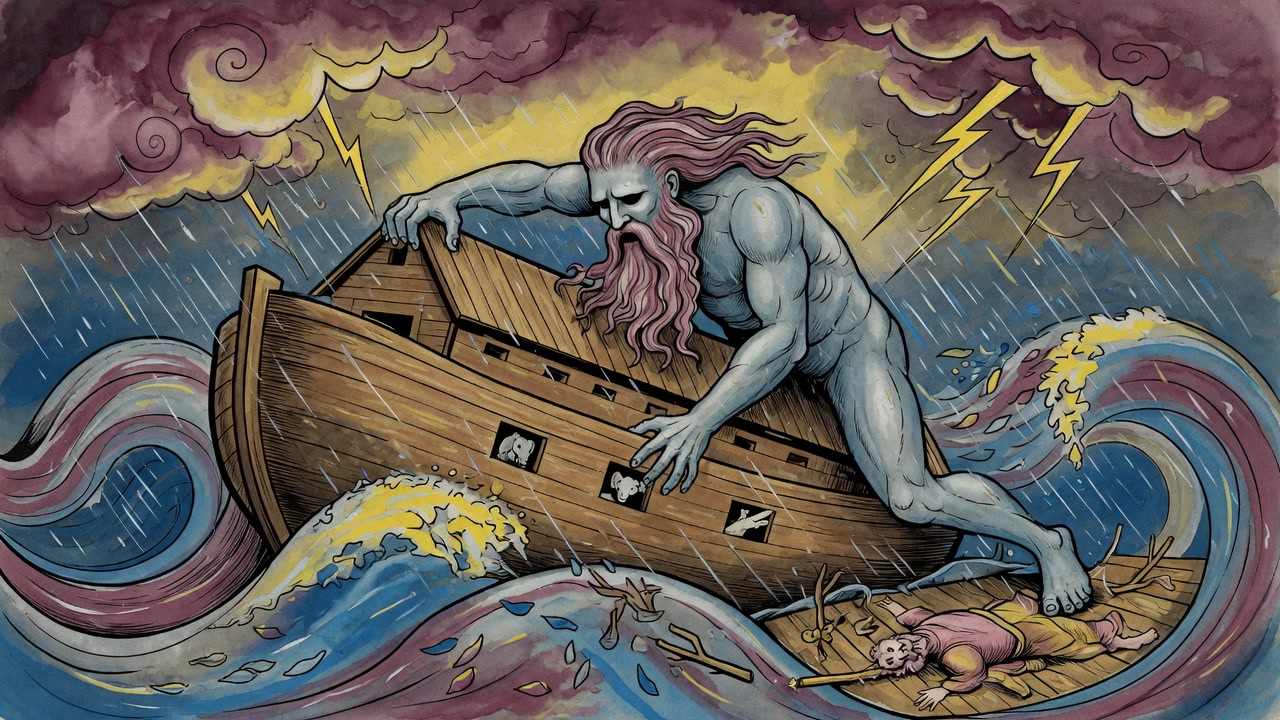
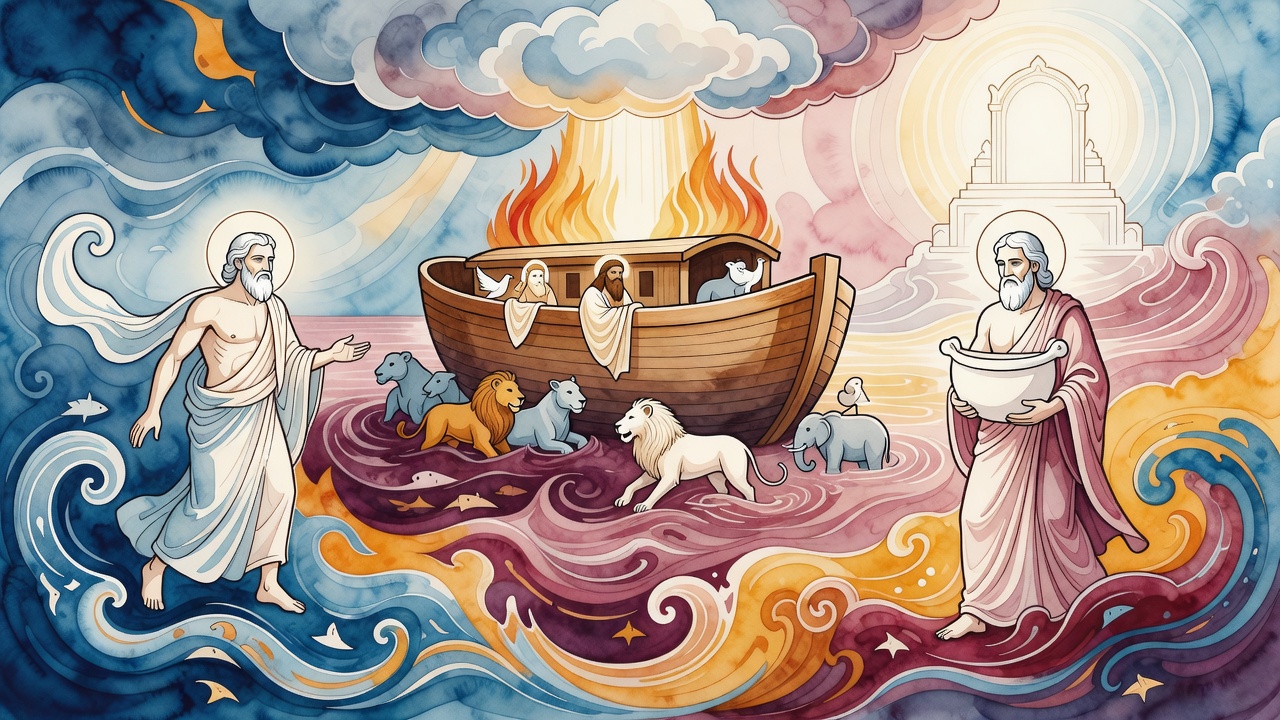
When Noah was loading animals into the ark, Og made a deal. He swore to Noah and his sons that if they let him come along, he would be their servant forever. Space on the ark was tight. Noah let him sit on the roof. A hole was cut so food could be passed through. And so the last of the giants rode out the destruction of the world clinging to the top of a floating box, eating through a hole, while every other creature of his kind drowned below him.

The Flood That Could Not Finish Him

Og came from the Nefilim, the giants whose fathers were the Watchers, the sons of God who had come down to the daughters of men. These unions produced children of massive size. One tradition measures them at three hundred ells from foot to knee. The Flood was God's response to the corruption they had brought into the world, and the Flood killed them all. Except Og. He was already on the roof before the first drop fell.

He was not grateful. He was never grateful. The moment Israel became his problem, he began scheming. At the time of Abraham, Og brought news that Lot had been taken captive, and some sages say he did it not from any loyalty to Abraham but because he wanted Abraham killed and Sarah available. Abraham saw through the trap, defeated the kings anyway, and Og walked away empty-handed. He had been circling Israel for generations before Moses ever picked up a staff.

The Mountain He Tore Out

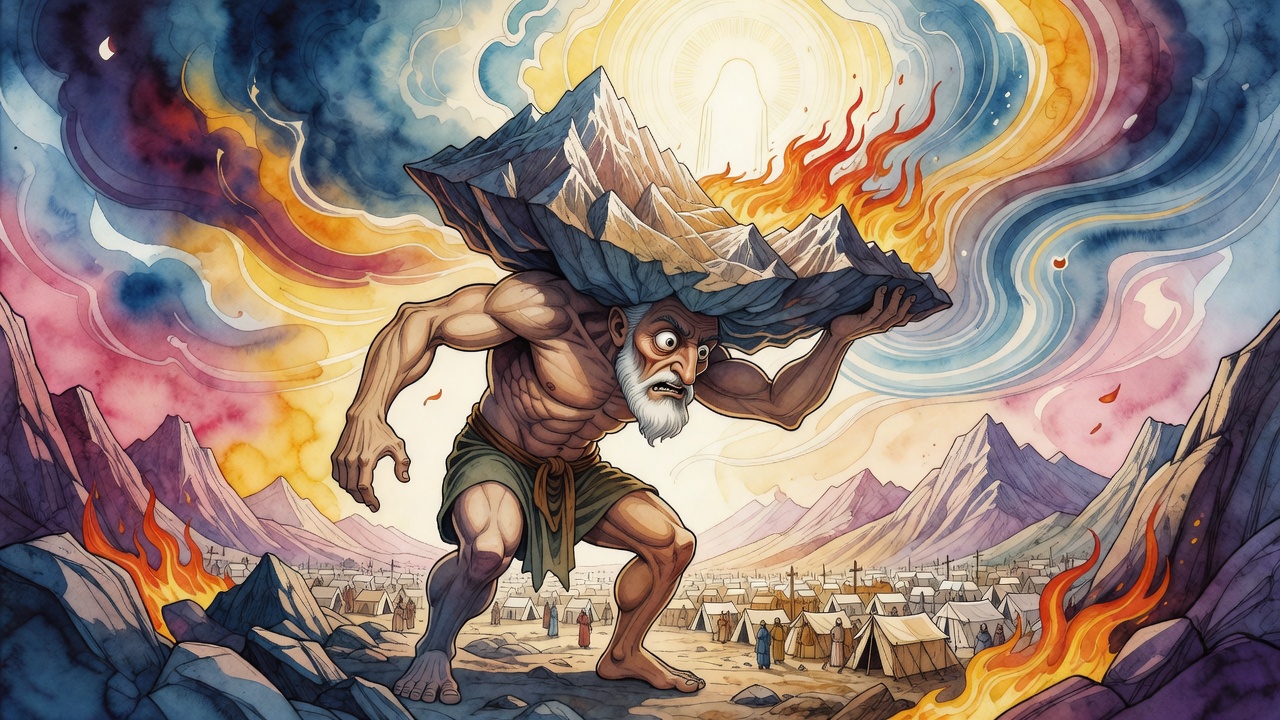
When the Israelites came to the Bashan, Og was still king, still alive, still enormous. His iron bed measured nine cubits long and four cubits wide, roughly thirteen and a half feet by six. He was the last of the Rephaim standing. And when he saw the Israelite camp spread below him, he had an idea simple enough to match his size. He walked to the nearest mountain, tore it from its roots, and carried it on his head toward the camp. He planned to drop it and flatten Israel in a single moment.

But ants had gotten into the mountain during the time it took him to carry it. They bored through the stone while Og walked. The mountain crumbled and settled down around his neck like a collar he could not remove. He stood there with a mountain around his shoulders, unable to throw it, unable to lift it off.

How Moses Reached His Ankle

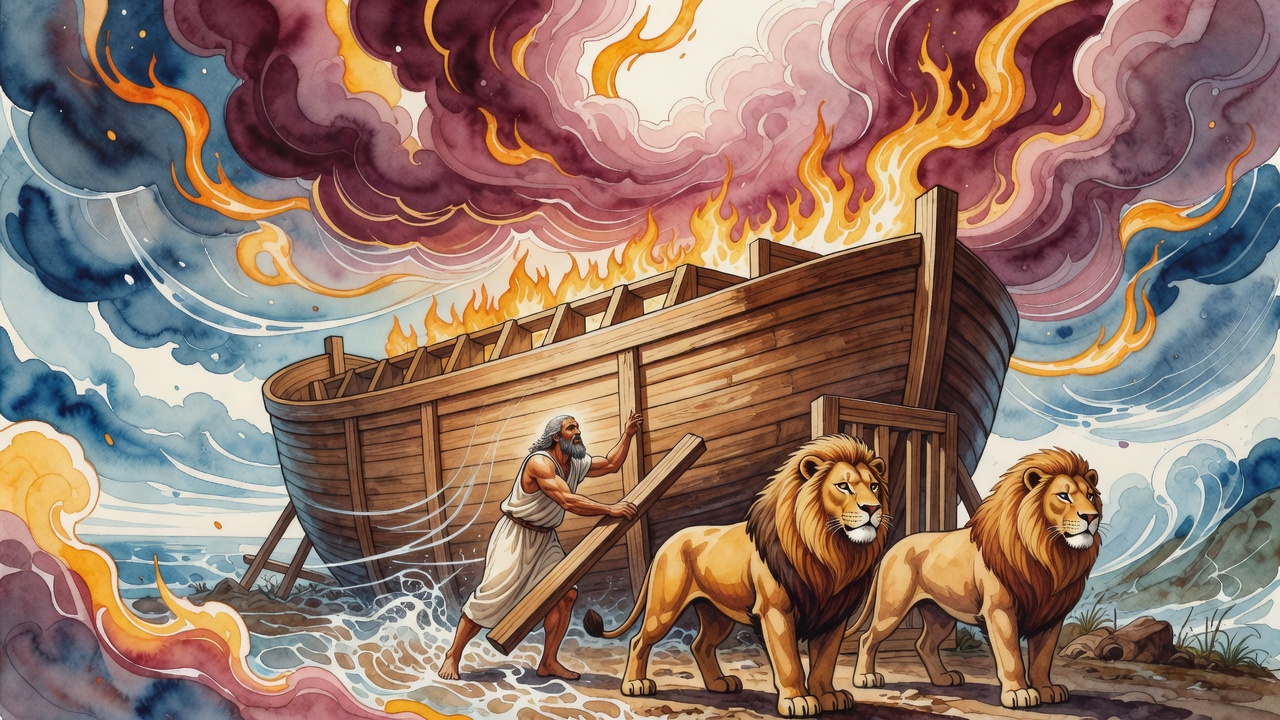
Moses was ten cubits tall, which is not short. He took a ten-cubit axe. He jumped ten cubits into the air. He swung the axe and struck Og in the ankle. It was enough. The giant fell. The Israelites stood over his body in the Bashan and had to acknowledge what they had just witnessed: the creature who had watched Noah's ark float over the bodies of his own kind, who had schemed against Abraham and waited out the generations, who had just tried to drop a mountain on their camp, was dead because a man with an axe had managed to reach his ankle.

God had told Moses not to be afraid of Og before the battle. Moses had been afraid anyway. He remembered that Og had survived the Flood, that Og had been alive when Abraham walked the earth, that men like this did not die easily. The command came again: do not fear him. I have given him into your hand. Moses went.

What Og Left Behind

The iron bed was placed in Rabbath of the Ammonites as a curiosity for visitors, the largest bed anyone had ever seen in a land that no longer had anyone to fill it. The Rephaim were finished. The Nefilim line that had survived the Flood on a rooftop, that had circled Israel for centuries like a threat that never quite arrived, ended in the Bashan with an axe blow to the ankle. The Torah notes his bed in two spare verses and moves on. The sages spent considerably longer on him, because a creature who survives a world-ending flood and still dies eventually requires more than two verses to put to rest.


← All myths

From the tradition

Sources

6 sources

The texts this telling draws on, in full. Open a card to read inline, or expand it for a wider, quieter read.

Targum Jonathan on Genesis 14:13Targum Jonathan

When Noah was loading up the ark, Og made a deal. He swore to Noah and his sons that if they’d let him come along, he’d be their servant forever.

Space on the ark was tight, to say the least! So, what did Noah do? He let Og sit on the roof! He poked a hole in the roof and passed Og his daily food through it. Can you The last of the Refaim – giants – hitching a ride, surviving the Flood by literally clinging to the top of the ark! (Deuteronomy 3:11) even mentions that King Og was the last of the remaining Refaim.

Og wasn't exactly a grateful passenger. Later on, he became an enemy of Israel. The stories say he even tried to uproot a whole mountain and drop it on the Israelites! A mountain big enough to wipe them all out at once!

Yikes!

Thankfully, God intervened. He sent a swarm of rock-eating ants – talk about a tiny army! – who bored through the mountain, causing it to fall from Og's hands and land around his neck. According to Bereshit Rabbah 42:8, Og had originally told Abraham that his nephew Lot had been captured, in the hopes that Abraham would die trying to save him and Og could marry Sarah!

Now, Og's teeth were so big, they jutted out, so he couldn't get the mountain off. Then Moses, who, by the way, was said to be ten feet tall himself, jumped another ten feet into the air and whacked Og on the ankle with a hammer (or, depending on the version, a lance or a nail). Down went the giant! Crushed by the weight of the mountain.

But wait, there’s more! Even in death, Og was a menace. When he fell, the mountain was about to fall on Israel! Moses, ever the hero, prayed to God, and some say he took a small tree and propped up the mountain, preventing it from crushing the people. Others say God suspended the mountain between heaven and earth. What a scene!

The story doesn’t end there. There's a tale about Abba Shaul, a guy who buried the dead, finding Og's skeleton. He was chasing a deer (as one does), and it led him into a hole that turned out to be the thigh bone of a giant skeleton. He ran for three miles inside the bone and still didn't reach the end! Eventually, he figured out it was Og, King of Bashan.

And then, just when you think the story’s over, there's another version! This one says Og survived, wandered into Poland in the winter, and, freezing cold, demanded a tailor make him a coat. The terrified tailor, seeing the size of the giant, gathered all the tailors in the land to finish the coat in time. They hid in the pockets, Og put it on, squished them all, and that’s why tailors are pale to this day. As for Og, some say he's still wandering the earth!

The origin of giants, by the way, is traced back to (Genesis 6:4). That verse talks about the Nefilim, understood as giants who were the offspring of the "Sons of God" and the "daughters of men." So, the story of Og and the Ark is one explanation for how giants survived the Flood.

What’s really interesting is how Og is portrayed. Most of the time, he’s the enemy, a symbol of overwhelming power against little Israel. But in this story about the ark, he’s almost… pathetic. He needs help, he makes a deal. It's a more childlike, almost sympathetic portrayal. As we find in Midrash Tehillim, other accounts depict Og holding a mountain over Israel, threatening to crush them.

The tale of Og is like a Jewish David and Goliath story. Og threatens Israel, but is defeated by the smallest of opponents, the ants. Moses then completes the conquest with a blow to Og's ankle. The moral? Even a tiny nation can overcome a mighty foe with God's help and unity, as emphasized by the collaborative work of the ants.

So, the next time you think about the Flood, remember Og, the giant on the roof. A reminder that even the biggest challenges can be overcome, and that sometimes, the smallest creatures can make the biggest difference.

Full source
1 Enoch 7:2-5Apocrypha

(Genesis 6:4) mentions the Nefilim. That word, Nefilim, generally understood to mean “giants.” But who were they, really? And where did they come from? The Torah just kind of drops that in there, doesn't it? "The Nefilim were on the earth in those days. And also afterward, when the sons of God went to the daughters of humans and had children by them. These were the heroes of old, men of renown."

Well, Jewish tradition has a lot to say about it, filling in the gaps with some truly wild stories.

One particularly striking account tells us that the "Sons of God" – often interpreted as Watchers – took wives from among the daughters of men. And these unions… well, they didn’t produce ordinary children. These women gave birth to giants. Really big giants. Now, an "ell" is an old measurement, but whatever it was, it’s clear – these guys were HUGE.

Hungry. Very, very hungry.

The story goes that these giants quickly devoured all the resources of humanity.: imagine trying to feed beings that size. It wouldn’t take long to strip the world bare. And when the humans couldn't sustain them any longer? The giants turned on them, devouring people, too. It gets worse. They began sinning against every living creature – birds, beasts, reptiles, fish. They devoured each other, drank blood. You can imagine the scene… it wasn't pretty.

The earth itself cried out against this lawlessness. The air was thick with the stench of rotting carcasses.

One particularly gruesome detail involves Shemhazai, a Watcher, who supposedly fathered two sons, Hiwa and Hiya. According to the tale, these two alone consumed a thousand oxen, a thousand camels, and a thousand horses every single day. Can you even imagine the logistics of that?

It’s no wonder, then, that God decided to cleanse the earth with the Flood.

But where did these giants come from, really? Why were they so…awful?

Some say these giants, born of spirit and flesh, are the evil spirits that still roam the earth today, relentlessly pursuing us. Others offer a slightly different take. According to this version, the angels transformed themselves, taking the shape of men, and appeared to the women while they were with their husbands. The women, bewitched by these angelic forms, lusted after them. As a result, they gave birth to giants. It’s a fascinating idea – that even the thought of infidelity could have such monstrous consequences. The Testament of Reuben gives us this version.

And while most accounts attribute the birth of the Nefilim to these unions, the Zohar, that foundational text of Kabbalah, offers a different, darker origin. The Zohar tells us that Samael (the angel of death), often identified as the angel of death, copulated with Eve, "injecting her with slime," and from that union came Cain, whose very essence was different from other humans. The Nefilim, then, issued from the seed of Cain.

These myths – and they are myths, stories meant to teach us something profound – also provide a potential origin for the giants that the Israelites encountered in the Land of Israel, as described in (Numbers 13:31-33).

What are we to make of all this? Maybe it's about the dangers of unchecked power, or the consequences of straying from our moral compass. Maybe it's about the dark side of desire. Or maybe, just maybe, it's a reminder that even the smallest seed of corruption can grow into something truly monstrous. And that's a thought worth pondering, isn't it?

Full source
Legends of the Jews, IV. Noah, The Inmates Of The ArkLegends of the Jews

It is often remembered as a cozy, if crowded, zoo. But Jewish tradition paints a far more complex – and at times, unsettling – picture.

The Ark wasn't just thrown together. It was built according to precise instructions, detailed in the mysterious Sefer Raziel, the Book of Raziel. According to Legends of the Jews, Noah had a daunting task: gathering no less than thirty-two species of birds and three hundred and sixty-five of reptiles! Could you imagine rounding up that many critters?

Noah didn't have to chase them down. According to Ginzberg's retelling, God commanded the animals to come to him. They just… showed up. But not all were welcome. God instructed Noah to watch which animals lay down and which stood as they approached. Those who lay down were meant to be on board. Those who stood? Nope.

We even get a little story within the story. A lioness and her two cubs approached, all crouching down. But the cubs started squabbling, and the mother rose to her feet. Noah, following God's instructions, only took the cubs. Imagine the scene: the roars, the confusion, the heartbreaking decisions Noah had to make.

Now, picture this: the animals assemble a week before the flood. The sun darkens, the earth trembles, lightning flashes, and thunder booms – louder than ever before. Despite all this, the people remained unrepentant. As the floodwaters rose, seven hundred thousand people begged Noah for entry, according to Legends of the Jews.

"Too late!" Noah essentially replied. "You rejected God, and now you face the consequences!" He reminded them that he had been prophesying this for 120 years! But they wouldn't listen. Now, they were ready to repent, but it was too late. the verse says, Noah pointed out their hypocrisy; they only turned to God because they were in distress.

The desperate crowd even tried to storm the Ark. But the wild animals guarding it turned on them, and the rest were left to drown.

These weren't ordinary people. They were giants, confident in their strength. They scoffed at Noah's warnings, saying the floodwaters would never reach their necks or that their feet were big enough to dam the springs. But God, in His wrath, sent the water through Gehenna, a sort of hellish fire, before it fell. The heated rain scalded their skin – a punishment fitting their lustful crimes.

It gets even darker. In their desperation, some threw their own children into the rising waters, hoping to stem the tide. A truly horrifying image.

The text is clear that Noah's salvation was by grace, not merit. He was righteous compared to his contemporaries, but not worthy of such a miracle. In fact, he supposedly didn't even enter the Ark until the water reached his knees!

Who else was on board? Noah's pious wife, Naamah, the daughter of Enosh. And his three sons, along with their wives. According to Legends of the Jews, Noah didn't marry until he was 498 years old, and only had children shortly before the flood, so they wouldn't suffer the fate of the rest of humanity or cause him to build an even larger ark.

And what about the animals? Only those who had remained "pure" – meaning they hadn't engaged in unnatural couplings – were allowed. Before the flood, unclean animals outnumbered the clean. Afterward, the ratio reversed because more pairs of clean animals were saved.

There are even more unusual stories! One tells of the reem, a creature so huge it couldn't fit inside. Noah tied it to the Ark, and it ran alongside. Then there's Og, the giant king of Bashan, who sat on top of the Ark and survived, fed daily by Noah through a hole, in exchange for a promise of servitude.

And lastly, two allegorical figures – Falsehood and Misfortune – also found refuge. Falsehood, denied entry alone, teamed up with Misfortune, agreeing that she could take whatever he earned. After the flood, Falsehood discovered that everything he gathered vanished, a harsh lesson about the nature of their partnership.

So, what does it all mean? The story of Noah's Ark is more than just a children's tale. It's a complex exploration of sin, repentance, divine judgment, and the fragile nature of survival. It reminds us that even in the face of overwhelming destruction, there’s always the possibility of a new beginning… even if it means sharing close quarters with a lot of animals, and maybe a giant clinging to the roof.

Full source
Legends of the Jews, IV. Noah, The FloodLegends of the Jews

The familiar story is this: – the flood, the animals, the rainbow. But have you ever stopped to imagine the sheer logistical nightmare of keeping all those creatures alive and well for over a year?

In Legends of the Jews, gathering the animals was just the beginning for Noah. The real challenge? Food and lodging. Shem, Noah's son, later recounted the trials to Eliezer, Abraham's servant. "We had sore troubles in the ark," he confessed. day animals needing daytime snacks, night animals demanding midnight feasts.

How did Noah even know what to feed each creature? The story goes that one day, he sliced open a pomegranate for some hungry critter, and a worm wriggled out. A tiny zikta (the text doesn't elaborate what this is, but you can imagine some small, unusual creature) snapped it up. From then on, Noah apparently became a worm farmer, kneading bran and waiting for the wriggling treats to emerge!

The lion? Poor thing had a fever the whole time! Apparently, he was too sick to cause trouble and lost his appetite. Then there was the polite urshana. Finding him asleep, Noah asked if he needed anything. The urshana replied that he didn't want to add to Noah’s burdens. So Noah blessed him, wishing him eternal life – and, according to the tale, that blessing was realized.

But the chaos didn’t stop there. Imagine being tossed around like a lentil in a pot as the floodwaters raged. The lions roared, the oxen lowed, the wolves howled – a cacophony of animal agony. Noah and his sons, fearing death, cried out to God. "O Lord, help us!" he prayed. "The billows surge about us... death stares us in the face!"

Where did all that water come from anyway? The flood, we learn, was a result of the joining of the male waters above the firmament and the female waters from the earth. According to this tradition, the upper waters burst through the space left when God removed two stars from the constellation Pleiades. To stop the deluge, God had to move two stars from the constellation of the Bear to Pleiades. Hence, the Bear forever chases the Pleiades, longing for her lost children, who will only return in the future world. How's that for cosmic drama?

And the darkness! For the entire year, the sun and moon hid their faces. That’s why Noah's name is connected to the Hebrew word for "resting" (noach), because during his time, the heavenly lights “rested." How did they see? The ark was illuminated by a precious stone, shining brighter at night than during the day, allowing Noah to distinguish between the two.

The flood lasted a full year, beginning on the seventeenth of Heshvan (a month in the Jewish calendar, usually falling in October/November) and raining for forty days until the twenty-seventh of Kislev (November/December). The punishment, we are told, fit the crime. The sinful generation was punished for their immoral behavior.

For 150 days, the water remained at the same level, fifteen ells above the earth. During this time, all the wicked perished, each receiving their due punishment. Even Cain, the original murderer, met his end, avenging the death of Abel. The waters were so powerful that even Adam's grave wasn't spared.

Then, on the first of Sivan (May/June), the waters began to recede, a quarter of an ell each day. After sixty days, on the tenth of Av (July/August), the mountain tops emerged. But before that, on the tenth of Tammuz (June/July), Noah sent out the raven, and a week later, the dove.

Now, about that raven… He wasn't exactly enthusiastic about his mission. As Ginzberg tells us, drawing from earlier traditions, the raven whined, "The Lord, thy Master, hates me, and thou dost hate me, too!" He felt unfairly chosen, arguing that Noah favored the species with seven pairs in the ark. Maybe Noah just wanted to get rid of him to get to his mate! Noah, understandably, was offended. "Wretch!" he retorted. "I must live apart from my own wife in the ark. How much less would such thoughts occur to my mind as thou imputest to me!"

The raven’s mission failed. Spotting a floating corpse, he decided to snack instead of delivering the message. So, the dove was sent. She returned in the evening with an olive leaf in her beak, plucked from the Mount of Olives in Jerusalem, a sign that the Holy Land had been spared. As she plucked it, she prayed, "O Lord of the world, let my food be as bitter as the olive, but do Thou give it to me from Thy hand, rather than it should be sweet, and I be delivered into the power of men." A powerful prayer of trust and reliance.

It took until the first of Tishri (September/October) for the waters to completely recede. Even then, the ground was so muddy that Noah and his family had to wait until the twenty-seventh of Heshvan to leave the ark – a full solar year after they entered.

The story of Noah's ark is more than just a children's tale. It's a complex narrative about survival, divine judgment, and the incredible challenges of preserving life against all odds. It makes you wonder, doesn't it? What "ark" are we building today, and what sacrifices are we willing to make to ensure its survival?

Full source
Jasher 6Book of Jasher

The familiar version gives us the basic story: the flood, the animals, the rainbow. But some ancient texts offer us a glimpse into the nitty-gritty, the behind-the-scenes drama. Book of Jasher, a fascinating, albeit non-canonical, Jewish text that expands on the biblical narrative.

So, Methuselah has passed, and God tells Noah it's time to board the ark. It wasn't just a matter of rounding up the animals. God instructs Noah to sit by the ark's door and let the animals present themselves. Those that crouch before him are deemed worthy to enter.

The next day, the animals arrive "in great multitudes," ready for their close-up. Noah, ever the discerning judge, ushers in those who bow before him. A strange scene unfolds with a lioness and her two cubs. The cubs actually attack their mother, driving her away, before returning to crouch before Noah. What's that about? Noah, understandably "wondered greatly," but he took the cubs aboard. It's a curious detail, isn't it? Perhaps a reminder that even the animal kingdom was in disarray before the Flood.

The text specifies that Noah brought two of each animal, but seven couples of the "clean" ones, just as God commanded in the Torah. (Genesis 7:2) But the rain doesn't start immediately. For seven days, the animals surround the ark, patiently waiting.

Then comes the cataclysm. "The Lord caused the whole earth to shake, and the sun darkened." The foundations of the world raged! As we read in the Book of Jasher, God unleashes this terror to frighten humanity, hoping they'll repent. But do they? Of course not. "And still the sons of men would not return from their evil ways." Sound familiar?

After seven days, in the six hundredth year of Noah's life, the flood begins. "All the fountains of the deep were broken up, and the windows of heaven were opened." Forty days and nights of relentless rain. (Genesis 7:11-12) The people, finally realizing the gravity of the situation, gather around the ark.

Seven hundred thousand people, according to Jasher, beg Noah to open the door. "Open for us that we may come to thee in the ark. And wherefore shall we die?" Their plea is desperate, but Noah's response is unwavering. He reminds them of their past defiance, their refusal to believe in God. "Have you not all rebelled against the Lord, and said that he does not exist?" Ouch.

They offer to repent, but Noah isn't buying it. He points out that they had 120 years – the time it took him to build the ark – to change their ways. Now, in their desperation, their repentance rings hollow. The Lord, he says, will not listen.

In a last-ditch effort, the people try to break into the ark. But God sends the very animals they scorned to drive them away. The rain continues, and all life outside the ark perishes. Only Noah and his family, along with the animals, remain.

And here's where Jasher paints a vivid picture of the ark's tumultuous journey. "The ark floated upon the face of the waters, and it was tossed upon the waters so that all the living creatures within were turned about like pottage in a cauldron." Can you imagine the chaos? The terror? "Great anxiety seized all the living creatures… the lions roared, and the oxen lowed, and the wolves howled." Every animal cries out in its own language, a cacophony of fear.

Noah, understandably, is terrified. He cries out to God: "O Lord help us, for we have no strength to bear this evil that has encompassed us." (Psalm 69:1-2)

God hears Noah's plea. "And a wind passed over the earth, and the waters were still and the ark rested." (Genesis 8:1) The floodwaters begin to recede. The ark eventually comes to rest on the mountains of Ararat. (Genesis 8:4)

Yet, Noah doesn't immediately leave the ark. He continues to pray, longing for release from their confinement. "O Lord, who didst form the earth and the heavens and all that are therein, bring forth our souls from this confinement. for I am much wearied with sighing."

Finally, after a full year, the earth is dry. Noah removes the covering of the ark, but still waits for God's command. (Genesis 8:13-14)

And then it comes. The word to leave. Noah, his family, and all the animals emerge from the ark. They return to their respective places, and Noah and his sons dwell in the land, serving God. God blesses them, commanding them to be fruitful and multiply. (Genesis 9:1)

So, what are we to make of this expanded version of the Noah story? The Book of Jasher offers a compelling, if sometimes unsettling, glimpse into a pivotal moment in human history. It reminds us of the consequences of our choices and the importance of genuine repentance. But perhaps most powerfully, it highlights the enduring power of prayer and the unwavering faithfulness of God, even in the face of unimaginable destruction.

Full source
Legends of the Jews 5:110Legends of the Jews

Not just any giant, but the giant. The one with a bed. well, you won't believe it.

In Ginzberg's retelling in, Legends of the Jews, Og had this bed, fashioned out of ivory, no less!, that was nine arms' length long. And get this: that's using Og's arm as the standard. Can you imagine? It makes your California King look a little inadequate, doesn't it?

So, why a ridiculously huge ivory bed? And why did Og keep it in the Ammonite city of Rabbah? Because, Og, apparently, was no dummy. He figured that the Israelites wouldn't be messing with the Ammonites or the Moabites. Why? Because God had specifically told them not to get too close to the descendants of Lot.

It's all about boundaries, both physical and divine, isn't it?

And it wasn't just the Ammonites and Moabites. God also forbade the Israelites from waging war with the Edomites. Now, this is where things get interesting. the verse says, Esau, a son kind to his father Isaac, was rewarded in this way. Because he was good to his father, his descendants, the Edomites, were protected from the Israelites.

It makes you think about the ripple effects of our actions, doesn't it? How kindness in one generation can create a shield for the next.

But here's the kicker. God says to Israel: "In this world ye shall have no sway over the mountain Seir, Edom's realm, but in the future world, when ye shall be released, then shall ye obtain possession of it." It's a promise, but also a warning.

"Until then, however, beware of the sons of Esau," God cautions, "even when they fear ye, much more so when ye shall dwell scattered among them."

There's a lot packed into that statement. It speaks to the complexities of power, the long game of history, and the enduring relationships between peoples. Even when the Israelites might be tempted to exert dominance, even when they are scattered and vulnerable, they must remember the divine decree.

So, what do we take away from the story of Og's bed and the fate of the Edomites? Perhaps it's a reminder that divine promises often come with conditions. That kindness has consequences. And that even giants, with their enormous ivory beds, are ultimately subject to a higher power. It also shows how much emphasis Judaism places on keeping one's word, with divine decrees lasting for generations.

Full source