Moses Argued Five Times Before God Lost Patience
At the burning bush he said he was the wrong man, that nobody would believe him, that his tongue was slow. The fifth excuse cost him the high priesthood.
Table of Contents
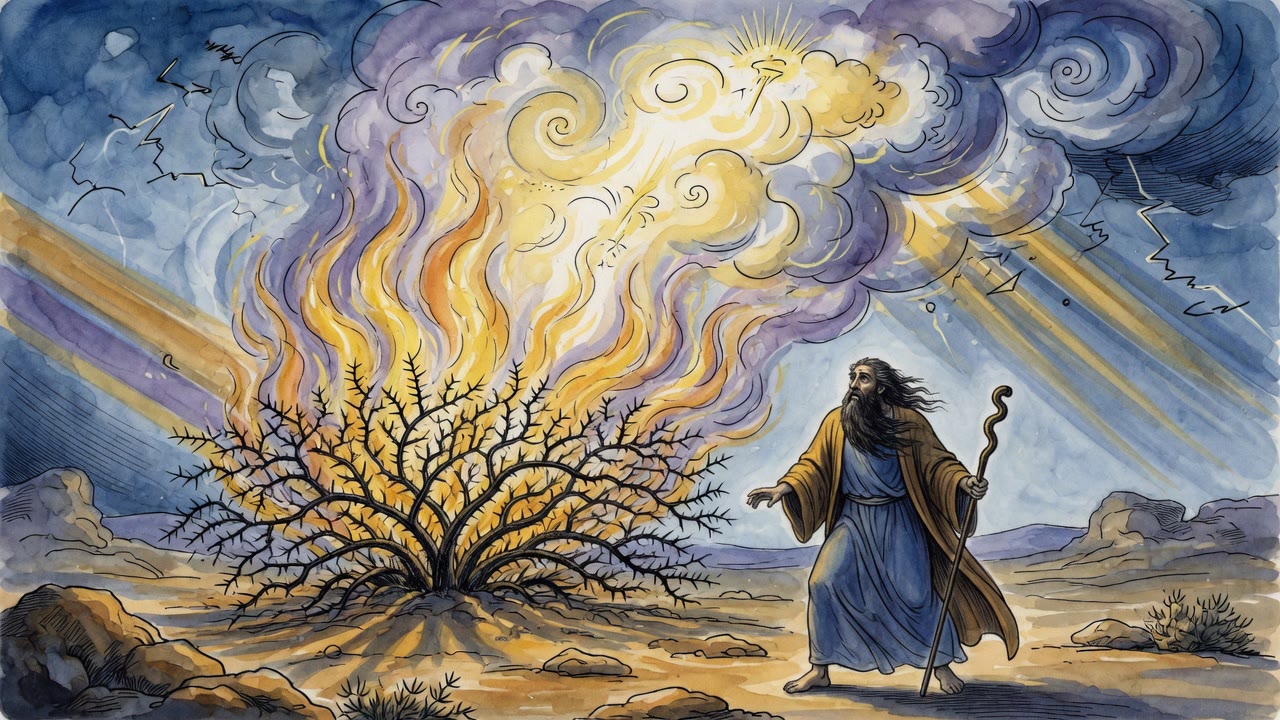 Click for full size
The Bush That Burned Without Burning Up
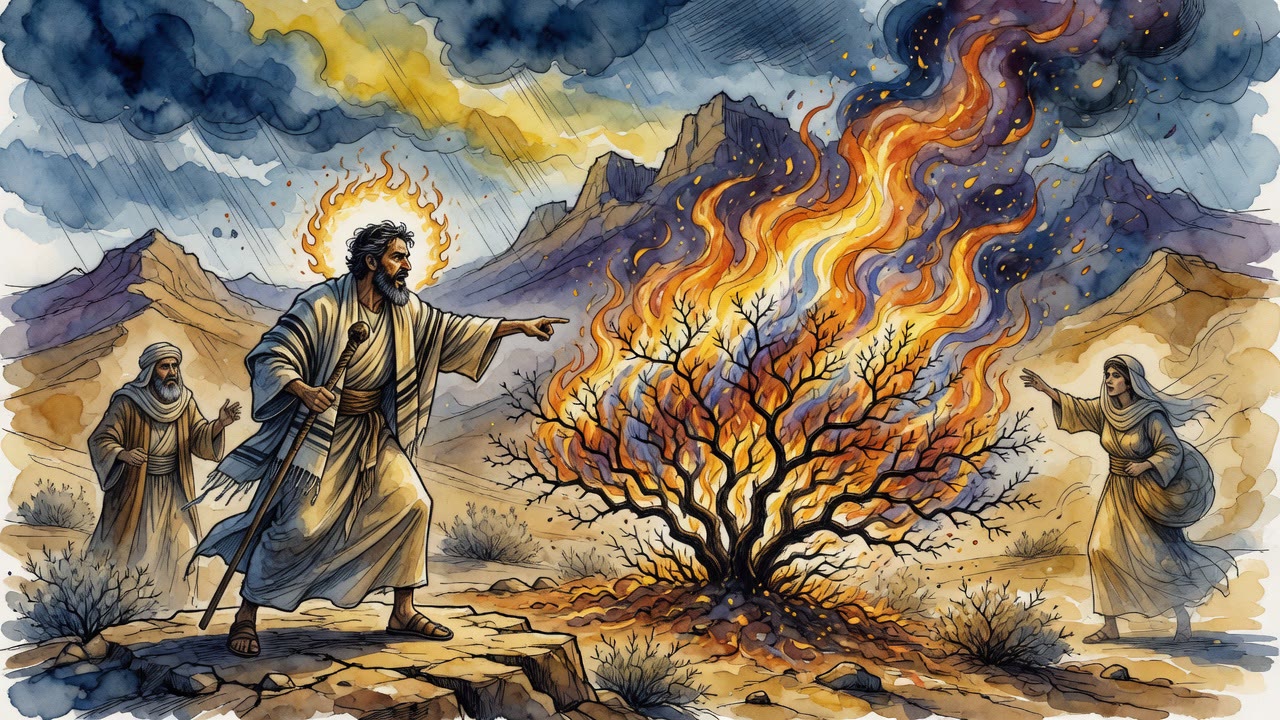
Moses had been in the wilderness of Midian for forty years when the bush caught fire and refused to be consumed. He was eighty years old by then. He had gone from prince of Egypt to fugitive in a single afternoon, and in the decades since had married Zipporah, fathered sons, and settled into the life of a shepherd working his father-in-law's flocks. The burning bush was not merely a strange phenomenon. It was a summons, and the particular strangeness of fire that did not consume what it burned was the wonder of it. Moses stopped and looked, and the voice from inside the flame knew his name.
The instructions were direct. "Go down to Egypt. Confront Pharaoh. Bring my people out of slavery." Moses stood at the edge of the fire and began his negotiation. He was not the right man, he said. Who was he, to go to Pharaoh, to speak for all of Israel? God answered: "I will be with you, and this will be the sign, you will worship on this mountain when it is done." Moses was not satisfied. He pressed the next objection immediately.
Five Excuses and the Answers That Came Back
The people would not believe him, Moses said. They would ask for God's name and Moses would not know what to say. God gave him the Name: "I Am What I Am. Tell them I Am sent you." Moses had a third objection ready. They still would not believe him. No name would be sufficient. God turned Moses' shepherd's staff into a serpent and back again, and turned his hand leprous and restored it clean. Two signs, hard to dismiss. Moses offered his fourth objection. He could not speak well. He was slow of tongue, slow of mouth. Something about his voice or manner was inadequate for the task of addressing Pharaoh. God said: "Who made your mouth? I did. I will teach you what to say. Go."
Moses asked, for the fifth time, that God send someone else instead. That is when God's anger kindled against him. The text in Exodus uses the specific word for divine anger, and the tradition took it seriously. God told him Aaron his brother could speak well enough, that Aaron was coming out to meet him in the desert at this moment, and that they would go together. But the permission to use Aaron as a spokesperson carried a cost. Moses was originally supposed to be both prophet and priest. Because he had pushed God past the fourth answer and into the fifth, the high priesthood would pass to Aaron permanently and Moses would not inherit it.
What the Staff and the Serpent Meant
When God asked Moses what was in his hand, Moses answered: "a rod." A simple shepherd's staff. The transformation God performed with it was a preview. The same object that was adequate for tending sheep would split the sea and draw water from rock and represent the power of the God of Israel before the court of Egypt. But in the moment at the bush, the staff becoming a serpent and then reverting carried a more immediate message. Moses had told God that Israel would not believe him. God's response was to show him that his own ordinary possession, the thing already in his hand, was not what it appeared to be, just as Moses himself was not what he appeared to be, just as the burning bush was not what a burning bush appeared to be. The problem of credibility had already been addressed before Moses raised it.
The Punishment That Stuck
The tradition tracked what Moses' reluctance had cost him with precision. He had delayed at the burning bush for seven days, pressing objection after objection. That delay introduced the first sign of God's displeasure. When the journey to Egypt began, God met Moses at a night-lodging and threatened to kill him because he had failed to circumcise his son. Zipporah performed the circumcision herself and averted the threat. The tradition saw this as directly connected to the delay at the bush, one thing in Moses' private life being called to account because of the hesitation at his public commission.
And the high priesthood never returned to Moses' line. Aaron became Kohen Gadol. Moses became the greatest prophet in Israel's history, the lawgiver, the one who stood on Sinai while Israel waited below, the one who shattered the tablets and then climbed back up and argued God out of annihilating a nation. He was present at every decisive moment of the covenant's formation. But the priestly office, the incense and the vestments and the entrance into the Holy of Holies on Yom Kippur, those were not his. He had asked one question too many at the burning bush, and the cost was permanent.
← All myths