Translation of the source text.William Davidson Edition - Vocalized Aramaic + William Davidson Edition - English · CC-BY-NC
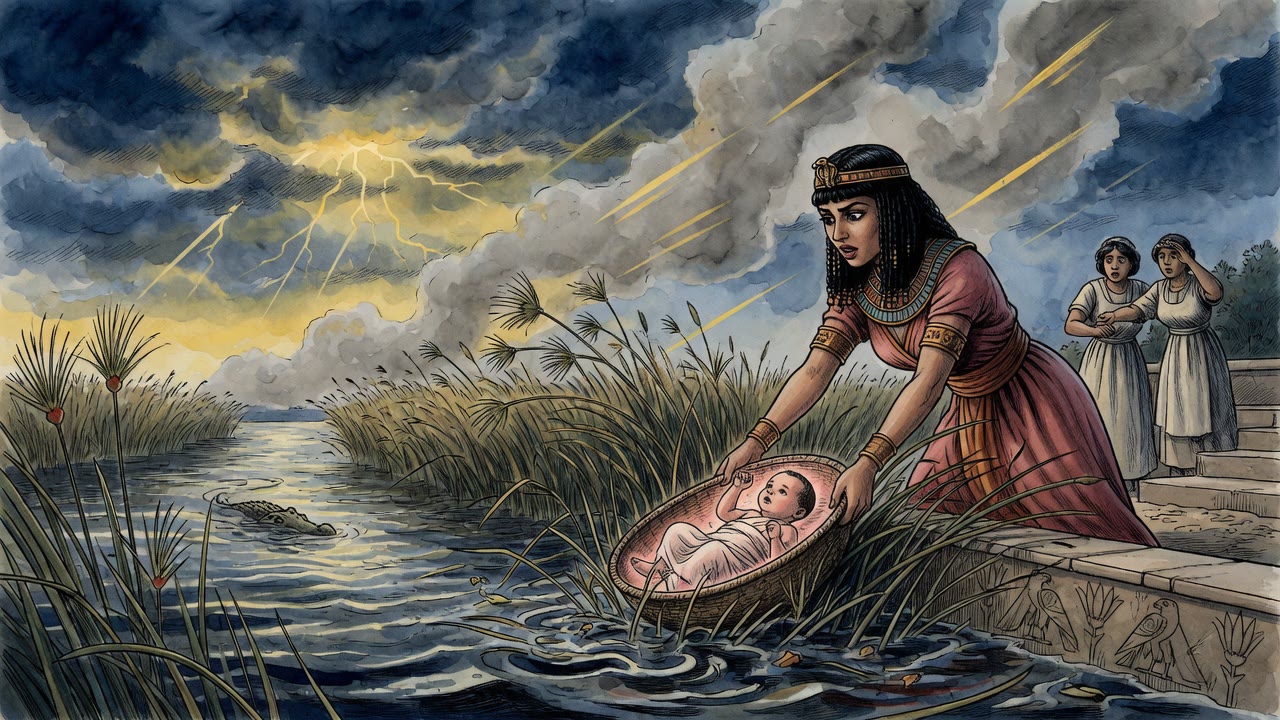
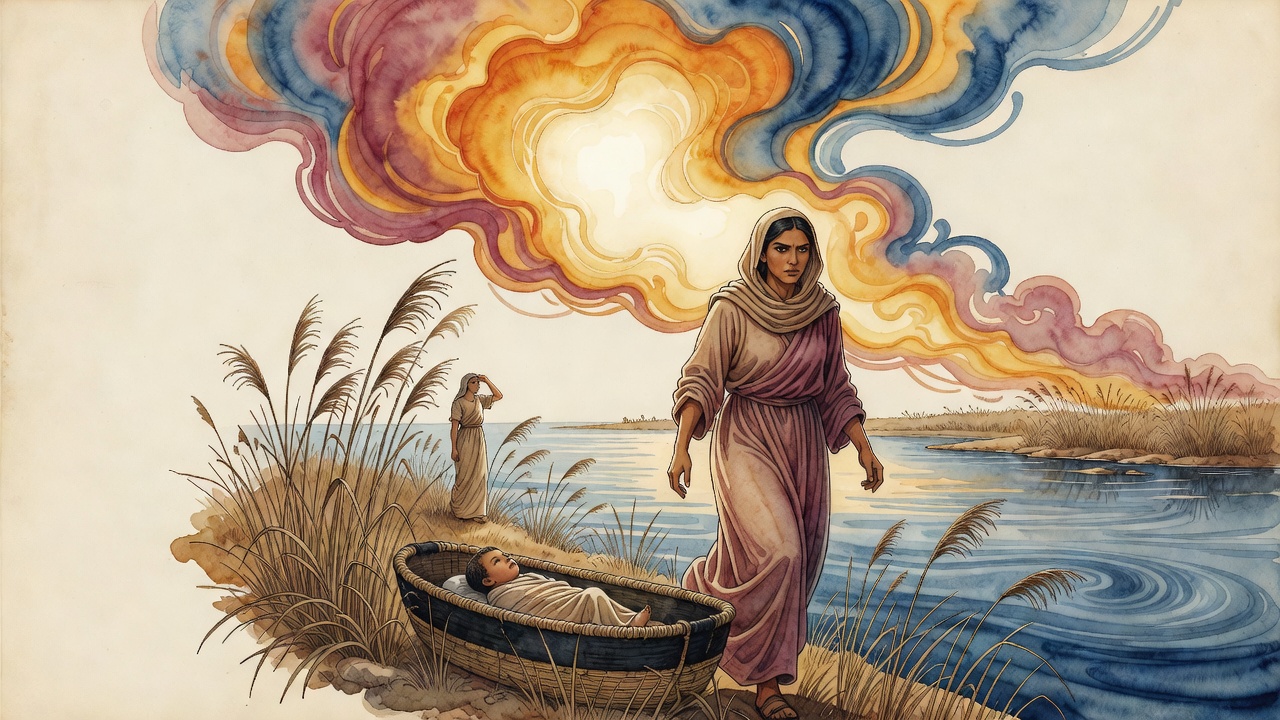
She placed him in a marsh, as it is written: “The reeds and willows [suf] shall wither” (Isaiah 19:6). The verse states: “And the daughter of Pharaoh came down to bathe [lirḥotz] in the river” (Exodus 2:5). Rabbi Yoḥanan says in the name of Rabbi Shimon ben Yoḥai: This teaches that she came down to the river to cleanse herself from the impurity of her father’s idols, as she was immersing herself as part of the conversion process.
And similarly it states: “When the Lord shall have washed [raḥatz] away the filth of the daughters of Zion, and shall have purged the blood of Jerusalem from the midst thereof, by the spirit of judgment, and by the spirit of destruction” (Isaiah 4:4). This washing clearly refers to the purging of spiritual sins, rather than bathing for the sake of cleanliness. The verse continues: “And her maidens walked along [holekhot] by the riverside” (Exodus 2:5).
Rabbi Yoḥanan says: This walking is nothing other than the terminology of going toward death, and similarly it states: “Behold, I am going [holekh] to die” (Genesis 25:32). The verse continues: “And she saw the ark among the willows” (Exodus 2:5). Once her maidens saw that the daughter of Pharaoh was intending to save Moses, they said to her: Our mistress, the custom of the world is that when a king of flesh and blood decrees a decree, even if all the world does not fulfill it, at least his children and members of his household fulfill it, and yet you are violating the decree of your father.
After the maidens tried to convince her not to save Moses, the angel Gabriel came and beat them to the ground and they died. The verse concludes: “And she sent amatah to take it” (Exodus 2:5). Rabbi Yehuda and Rabbi Neḥemya disagree as to the definition of the word “amatah.” One says that it means her arm, and one says that it means her maidservant.
The Gemara explains: The one who says that it means her arm explained it in this manner, as it is written “amatah,” which denotes her forearm. And the one who says that it means her maidservant explained it in this manner because it does not explicitly write the more common term: Her hand [yadah]. Therefore, he understands that this is the alternative term for a maidservant, ama. The Gemara asks: And according to the one who says that it means her maidservant, didn’t you say earlier: Gabriel came and beat them to the ground and the maidservants died, so how could Pharaoh’s daughter send her?
The Gemara answers: It must be that Gabriel left her one maidservant, as it is not proper that a princess should stand alone. The Gemara asks: And according to the one who says that it means her hand, let the Torah write explicitly: Her hand [yadah]. Why use the more unusual term amatah? The Gemara answers: This verse teaches us that her arm extended [ishtarbav] many cubits.
As the Master said in another context: And similarly you find with regard to the hand of Pharaoh’s daughter that it extended, and similarly you find with regard to the teeth of evildoers, as it is written: “You have broken [shibbarta] the teeth of the wicked” (Psalms 3:8), and Reish Lakish said: Do not read the word as shibbarta, rather read it as sheribbavta, you have extended. The next verse states: “And she opened it and saw it [vatirehu], even the child” (Exodus 2:6).
The Gemara comments: The verse states: “And she saw it”; it should have stated: And she saw. Rabbi Yosei, son of Rabbi Ḥanina, says: In addition to Moses, she saw the Divine Presence with him. This is indicated by the usage of “saw it.” The verse states: “And saw it, even the child [yeled]; and behold a lad [na’ar] that wept” (Exodus 2:6).
The verse calls him “a child [yeled],” and the same verse calls him “a lad [na’ar].” A Sage teaches: He is the age of a child but his voice is as loud and deep as a lad; this is the statement of Rabbi Yehuda. Rabbi Neḥemya said to him: If that is so, you made Moses our teacher blemished, since his voice was unusually deep. Rather, this teaches that his mother made a canopy of youth, i.e., a small canopy, for him in the ark, as she said: Perhaps I will not merit to see his wedding canopy.
The verse concludes: “And she had compassion on him, and said: This [zeh] is one of the Hebrews’ children” (Exodus 2:6). The Gemara asks: From where did she know that he was a Hebrew child? Rabbi Yosei, son of Rabbi Ḥanina, says: As she saw that he was circumcised. The Gemara comments: The Pharaoh’s daughter said: “This [zeh] is one of the Hebrews’ children” (Exodus 2:6).
Rabbi Yoḥanan says: This teaches that she prophesied unknowingly, as the intention of the word “zeh” was: This one falls, i.e., is cast, into the water, but no other will fall by means of water, for on that day Pharaoh’s decree was canceled. The Gemara explains: And this is what Rabbi Elazar said: What is the meaning of that which is written: “And when they shall say to you: Seek unto the necromancers and the diviners, that chirp [metzaftzefim] and that mutter [mahggim]” (Isaiah 8:19)?
The explanation of their chirping and muttering is: They see [tzofin], but they do not know what they are seeing; they enunciate [mahggim], but they do not know what they are enunciating. Although necromancers and diviners do have some insight into the future, they do not see clearly enough to understand what they are actually seeing. The Gemara applies this to Pharaoh: Pharaoh’s astrologers saw that the savior of the Jewish people would be stricken by water.
Therefore, they arose and decreed: “Every son that is born you shall cast into the river” (Exodus 1:22); they thought that their vision indicated that Moses would be killed in the water. Once Jochebed cast Moses into the water, although he was protected in an ark, the astrologers said: We no longer see in the stars anything like that sign we saw as to the downfall of the leader of the Jews by water, and therefore at that moment they canceled their decree.
But they did not know that what they saw foretold that Moses would be stricken on account of the waters of Meribah. They envisioned a downfall for Moses by water but didn’t fully comprehend their vision. And this is what Rabbi Ḥama, son of Rabbi Ḥanina, says: What is the meaning of that which is written: “These [hemma] are the waters of Meribah, where the children of Israel strove with the Lord, and He was sanctified in them” (Numbers 20:13)?
The verse indicates that these are the waters that the astrologers of Pharaoh saw and on account of which they erred. And this is what Moses said: “The people, among whom I am, are six hundred thousand men on foot [ragli]; and yet You have said: I will give them flesh, that they may eat a whole month” (Numbers 11:21). Moses said to the Jewish people: On account of me, which is an alternative meaning of the word ragli, all of you were saved, as the decree to throw all males into the river was canceled on my account.
Rabbi Ḥanina bar Pappa says: That day that Moses was placed in the river was the twenty-first day of the month of Nisan. The ministering angels said before the Holy One, Blessed be He: Master of the Universe, should the one who in the future will say the Song at the Red Sea on this day be stricken on this day? As this was also the date on which the Red Sea would be parted during the salvation of the Exodus.
Rabbi Aḥa bar Ḥanina says: That day was actually the sixth day of the month of Sivan. The ministering angels said before the Holy One, Blessed be He: Master of the Universe, should the one who in the future will receive the Torah on Mount Sinai on this day be stricken on this day? As this was also the date on which the Torah was received. The Gemara asks: Granted, according to the one who says that Moses was placed in the water on the sixth of Sivan, you find that there can be three months during which Moses was hidden after his birth; as the Master said (Tosefta 11:7): Moses died on the seventh of Adar, and Moses was born on the seventh of Adar.
And based on this, from the seventh of Adar until the sixth of Sivan there are three months, which correspond to the three months Moses was hidden before being placed in the water. But according to the one who says that it was on the twenty-first of Nisan, how can you find that he was hidden for three months? The Gemara answers: That year was a leap year in which there were two months of Adar. Moses was hidden most of the first month of the three, from the seventh day of the first Adar when he was born, and most of the last month of the three, i.e., all of Nisan until the twenty-first, and the entire middle one.
All of this together is considered as three months. The Gemara now discusses the next verse in Exodus: “Then said his sister to Pharaoh’s daughter: Shall I go and call you a nurse of the Hebrew women, that she may nurse the child for you?” (Exodus 2:7). The Gemara asks: And what is different that Pharaoh’s daughter would specifically want a nurse of the Hebrew women? The Gemara answers: This teaches that prior to this, they took Moses around to all the Egyptian wet nurses and he did not agree to nurse from any of them, as he said: Shall a mouth that in the future will speak with the Divine Presence actually nurse something impure?
And this is as it is written: “Whom shall one teach knowledge? And whom shall one make understand the message?” (Isaiah 28:9). The prophet is asking: To whom shall God teach the knowledge of the Torah, and to whom shall God make to understand the message of the Torah? The answer is as the verse continues: “Them that are weaned from the milk, them that are drawn from the breasts” (Isaiah 28:9).
The conclusion of the verse indicates that the Torah should be taught to the one who did not want to nurse from the milk of a gentile woman, i.e., Moses. The next verse states: “And Pharaoh’s daughter said to her: Go. And the maiden [ha’alma] went and called the child’s mother” (Exodus 2:8). Rabbi Elazar says: This teaches that she went quickly like a maiden, i.e., with the strength of one of marriageable age, and not as the young child that she was.
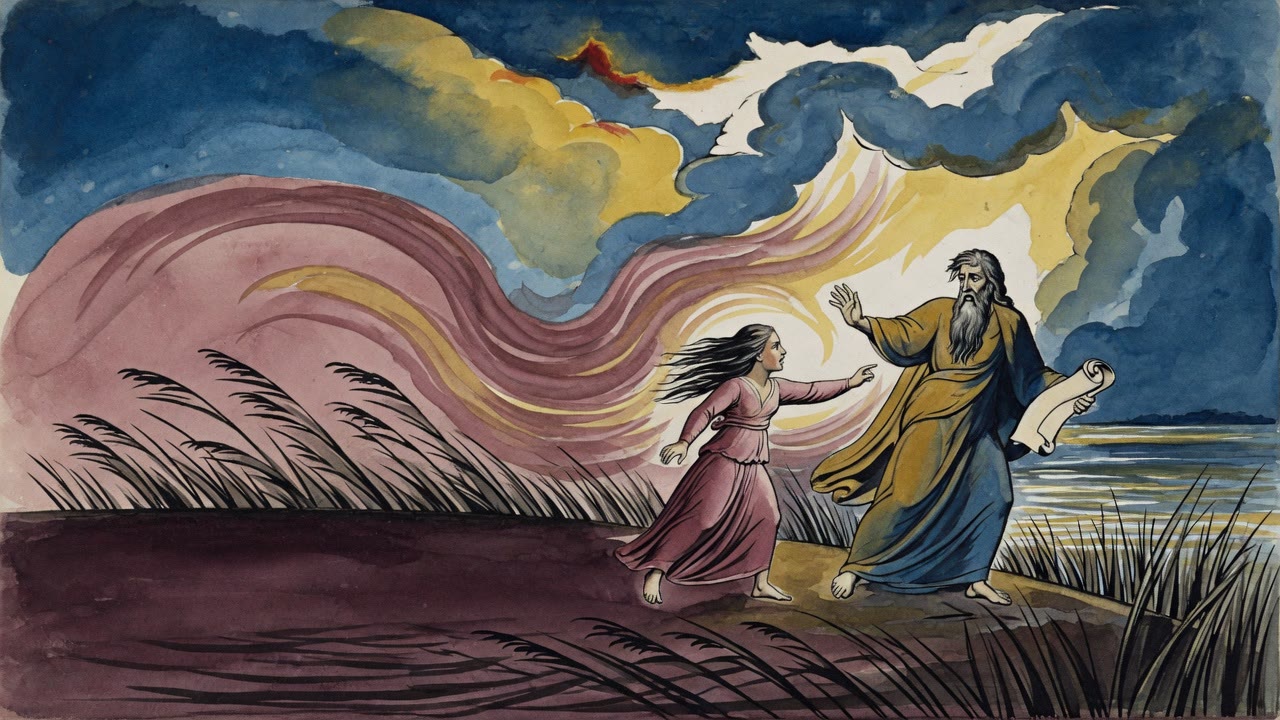
Rabbi Shmuel bar Naḥmani says: The word ha’alma is related to the word meaning to hide [le’alem], for she hid her words and didn’t tell Pharaoh’s daughter that she was bringing the baby’s mother. The next verse states what Pharaoh’s daughter said to Jochebed: “And Pharaoh’s daughter said to her: Take this [heilikhi] child away, and nurse it for me, and I will give you your wages. And the woman took the child, and nursed it” (Exodus 2:9).
Rabbi Ḥama, son of Rabbi Ḥanina, says: Pharaoh’s daughter is prophesying and she does not know what she is prophesying, as the word heilikhi means: This is yours [ha shellikhi], i.e., this is your child. The next part of the verse states: “And I will give you your wages.” Rabbi Ḥama, son of Rabbi Ḥanina, says: This teaches that with regard to righteous people, not only is it so that God arranges that their lost items are returned to them, but He also arranges that they get their wages, as the son of Jochebed was returned to her and she also received payment for nursing him.
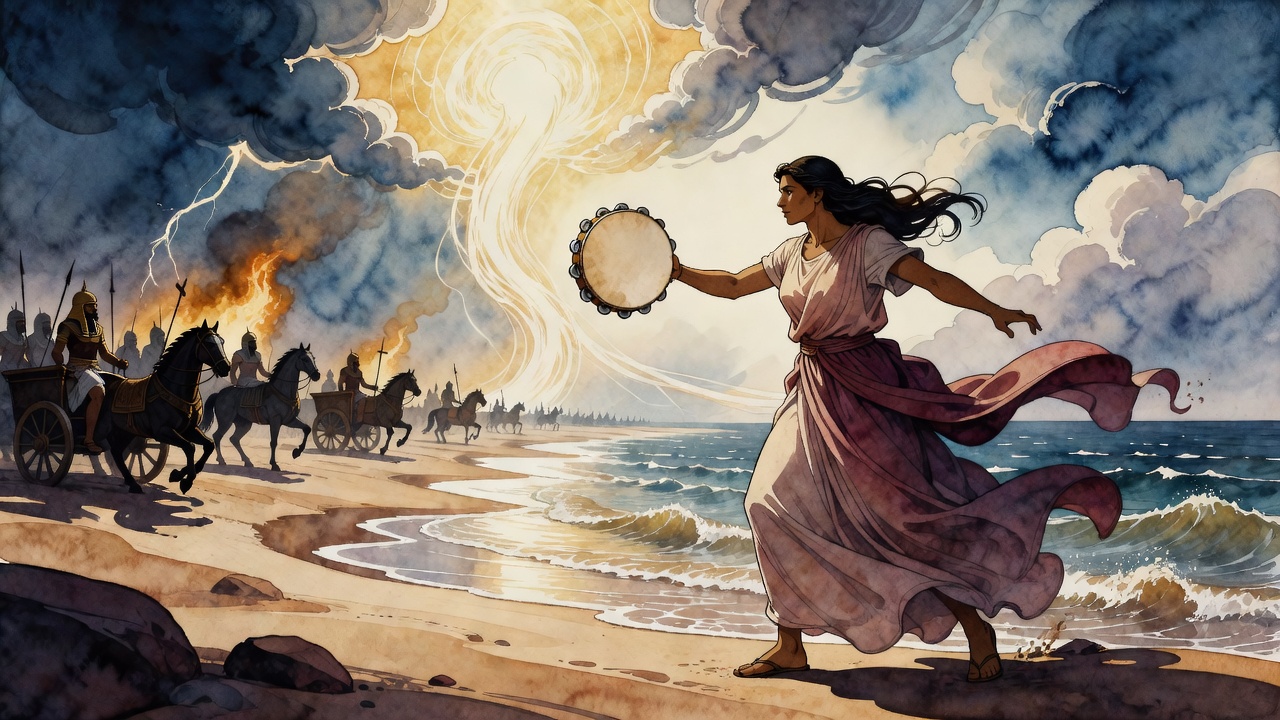
Elsewhere, the verse states with regard to Miriam: “And Miriam the prophetess, the sister of Aaron, took a timbrel in her hand; and all the women went out after her with timbrels and with dances” (Exodus 15:20). The Gemara asks: Why is Miriam referred to as “the sister of Aaron,” and not the sister of Moses? Rav Amram says that Rav says, and some say that Rav Naḥman says that Rav says: This teaches that Miriam already prophesied when she was still the sister of only Aaron, i.e., before Moses was born.

 Click for full size