5 min read

Moses Heard the Name and Saw God's Passing Glory

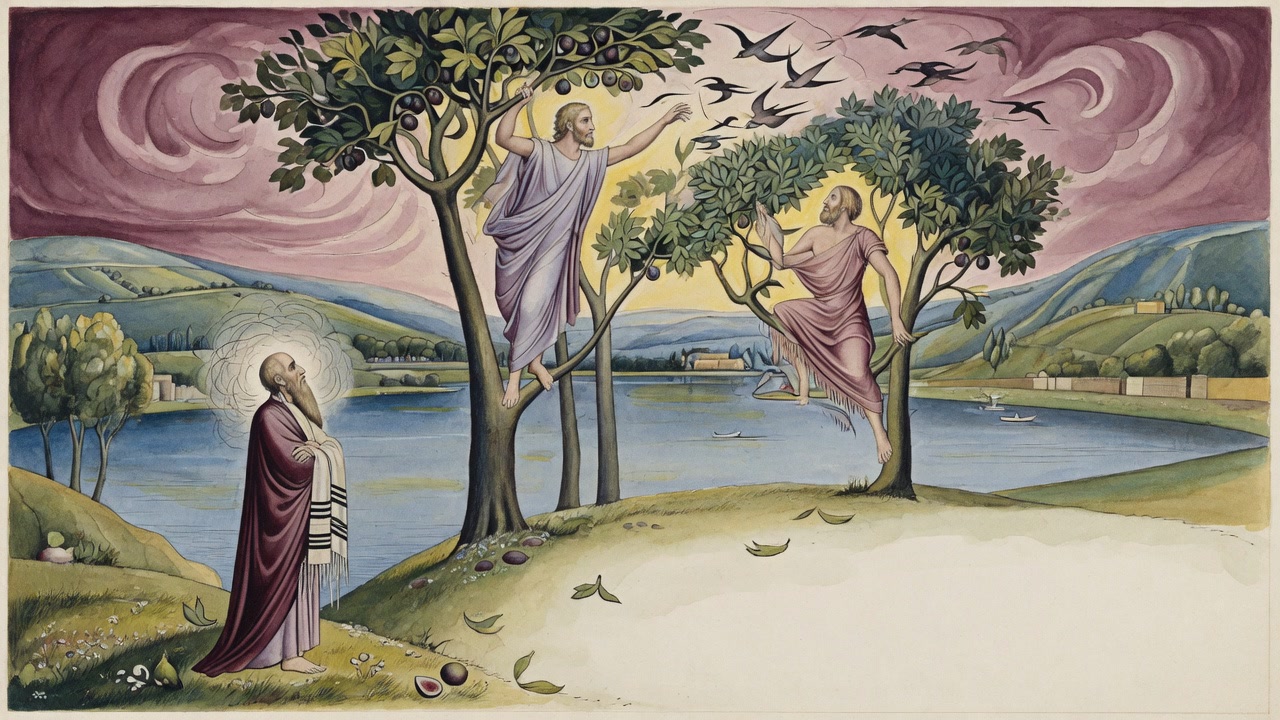
Moses asked to see God's glory and was given a cave, a hidden Name, a procession of angels, and the trace left after God passed.

Curated by Arthur · Told by Maggid ·
Table of Contents
  1. The Answer Was No With a Door Inside It
  2. The Angels Passed in Review
  3. The Mountains Trembled Before Speech
  4. The Vast Countenance Held Back Judgment
  5. The Jordan Became Another Cleft

Moses asked for the one sight no living body could survive.
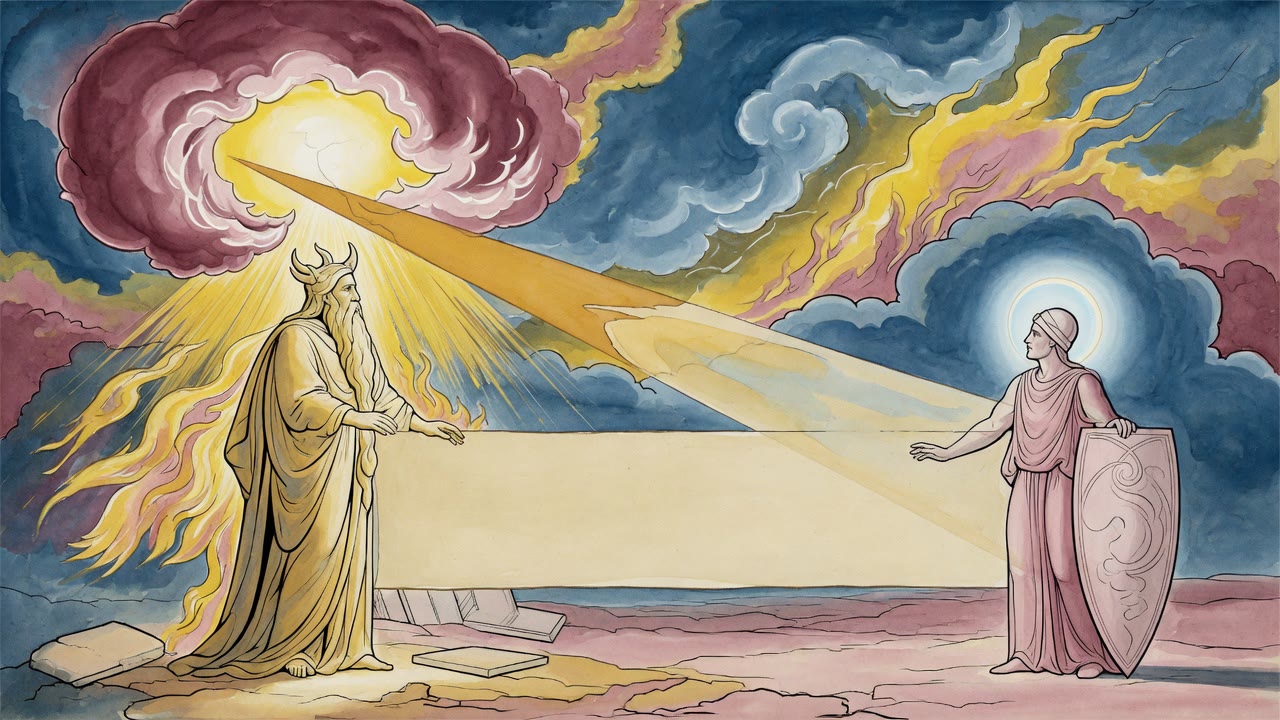
He had seen water split, fire speak from a bush, bread fall from heaven, and Sinai vanish into cloud. He had carried tablets written by God. He had stood where Israel trembled below and angels guarded above. Still he wanted more.

Show me Your glory.

The Answer Was No With a Door Inside It

God refused the face.

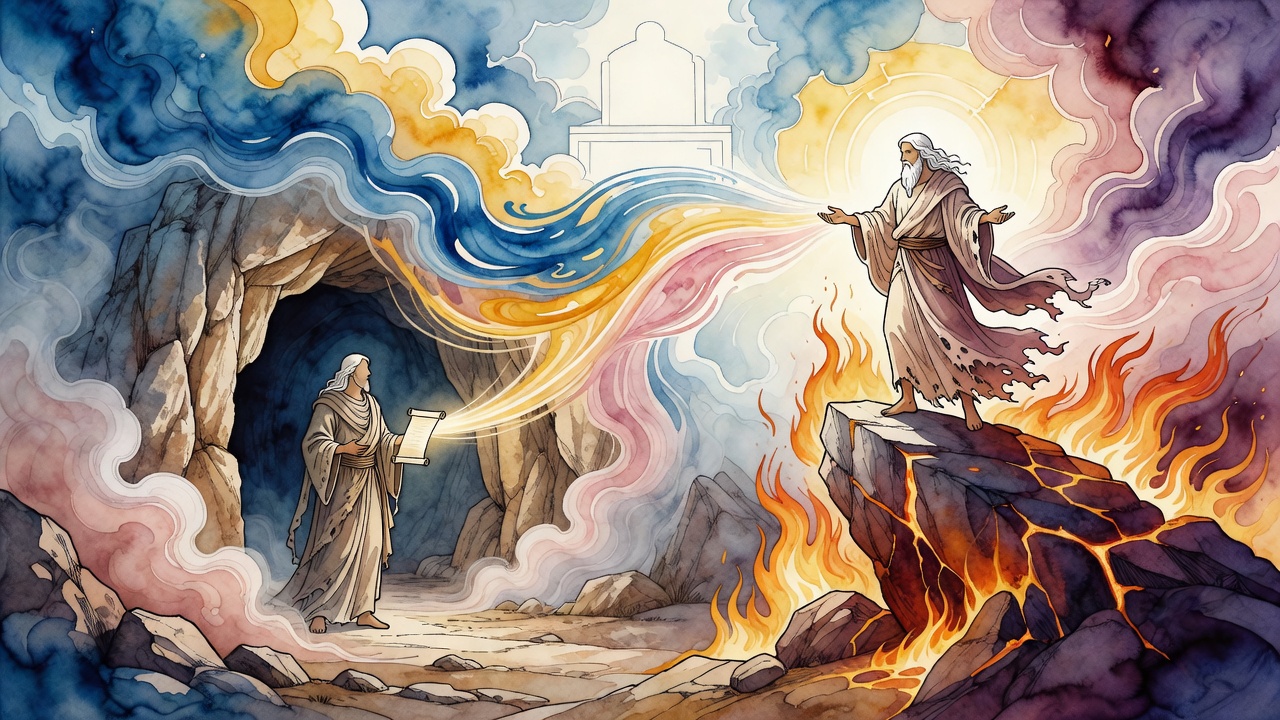
No human being could see that and live. The refusal was not distance. It was mercy with a boundary around it. Moses had been granted wish after wish, and he possessed the secret of the Name. So heaven opened a narrower way. Not the face. Not the full blaze. A cave. A cleft in the rock. A hand covering him while the unbearable passed.

Moses would not see God arrive. He would see what remained after God moved by.

The Angels Passed in Review

Before the moment, the hosts passed before him.

Angels moved like ranks of fire, each one a force with a task, each one less than the One whose name Moses waited to hear. The cave became a threshold between courage and dissolution. God told Moses that when he heard the revealed Name, he should know the Presence was there and hold himself without fear.

Fear had carried Israel from Egypt. Now Moses had to stand inside fear without letting it command him.

The Mountains Trembled Before Speech

The upper palaces remembered what Moses had received.

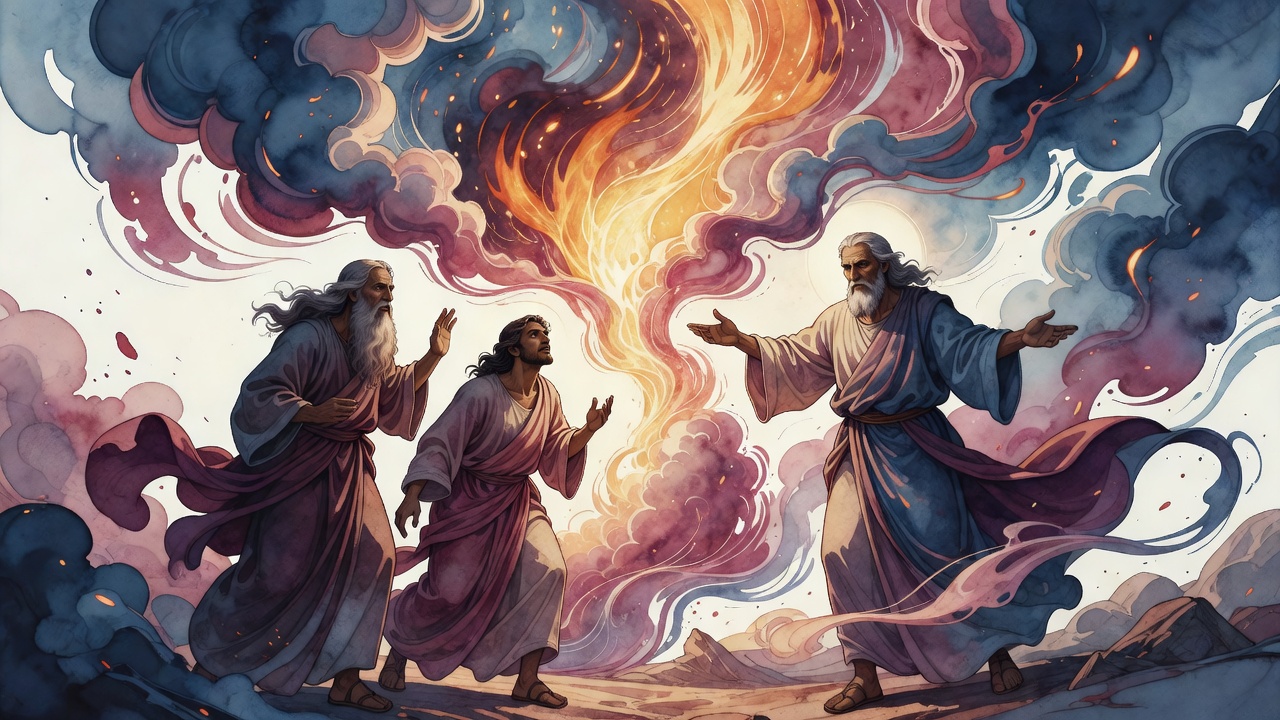
The mighty works had not been hidden from him. The secret had been opened. Even before a word left God's mouth, lofty mountains trembled in dread. When the word went forth, they burned with flame. The divine voice was not sound only. It was an event that made creation answer with its body.

Rivers of fire surrounded the dwelling. Flame did not merely guard the secret. Flame was the atmosphere around it.

The Vast Countenance Held Back Judgment

Mercy had structure.

The mystics named the Vast Countenance, Arich Anpin, the long patience within the divine order. Judgment was real. Zeir Anpin, the active face, could move with severity. But the Vast Countenance held that severity within the final intention, preventing judgment from becoming the whole story.

The passing glory in the cleft was tied to that patience. The attributes of mercy were not a mood. They were a repair, a tikkun, a way for fire to remain fire without consuming the world it judged.

The Jordan Became Another Cleft

At the end of his life, Moses stood before another boundary.

God told him to lift his eyes west, north, south, and east. See the land. Do not cross the Jordan. It was another mercy with a boundary around it. Nearness, not possession. Vision, not entry. The servant who had asked to see glory was again given sight without crossing into what sight desired.

Then mercy opened differently. If Moses were buried with the wilderness generation, they would one day come by his merit. He would be the gold coin dropped in darkness so the scattered copper coins could be gathered after him.

The cave and the mountain were kin. In one, Moses was hidden so glory could pass. In the other, Moses was halted so a whole dead generation could remain attached to him. He did not receive the face. He did not receive the crossing. He received the trace, the Name, the fire-held mercy, and the power to stand at a boundary without letting the boundary become abandonment.

God passed, and Moses lived.

That was already more than yes.

The request was dangerous because Moses was not asking for information. He was asking for immediacy. Commandments can be carried. Names can be guarded. Visions can be remembered. The face would have ended the one who saw it. So God gave Moses an encounter shaped like survival: enough nearness to mark him forever, enough covering to keep breath in his body.

That pattern followed him to the edge of the land. Moses received the sight that could be borne, not the crossing he wanted. The gift was measured, and the measure itself was mercy.


← All myths
From the tradition

Sources

5 sources

The texts this telling draws on, in full. Open a card to read inline, or expand it for a wider, quieter read.

Legends of the Jews 2:120Legends of the Jews

Even after witnessing incredible miracles, after leading the Israelites out of Egypt, after receiving the Torah itself, Moses still yearned for something more. He pleaded with God, "I beseech Thee, show me Thy glory!"

The audacity! To ask the Creator of the universe to reveal Himself. What made Moses think he could even handle such a revelation?

Moses wasn't just anyone. He had a unique relationship with the Divine, forged in the fires of hardship and strengthened by unwavering faith. And, as Legends of the Jews tells us, God had already granted all of Moses' wishes (Ginzberg). So, how could God refuse this ultimate request?

Well, the answer is complex, and reveals something profound about the nature of God and our own limitations. God replied, essentially, "Thou mayest not behold My glory, or else thou wouldst perish." It's a stark warning. The sheer power and intensity of God's true form are simply too much for mortal beings to bear.

But God, being merciful and true to His word, offered a compromise. "In consideration of My vow to grant thee all thy wishes, and in view of the fact that thou art in possession of the secret of My name, I will meet thee so far as to satisfy thy desire in part.” What does it mean to possess the "secret of My name"? Jewish tradition teaches that God's name is not merely a label, but a key to understanding His essence. To know the name is to have a glimpse into the Divine nature itself.

So, God instructs Moses to lift the opening of a cave. He promises that all the angels who serve Him will pass in review before Moses. It's a celestial parade, a breathtaking display of heavenly power. But the crucial moment comes with the utterance of the Name. God tells Moses, "As soon as thou hearest the Name, which I have revealed to thee, know then that I am there, and bear thyself bravely and without fear."

Think about the weight of that moment. Moses, standing at the mouth of the cave, witnessing the angelic hosts, waiting for that single, earth-shattering Name. The Name, which represents God's very being, will be the signal. The ultimate test of Moses' faith and courage.

What happens next? The text leaves us hanging, focusing on the preparation and the promise. But perhaps that's the point. The true encounter with the Divine is often beyond words, beyond description. It's a moment of profound personal experience, a glimpse of something so vast and awe-inspiring that it can only be hinted at.

The story of Moses' request reminds us that the desire to connect with the Divine is a fundamental part of the human experience. We may not be able to see God in all His glory, but perhaps, like Moses, we can catch a glimpse through the wonders of creation, through the teachings of our traditions, and through the quiet whispers of our own hearts. And maybe, just maybe, that's enough.

Full source
Heikhalot Rabbati 27:1Heikhalot Rabbati

The Heikhalot (the heavenly palaces) texts, by the way, are a collection of mystical Jewish writings that describe ascensions through heavenly palaces – heikhalot in Hebrew – to witness the Divine.

This particular passage paints a vivid picture. "It is Thou who hast revealed thy secret to Moses and who hast not concealed from him any of Thy mighty works." Moses, our teacher, received divine secrets, a glimpse behind the curtain of reality. This wasn't just a set of rules, but a profound understanding of God's actions and power.

The text continues, describing the impact of God's word: "When the words goeth not forth from Thy mouth all the lofty mountains trembled and stood before Thee in great consternation; when the word goeth forth from Thy mouth they were all of them burned with flames of fire." Imagine the sheer force! Mountains, symbols of stability and permanence, quake at the very possibility of God's speech. And when that word is spoken? Consuming fire. It’s not a gentle whisper, but a cosmic pronouncement.

It's not all about overwhelming power. The passage also speaks of God's intimate knowledge and care: "It is Thou who examinest the inward parts and choosest the faithful." This isn't just a God of thunder and lightning; it’s a God who knows us, our innermost thoughts and motivations. A God who seeks out the faithful.

"Thou dwellest in the flame of rivers of fire and conflagrations." This imagery is intense! The divine presence isn't some placid lake, but a raging inferno. It speaks to the raw, untamed energy at the heart of creation, an energy that both creates and destroys.

The passage culminates in a declaration of God's ultimate authority: "It is Thou who art mighty, more lofty than all the lofty and lifted up above all, who dost cast down the haughty and exaltest the humble." This isn't just about physical power, but about moral authority. God humbles the arrogant and elevates the meek. It's a reminder that true strength lies not in worldly power, but in humility and faithfulness.

What does this mean for us? Perhaps it’s a call to remember the awesome power that underlies all existence. A power that can shake mountains and consume with fire. But it is also a power that sees us, knows us, and chooses the faithful. Maybe it encourages us to strive for humility, knowing that true greatness lies not in pride, but in service to something larger than ourselves. A service to the Divine that revealed its secrets to Moses so long ago.

Full source
Kalach Pitchei Chokhmah 93:8Kalach Pitchei Chokhmah

It all comes into play in the mystical concept of Arich Anpin.

Arich Anpin, often translated as "Long Face" or "Vast Countenance," represents divine patience and forbearance. It's one of the aspects of God in Kabbalistic thought. But what exactly is it regulating? That's where things get interesting.

Kalach Pitchei Chokhmah (Wisdom) explores some pretty complex stuff, even for Kabbalah! It talks about how Arich Anpin influences another aspect, Zeir Anpin. Zeir Anpin, or "Short Face," is associated with the more active, expressive attributes of God, including, crucially. Judgment.

The big question is: how does Arich Anpin keep Zeir Anpin in check? Sometimes, the text explains, Arich Anpin can completely neutralize the "stern Judgment" emanating from Zeir Anpin. It's like hitting the cosmic "mute" button on severity. This is a special kind of tikkun (תיקון), or repair, a fixing of something that's out of balance. We find an example of this in the Idra Rabba (131b) and in the Shaar HaKavanot, specifically in the Derushey Vayaavor, connected to the verse "and [the Lord] passed by" (Exodus 34:6). This verse is traditionally recited as a litany of God's merciful attributes.

Imagine a parent dealing with a child. Sometimes, a firm hand is needed. Other times, overwhelming love and forgiveness is the answer. The Kabbalists are essentially applying this dynamic to the very structure of the divine.

However, Kalach Pitchei Chokhmah points out that completely nullifying Judgment isn't the primary function of Arich Anpin. The world needs Judgment, after all. There has to be consequences for actions. The goal isn't to eliminate Judgment entirely, but to prevent it from becoming too powerful, too overwhelming.

So, how does Arich Anpin achieve this delicate balance? Here's the key: Arich Anpin consists of the same aspects as Zeir Anpin, but. And this is crucial, they exist "in accordance with the ultimate intention, not in accordance with the means that precedes the final goal."

Think of it like this: Zeir Anpin is the process, the messy, sometimes painful journey. Arich Anpin is the destination, the perfected state. Both contain the same ingredients, but one is raw and unfolding, the other is refined and complete.

Arich Anpin provides the long-term perspective. It’s the cosmic patience that understands the need for both mercy and judgment, ensuring that neither overwhelms the other. It's a reminder that even in the face of harsh realities, there's always a higher purpose, a greater plan unfolding. And maybe, just maybe, understanding this divine balancing act can help us find a little more balance in our own lives, too.

Full source
Devarim Rabbah 2:9Devarim Rabbah

In the book of Deuteronomy (Devarim), we find Moses at a pivotal moment. God tells him, "Ascend to the top of the peak, and lift your eyes to the west, and to the north, and to the south, and to the east, and see with your eyes, as you will not cross this Jordan" (Deuteronomy 3:27). He's shown the Promised Land, but he won't be entering it.

Then comes the kicker: "As you will not cross this Jordan" – the Holy One, blessed be He, says to Moses: “If you are buried here with them, by your merit, they will come with you.”

What does that even mean?

Well, according to Devarim Rabbah, it's a powerful promise, a beautiful, bittersweet bargain. God is essentially saying that if Moses is buried in the wilderness with those who died there, all those who perished during the long journey will, through his merit, eventually enter the Land of Israel with him after the Revival of the Dead. Imagine that – a second chance, a collective redemption led by their faithful leader.

Rabbi Levi offers a striking analogy to help us understand. He compares the situation to a man who scatters copper coins in a dark place. If he simply asks for light to find his coins, no one will pay attention. But what if he drops a single, valuable gold coin and cries out, “Help me find it! I lost a gold coin!” Suddenly, everyone is eager to help. Once he retrieves the gold coin, he asks them to wait so he can gather the rest of his copper coins. Because of the value of that single gold coin, he's able to gather everything.

The gold coin, of course, is Moses. His righteousness, his connection to God, is the invaluable thing that can bring redemption to those who seemed lost. The copper coins are the people who died in the wilderness. As Devarim Rabbah explains, the Holy One blessed be He said to Moses: “If you are buried with them in the wilderness, they will all come by your merit, and you will come at their head,” as it is stated: “He saw the first for himself, [as there the plot of the lawgiver is hidden;] he came at the head of the people” (Deuteronomy 33:21).

Moses, in a way, becomes the ultimate shepherd, even in death. He paves the way for his flock to ultimately reach their destination.

It's a poignant image, isn't it? It speaks to the power of leadership, the enduring impact of righteousness, and the hope for redemption, even beyond the grave. It makes you wonder: what "gold coins" can we offer to help those around us, to light the way for others to reach their own promised lands? How can we use our own merits to elevate others?

Full source
Exodus 33:18-23Torah (Masoretic Text)

And he said: Show me, I pray You, Your glory. And He said: I will make all My goodness pass before you, and I will proclaim the name of the LORD before you; and I will be gracious to whom I will be gracious, and I will show mercy to whom I will show mercy. And He said: You cannot see My face, for no man shall see Me and live.

And the LORD said: Behold, there is a place by Me, and you shall stand upon the rock. And it shall come to pass, while My glory passes by, that I will put you in a cleft of the rock, and I will cover you with My hand until I have passed by. And I will remove My hand, and you shall see My back; but My face shall not be seen.

Full source