Parshat Shelach5 min read

Moses Showed the Spies Poor Land Before Rich

Moses sent the twelve south through poor country first, like a merchant hiding his best cloth, until Hebron still outshone Egypt's finest field.

Curated by Arthur · Told by Maggid ·
Table of Contents
  1. Orders at the Edge of the Wilderness
  2. The Merchant's Path Through Canaan
  3. Three Brothers Who Ate the Sun
  4. What the Report Chose to Carry Home
  5. The South That Was Supposed to Soften Them
Moses Showed the Spies Poor Land Before Rich Click for full size

Orders at the Edge of the Wilderness

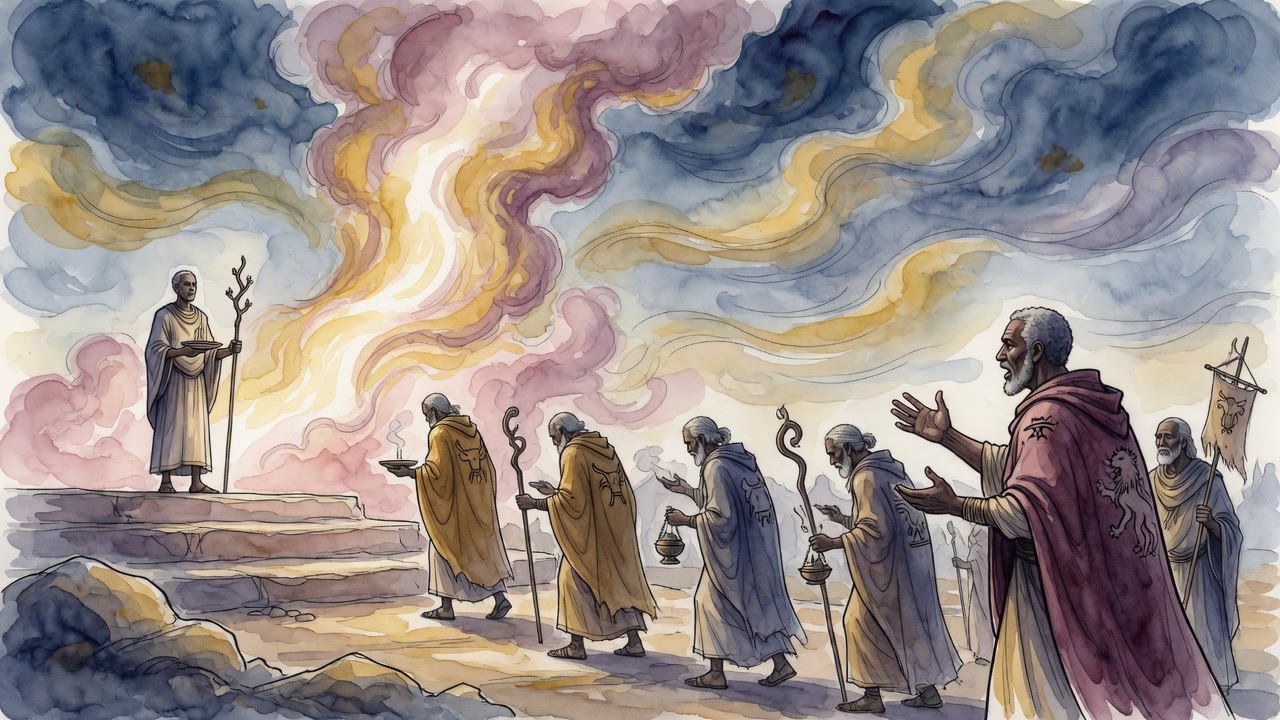
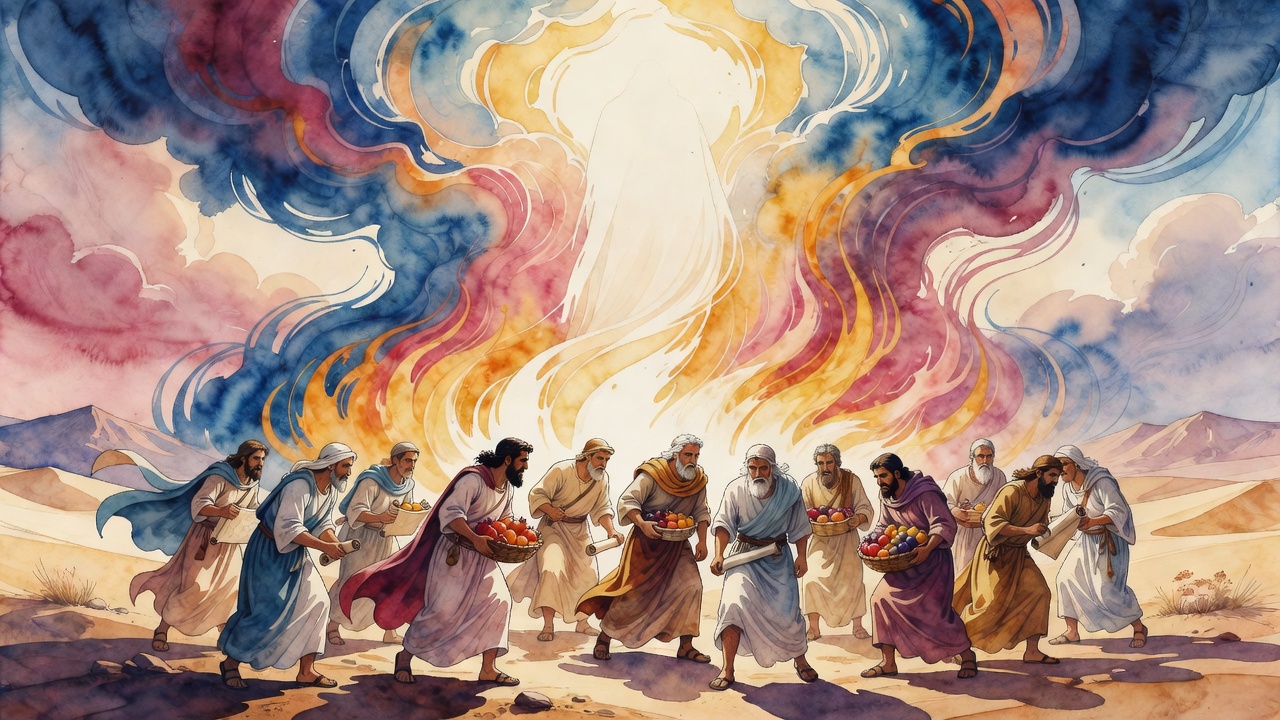
Moses stood at Kadesh-Barnea in the wilderness of Paran and named twelve men for a road that could break a nation. On the twenty-seventh of Siwan he sent them toward Canaan with a map that began in disappointment on purpose. "Ascend there in the South, and ascend the highland" (Numbers 13:17). The south was the poorer stretch. He wanted their eyes trained the way a merchant trains a buyer's eyes, lesser cloth first, then the goods that stop the breath.

Three times he pressed them about the land itself. What is the Land. Are the people strong or weak, few or many. Do they live in open places or fortified cities. He was not collecting travel notes. He was teaching twelve witnesses how to see without panicking at the first hard ridge.

The Merchant's Path Through Canaan

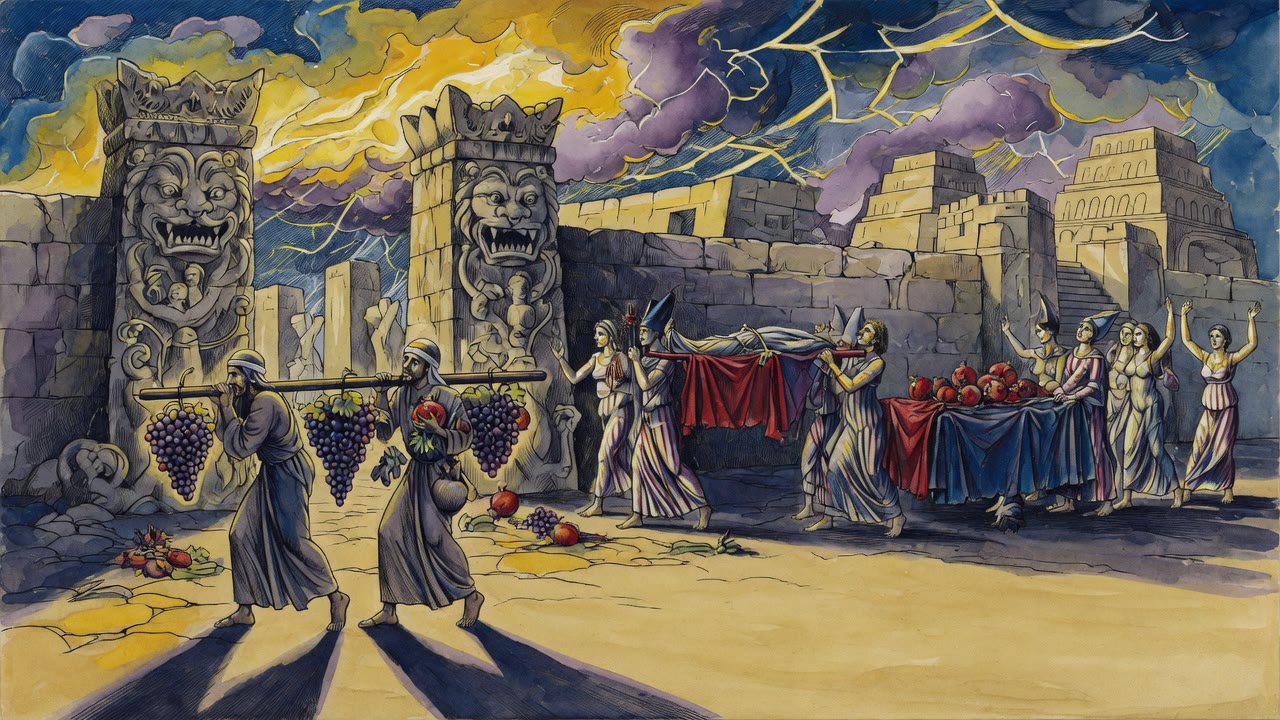
They entered by the south, the poorest tract of the Holy Land. Moses wished each mile farther north to feel richer than the mile behind it. When they reached Hebron, the poorest strip of Palestine still shamed Zoan, Egypt's best. The sons of Ham had built Hebron first for that excellence, and only seven years later raised Zoan in Egypt. Even the "worst" of the promise already outclassed the empire they had fled.

As they moved, cities fell into mourning around them. God struck each place with plague as the spies entered, so the living buried the dead and had no time for strangers. The road was easy in the human sense. No gate captain stopped them. The ease did not make the land small. It only kept twelve men alive long enough to misread what they saw.

Three Brothers Who Ate the Sun

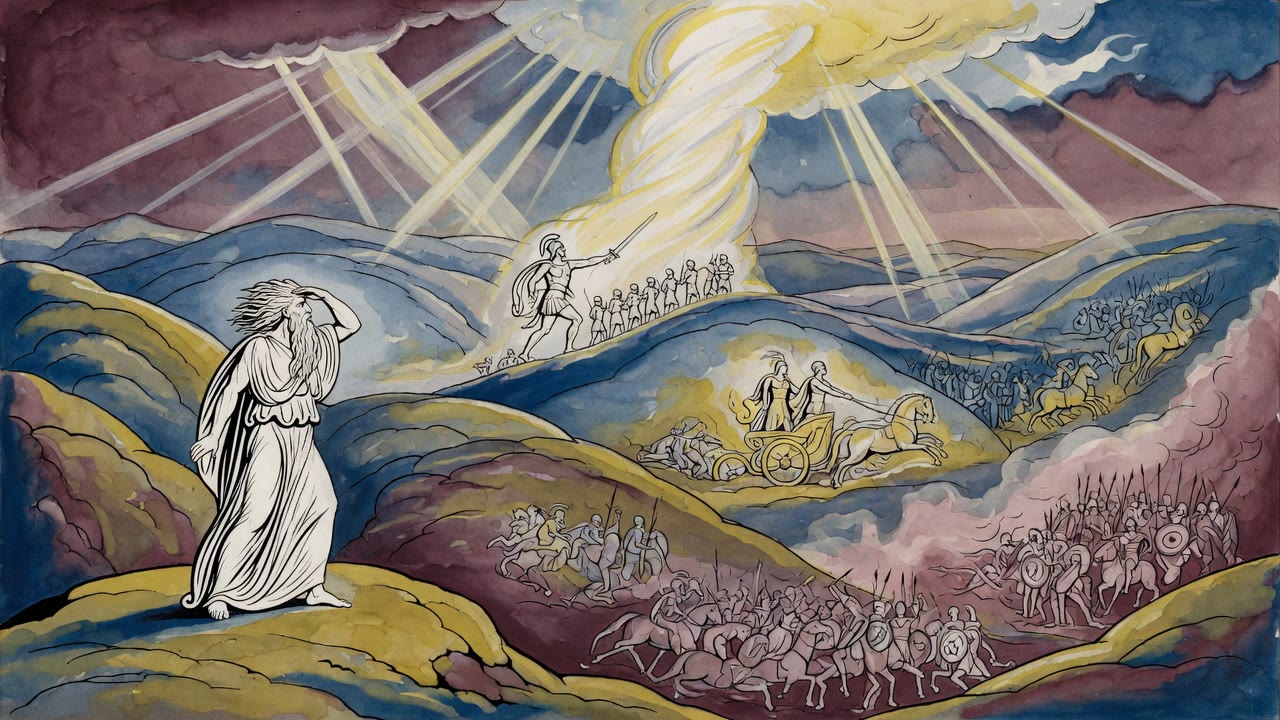
At Hebron the ease broke. Ahiman, Sheshai, and Talmai stood so tall the sun reached only their ankles. Ahiman looked like a mountain about to fall; a man seeing him cried, "What is this that is coming upon me?" Sheshai was hard as marble. Talmai's strength made ridges feel temporary. The spies walked among funerals and still felt small as insects under those three shadows.

Moses had sent them to measure fruit, walls, and people. The giants measured the spies instead. Terror entered the report before grapes did. The south's poor fields had been meant to steady them. The brothers in Hebron undid the lesson. What the merchant showed as opening stock, the eye of fear called proof that the whole house was empty.

What the Report Chose to Carry Home

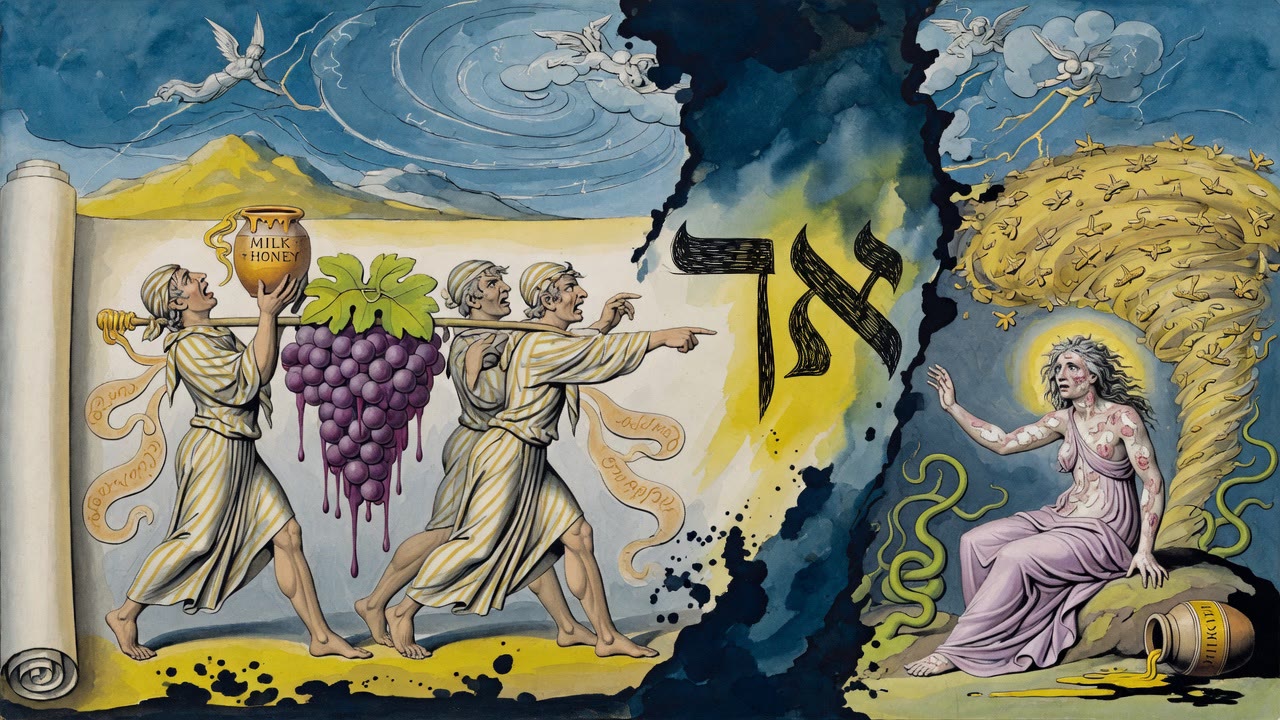
They cut a cluster that needed two men and a pole. They could have returned speaking only of milk, honey, and a Hebron better than Zoan. Instead the giants rode home in their mouths. "The land eats its settlers," they said. "We were as grasshoppers." The merchant path had worked until the tallest merchandise of all, human height used as a weapon, filled the frame.

Moses had asked, "What is the Land?" three times because land is never only soil. It is also the courage of the people who will walk it. The spies answered with ankles of giants and forgot the funerals God had arranged so they could pass. They forgot that the poorest Hebrew ridge already beat Egypt's prize field. They brought back fruit and fear in the same sling.

The South That Was Supposed to Soften Them

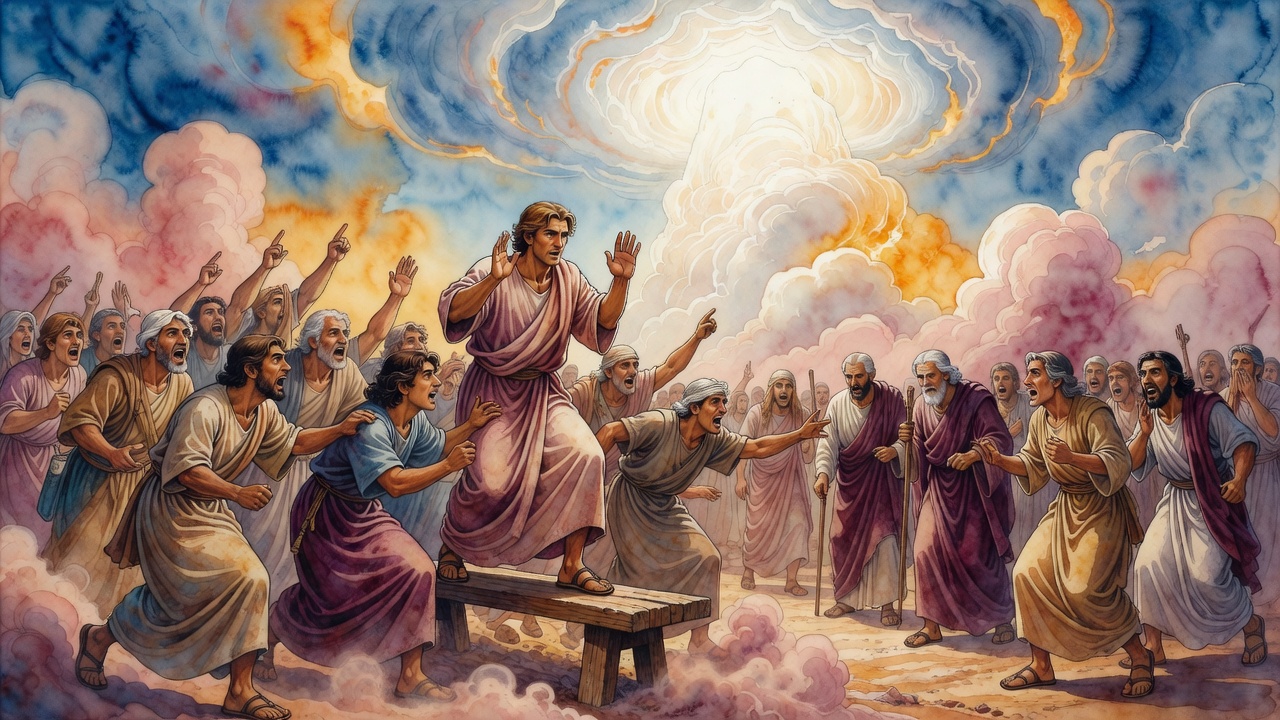
Picture the first night on the southern trail. Thin soil. Hard water. Men already muttering that Moses had sent them into scrap country. By Hebron the muttering should have flipped into wonder. It flipped into dread instead. The strategy was sound. The witnesses were not. A nation waiting in tents would hear the dread louder than the cluster on the pole.

The south still sits in the order of the verse for a reason. Ascend there first. Learn hunger for better ground. Then meet the highland with a trained appetite. The giants did not erase the order. They only proved how fast fear can reverse a merchant's careful display. Moses showed poor land before rich land. The spies showed Israel their own smallness before they showed Israel the gift.

At the first southern well the water tasted thin. One spy filled a skin and spat. Another marked the soil with his heel and found more stone than loam. Moses had wanted that taste. He wanted their tongues trained so that later figs would shock them. The plan assumed patience. The plan did not account for ankles of giants blotting out the sun.

Caleb would later try to still the camp with a different report, but the first telling already had its claws in. Grasshopper speech travels faster than grape speech. The merchant path through poor country remains in the verse as Moses wrote it, a pedagogy the twelve only half obeyed. They walked the route. They refused the lesson. Israel paid for the refusal with a generation of graves in the sand.

Even the plague-struck cities could have taught them mercy. God cleared streets so scouts could pass without swords. They took the empty streets as omen of a land that eats settlers, not as cover arranged for their lives. Sight without gratitude becomes its own wilderness. The pole of fruit still glistened. The mouths beside it chose terror as their main crop.


← All myths
From the tradition

Sources

3 sources

The texts behind this telling. Some cards carry a translation of the source; others are our own retelling of it, and each card says which. Every card links out to the original.

Bamidbar Rabbah 16:12Bamidbar Rabbah

Retold in our words. Read the original at the link below.The Sefaria Midrash Rabbah, 2022 · CC-BY

Even in the Bible, the order in which things are presented can tell a whole story. Take the story of the spies sent by Moses to scout out the Land of Canaan, the Promised Land, before the Israelites entered.

As we read in the Book of Numbers, Moses gave them very specific instructions. But have you ever paused to consider why he instructed them the way he did? Bamidbar Rabbah, a fascinating collection of rabbinic interpretations on the Book of Numbers, illuminates this.

"Ascend there in the South, and ascend the highland," Moses tells them (Numbers 13:17). Why start in the South? Bamidbar Rabbah explains it's like a merchant showing off their wares. They present the less impressive stuff first, then wow you with the premium goods. The southern part of Israel was considered less fertile than the northern part. So, Moses, in a way, was softening the blow, saving the best for last.

Then comes the repeated questioning: "And you shall see the Land… What is the Land?" Moses asks this three times (Numbers 13:18-20). It seems repetitive. But the Rabbis in Bamidbar Rabbah see layers of meaning. Moses wasn’t just asking about geography. He wanted to know the land's character. "Look at the Land of Israel," he urges. "There is a land that grows mighty men and there is a land that grows weak men. There is one that maximizes population, and one that minimizes population.”

He wanted to understand the people, too. Were they strong or weak? Few or many? And their land, what was it like? "What is the land in which they live?" (Numbers 13:19). Bamidbar Rabbah tells us that if they lived in open areas, without fortifications, it suggested strength, a reliance on their own might. But if they huddled behind walls, they were likely weaker, soft-hearted.

And the land itself! "And what is the land, is it fat?" (Numbers 13:20). Was it fertile? The commentary clarifies: Are its fruits lean or fat? Moses instructed the spies to examine the rocks and the earth. If the rocks were hard and didn't crumble easily, the land would be fertile. If the earth was like earthenware, easily broken, it would be lean.

Finally, there's this little detail: "The days were the days of the first grapes" (Numbers 13:20). A seemingly simple observation, but it leads to a lovely saying: "There is no season of Tamuz [a Hebrew month roughly corresponding to July] without figs and grapes."

So, what does this all mean? It's more than just a scouting mission. It’s about perception, about understanding the nuances of a place and its people. Moses wasn't just sending spies; he was sending observers, asking them to look beyond the surface, to explore the very essence of the Land of Israel. And maybe, just maybe, it's a reminder for us to look a little deeper, too, in everything we encounter. What do you think?

Full source
Legends of the Jews 4:95Legends of the Jews

Retold in our words. Read the original at the link below.The Legends of the Jews by Louis Ginzberg (1909) · Public Domain

The Torah tells us in Numbers 13 that they departed from Kadesh-Barnea. But where did they go first? The south of Palestine, the least impressive part. Now, why would Moses do that?

Well, according to Legends of the Jews, Ginzberg retells a fascinating explanation: Moses, in a way, was acting like a savvy merchant. He wanted to manage expectations. Show the "lesser" wares first, so the "better kind" would truly shine in comparison.

The idea was that as the spies journeyed further into the land, they’d see increasingly more impressive areas. Each vista would be better than the last. A clever strategy. A bit of psychological priming, perhaps?

There's more to this story.

When the spies arrived in Hebron, they were able to really grasp just how blessed this land really was, this land promised to them. Even though Hebron was considered the poorest tract in all of Palestine, it was still far superior to Zoan, the most fertile region in Egypt!

Let that sink in for a moment. The least desirable part of the Promised Land was still better than the best part of Egypt.

This detail about Hebron being built before Zoan is particularly striking. According to this tradition, when the sons of Ham were building cities across the world, they chose Hebron first, not because it was easy, but because its inherent excellence was clear. Zoan in Egypt came a full seven years later.

Imagine: the very first priority, the place deemed most worthy of human ingenuity and effort, was this seemingly humble place in the land promised to the Israelites.

It's not always about showing your best face immediately. Sometimes, starting with the modest allows the truly exceptional to reveal itself in its full glory. And sometimes, what appears to be the "poorest" part is still richer than we can possibly imagine.

Full source
Legends of the Jews 4:96Legends of the Jews

Retold in our words. Read the original at the link below.The Legends of the Jews by Louis Ginzberg (1909) · Public Domain

The journey itself, surprisingly, wasn't fraught with peril from the locals. The text explains that God smoothed their path. As soon as the spies, sent by Moses to scout the land, entered a city, a plague would strike. The inhabitants, preoccupied with burying their dead, had neither the time nor the will to bother with the strangers. A grim blessing, perhaps.

What they did encounter was something far more terrifying: giants.

Specifically, three brothers: Ahiman, Sheshai, and Talmai. These weren't just big guys; they were colossal. The sun, according to the story, only reached their ankles! Their very names,

The strongest of them all was Ahiman. The sight of him was so overwhelming, it felt like standing at the foot of a mountain about to crumble. Involuntarily, people would cry out, "What is this that is coming upon me?" Thus, his name, Ahiman, was born.

Sheshai, the second brother, was described as being as strong as marble – hence his name, “marble.”

And Talmai? His mighty strides were so powerful that they tore up plots of ground with every step. Thus, he was called Talmai, "plots."

It wasn’t just the sons of Anak (the father of the giants) who possessed such incredible size and strength. According to Legends of the Jews, his daughters were equally imposing.

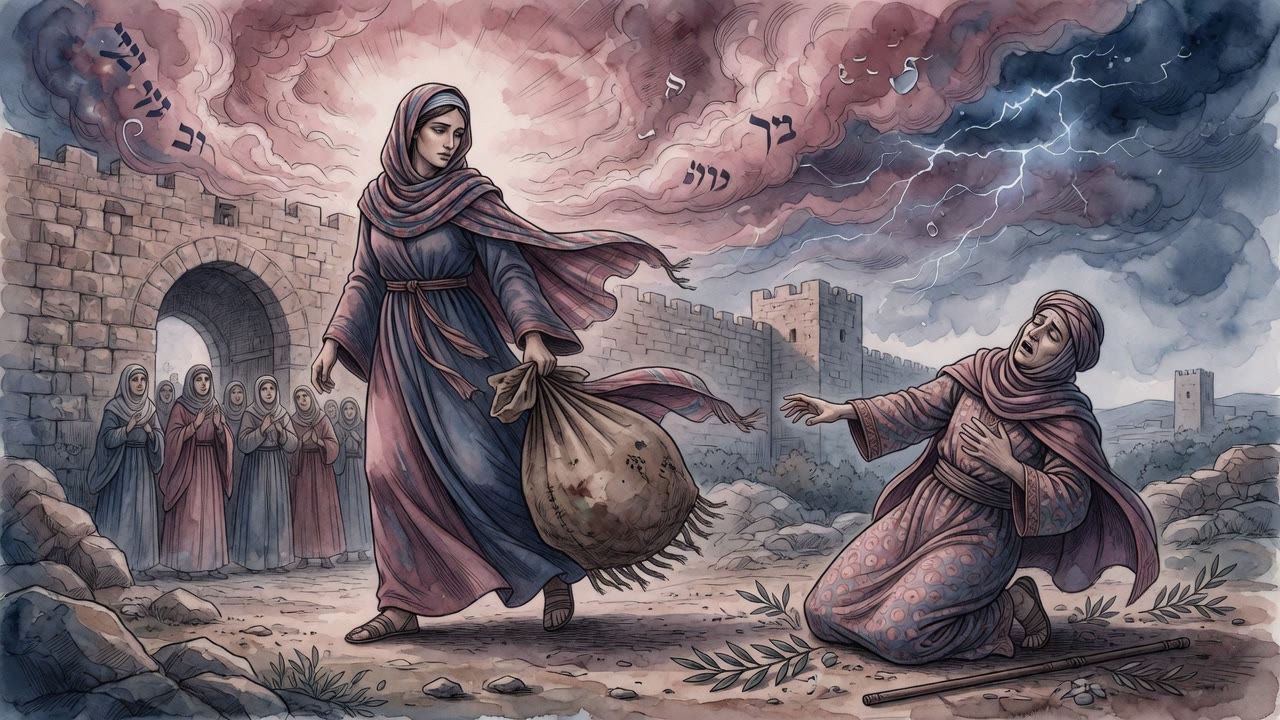
The spies stumbled upon one of these daughters in Kiriath-Arba, the "City of Four," named so because Anak and his three sons resided there. Overcome with terror, they sought refuge, thinking they’d found a cave.

But it wasn't a cave. It was merely the rind of a pomegranate! A pomegranate discarded by the giant's daughter. After she'd finished eating, she remembered she shouldn't anger her father by leaving the rind lying around. So, she picked it up, with the twelve spies hiding inside, "as one picks up an eggshell," and tossed it into the garden. She never even noticed she was carrying twelve men, each measuring sixty cubits in height!

When the spies finally emerged from their makeshift hiding place, they exclaimed to one another: "Behold the strength of these women and judge by their standard the men!"

What a stark reminder of the power, or perceived power, of the inhabitants of Canaan.

This episode emphasizes the immense psychological barrier the Israelites faced. It wasn’t just about military might; it was about overcoming the sheer terror instilled by the stories and the sights they encountered.

Full source