5 min read

Ptolemy Bowed Seven Times Before the Gold Scrolls

The king did not rise when the Jewish envoys entered. He rose when the coverings came off, and gold letters sat on parchment whose seams had vanished.

Curated by Arthur · Told by Maggid ·
Table of Contents
  1. Gifts That Outranked the Gifts
  2. Between Commandments, Smaller Waves
  3. Why More Books Keep Coming
  4. What the King Could Not Take Home

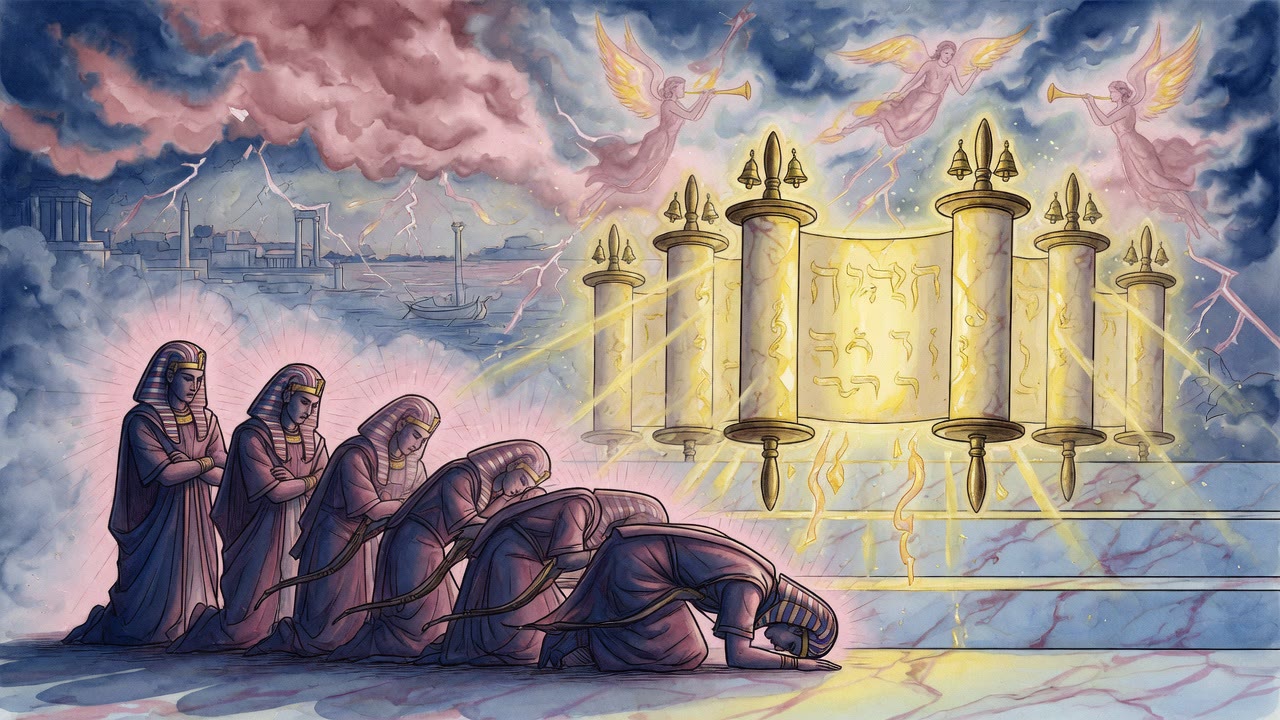
Ptolemy did not rise when the Jewish envoys first entered. He rose when the coverings came off the scrolls.
Ptolemy Bowed Seven Times Before the Gold Scrolls Click for full size

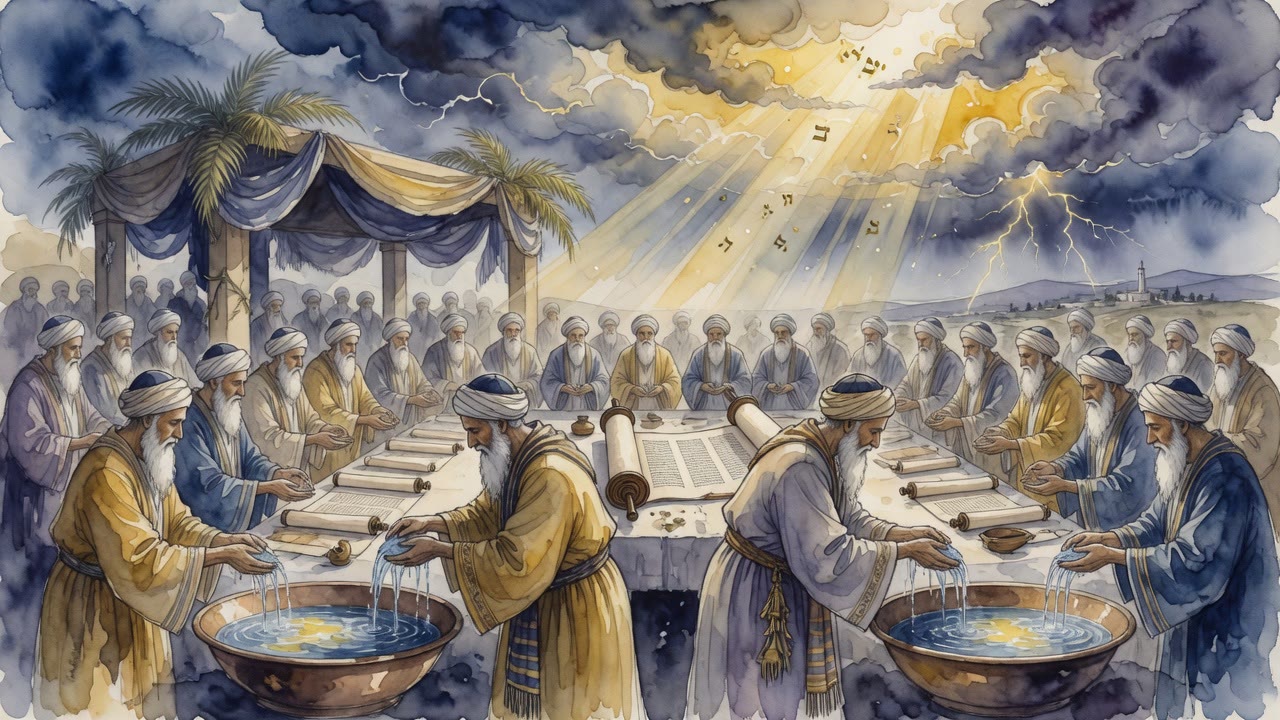
Gold letters sat on parchment prepared so finely that the joins between sheets vanished. The law of Israel lay open in Jewish characters under Alexandrian light. The king stared a long time, as if the room had tilted toward a different center of gravity. Then he bowed, about seven times, and said he thanked the messengers, and thanked the one who sent them more, and most of all God, whose oracles these were.

Gifts That Outranked the Gifts

They had brought treasures with them, the ordinary currency of courts. The scrolls outranked every cup and cloth. A king who owned libraries learned in one hour that ownership is not the same as kneeling. He asked about the books before he asked about politics. The Letter of Aristeas freezes that moment: the monarch of a Greek empire treating Hebrew writing as something that commands the body.

Seven bows are not a casual nod. They are a full lowering of the head that rules fleets. In that chamber the sea of empire met the sea of Torah, and the empire went first to its knees. Courtiers who had watched him judge nations watched him judge himself against a text he could not yet read without translators.

Outside, Alexandria's harbor moved grain and gossip. Inside, the only cargo that mattered was ink that claimed to be speech from the Maker of seas. The king felt the claim in his spine before he felt it in his mind.

Between Commandments, Smaller Waves

Shir HaShirim Rabbah hears Torah as a great sea. Between large waves run smaller ones. Between each major commandment run details, inferences, and the oral river that never stops moving. Rabbi Yochanan would reach the verse about beryl, tarshish, and remember a nephew's teaching: Talmud is like Tarshish, a long voyage, a deep that holds more than the shore can name.

Jonah once fled toward Tarshish as if distance could outrun a word. The midrash turns the same name into a metaphor for study that cannot be finished in a single palace visit. Ptolemy saw only the written gold that day. He did not yet hear the smaller waves. Still the midrash stands behind the scene like a second court. A king who bows to the scroll has already confessed that the text is larger than a palace.

Leviticus sits in the middle of the five books like a belly of ivory, the midrash says, dense with craft. A foreign king touching the edge of that craft does not become a priest. He becomes a witness that the craft has weight outside its own camp.

Why More Books Keep Coming

Kohelet Rabbah leans on Ecclesiastes: of making many books there is no end. The verse can sound like weariness. In the midrash it also sounds like hunger that refuses to close the shop. Every generation writes because every generation stands again before the same mountain of letters and needs a new path up the slope.

Alexandria was a city of books. Ptolemy's bow did not end the making of books. It justified them. If a king must thank God for oracles on parchment, then scribes must keep copying, translators must keep sweating, and teachers must keep opening the next wave between the commandments. The fear of endless writing is real. The greater fear is a world that stops writing because it thinks one bow was enough.

The seventy-two translators would later work in their own pressure, each alone and yet aligned. That labor is the aftershock of the king's knees hitting the floor. Reverence without transmission dies in a single generation. Transmission without reverence becomes only paper. The scene wants both.

What the King Could Not Take Home

He could store the scrolls. He could order a translation. He could host banquets for the sages and test their wisdom with riddles. He could not become Israel by owning Israel's law. The gold stayed gold. The covenant stayed with the people who still said the words with their mouths after the envoys sailed home.

That is the hard edge of the story. Reverence from outside is not nothing. It is also not entry. The midrashim that call Torah a sea know that swimming and collecting seashells are different arts. Ptolemy collected a moment of awe. Israel keeps swimming.

Years later, when other kings would demand the books as trophies or ban them as threats, this first bow remains a counter-image: power that briefly knows it is not the highest voice in the room. The gold ink can be melted. The voice cannot, so long as someone still bows with the mouth in daily speech.


← All myths
From the tradition

Sources

3 sources

The texts behind this telling. Some cards carry a translation of the source; others are our own retelling of it, and each card says which. Every card links out to the original.

Letter of Aristeas 1:177Letter of Aristeas

Retold in our words. Read the original at the link below.The Letter of Aristeas, Clarendon Press (1913) · CC-BY

When they entered with the gifts which had been sent with them and the valuable parchments, on which the law was inscribed in gold in Jewish characters, for the parchment was wonderfully prepared and the connexion between the pages had been so effected as to be invisible, the king as soon as he saw them began to ask them about the books.

And when they had taken the rolls out of their coverings and unfolded the pages, the king stood still for a long time and then making obeisance about seven times, he said: 'I thank you, my friends, and I thank him that sent you still more, and most of all God, whose oracles these are.'

Full source
Kohelet Rabbah 12:1Kohelet Rabbah

Retold in our words. Read the original at the link below.The Sefaria Midrash Rabbah, 2022 · CC-BY

The book of Ecclesiastes, or Kohelet as it’s known in Hebrew, grapples with this in its final chapter. Chapter 12, verse 12, reads: "More than that, my son, be careful: Making many books has no end, and much prattle is exertion of the flesh.

What does it really mean?

Kohelet Rabbah, a classic rabbinic commentary on Ecclesiastes, dives deep into this very verse. It's like eavesdropping on a fascinating conversation between ancient scholars trying to make sense of the world, just like we are.

The commentary begins by focusing on the phrase "More than that [mehema], my son, be careful." But instead of reading mehema literally, the rabbis cleverly connect it to the word mehuma, which means "confusion." So, the verse is reinterpreted as: "More than that… be careful of…confusion!"

Anyone who brings more than the sacred twenty-four books into their home brings confusion, the rabbis suggest. Twenty-four? What’s so important about that number? Well, that's the traditional number of books in the Tanakh – the Hebrew Bible, the Hebrew Bible. These are the foundational texts: the Torah, the Prophets, and the Writings.

And what are these other books that are considered dangerous? The commentary specifically names "the book of ben Sira and the book of ben Tigla." These were ancient works of wisdom literature, similar to Proverbs or Ecclesiastes, but not considered part of the divinely inspired canon. These books, while perhaps containing some wisdom, were not on the same level as the sacred books.

Now, the commentary turns to the second part of the verse: "And much prattle is exertion of the flesh." The rabbis explain that these extra books were "given for prattle and were not given for exertion." This is in sharp contrast to the twenty-four books of the Bible, which do require serious exertion, deep study, and intense engagement. We can easily skim through countless articles and opinions online. But truly wrestling with the Torah, confronting the words of the prophets – that takes real work. It demands our full attention, our intellectual energy, and our spiritual commitment. It's not just passive consumption; it's active participation.

So, what’s the takeaway here? Are we being told to avoid all other books besides the Bible? Probably not. But perhaps the message is about discernment. It’s about prioritizing what truly nourishes our souls and challenges us to grow. It's about recognizing the difference between empty chatter and profound wisdom. Kohelet Rabbah encourages us to be mindful of what we let into our minds and hearts and to focus on the texts and teachings that demand our full selves. Maybe, just maybe, less really can be more.

Full source
Shir HaShirim Rabbah (chapter/verse reference unresolved; pre-import artifact 14:2)Shir HaShirim Rabbah

Retold in our words. Read the original at the link below.The Sefaria Midrash Rabbah, 2022 · CC-BY

He suggests that between each commandment, the very parshiyot (portions) and details of the Torah are inscribed. It's like saying there's a hidden river flowing beneath the surface of the text.

Rabbi Yoḥanan clearly valued this insight. The text in Shir HaShirim Rabbah tells us that whenever Rabbi Yoḥanan would reach the verse "Set with beryl" while explaining scripture, he would acknowledge the wisdom of Rabbi Yehoshua's nephew.

What does "Set with beryl" even mean in this context? The text uses the Hebrew word for beryl, tarshish, to make an analogy. It says that tarshish is like the Talmud, which is like the Great Sea. Just as it says: “To Tarshish” (Jonah 1:3), when Jonah attempted to flee to Tarshish, which was a significant sea voyage away.

Think of ocean waves, galim in Hebrew. Ḥananya uses this image, too. Just as between large waves, there are smaller, rippling waves, so too, between each major commandment, there are countless smaller details and insights. All of Torah flows into the sea of Talmud! This idea echos (Ecclesiastes 1:7): “All the streams go to the sea.”

And what about the phrase, "His belly is a slab of ivory?" According to this midrash (rabbinic interpretive commentary), it refers to the book of Leviticus. Just as the belly is central, with the heart on one side and the legs on the other, so too Leviticus sits in the middle of the Torah, with two books on either side.

Furthermore, "a slab of ivory" suggests that you can craft many things from it. Similarly, the book of Leviticus contains numerous mitzvot (commandments), details, a fortiori inferences (arguments from the lesser to the greater), and specific laws related to sacrificial offerings, like pigul (offerings disqualified by improper intent) and notar (offerings left over after their designated time).

So, what's the takeaway here? It's a living, breathing text, filled with layers of meaning and connection. It encourages us to delve deeper, to look between the lines, and to appreciate the richness of Jewish tradition. It's in those details, those "smaller waves," that we often find the most profound wisdom.

Full source