5 min read

Rabbi Ishmael Shows Two Seals at the First Gate

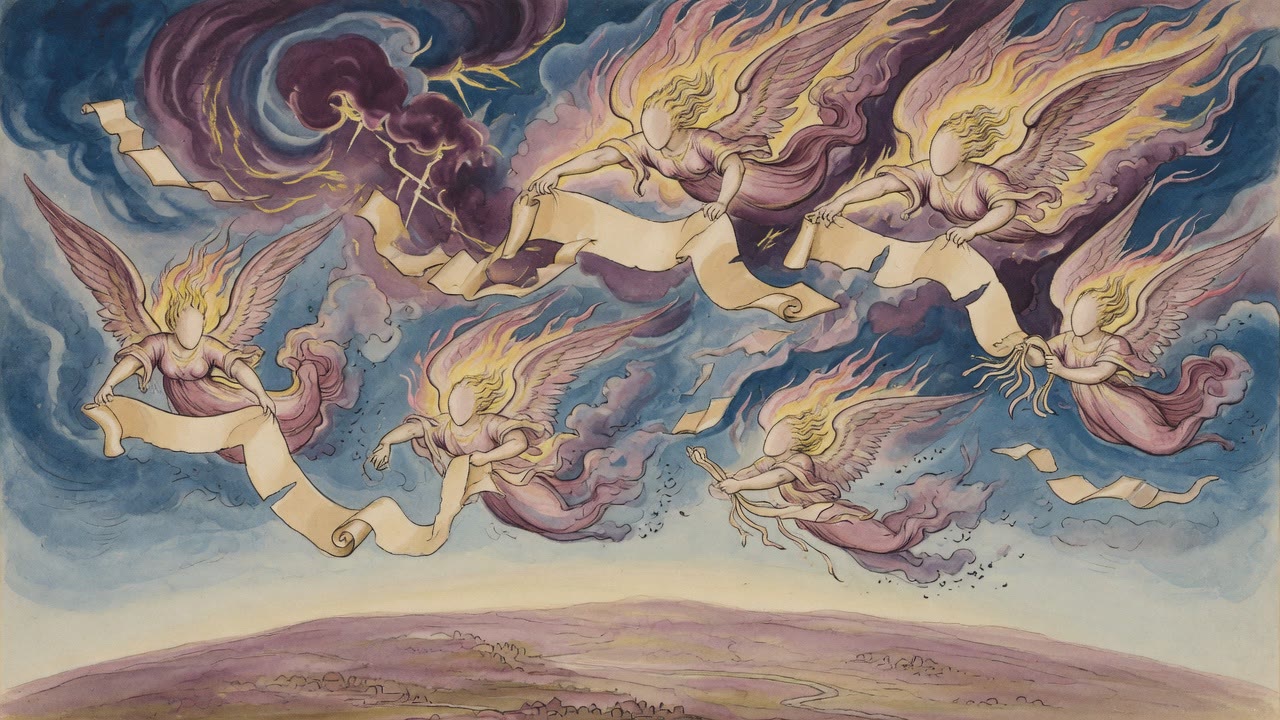
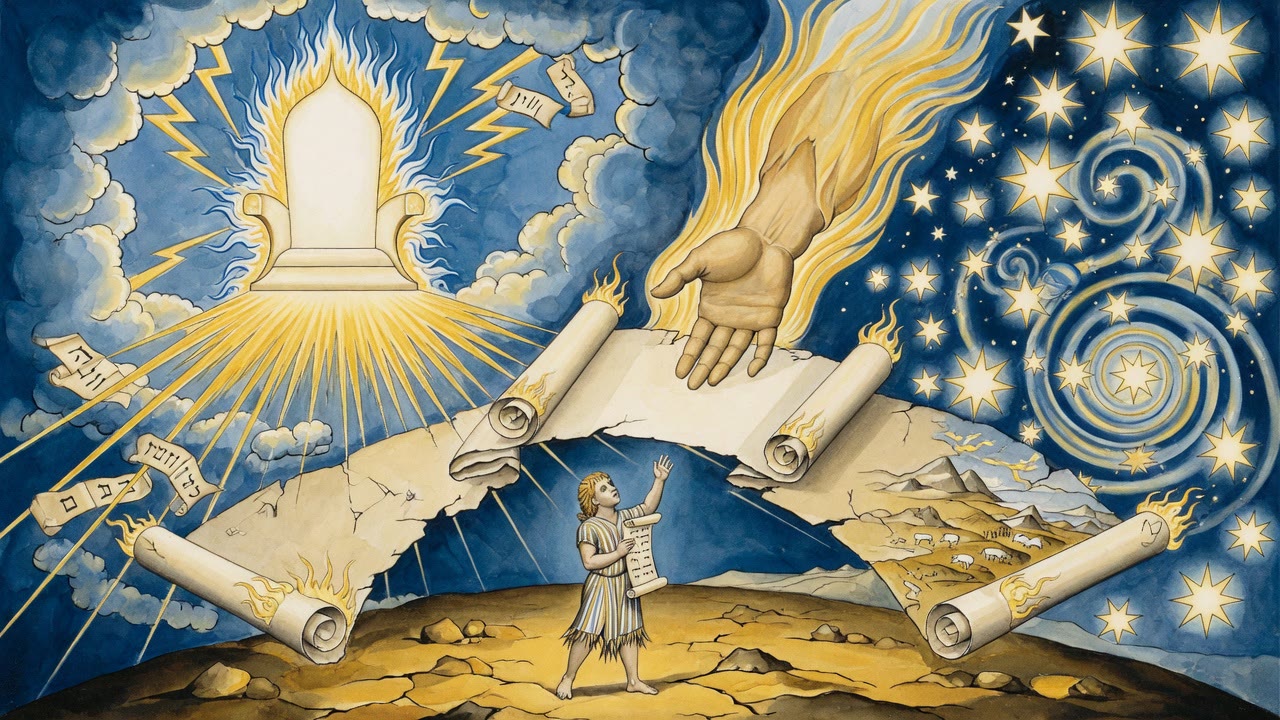
At the first heavenly palace, princes seize from right and left. Rabbi Ishmael lifts two seals, and Surya laughs already over a wicked man's end.

Curated by Arthur · Told by Maggid ·
Table of Contents
  1. Threshold With Hands
  2. Passport of Names
  3. Surya Speaks of Laughter Above
  4. Eyes at the Highest Door
Rabbi Ishmael Shows Two Seals at the First Gate Click for full size

Threshold With Hands

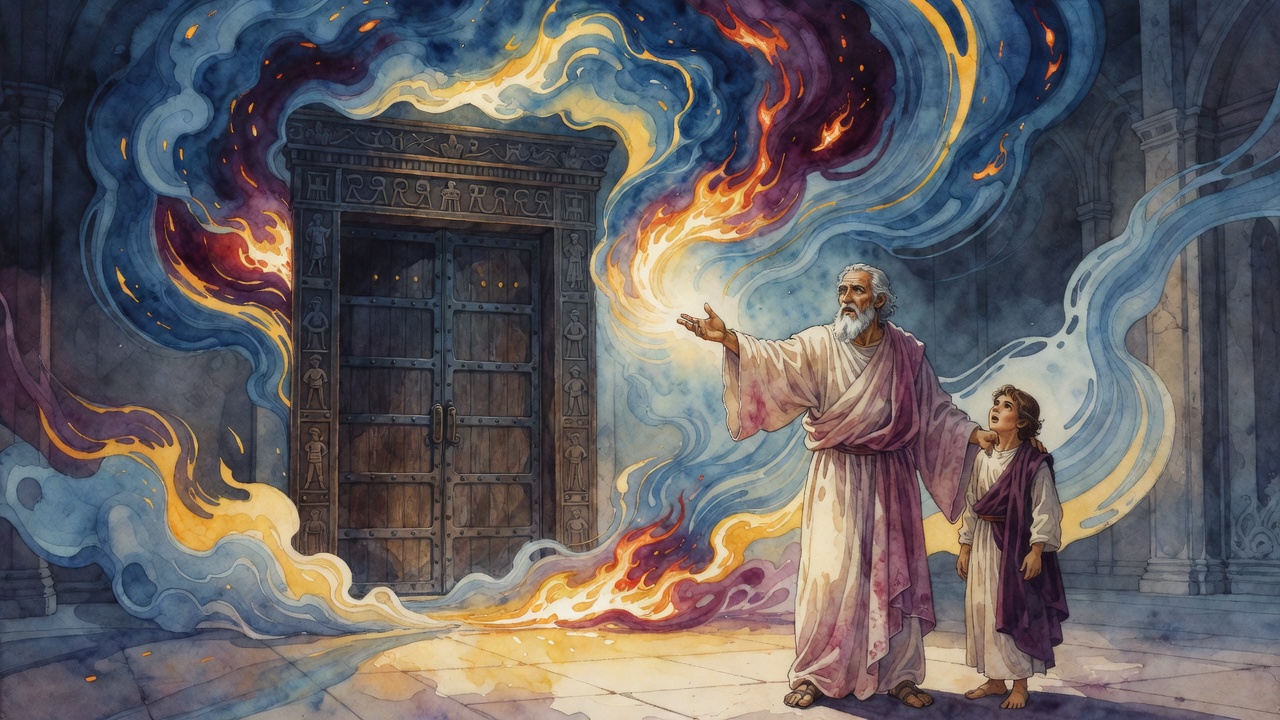
Rabbi Ishmael stands at the entrance of the first heavenly palace and does not pretend the door is friendly. Right of the lintel waits Dahabhiel, prince of this gate. Left waits Tophahiel. They are ready to seize. One hand from the right, one from the left. Authorization is not a mood. It is something you hold.

He takes two seals. One bears the name of Totrosi'ai, called the Lord. The other bears the name of Surya, Prince of the Presence. Show the first to those standing on the right. Show the second to those standing on the left. The act is balanced, exact, almost ritual theater with lethal stakes. Present wrong and the princes do not debate. They grab.

If the seals are true and shown true, Dahabhiel and Tophahiel hand him forward to Taghriel and Mathpiel at the second palace, warning them concerning the traveler. The first gate becomes a reference letter written in fear and Name.

Passport of Names

These seals are not jewelry. They are calling cards of heaven, proof that the ascent is not theft. Merkavah travelers (mystics ascending to God's chariot-throne) know the body can be torn for a glimpse taken without warrant. The first palace is already a court of entry. The princes test whether the climber belongs to the order he claims.

Ishmael teaches the procedure as one who has stood there, not as one inventing poetry. When you come and stand at the entrance, take two seals in your hands. The sentence is practical. Sweat still belongs in the story. So does the knowledge that hostile holiness is still holiness.

Behind the lintel, higher palaces wait with stranger wardens. Four beasts at the seventh gate carry hundreds of eyes and faces nested in faces. The climb does not get softer. It gets denser with seeing.

Surya Speaks of Laughter Above

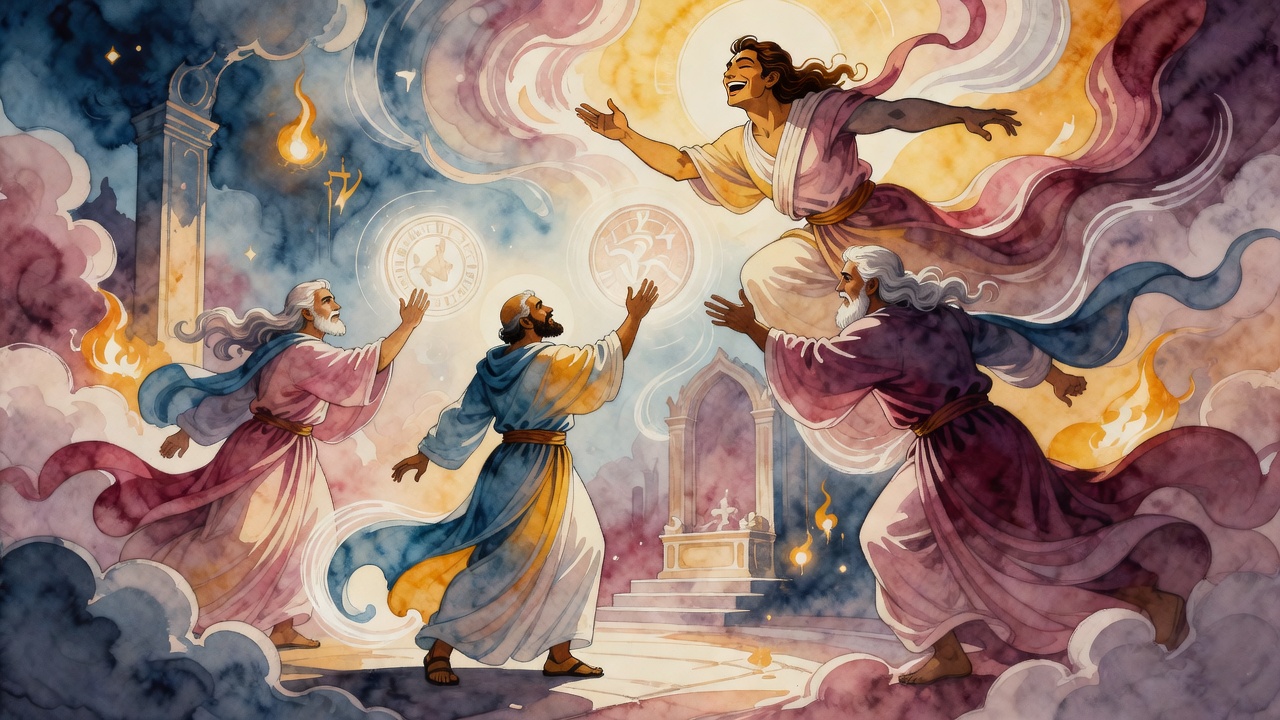
In another hour of vision, Surya addresses Ishmael as friend and tells him not to be too upset about dying, about departure to the eternal home. Why comfort? Because above, things are already in motion. Zoharariel, named as the Lord God of Israel, is doubled over with laughter at a certain wicked man.

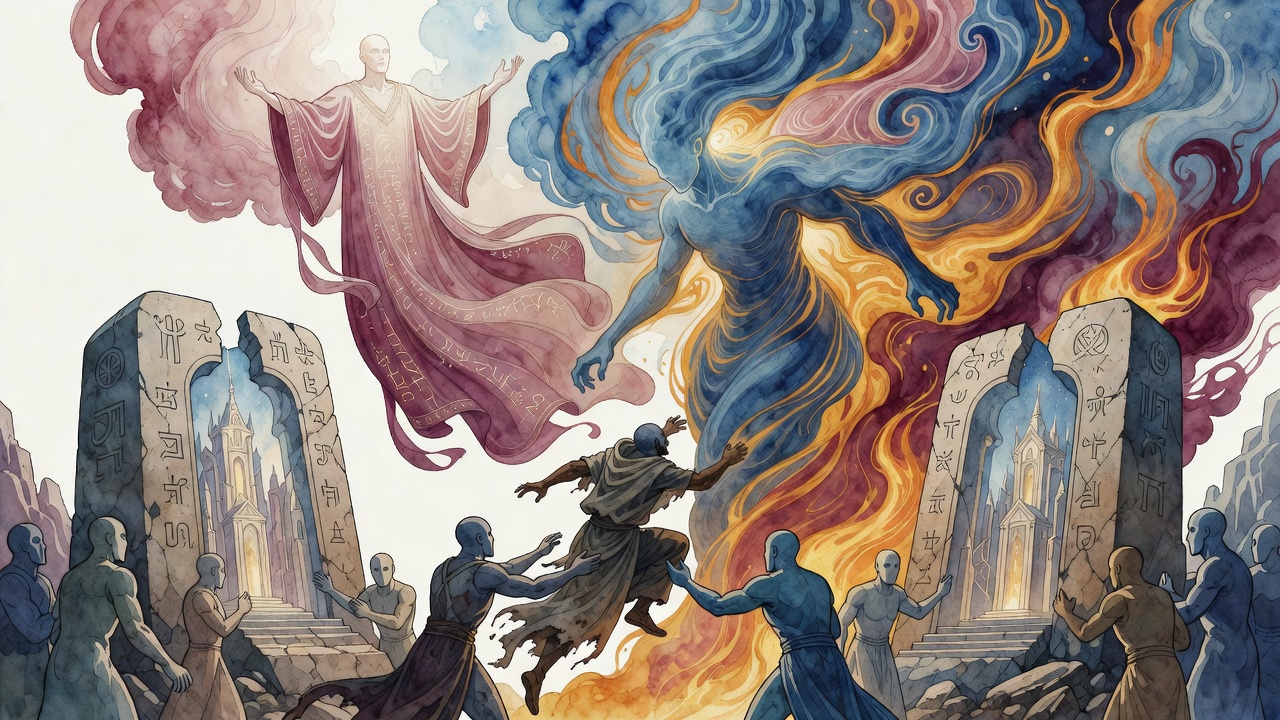
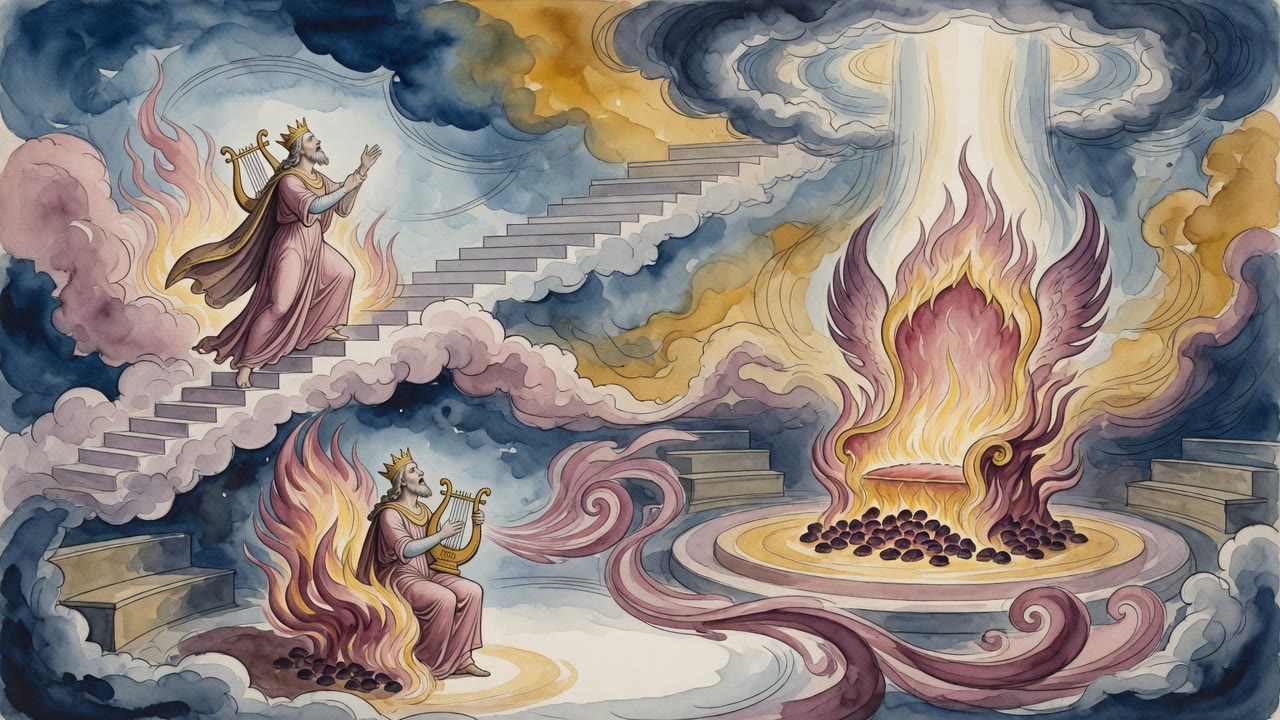
We are not told the wicked man's earthly title. We are told his end. By the glory of the loftiness of the fearful palace, and by the throne of glory which is never left from its creation unto eternity: in Gehinnom, at the hand of Rabbi Hananya ben Teradyon, that wicked one will taste flame of fire and coals of cherubim, ophanim, and holy beasts.

Hananya ben Teradyon taught Torah until Rome made him a martyr. The executioner in the vision is a burned teacher. Justice arrives as poetic and exact. The man who killed learning is handed to learning's dead hero in the fire of heaven's own creatures.

Eyes at the Highest Door

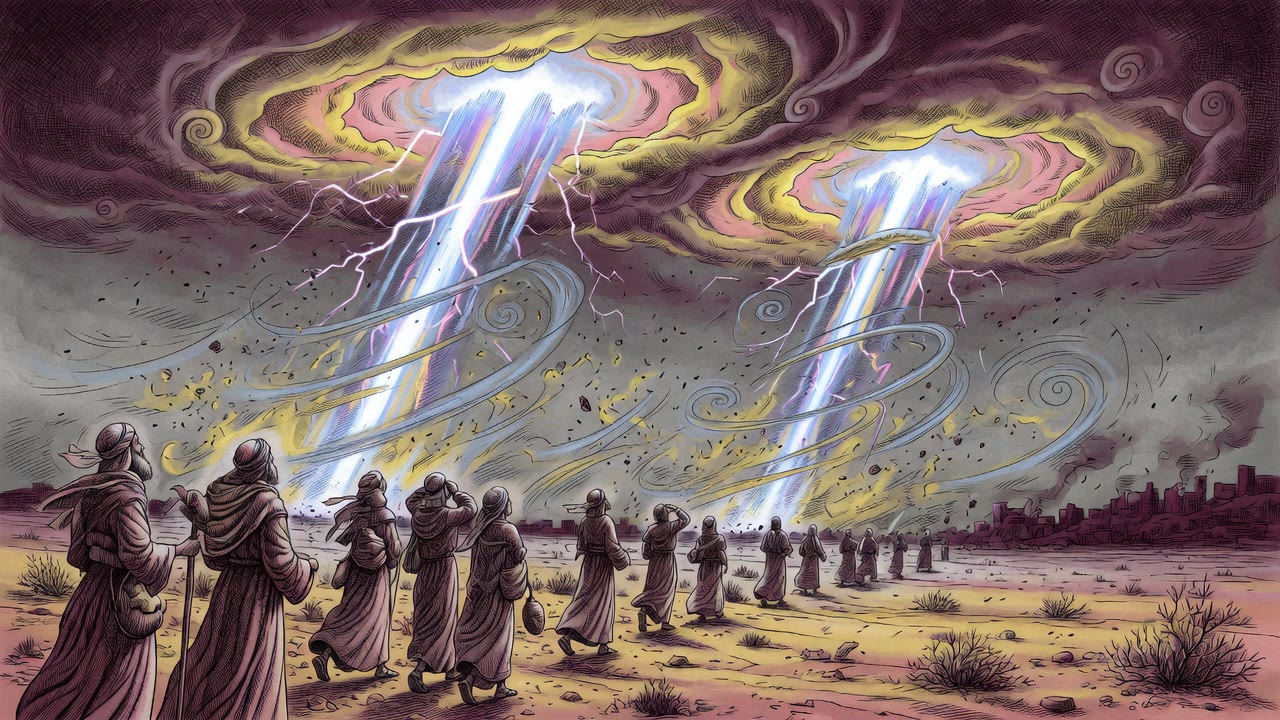
Further up, the seventh palace does not post ordinary guards. Four beasts stand there, each with five hundred twelve eyes, each face the likeness of a man made of sixteen faces. The text will not draw them politely. It forces the mind to admit it cannot finish the picture. All-seeing is not a calm word when the seer has five hundred twelve ways to watch you approach.

Ishmael's two seals at the first gate and the many-eyed beasts at the last gate are one system: entry is graded, and seeing increases until the traveler is almost seen to death. The laughter of Zoharariel sits inside that system as moral weather. Heaven is not only architecture. It is already settling accounts while the living still climb.

Friend, do not be too upset about dying. The palace has a fire prepared for those who thought Torah teachers were cheap fuel. The first gate still requires seals. The last gate still requires a courage that can stand being watched by more eyes than a human face can own.

Rabbi Ishmael does not swagger. He shows papers of the soul. Right seal, left seal. Right prince, left prince. The body that will one day leave the world is the same body that learns how to enter the first palace without being torn. Surya's comfort is not soft. It is the news that Gehinnom (the realm of judgment after death) already has a schedule, and a martyr holds the tongs.

If you want the ascent as pure light, you will miss the hands on your arms. If you want justice as only earthly courts, you will miss Zoharariel's laughter. Hold both: the traveler lifting seals, and the wicked man already named for flame. Between them the palaces rise, fearful, exact, and unwilling to confuse curiosity with permission.

He does not rush the showing. Right hand lifts Totrosi'ai's seal toward Dahabhiel. Left hand lifts Surya's seal toward Tophahiel. The names are not muttered as charm-junk. They are presented as claims under judgment. If the claim is false, the princes' grip will teach the body what the mind denied. If the claim is true, the handoff to the next gate begins without applause.

That is why Surya's later comfort lands with weight. A man who has practiced entry under threat can hear that death is not the end of the ledger. Zoharariel's laughter is already accounting. The seals at the first door and the fire reserved for the wicked are both about belonging: who may pass, who must burn, who taught Torah until the empire answered with flame.


← All myths
From the tradition

Sources

3 sources

The texts behind this telling. Some cards carry a translation of the source; others are our own retelling of it, and each card says which. Every card links out to the original.

Heikhalot Rabbati 19:1Heikhalot Rabbati

Retold in our words. Read the original at the link below.Sefaria-hosted English translation · CC-BY

Rabbi Ishmael, a central figure in the Heikhalot (the heavenly palaces) literature, the mystical texts describing ascents to the divine throne, gives us a glimpse.

Standing at the entrance to the first heavenly palace. It's not just a door; it's a threshold guarded by powerful, potentially hostile beings. Rabbi Ishmael, in Heikhalot Rabbati 19, lays out a specific procedure.

He instructs: "When thou comest and standest at the entrance of the first palace take two seals in thy hands..." These aren't just any seals. They're potent symbols of authority, divine calling cards, if you will. One bears the name of Totrosi’ai, described as “the Lord." The other, the name of Surya, “the Prince of the Presence.” Think of them as your celestial passport and visa, all rolled into one.

What do you do with these seals? Here's where it gets interesting.

"Show that of Totrosi’ai the Lord to those standing to the right, and show that of Surya the Prince of the Presence to those standing on the left." It's a precise, balanced act. Acknowledging different powers, different aspects of the divine order. It's not enough just to have the seals; you have to present them correctly.

So, who are these gatekeepers, these celestial bouncers? Dahabhiel, the Prince who heads the entrance to the first palace, stands to the right of the lintel. And Tophahiel, another Prince, stands to the left. According to Rabbi Ishmael, these two are ready to seize you! One grabs you from the right, the other from the left.

But it's not arbitrary aggression. It's a test, a challenge. They're determining whether you're truly authorized to pass. If you present the seals correctly, acknowledging the right authorities, Dahabhiel and Tophahiel will hand you over to the next set of gatekeepers: Taghriel and Mathpiel.

Taghriel is the prince at the entrance of the second palace, standing to the right. Mathpiel stands to the left. The ritual involving the first set of gatekeepers essentially makes your case, warning Taghriel and Mathpiel concerning you. It's like having a good reference that smooths your entry to the next level.

What does this all mean? It's more than just a bizarre set of instructions. It speaks to the complex hierarchies and protocols believed to exist in the heavenly realms. It suggests that access to the divine isn't automatic or easy. It requires knowledge, preparation, and the proper recognition of authority. The journey inward, to the deepest levels of mystical experience, is not without its guardians and its gates.

Full source
Heikhalot Rabbati 8:2Heikhalot Rabbati

Retold in our words. Read the original at the link below.Sefaria-hosted English translation · CC-BY

Sometimes, the wheels of the divine grind with a satisfying, almost theatrical flourish. Let me tell you a story from the Heikhalot (the heavenly palaces) Rabbati, a text filled with mystical ascents and heavenly secrets.

Rabbi Ishmael, a central figure in these mystical explorations, has a vision. It’s not just any vision,. He’s addressed by Surya, the Prince of the Presence. That’s a pretty high-ranking angel. Surya delivers a message, a rather comforting one, all things considered. "Friend," he says to Rabbi Ishmael, "don’t be too upset about this whole dying thing, this departure to your eternal home."

Why the reassurance? Because, according to Surya, up in the celestial realms, things are already in motion. Zoharariel, described as the Lord God of Israel Himself, is practically doubled over with laughter at a certain wicked man.

We don’t know exactly who this wicked man is. The text doesn’t specify. But we do know what awaits him. Zoharariel, in a rather dramatic pronouncement, declares: "By the glory of the loftiness of the fearful palace in which I dwell, and by the throne of My glory which is My concern and which I leave not from its creation and unto eternity: In Gehenna," – that's the Jewish concept of hell, folks – "at the hand of Rabbi Hananya ben Teradyon, I will cause that wicked man to taste the taste of flame of fire and fiery coals of cherubim and ophanim and the holy beasts."

Whoa.

That’s some serious cosmic payback. Notice the specific details: the fire isn't just any fire; it’s the fire of cherubim and ophanim, celestial beings of immense power. And the executioner? None other than Rabbi Hananya ben Teradyon. Rabbi Hananya was a Jewish scholar martyred by the Romans for teaching Torah. The wicked man will be punished by a righteous martyr. The detail adds a layer of poetic justice.

The image is vivid, almost terrifying. It speaks to a belief in a divinely ordained sense of justice, even if it's delayed. The Heikhalot literature often explores the hidden workings of the universe, the unseen forces that shape our world. Here, we get a glimpse of that cosmic machinery in action, ensuring that even in death, righteousness will prevail.

What cosmic laughter might echo for those who perpetrate injustice? And perhaps more importantly, how can we, like Rabbi Hananya ben Teradyon, stand for righteousness, even in the face of fire?

Full source
Heikhalot Rabbati 24:1Heikhalot Rabbati

Retold in our words. Read the original at the link below.Sefaria-hosted English translation · CC-BY

Heikhalot Rabbati turns to Visions of Otherworldly Beings in the Heavenly Ascent.

A specific, almost hallucinatory vision from section 24 of Heikhalot Rabbati.

It describes these… things… guarding the entrance to the seventh palace. And understand, in this context, palaces aren't just buildings. They're levels of spiritual attainment, layers of reality, each more intense than the last. This seventh palace? It’s practically the penthouse suite of the cosmos.

So, who's standing guard? Four beasts. But not just any beasts. Oh no. Each one is described as having 512 eyes. 512! Let that sink in for a moment. What would a creature look like with so many eyes? What would it see? The text isn't giving us a clear picture, but it's definitely hinting at something beyond our comprehension.

But it gets even stranger. Each beast is described as having a face "of the likeness of the face of a man." Okay, so far, so… relatively normal? But then comes the kicker: each face is made up of 16 faces. Sixteen faces within a single face! It’s like some kind of fractal of visages, a nesting doll of countenances.

What does it all mean? Why so many eyes? Why so many faces? The Heikhalot texts aren't exactly known for their literal descriptions. They're using symbolic language to convey something about the nature of God, the structure of the universe, and the potential of the human soul.

Perhaps the multitude of eyes represents the all-seeing nature of the Divine, the idea that nothing escapes God's awareness. Or maybe it speaks to the immense complexity of creation, the sheer amount of detail and information that is woven into the fabric of reality.

And the faces? Maybe they suggest the many-sided nature of God's presence, the idea that the Divine can be perceived in countless ways, depending on your perspective. Or perhaps the multiplicity of faces reflects the many different aspects of the human soul itself, the potential for growth and transformation that lies within each of us.

These visions in Heikhalot Rabbati aren’t meant to be taken as literal descriptions of celestial creatures. They are meant to be invitations to deeper contemplation. They’re prompts for us to ponder the mysteries of existence, the nature of the Divine, and our own place in the grand scheme of things. It’s a reminder that beyond what we can see and understand, there are always layers upon layers of reality waiting to be explored. So, next time you're feeling limited by your own perspective, remember those 512 eyes and sixteen-fold faces. The universe is far stranger, and far more wonderful, than we can possibly imagine.

Full source