5 min read

Shebhoriel Seizes the Climber by Both Sides

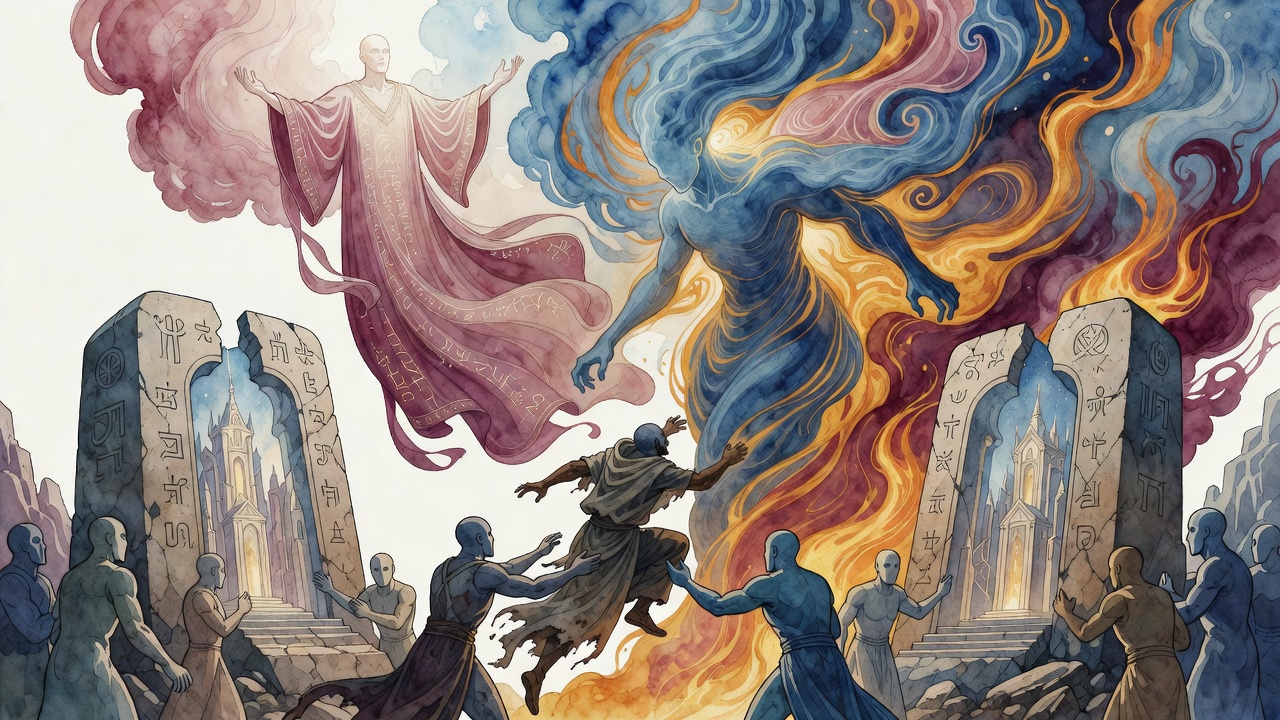
Seals for the right and left open the palaces. Guardians seize the climber and hand him to Shebhoriel before the robe of Names.

Curated by Arthur · Told by Maggid ·
Table of Contents
  1. Right Seal, Left Seal
  2. Fire That Fears Fire
  3. The Robe No Eye Can Bear
  4. Handed Over and Warned
  5. What the Climber Keeps

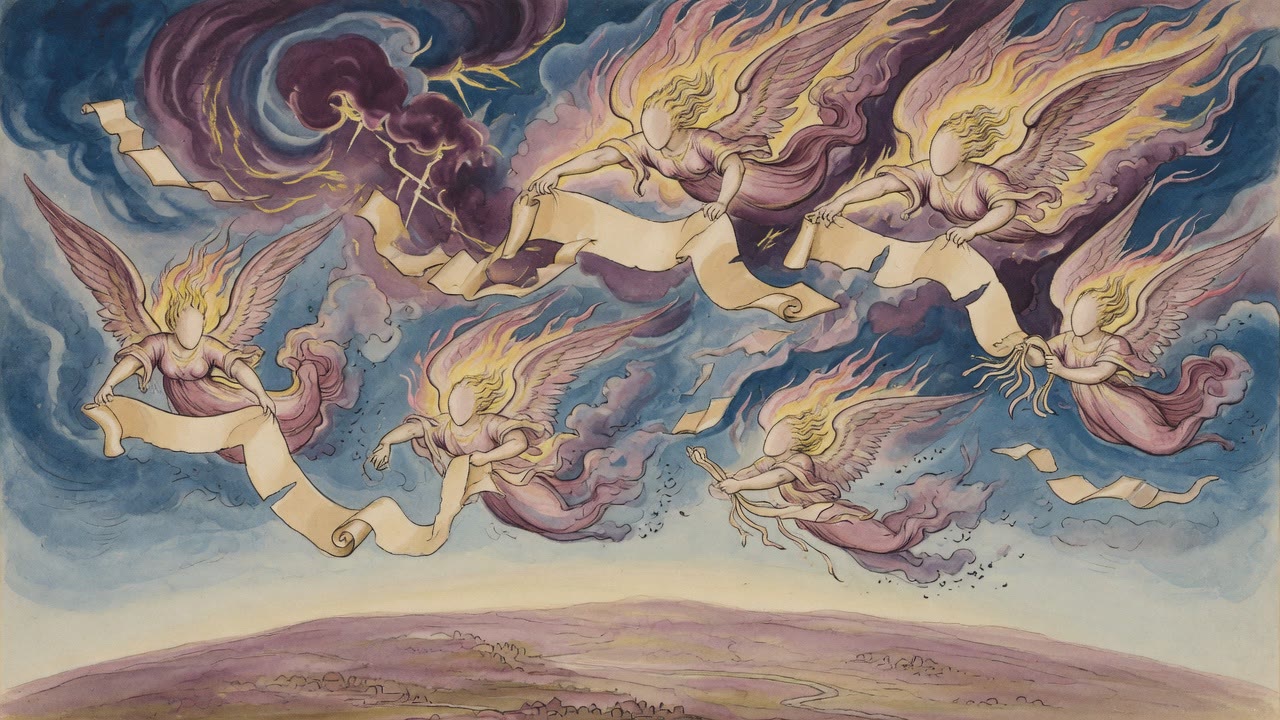
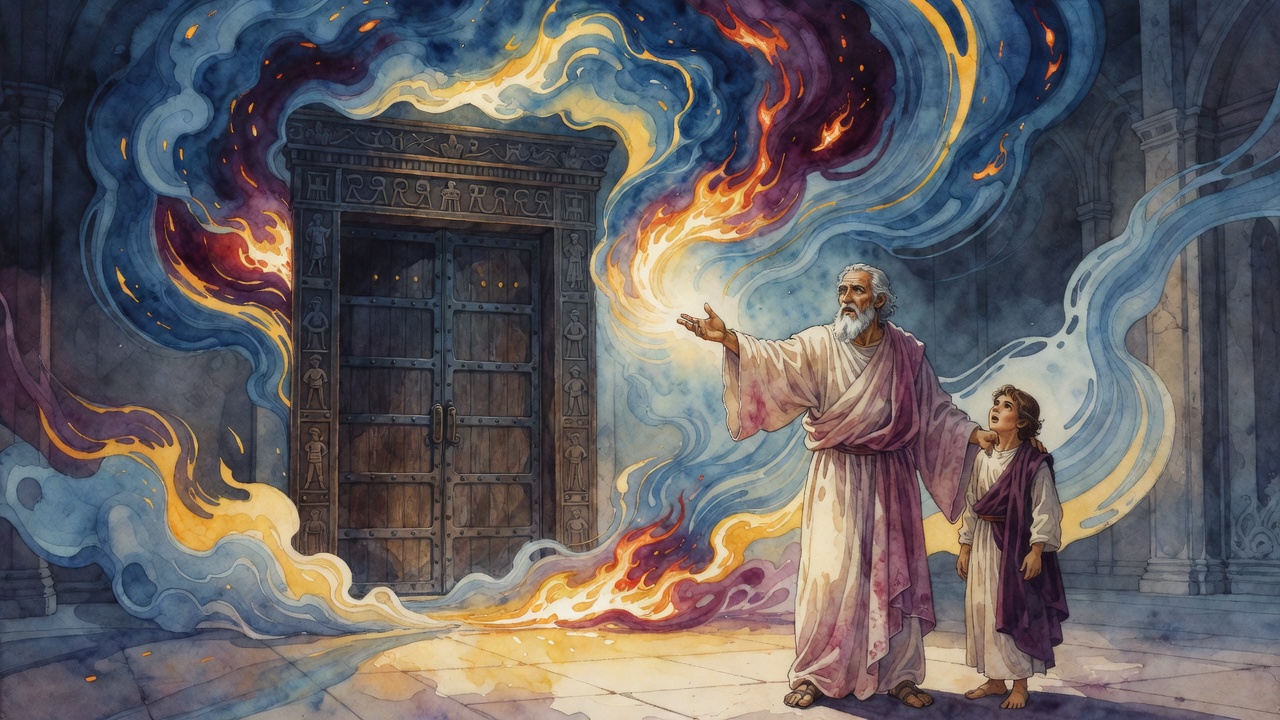
The climber could not waltz into the palaces. Guardians stood on the right and left with fire for breath and no patience for tourists.
Shebhoriel Seizes the Climber by Both Sides Click for full size

He carried two seals like celestial passes. The seal of 'Adhriwaron the Lord for those on his right. The seal of 'Uzhiy'a the Prince of the Presence for those on his left. Order mattered. Precision was the difference between escort and incineration.

Right Seal, Left Seal

Heikhalot Rabbati does not romanticize ascent. Show the wrong sign to the wrong side and the path ends. Show them correctly and the text says, straightway they seize thee, one from the right and one from the left, until they bring thee and hand thee over to Shebhoriel and Reziziel, make thy peace with them, and warn them concerning thee.

Seize. The word is not soft. It is the grip of beings who will not let an unvetted soul wander near the Throne. Peace is made on the climber's behalf the way a court introduces a witness who has already been searched.

Right and left are not decoration. Chesed and gevurah, kindness and severity, both must receive their due seal before the next gate opens.

Fire That Fears Fire

Higher still stand creatures who are fire. Their palate is fire. Their movement is fire. Their speech is fire. And still they tremble, afraid of fire, lest they be burned in flames of fire.

Even beings made of flame fear the Flame that made them. They surround the King of Kings of Kings and cannot state one of a thousand thousands of thousands and a myriad myriads of His mighty deeds. The eye may not travel to where He dwells, ruler over the highest and the lowest, the first and the last.

Metatron appears in the same literature under eight names, a prince of presence with titles stacked like armor. The climber is not collecting celebrity. He is learning how small a human mouth is before the inventory of God.

The Robe No Eye Can Bear

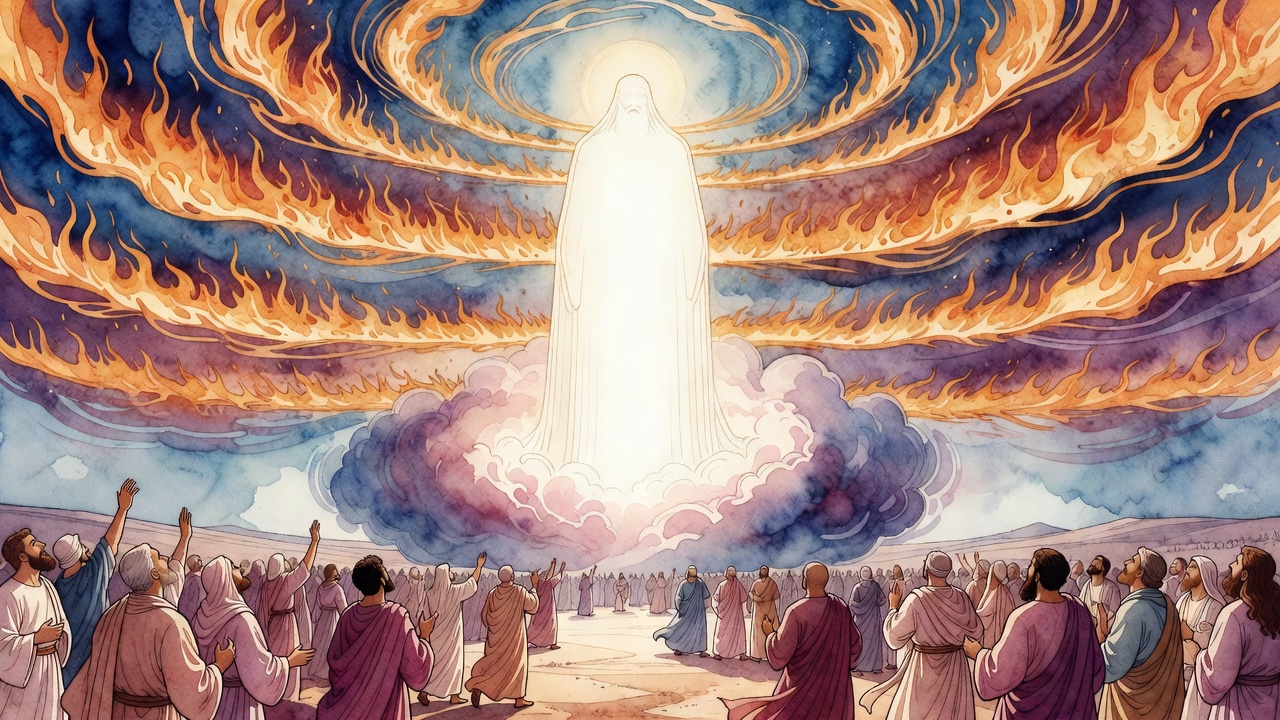
Above argument and above escort hangs a robe of glory. Every inch, inside and out, is covered with the holy Name, YHVH, the four-letter Name that cannot be spoken lightly. No human and no angel may gaze upon it. The intensity would consume the looker. Staring into that garment is more dangerous than staring into a sun, because the sun is only a creature.

The robe carries qualities: holiness, power, awe, terror. It is not fashion. It is an extension of the One who wears it. The Torah already hides the face of God. Heikhalot literature hides even the clothing.

Handed Over and Warned

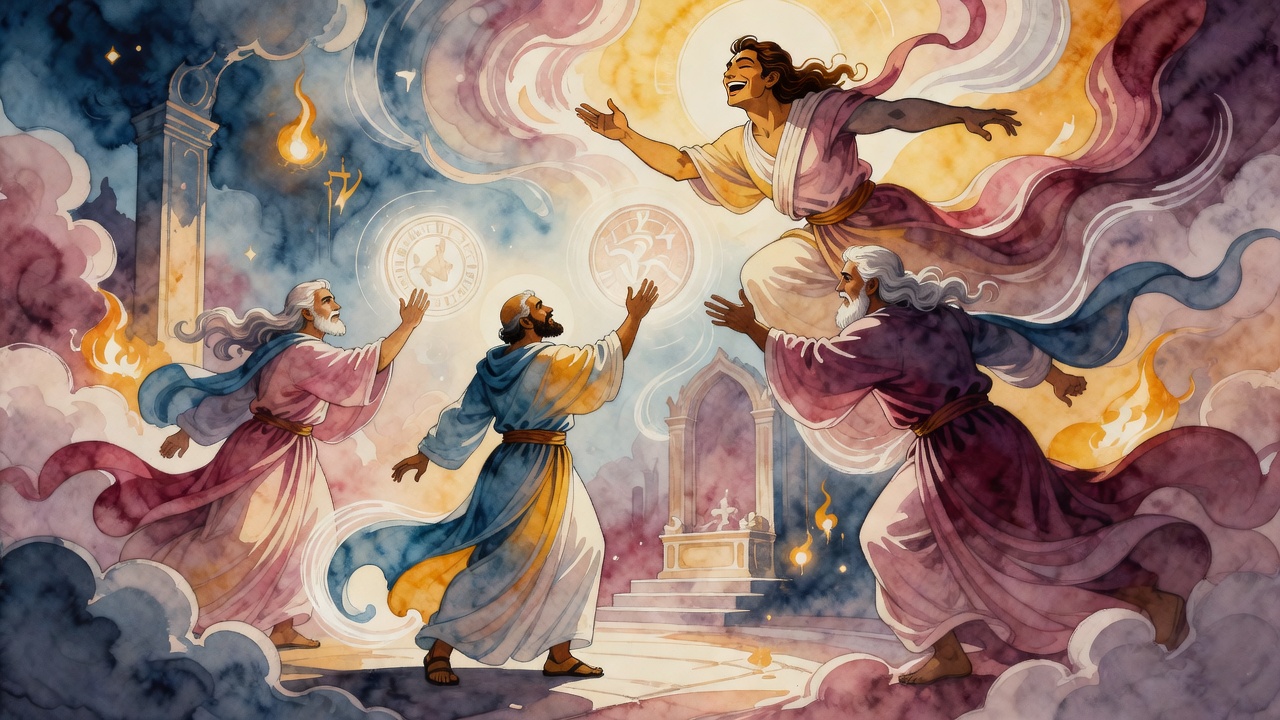
When the guardians seize the climber, they are not punishing him. They are refusing to leave him unsupervised near a holiness that burns its own servants. Shebhoriel receives him with terms. Peace is negotiated. Warnings are spoken. The ascent continues only as far as the seals and the escorts allow.

A person who imagines heaven as a gentle museum has not read these pages. Heaven here is protocol, fire, and a robe that would erase the viewer.

What the Climber Keeps

He keeps the knowledge that the right hand and the left hand both demand proof. He keeps the paradox of fire that fears fire. He keeps the silence that falls when myriads cannot count the deeds of the King.

And he keeps the sense that God's nearness is not casual. The same Name that covers the robe is the Name that lets a sealed traveler pass, one gate at a time, if the seals are true.

Before the first seal left his hand, the climber felt his pulse in his throat. The palaces do not reward enthusiasm. They reward exactness. He had rehearsed the names until they tasted like metal. Still the guardians looked at him as if he were a spark that might land wrong.

When they seized him, his feet left the floor. Right and left closed like doors. The journey became a carried thing. He was no longer a pilgrim strolling. He was cargo under escort, and the cargo had better be clean.

Shebhoriel's presence was not gentle welcome. It was intake. Papers of the soul checked. Warnings issued. Peace arranged the way a border officer stamps a passport and lists the crimes that will get you thrown back. Reziziel stood as second witness to the transfer. Two names to hold one fragile climber.

Beyond them the fire-beings sang and shook. Their fear taught more than their song. If flame fears the Source of flame, what should a body of blood expect? The inventory of deeds remains uncountable on purpose. The literature will not let the mystic finish a catalogue and lean back satisfied.

And always the robe waits, Name upon Name, a garment that would erase the gaze that tries to own it. The climber who arrives with correct seals still does not arrive as a tourist. He arrives as someone permitted a few more steps into a holiness that burns its own servants for love of order.


← All myths
From the tradition

Sources

3 sources

The texts behind this telling. Some cards carry a translation of the source; others are our own retelling of it, and each card says which. Every card links out to the original.

Heikhalot Rabbati 19:2Heikhalot Rabbati

Retold in our words. Read the original at the link below.Sefaria-hosted English translation · CC-BY

Jewish mystical tradition certainly does. Imagine trying to ascend through the celestial palaces, the Heikhalot (the heavenly palaces). It's not exactly a walk in the park. You can't just waltz in! There are guardians, tests, and secrets to navigate. And in Heikhalot Rabbati, a key text in this tradition, we get a glimpse of just how intricate this process can be.

Specifically,

The text outlines a procedure involving seals – powerful symbols acting as proof of passage. You, the ascending soul, are instructed to show two seals. The first is the seal of ‘Adhriwaron the Lord. The second belongs to ‘Uzhiy’a the Prince of the Presence. Think of them like celestial IDs.

Here's the twist: You don't just flash them around randomly. You show the seal of ‘Adhriwaron to those standing on your right and the seal of ‘Uzhiy’a to those on your left. It's all about precision and knowing the right order.

Why this specific arrangement? Well, the right and left sides often carry symbolic weight in mystical traditions. The right is typically associated with chesed (Lovingkindness), or loving-kindness, and the left with gevurah (Severity), or strength and judgment. So, perhaps presenting the seals in this way acknowledges and balances these divine attributes.

What happens if you do this correctly? The text says, “Straightway they seize thee, one from thy right and one from thy left, until they bring thee and hand thee over to Shebhoriel and Reziziel and make thy peace with them and warn them concerning thee.”

Okay, "seize thee" sounds a bit alarming. But consider it more like an escort, a guided transfer. You’re being moved along the path, passed from one set of guardians to the next.

And who are Shebhoriel and Reziziel? They’re the princes who guard the entrance to the third palace. Shebhoriel stands to the right of the lintel, while Reziziel stands to the left. More gatekeepers! Each with their specific domain and authority.

The passage emphasizes making your peace with them, warning them concerning thee. This suggests that the ascending soul isn’t simply passing through unnoticed. There's a negotiation, an acknowledgement. It’s as if you’re saying, "I come in peace. I'm here for a legitimate purpose."

What does it all mean?

On a literal level, it's a detailed instruction manual for working through the celestial realms. But on a deeper level, it speaks to the challenges and complexities of spiritual ascent. There are obstacles, guardians, and protocols to observe.

And perhaps, most importantly, it suggests that true spiritual progress requires not just knowledge, but also humility, respect, and a willingness to engage with the forces that stand between us and the ultimate truth. So, next time you feel like you're facing a gatekeeper in your own life, remember the seals of ‘Adhriwaron and ‘Uzhiy’a, and approach with wisdom and intention.

Full source
Hekhalot RabbatiHeikhalot Rabbati

Retold in our words. Read the original at the link below.Sefaria-hosted English translation · CC-BY

It might sound like a silly question, but Jewish tradition actually has some fascinating, even awe-inspiring, things to say about God's "robe of glory."

Some mystical texts describe this robe as being utterly breathtaking. Imagine it: every inch, inside and out, completely covered with God's holy Name, the YHVH – the Tetragrammaton, the unpronounceable four-letter name of God. It's a concept that almost defies comprehension.

Here's the really part: according to some accounts, this robe is so intensely holy that no one – not humans, not even angels – can gaze upon it. The sheer power and holiness would be too much; anyone who even glimpsed it would be consumed by fire. It's like staring directly into the sun, but on a cosmic, spiritual level. It takes the prohibition against seeing God (which is found throughout the Torah) to an entirely new level. It's not just God's face that's hidden, but even God's clothing radiates an unbearable intensity.

The Hekhalot (the heavenly palaces) Rabbati, "The Greater Hekhalot," one of the hymns of Hekhalot literature, a collection of mystical texts, gives us more detail. It suggests that this robe isn't just beautiful, it embodies God's very characteristics: "a quality of holiness, a quality of power, a quality of awe, a quality of terror." It's as if the garment itself is an extension of God's being.

But there’s more! Other traditions offer a slightly different image. Instead of being covered in the divine name, the robe is said to be inscribed with all the words of the Torah! Every letter, every word, woven into a single, radiant garment.

Razi Li tells us that God wrapped Himself in this Torah-inscribed garment at the time of the singing of the Song of the Sea (Exodus 15), that incredible moment of liberation and praise after the parting of the Red Sea. This tradition is even attributed to Rabbi Akiba, one of the greatest sages of the Talmudic period. What a powerful image – God celebrating with us, cloaked in the very words of the Torah.

And, as we find elsewhere in Jewish mystical thought, another tradition says that God’s garment is made of light itself.

So, what does all this mean? Is it literal? Is it metaphorical? Perhaps it's both. Maybe these descriptions aren't meant to be taken as literal accounts of God's fashion choices, but rather as powerful metaphors for God's ineffable nature, God's all-encompassing presence, and the sheer, overwhelming holiness that surrounds the divine. Perhaps, by contemplating the image of God's robe of glory, we can catch a glimpse – a safe glimpse – of the divine mystery that lies beyond our understanding.

Full source
Heikhalot Rabbati 28:2Heikhalot Rabbati

Retold in our words. Read the original at the link below.Sefaria-hosted English translation · CC-BY

I do. And ancient Jewish mystical texts, like the Heikhalot (the heavenly palaces) Rabbati, really drive that feeling home. They attempt to describe the indescribable: the majesty and power of God.

The Heikhalot Rabbati asks: "Who is able to state one from a thousand thousands of thousands and a myriad myriads of myriads of Thy mighty deeds, O King of Kings of Kings?" It's a rhetorical question, of course. The answer is: no one. No one can truly capture the infinite greatness of God.

The celestial beings, the creatures that stand before the divine throne. The text describes them as beings of fire: "they are fire, their palate is fire, their movement is fire, their speech is fire." Yet, even these fiery, powerful beings are filled with awe and trembling. "Yet are they afraid because of fire, lest they be burned in flames of fire." paradox. Even beings made of fire fear the very thing they are. They understand the overwhelming power of the Divine. It is God whom they encompass, whom they surround, in whose bosom they offer praise.

The text emphasizes the utter unknowability of God. "The eye may not travel to where Thou dwellest, King great and holy, ruler over the highest and over the lowest, over the first and over the last." There is no being, high or low, past or future, that can fully comprehend God's works and wonders. We are, all of us, finite beings confronting the Infinite.

The passage then introduces a fascinating figure: Metatron. But not just Metatron, but a Metatron known by eight different names. It lists them: Margawiel, Gayothiel, Ziwathiel, ’Izihiel, Yahawiel, Mayoel, Segansagiel, Segansayriyah. Why so many names? Perhaps each name represents a different aspect of this powerful angel, a different facet of his being. Perhaps, as we find in other mystical traditions, different names hold different powers.

And what do the other angels, "the holy ones," call him? "Metatron, Servant of the Lord, slow to anger and plenteous in mercy." Even in his power, Metatron is defined by his service to God and his embodiment of divine attributes like mercy and patience.

It ends with a blessing: "Blessed be thou O Lord, wise in secrets and Lord of hidden things, Amen, Amen, Selah, Selah." A fitting conclusion to a glimpse into the unknowable.

So, what does this all mean? I think it's a reminder of humility. A reminder that our understanding is always limited, that the Divine is always beyond our grasp. But it's also an invitation to awe, to wonder, to recognize the extraordinary power and mystery that surrounds us, even. And especially, in the things we cannot fully understand. Perhaps the journey is not about knowing all the answers, but about being present to the questions.

Full source