5 min read

Right Line and Left Line Fight for the Crown

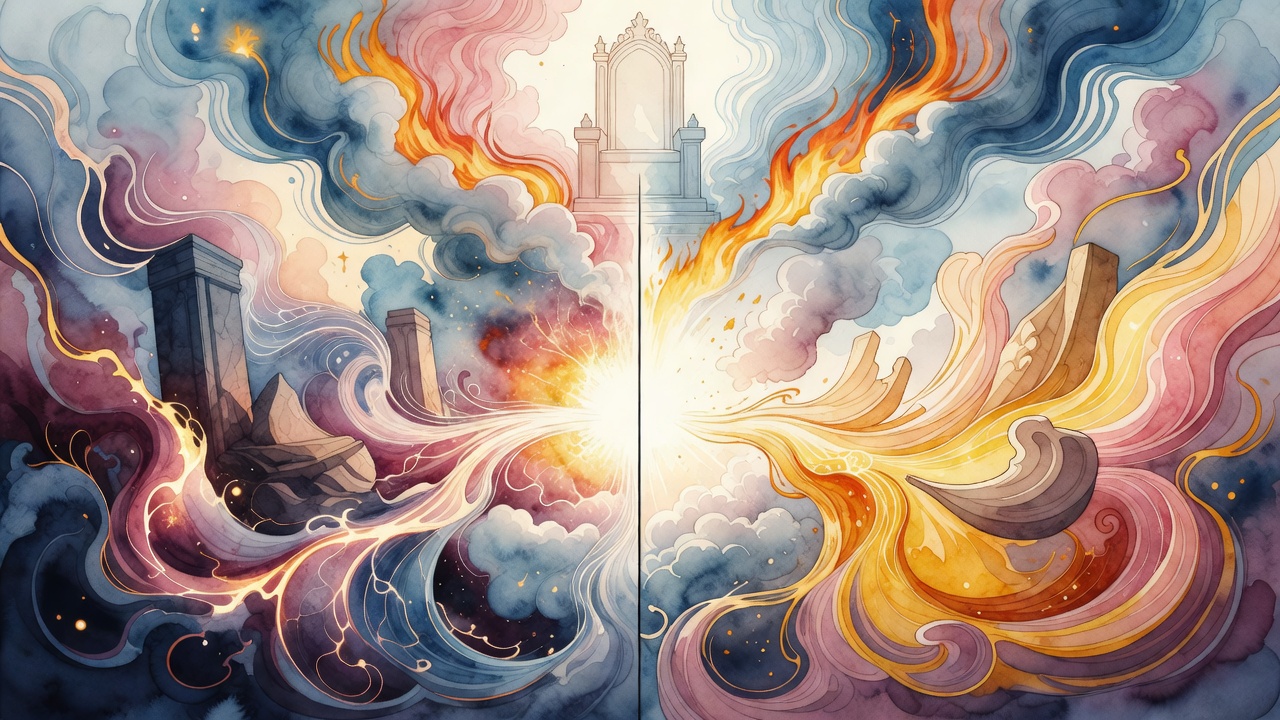
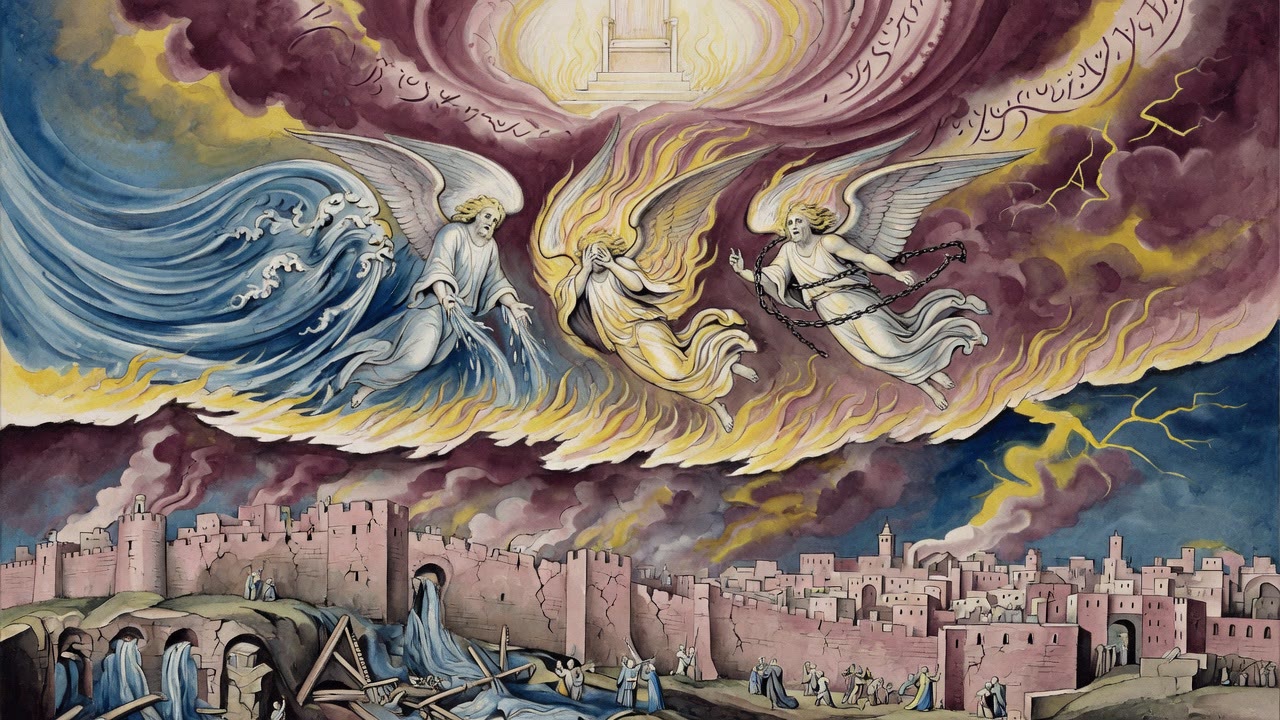
Right line pours giving. Left line answers with raw wisdom. A partition and middle force cut both lights to a height a world can bear.

Curated by Arthur · Told by Maggid ·
Table of Contents
  1. Two Rivers Leave the Same Source
  2. The Push That Would Cancel the Other
  3. Partition and the Dimmed Flash
  4. Harmony That Still Remembers the War
Right Line and Left Line Fight for the Crown Click for full size

Two Rivers Leave the Same Source

One flow leaves the Creator and splits. The right line runs thick with the light of giving, Ḥassadim that want to pour without pause. The left line runs bright with Ḥokhma, wisdom so sharp it can cut a path through chaos and also cut the hand that tries to hold it without care or measure. Both rivers claim the same mouth of the sea.

The right wants the crown of control for pure bestowal. Give, give, give, until nothing stands opposed to generosity. The left wants the crown for pure wisdom. Know, measure, refuse the soft flood that would wash every boundary away and call the drowning mercy. Neither line is evil. Both are hungry for sole rule, and hunger makes them loud.

The dispute is older than any human quarrel about mercy and law. It is the template those quarrels will later inherit without knowing they are quoting a war of lights that began before dust had a name. The rivers do not apologize for their volume. They only refuse to share the crown.

The Push That Would Cancel the Other

Right presses left. Left presses right. The light of giving tries to overshadow Ḥokhma so that only outflow remains. The light of wisdom tries to diminish giving so that only the flash of insight remains. A world built on either victory alone would fail before its first night. Pure giving without discernment becomes chaos. Pure wisdom without bestowal becomes a cold lamp no one can live under.

Ḥokhma is life-force, the Creator's breath in the form of knowing. Ḥassadim is creation's answer, the will to give back and to share. They need each other the way breath needs a body. Still they fight, because each, in its first strength, cannot imagine sharing the throne with a rival that feels like a threat to its whole nature.

Somewhere between them a space must open that neither owns, or the cosmos stays a stalemate of beautiful forces that refuse to host life. The push continues until a third presence has room to stand, and standing is the first act of peace that is not surrender.

Partition and the Dimmed Flash

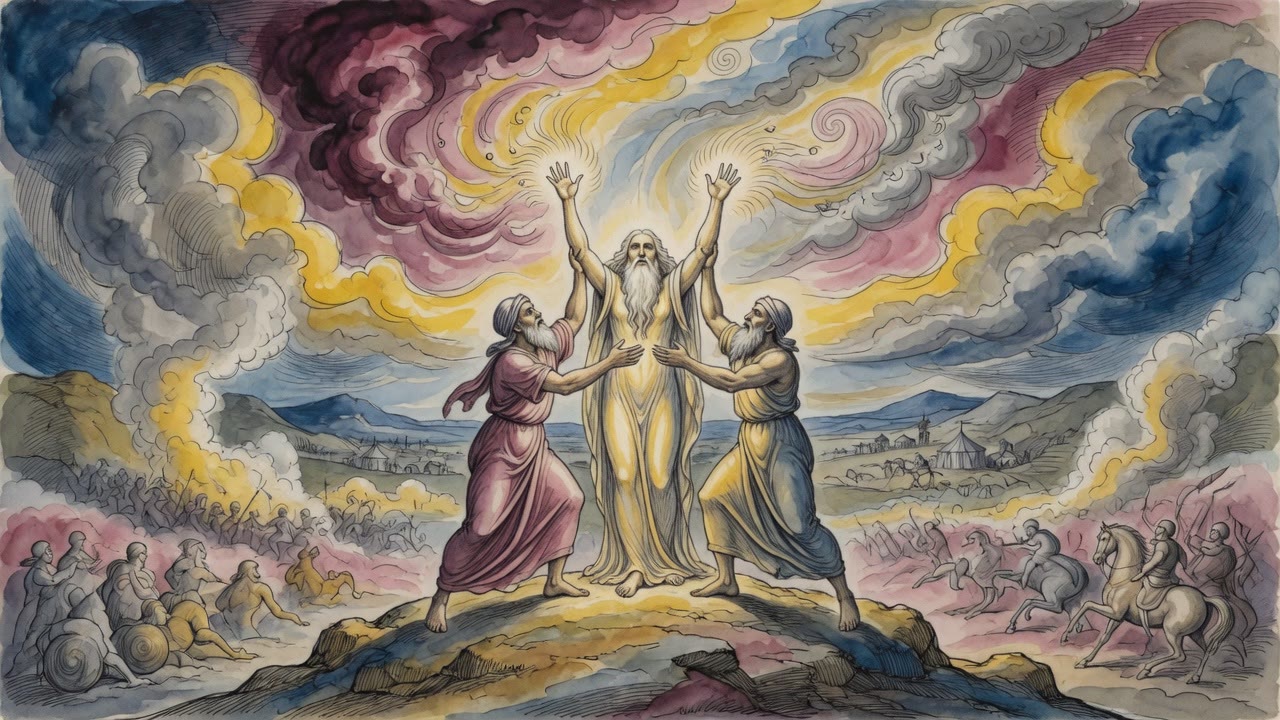
A partition rises in the middle line, a masach that is not a wall of hate but a screen of measure. On the left, Ḥokhma is reduced from the intensity of the first three to the six extremities, light cut down until a vessel can stand near it without dying of pure insight. At the same time the light of giving grows, fed from the right and from the fusion of supernal light on the middle partition.

Two forces inside the middle work on the raw burst of wisdom. They temper the first three of Ḥokhma on the left until insight becomes usable, sharp enough to cut falsehood and soft enough not to cut the hand that holds the knife. The left still judges. The right still gives. Neither cancels the other. Both are forced into a height a living structure can bear.

The crown neither line wanted to share becomes a shared weight held by a third presence that rose between them and refused to leave. The flash dims. The giving thickens. For the first time, both lights can occupy the same hour without trying to erase the hour's other half.

Harmony That Still Remembers the War

Harmony here is not a soft ending. The lines still pull. The middle holds. Light of giving and light of wisdom finally illuminate each other instead of trying to erase each other from the map. In the seven lower sefirot (divine emanations), Ḥokhma cannot shine without Ḥassadim present. Giving without wisdom becomes aimless water. Wisdom without giving becomes a sealed fire that warms no one.

Every later human fight between open hand and strict measure is a small echo of this first standoff. The cosmic answer is not the death of one line. It is the screen, the middle, and the long work of making both lights fit the same house without burning the roof off or flooding the floor until no one can stand.

The rivers still run. The crown sits where neither alone can reach it, and the world below finally has weather it can plant in. The war is not forgotten. It is held, and holding is the only peace that lasts past the first calm morning.

The pressure does not ease because someone named it. It eases when a body moves, a light yields, a vessel holds, or a face climbs one more rung and feels the rung hold back.

Nothing in this hour is decoration. Every crack, climb, screen, and seal is a decision with weight, and the worlds that will later stand on these decisions are already implied in the strain.


← All myths
From the tradition

Sources

4 sources

The texts behind this telling. Some cards carry a translation of the source; others are our own retelling of it, and each card says which. Every card links out to the original.

Introduction to Sulam Commentary 31:1Introduction to Sulam Commentary

Retold in our words. Read the original at the link below.The Sefaria Sulam, 2023 · CC-BY

That tension, that struggle for dominance – it's not just a human experience. According to Kabbalistic teachings, it's happening on a cosmic scale, too.

What are these lines, and why are they seemingly at odds?

A divine flow emanating from the Creator. This flow splits into two distinct channels: the right line, associated with the light of giving (Ḥassadim), and the left line, associated with the light of wisdom (Ḥokhma). Now,

The right line, overflowing with the desire to bestow goodness, wants to overshadow the light of Ḥokhma. It seeks to give freely, without limit. As explained in Bereshit I, page 57, s.v. “vezeh” and Idra Rabba 214, it desires control solely for the light of giving. But why? Because it embodies the very essence of the Creator's boundless generosity.

Conversely, the left line, radiant with the light of Ḥokhma, the very essence of the Creator, desires to diminish the light of giving. It wants to bring the control solely to the light of Ḥokhma. The light of Ḥokhma is the animating lifeforce of all creation; it could be considered superior.

This conflict, this "dispute," isn't some petty squabble. It's a fundamental tension between two aspects of the divine. The light of Ḥokhma is the life force, the very essence of the Creator breathed into existence. The light of giving, or Ḥassadim, is the desire of creation to reciprocate, to "give back" to the Source, reflecting the Creator's own capacity for boundless generosity. The light of Ḥokhma represents receiving life force; the light of giving represents the desire to emulate the Creator.

So, what happens when these two forces are locked in opposition? According to the Sulam commentary, neither can truly illuminate. The light of giving, untempered by the light of Ḥokhma, becomes like "a body without a head." As it lacks the animating life force, it cannot give. And conversely, the light of Ḥokhma cannot illuminate without the light of giving (as explained in Bereshit I, page 47, s.v. “nafak”), because of the first constriction, leaving the vessel dark.: pure giving without wisdom can be aimless, even destructive. And pure wisdom without compassion can be cold and sterile.

This is where the concept of the middle line comes in. It's the crucial mediator, the harmonizing force that unites these opposing energies into a synergistic whole. Without it, we're left with imbalance, with potential unrealized.

Perhaps that’s where true illumination lies.

Full source
Introduction to Sulam Commentary 37:1Introduction to Sulam Commentary

Retold in our words. Read the original at the link below.The Sefaria Sulam, 2023 · CC-BY

How Two Opposing Forces Reach Harmony is the question behind this passage from Introduction to Sulam Commentary.

The passage speaks of a "left line" and a "right line." Think of these as opposing forces. The "right line" embodies the light of giving, of expansive love and generosity. It’s a force that wants to flow outward, to share and to connect. Sounds pretty good. But what about the "left line?" This line represents the light of Ḥokhma, of wisdom. Now, Ḥokhma is profound, but it's also discerning. It holds back, analyzes, and judges. The left line, because it holds such important wisdom, refuses to simply submit to the giving nature of the right. It battles the right line, even wanting to negate it! A constant push and pull.

Why this resistance? Why can’t these forces just get along? Because, uncontrolled giving without discernment can lead to chaos. Unchecked mercy can be just as damaging as unchecked judgment. The Kabbalists understood this inherent tension and sought to understand how to resolve it.

So, how do we achieve balance? How does the left line, representing judgment and wisdom, finally submit to the right line, representing mercy and giving? It's not a simple surrender. It requires something else, something that arises from the middle.

Only through "two forces that arise from the middle line" can the left be subjugated. This "middle line" is crucial. It's the harmonizing force, the mediator between these two extremes. This concept echoes throughout Kabbalistic thought. The middle path is essential.

These two forces from the middle line act upon the left, softening its resistance. They don't negate the power of Ḥokhma, but rather guide it, temper it, and direct it toward a constructive purpose. They allow wisdom to inform giving, and giving to be guided by wisdom.

The Sulam Commentary offers us a glimpse into the intricate dance of opposing forces. And that's a lesson that resonates far beyond the realm of Kabbalah. It speaks to the very heart of how we work through the complexities of our own lives, and the world around us.

Full source
Introduction to Sulam Commentary 37:4Introduction to Sulam Commentary

Retold in our words. Read the original at the link below.The Sefaria Sulam, 2023 · CC-BY

Specifically, Think of them as channels through which Ohr, divine light, descends into our world.

In Introduction to the Sulam Commentary, something interesting happens. the Ḥokhma – that’s wisdom, one of the Sefirot (the divine emanations), or divine attributes – on the left line experiences a reduction in its intensity. Why? Because of this "partition," or Masach in Hebrew, which acts as a filter or screen. This partition is crucial because it allows us to receive the light without being overwhelmed by its intensity. It’s like dimming the lights so you can actually see. In this case, the height of Ḥokhma in the left line is reduced to six extremities because of this partition.

At the same time that this reduction is happening, the "light of giving" increases. This light of giving, or bestowal, comes from two directions. Firstly, from the right line, which is naturally associated with giving and kindness. And secondly, from the "fusion of the supernal light" – that is, the light from above – on the partition of the middle line.

So, what's the result of all this? The left line, facing both a reduction in its own light and an increase in the light of giving, submits. It unites with the light of giving present in both the right line and the middle line! It's a beautiful image of integration, of seemingly opposing forces finding harmony. The Zohar, in Emor 197 (as explained in the Sulam commentary), touches on this very idea.

But there’s a crucial condition. This union can only occur if the partition in the middle line doesn't reduce the level of the first three aspects of Ḥokhma. These first three – often referred to as the intellectual Sefirot – are the foundation. As we find in Bereshit 1:60 (s.v. “maḥloket”), if this foundational level is compromised, there’s no power in the world that can unite the left line with the right line. Think of it like a building: if the foundation crumbles, the structure collapses.

So, what does this all mean for us? It suggests that true unity isn't about suppressing one side in favor of another. It's about finding the balance, ensuring the foundations are solid, and allowing the natural flow of giving and receiving to occur. Only then can seemingly opposing forces come together to create something truly harmonious.

Where in your own life might you be experiencing this interplay of forces? And what "partition" might be at play, either helping or hindering the path to unity?

Full source
Introduction to Sulam Commentary 38:1Introduction to Sulam Commentary

Retold in our words. Read the original at the link below.The Sefaria Sulam, 2023 · CC-BY

We’ve been exploring the Sulam Commentary, a key to unlocking the wisdom of the Zohar, that foundational text of Kabbalah. And right now,

Think of it like this: Ḥokhma, often translated as wisdom, is a powerful, almost overwhelming, burst of initial insight. It’s raw potential, pure creative energy. But raw energy, untamed, isn't always useful. It can be chaotic, even destructive. So, how does this raw potential become something we can actually understand and use?

That's where these two forces come in. They operate within what's called the "middle line" – a central channel that balances the energies of the "left line" (associated with judgment and severity) and the "right line" (associated with mercy and expansion). What they're doing, essentially, is stepping in to reduce the intensity of the first three aspects of Ḥokhma within that left line.

Why the left line specifically? Well, remember that judgment aspect? The left line is where we encounter limitations, restrictions, the "no's" that define the boundaries of creation. And Ḥokhma, in its purest form, can be so expansive that it overwhelms these limitations.

So, these two forces are like cosmic regulators, carefully channeling and modulating the flow of Ḥokhma. They're working to ensure that this powerful wisdom can be integrated, understood, and ultimately, used to bring about balance and harmony.

It’s a complex idea, absolutely. But at its heart is a beautiful truth: even the most potent and transformative forces need to be tempered and refined to be truly beneficial. It's a reminder that growth, wisdom, and understanding often come through a process of careful calibration, a dance between opposing forces. And that, perhaps, is something we can all relate to.

Full source