6 min read

Ruth Walked Through the Gate Closed to Moab

Two widows walked the road out of Moab. One kissed her mother-in-law goodbye. The other kept going toward a town that had no reason to feed her.

Curated by Arthur · Told by Maggid ·
Table of Contents
  1. The Road Where Orpah Turned Back
  2. Barley at the Edge of a Rich Man's Field
  3. Night on the Threshing Floor
  4. The Sandal at the Gate
  5. The Child Laid in Naomi's Lap
Ruth Walked Through the Gate Closed to Moab Click for full size

The Road Where Orpah Turned Back

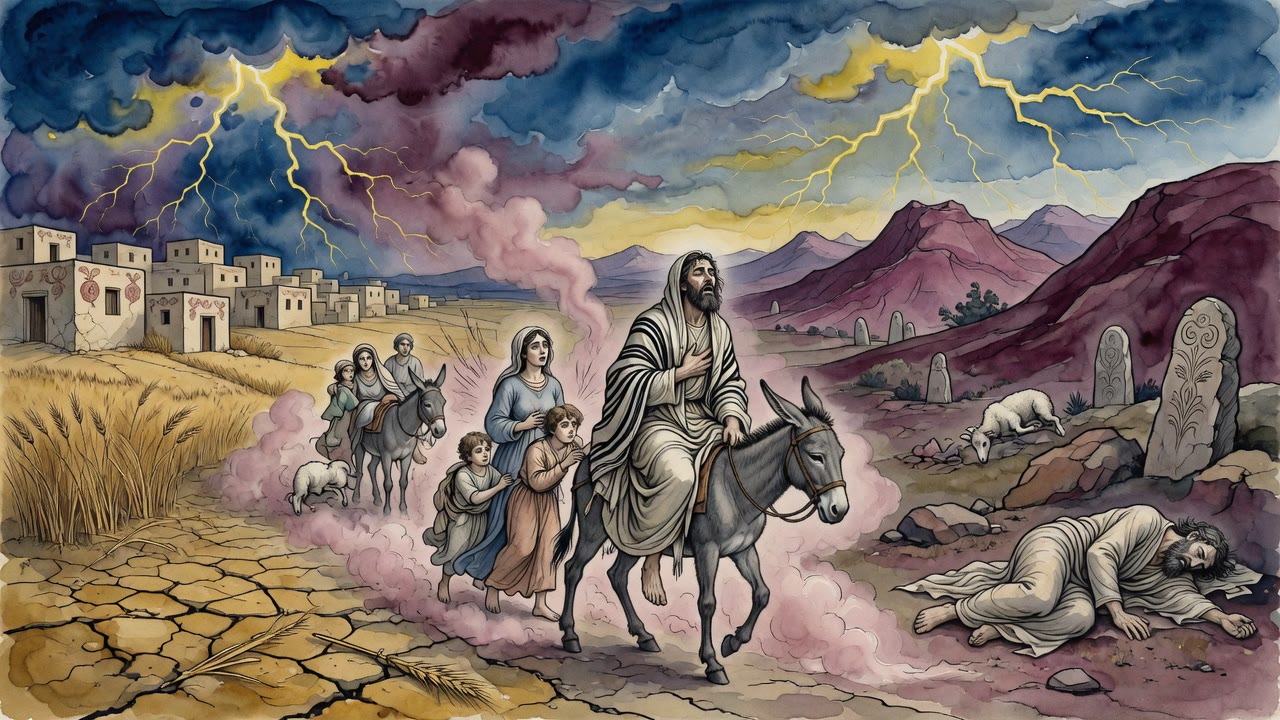
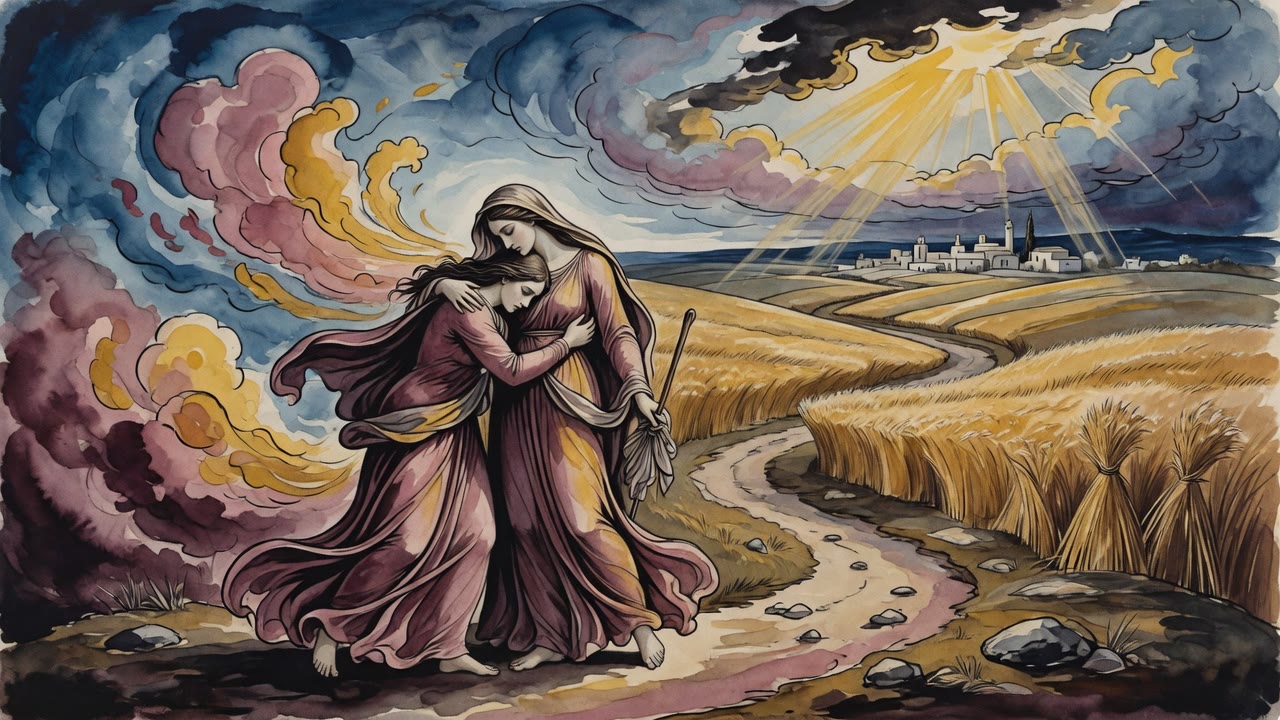
Three widows stood in the wind on the road out of Moab. Naomi had buried a husband and two sons in ten years of foreign soil, and now she turned on her daughters-in-law like a woman shaking off a debt. "Go back," she said. "Each of you to your mother's house. May the Lord deal kindly with you."

They wept. Orpah kissed her and went.

Ruth would not let go of her.

"Where you go I will go," Ruth said. "Your people will be my people, and your God my God. Where you die, I will die, and there I will be buried."

Naomi stopped arguing. They walked the rest of it in silence, down out of the Moabite highlands, over the Jordan, up into barley country. When they came into Bethlehem the whole town stirred. Women crowded to the street and said, "Is this Naomi?"

"Do not call me Naomi," she told them. "Call me Mara. I went out full and the Lord has brought me back empty." She had not said one word about the young Moabite standing behind her with the bundles.

Barley at the Edge of a Rich Man's Field

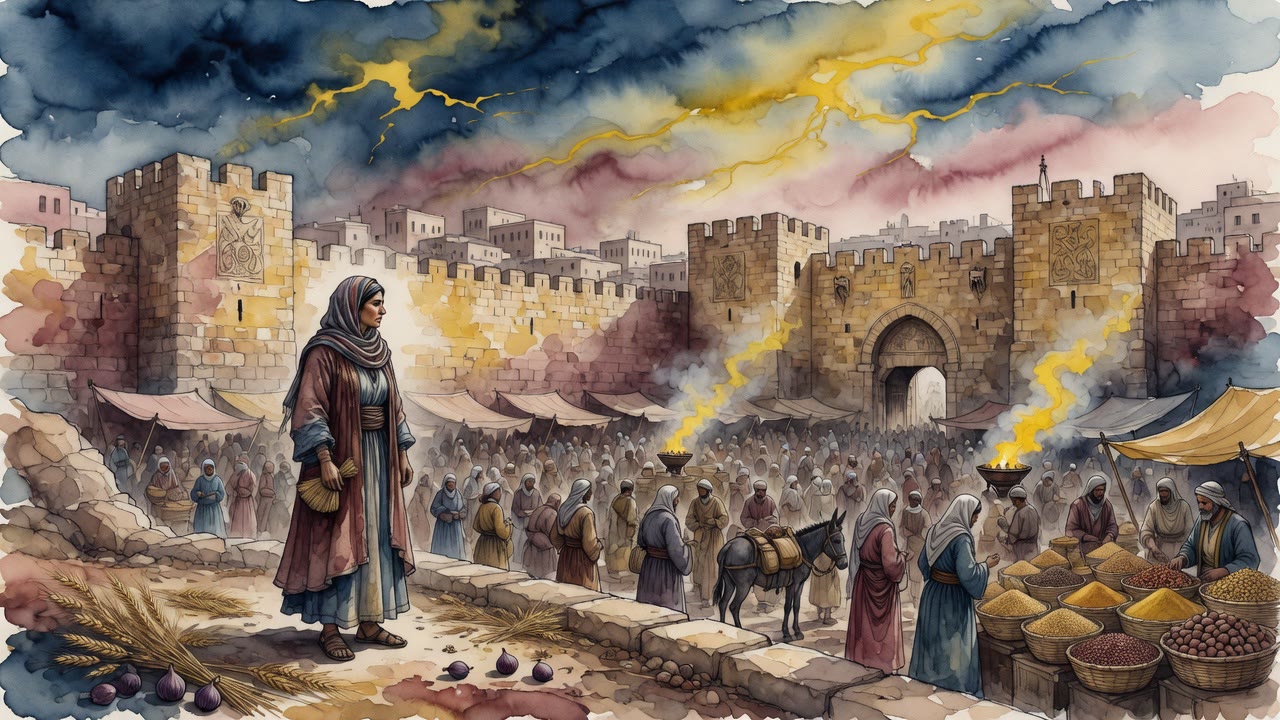
The harvest had just started. Ruth asked to go out and glean behind whoever would let her, and Naomi let her go, because there was nothing in the house.

She landed on a field belonging to Boaz, a wealthy man of Elimelech's clan. He came out from Bethlehem in the middle of the morning, greeted his reapers, and stopped. "Whose girl is that?"

"The Moabite girl who came back with Naomi," the overseer said. "She asked to glean among the sheaves. She has been on her feet since morning and has hardly sat down."

Boaz walked over to her. "Do not go glean in another field. Stay here with my young women. Keep your eyes on the plot they are cutting and follow behind them. I have told the young men not to touch you. When you are thirsty, go drink from the jars the young men have filled."

Ruth put her face to the ground. "Why have I found favor in your eyes, that you should notice me, when I am a foreigner?"

He had heard what she did for her mother-in-law. He said so, and at mealtime he handed her roasted grain until she ate her fill and had some left to carry home. When she got up, he told the young men quietly to pull stalks out of the bundles and drop them for her, and not to shame her.

She beat out what she had gathered. It came to most of a sack of barley. Naomi looked at it and asked where she had worked.

Night on the Threshing Floor

At the end of the harvest Naomi gave her instructions like a woman laying out a bet. "Wash. Put on oil. Put on your cloak and go down to the threshing floor. Do not let him know you are there until he has finished eating and drinking. Watch where he lies down. Then go and uncover his feet and lie down."

Boaz ate, drank, and lay down at the end of the grain pile in good spirits. Ruth came softly, lifted the cloak off his feet, and lay there in the dark.

At midnight the man jerked awake and twisted around. A woman was lying at his feet.

"Who are you?"

"I am Ruth your servant. Spread your cloak over your servant, for you are a redeemer."

He blessed her for coming to an older man instead of chasing the young ones. Then he told her the hard part. There was a kinsman closer than he was, and the closer man had the first claim. "Stay tonight. In the morning, if he will redeem you, good. If he will not, I will."

She lay there until it was almost light. He poured six measures of barley into her cloak before anyone could recognize a face on the threshing floor, and sent her back up to town.

The Sandal at the Gate

Boaz went up to the gate and sat down where the elders sat. The nearer kinsman came by and Boaz called him over. Ten elders of the town took their places.

"Naomi is selling the piece of land that belonged to our brother Elimelech," Boaz said. "If you will redeem it, redeem it. If not, tell me, because I come after you."

"I will redeem it," the man said.

"On the day you buy the field from Naomi," Boaz said, "you also acquire Ruth the Moabitess, the widow of the dead man, to raise up the name of the dead on his inheritance."

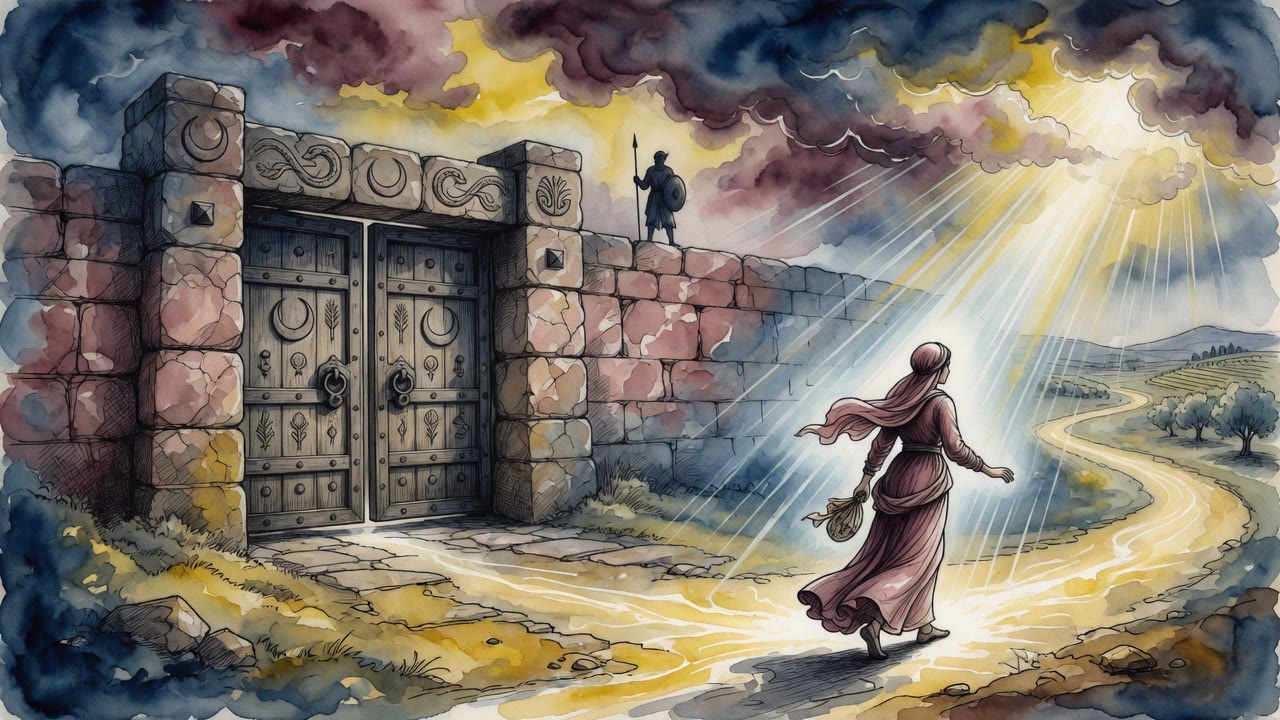
The man pulled back from it. "Then I cannot redeem it. I would ruin my own inheritance. Take my right of redemption yourself." He did not say the word Moab out loud. He did not have to. He drew off his sandal and handed it over, which was how a bargain was closed in Israel in those days, and the elders watched a whole line change hands over a strap of leather.

"You are witnesses," Boaz said.

"We are witnesses," the elders answered. "May the Lord make the woman coming into your house like Rachel and Leah, who between them built the house of Israel."

The Child Laid in Naomi's Lap

Boaz took Ruth, and she bore a son.

The women who had stood in the street asking whether that grey woman could really be Naomi came crowding back in. "Blessed be the Lord, who has not left you without a redeemer. Your daughter-in-law who loves you, who is worth more to you than seven sons, has borne him."

Naomi took the baby, laid him against her chest, and became his nurse. The neighbor women named him Obed. He fathered Jesse, and Jesse fathered David.

Nobody at that naming said the word Moab either.


← All myths
From the tradition

Sources

3 sources

The texts behind this telling. Some cards carry a translation of the source; others are our own retelling of it, and each card says which. Every card links out to the original.

Sifrei Devarim 249:1Sifrei Devarim

Retold in our words. Read the original at the link below.Sifrei by Rabbi Shraga Silverstein · CC-BY

Take this little snippet from Sifrei Devarim (Deuteronomy) – it’s a perfect example.

(Deuteronomy 23:4) states, "An Amoni and a Moavi shall not come into the congregation of the L-rd." Sounds

The text specifies "Amoni" and "Moavi" – masculine forms. The question is, does this exclusion apply to women from Ammon and Moab as well? The Rabbis in Sifrei Devarim are unequivocal: Scripture speaks of males, not females. It says "Amoni," not "Amonith" (the feminine form); "Moavi," not "Moavith."

Why does this matter? Well, think about the implications. This seemingly minor grammatical point opens the door for women from these nations to potentially integrate into Israelite society, a door that would be firmly shut if the prohibition was understood as applying to both genders.

And this isn't just academic nitpicking. Consider the story of Ruth. Ruth, the Moabitess, is one of the most beloved figures in the entire Hebrew Bible. She's the great-grandmother of King David!

The book of Ruth never actually states that the prohibition of a "Moabi" entering the congregation of the L-rd doesn't apply to her. It's just that she is lauded for her devotion to Naomi, and to the Jewish people, and ultimately becomes part of the lineage of the Messiah.

Without this interpretation in Sifrei Devarim, the entire lineage of King David, and ultimately the future messianic line, could be called into question!

This passage from Sifrei Devarim highlights the power of interpretation, the importance of nuance, and the enduring relevance of these ancient texts. It's evidence of the careful, thoughtful way our tradition approaches the complexities of life, law, and belonging.

Full source
Sifrei Devarim 252:1Sifrei Devarim

Retold in our words. Read the original at the link below.Sifrei by Rabbi Shraga Silverstein · CC-BY

Sifrei Devarim turns to Esau Remembered.

The passage begins by referencing (Deuteronomy 23:17), which says, "..where it is good for him (an escaped servant); you shall not oppress him.” The verse is about a servant who has escaped to the land of Israel. The law says to treat him well, to make sure he’s safe and not oppressed. Seems straightforward. But The text immediately raises a question: Should this same principle of kindness and non-oppression apply to everyone, including the people of Edom? After all, shouldn't we always strive to do good?

That’s where the next part of the verse comes in: "…and (do not seek) their good." Wait, what? How can we reconcile this with the previous instruction to be kind to the escaped servant? It sounds like a direct contradiction! Why wouldn't we seek the good of others?

This is the brilliance of how these texts often work. They present a tension, a paradox, forcing us to think deeply about the complexities of ethical decision-making. It's not about simple black and white answers, but about understanding the shades of gray.

The commentary then shifts to (Deuteronomy 23:8): "You shall not despise an Edomi." Now, why not? The answer is simple, yet profound: "because he is your brother."

“Great is brotherhood.” That’s the closing statement. So, on the one hand, we are told not to actively seek the good of Edom. On the other hand, we are commanded not to despise them because they are our brothers.

So what’s going on here? Is it a contradiction? Maybe not. Perhaps the emphasis isn't on active benevolence toward Edom but on avoiding hatred and remembering the familial connection despite past conflicts. The Edomites were descendants of Esau, Jacob's brother. The relationship between Jacob and Esau was…complicated, to say the least. There was rivalry, deception, and ultimately, a strained peace. This history likely informed the complex relationship between the Israelites and the Edomites.

The message could be this: Even with a difficult history, even with potential disagreements, the bond of brotherhood should prevent outright hatred and contempt. It's a call to remember shared ancestry and to treat others with a basic level of respect, even if we don’t actively seek to benefit them.

There are layers of history, emotion, and obligation. And sometimes, the most ethical path isn't about grand gestures, but about basic decency and remembering our shared humanity. What does that look like in your life today?

Full source
Sifrei Devarim 110:1Sifrei Devarim

Retold in our words. Read the original at the link below.Sifrei by Rabbi Shraga Silverstein · CC-BY

It concerns the ma'aser ani, the poor-tithe. (Deuteronomy 14:29) instructs us to provide for "the stranger, the orphan, and the widow that are in your gates." Seems straightforward. But here’s the question: does every stranger, orphan, and widow automatically qualify for this assistance? Do we just assume that because they fall into one of these categories, they're automatically entitled to the poor-tithe?

The text in Sifrei Devarim, a collection of early rabbinic legal interpretations on the book of Deuteronomy, dives right into this. It raises a critical point: maybe we should give the poor-tithe to anyone who is a stranger, an orphan or a widow, regardless of their actual financial situation. After all, (Deuteronomy 24:17) says, "You shall not take as a pledge the garment of a widow". And that applies whether she's rich or poor! So, shouldn't the same logic apply here?

The rabbis weren’t so easily convinced. They looked elsewhere in the Torah for clues.

They turned to (Leviticus 23:22), which states: "To the poor man and to the stranger shall you leave them." Notice the connection made here? The text specifically mentions “the poor man.” The Sifrei Devarim asks: just as the poor man is, by definition, needy, shouldn't everyone receiving the poor-tithe also be needy? In other words, the defining characteristic isn't simply being a "stranger," "orphan," or "widow," but being in a state of need.

It’s a beautiful example of how the rabbis used the Torah itself to interpret the Torah. They didn't take verses in isolation but looked for connections, parallels, and overarching principles. This method is called peshat, seeking the plain or contextual meaning of the text.

What does this teach us? Perhaps it's not enough to simply identify categories of people who might need help. True compassion requires us to look deeper, to understand the actual circumstances of individuals, and to respond with genuine empathy to their specific needs. It’s a reminder that charity isn't just about fulfilling a commandment; it's about seeing the humanity in each person and responding to their unique situation.

Full source