6 min read

Ruth Clung to Naomi and Changed Jewish History

Ruth chose Naomi over Moab, accepted her people and God, and carried a broken family toward Boaz, Bethlehem, and King David.

Curated by Arthur · Told by Maggid ·
Table of Contents
  1. Naomi Walked Back Empty
  2. Orpah Kissed and Ruth Clung
  3. The Road Became a Gate
  4. Boaz Guarded the Barley
  5. The Redeemer Rose at Midnight
  6. Bethlehem Received a Future King

Ruth could have gone home with clean hands.

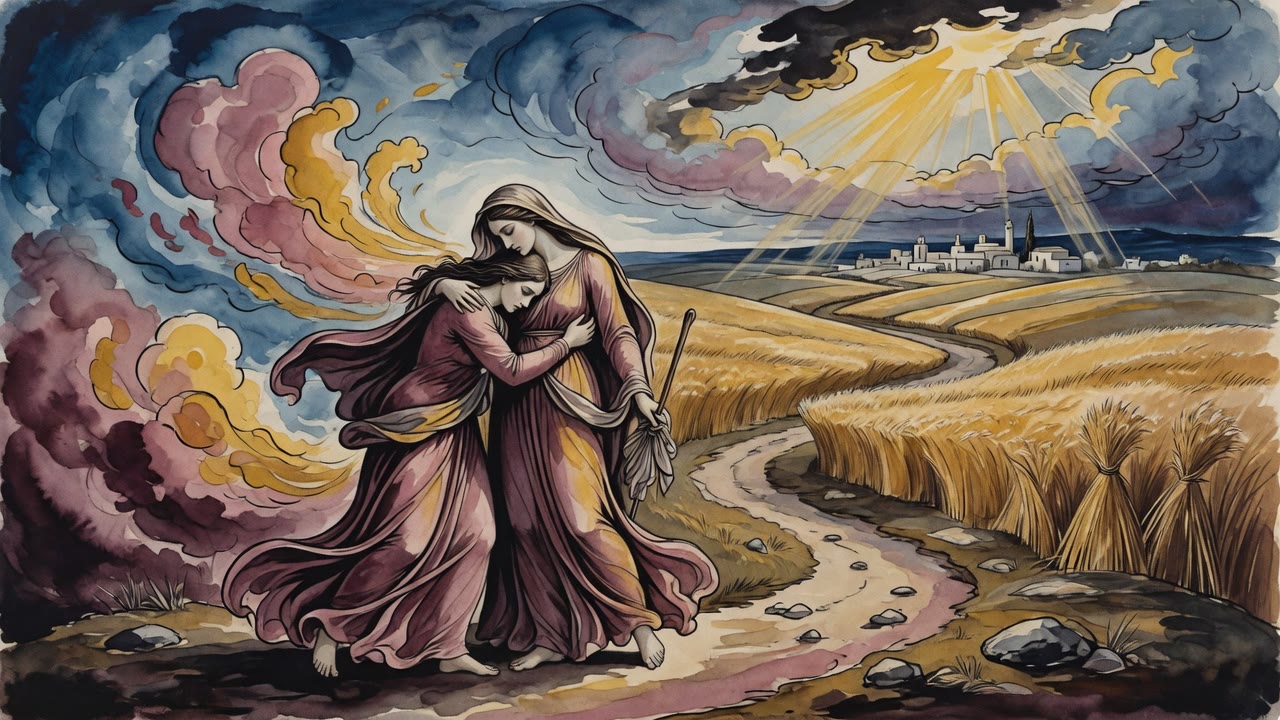
Moab was behind her. It held the graves of her husband and the language of her childhood, the mothers' houses where widows could be gathered back into safety, the familiar road that did not ask her to become someone else. In front of her walked Naomi, emptied by famine and death, moving toward Bethlehem with no husband, no sons, and no promise that the city would recognize the woman returning to its gate.

Naomi Walked Back Empty

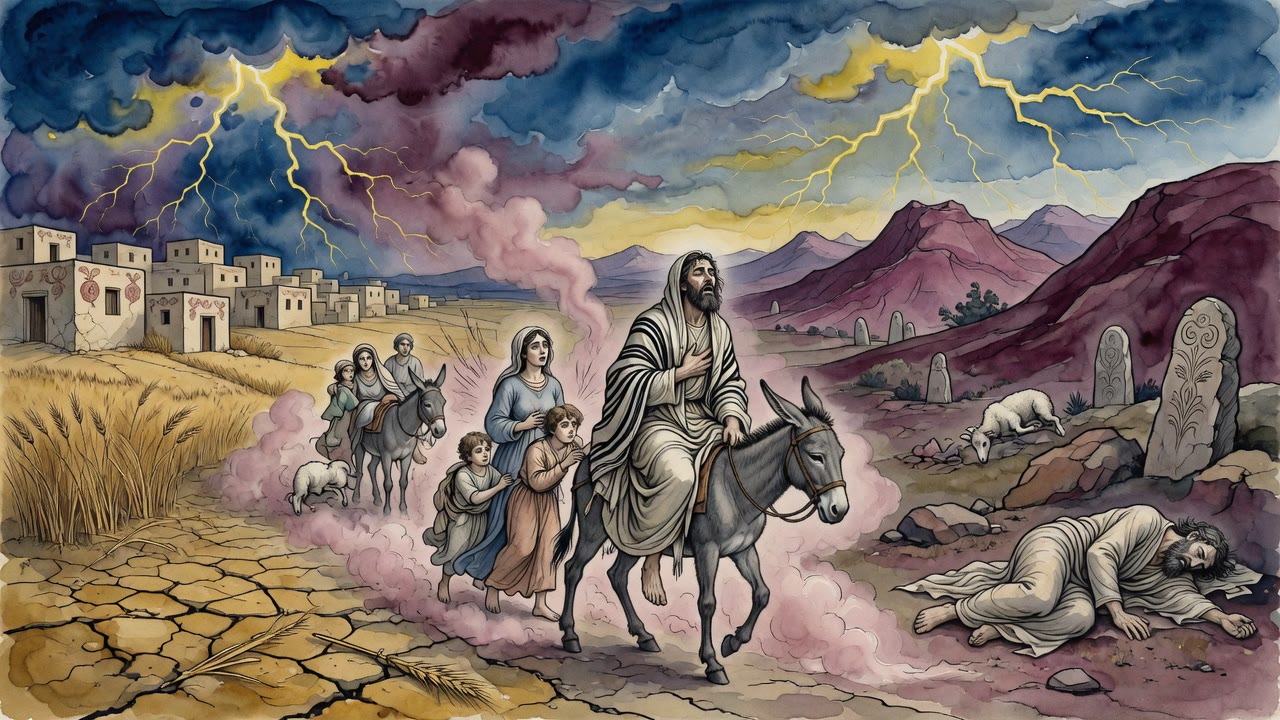
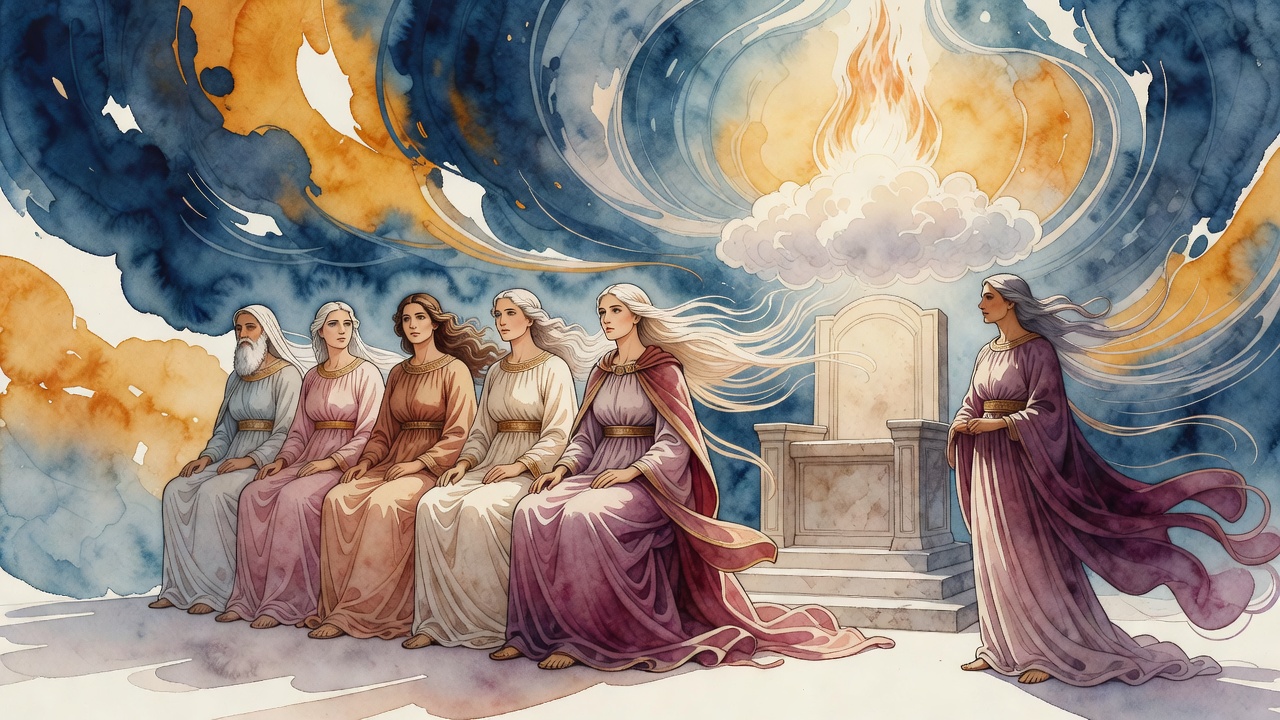
The trouble had begun with hunger. Elimelech left Bethlehem in the days of famine and crossed into Moab with Naomi and their two sons. The sons took Moabite wives, Ruth and Orpah. Then the house collapsed one death at a time. First Elimelech. Then both sons. Three women remained, bound to one another by graves and by the thin mercy of shared grief.

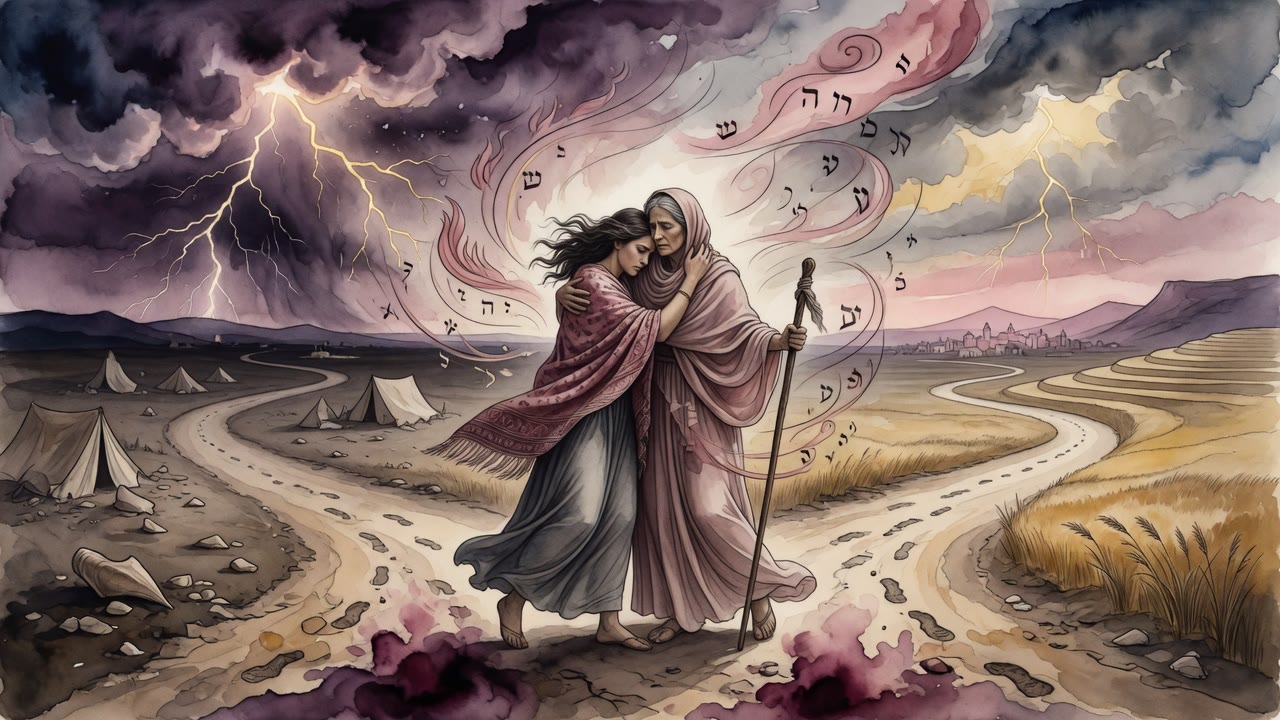
Naomi heard that bread had returned to Judah. Bethlehem, the house of bread, had bread again. She rose to go back, but she did not ask the young women to spend their lives paying for her losses. She turned to them on the road and released them. Go back, she said in effect. Return to mothers, to homes, to husbands still possible. Her blessing was not cruelty. It was the last gift she had left.

Orpah Kissed and Ruth Clung

Orpah wept. She kissed Naomi and went back. The kiss was not treachery. It was a human answer to an unbearable demand. She had followed as far as she could, and the road home opened under her feet.

Ruth did not move. Her hands stayed with Naomi. The older woman pressed harder, because kindness can become a burden when it lets another person walk into ruin. Naomi set before Ruth the life she was choosing: a people not hers by birth, a land where she would be the Moabite woman, commandments that would enter her calendar, her table, her body, her sleep. Sabbaths. Festivals. Boundaries. Poverty with a mother-in-law who had nothing to offer except the road.

Ruth heard it and stayed.

The Road Became a Gate

Her answer was not a sigh of affection. It was a threshold. Do not press me to leave, she said, and the plea carried an edge: do not turn kindness into a sin against me. Ruth had already chosen conversion. Better that it come through Naomi's hands than through the hands of a stranger.

Then came the words that made the road into a covenant. Naomi's road would become her road. Naomi's lodging, her lodging. Naomi's people, her people. Naomi's God, her God. In Hebrew, the first movement is only three words, asher telchi elech. Small enough to fit in one breath. Heavy enough to bend a dynasty toward Bethlehem.

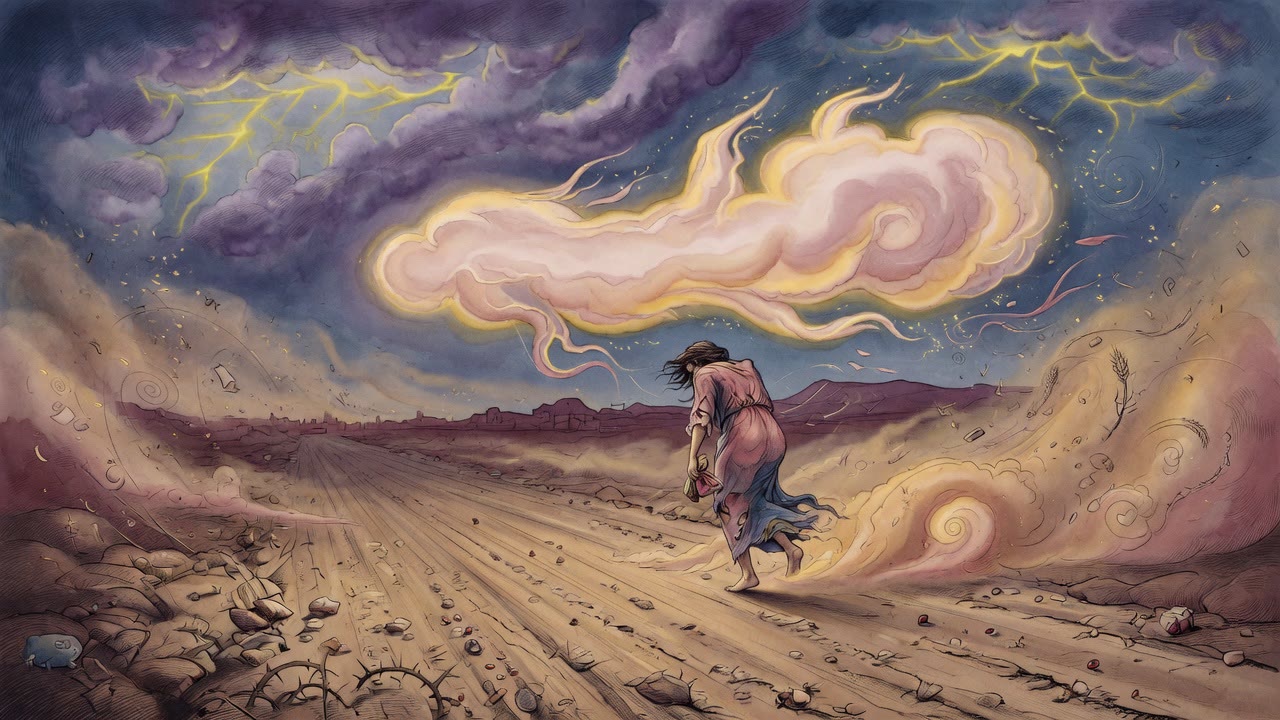
Naomi stopped arguing. There are moments when persuasion has done all it can do, and the soul standing in front of it has become harder than refusal. The two women went on together. One carried bitterness. One carried a promise. Neither carried bread.

Boaz Guarded the Barley

Bethlehem saw Naomi and recoiled. Is this Naomi? The name no longer fit her face. Famine had taken the softness from it, and Moab had sent her back with a daughter-in-law instead of sons.

In the fields, Ruth bent among the stalks and gathered what the poor were permitted to gather. The barley field belonged to Boaz, a man of standing who still guarded his own threshing floor at night. A prince can hire watchmen. Boaz kept watch himself, because the generation had cracks in it. Grain could be stolen. Bodies could be used. The dark around the threshing floor needed a righteous man awake inside it.

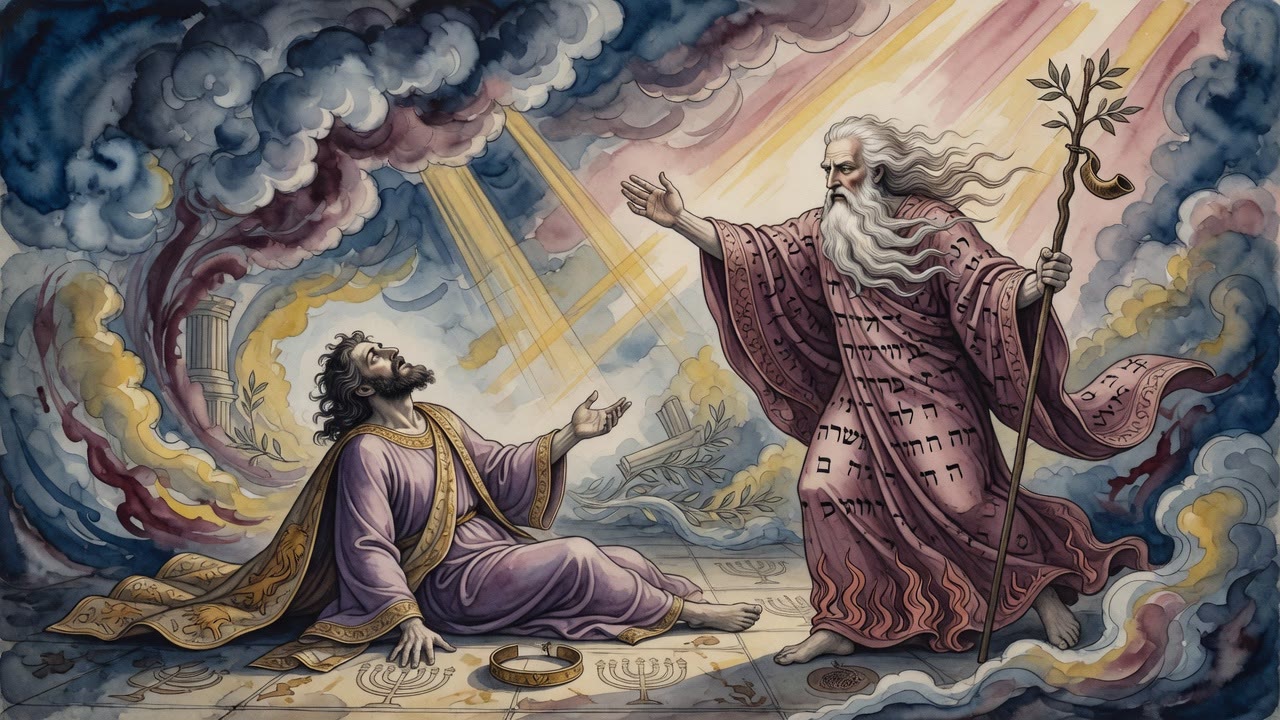
Ruth did not make herself a spectacle. When Naomi sent her down to the threshing floor, Ruth waited to wash and anoint herself until after she had descended, so no one would mistake preparation for invitation. She stepped into danger with discipline. At midnight, Boaz startled awake and reached toward the figure at his feet. For one breath he thought a spirit had risen from the grain.

The Redeemer Rose at Midnight

He demanded her name.

Ruth answered from the floor. Not a spirit. Not a temptation. His handmaid. She asked him to spread his wing over her, because he was a redeemer.

The field, the dead husband, Naomi's broken house, Ruth's vow on the road, all of it entered that midnight sentence. Redemption was not a soft word. It meant property restored, names preserved, hunger answered, and the dead not erased from Israel. Boaz stood inside the law and let mercy breathe through it. He would not seize what belonged to another kinsman. He would not turn Ruth's boldness into shame. He sent her back before morning with grain in her arms, so Naomi would not wait empty in the dark.

Bethlehem Received a Future King

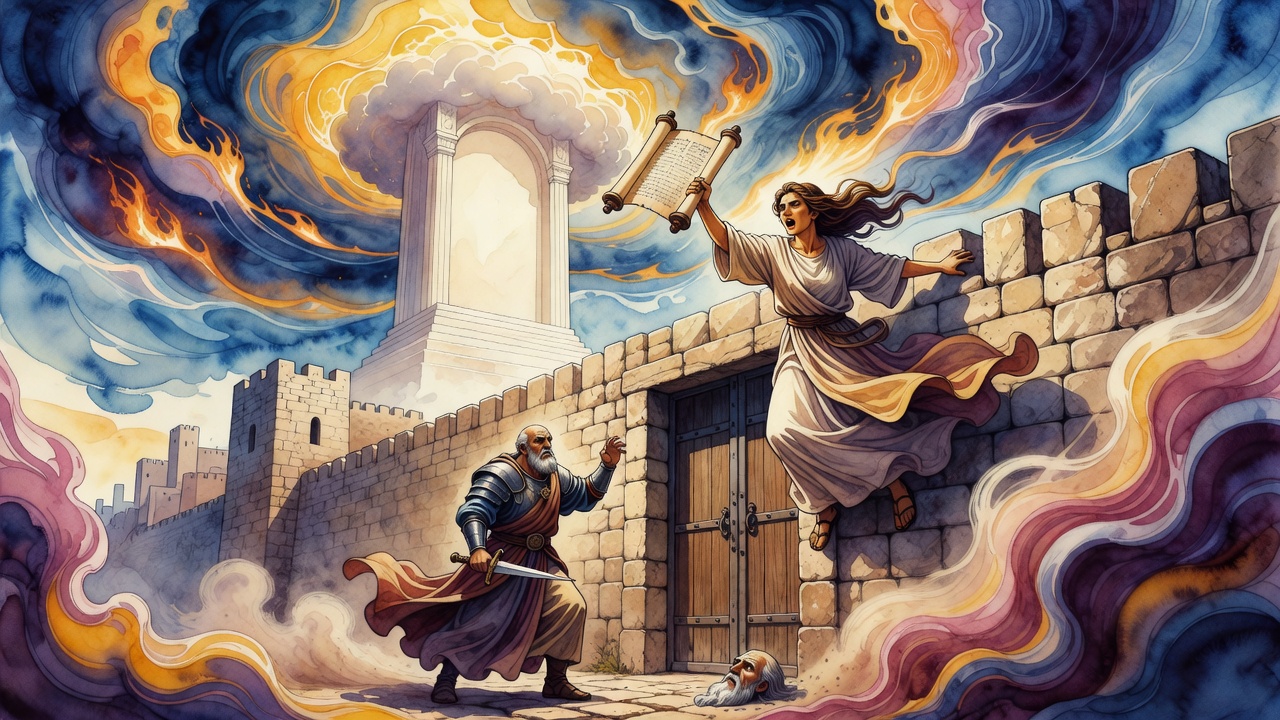
The gate of Bethlehem became a court. The nearer redeemer stepped aside, and Boaz took the field and Ruth together. The Moabite widow entered the house of Israel not as a shadow at the edge of the harvest, but as the woman through whom a buried name would live.

A child came. Naomi, who had walked home with nothing, held him against her breast while the women named the restoration aloud. Obed was born to Ruth and Boaz. Obed fathered Jesse. Jesse fathered David.

History moved through a widow's grip on another widow's cloak. Ruth had no army, no throne, no guarantee that Bethlehem would ever stop calling her foreign. She had three words and the stubborn holiness to keep walking after them. The road from Moab did not end at the city gate. It ended with a king in the bloodline.


← All myths

From the tradition

Sources

4 sources

The texts this telling draws on, in full. Open a card to read inline, or expand it for a wider, quieter read.

Ruth Rabbah (Lerner)Ruth Rabbah (Lerner)

Not just the biblical Ruth, but the Ruth we meet in the rabbinic imagination – a figure so compelling that her story continues to resonate with us centuries later.

The familiar version gives us the basic story: Ruth, a Moabite woman, chooses to stay with her Jewish mother-in-law, Naomi, after tragedy strikes. She famously declares, "Your people shall be my people, and your God, my God." (Ruth 1:16). Simple enough. But what does that really mean?

The rabbis, those masterful interpreters of scripture, unpack that declaration in fascinating ways in Ruth Rabbah, a Midrashic (rabbinic interpretive commentary) compilation that delves deep into the Book of Ruth. And it's here that we start to see the layers of meaning.

So, the story turns to those two key phrases: "Your nation is my nation," and "Your God is my God."

Ruth Rabbah doesn't just take these lines at face value. It sees them as a profound transformation. When Ruth says "Your nation is my nation," it’s not just about changing citizenship. It’s about shedding her past, shedding her former beliefs. According to Ruth Rabbah (6), this declaration "refers to abandoning my idolatry." Ruth isn't just joining a new family; she's actively rejecting the gods she grew up with. This is a powerful statement of faith, a complete break with her previous life.

It makes you wonder, what was it that Ruth saw in Naomi and her people that made her willing to give up everything she knew?

But the story doesn’t end there. What about the second part? "And your God is my God." It's tempting to see this as simply accepting a new deity. But Ruth Rabbah (7) gives us a more nuanced understanding. It suggests that "Your God is my God" implies that Ruth is ready "to pay the reward of my deeds." In other words, she accepts the consequences, both good and bad, that come with following this new path. She’s not just embracing a new faith, but also taking responsibility for her actions within that faith. She understands that actions have consequences, and she's willing to accept them as part of her commitment.

Think about the weight of that decision. Ruth wasn't just making a casual statement. She was consciously choosing a new way of life, with all its potential challenges and rewards. And it's through this lens that we can truly appreciate the depth of her character.

Ruth's story, as interpreted by the rabbis, isn't just a sweet tale of loyalty. It's a powerful narrative about conversion, about faith, and about the courage to embrace a new identity. It’s about recognizing the divine spark in another culture and being willing to make a complete transformation. And ultimately, it's a reminder that sometimes, the greatest blessings come from taking the biggest leaps of faith.

Full source
Ruth Rabbah (Lerner) 22:1Ruth Rabbah (Lerner)

In this little snippet of that text, we find a moment of intense connection, and a gentle but firm assertion of self.

The verse But the Rabbis, in their insightful way, see so much more within these words.

"Do not beseech me," Ruth says to Naomi. But according to Ruth Rabbah, as interpreted by Lerner, this isn't just a polite request. Ruth is actually saying, "Do not sin toward me." It's a powerful statement. She's asking Naomi not to hold back her own misfortunes, not to try and shield Ruth from the difficulties that lie ahead. Don't think, Ruth is saying, that trying to dissuade me is somehow doing me a favor.

Why? Because Ruth has already made up her mind. "Regardless," she declares, "my intention is to convert." But here's the kicker: "it is not better that my conversion be at your hands and not at the hands of another." It's a fascinatingly nuanced position. Ruth isn't rejecting Naomi, but she's asserting her own agency. She's choosing this path, not simply being led down it. She wants Naomi to know this isn't about her out of pity or obligation.

Naomi, understanding the depth of Ruth's commitment, then begins to explain some of the realities of Jewish life. According to Ruth Rabbah, Naomi presents the laws of converts. "My daughter," she says, "it isn't the way of Israel to go to theaters and places of amusement, but rather to synagogues and houses of study." She's painting a picture of a life dedicated to community, to learning, to spiritual growth. And she adds, "it is not the way of Israel to go more than two thousand cubits (from civilization) on Shabbat (the Sabbath)," referring to the restrictions on travel during the Sabbath.

To each of these points, Ruth has a ready answer, echoing the powerful words of the original verse. When Naomi speaks of synagogues and study, Ruth replies, "Wherever you go I will go." When Naomi speaks of Shabbat restrictions, Ruth again responds, "Wherever you go I will go."

Then Naomi continues, "And it is not the way of Israel to live in a house that doesn't have a Mezuzah (a parchment scroll affixed to doorposts)" (a small parchment scroll containing biblical verses, affixed to the doorpost).

And Ruth's unwavering response? "Wherever you lie I will lie."

This isn't just about following the rules. It's about embracing a way of life, a culture, a people. Ruth isn’t just saying she'll do what's required; she's saying she'll share in Naomi's life, in every aspect, from the sacred to the mundane.

The Rabbis, in Ruth Rabbah, are showing us the depth of Ruth's conviction. This isn't a casual decision. This is a soul aligning itself with a new destiny, a new people, a new God. It's a powerful evidence of the human capacity for change, for growth, and for unwavering commitment. It’s a reminder that sometimes, the greatest journeys begin with the simplest of declarations: "Wherever you go, I will go." And perhaps, in our own lives, we can find inspiration in Ruth's steadfast spirit, in her willingness to embrace the unknown, and in her unwavering commitment to the path she has chosen.

Full source
Midrash Tanchuma Buber, Behar 8:3Midrash Tanchuma Buber, Behar

"And his redeemer shall come" (Leviticus 25:25): Who was this? It was Boaz. When? At the time when Naomi sold the field, as it is said, "The parcel of land which belonged to our kinsman Elimelech, Naomi is selling" (Ruth 4:3). Thus, "and he sells some of his property."

Rabbi Simeon ben Yohai said: Elimelech, Salmon, and "So-and-so" (Peloni Almoni), and Naomi's father, were all sons of Nahshon ben Amminadab. Elimelech, Mahlon, and Chilion were the providers of the generation. And for what reason were they punished? Because they went out from the land of Israel to outside the land, as it is said, "And the whole city was stirred over them, and they said, 'Is this Naomi?'" (Ruth 1:19). What is the meaning of "Is this Naomi?" Did you see Naomi, who went out from the land of Israel to outside the land, what has befallen her?

"And his redeemer shall come", this is Boaz, as it is said, "The man is near of kin to us, he is one of our redeemers" (Ruth 2:20). At that hour Ruth went to Boaz. Her mother-in-law said to her, "Behold, he is winnowing the threshing floor of barley tonight" (Ruth 3:2). He was a prince, yet he was winnowing on the threshing floor; but it was because his generation was breached in sexual immorality and in robbery, and he went out to guard his threshing floor. She said to her, "And you shall wash and anoint yourself" (Ruth 3:3), and afterward, "and go down to the threshing floor" (ibid.), "and I shall go down" is what is written. She said to her: My merit shall go down with you. She did not do as her mother-in-law told her. What did Ruth do? After she went down to the threshing floor, she did so, as it is said, "And she went down to the threshing floor and did according to all that her mother-in-law commanded her" (Ruth 3:6). Why? Rather, she said: The generation is breached in sexual immorality, perhaps they will see me adorned and say, "Perhaps she is a harlot."

"And Boaz ate and drank and his heart was merry" (Ruth 3:7). What is "and his heart was merry"? That he occupied himself with Torah, as it is said, "Come, eat of my bread" (Proverbs 9:5). "And he came to lie down at the end of the heap, and she came in stealth" (Ruth 3:7). What is "in stealth" (ba-lat)? In secret, as you say, "Behold, it is wrapped (lutah) in a cloth" (1 Samuel 21:10). "And it came to pass at midnight that the man was startled and turned (va-yilafet)" (Ruth 3:8). What is "va-yilafet"? That he seized the head, for he thought it was a spirit, as you say, "And Samson grasped (va-yilpot) the two middle pillars" (Judges 16:29). "And he said, Who are you? And she said, I am Ruth your handmaid" (Ruth 3:9). He said to her: What have you come to do here? She said to him: To fulfill the Torah, "When your brother becomes poor… and his redeemer shall come", arise and fulfill the Torah.

He said to her: Since you have come to fulfill the Torah, "Stay the night, and it shall be in the morning, if he will redeem you, good (tov)" (Ruth 3:13), for he had another kinsman, greater than he, whose name was Tov. Rabbi Hanina said: She said to him: Are you putting me off with words? He said to her: "As the Lord lives" (ibid.), I am not putting you off with words. "And Boaz went up to the gate and sat down there" (Ruth 4:1). He said to him: Sit, and let us look into the Torah: what is "When your brother becomes poor"? Boaz said to Tov: "The parcel of land which belonged to our kinsman Elimelech, Naomi is selling" (Ruth 4:3), "and I said I would disclose it to you, saying, Buy it" (Ruth 4:4), for you are greater than I in the right of redemption; "if you will redeem, redeem" (ibid.). "And the redeemer said to Boaz, Redeem it for yourself" (Ruth 4:6). At that hour Boaz redeemed what Naomi had sold. And from where did Boaz learn it? From this section: "When your brother becomes poor and sells some of his property" (Leviticus 25:25).

Full source
Legends of the Jews 2:31Legends of the Jews

Her story isn't just a sweet tale; it’s a foundation of Jewish tradition.

Ruth wasn's born Jewish. She was a Moabite princess. But her heart, it seemed, had other plans. Ruth's path crossed with Naomi, an Israelite woman who had suffered immense loss – her husband and sons had passed away while living in Moab. Naomi decided to return to her homeland, Bethlehem, and urged her daughters-in-law, including Ruth, to stay in Moab.

Ruth? She was different. Something had resonated deep within her, a connection to Naomi and her faith.

Naomi, as any good Jewish mother would, felt obligated to lay out the realities of Jewish life. As we find in the Talmud (Yevamot 47b), there's a requirement to dissuade converts, to explain the weight of the mitzvot (commandments) and the challenges of the Jewish path. It wasn't about pushing her away, but about ensuring she understood the commitment she was making.

So, Naomi warned Ruth. She spoke of the stringent observances, the Sabbaths and feast days that demanded dedication. She mentioned how Jewish women didn't partake in the kinds of amusements common in other cultures. Can you imagine that conversation? Naomi, weary and grieving, trying to explain the intricacies of a life so different from what Ruth knew.

But Ruth remained steadfast. Undeterred. She affirmed her willingness to embrace Jewish customs, to live by Jewish law. As Ginzberg beautifully recounts in Legends of the Jews, when Naomi declared, "We have one Torah (law), one law, one command; the Eternal our God is one, there is none beside Him," Ruth responded with words that have echoed through generations: "Thy people shall be my people, thy God my God." (Ruth 1:16)

Talk about a powerful moment!

And so, the two women journeyed together to Bethlehem. Can you picture them, these two figures bound by love and shared loss, walking towards an uncertain future?

Their arrival was no accident. As fate would have it, they reached Bethlehem on the very day that Boaz's wife was being buried. The whole town was gathered. The assembled crowd witnessed Naomi's return, a homecoming filled with both sorrow and, perhaps, a glimmer of hope. It's like a scene from a movie, isn't it? Everything aligning for a reason.

And what was that reason? Well, that's a story for another time. But let's just say that Ruth's unwavering devotion and her fateful encounter with Boaz would have consequences that changed the course of Jewish history. It makes you wonder, doesn't it? How seemingly small decisions, acts of faith and love, can ripple outwards, shaping the destiny of nations.

Full source