6 min read

Job's Friends Said the Right Words All Wrong

Job's friends crossed hundreds of miles to sit with him in silence, then turned comfort into accusation when grief needed witness.

Curated by Arthur · Told by Maggid ·
Table of Contents
  1. The Crowns Carried the News
  2. Eliphaz Put Wisdom on Trial
  3. Bildad Measured the Ashes
  4. Zophar Offered Physicians
  5. Job Refused Their Cure
  6. God Answered the Comforters

The portraits in the crowns changed first.
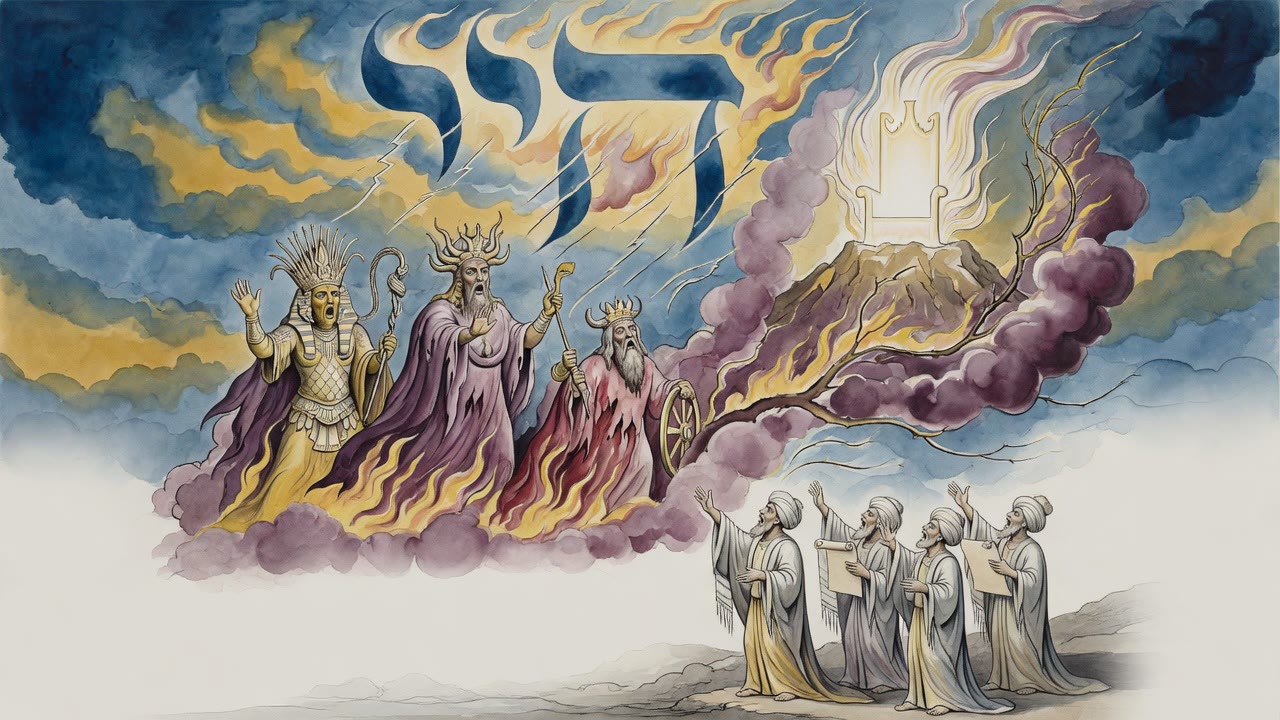
Eliphaz was far from Uz when the image of Job darkened beneath the gold. Bildad, three hundred miles away, saw the same ruin in his own crown. Zophar looked down and found the face of his friend altered, as if disaster had climbed inside the metal and breathed there. These were not casual companions. Kings do not ride across distance because of a rumor. They came because the sign on their heads had turned against them.

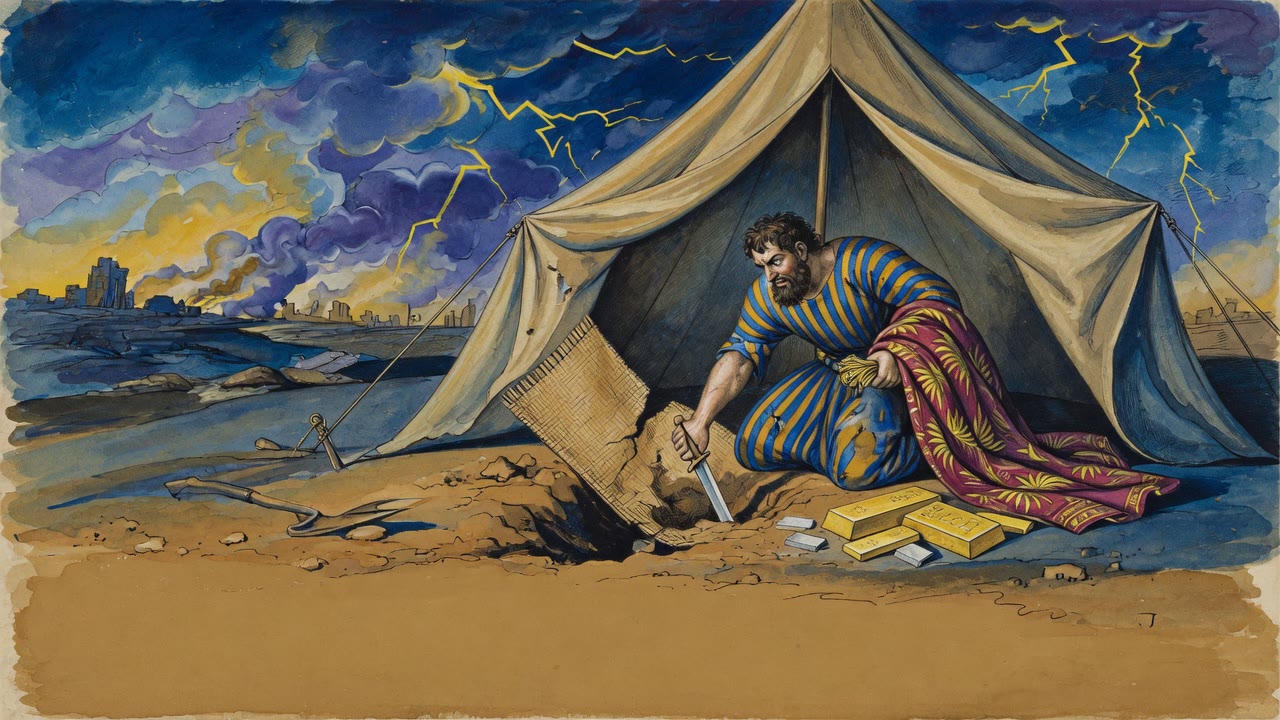
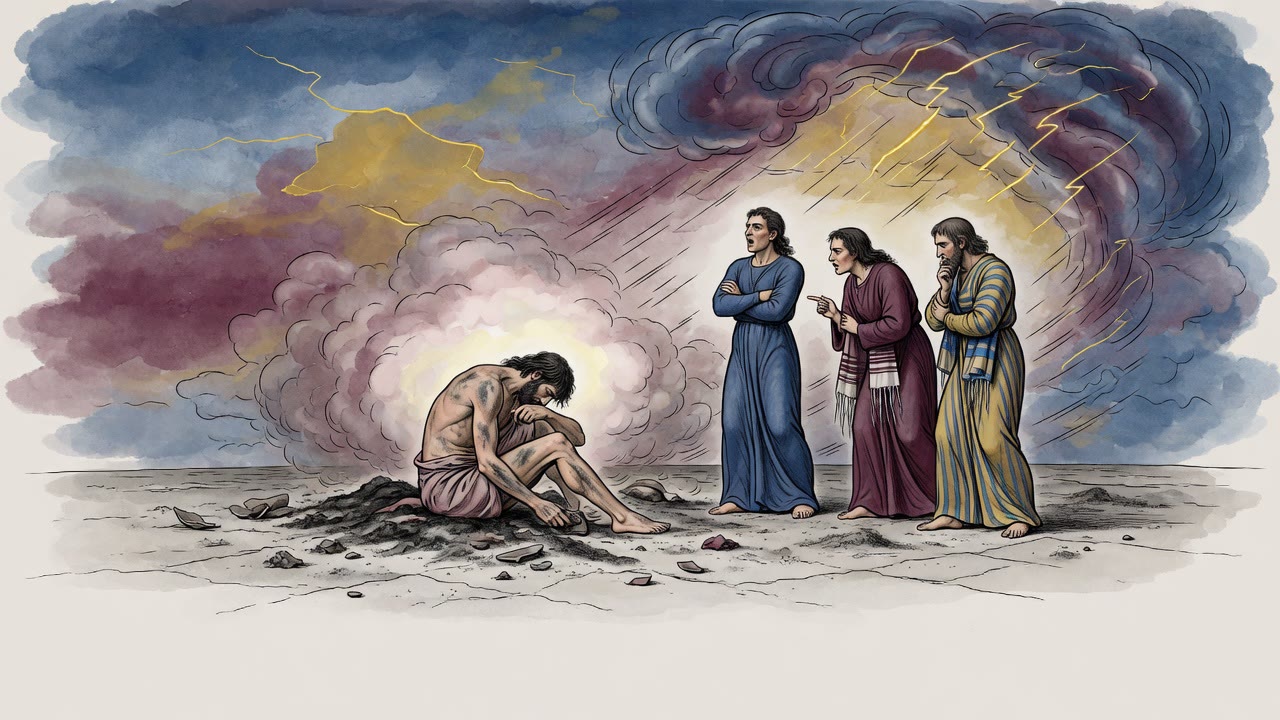
By the time they reached him, the man they knew was almost gone. His animals had been stolen or burned. His children were dead. His skin had broken open. The prince of Uz sat in ashes, scraping himself with a shard of pottery, while his wife moved through the wreckage in rags. The friends tore their garments. They lifted dust over their heads. Then they did the holiest thing they would do in the whole ordeal.

They sat down and shut their mouths.

The Crowns Carried the News

Seven days passed without argument. No one measured guilt. No one explained heaven. No one sorted the ashes into reasons. The friends looked at Job and understood that speech would be an intrusion. His grief was too large for language, and for one full week they honored that size.

That silence was not emptiness. It was labor. Around them the house had become a wound. The air smelled of dust, sickness, and old smoke.

For seven days, the friends almost understood.

Eliphaz Put Wisdom on Trial

Then Job cursed the day he was born, and Eliphaz could not bear the sound of it. The first friend reached for the only tool he trusted: order. God is just. The world is not loose. Suffering has a cause. A righteous man may stumble and not know where his foot went wrong, but heaven does not strike without a reason.

Eliphaz spoke with the softness of someone who thinks gentleness makes an accusation less sharp. He had seen visions, he said. He knew no mortal could be pure before God. Even angels could be charged with error. What, then, was a man of dust?

The words had dignity. They also landed like stones.

Job heard the hidden sentence beneath them: search yourself until you find the sin that makes your dead children make sense. Eliphaz wanted a clean world more than he wanted a suffering friend. He wanted the ledger balanced, even if the balance had to be written across Job's body.

Job answered from the ash heap. A man in pain does not need a lecture on the frailty of flesh. He was living inside that lecture already.

Bildad Measured the Ashes

Bildad tried to restrain Eliphaz, but restraint is not mercy when it still puts a mourner on trial. He approached Job as if sanity could be inspected from the outside. Was Job speaking from wisdom, or had pain torn his mind loose? Could the God Job trusted bend justice? Could the Judge of all the earth twist the scales?

Bildad arranged his questions like legal instruments. If Job's children died, perhaps their own transgression had delivered them into consequence. If Job would seek God properly, perhaps the old house could rise again.

Hope entered the room wearing a knife.

Job did not deny that God ruled the world. He denied that Bildad understood the ruling. These were not fools. That was the ache. They were wise enough to wound him carefully.

Zophar Offered Physicians

Zophar listened and decided Job had lost himself. Pain had made him wild. Words poured out of him like fever. The three friends were kings, counselors, men of stature. Why would Job not accept treatment from such physicians?

Job refused their medicine. His healing would not come from men who mistook accusation for cure. God, the Creator of all physicians, held his restoration. If Job was to be mended, the hand that made bone, breath, and morning would have to do it.

Then Zitidos broke into the circle.

She came in torn clothing and threw herself before the friends. Her hunger had its own voice. Her dead children had left empty places in her body too. She begged the royal men with crowns and arguments to look at what was happening on the ground.

The friends had come to comfort a righteous man. Now a ruined woman lay at their feet, and the room asked whether wisdom could bend low enough to see her.

Job Refused Their Cure

Job kept answering, not because he loved argument, but because silence had been stolen from him. He had endured loss, disease, and shame. Now he had to defend his soul against the people who came to hold him.

He pointed beyond them. Wisdom was not sitting in their crowns. It ran through stone, beast, bird, sea, and sky, and still no human hand could seize it. The friends had a system. God had a world.

At the edge of every answer stood the same refusal: Job would not confess to a crime invented to protect other men's certainty. He would not let his children become evidence in a case against him. He would not call the ash heap justice simply because his friends were frightened by a universe where a righteous man could suffer without explanation.

The crowns had warned them that Job was in trouble. They rode to him as friends. Their silence was precious. Their speeches became a second calamity.

God Answered the Comforters

When God finally spoke from the whirlwind, the friends were not praised for defending heaven. They had guarded God's justice with arguments God did not ask them to make. Their theology had clean edges, but Job's torn words were nearer to truth than their careful accusations.

The command that followed was sharp. The friends would bring offerings, and Job would pray for them. The wounded man became the intercessor for the men who wounded him. The ash heap turned into an altar, not because the friends had solved suffering, but because they had to stand before the person they failed and need his mercy.

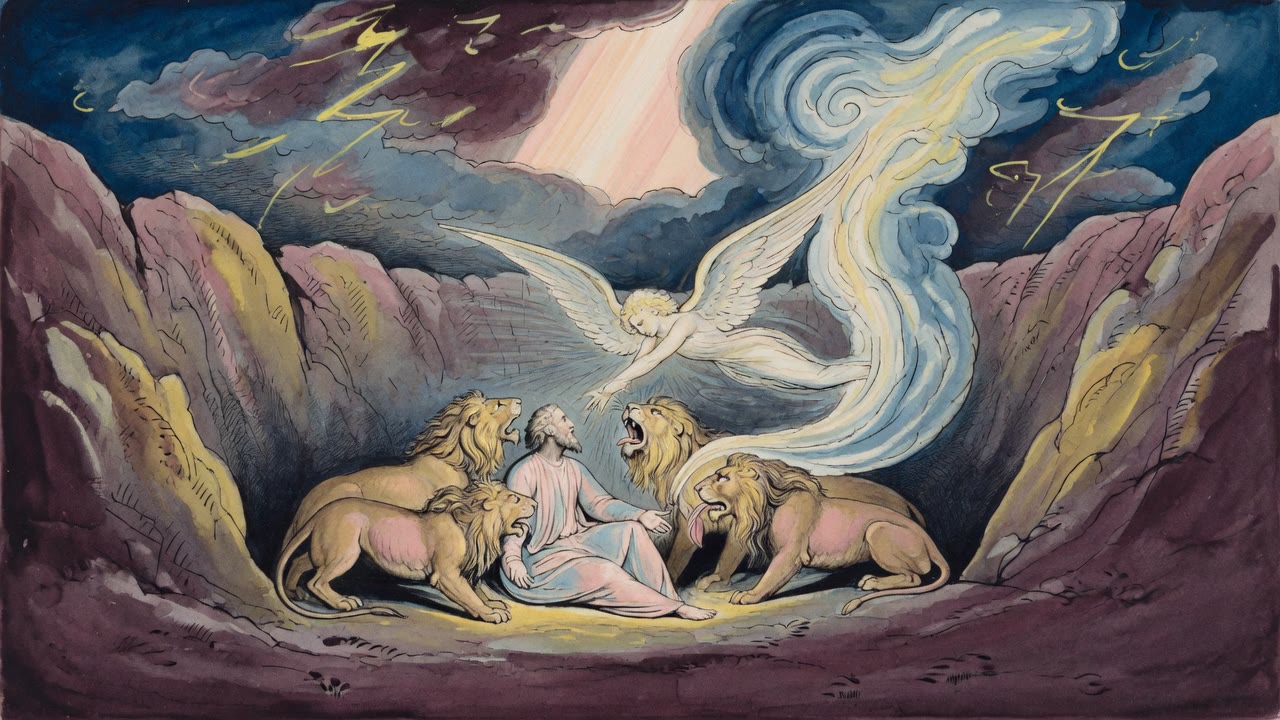
Job prayed. The friends lived. The crowns, if they still carried his face, had to show something stranger than disaster now: a man scraped raw by grief, asked to bless the very mouths that made his grief heavier.


← All myths
From the tradition

Sources

8 sources

The texts this telling draws on, in full. Open a card to read inline, or expand it for a wider, quieter read.

Legends of the Jews, II. The Sons Of Jacob, The Four FriendsLegends of the Jews

The story of Job and his companions, as retold in Ginzberg's Legends of the Jews, offers a powerful, if sometimes strange, glimpse into that very question. It’s a tale filled with ancient wisdom and, surprisingly, a touch of magical realism.

The tradition says Job wasn't just some random guy. He was a righteous man of immense wealth and influence, a king among men. And, crucially, he had friends – not just acquaintances, but true companions who lived far apart, yet were bound by a deep connection.

The story goes that these friends – Eliphaz, Bildad, Zophar, and Elihu – lived three hundred miles apart. Now, how did they know when trouble befell one of their own? Well, each had a rather unique device: their crowns held portraits of each other. When one friend experienced hardship, it would visibly manifest in his picture within the others' crowns!

As Ginzberg tells it, these weren't just any ordinary guys, either. They were all related to each other and to Job himself. Eliphaz, king of Teman, was a son of Esau. Bildad, Zophar, and Elihu were cousins, sons of Shuah, Naamat, and Barachel, who were sons of Buz. And Buz? He was Job's brother and Abraham's nephew!

When Job was struck with his legendary misfortunes, his friends, alerted by their magical crowns, immediately set out to find him. But when they arrived at Job's city, they couldn't even recognize him! The townspeople pointed them towards a figure reclining on an ash heap some distance away. But they were skeptical: could this really be the great Job?

The stench emanating from Job was so overpowering that they couldn’t get close. It’s said they had to order their armies to scatter perfumes and aromatics for hours before they could even approach him. Can you imagine the scene? The sheer desperation and horror they must have felt?

Finally, Eliphaz managed to get close enough to speak. "Art thou indeed Job, a king equal in rank with ourselves?" he asked. And when Job confirmed, with a simple "Aye," their grief erupted. They wept bitterly and sang an elegy together, joined by the armies of the three kings.

Eliphaz began to lament Job's fate, contrasting his present misery with his former glory, repeating the refrain, "Whither hath departed the splendor of thy throne?" Job, after listening to their wailing for some time, responded with defiance, declaring that his true kingdom, the kingdom of his Father, would endure forever, unlike the fleeting glory of earthly rulers.

This response angered Eliphaz, who wanted to abandon Job to his fate. But Bildad, ever the voice of reason, calmed him down, reminding him to have compassion for someone suffering so greatly. He then began to question Job, trying to understand how God could inflict such suffering on a loyal servant. He even asked Job about the movements of the heavenly bodies!

Job, in turn, responded that human beings cannot comprehend Divine wisdom. As he put it, and I'm paraphrasing here, we can't understand God's plan whether it's revealed in nature or in human affairs. He even posed a riddle to Bildad: "Solid food and liquids combine inside of man, and they separate again when they leave his body. Who effects the separation?" When Bildad admitted he didn't know, Job retorted, "If thou canst not comprehend the changes in thy body, how canst thou hope to comprehend the movements of the planets?"

Zophar, convinced that Job was still of sound mind, offered him medical treatment from the kings' physicians. But Job refused, declaring that his healing would come from God alone.

Then, Job's wife, Zitidos, appeared, clad in rags. She threw herself at the feet of Job's friends, begging them to remember her former glory. Her plight moved them so deeply that they could only weep. Eliphaz, in a gesture of compassion, draped his royal mantle around her shoulders. Zitidos asked one favor: that they clear away the ruins of the building where her children were entombed, so she could give them a proper burial.

But Job, again seemingly detached from reality, told them not to bother, claiming that his children were safely with their Creator. This, of course, made his friends even more convinced that he had lost his mind.

However, Job then prayed to God and, upon finishing, instructed his friends to look eastward. There, they beheld Job's children, crowned with glory, alongside the Ruler of Heaven. Zitidos prostrated herself, declaring that her memorial resided with the Lord. She returned to her master’s house, where she had been forbidden to leave previously and soon died of exhaustion. The people mourned her greatly, and an elegy was written in her honor.

What are we to make of this story? It's a strange mix of profound suffering, unwavering faith, and, frankly, some bizarre elements like the magical crowns and the vision of Job's children in heaven.

Perhaps the most enduring message is the importance of presence, even when understanding fails. Job's friends, despite their initial bewilderment and their differing perspectives on his suffering, traveled great distances to be with him. They mourned with him, even when they couldn't comprehend his situation.

The story also highlights the limits of human understanding when faced with divine mysteries. Job's friends sought to explain his suffering through logic and reason, but Job insisted that God's ways are beyond human comprehension. Sometimes, all we can do is have faith and be present for those who are suffering.

And maybe, just maybe, there's a little bit of magic in true friendship, a connection that transcends distance and hardship, a bond that allows us to see each other's pain, even from afar.

Full source
Legends of the Jews 3:35Legends of the Jews

The familiar version gives us Job. His story is a evidence of faith tested by unimaginable suffering. But beyond the trials, Job’s story is a profound exploration of human understanding, or rather, the limits of human understanding.

His friends, in their own way, were trying to make sense of it all, weren't they? Trying to fit Job's suffering into a neat little box of cause and effect. "You must have done something wrong, Job!" they insisted. But Job, in his pain and confusion, cuts through their simple explanations with a profound insight: we simply can't grasp the fullness of Divine wisdom.

He challenges them, and in doing so, challenges us. Job declares, according to Legends of the Jews, that humanity cannot truly comprehend Divine wisdom. It's a wisdom that reveals itself in everything around us, from the inanimate world to the animal kingdom, and most especially in the intricate dance of human existence.

Job doesn't just make a statement; he poses a question. A question so simple, so… human. "Solid food and liquids combine inside of man," he asks, "and they separate again when they leave his body. Who effects the separation?" It's a question about the very processes that keep us alive, the hidden workings of our own bodies. And when Bildad, one of Job's friends, admits he cannot answer, Job drives home his point: "If thou canst not comprehend the changes in thy body, how canst thou hope to comprehend the movements of the planets?"

It’s a powerful analogy, isn’t it? If we can't understand the microcosm that is our own physical being, how can we possibly expect to grasp the macrocosm of the universe, the Divine plan that governs all things? We, with our limited senses and finite minds, attempting to decipher the infinite?

Job's response isn’t an admission of defeat, though. It’s an invitation to humility. To recognize that there are forces at play, mysteries unfolding, that are simply beyond our current capacity to fully understand. And maybe, just maybe, that's okay. Perhaps the point isn't to have all the answers, but to live with the questions, to stand in awe of the unknown, and to trust in something greater than ourselves.

So, the next time you find yourself wrestling with a question that seems unanswerable, remember Job. Remember the limits of human understanding and the vastness of the Divine. And perhaps, find a strange comfort in the mystery of it all.

Full source
Legends of the Jews 3:34Legends of the Jews

His story, filled with unimaginable trials, continues to resonate through the ages.

After the initial shock of Job's catastrophic losses, his so-called friends arrive to "comfort" him. But their comfort quickly turns into accusation. Eliphaz, for one, is absolutely furious. According to Legends of the Jews, his words were so sharp that he urged his companions to just abandon Job to his misery!

Can you imagine?

Bildad, ever the slightly more reasonable one, steps in to temper Eliphaz’s rage. He reminds them that, come on, Job is suffering immensely. Maybe, just maybe, they should cut him a little slack.

But Bildad's "mercy" comes with its own set of barbs. He begins to interrogate Job, essentially putting him on trial. He's trying to figure out if Job has lost his mind, if he’s still sane enough to even have a conversation. He wants to understand. Or perhaps prove, how a God in whom Job still places his faith could possibly inflict such devastating suffering.

It’s a fascinating, if deeply unsettling, line of questioning.

Bildad even uses a rather cutting analogy. He argues that even a human king wouldn't let a loyal guardsman suffer so greatly. So how could God, the King of Kings, allow this to happen to Job?

It’s a powerful question, isn't it? One that gets to the heart of the problem of suffering. Why do bad things happen to good people? As we find in Legends of the Jews, Bildad also wants to quiz Job on the movements of the heavenly bodies. What does that have to do with anything? Perhaps he was attempting to find a cosmic explanation, a divine alignment that could account for Job's misfortune. Or maybe it was simply a way to test Job's knowledge and further assess his mental state.

Either way, it's clear that Job's ordeal is far from over. His friends, instead of offering solace, are adding to his burden with their relentless questioning and thinly veiled accusations. Will Job be able to maintain his faith in the face of such adversity? And will his friends ever truly understand the depth of his suffering? These are questions that linger long after the story is told. They challenge us to consider our own responses to suffering, both in ourselves and in others. What does it mean to be a true friend in times of crisis? And how do we reconcile our faith with the harsh realities of life?

Full source
Legends of the Jews 3:37Legends of the Jews

Legends of the Jews turns to Zophar Thought Job's Suffering Had Driven Him Mad.

In Ginzberg's Legends of the Jews, we find a poignant continuation of Job’s trials. Zophar, one of Job's companions, after hearing Job's words to Bildad, concludes that Job's suffering has, alas, driven him mad. He wonders if Job would allow himself to be treated by the "physicians" – referring to the three kings who are his friends. Job, however, refuses this offer, declaring, "My healing and my restoration come from God, the Creator of all physicians." It's a powerful statement of faith, a refusal to rely on earthly solutions for a spiritual wound.

Just as the conversation reaches an impasse, a figure emerges from the periphery – Zitidos, Job's wife. She appears in rags, a stark contrast to the royalty surrounding her. She throws herself at the feet of Job's friends, pleading, "O Eliphaz, and ye other friends of Job, remember what I was in other days, and how I am now changed, coming before you in rags and tatters." The sight of her misery is so profound that the kings are rendered speechless, overcome with grief. Eliphaz, moved by her plight, removes his royal purple mantle and drapes it around her shoulders – a gesture of empathy and a silent offering of comfort.

Zitidos asks only one favor: that the kings order their soldiers to clear the rubble of the collapsed building where her children are buried, so she can give them a proper burial. A mother's grief, seeking a final act of love. The kings are ready to grant her request, but Job intervenes, saying, "Do not put yourselves to trouble for naught. My children will not be found, for they are safely bestowed with their Lord and Creator."

Again, Job's friends are convinced he's lost his mind. Can you imagine their frustration? They see only ruins and despair, while Job speaks of divine safekeeping. But Job persists. He prays to God, and then instructs his friends to look eastward. When they do, they witness an astonishing sight: Job's children, adorned with crowns of glory, standing beside the Ruler of Heaven.

Zitidos, witnessing this miracle, prostrates herself, exclaiming, "Now I know that my memorial resides with the Lord." She then returns to her master's house, having been away against his will, as Job feared the kings would take her with them.

What does this scene tell us? It’s a powerful reminder of the enduring power of faith in the face of unimaginable loss. It highlights the contrast between earthly perception and spiritual reality. Job's friends see only suffering and madness, while Job sees a deeper truth, a divine plan beyond their understanding. Zitidos' journey, from despair to recognition of her children's eternal reward, emphasizes the idea that even in the darkest of times, hope and faith can endure. And perhaps most importantly, it reminds us that even when we feel utterly alone, our memorial, our true essence, resides with the Divine.

Full source
Legends of the Jews 3:9Legends of the Jews

Legends of the Jews turns to God Defends Job Against His Judgmental Friends.

Even with Job’s moments of… let’s say, unconventional pronouncements during his suffering, the Holy One, blessed be He, wasn't exactly thrilled with Job’s friends. they were a little too quick to judge. The sages teach that "a man may not be held responsible for what he does in his anguish." And Job, well, he was certainly in anguish!

There's a fascinating story about Job being asked what he thought the worst affliction could be. You might expect him to say boils, or losing his family. But no. He said it was "My enemies' joy in my misfortune." It’s not just about the pain itself, but the added sting of others relishing in it.

Then there's the story of how God, after Satan's accusations, gave Job a choice: poverty or physical suffering. And Job chose… pain. Why? Because, as Ginzberg retells in Legends of the Jews, poverty seemed like the greater scourge. Before his trials, Job held a truly impressive position because of his immense wealth.

Job’s story, in some ways, is also a glimpse into the Messianic age. He was blessed with abundance – a taste of what's to come. His harvests were instantaneous: the moment he sowed, the seeds sprouted, grew, and ripened. His livestock prospered; his sheep even took down wolves! We're talking about one hundred and thirty thousand sheep, guarded by eight hundred dogs, plus two hundred more just for his house. And his herds? Three hundred and forty thousand asses and thirty-five hundred pairs of oxen!

But here’s the thing: Job didn't hoard his wealth. It wasn't about self-indulgence. It was about tikkun (spiritual repair) olam, repairing the world. It was for the good of the poor and the needy. He clothed them, fed them, and provided them with everything they needed. According to Legends of the Jews, he even had ships that carried supplies to all the cities and dwelling places of the destitute. Imagine the scale!

His house was designed for hospitality. Doors on all four sides, so the poor and wayfarers could enter from any direction. Thirty tables constantly laden with food, and another twelve just for widows. Everyone who came found what they desired.

And Job’s compassion went even deeper. He employed servants just to wait on the poor. Guests, so moved by his generosity, often offered to help, but Job insisted on paying them for their service. If someone needed a loan for business, and promised to give a portion of their profits to the poor, Job wouldn't even ask for collateral, just a signature. And if the borrower couldn't repay the debt? Job would return the note or tear it up in front of them.

It's a truly remarkable picture of generosity, far beyond just giving money. It’s about dignity, respect, and understanding the needs of others. It’s about creating a world where everyone has enough, where no one is forgotten. Job’s story, even amidst his suffering, reminds us that true wealth lies not in what we possess, but in what we give. It makes you wonder, doesn't it: what could we do to bring a little bit of that Messianic abundance into the world, right here and now?

Full source
Legends of the Jews 3:31Legends of the Jews

Not just a bad day, but their life completely shattered, hope seemingly extinguished.

That's the scene that confronts Job's friends in one of the most poignant moments in Jewish tradition.

The story goes that these four friends, Eliphaz, Bildad, Zophar, and Elihu, heard of Job's terrible plight and journeyed to comfort him. Can you imagine what they expected to find? We know from the Book of Job that he lost everything: his wealth, his children, and finally his health.

Seeing it, truly seeing it, was something else entirely.

According to Ginzberg's retelling in Legends of the Jews, when they finally arrived at the city where Job was suffering, the inhabitants didn't even bring them to a house. Instead, they pointed out a figure in the distance, slumped on a heap of ashes.

"Yonder is Job," they said.

At first, Job's friends couldn't believe it. Was this truly the man they knew? The prosperous, righteous Job? They wanted to get closer, to be absolutely sure. But there was a problem. A terrible problem.

The stench coming from Job was so overwhelming, so utterly repulsive, that they couldn't even approach him. The putrescence wasn't just unpleasant; it was a barrier, a wall of decay keeping them at bay. The text says they ordered their armies, yes, armies!, to scatter perfumes and aromatic substances all around. And they had to do this for hours before they could even get close enough to recognize him.

Imagine the scene: clouds of incense battling the overwhelming odor of suffering and disease. It's a stark reminder of the depths of Job's despair, a physical manifestation of his spiritual and emotional anguish. It highlights how far he had fallen, not only in fortune but in his very being.

This detail, often overlooked, adds another layer to the already complex story of Job. It speaks to the visceral reality of suffering, the way it can permeate every aspect of a person's existence. It is a reminder that sometimes, even with the best intentions, approaching someone in pain can be difficult, even physically challenging.

How do we overcome that barrier? How do we offer comfort and support when faced with such profound suffering? That's the question that echoes through the ages. And perhaps, the beginning of an answer lies in the persistence of Job's friends, their willingness to push past the unpleasantness, the discomfort, and ultimately, to be present with him in his darkest hour. Because sometimes, simply being there is the most profound act of compassion we can offer.

Full source
Legends of the Jews 3:33Legends of the Jews

When tragedy struck, his friends showed up. But their arrival wasn't exactly a comfort. Instead, it opened up a whole new layer of… well, let's just say it was complicated.

The first to speak was Eliphaz. Imagine the scene. He looks at Job, this man brought so low, and asks, almost incredulously, "Art thou indeed Job, a king equal in rank with ourselves?" Can you hear the doubt, the shock in his voice? Job confirms it. Yes, it's him.

Then, according to Legends of the Jews, something extraordinary happens. They weep. Not just a polite tear or two, but full-on lamentations and bitter tears. The armies of the three kings. Eliphaz, Bildad, and Zophar, join in a mournful elegy. Eliphaz begins to speak again, lamenting Job's misfortune. He paints a picture of Job's former glory, each sentence ending with the mournful refrain, "Whither hath departed the splendor of thy throne?"

It’s almost theatrical, isn't it? A grand performance of sorrow.

But here's the thing: is it genuine empathy, or something else entirely? Is it possible that Eliphaz and his friends were focusing more on their own perception of loss than on truly comforting Job? It's something to consider.

After what must have felt like an eternity of wailing and lamenting, Job finally speaks. Can you imagine the weight of his words after all that sorrow? He says, "Silence, and I will show you my throne and the splendor of its glory." Now, this isn’t about earthly power. This is something far greater. Job continues, "Kings will perish, rulers disappear, their pride and lustre will pass like a shadow across a mirror, but my kingdom will persist forever and ever, for glory and magnificence are in the chariot of my Father."

Whoa.

Job's response is a powerful reminder that true glory isn’t about earthly possessions or status. It's about something eternal, something connected to a higher power. It's a kingdom that can't be taken away, a glory that doesn't fade.

So, what does Job’s story tell us? Maybe it’s about questioning what we truly value. Is it fleeting earthly things, or something deeper and more lasting? And when others are suffering, are we truly present with them in their pain, or are we caught up in our own perceptions of loss? Powerful questions,.

Full source
Legends of the Jews 3:30Legends of the Jews

It’s about Job, of course, and his friends. The familiar story is this:. Job, the righteous man, suffers unimaginable hardship. But how did his friends, living far away, even know to come and comfort him?

In this legend, Job’s friends didn’t just receive a casual raven-delivered letter (though that would have been cool, too). This is far more…magical. Legends of the Jews, as retold by Rabbi Louis Ginzberg, shares this amazing image: Each of Job’s friends possessed crowns, and within these crowns were embedded images of the others. Think of it like… the world’s most ancient, most exclusive social network!

Here’s the kicker: When one of them experienced hardship – when Job, for example, was struck with his infamous misfortunes – it would immediately show in his picture within the others' crowns. Can you imagine? A shifting of the face, a darkening of the image, a clear sign that something was terribly wrong. So, even though they lived three hundred miles apart, they all knew instantly, simultaneously, of Job’s suffering and could rush to his side.

It’s a beautiful image, isn’t it? A evidence of the deep bonds of friendship and the almost supernatural way that true empathy can connect us.

Now, who were these friends? The story also goes into their lineage. These weren't just casual acquaintances; these were family. Eliphaz, king of Teman, was said to be a son of Esau. Bildad, Zophar, and Elihu were cousins. Their fathers, Shuah, Naamat, and Barachel, were the sons of Buz, who was Job’s brother and also a nephew of Abraham. So, a tight-knit group, bound by blood and, as the story suggests, by something even deeper.

What does this tell us? Perhaps that true connection transcends distance. Perhaps that when we are truly attuned to the well-being of those we care about, we somehow know when they are in pain. Maybe not through magical crowns, but through that mysterious, powerful force of empathy. It makes you wonder about the people in your life, doesn’t it? Are you attuned to their joys and sorrows? Are they to yours?

Full source