5 min read

David's Five Stones Gathered Against Goliath

David chose five stones at the brook, but the midrash makes the whole created world hurry into his hand before Goliath fell.

Curated by Arthur · Told by Maggid ·
Table of Contents
  1. The Armor That Fit Too Well
  2. Five Stones Came to His Hand
  3. The Giant Left One Place Bare
  4. The Stone Sank Like a Seal
  5. Dagon Fell Into the Dust

David did not go to the brook because he was short of courage. He went because one giant stood in front of him, and the future had four more shadows behind it.
The valley had listened to Goliath for forty days. Morning and evening, the giant came out in bronze and noise, and Israel's ranks pulled inward as if every insult had weight. Saul wore the crown, but his army stood still.

The Armor That Fit Too Well

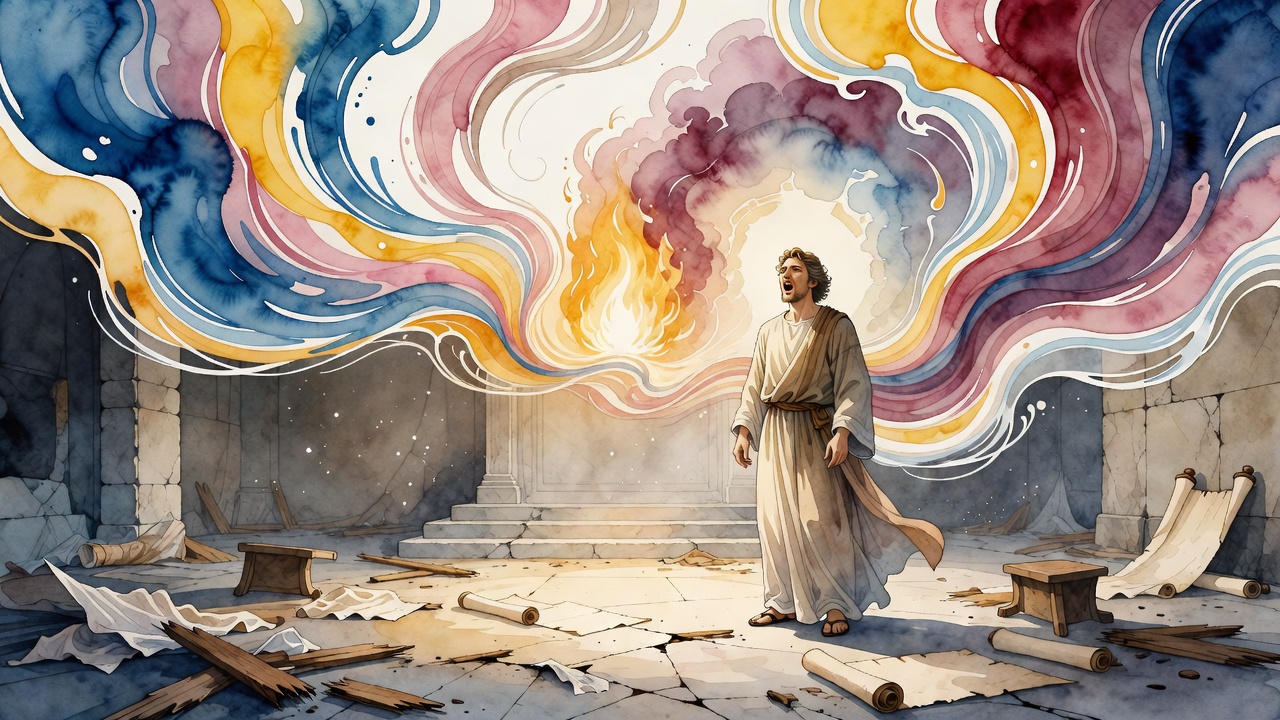
Saul tried the king's armor on the shepherd. The metal should have swallowed him. Instead the openings settled on David as if the breastplate had been waiting for that body. Saul's face darkened. He had already heard that the kingship would not remain with him after the matter of Agag and Amalek, and now his own armor had begun telling the same truth without a word.

David saw the darkness on Saul's face and stepped out of the bronze. "I cannot go with these," he said. He had not tested them. A boy in royal armor would meet Goliath on Goliath's terms, weight against weight, metal against metal. David had a staff, a sling, and the memory of the lion and the bear. That was enough equipment for the kind of battle he had been given.

Five Stones Came to His Hand

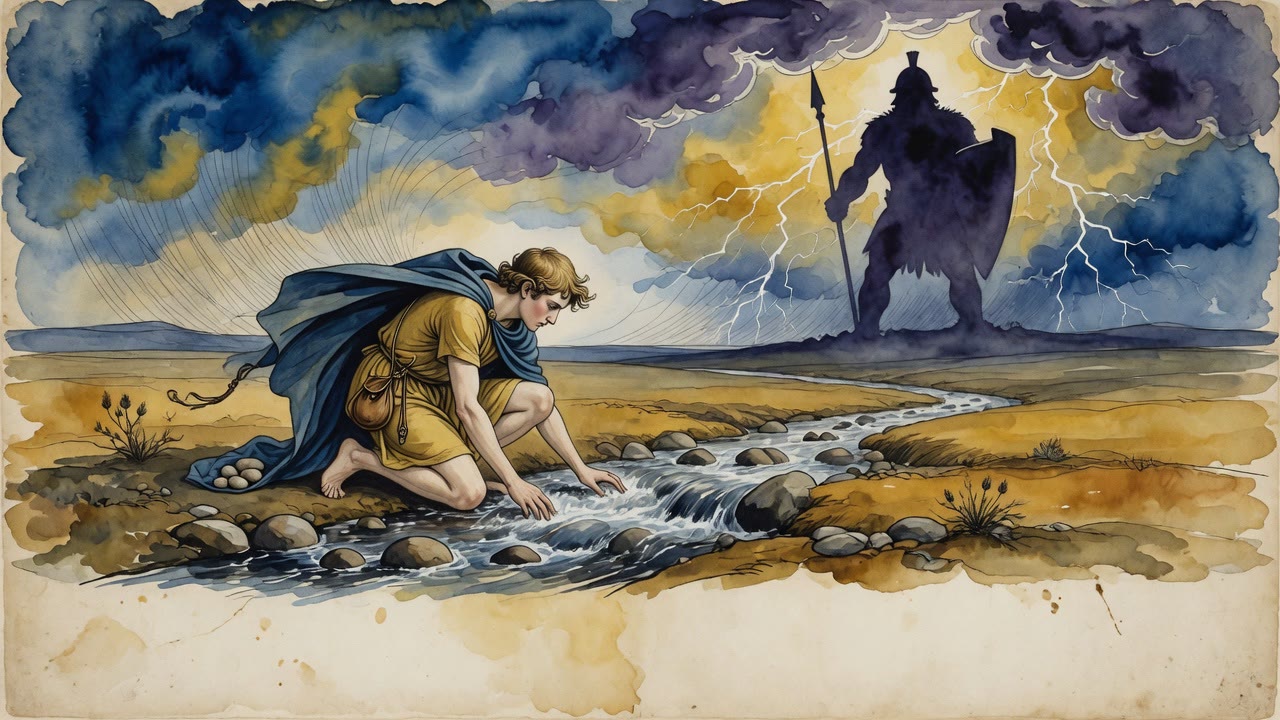
The brook was running at the bottom of the valley, small and unconcerned with the armies on either side. David bent down and chose five smooth stones. They were not random pebbles. One was for the name of the Holy One, blessed be He. One was for Aaron the priest. Three were for Abraham, Isaac, and Jacob, the fathers of the world.

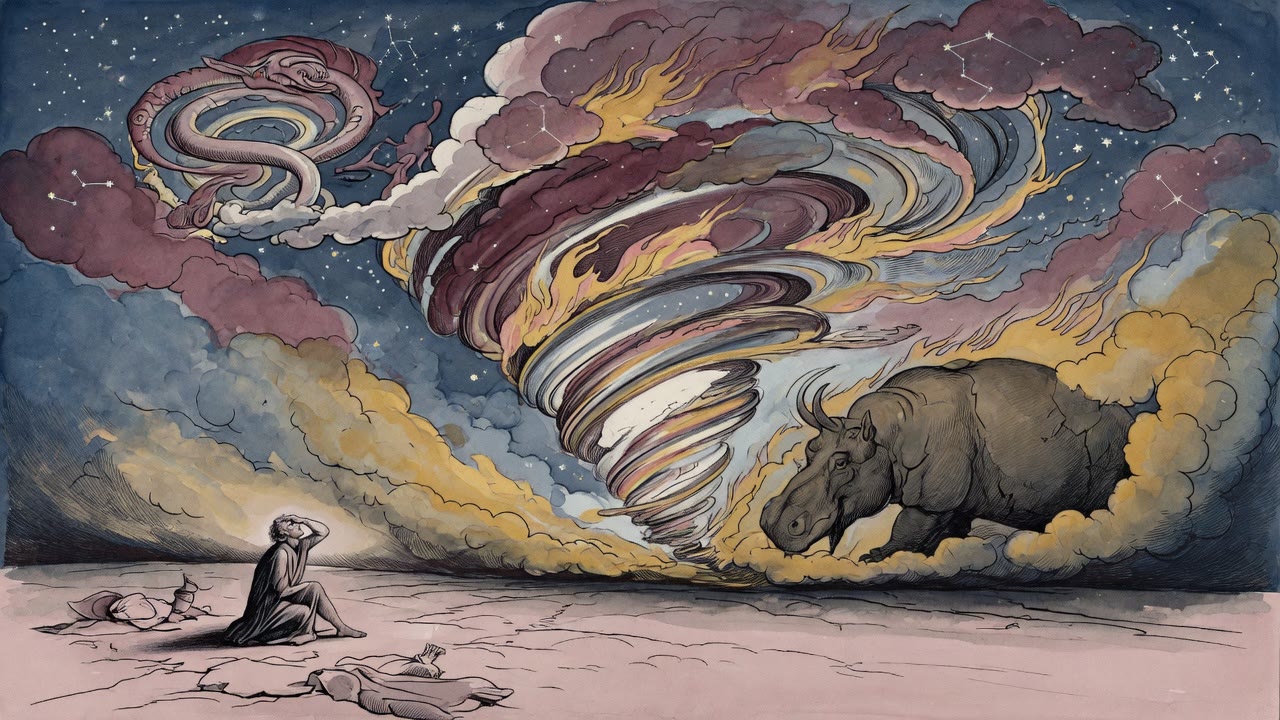
A quarrel of love rose around the giant's fate. Aaron pressed forward as avenger of blood. The Holy One answered that Goliath had reviled before Him, so the reckoning belonged to Him. Creation did not wait for the argument to finish. The stones gathered themselves into David's hand, because the world itself was tired of hearing God's name dragged through the dust.

Below the surface, the five stones were also more than stone. The life-force of the worlds pressed into them, and the sling became holy kingship in the shepherd's hand. A small leather pouch held a map of power no bronze helmet could read.

The Giant Left One Place Bare

Goliath came forward as a wall that could speak. Helmet, scale armor, leg guards, spear, javelin, shield-bearer. He had covered everything a soldier knows to cover. He had not covered the forehead.

That bare place waited like a door pride had forgotten to close. Goliath looked at the staff in David's hand and mocked him as if he were a dog. He cursed the boy by his gods. David answered with the Name, not with a heavier weapon. Sword and spear were standing on one side. The Lord of Hosts stood on the other.

For a breath, the valley became narrower than a throat. The armies watched. The brook kept moving behind him. David put one stone in the sling.

The Stone Sank Like a Seal

The sling turned. The stone flew.

It did not glance off. It did not merely cut skin. It sank into Goliath's forehead the way a finger presses into dough, the way a seal goes down into a soft cake and leaves its mark. Six cubits and a span of giant body lost its command over the valley in a single blow.

Goliath fell forward, face to the ground. Mercy was inside even that collapse, because David did not have to stare at the dead face towering over him. Judgment was inside it too, because the mouth that had reviled the living God was stopped in dust. The giant who had shouted upward ended with earth packed against his lips.

Dagon Fell Into the Dust

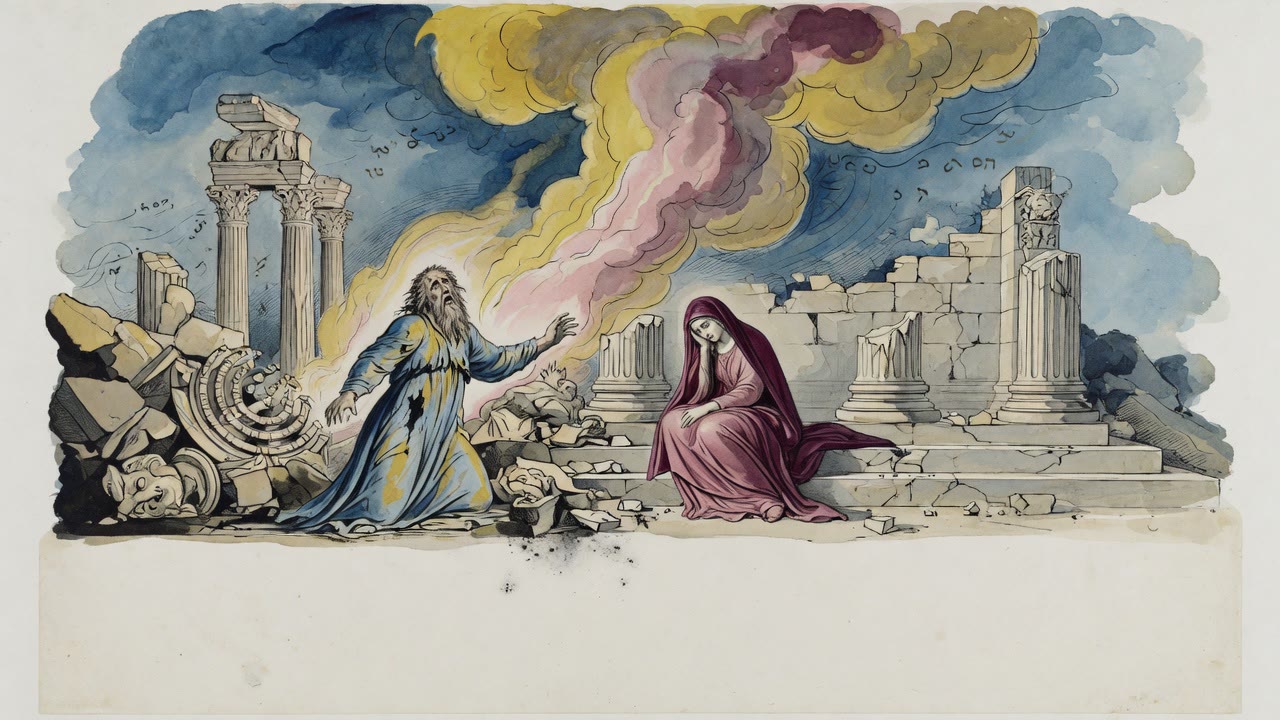
There was another weight on the giant's chest. Dagon hung there, an idol close to the heart that had trusted armor more than heaven. When Goliath fell forward, the idol fell with him. The god he carried was driven into the ground under the body that carried it.

David ran. The sword that had looked too large for a shepherd became useful only after the stone had done its work. He drew it, severed the giant's head, and the stillness broke. Israel moved. The Philistines ran. Saul's camp, which had spent forty days swallowing insult, suddenly had legs again.

One stone had struck the forehead, but the other four still rested in the pouch. They kept their silence. Goliath was down, not the whole line of giants. David's hand had opened the first breach, and Israel's future would have to finish what the brook had already counted.


← All myths
From the tradition

Sources

4 sources

The texts this telling draws on, in full. Open a card to read inline, or expand it for a wider, quieter read.

Midrash Shmuel 21:1Midrash Shmuel

"And Saul clothed David with his garments, and he put a helmet of bronze upon his head, and he clothed him with armor" (1 Samuel 17:38). The armholes were found to be neither hanging too low nor drawn up too high. When Saul saw this, his face grew dark. When David saw that Saul's face had grown dark, what did David say to him? "And David said to Saul: I cannot go with these, for I have not tested them," and so forth (1 Samuel 17:39).

"And he took his staff in his hand, and he chose for himself five smooth stones from the wadi" (ibid., verse 40): one for the name of the Holy One, blessed be He; and one for the name of Aaron; and three for the three patriarchs of the world. Aaron said: Am I not the avenger of blood? It is upon me to exact payment from him. The Holy One, blessed be He, said: But did he not blaspheme and revile before Me? It is upon Me to exact payment from him. And in the Yalkut (ibid.): Rabbi Yehoshua of Sikhnin in the name of Rabbi Levi: the stones were gathering themselves of their own accord.

"And the Philistine looked and saw David, and he despised him" (ibid., verse 42). Rabbi Yudan said: he desired him, for David was "ruddy, with beautiful eyes" (ibid.).

Full source
Antiquities VI.7-8Antiquities of the Jews (Josephus)

Samuel delivered God's command to Saul without ambiguity: destroy the Amalekites completely. Every man, woman, child, and animal, total annihilation as divine punishment for what Amalek had done to Israel during the Exodus. Saul assembled four hundred thousand soldiers plus thirty thousand from the tribe of Judah, set ambushes along the rivers, and crushed the Amalekite army. He burned their cities. He killed the women and children, as ordered.

He kept one thing alive: Agag, the Amalekite king, whose beauty and stature impressed him. The soldiers, too, kept the best livestock for themselves. Everything worthless they destroyed. Everything valuable they spared. It was selective obedience, which is to say, disobedience.

God told Samuel he regretted making Saul king. Samuel prayed all night for reconciliation. God refused. When Samuel arrived at Gilgal the next morning, Saul ran to embrace him, declaring he had fulfilled every command. Samuel's reply was devastating: "Then why do I hear sheep bleating and cattle lowing?" Saul blamed the people. Samuel cut him off with words that would echo through all of Israelite theology: God does not delight in sacrifices but in obedience. To obey is better than any burnt offering. Your kingdom will be torn from you and given to a better man.

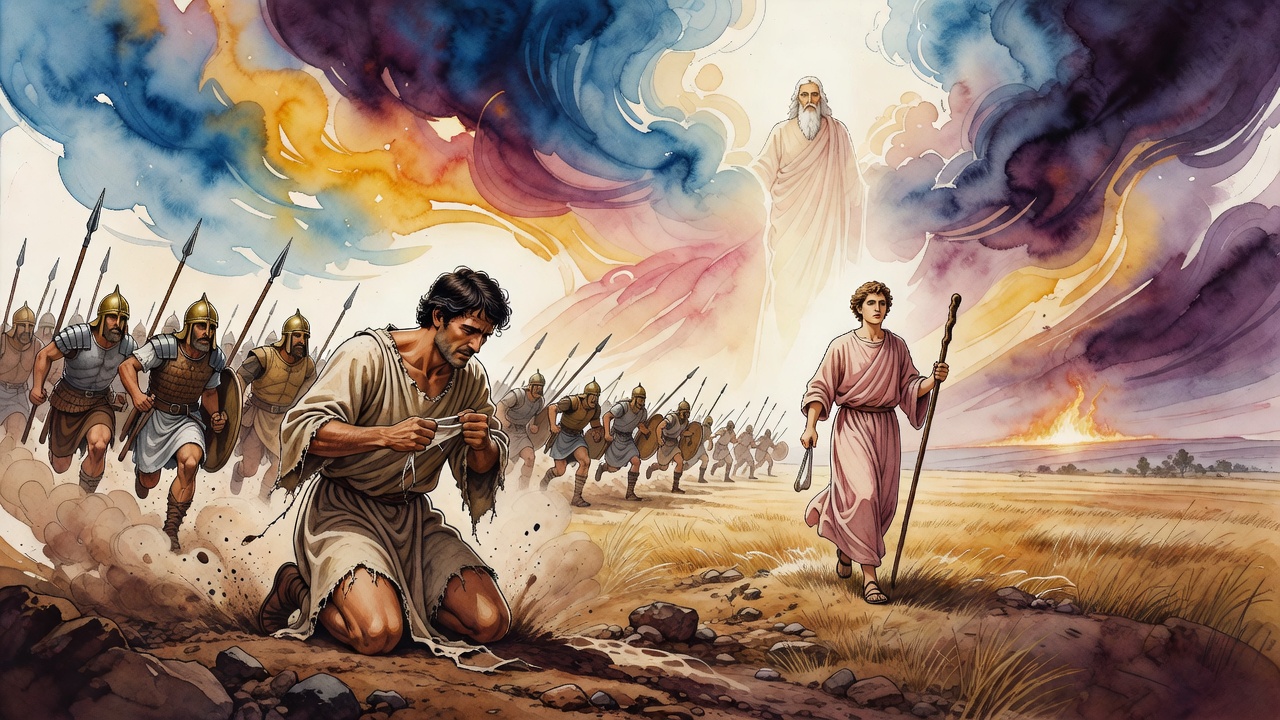
As Samuel turned to leave, Saul grabbed his cloak so desperately that it ripped. And Samuel said the kingdom would be ripped from him in exactly the same way. Then Samuel had Agag brought before him. The Amalekite king asked, trembling, "Surely the bitterness of death has passed?" Samuel answered: "As your sword made mothers childless, so shall your mother be childless." He executed Agag at Gilgal and never saw Saul again.

God then sent Samuel to Bethlehem, to the house of Jesse. Seven sons paraded before the prophet, tall, handsome, impressive. God rejected every one. "Man looks at outward appearance," God said, "but I look at the heart." The youngest, David, a ruddy-faced shepherd boy, was called in from the fields. Samuel anointed him in secret. The divine spirit left Saul that very day and settled on David, who began to prophesy. And a darkness, strange, demonic, suffocating, descended on the rejected king, who could find relief only when a young harpist from Bethlehem played music in his chambers.

Full source
Midrash Shmuel 21:4Midrash Shmuel

"And David put his hand into the bag and took from there a stone and slung it [and the stone sank into his forehead]" (1 Samuel 17:49). Yehudah bar Rabbi said: like into dough. And similarly, "and it crushed all their bones" (Daniel 6:25). Yehudah bar Rabbi said: like these pastilim (pressed cakes).

"And he fell upon his face to the ground" (1 Samuel 17:49), so that righteous one would not be troubled; his height was six cubits and a span.

Another interpretation: why "he fell upon his face to the ground"? Rather, so that the mouth that reviled and blasphemed would be buried away, as it is written, "Hide them in the dust together; bind their faces in the hidden place" (Job 40:13).

Another interpretation: why "and he fell upon his face to the ground"? Because Dagon his god was placed upon his heart, to fulfill what is said, "upon the carcasses of your idols" (Leviticus 26:30), and to fulfill, "and you shall tread upon their high places" (Deuteronomy 33:29). [And it is written:] "And it came to pass, when they brought out these kings to Joshua… that they drew near and set their feet upon their necks" (Joshua 10:24).

Full source
Tikkunei Zohar 123:12Tikkunei Zohar

The familiar story is this: David, armed with only a sling and some stones, takes down the Philistine warrior. But what if there was more to it than just a lucky shot? What if this seemingly simple act was actually a powerful allegory, a symbolic representation of something much deeper?

The Tikkunei (spiritual repair) Zohar, a later addition to the Zohar, that foundational text of Kabbalah, offers a fascinating interpretation. It explores the mystical significance of those five smooth stones David chose from the brook. These aren't just any pebbles; they represent something vital.

In Tikkunei Zohar, these five stones represent the Yesod, the "life-force of the worlds" (ḥaiy almin). Yesod, in Kabbalistic terms, is the sefirah (a divine emanation), or divine attribute, that channels divine energy and connects to Malkhut (Sovereignty).

Where does David place these stones? In his sling, which represents the holy Malkhut. Malkhut, often translated as "kingdom," is the final sefirah on the Kabbalistic Tree of Life, associated with the Shekhinah, the divine feminine presence, and the physical world. When David places the stones in the sling, they become one within Her. It’s a potent image of unification and focused power.

Then comes the crucial moment: the stone sinks into the forehead of the Philistine and kills him. The Tikkunei Zohar connects these five stones to the most central declaration of Jewish faith: the Shma. You know it: "Hear, O Israel: YHVH is our God, YHVH is One" (Deut. 6:4). The unpronounceable name of God, YHVH, appears twice in this verse, along with Eloheinu, "our God." These components, the text suggests, are the five stones.

Now, here’s where it gets really interesting. The Tikkunei Zohar says that when you place these "stones", these divine names, in the sling, which is the "lip of the mouth," you should make them all "One" (Eḥad). In other words, the act of reciting the Shma, of declaring God's oneness, is a powerful act of unification. It's like loading the sling with divine energy.

The Tikkunei Zohar takes this idea even further, connecting it to a future messianic age. It says that when the Holy One, blessed be He, is victorious over all the nations of the world, the prophecy of (Zephaniah 3:9) will be fulfilled: "For then I will change the speech of the peoples to a pure speech, that all of them may call on the name of the Lord and serve him with one accord." This "pure language" (saphah) is, the Shekhinah. And here's a neat numerical trick: the Hebrew word saphah, meaning "language" or "lip," has a numerical value of 385 – the same as Shekhinah!

So, what does it all mean? Is it just a complex word game? Perhaps. But it also points to something profound. The story of David and Goliath, through the lens of Kabbalah, becomes a story about the power of faith, the unification of divine energies, and the potential for transformation. It suggests that even the smallest of us, armed with the power of belief and the declaration of God's oneness, can overcome seemingly insurmountable obstacles. Just like David, we all have the potential to access the power of Yesod, to load our slings with divine intention, and to speak words that can change the world.

Full source