5 min read

Deborah Judged Under a Palm Tree and Then Won a War

Israel's only female judge sat under a palm tree and handed down rulings, then sent a reluctant general to face Sisera's nine hundred iron chariots.

Curated by Arthur · Told by Maggid ·
Table of Contents
  1. The Palm Tree as Court
  2. Sisera's Iron Chariots
  3. The River and the Hailstorm
  4. The Song Deborah Sang

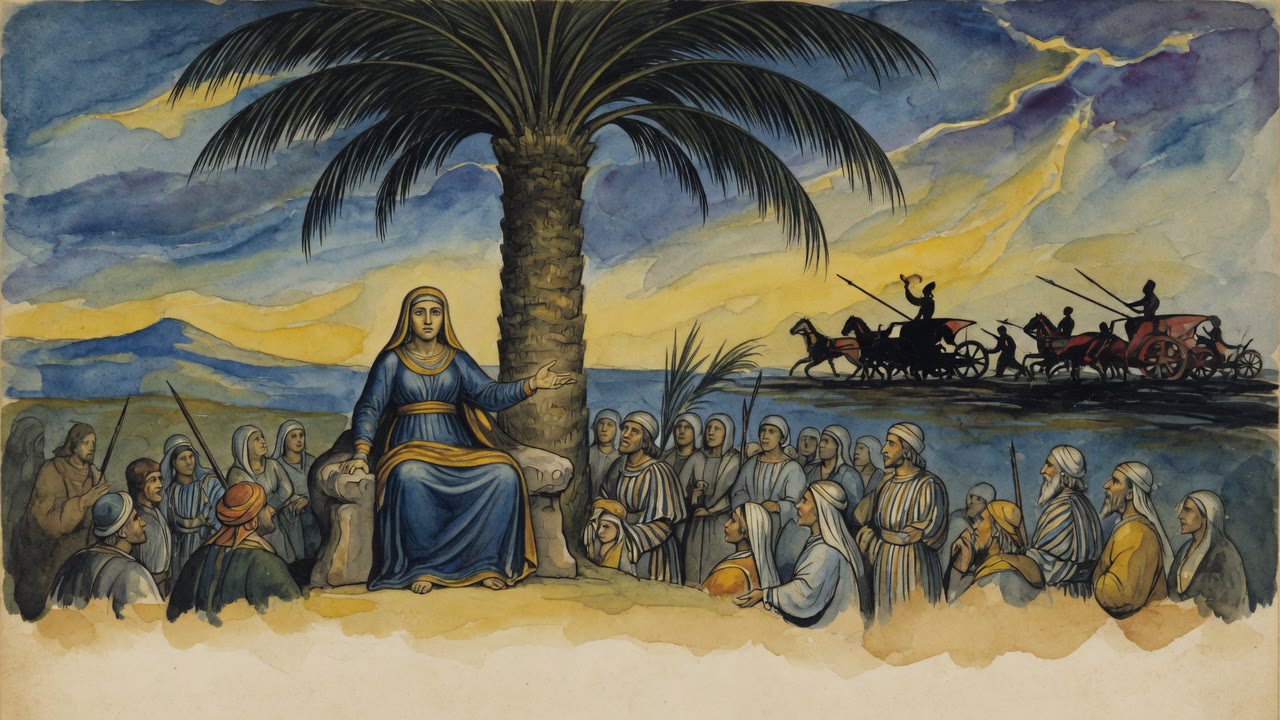
Deborah did not need a throne. She had a palm tree, and Israel came to her there. Judges calls her a prophetess, a judge, and the wife of Lappidot. She sat between Ramah and Bethel in the hill country of Ephraim and held court, and the people climbed the mountain to bring their disputes before her because heaven had given her a voice and Israel trusted it.
The Palm Tree as Court

The palm mattered in the way the tradition told it. Deborah judged in the open air, in a place anyone could see from a distance. There was no closed room that could be mistaken for a private consultation, no secrecy attached to the judgment. She was not operating on borrowed authority or stepping into a man's space while he was absent. She had built her court under a living tree, and the tribes walked up to her because judgment was already hers.

The tradition added a detail about the palm itself. Deborah owned it. She had planted it, tended it, and worked under it for decades. The same woman who had lamps burning in the Tabernacle at Shiloh, so that the light of the sanctuary could be seen from a distance, now worked beneath a tree she had raised. Both gestures were the same gesture: tending the light, keeping something alive so others could find their way to it.

Sisera's Iron Chariots

Jabin, king of Canaan, had oppressed Israel for twenty years. His commander Sisera controlled the army, and the army had nine hundred iron chariots. The Israelites had been so thoroughly defeated that they paid tribute to survive. When they finally turned and cried out, Deborah received the answer from God and summoned Barak of Naphtali.

Josephus put the scale of the Canaanite force at three hundred thousand infantry, ten thousand cavalry, and three thousand chariots. Whatever the exact numbers, Barak heard the command to take ten thousand men to Mount Tabor and looked at the gap between what he had and what he was facing, and refused to go unless Deborah came with him. She agreed to come but told him plainly that the honor of killing Sisera would not go to him because of his hesitation. A woman would take that honor.

The River and the Hailstorm

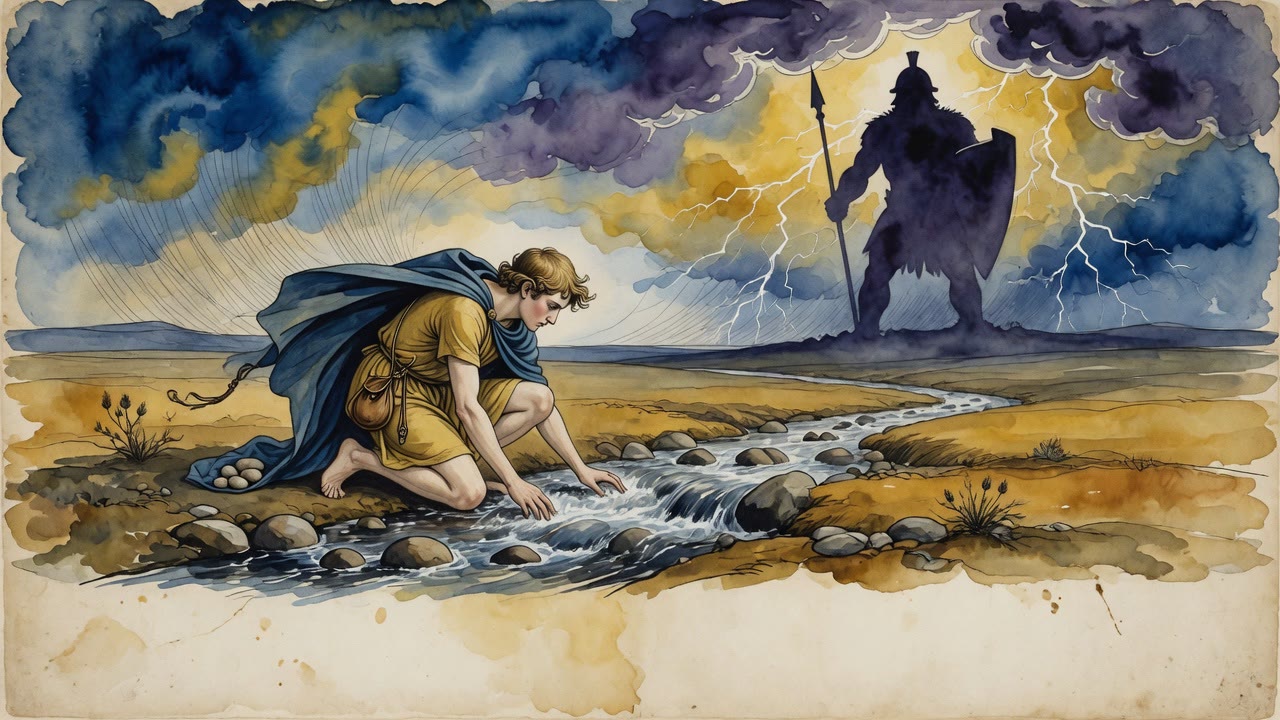
The battle itself was not won by human strength alone. God sent a fierce tempest, hail and rain and lightning, into the faces of Sisera's forces. The chariots that had been the source of Canaanite power became a liability in the mud of the Kishon valley. The river rose. The horses could not hold position. The chariot drivers were blinded by the weather coming at them from the direction of the Israelite line. The thirty-one kings who had gathered behind Sisera, the unconquered remnant of the Canaanite alliance that Joshua had not finished in his own generation, broke and ran.

Sisera left his chariot on foot and fled to the tent of Jael, wife of Heber the Kenite, whose clan was at peace with Jabin. He asked for water. She gave him milk. He asked her to stand at the tent door and tell any searcher he was not there. She covered him and waited until he fell asleep, then drove a tent peg through his temple into the ground. When Barak arrived still hunting the commander, Jael met him at the tent door and showed him the body. The honor went exactly where Deborah had said it would go.

The Song Deborah Sang

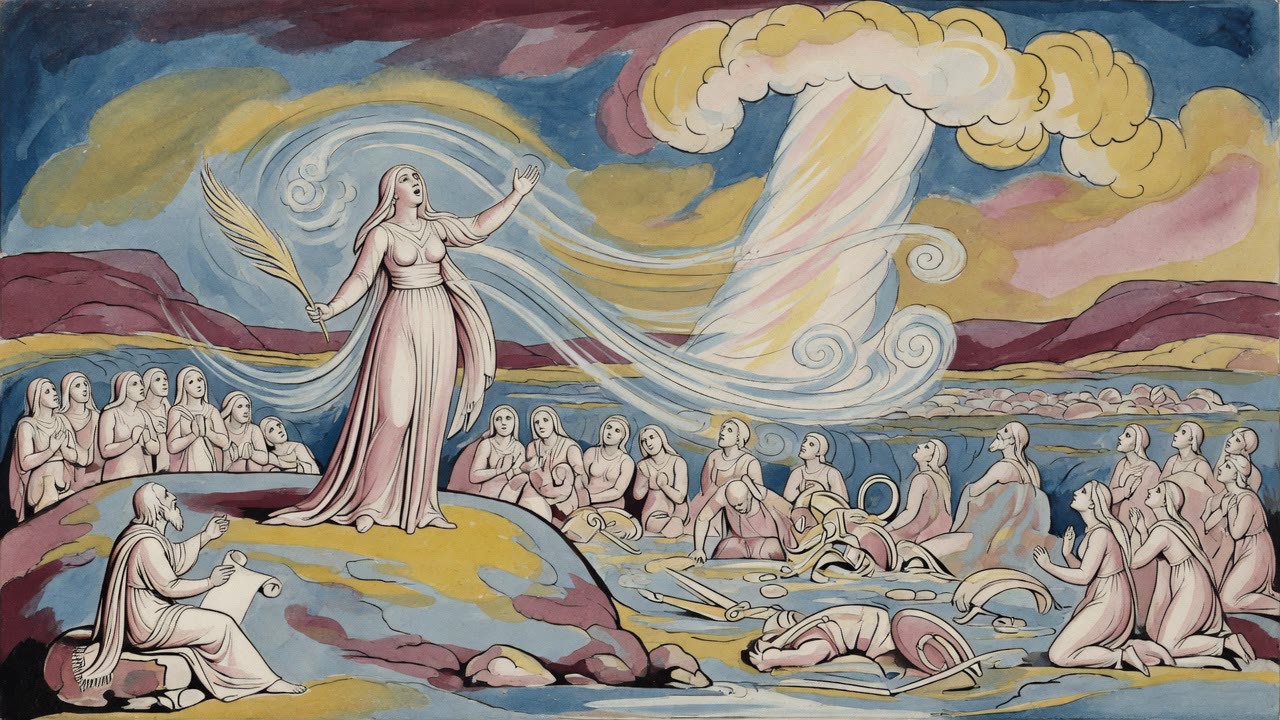
Deborah and Barak composed a song after the victory and sang it together. The tradition treated this as one of the great moments of praise in all of Israel's history, linking the battle victory to the whole arc of the people's story from Abraham forward. The song named the stars themselves as having fought for Israel. It named the river Kishon as an ancient river, a river of battles. It named Jael with a blessing louder than the blessing on the matriarchs.

Deborah led Israel for forty years. When she died, her last instruction was that the living must stand on their own. While they are alive, their prayers can help. After death, do not lean on the dead. Israel was on its own again.


← All myths

From the tradition

Sources

5 sources

The texts this telling draws on, in full. Open a card to read inline, or expand it for a wider, quieter read.

Legends of the Jews 2:47Legends of the Jews

Sometimes, out of that chaos, heroes rise.

We've been talking about Deborah, one of the great judges and prophets of Israel. Can you It's incredible. Remember that Deborah, along with Barak, led the Israelites to a stunning victory against Sisera and his Canaanite army. A truly decisive moment.

What do you do after such a victory? You sing! Deborah and Barak, overflowing with gratitude, intoned a song of praise. A song thanking God for delivering Israel from the clutches of Sisera. It wasn't just a victory song, though. It was a retelling of their history, a reminder of God's unwavering presence in their lives, stretching all the way back to Abraham himself. It was a way of rooting themselves back in their story, to understand that this triumph was part of something bigger. This song isn't recorded in Legends of the Jews itself, but rather in the Book of Judges (Judges 5). Ginzberg is merely summarizing the biblical text.

Deborah didn't just disappear after the victory. She continued to work for the well-being of her people for forty long years. Forty years! kind of dedication. Imagine the wisdom she accumulated, the lives she touched.

But even the greatest leaders eventually pass on. And when Deborah's time came, her last words were powerful, a final lesson for her weeping people. She urged them not to depend on the dead. Strong words. She told them, plainly, "They can do nothing for the living."

Why would she say that?

Well, she went on to explain. As long as you are alive, your prayers have power, both for yourself and for others. But once you're gone, that power is gone too. Now, this isn't a dismissal of mourning or remembrance. It’s something deeper. It's about agency. It's about responsibility. It's about focusing on the present and the living. Deborah, even in her final moments, was teaching her people a vital lesson: Don't rely on the past, on those who are no longer here, to solve your problems. The power to change, to improve, to pray, resides within the living.

It's a poignant message, isn’t it? A reminder that we each have a role to play, that our actions in this life matter. So, what will we do with our time, with our prayers, with our power? What will our legacy be? Deborah challenges us, even now, to focus on the present, to act with purpose, and to remember that the ability to make a difference lies within each of us, while we are still here.

Full source
Antiquities V.5-6Antiquities of the Jews (Josephus)

Three hundred men with clay jars and torches routed an army of over a hundred thousand. That is the story of Gideon, and according to Josephus, God designed it specifically so that no one could credit the victory to human strength.

First came Deborah. After Ehud's death, Israel fell back into lawlessness, and Jabin, king of the Canaanites, enslaved them for twenty years. His general Sisera commanded three hundred thousand infantry, ten thousand cavalry, and three thousand chariots. The Israelites were so thoroughly beaten they had to pay tribute just to survive. When they finally repented, they turned to Deborah, a prophetess whose name, Josephus notes, means "bee" in Hebrew (Devorah, דבורה). She declared that God had chosen Barak of the tribe of Naphtali as their general. Barak refused to go unless Deborah came with him. She agreed, but told him the glory of the kill would belong to a woman.

Ten thousand Israelites faced Sisera's massive force at Mount Tabor. Then God intervened. A violent storm crashed down, rain, hail, wind driving directly into the Canaanites' faces. Their archers couldn't see. Their swords were too cold to grip. The Israelites, with the storm at their backs, cut through them. Sisera fled on foot to the tent of Jael, a Kenite woman, who offered him shelter and sour milk. He drank until he fell asleep. Then she took an iron nail and hammered it through his temple into the ground (Judges 4:21). When Barak arrived, she showed him Sisera, pinned to the earth. Victory by a woman, exactly as Deborah had promised.

Forty years of peace followed. Then, after Deborah and Barak died, the Midianites and their Amalekite and Arabian allies devastated Israel for seven years. They burned crops at harvest and left the fields alone only in winter, letting the Israelites do the hard work of plowing, then stealing everything they grew. The people were reduced to hiding in caves and underground hollows, starving.

Gideon, from the tribe of Manasseh, was secretly threshing wheat in a winepress, too afraid to use the open threshing floor, when an angel appeared and told him he was chosen to deliver Israel. Gideon protested. His tribe was small. He was young and insignificant. The angel insisted. Ten thousand volunteers assembled, but God ordered Gideon to thin the ranks. He brought the soldiers to a river. Those who knelt and drank carefully were sent home. Only the three hundred who scooped water hastily with their hands, too eager to fight to kneel, remained.

That night, Gideon divided his three hundred into three companies. Each man carried an empty clay pitcher hiding a lit torch, and a ram's horn. At the fourth watch of the night, they surrounded the Midianite camp and gave the signal. Three hundred pitchers shattered at once. Three hundred torches blazed in the darkness. Three hundred horns screamed. The Midianites, jolted from sleep, panicked. In the chaos and the dark, they turned on each other, unable to distinguish friend from enemy because of the many different languages spoken among their allied forces. The slaughter was catastrophic. One hundred and twenty thousand soldiers died, many by their own comrades' swords. Gideon pursued the survivors, captured the Midianite kings Zeba and Zalmuna, and executed them. Israel begged him to become their ruler. He governed for forty years and was buried in his homeland of Ophrah.

Full source
Legends of the Jews 2:42Legends of the Jews

Their task? It was not slight. In fact, according to Legends of the Jews, it was comparable to Joshua's entire conquest of Canaan! Now, you might remember Joshua. He took on the land of Canaan and defeated thirty-one kings. But here's the thing: he only defeated half of them. The other thirty-one were still out there, causing trouble. And guess who was leading them? The fearsome Sisera.

Ginzberg, in Legends of the Jews, tells us these unconquered kings amassed a staggering force. Arrayed against Deborah and Barak. So how did they stand a chance?

Well, like so many stories in Jewish tradition, the answer is: with a little help from above. As the tale goes, God aided Israel with both water and fire.

The Kishon – that’s the river we’re talking about here – and “all the fiery hosts of heaven” joined the battle. Except for the star Meros, that is. The Kishon, it turns out, had a long-standing appointment to play a crucial role in Sisera's downfall. But how does a river get involved in divine promises, you ask?

This is where it gets really interesting. The story goes that when the Egyptians were drowning in the Red Sea, God commanded the Angel of the Sea to cast their corpses onto the land. Why? So the Israelites could see the destruction of their enemies and wouldn't later doubt that the Egyptians had truly perished.

But the Angel of the Sea wasn't thrilled. He complained about having to give up a "gift," as we learn from Ginzberg. So, God promised compensation. The Kishon was offered as security, pledging to deliver half as many bodies again as the Angel of the Sea was giving up at the Red Sea. A divine IOU, if you will!

So, when Sisera's troops sought refuge from the scorching heavenly fire in the cool waters of the Kishon, God commanded the river to redeem its pledge. According to Legends of the Jews, the river rose up and swept the heathen down into the Sea. And the fishes in the Sea, well, they exclaimed, "And the truth of the Lord endureth forever!"

A pretty dramatic ending. The river Kishon, fulfilling its ancient promise, washing away the enemies of Israel. A reminder that even seemingly inanimate objects can play a part in the divine plan. A reminder that sometimes, the most unlikely allies can rise to meet the challenge. And maybe, just maybe, a hint that even when things seem impossible, the universe might just be on your side.

Full source
Chronicles of Jerahmeel LVIIIChronicles of Jerahmeel (Gaster, 1899)

The period of the Judges was an era of divine intervention so direct that storms fought battles and fires executed corrupt leaders. According to the Chronicles of Jerahmeel, a 12th-century Hebrew chronicle translated by Moses Gaster in 1899, the cycle of sin and salvation repeated itself in increasingly dramatic fashion.

Ehud followed Othniel as judge, and during his time the ancient world was being reshaped. Cities were built across the Mediterranean, ships were launched for the wheat trade, and Troy rose in Dardania. Then came Shamgar, followed by Deborah and Barak, who faced Sisera and his massive chariot army. God did not leave the fighting to Israel alone. He sent a fierce tempest that overwhelmed Sisera's forces with hail, blinding rain, lightning, and thunder. The charioteers could not stand. They fell by the sword in confusion.

Sisera fled on foot and took refuge in the tent of Jael, wife of Heber the Kenite. When he fell asleep, Jael drove a tent peg through his temple. Gideon came next, defeating the Midianites with his famous 300 men. But after Gideon's death, his son Abimelech murdered seventy of his own brothers on a single stone to seize power. Only Jotham, the youngest, escaped.

The most shocking episode belonged to Yair, who judged Israel for twenty-two years. Yair built a sanctuary to Baal and commanded all Israel to worship it. Seven righteous men refused, invoking Moses' warning against idolatry. Yair ordered them burned alive. But the fire swerved away from the seven men and instead consumed Yair's own servants. The seven walked out unharmed, while everyone around them was struck blind. Then the flames reached Yair's own house, and God's voice declared: "I promoted you to judge Israel, but you corrupted the people and burned those who remained faithful to Me. They shall live, and you shall die." The fire consumed Yair, his household, Baal, and 10,000 of Baal's followers.

Full source
Legends of the Jews 2:45Legends of the Jews

Sometimes, the most poignant stories are found in the aftermath, in the echoes of what was.

Let's rewind to the story of Barak and Sisera. You remember the story. Sisera, the commander of the Canaanite army, utterly crushed by Barak and Deborah.

What happened to Sisera's body? It's a detail often overlooked, but it speaks volumes.

Barak, victorious but also keenly aware of the psychological impact of war, took charge of Sisera's remains. According to Legends of the Jews, as retold by Louis Ginzberg, Barak sent Sisera's body to his mother, Themac.

But it wasn't just the body he sent. He sent a message too. A pointed one.

"Here is thy son," the message said, "whom thou didst expect to see returning laden with booty." Ouch.

Why such a cutting message? What motivated Barak to add insult to injury?

It all goes back to a vision – a conjured image, no less. As Ginzberg tells it, when Sisera went off to war, Themac and her ladies-in-waiting engaged in some… well, let's call it "spiritual forecasting." Through their "conjuring tricks," they saw Sisera in a vision, lying on the bed of a Jewish woman.

What did they interpret that to mean? Not what you might think. They figured he'd be returning with Jewish captives. Trophies of war.

"One damsel, two damsels for every man," they supposedly said, envisioning the spoils. As we find in the Book of (Judges 5:30), “Are they not finding and dividing the spoil?. A maiden or two for every man, spoil of dyed stuffs for Sisera, spoil of dyed stuffs embroidered, dyed stuffs embroidered and piled high for neck.”

So, you can imagine the crushing disappointment when, instead of a triumphant hero surrounded by captive women, Themac received her son's lifeless body.

She uttered no less than a hundred cries over him. A hundred cries! Can you hear them? A lament echoing the shattered expectations of a mother and her court.

It's a stark reminder that war isn't just about battles and victories. It's about the human cost, the dashed hopes, and the enduring grief that ripples through families and communities long after the fighting stops. It’s a reminder that even in victory, there’s often a deep well of sorrow.

Full source