6 min read

God Answered Job From the Whirlwind Without Explaining

Job demanded an answer from heaven, but God answered from the storm without explaining, with stars, beasts, Behemoth, and Leviathan.

Curated by Arthur · Told by Maggid ·
Table of Contents
  1. The Storm Refused the Courtroom
  2. The Sea Had Doors
  3. The Stars Were Bound by Hands Job Never Saw
  4. The Monsters Rose From the Deep
  5. Job Put His Hand Over His Mouth

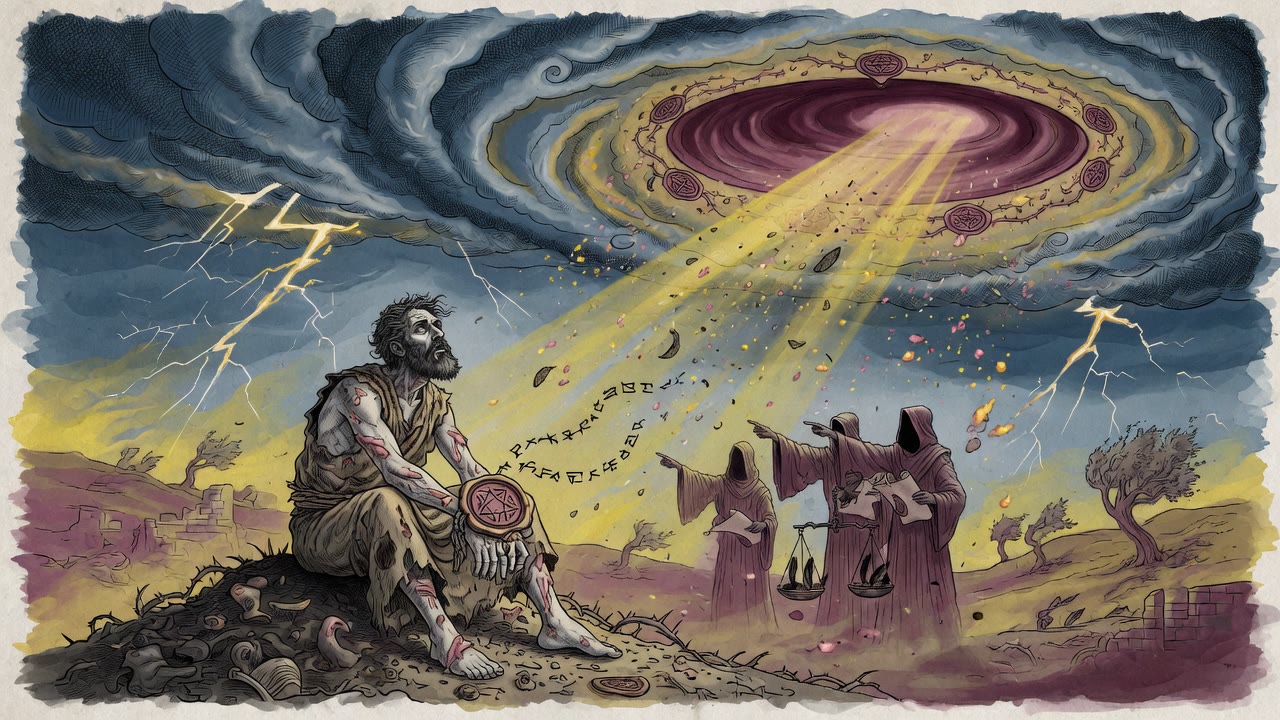
Job wanted a trial. He had sat long enough in the ashes. His friends had weighed him, judged him, and wrapped accusation in the language of comfort. He wanted God to appear, to name the charge, to explain why a righteous man could be stripped down to sores and graves.

The sky answered with a storm.

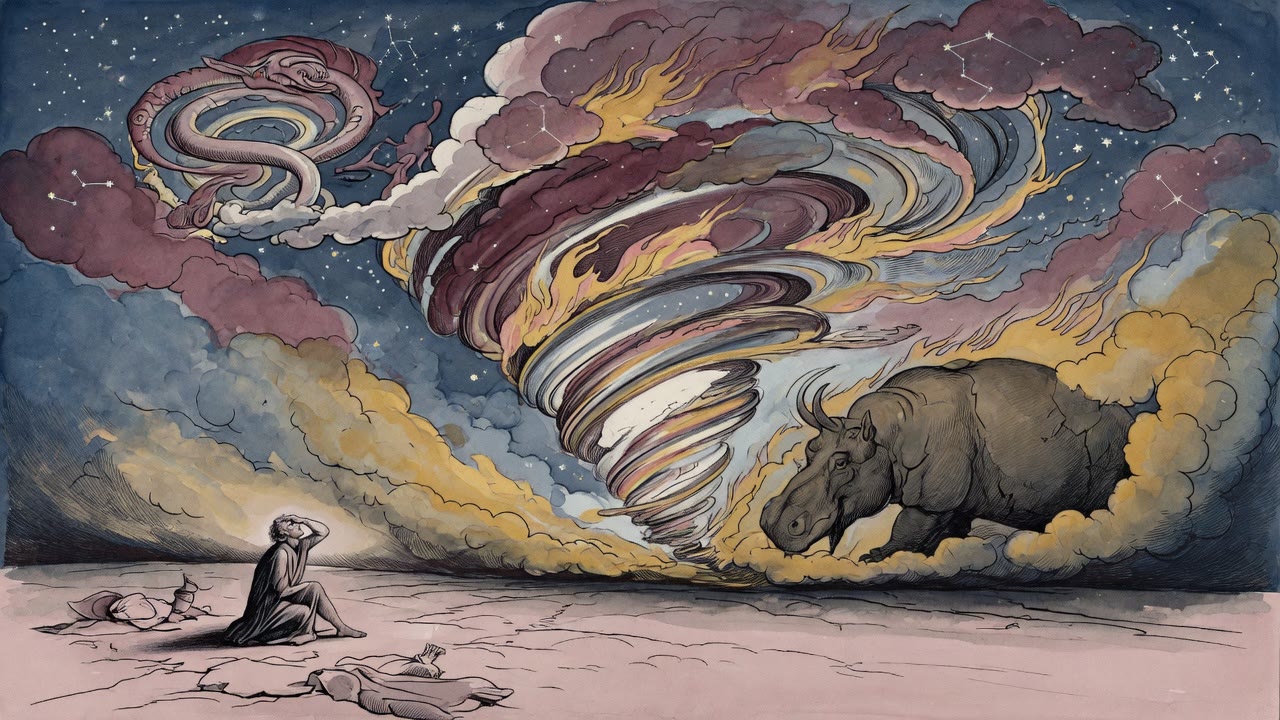
Out of the whirlwind came no apology, no ledger, no secret file opened at last. A voice broke through the weather and demanded strength from the man on the ash heap. Stand like a warrior. Answer if you can.

The Storm Refused the Courtroom

Job had built his case with the only facts he had. Children dead. Wealth gone. Body ruined. Friends certain. God silent. His suffering stood before him like a sealed decree, and he wanted the seal broken.

The whirlwind did not accept his courtroom. It moved him to a construction site older than any human grief.

Where were you when the earth's foundations were laid? Who stretched the measuring line across it? Where did its sockets sink? Who set the first stone while the morning stars sang and the divine beings shouted together?

The questions came like hammer blows, but they were not mockery. They dragged Job from the ash pile to the rim of creation. The world beneath his wounded feet had once been measured, founded, sung over. Before his house fell, before raiders crossed his fields, before boils climbed his skin, there had been a beginning so vast that even angels answered it with song.

Job had asked for the reason of pain. The storm showed him a world whose first beam he had never seen.

The Sea Had Doors

The voice turned from earth to water. The sea was not a blue surface spread politely under the sky. It was a birth, a force bursting from the womb, wrapped in cloud like swaddling cloth and held back by doors God had set in place.

So far, and no farther.

The line mattered. The sea wanted to run. It had to be bounded. Dawn had to be commanded by its place. Darkness had storehouses. Snow and hail had treasuries. Rain fell on wilderness where no human farm waited to receive it. Grass rose where no one stood to bless the growth.

Job's pain had made the universe feel like a narrow room with no exit. The whirlwind tore the roof away. Somewhere beyond his village, wild land drank rain that no person owned. Somewhere beyond his argument, light and dark obeyed borders he had never drawn.

The world was not smaller than his suffering. It was larger, stranger, and less centered on human accounting than his friends had dared imagine.

The Stars Were Bound by Hands Job Never Saw

The voice lifted him higher. Could he bind the chains of the Pleiades? Could he loosen Orion's belt? Could he bring out the constellations in their seasons or guide the Bear with her children?

Job had no rope for the stars.

He had no command over the mountain goats when they crouched to give birth, no schedule for the wild deer, no bridle for the wild donkey that laughed at city noise and refused the driver. The ostrich beat her wings and left her eggs in the dust. The horse pawed the valley and rushed toward the clash of weapons. The hawk stretched south. The eagle nested high and fed her young with blood.

Creature after creature entered the storm speech, each one alive outside Job's grievance and outside his friends' tidy justice. Not innocent props. Not moral examples lined up for a sermon. Beings with hunger, motion, terror, mating, birth, flight, and strange forms of wisdom.

Job had demanded the plan. God gave him the living map of a world that could not fit inside a single explanation.

The Monsters Rose From the Deep

Then the voice brought out the great beasts.

Behemoth stood with strength in his loins, bones like bronze, limbs like iron bars. He ate grass like an ox, but the hills yielded food for him and the river did not frighten him. Even if the Jordan rushed against his mouth, he trusted his size.

Leviathan was worse. No hook could master him. No merchant could bargain over him. His scales closed like shields. His sneezings flashed light. Smoke poured from his nostrils like a boiling pot. Behind him the deep churned white, as if the sea itself had grown old in his wake.

Job's sores remained. His dead remained dead. The whirlwind did not soften the facts. It placed beside them creatures no human court could subpoena, forces no human hand could tame, powers created and bounded by God alone.

The ash heap was real. So was Leviathan.

Job Put His Hand Over His Mouth

The friends had tried to defend God by shrinking the world. They made suffering a simple sentence: sin, punishment, case closed. The whirlwind shattered that little courtroom first. The earth had foundations Job did not lay. The sea had doors he did not hang. The stars had bonds he did not tie. Wild creatures lived beyond his use. Monsters breathed beyond his courage.

Job answered with less than he had planned. His speeches had been long. His reply became small.

I am dust, he said in effect. I spoke of things beyond me. He put his hand over his mouth.

That silence was not defeat before his friends. They were the ones rebuked. Their explanations had been too clean, too eager to protect heaven by crushing the sufferer. Job had spoken from pain, and God could answer pain. What could not stand was their false certainty.

The storm passed. Job remained alive. The answer had not solved the wound like a riddle. It had broken open the room around it, until grief stood under stars, beside sea doors, near the breath of monsters, in a creation too vast for the ash heap to govern and too watched for chaos to have the final word.


← All myths

From the tradition

Sources

4 sources

The texts this telling draws on, in full. Open a card to read inline, or expand it for a wider, quieter read.

Midrash Tehillim 72:4Midrash Tehillim

Midrash Tehillim, a collection of rabbinic interpretations on the Book of Psalms, offers a surprising answer, linking peace to…mountains. Yes, mountains!

"Let the mountains bring peace to the people, and the hills bring righteousness," it says, quoting Psalm 72. But wait a minute, do mountains actually bring peace?

The Midrash (rabbinic interpretive commentary) doesn't take things literally, of course. It dives deeper. It suggests that peace isn’t just a feeling; it's tied to our material reality, specifically, abundance. The text argues that scarcity breeds conflict. Imagine a time of famine. People are desperate. Resources are limited. Suddenly, that neighbor's vineyard looks a lot more tempting.

The Midrash illustrates this with a stark example: "When a person enters his friend's vineyard, he asks him, 'What are you doing in my vineyard?' and they argue with each other." – when resources are scarce, we become territorial, suspicious. We guard what little we have, leading to friction and ultimately, a lack of peace.

But flip the script. What happens when there’s plenty to go around?

"When there are many fruits," the Midrash continues, "there is goodwill in the world." Suddenly, that vineyard isn’t a source of anxiety, but a place of shared bounty. There’s enough for everyone. The Midrash then quotes (Zechariah 3:10): "In that day, each of you will invite his neighbor to sit under his vine and fig tree."

Imagine that scene: neighbors sharing food, stories, and companionship. That's the picture of true peace – a peace born not from treaties or declarations alone, but from a sense of shared prosperity and abundance. It’s a powerful idea, isn’t it? That the physical world, the "mountains" and "hills," can actually contribute to our inner and collective peace.

The Midrash doesn’t stop there. It connects this idea of peace and righteousness with divine judgment. "Judgment shall be done with justice," it states. And then Rabbi Yose bar Tachlifa adds a rather sobering thought: "Every day a person is judged, as it says (Job 7:18), 'You examine him every morning.'"

Wow. Every. Single. Day.

This isn't about a final judgment in some distant future. It's about the constant, ongoing evaluation of our actions, our intentions. Are we contributing to a world of abundance and peace? Or are we perpetuating scarcity and conflict? It’s a daily reckoning.

So, what does this all mean for us today? Perhaps it's a call to cultivate generosity, to share what we have, and to work towards a world where everyone has enough. Maybe true peace isn't just a lofty ideal, but a tangible goal that starts with how we treat our neighbors, how we share our resources, and how we live each and every day. What kind of "fruits" are we cultivating in our own lives, and in the world around us? And are those fruits leading to conflict or to an invitation to sit together, in peace, under the vine?

Full source
Job 38:1, 38:4-7Writings (Ketuvim)

Then the LORD answered Job out of the whirlwind, and said:

Where were you when I laid the foundations of the earth? Declare, if you have understanding.

Who set its measurements, if you know? Or who stretched the line upon it?

Upon what were its bases sunk? Or who laid its cornerstone,

when the morning stars sang together, and all the sons of God shouted for joy?

Full source
Legends of the Jews 3:3Legends of the Jews

Complaining about our lot in life seems almost… human. But what does Jewish tradition say about this very human tendency?

The Legends of the Jews, that incredible compilation by Rabbi Louis Ginzberg, includes stories and interpretations that explore the heart of this question. One passage really struck me – it speaks of a person complaining about suffering. And GOD, in turn, gently rebukes them.

It’s not a harsh condemnation,. More of a… cosmic perspective check.

The Almighty asks: "Why didst thou murmur when suffering came upon thee?" It's almost like a loving parent trying to help a child understand a difficult lesson. The text continues, "Dost thou think thyself of greater worth than ADAM?" Adam, the first human, the pinnacle of creation, who faced mortality because of one single act. And yet, "Adam murmured not."

Wow.

But it doesn't stop there. We're then asked if we consider ourselves more worthy than ABRAHAM, the patriarch tested beyond measure. Remember the covenant? God tells Abraham, “Know of a surety that thy seed will be a stranger in a land that is not theirs, and shall serve them; and they shall afflict them four hundred years" (Genesis 15:13). That's a heavy burden to bear! But Abraham, according to this legend, accepted it without complaint.

And what about MOSES? The man who led the Israelites out of Egypt, spoke directly to God, and yet was denied entry into the Promised Land because he momentarily lost his temper, uttering the words, "Hear now, ye rebels; shall we bring you forth water out of this rock?" (Numbers 20:10). Even Moses, with all his greatness, faced disappointment with quiet dignity.

Finally, the text turns to AARON. Aaron, the High Priest, who, according to the legend, was so revered that even the angels withdrew from the Holy of Holies when he entered. Yet, when his two sons died, a profound tragedy, he, too, remained silent in his grief.

What’s the takeaway here? It's not that we're forbidden from feeling pain or sorrow. It's that perspective matters. These figures, held up as paragons of faith and resilience, faced immense challenges. Their stories aren’t meant to shame us into silence, but to remind us that suffering is a part of life, even for the most righteous.

Maybe, just maybe, when we face our own trials, we can draw strength from their examples. Not by denying our pain, but by finding a deeper understanding of our place in the interplay of existence. Perhaps by acknowledging that even in our darkest moments, we are part of a lineage of individuals who faced adversity with faith and fortitude.

Full source
Legends of the Jews, II. The Sons Of Jacob, Job's SufferingLegends of the Jews

The story of Job, as amplified in Jewish legend, takes us to some truly harrowing depths. We know the basic outline from the Book of Job in the Bible, but the aggadah, the body of Jewish storytelling, really fleshes out the details in ways that are both terrifying and, ultimately, inspiring.

In Ginzberg's retelling in, Legends of the Jews, Satan wasn't content with simply taking away Job's possessions. He went all out. Part of Job's cattle was burnt, and the rest was stolen, a devastating blow made even worse by the fact that those who had once benefited from Job's generosity were now among his tormentors.

The attacks didn't stop there. One particularly striking detail involves Lilith, the queen of Sheba. Yes, that Lilith! She lived far from Job's home – Ginzberg tells us it took her and her army three years to travel to him. She slaughtered Job's men and seized his oxen and asses, leaving only one wounded survivor to deliver the dreadful news before collapsing dead.

Then came the Chaldeans, who made off with Job's sheep. Job initially considered fighting back, but when he learned that fire from heaven had destroyed some of his property, he resigned himself, saying, "If the heavens turn against me, I can do nothing."

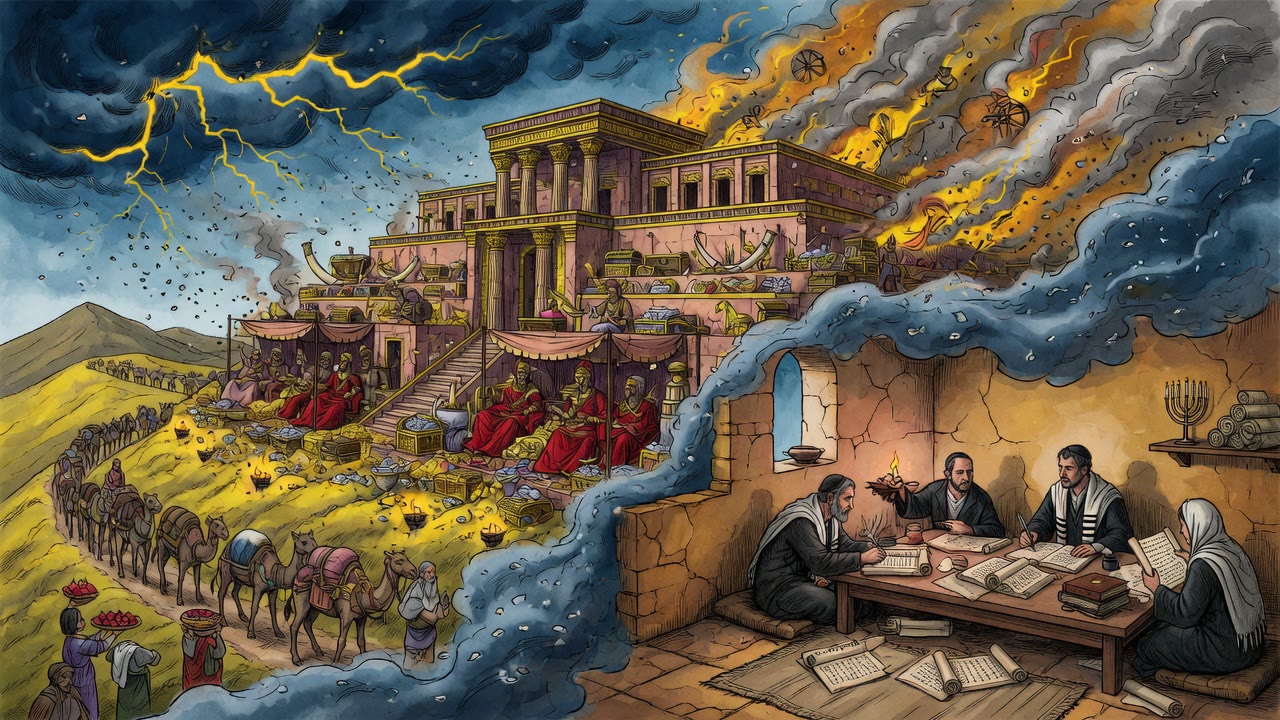
Dissatisfied with these results, Satan took things to an even more personal level. He disguised himself as the king of Persia and besieged Job's city, telling the inhabitants that Job had hoarded all the world's goods and even torn down their god's temple (quite the accusation!). He incited them to pillage Job's house. At first, they hesitated, fearing retribution from Job's children. So, in a truly devastating move, Satan pulled down the very house where Job's children were gathered, killing them all. Only then did the people sack Job's house.

Seeing that neither material loss nor the death of his children had broken Job's spirit, Satan returned to God and requested permission to attack Job's body itself. God granted this request, but with one crucial limitation: Satan could not touch Job's soul.

And here's where things get really intense.

The Zohar tells us that Satan was, in a way, worse off than Job. He was like a slave ordered to break the pitcher but not spill the wine. He unleashed a terrible storm upon Job's house. Then, he struck Job with a horrific case of leprosy "from the sole of his foot unto his crown." Job was forced to leave the city and sit on an ash heap, covered in oozing boils. He used a potsherd – a broken piece of pottery – to scrape himself, trying to relieve the unbearable itching. His body was infested with vermin, and even then, he refused to let them leave, saying, "Remain on the place whither thou wast sent, until God assigns another unto thee."

Even Job's wife, who had once been his partner and support, was struggling under the weight of their misfortune. She became a water-carrier, and when her master discovered she was sharing her bread with Job, he fired her. Desperate to feed her husband, she cut off her hair and sold it for bread. But the bread merchant was none other than Satan himself, testing her. He taunted her, saying, "Hadst thou not deserved this great misery of thine, it had not come upon thee." This was too much for her to bear. She urged Job to curse God and die, hoping to end their suffering.

But Job, recognizing Satan's influence, rebuked her. He saw through the deception, turning to the tempter and asking, "Why dost thou not meet me frankly? Give up thy underhand ways, thou wretch." At that, Satan appeared before Job, admitted defeat, and vanished in shame.

What are we to make of all this? The story of Job, especially as embellished by the aggadah, is a powerful exploration of faith, suffering, and the limits of evil. It shows us the incredible lengths to which evil will go to break the human spirit. But it also shows the incredible strength and resilience that can be found even in the face of unimaginable hardship. Job's story reminds us that even when everything seems lost, even when we are at our lowest point, the choice to remain steadfast in our faith is always ours.

Full source