5 min read

Achan Buried a Stolen Cloak and Israel Lost Its Next Battle

Jericho fell without a siege, so its spoils were sacred. One man decided otherwise, buried them in his tent floor, and thirty-six men died at Ai.

Curated by Arthur · Told by Maggid ·
Table of Contents
  1. What He Saw in the Ruins
  2. The Lot That Found Him
  3. One Theft Against Five Books
  4. Achan's Confession and What It Cost

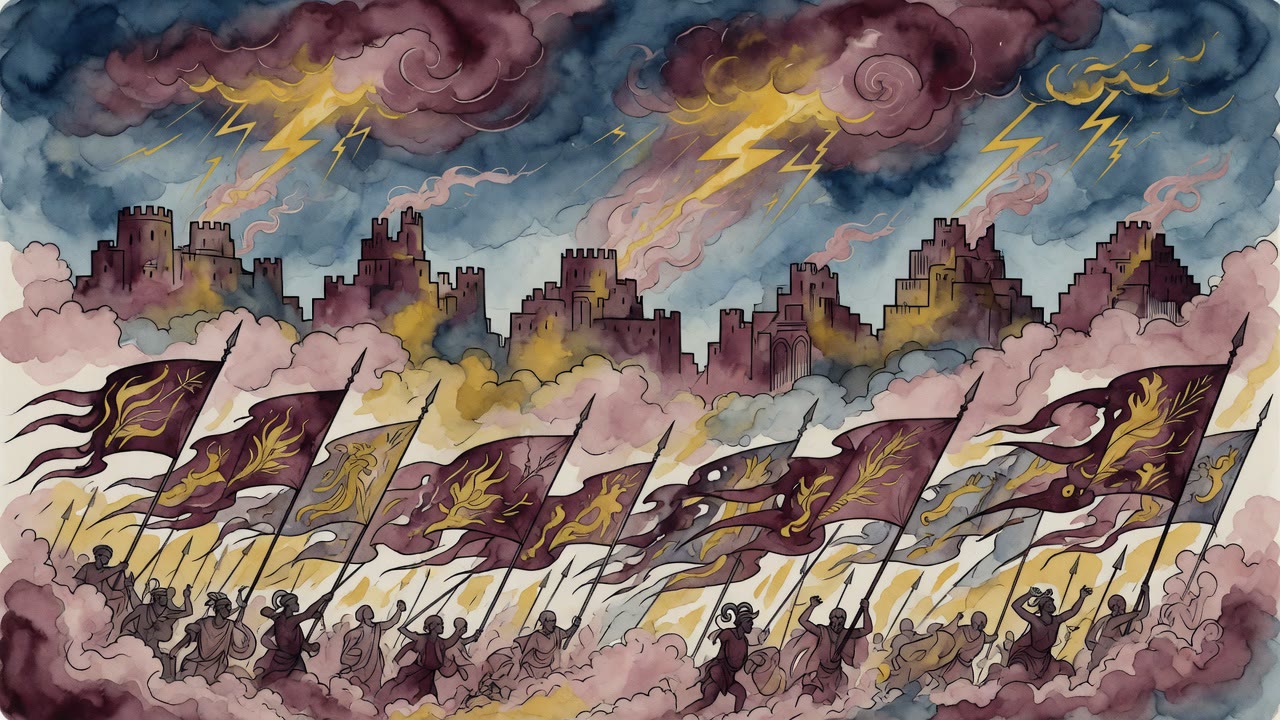
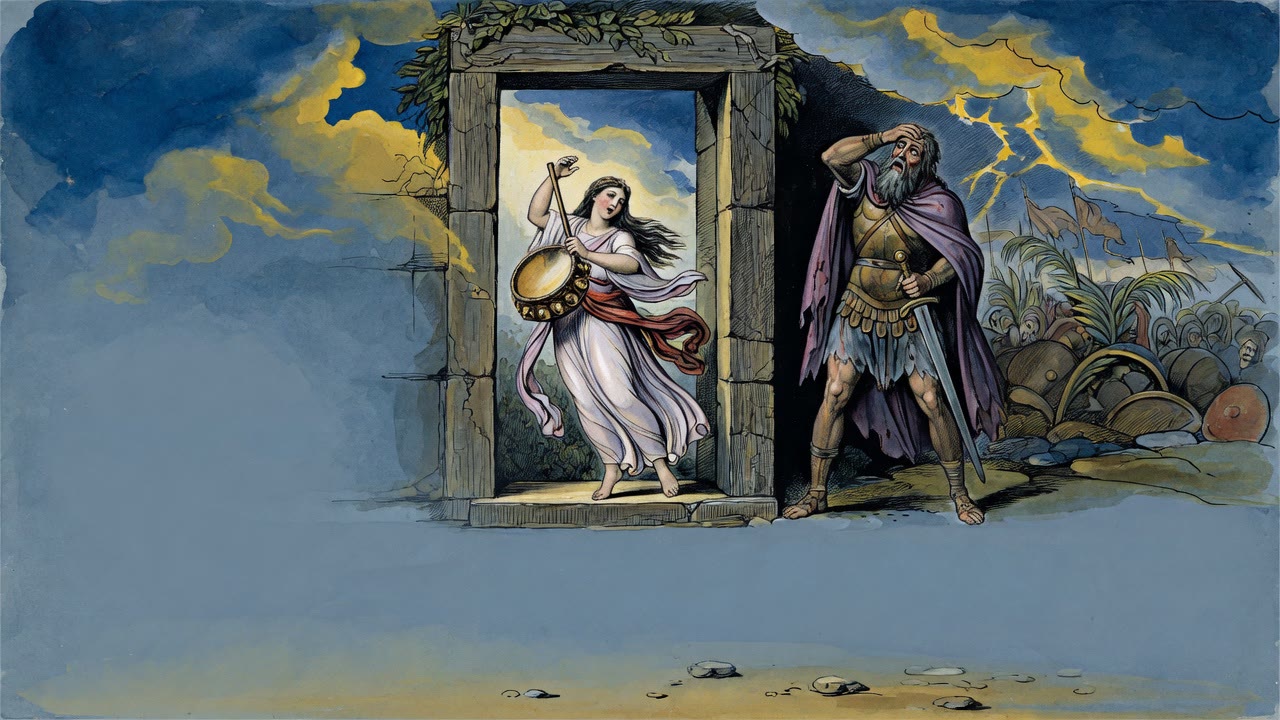
Jericho had fallen without a siege engine, and that was exactly why its spoils could not become ordinary plunder. Joshua declared the city under cherem, devoted entirely to God, because it had been taken on Shabbat. If the day was holy, then the victory belonged to holiness. Silver, gold, bronze, and iron went into God's treasury. Nothing else was permitted to move from ruin to tent.
Achan, son of Carmi, from the tribe of Judah, looked anyway.

What He Saw in the Ruins

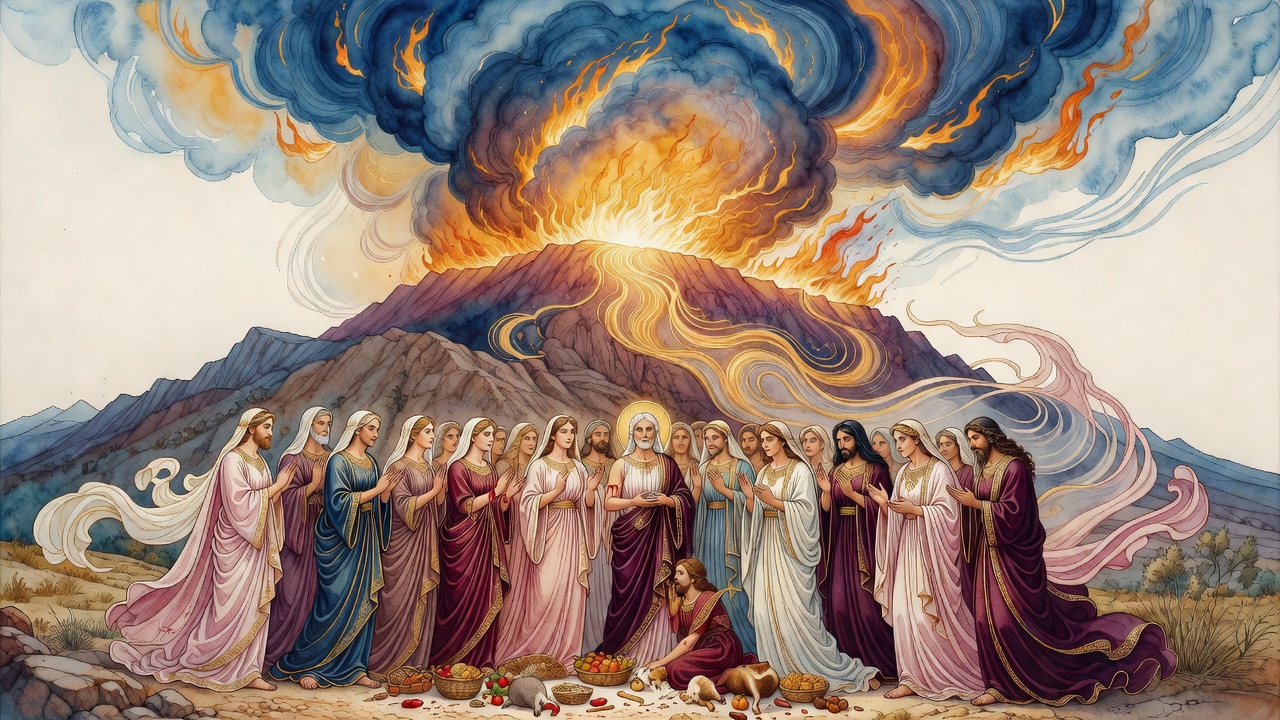
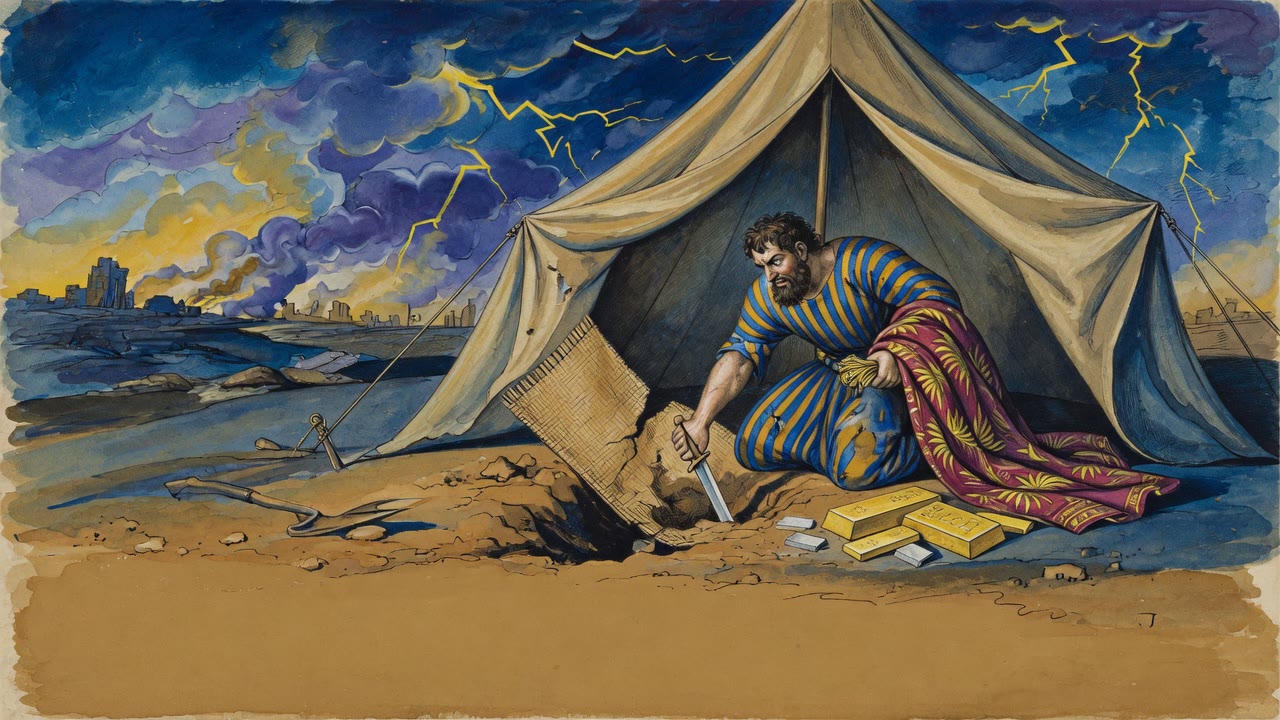
He saw idols with silver offerings laid before them. He saw a beautiful mantle from Babylon, an aderet, a garment worth wanting. He saw a tongue of gold. Desire moved faster than fear. He took the mantle, the silver, and the gold, carried them back to his tent, and buried them in the floor with the mantle on the bottom. Then he walked back out into camp as if he had seen nothing worth keeping.

The camp moved on to Ai, a smaller city by every measure. Three thousand soldiers should have been enough. Israel ran. Thirty-six men died in the retreat. One of them, tradition says, was Jair son of Manasseh, and the rabbis treated his death as a loss equivalent to most of the Sanhedrin. The size of the defeat was not military. It was moral. Something had been taken out of Israel's portion and placed underground in a private tent, and until it came back out, the army could not function.

The Lot That Found Him

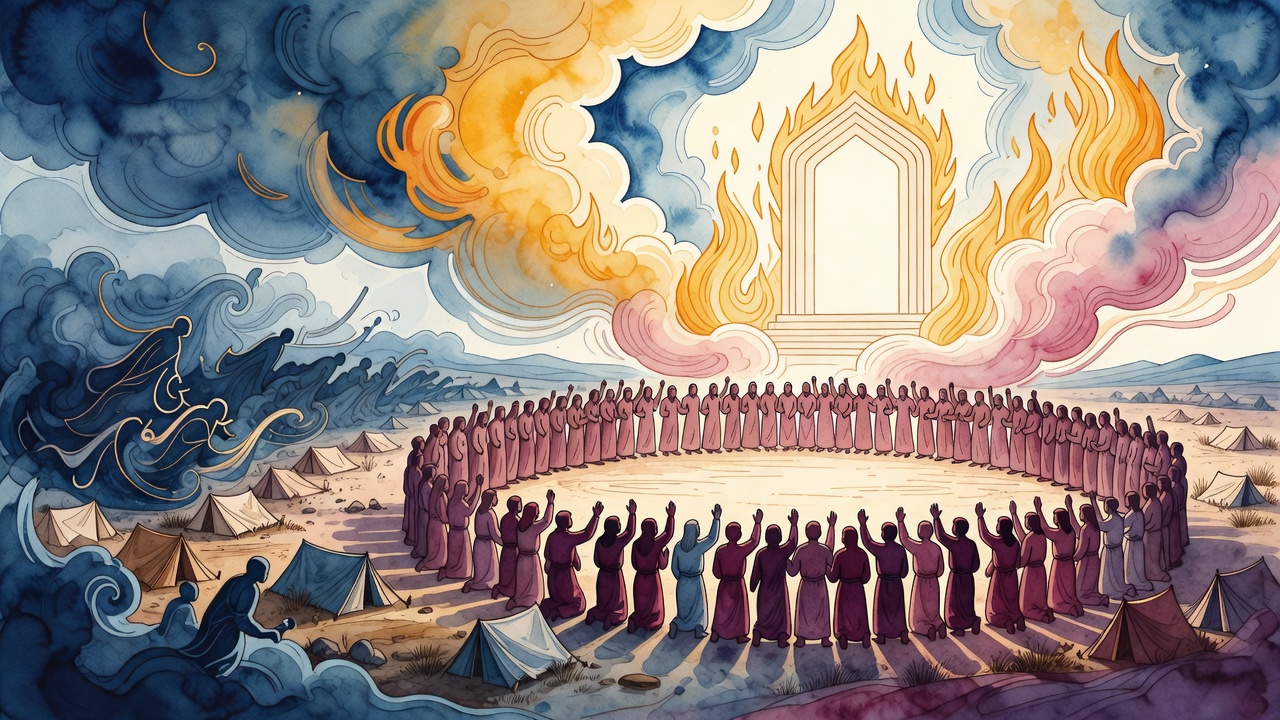
Joshua tore his garments and lay face down before the Ark with the elders of Israel. God's answer was brief: there is stolen property in the camp. Rise up. Sanctify the people. In the morning, come tribe by tribe, clan by clan, household by household, man by man, until the lot falls on the one who took it.

Achan knew what was coming. When the lot moved toward him through the tribes, he understood he was trapped. He tried to turn it around, to challenge Joshua, to force a comparison between Joshua's own household and his. Joshua refused the deflection. My son, Joshua said, give glory to God and make your confession. Tell me what you have done.

Achan confessed. He described the mantle from Babylon, the silver, the gold, and where they were buried in his tent. Messengers ran and dug them out and brought them before Joshua and before all Israel, and spread them on the ground. The evidence was exactly what he had described.

One Theft Against Five Books

The rabbis looked at the verse that described his crime and counted five repetitions of the word also. They have transgressed my covenant, they have also taken, they have also stolen, they have also deceived, they have also put it among their own stuff. Five times also, each one pointing to one of the five books of Moses. A Talmudic teaching in the name of Rav Illa said that Achan's single act of theft had managed to violate all five books simultaneously. The whole Chumash was bruised by what one man did in the ruins of Jericho.

Achan's Confession and What It Cost

Joshua urged him to confess not to escape punishment but to preserve his share in the world to come. The Sanhedrin procedure the tradition eventually codified was built on exactly this moment. Even a man walking to his execution had the right to be brought back if he remembered new evidence. A herald walked before the condemned calling out the name and the crime and asking aloud whether anyone could speak in his defense. The system was built to make sure no innocent person died without every possible word being spoken on his behalf.

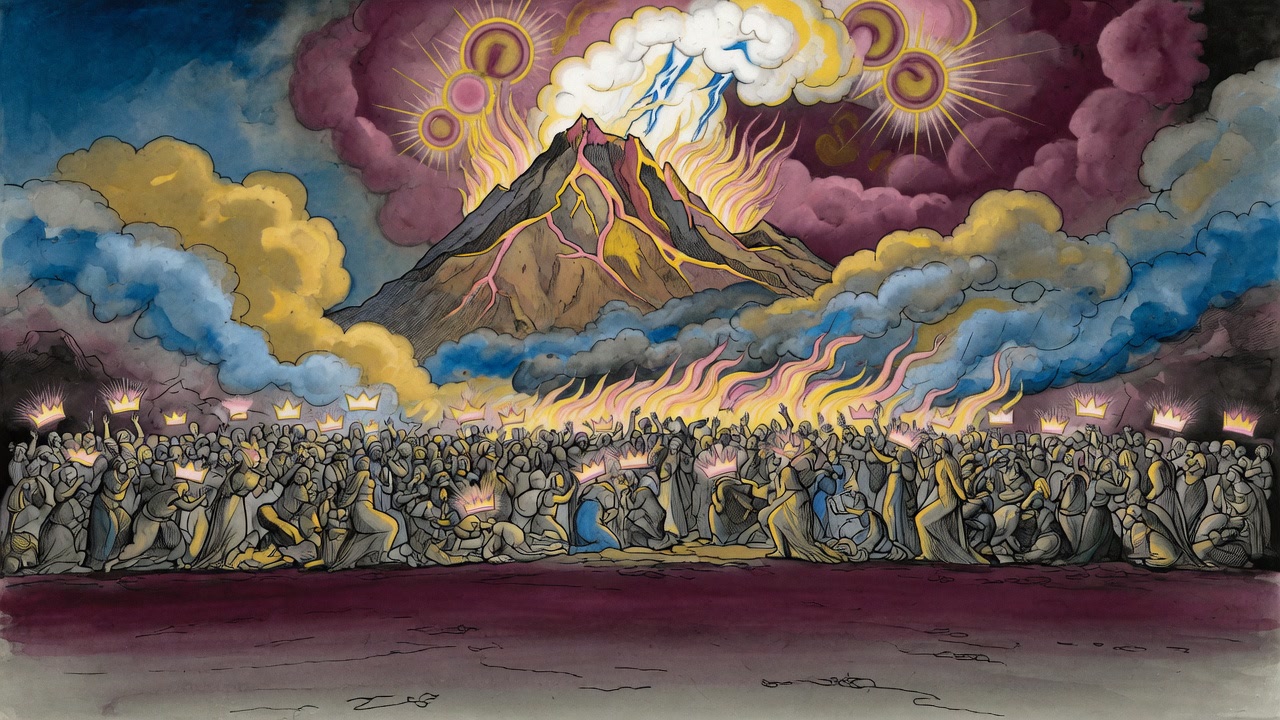
Achan was not innocent. He confessed, and he died, along with his household and his animals. His tent and everything in it was burned in the valley of Achor, the valley of trouble. The rabbis debated which members of his family had known and which had not, and which died for complicity and which for contamination. The valley kept the name. Trouble, because of what one man buried there in the dark after Jericho fell.


← All myths
From the tradition

Sources

9 sources

The texts this telling draws on, in full. Open a card to read inline, or expand it for a wider, quieter read.

Legends of the Jews 1:11Legends of the Jews

The story of Joshua’s conquest of the Promised Land is full of such moments, a rollercoaster of triumph and tragedy, and it all starts with Jericho.

Joshua, leading the Israelites after Moses' death, stands before the mighty walls of Jericho. And what a victory it was! A miraculous capture, the very first major conquest in this new land. But The entire city was declared anathema – set apart, devoted to destruction, a concept called herem in Hebrew. Why? Because, according to some accounts, this incredible feat happened on the Shabbat, the Sabbath.

You might be thinking, isn't working on the Sabbath forbidden? Well, Joshua reasoned that since the Sabbath is holy, what is won on the Sabbath must also be holy, consecrated to God. A fascinating interpretation, isn’t it? The spoils, the city itself, were considered off-limits, dedicated.

This dazzling victory was soon followed by a crushing defeat at Ai. Can you feel the whiplash? One moment, divine favor, the next, utter loss. In this battle, Jair, the son of Manasseh, perished, a loss so significant it was compared to the destruction of most of the Sanhedrin, the Jewish high court! A heavy blow.

So, what went wrong? Why this sudden reversal of fortune? Joshua, understandably desperate, sought answers. And it was revealed that the defeat was a direct consequence of the Israelites’ sin, specifically the actions of a man named Achan.

Achan, we learn, had taken forbidden spoils from Jericho. He’d laid hands on things that had been declared anathema, violating the sacred trust. The text paints him as a hardened transgressor, a criminal even before the crossing of the Jordan River. According to Ginzberg's retelling in Legends of the Jews, he had a history of appropriating things declared herem and committing other capital offenses.

Now, here's a crucial point: before the Israelites became a unified nation by crossing the Jordan, Achan's sins didn’t immediately impact everyone. But when he stole an idol and all its associated items from Jericho, the repercussions were swift and severe. As we find in Midrash Rabbah, the misfortune at Ai followed almost immediately. It's a powerful illustration of collective responsibility, the idea that the actions of one person can affect the entire community.

This story isn't just about battles and spoils. It's about the delicate balance between victory and defeat, obedience and transgression, individual actions and communal consequences. It makes you wonder: How often do we, individually or collectively, unknowingly invite misfortune through our choices? And how do we ensure that our triumphs are truly built on a foundation of integrity?

Full source
Pirkei DeRabbi Eliezer 38:15Pirkei DeRabbi Eliezer

The story of Achan, found in the Book of Joshua, gives us a pretty stark answer. And it's a story echoed and expanded upon in Pirkei DeRabbi Eliezer, a fascinating early medieval text that weaves together biblical narrative, aggadah (Jewish storytelling), and halakha (Jewish law). Joshua, successor to Moses, has just led the Israelites across the Jordan River. They’re facing Jericho, a formidable city. God commands that Jericho be placed under a herem. Everything in it – every object, every person – is to be devoted to God, which in practice meant destruction, a complete offering. It was to be burnt with all things therein by fire.

Then comes Achan, son of Carmi. Now, Pirkei DeRabbi Eliezer fills in some details that maybe you missed in the original biblical account. It tells us he saw Teraphim – idols, basically. And silver offerings before them. And a beautiful mantle. And a tongue of gold in the idol's mouth. (Pirkei DeRabbi Eliezer 38)

Achan wasn't supposed to touch any of it. It was all under the ban, completely forbidden. But temptation got the better of him. He coveted those forbidden treasures, and he went and buried them right there in the middle of his tent, thinking he’d get away with it.

Big mistake.

The consequences were devastating. After the victory at Jericho, the Israelites went to conquer the much smaller city of Ai. They expected an easy win. Instead, they were soundly defeated. Thirty-six righteous men died! As it says in (Joshua 7:5), "And the men of Ai smote of them about thirty and six men."

Thirty-six lives lost because of one man's transgression. That’s how seriously they took the idea of herem! It wasn't just about the material value of the stolen goods; it was about the broken vow, the betrayal of God’s command, and the disruption of the entire community’s relationship with the Divine.

It makes you think, doesn’t it? About the power of our choices, and the ripple effects they can have. Achan’s story serves as a potent reminder that even seemingly small acts of disobedience can have enormous consequences. It’s a sobering thought, and a powerful lesson.

Full source
Sanhedrin 44a (Harris, Hebraic Literature, 1901)Hebraic Literature (1901)

When Achan took the banned spoil from Jericho, the book of Joshua describes his crime with a strange fivefold repetition. They have transgressed my covenant which I commanded them; they have even taken of the accursed thing, and have also stolen, and dissembled also, and have also put it among their own stuff (Joshua 7:11). Five times the word also. The sages of the Talmud noticed.

Rav Illa, speaking in the name of Rav Yehudah ben Mispartha, taught that the fivefold also is not decorative. Each also points to one of the Five Books of Moses. Achan's theft was not a single sin but a fivefold one. In taking the banned cloak and the silver and the gold, he had transgressed against Genesis, Exodus, Leviticus, Numbers, and Deuteronomy at once. The whole Chumash was bruised by what one man did in the tent of one looted city.

The same Rabbi pressed even further. Achan had also obliterated the sign of the covenant in his own flesh, the mark of circumcision. He reasoned from the language itself. Of Achan it is written, they have transgressed my covenant, and of circumcision it is written, he has broken my covenant (Genesis 17:14). The shared phrase joins the two. Whoever steals from the herem has also erased the mark of Abraham.

This passage from Sanhedrin 44a, preserved in Harris's 1901 anthology of Hebraic Literature, teaches that sin is rarely contained. A single hidden act, small enough to hide under a tent floor, can ripple outward until the whole Torah and the covenant itself are implicated.

Full source
Midrash Tanchuma, Masei 5Midrash Tanchuma

It is written (in Josh. 7:19), “Then Joshua said unto Achan, ‘My son, please give glory [to the Lord God of Israel and make a confession to Him; please tell me what you have done, do not hide it from me.]’” Achan said to him, “Am I to die because of this thing that you are saying?” When Achan saw [the situation], he said in his heart, “Now I shall be entrapped by the lot. Then I shall be found untrue (rt. 'mn) and deemed a liar before Joshua.” At that moment Achan said to Joshua, “Why are you casting lots between me and my house? Let me cast lots between you and Phinehas! If the lot comes up for both of you, I also shall believe (rt. 'mn) [in it].” At that moment (according to Josh. 7:19) Joshua said to Achan, “My son, please give glory to the Lord God of Israel [and make a confession to Him]. Please tell me what you have done.” Achan said to him, “You also tell me what you have done.” Immediately discord broke out in Israel, so that [Achan's] tribe of Judah arose in strife and killed one group in Israel after another. When Achan saw this, he said in his heart, “If anyone saves a single life in Israel, it is as though he had saved the entire world; yet in my case, it has been through me that several people in Israel have been killed. I am a sinner and one who causes [others] to sin. It is better [for me] to confess my transgression before the Holy One, blessed be He, and before Joshua, so that no calamity come about through me.” What did Achan do? He arose and made his voice heard, so that the whole congregation turned to him. He said to Joshua (in vs. 20), “’(Truly) I am the one who sinned before the Lord God of Israel; thus and so (literally, like this and like this) is what I have done.’ So it was not this alone, but I have already misappropriated other [things].” Joshua said to him, “Indeed I also knew that you were responsible for the situation; (Josh. 7:19:) ‘please tell me what you have done. Do not hide it from me.’” (Vs. 21:) “I saw among the spoils.” [He said,] “I have seen what is written in the Torah (in Deut. 20:14), ‘you may eat the spoils of your enemies.’” (Josh. 7:21, cont.) “A fine shinar mantle.” [He continued,] “Now do not say that I am poor and in need, for there is no one in the tribe of Judah wealthier than I. Immediately (there follows vs. 22), “Then Joshua sent messengers, and they ran to the tent.” For what reason did Joshua send them? So that the tribe of Judah would not steal them (i.e., the stolen articles) and continue in the discord. Joshua therefore sent quickly, and (according to vs. 23) “they brought them unto Joshua and unto all the Children of Israel; and they spread them out before the Lord.” What is the significance of “and they spread them out?” Joshua said in front of the Holy One, blessed be He, “Master of the world, is it because of these that You have been angry with Your children? Here they are set before you.” Immediately [we read] (in vs. 24), “Then Joshua took Achan ben Zerah, the silver, the mantle, and the wedge of gold, together with his sons and his daughters,” [the latter] in order to teach them a lesson; “his ox, his ass, […] and his tent,” for burning. (Vs. 24, cont.) “All Israel [Joshua took] with him,” to see his punishment so that they would not become accustomed to acting in this way. (Vs. 24, cont.) “And they brought them up to the Valley of Achor (akhor; rt. 'kr).” (Vs. 25:) “Then Joshua said, ‘Just as you have afflicted (rt. 'kr) us, [may the Lord afflict (rt. 'kr) you] this day.’” This day [only] is he to be afflicted ('akhur; rt. 'kr), but he will have a share in the world to come. (Vs. 25, cont.) “Then all Israel pelted him with stones,” him alone; “and they burned them with fire.” The text is speaking of his wealth, for so it had been told [Joshua] by the Almighty (in vs. 15), “And it shall come to pass that the one who has been seized with what has been proscribed shall be burned with fire...” If so, what do we learn from the verse (vs. 15, cont.), “him, and all that he has?” [This passage] is only to teach you that Achan had confessed that he had stolen them on the Sabbath, when he took them out of Jericho and buried them in the midst of his tent. Thus he was stoned for profaning the Sabbath and burned because he had transgressed the ban. And where is it shown? You find that the Holy One, blessed be He, said so to Joshua (in Josh. 6:2–4), “See, I have given Jericho into your hands, [along with its king and the mighty warriors. So you shall go around the city with all the men of war to encompass the city one time, thus shall you do for six days. …] but on the seventh day you shall go around the city seven times.” [This passage serves] to teach you that Jericho was conquered on the Sabbath. Now Joshua did this thing on his own, and the Holy One, blessed be He, gave his consent. Joshua said (to himself), “The Sabbath is holy, as stated (in Exod. 31:14), ‘You shall keep the Sabbath, because it is holy for you.’ So whatever we conquer on it shall be holy.” It is so stated (in Josh. 6:19), “But all the silver and gold, and the vessels of bronze and iron, are holy to the Lord.” And where is it shown that he received consent? Where it is stated (in (Joshua 6:1)7), “The city and everything in it are to be proscribed for the Lord.” At that time (according to Josh. 7:26) “the Lord turned from His burning anger.” Concerning [this matter], it is stated (in Prov. 16:14), “The king's anger is like messengers of death, and whoever is wise will appease it.” This refers to Joshua, who caused the burning anger of the Lord to turn away from Israel.

Full source
Hebraic Literature (1901), Mishnah Sanhedrin 6Hebraic Literature (1901)

The procedure for a capital trial under the Sanhedrin, as preserved in the Mishnah (Sanhedrin 6) and carried forward in the 1901 anthology Hebraic Literature, sounds less like an execution and more like an argument the prosecution is trying to lose.

If the condemned man, on his walk to the stoning ground, suddenly remembered a new point in his defense, he was brought back, once, twice, four or five times over. So long as the new argument carried weight. If any witness produced new evidence, the procession stopped. A herald walked in front of the condemned calling out his name, his father's name, the crime he was convicted of, and the names of the witnesses, and shouting: "If anyone knows something that would clear him, let him come forward now." The whole system was built to make sure no innocent man ever reached the stones.

When the procession was ten cubits from the pit, the condemned was ordered to confess. Every criminal was urged to do this, the Mishnah teaches, because confession secures a portion in the World to Come. We learn this from Joshua's words to Achan, the man who stole from the spoil of Jericho: My son, give, I pray you, glory to the Lord God of Israel, and make confession to Him (Joshua 7:19). Achan answered, Indeed I have sinned (Joshua 7:20). And where do we see that his confession was his atonement? In the very next verse: Why have you troubled us? The Lord shall trouble you this day (Joshua 7:25). This day, only this day, the Rabbis read, not the day to come.

Four cubits from the pit they stripped the condemned of his clothes. A man was covered in front; a woman, in front and behind. So taught Rabbi Yehudah. The other Sages said a man was stoned naked, but never a woman. Even at the last moment of a person's life, dignity was something the court argued over.

The whole procedure, start to finish, is the Rabbinic answer to a question that still haunts every justice system: how do you execute a person and still fear God? The Sanhedrin answered by making execution almost impossible, and making confession the one thing that reached past death.

Full source
Yalkut Shimoni on Nach 18:4Yalkut Shimoni on Nach

Achan said to Joshua: For this matter that you speak of, am I to die? Why do you cast lots between me and my household? I too will cast lots between you and Phinehas. If the lot does not fall upon the two of you, I too will believe. He said to him, Tell me what you did. Achan said to him, You too, what did you do? Immediately a quarrel broke out in Israel, and the tribe of Judah rose and killed in Israel group upon group. When Achan saw this, he said in his heart: Whoever sustains one soul of Israel is as one who sustains a whole world, and through me all those souls are being killed. Immediately he confessed and said, "Truly I have sinned" (Joshua 7:20). Achan said to Joshua: Has not Moses our teacher been asleep [dead] only thirty or forty days? Did not Moses your teacher teach you, By the mouth of two witnesses or three witnesses shall the condemned be put to death (Deuteronomy 17:6)? You have begun to err! Joshua foresaw by the Holy Spirit that the land was destined to be divided by lot. He said: If they hold their ground now [in challenging the lot], all Israel will say, In capital cases [the verdict] held by lots; in monetary cases, how much more so. He began to appease him, "My son, give now honor" (Joshua 7:19).

Full source
Yalkut Shimoni on Nach 18:6Yalkut Shimoni on Nach

"And I saw among the spoil" (Joshua 7:21). I saw what is written in the Torah, "And you shall eat the spoil of your enemies" (Deuteronomy 20:14). Immediately, "And Joshua sent messengers, and they ran to the tent" (Joshua 7:22), so that the tribe of Judah would not steal them and add to the quarrel.

Full source
Midrash Tanchuma Buber, Masei 4:1Midrash Tanchuma Buber, Masei

It is written (Joshua 7:19): "And Joshua said to Achan" etc. Achan said to him: Because of this thing that you are saying to me, am I to die? When Achan saw this, he said in his heart: Now I shall be caught by the lot, and I will not be believed, and I shall be reckoned a liar before Joshua. At that moment Achan said to Joshua: Why do you cast lots between me and my household? Let me cast the lot between you and Phinehas; if the lot does not come up upon the two of you, then I too shall believe.

At that moment "Joshua said to Achan: My son, give, I pray you, glory to the LORD, the God of Israel, and make confession to Him, and tell me, I pray you, what you have done" (ibid.). Achan said to Joshua: You too, tell me what you have done. Immediately discord fell upon Israel, and the tribe of Judah rose up in strife, and they killed of Israel group after group. When Achan saw this, he said in his heart: Whoever sustains a single soul of Israel, it is as though he had sustained an entire world; and through me several men of Israel have been killed. I am a sinner and one who causes others to sin. It is better that I confess my transgression before the Holy One, blessed be He, and before Joshua, and that no ruin come about through me.

What did Achan do? He stood and made his voice heard, and the whole congregation fell silent before him. He said to Joshua: "Truly I have sinned against the LORD, the God of Israel, and thus and thus have I done" (ibid., v. 20), and not this alone, for I have already acted faithlessly in other matters. Joshua said to him: I too knew that the matter depended upon you. "And tell me, I pray you, what you have done; hide it not from me" (ibid., v. 19). "And I saw among the spoil" (ibid., v. 21), [he said to him:] I saw what is written in the Torah, "And you shall eat the spoil of your enemies" (Deuteronomy 20:14), "a goodly Shinar mantle" etc. (Joshua, ibid.). And do not say that I am poor and was in need, for there is none in the tribe of Judah richer than I.

Immediately "Joshua sent messengers, and they ran to the tent" etc. (ibid., v. 22). Why did Joshua send them? So that the tribe of Judah would not steal them and add to the discord; therefore Joshua sent in haste. "And they brought them to Joshua and to all the children of Israel, and they laid them out before the LORD" (ibid., v. 23). What is "and they laid them out"? Joshua said: Master of the Universe, was it over these that You were angry with Your children? Behold, they are set before You.

Immediately "Joshua took Achan son of Zerah" etc. [and his sons and his daughters and his ox and his ass] (ibid., v. 24): his sons and his daughters, in order to chasten them; and his ox and his ass and his tent, for burning. "And all Israel with him" (ibid.), to see his judgment, so that they would not be accustomed to act so. "And they brought them up to the Valley of Achor" (ibid.). "And Joshua said: Why have you troubled us? [The LORD shall trouble you] this day" (ibid., v. 25), this day he is troubled, yet he has a portion in the world to come. "And all Israel stoned him with stones" (ibid.), him alone; "and they burned them with fire" (ibid.), Scripture speaks of his property, for so it had been said to him by the mouth of the Almighty: "And it shall be that he who is taken with the proscribed thing shall be burned with fire, he and all that he has" (ibid., v. 15).

Rather, this is to teach you that Achan confessed that he had stolen them on the Sabbath, and brought them out of Jericho and hid them inside his tent; and he was stoned for profaning the Sabbath, and burned because he had trespassed against the proscribed thing. And whence do you find this? For thus the Holy One, blessed be He, said to Joshua: "See, I have given into your hand Jericho and its king, the mighty men of valor. And you shall encircle the city, all the men of war, going around the city one time; thus shall you do six days. And seven priests" etc. (ibid. 6:2–4), to teach you that Jericho was conquered on the Sabbath.

And this thing Joshua did of his own accord, and the Holy One, blessed be He, agreed with him. Joshua said: The Sabbath is holy, as it is said, "And you shall keep the Sabbath, for it is holy to you" (Exodus 31:14); and all that we conquer on it shall be holy, as it is said, "And all the silver and gold and vessels of bronze [and iron are holy to the LORD]" (Joshua 6:19). And whence that He agreed with him? As it is said, "[And the city] shall be proscribed, it and all that is in it, to the LORD" (ibid., v. 17). At that moment "the LORD turned from His fierce anger" (ibid. 7:26). And concerning him it is said, "The wrath of a king is messengers of death, but a wise man will appease it" (Proverbs 16:14), this is Joshua, who turned away the fierce anger of the LORD from Israel.

Full source
Yalkut Shimoni on Nach 18:2Yalkut Shimoni on Nach

"And also they have transgressed My covenant" (Joshua 7:11). Rabbi Yehudah said in the name of Rabbi Yehudah bar Misparta: This teaches that Achan transgressed the five books of the Torah, for it says five times "also." And Rabbi Ila said in the name of Rabbi Yehudah bar Misparta: Achan drew his foreskin forward [to undo his circumcision]. It is written here "and also they have transgressed My covenant," and it is written there, "he has broken My covenant" (Genesis 17:14). This is obvious; what might you have said? That he was brazen regarding the commandment but not brazen regarding his own body. It teaches us otherwise. "And because he has done a disgraceful thing in Israel" (Joshua 7:15). Rabbi Abba bar Kahana said: He had relations with a betrothed maiden. It is written here "because he has done a disgraceful thing in Israel," and it is written there, "for she has done a disgraceful thing in Israel" (Deuteronomy 22:21). This is obvious; what might you have said? That he would not be so brazen as all that. It teaches us otherwise. Ravina said: His sentence was like that of a betrothed maiden, by stoning.

Full source