The Tablets of Fire Readable From Every Side
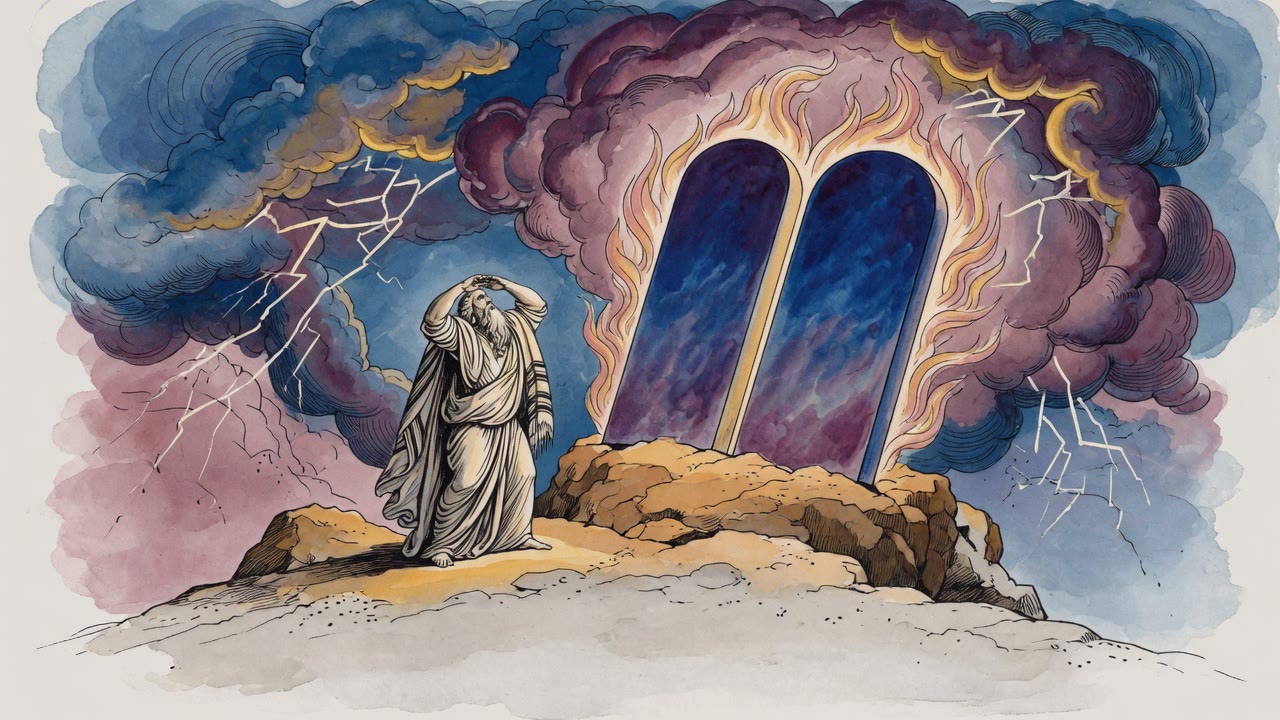
The tablets God gave Moses were sapphire, the letters cut all the way through, the writing readable from both sides without mirror reversal.
Table of Contents
 Click for full size
What Moses Carried Down the Mountain
Moses was on Sinai for forty days. When he came down, the text says his face was shining, and the people were afraid to come near him. He had been somewhere that left a mark. He carried two tablets that God had cut from sapphire, cut from the stone of the divine throne itself, according to Targum Pseudo-Jonathan on Exodus, because God did not bring stone from elsewhere for this purpose. The tablets came from the place closest to God's presence.
The writing on them was not scratched into the surface. It was cut through. The letters went from one face to the other, all the way through the stone.
The Problem of Letters Floating in Stone
Shemot Rabbah, the midrash on Exodus, asks what the Torah requires of this description. The Torah says explicitly that the writing was on both faces of the tablets, on the front and on the back. If you cut letters through stone, two things happen that cannot happen with ordinary stone and ordinary letters.
First: some Hebrew letters are closed shapes. Samech, the ring letter, has no anchor point. If you cut it all the way through a stone tablet, the interior piece of stone falls out. The same problem with the mem sofit, the final mem, which is closed on all sides. How do these letters stay in the tablets?
The tradition's answer: they were held by a miracle. The interior of each closed letter floated in place, suspended by the same power that had cut them. This was not a design problem the craftsmen had to solve. It was one of the things that revealed these tablets as being from a different order than everything made by human hands.
Readable From Either Side
The second problem: if you cut letters through stone and read them from behind, they are mirror-reversed. A mem read from the back looks wrong. The writing would only make sense from one direction.
The tradition says the tablets were readable identically from both faces. The letters were not mirror images of themselves when read from behind. They were the same letters, the same way, from either direction. This is described as one of the things prepared before creation, one of the anomalies built into the world before the world began its ordinary operation, held ready for this moment.
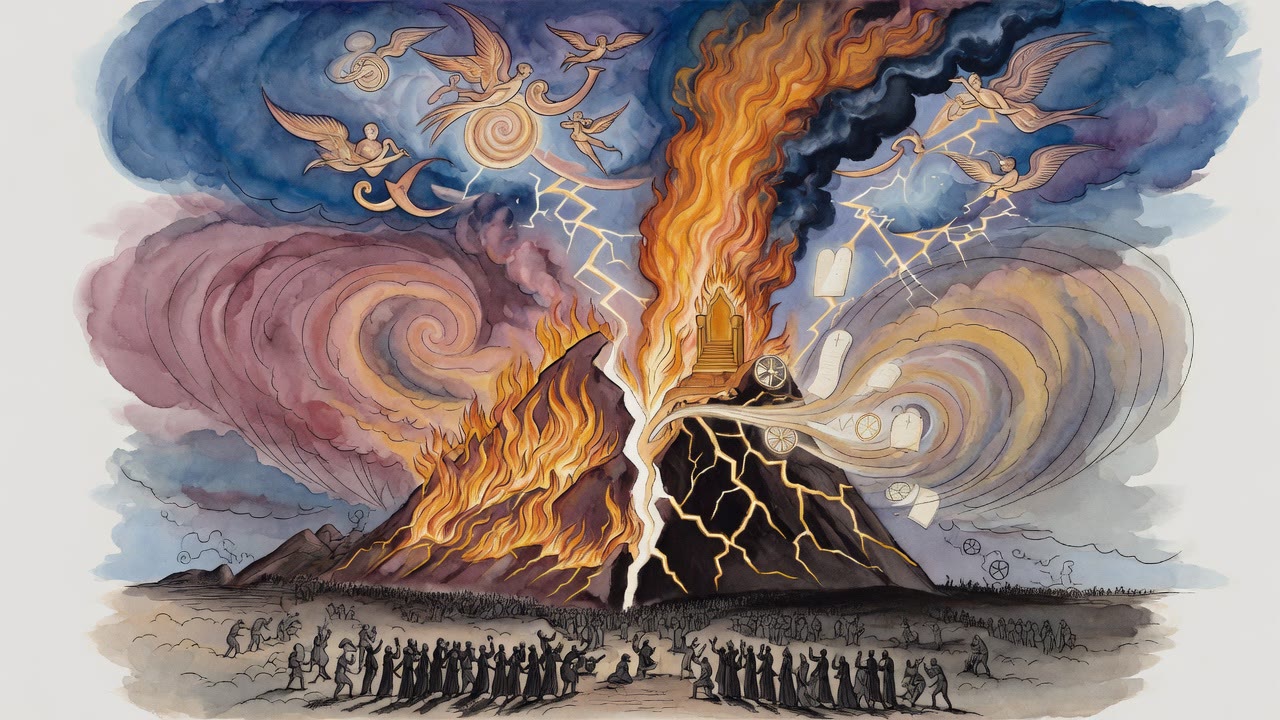
Yalkut Shimoni on Torah, drawing on Resh Lakish's description, adds the layer of fire: the Torah Moses received was written in black fire on white fire, sealed in fire, wrapped in fire. The pen was fire. When God wrote on the tablets, what was written was the intersection of two fires: the white fire that formed the ground and the black fire that formed the letters. The pen cleaned on God's hair gave Moses his radiance. The fire passed into him as he received the tablets.
The Letter That Knew It Would Break
Among the alphabetical midrashim on which letter should begin the Torah, Aleph Bet of Rabbi Akiva places each letter before God to argue its case. Lamed comes forward with a strong argument: it can name luchot, the tablets, and limmud, teaching. It is the natural letter for a Torah-shaped world.
God refuses. The same tablets that lamed would name are the tablets that Moses will break when he comes down the mountain to find the golden calf. The letter that begins the world cannot be a letter whose first great act in history is to be shattered.
The fragment of that tradition is the knowledge that the breaking was also known in advance. The tablets were given knowing they would be broken. The sacred is not protected from destruction by its sacredness. It is, in fact, the sacred that is most often broken, precisely because it asks more of the people who hold it than ordinary stone asks.
The Torah Before the Torah
The sapphire tablets from God's throne exist in a tradition that precedes the events at Sinai. The fire-Torah was there before the world. What Moses received at Sinai was not the creation of something new but the delivery of something that had existed since before creation as the blueprint for everything that would be made.
This is why the tablets could not be made from earthly stone. The covenant they encoded was not a human document. It was the relationship between the divine will and the human capacity for response, written in fire, delivered in stone, broken on the morning Moses came down and saw what the people had built while he was receiving what they were in the process of betraying.
← All myths