7 min read

The Priests Who Stepped Into the Jordan at Flood Stage

The priests carry the Ark to the flooded Jordan and stop at the edge. The river will not part until their feet touch the water first.

Curated by Arthur · Told by Maggid ·
Table of Contents
  1. The River Came Up to Meet Them
  2. An Order Turned Upside Down
  3. The Soles of Their Feet
  4. What Joshua Said in the Middle of the River
  5. The Word That Named a Grandfather
  6. The Land Cast Out Before Them

The River Came Up to Meet Them

The water was loud before they could see it. All morning the people had marched east of the camp toward a sound like wind trapped in a canyon, and when the ground opened and the valley fell away beneath them, there it was, the Jordan swollen brown and white, throwing itself against its own banks. It was the season when the river forgets its size. Snowmelt poured down from the far mountains, the barley stood ready in the fields, and the current had climbed over the willows and out across the flats, so that there was no shore left to stand on, only mud sucking at the heels and then the water, fast, cold, and rising.

No one had crossed here in living memory at this time of year. A man who waded in would be off his feet in three steps and gone in ten, rolled under and carried south to the dead salt sea where nothing comes back. The whole nation stood on the high lip of the valley and looked down at the thing that lay between them and the land they had been promised, and the land looked very far away.

An Order Turned Upside Down

Every other day of the march the fighting men went first. Spears at the front, the banners, the young and the strong, and the holy things carried safe in the middle of the column where no enemy could reach them. That was the order, and the order made sense.

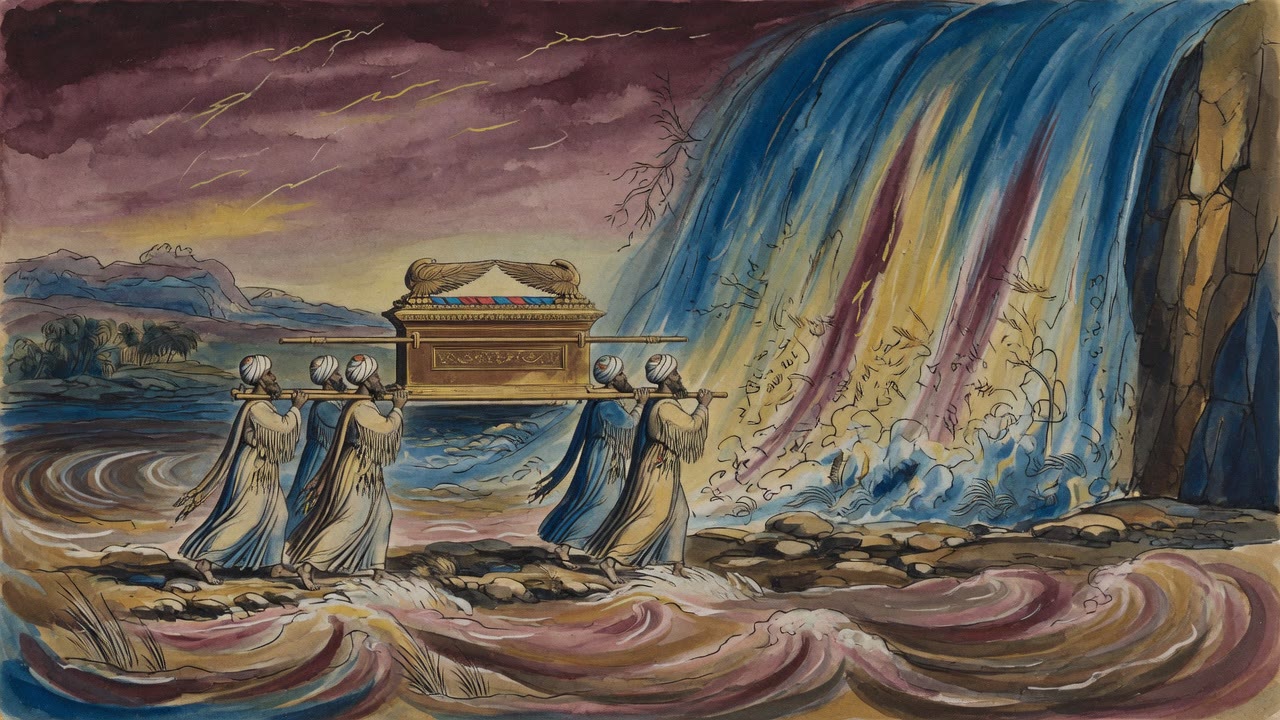
This day the order was overturned. Joshua sent the priests forward, and on their shoulders they bore the Ark, the gold-covered chest that held the tablets, the most guarded object the people owned, carried now ahead of everyone, straight at the flood. The instruction was strange enough that men repeated it to one another to be sure they had heard it. "The Ark goes first. The priests go first." And they were told the manner of it exactly, that the water would not move while they stood watching it. It would move only when the soles of their feet had already gone in.

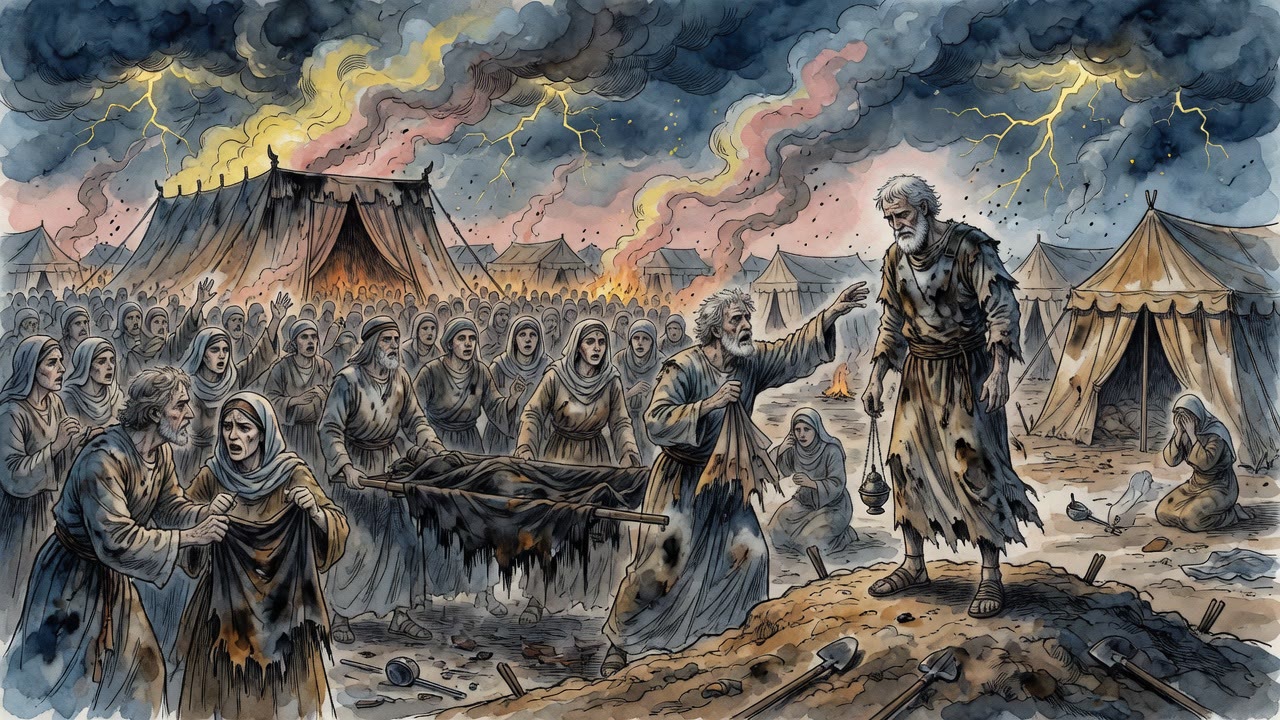
So the priests walked down the bank with the poles cutting into their shoulders, and behind them the whole nation held its breath, and the river kept its noise and gave no sign of yielding. The men were to step into a current that drowns, carrying the one thing that must never be lost, and they were to do it on the promise that the water would stop only after they were already wet. There was no proof until there was no turning back.

The Soles of Their Feet

The lead priests reached the edge where the brown water tore past. They did not stop. They put their feet down into it.

The instant the water closed over their sandals, the river heard them. Far upstream the current reared backward like a horse hauled up by the bit. The flood that had been racing south stopped, then turned, then began to climb. It did not spread into a shallow puddle that would slump and collapse and drown the men standing under it. It heaped. It went up. One wall of water rose and a second wall rose behind it and a third behind that, arch stacked on arch, packed and braced against itself the way stone is braced in a gate, climbing higher than any tower, higher than any hill, a green-and-white cliff of standing water that threw its shadow miles across the valley.

Men who knew measurements argued about the height of it for the rest of their lives. Some said the wall stood as high as a hard day's walk laid on its end. Others swore it rose higher still, so tall that every king east and west of the river, sitting in his far palace, looked up from his throne and saw the wall of the Jordan hanging in the sky and went cold, knowing whose nation was crossing.

What Joshua Said in the Middle of the River

The riverbed lay open, packed gravel and stones still wet, and the people poured down onto it. The priests carried the Ark to the middle and there they stopped and stood, the wall towering on the upstream side, the empty channel running dry below, and the nation walking across between them.

Joshua spoke while they crossed, and his words were a condition, not a comfort. "You go over on these terms," he told them. "You cross to clear that land of its idols, its carved stones and its high places and the names men whisper to wood. Cross for that, or the water that stands above you comes down." The wall was not a gift handed over without cost. It was held up like a held breath, and what held it was the thing they had sworn to do on the other side.

So they walked faster, every family, the children carried, the herds driven, all of them passing under a cliff of water that could fall, kept up only by a promise about the country ahead.

The Word That Named a Grandfather

There was something in the way the rescue was described that older men caught and held onto. The upstream waters, it was said, rose in one heap far off, near a town called Adam, and the same letters that spell that town's name also spell the plain word for a man. Those who listened closely heard a second meaning folded inside the first. The river did not climb for nothing and for no one. It climbed on an old debt.

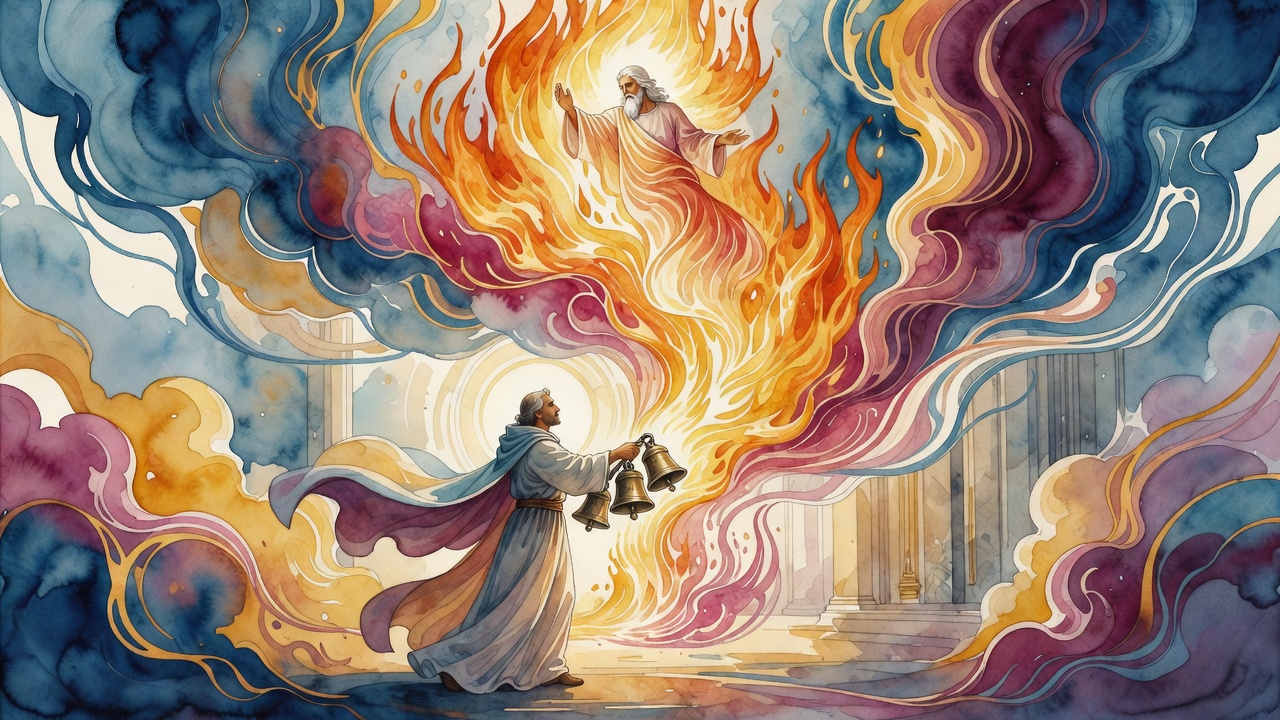
Long before, a lone man had crossed this same Jordan running the other way, fleeing for his life with nothing in his hands. Jacob, going out into exile, had said of himself that with only his staff he crossed this Jordan. One man, one stick, one frightened night at the water's edge. Now his children came back across the same river in their thousands, dry-shod, under a standing wall, and the merit of that grandfather and his single staff was the coin the crossing was paid with. The water remembered him. It rose for the staff he once carried over alone.

The Land Cast Out Before Them

When the last of the people had reached the far bank, the priests carried the Ark up out of the channel, and the moment the soles of their feet lifted clear of the riverbed and touched dry ground, the walls let go. The heaped water came down in one falling roar and the Jordan filled its banks and ran south again at flood stage as though it had never paused, as though no nation had ever walked through it.

The hill country lay open before them now, and they took it, and the people already living in those hills were driven out ahead of them. As long as the nation kept faith with the God who had stopped the river, they held the high ground and prospered, and the land stayed theirs.


← All myths
From the tradition

Sources

3 sources

The texts this telling draws on, in full. Open a card to read inline, or expand it for a wider, quieter read.

Book of Judith 5:18Book of Judith

The narrative unfolds, telling us how they crossed the Jordan River. crossing a major river, claiming land, establishing themselves. This wasn't a peaceful transaction. "They possessed all the hill country," the verse says. And it wasn't empty when they arrived!

The original inhabitants – the Canaanite, the Pherezite, the Jebusite, the Sychemite, and all the Gergesites – were, well, let's just say they were removed. "They cast out before them…" It’s a stark reminder of the power dynamics at play, and the often-brutal realities of ancient nation-building. According to this retelling, the Israelites then settled in the land and lived there "for many days."

Here's the real kicker, the core of the whole story. "While they did not sin before their God, they prospered, because the God who hates iniquity was with them." It's a simple equation, isn't it? Obedience equals prosperity. Divine favor brings success. When they remained true to their covenant, when they walked the path laid out for them, they thrived. The implication is clear: their strength, their success, wasn't just about military might or political maneuvering. It was rooted in their relationship with God.

What happens when that relationship frays? What happens when a people stray from the path?

"But when they departed from the way which he appointed for them, they were destroyed in many battles very badly and were led captive into a land which was not their own." The consequences of disobedience, according to the Book of Judith, are swift and severe. Defeat in battle, exile, the loss of their homeland. It's a harsh lesson, isn't it? But one that echoes throughout Jewish history. This portion of the story sets the stage for the drama about to unfold, a drama where Judith herself will become a key player in her people's redemption. It makes you wonder: is history destined to repeat itself, or can a nation learn from its mistakes?

Full source
Yalkut Shimoni on Nach 14:3Yalkut Shimoni on Nach

Our Rabbis taught: How did Israel cross the Jordan? On every other day the Ark traveled behind two banners, but on that day it traveled first, as it is said, "Behold, the Ark of the covenant of the Lord of all the earth passes before you into the Jordan" (Joshua 3:11). On every other day the Levites carried the Ark, but on that day the priests carried it, as it is said, "And it shall be, when the soles of the feet of the priests bearing the Ark of the LORD rest" (Joshua 3:13). It is taught: Rabbi Yose says, In three places the priests carried the Ark: when they crossed the Jordan, when they encircled the wall of Jericho, and when the Philistines returned it to its place.

As soon as the feet of the priests dipped into the water, the waters turned backward, as it is said, "and the feet of the priests... were dipped in the brink of the water" (Joshua 3:15), and it is written, "the waters that came down from above stood and rose up in one heap" (Joshua 3:16). And how high were the waters? Twelve mil by twelve mil, corresponding to the camp of Israel; these are the words of Rabbi Yehudah. Rabbi Eleazar son of Rabbi Shimon said to him: According to your words, which is swifter, a man or water? You must say water is swifter; then the water would come and sweep them away. Rather, this teaches that the waters were heaped up, arch upon arch, more than three hundred mil, until all the kings of east and west saw them, as it is said, "And it came to pass, when all the kings of the Amorites heard" (Joshua 5:1).

While they were still in the Jordan, Joshua said to them: Know on what condition you are crossing the Jordan: on condition that you dispossess the inhabitants of the land, as it is said, "then you shall drive out all the inhabitants of the land" (Numbers 33:52). If you do so, well and good; and if not, the water will come and sweep away otichem. What is otichem? Both me and you. While they were still in the Jordan, Joshua said: "Take for yourselves twelve men... one man from each tribe" (Joshua 4:2). While they were still in the Jordan, Joshua said: "Take up for yourselves twelve stones from the midst of the Jordan, from the place where the priests' feet stood firm, and carry them over with you, and lay them down in the lodging place where you lodge tonight" (Joshua 4:3).

Rabbi Yehudah said: Abba Chalafta and Chanina ben Chakhinai stood upon those stones and estimated each one at about forty se'ah; and it is a tradition that whatever a person lifts onto his shoulder is a third of what he can carry. From here you may reckon the cluster of grapes, as it is said, "and they bore it on a pole between two" (Numbers 13:23). From its saying "on a pole," do I not know it was carried by two? What then does "between two" teach? Upon two poles. Rabbi Yitzchak said: poles, and poles upon poles. How so? Eight men bore the cluster, one bore a pomegranate, and one bore a fig; Joshua and Caleb bore nothing, because they were not part of that counsel of the spies.

Rabbi Ami and Rabbi Yitzchak differ. One says: according to Rabbi Yehudah they crossed as they were encamped, and according to Rabbi Eleazar son of Rabbi Shimon they crossed one after another. And the other says: according to both they crossed as they were encamped; one Master holds a man is swifter, and the other Master holds water is swifter.

Our Rabbis taught: As soon as the last man of Israel came up from the Jordan, the waters returned to their place, as it is said, "And it came to pass, when the priests bearing the Ark of the covenant of the LORD came up out of the midst of the Jordan..." (Joshua 4:18). It thus turned out that the Ark and its bearers were on one side and Israel on the other; and the Ark carried its bearers and crossed, as it is said, "And it came to pass, when all the people had finished crossing, that the Ark of the LORD and the priests crossed over before the people" (Joshua 4:11). And for this matter Uzzah was punished, as it is said, "And Uzzah put forth his hand to the Ark of God and took hold of it, for the oxen stumbled, and the anger of God was kindled against Uzzah" (2 Samuel 6:6-7). The Holy One, blessed be He, said to him: Uzzah, it carried its bearers; itself, how much more so!

It thus comes out that there were three kinds of stones: one that Moses set up in the land of Moab, as it is said, "beyond the Jordan, in the land of Moab, Moses began to explain (be'er)" (Deuteronomy 1:5), and elsewhere it says, "and you shall write upon the stones... clearly (be'er heitev)" (Deuteronomy 27:8); we derive "be'er" from "be'er". And one that Joshua set up in the Jordan, and one that Joshua set up at Gilgal.

How did Israel write the Torah? Rabbi Yehudah says: They wrote it upon stones, as it is said, "and you shall write upon the stones all the words of this Torah very clearly" (Deuteronomy 27:8), and afterward they plastered it with lime. Rabbi Shimon said to him: According to your words, how did the nations of the world learn the Torah? He said to him: The Holy One, blessed be He, gave them extra understanding, and they sent their scribes and peeled off the lime and copied it; and for this matter their verdict was sealed for the pit of destruction, for they could have learned and did not. Rabbi Shimon says: They wrote it upon the lime and wrote beneath it, "that they teach you not to do" (Deuteronomy 20:18); thus you learn that if they repent, they are accepted. Rava bar Shila said: What is Rabbi Shimon's reason? As it is written, "and the peoples shall be as the burnings of lime" (Isaiah 33:12), on account of the lime. And Rabbi Yehudah says: like lime; just as lime has no remedy except burning, so too the wicked have no remedy except burning.

Come and see how many miracles were done for Israel on that day: on that very day they crossed the Jordan and came to Mount Gerizim and Mount Ebal, more than sixty mil, and no creature could stand before them, and whoever stood before them was at once seized with terror, as it is said, "I will send My terror before you" (Exodus 23:27), and it says, "terror and dread shall fall upon them... till Your people pass over, O LORD, till the people pass over whom You have acquired" (Exodus 15:16): "till Your people pass over" is the first entry, "till the people pass over whom You have acquired" is the second entry. Say from now: Israel were worthy that a miracle should be done for them in the days of Ezra as was done in the days of Joshua, except that sin caused it. And afterward they brought stones and built the altar and plastered it with lime and wrote upon it all the Torah, very clearly, in seventy languages, and offered burnt offerings and peace offerings and ate and drank and rejoiced and blessed and cursed and took up the stones and came and lodged at Gilgal, as it is said, "and carry them over with you and lay them down in the lodging place" (Joshua 4:3). One might think in any lodging place; therefore Scripture says, "in the lodging place where you lodge tonight." And it is written, "and those twelve stones which they took out of the Jordan, Joshua set up at Gilgal" (Joshua 4:20).

Full source
Yalkut Shimoni on Nach 15:1Yalkut Shimoni on Nach

"And the waters that came down from above stood and rose up in one heap, far off from Adam, the city that is beside Zarethan" (Joshua 3:16). You find that all the miracles done for Israel were done in the merit of Abraham. The exodus from Egypt was in his merit, as it is said, "For He remembered His holy word to Abraham His servant, and He brought forth His people with joy" (Psalms 105:42-43). The splitting of the Red Sea was in his merit, as it is said, "to Him who divided the Red Sea into parts" (Psalms 136:13), and it is written, "which passed between these pieces" (Genesis 15:17). The splitting of the Jordan was in his merit, as it is said, "You ascended on high, You led captivity captive, You took gifts among men (ba-adam)" (Psalms 68:19).

Rabbi Yehudah son of Rabbi Simon in the name of Rabbi Yochanan says: We find in the Torah, in the Prophets, and in the Writings that Israel crossed the Jordan only in the merit of Jacob. In the Torah: "for with my staff I crossed this Jordan" (Genesis 32:11). In the Prophets: "Israel crossed this Jordan on dry land" - that is, Israel the elder. In the Writings: "What ails you, O sea, that you flee? O Jordan, that you turn backward?... before the God of Jacob" (Psalms 114:5-7).

Full source