5 min read

Ruth Followed Naomi Into a City of Separate Markets

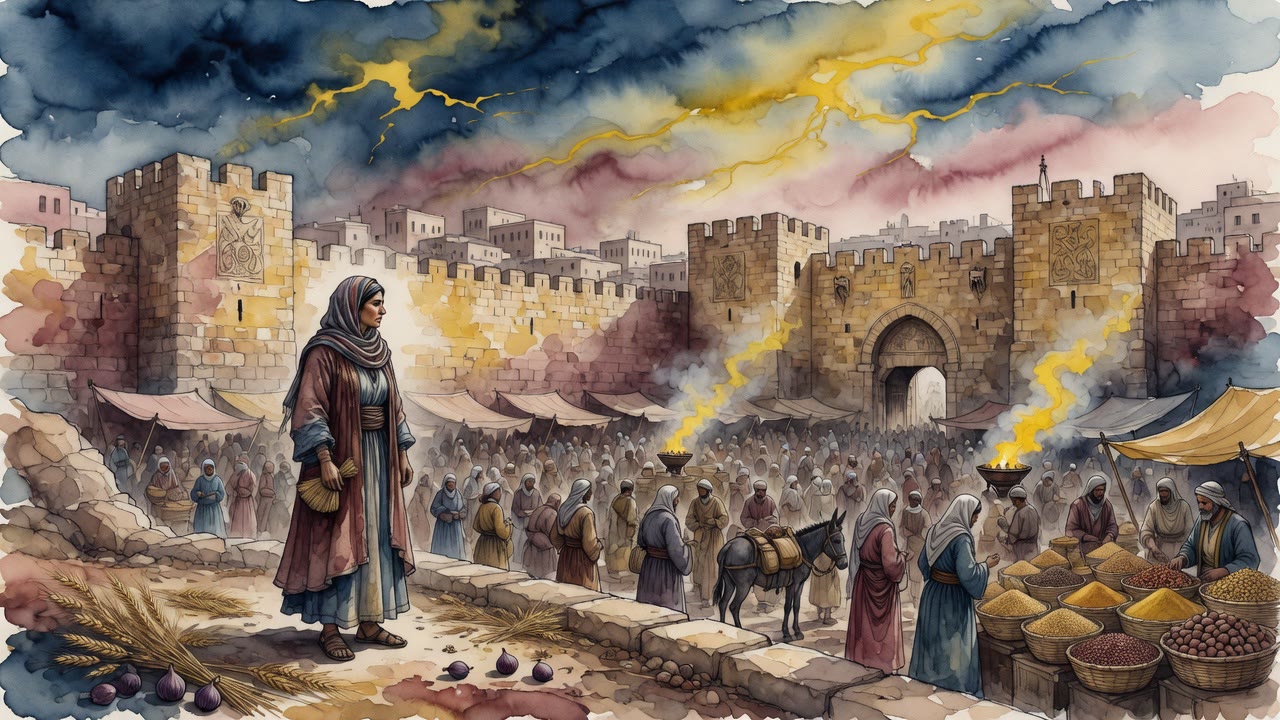
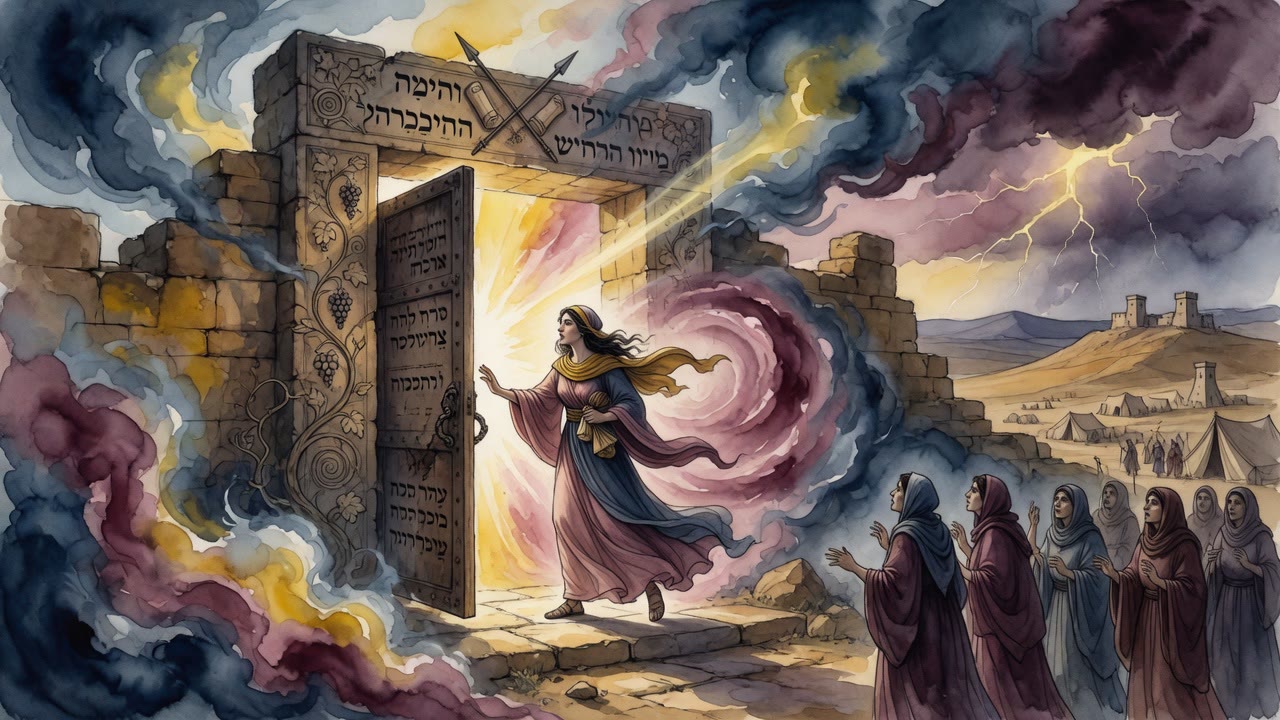
Jerusalem kept one market for kings, one for priests, one for Levites, and one for foreigners. Naomi did not want to arrive with two Moabite widows.

Curated by Arthur · Told by Maggid ·
Table of Contents
  1. Naomi Counted the Markets Before She Spoke
  2. Twenty-Four Generations of Suspicion
  3. Onkelos Asked What the Love Was Worth
  4. Resh Lakish Weighed a Convert Against Sinai
  5. The Robbed Man With Nobody to Pay
Ruth Followed Naomi Into a City of Separate Markets Click for full size

Naomi Counted the Markets Before She Spoke

Naomi stopped on the road out of Moab with two widowed daughters-in-law behind her and did the arithmetic of walking back into her own city.

Jerusalem sorted itself by street. A market for kings. A market for prophets. One for priests, one for Levites, one for ordinary Israelites, and they did not mix. Foreigners had their own market and their own clothes, and what one group wore the other group would not put on. A woman could be placed at a glance and priced accordingly.

She pictured herself coming through the gate with Orpah and Ruth at her heels, in Moabite dress, and she could not do it. "Go back, my daughters."

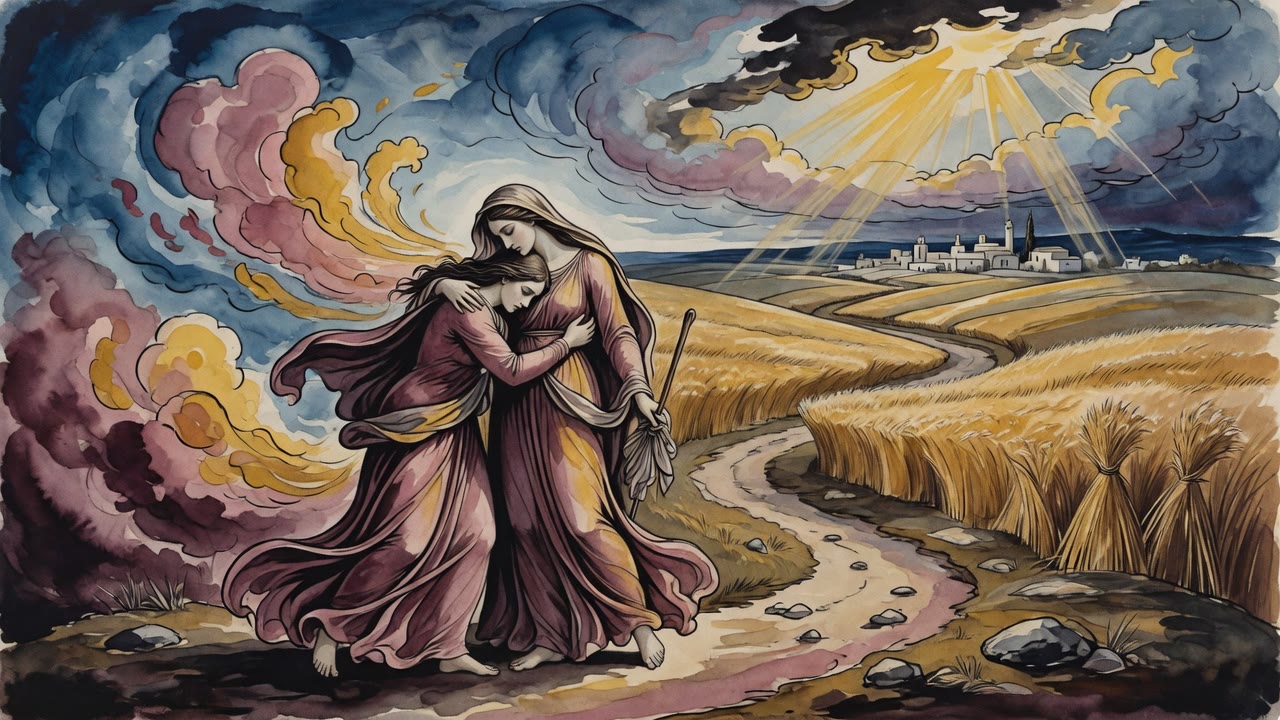
She said it three times, which is the number after which a person asking to come in is not turned away again. Orpah kissed her and took the road south. Ruth cried and did not move. Tamar had once shouted that she would not leave a house empty, and she and Ruth are the two women who handed themselves over for the sake of the tribe of Judah. Ruth said nothing that grand. She stood outside her mother-in-law's decision and would not go home.

Twenty-Four Generations of Suspicion

The city she was walking toward had opinions about people like her. Rabbi Chiya put his bluntly: do not trust a convert for twenty-four generations, because the old fermentation is still working in him.

The same mouth said the other half. When a convert takes the yoke of Heaven on himself in love and in awe, and does it for Heaven and not for a marriage or a field, God does not turn him away. God attached forty-eight warnings to the convert, as many as He attached to idol worship, which is a fair measure of how much trouble He expected the neighbors to be.

Onkelos Asked What the Love Was Worth

Onkelos, a convert himself, brought an elder a complaint he could not shake off. God says He loves the convert, and then says what the love consists of: bread and a garment (Deuteronomy 10:18). Is that the whole of it? A loaf and a coat?

The elder did not soften it. He answered with Jacob on the road at Bethel, a man with a birthright and a stolen blessing and a father's house behind him, standing in open country with nothing, asking God for two things. Bread to eat and a garment to wear (Genesis 28:20).

The patriarch had asked for the convert's portion and called it a good bargain.

There was a further step, and it belongs to God. When He wanted a word for His own position among His people in their trouble, He reached for this one. Why should You be like a stranger in the land (Jeremiah 14:8). Abraham is the father of the converts, and God had written His own name into their column.

Resh Lakish Weighed a Convert Against Sinai

Resh Lakish said a harder thing than any of them, and he said it about Sinai.

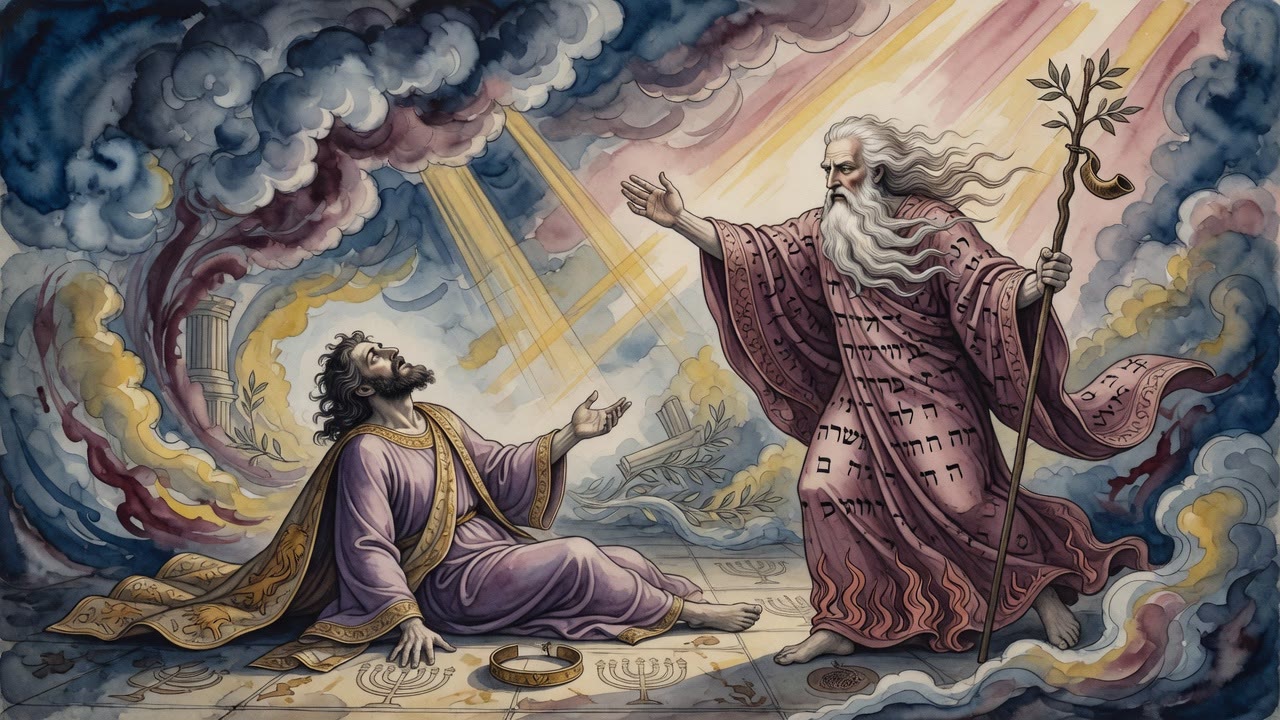
Israel stood at the mountain while the mountain shook. Voices, lightning, smoke, and the shofar (a ram's horn) going and going and not stopping. Take all of that away, he said, and they would not have accepted the Torah. Fear did a great deal of the work that day.

The convert saw none of it. No mountain moved for him. Nothing burned. He came on his own legs in an ordinary week, in a country where the neighbors were counting his generations, and took the kingdom of Heaven onto his own shoulders with nobody watching.

Resh Lakish looked at that and said the convert is more beloved than Israel standing at Sinai.

The Robbed Man With Nobody to Pay

Then the ledger, which is where love gets tested. A man robs a convert. When the convert names the theft, the robber puts his hand up and swears he never took a thing. Later the convert dies. No sons, no brothers, no cousins anywhere in the country. Nobody alive can walk up and claim the debt.

"If the man has no redeemer" (Numbers 5:8). Rabbi Yishmael refused to read that as a remark about Israelites in general, since every Israelite has kin somewhere. It is this man and this case. The robber pays the principal and adds a fifth on top, and because there is nobody left to receive it, he carries the silver up to the priests of the serving watch and brings a ram to the altar besides. Rabbi Nathan added that it makes no difference whether the dead convert was a man or a woman.

Abba Chanan, in Rabbi Eliezer's name, put the verse where it belongs. It is about the one who was robbed, not the one who robbed him.

So a stranger dies in Israel with no family, and the money taken off him does not quietly stay in the pocket of the man who took it. It goes up the Temple steps in daylight with witnesses watching.

Naomi had counted the markets and turned around three times. Ruth walked in past every one of them in Moabite clothes, into a city that would keep count of her too, in a different book.


← All myths
From the tradition

Sources

3 sources

The texts behind this telling. Some cards carry a translation of the source; others are our own retelling of it, and each card says which. Every card links out to the original.

Yalkut Shimoni on Nach 601:4Yalkut Shimoni on Nach

Retold in our words. Read the original at the link below.Sefaria Community Translation · CC-BY

The Book of Ruth, a tiny scroll nestled within the Hebrew Bible, grapples with this very feeling. And the Yalkut Shimoni, a medieval collection of rabbinic commentary, offers some fascinating insights into the story of Ruth and her mother-in-law Naomi.

The passage in Yalkut Shimoni on Nach 601 begins with Naomi urging her daughters-in-law, Orpah and Ruth, to return to their families after the death of her husband and sons. “Go back,” she says. But… why? The Yalkut Shimoni suggests a rather blunt reason: Naomi didn't want to be embarrassed by them.

Jerusalem in those days. Apparently, there were distinct marketplaces for different groups – kings, prophets, priests, Levites, and regular Israelites. Foreigners had their own spaces, their own clothes, their own ways. It was a society where belonging was visibly defined. Were Ruth and Orpah, as Moabite women, simply too different to integrate seamlessly into Judean society? Was Naomi sparing herself potential social awkwardness?

Then there's the repetition. "Turn back, my daughters," Naomi says not once, but three times. Why? The Yalkut Shimoni sees in this repetition a lesson about conversion. We learn that Jewish tradition dictates that a potential convert shouldn't be refused after the third attempt to join the community. It’s like Naomi is giving Ruth multiple chances to back out, mirroring the process a convert might undergo.

But here's where it gets complicated. Rabbi Chiya throws in a curveball, stating, "Do not have faith in a convert for twenty-four generations, as he retains his 'fermentation.'" Ouch! This concept of “fermentation” suggests a lingering influence of the convert’s former life, a skepticism that’s hard to ignore.

However, the passage immediately softens this stance. When a convert accepts the yoke of God "in love and in awe" – when the conversion is truly for the sake of Heaven – then God doesn't turn them away. There's a beautiful verse from Deuteronomy (10:18) quoted: "and [God] loves the convert to give him bread and a garment." Furthermore that God issued forty-eight warnings regarding the treatment of converts, mirroring the number of warnings against idolatry. This highlights the immense importance of treating converts with respect and dignity.

The Yalkut Shimoni then draws a parallel between Ruth and Tamar, two women who "gave themselves over for the sake of the tribe of Yehudah." Tamar, disguised as a prostitute, ensured the continuation of her husband's line. Ruth, through her unwavering loyalty to Naomi, became the great-grandmother of King David. Both were willing to defy social norms and personal hardship for the sake of family and faith. The text notes Tamar's bold declaration, "I will not leave this house empty!" and contrasts it with Ruth's tears each time Naomi urged her to leave, highlighting their different approaches to a similar situation.

The passage then explores the meaning of Naomi's blessing: "May the Lord deal kindly with you." Rabbi Chanina the son of Rav Acha points out a subtle difference in the Hebrew: it's written "Yaaseh" (He shall) instead of "Yaas" (May). This seemingly minor detail emphasizes the certainty of God's reward for their kindness – for occupying themselves with burial preparations and forgoing their marriage contracts to stay with Naomi.

And finally, Rabbi Zeira offers a stunning assessment of the entire Book of Ruth: "This scroll does not have impurity or purity in it, nor permission or prohibition. So why was it written? To teach you the reward of those who do acts of lovingkindness." The Book of Ruth isn't about ritual purity or legal obligations. It's about chesed, acts of lovingkindness. It's about loyalty, compassion, and the transformative power of embracing those who are different. It's a story about finding belonging, not in a marketplace defined by social strata, but in the embrace of a loving community. And isn't that what we all truly seek?

Full source
Midrash Tanchuma Buber, Lech Lecha 6:1Midrash Tanchuma Buber, Lech Lecha

Translation of the source text.Midrash Tanchuma (Buber), Public Domain, on Sefaria · CC-BY-SA

(Gen. 14:1:) "Now it came to pass in the days of Amraphel." Let our master teach us: A convert who converts on the eve of Passover, how does he eat his Passover offering? Thus our Rabbis taught: The House of Shammai say, he immerses and eats his Passover offering in the evening; but the House of Hillel say, one who separates from the foreskin is like one who separates from the grave.

Resh Lakish said: The convert who converts is more beloved than Israel at their standing on Mount Sinai. Why? Because, had they not seen the thunders and the lightnings, and the mountains quaking, and the sound of the shofars, they would not have accepted the Torah. But this one, who saw none of them, came and surrendered himself to the Holy One, blessed be He, and took upon himself the kingdom of Heaven. Have you one more beloved than this?

It happened that Onkelos the convert asked a certain elder, and said to him: How greatly did the Holy One, blessed be He, cherish the convert, when He said (Deut. 10:18), "and He loves the stranger, to give him bread and clothing"! Is this everything, bread and clothing? He said to him: But did not our father Jacob ask for only this, as it is said (Gen. 28:20), "and will give me bread to eat and clothing to wear"?

Our Rabbis said: The convert is beloved, for the Holy One, blessed be He, wrote concerning Himself (Jer. 14:8), "Why should You be like a stranger in the land?" The Holy One, blessed be He, said: Thus do I cherish the convert. And Abraham is the father of converts, and these wicked ones came to join in battle against him. Woe to them, for their end is to fall before him. From where? From what they read on the matter, "Now it came to pass in the days of Amraphel."

Full source
Sifrei Bamidbar 4:1Sifrei Bamidbar

Retold in our words. Read the original at the link below.Sifrei by Rabbi Shraga Silverstein · CC-BY

It deals with a rather specific scenario: what happens when someone steals from a convert to Judaism, a ger, and then that convert dies?

The verse in question is Bamidbar 5:8: "And if the man does not have a redeemer (to whom to return the debt).." Now, the rabbis of the Talmud, ever sharp, immediately ask: Wait a minute, does that mean there's anyone in Israel without a redeemer? Isn’t everyone connected somehow?

R. Yishmael offers a compelling explanation. The Torah is speaking about a particular case: someone who robs a proselyte, swears falsely about it, and then, tragically, the proselyte passes away. Because, halachically, a proselyte has no heirs (unless they had converted children), where does the money go? According to R. Yishmael, the robber must pay the principal amount plus a fifth (as a penalty) to the Cohanim – the priests – and bring a guilt offering to the altar.

R. Nathan takes the discussion in a slightly different direction. He asks, does this law apply only to men? He derives from the phrase "to whom to return the debt" that it applies equally to men and women. So why does the verse specifically mention "the man"? R. Nathan explains that if the victim was a man, you have to make an effort to see if he actually does have a redeemer, a relative who could inherit the debt. But if the victim was a minor, you don't need to search, because it's assumed they wouldn't have an heir.

Then Abba Chanan, quoting R. Eliezer, brings another perspective: The verse is primarily concerned with the robbed person, not the robber. But how do we know that? Because the phrase "to whom to return the debt" clearly indicates that the focus is on the victim.

The passage then explores the nuances of the word ha'asham, "the debt" or "the guilt." Does it refer to the money owed, or specifically to the guilt offering? The text clarifies that it refers to the money – the principal and the additional fifth. How do we know this? Because the Torah separately mentions "the ram of atonement whereby atonement shall be made for him," distinguishing the guilt offering from the monetary restitution.

Finally, the text addresses the phrase "is the L-rd's to the Cohein." Does that mean the robber can give the money to any Cohein he chooses? The text clarifies that it goes to the Cohanim of the officiating watch – those who are actively serving in the Temple during that time. This is linked back to the verse about atonement, emphasizing that the money should go to those who are involved in the process of atonement.

What’s so fascinating about this passage? It's not just about the specific legal ruling regarding theft from a convert. It's about the rigorous, detailed way the rabbis approached the text, teasing out every possible meaning, considering every angle, and ensuring justice and fairness even in the most complex of situations. It demonstrates the profound commitment to ethical conduct and the meticulous attention to detail that characterize Jewish legal thought.

Full source