6 min read

Samson Smote a Thousand With a Foal's Jawbone

Samson found a fresh jawbone from a donkey only three days old and dropped a thousand Philistines, then nearly died of thirst before a hollow cracked open.

Curated by Arthur · Told by Maggid ·
Table of Contents
  1. Like the Outstanding of the Tribes
  2. No Second Pair of Hands
  3. Thirst After the Shout
  4. A Gift That Looks Like Judgment
  5. The Field After Both Miracles

The jawbone was still wet at the joint.
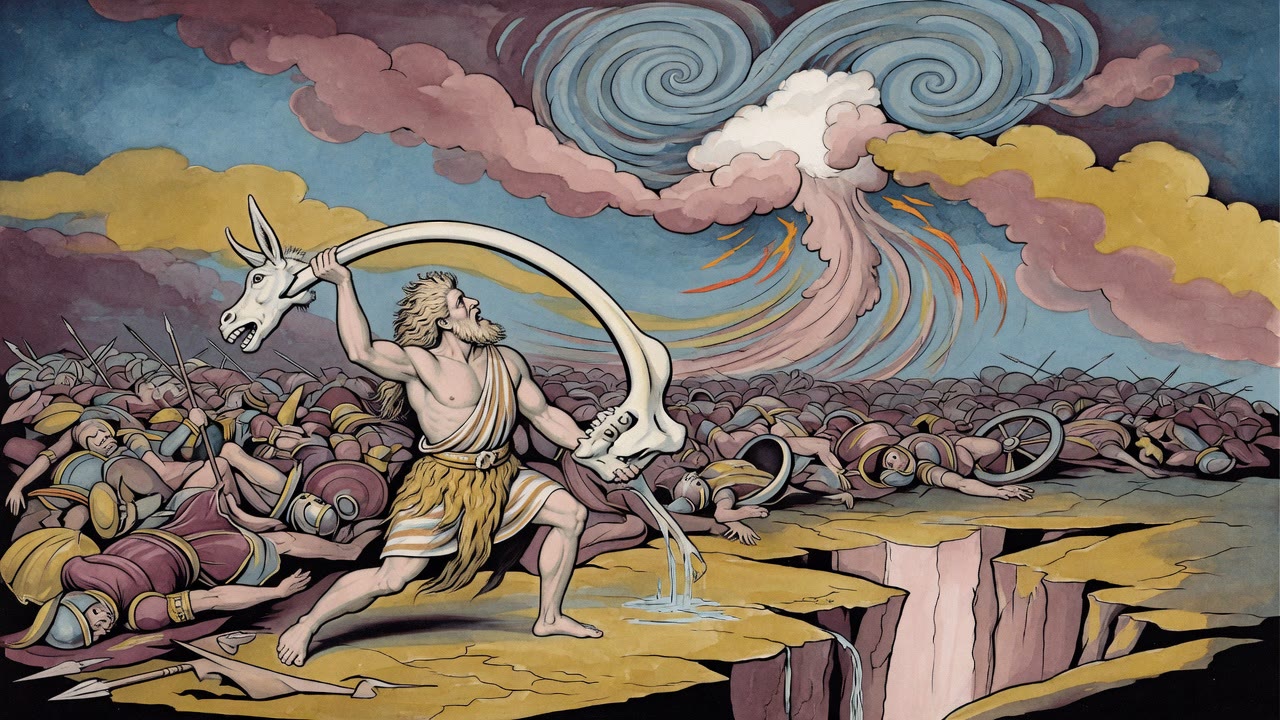
Samson Smote a Thousand With a Foal's Jawbone Click for full size

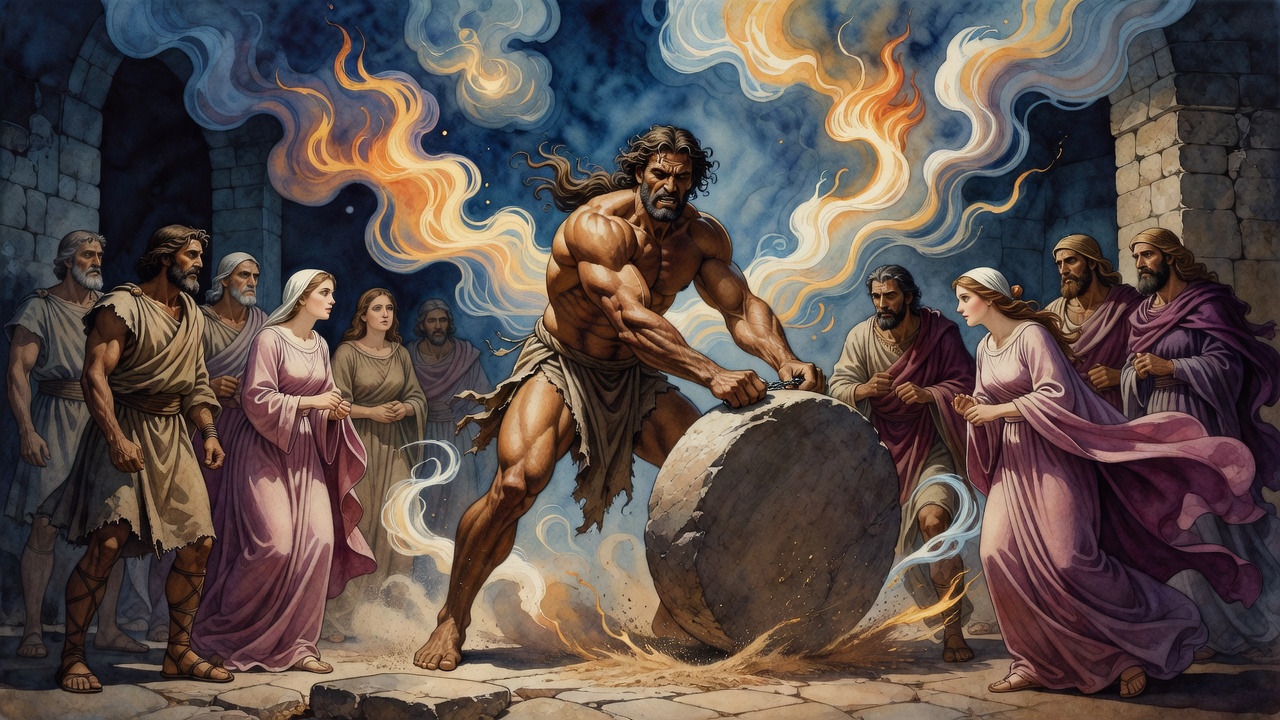
Samson found it on the ground after the Philistines closed around him, a fresh bone from a donkey so young the teachers later said it was only three days old, some saying even a twin foal's undergrown jaw. He extended his hand, took it, and the thing that should have cracked like green wood became a weapon that did not ask permission of nature (Judges 15:15).

One man. One impossible club. A thousand enemies went down in the dust of Lehi while the bone stayed in his grip.

Like the Outstanding of the Tribes

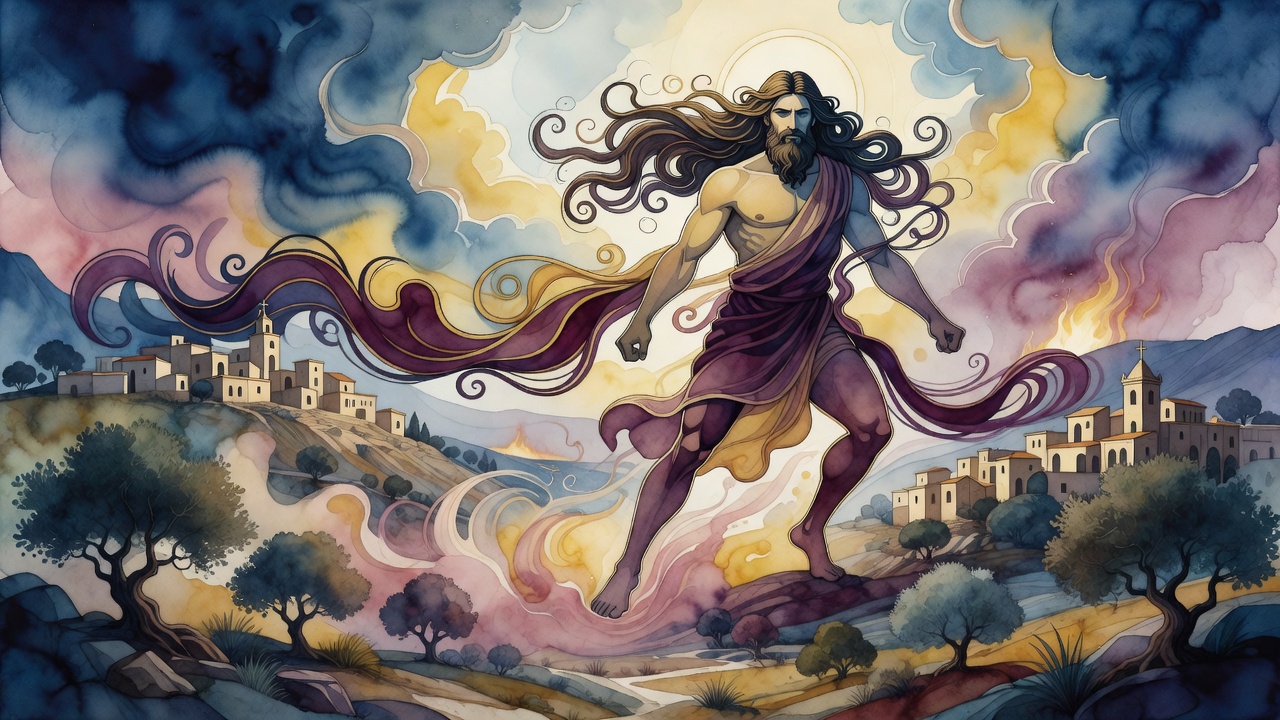
Jacob had once spoken over Dan the way a father speaks a future into a son's spine. Dan will avenge his people as one of the tribes of Israel (Genesis 49:16). The midrash hears in that "one" not a lonely orphan tribe but the outstanding, the unique, the measure set by Judah, house of kings. Dan produced no long line of crowns. It produced Samson, and the sages said that if Dan had not cleaved to the height of Judah's standard, even this one judge would not have risen from it.

Samson fought the way David would later fight, alone against a pressure that should have broken a nation. Dan's strength counted when it leaned toward Judah's kind of courage, the kind that stands when the camp wants a safer plan. On the ridge that day there was no safer plan. Philistine ranks filled the slopes. Spears caught the sun. Someone laughed when they saw he held a donkey bone. The laugh died when the first line broke.

No Second Pair of Hands

The teachers pressed the miracle further. Samson was like the Unique One of the world, like God who needs no assistant to finish a work. No armor-bearer stood at his shoulder. No circle of tribes closed ranks around him. The jawbone of a three-day foal should have snapped on the first helmet. It did not. Fresh meant weak by every ordinary rule. Weak became total in his hand.

He swung until the field quieted. Bodies lay where running men had been. The air stank of dust and blood. Samson stood in the center of a victory so large it felt like a borrowed name for a moment, as if the power had used him and might leave him empty the second he noticed he was alone.

He turned a full circle. No living enemy within reach. Only the bone, sticky now, and his own breath tearing in and out like a saw. He had wanted room to move when they closed. Now the room was too large and too quiet.

Thirst After the Shout

Then his throat closed.

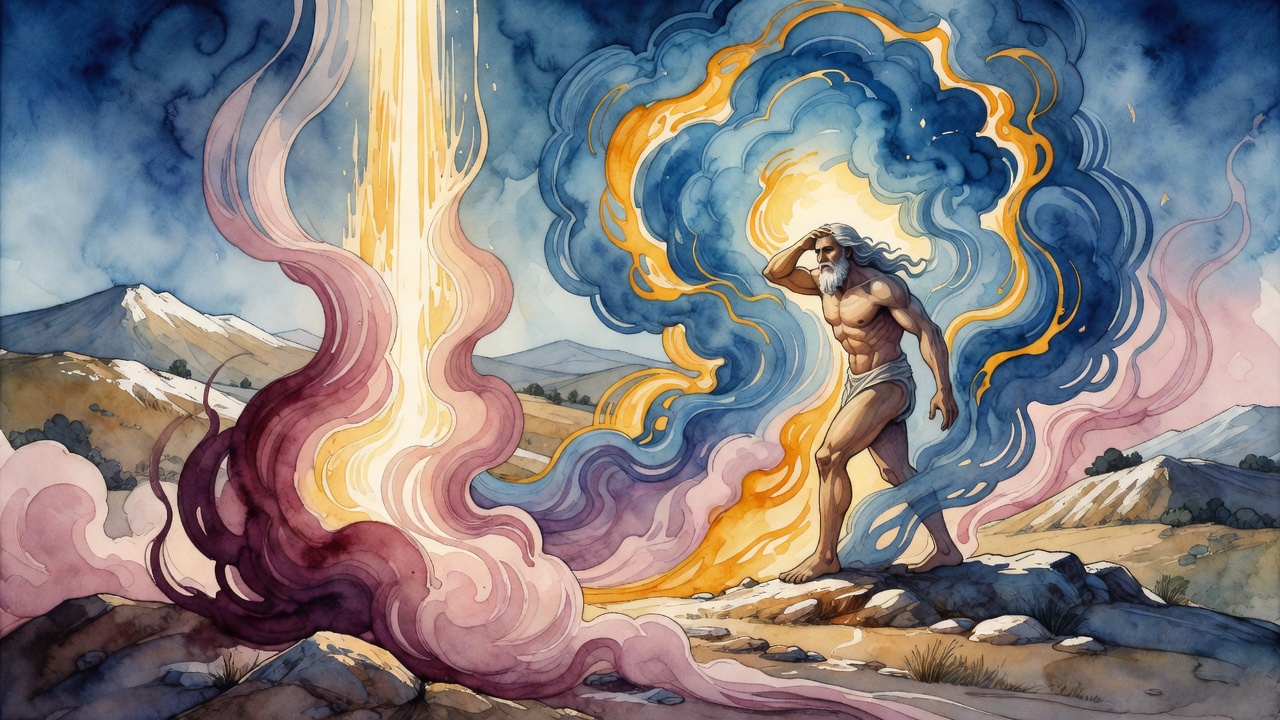
He became very thirsty (Judges 15:18). The midrash ties prattle to thirst, speech that spends the body after the body has already spent itself in war. Whether he had boasted or only gasped names into the heat, the need that hit him was not a mild dryness. It was the kind that makes a man who has just felled a thousand feel smaller than a cracked jar.

He called out. He did not ask for another army. He asked for water, for life after a victory that would mean nothing if he died on the same ground. The Holy One split a hollow in the jawbone's place, or in the rock the place was named for, and water came. Samson drank. The man who had needed no help to kill needed help to live five minutes later.

He drank until his hands stopped shaking. Water ran from his chin onto dust that still held footprints of men who would not rise.

A Gift That Looks Like Judgment

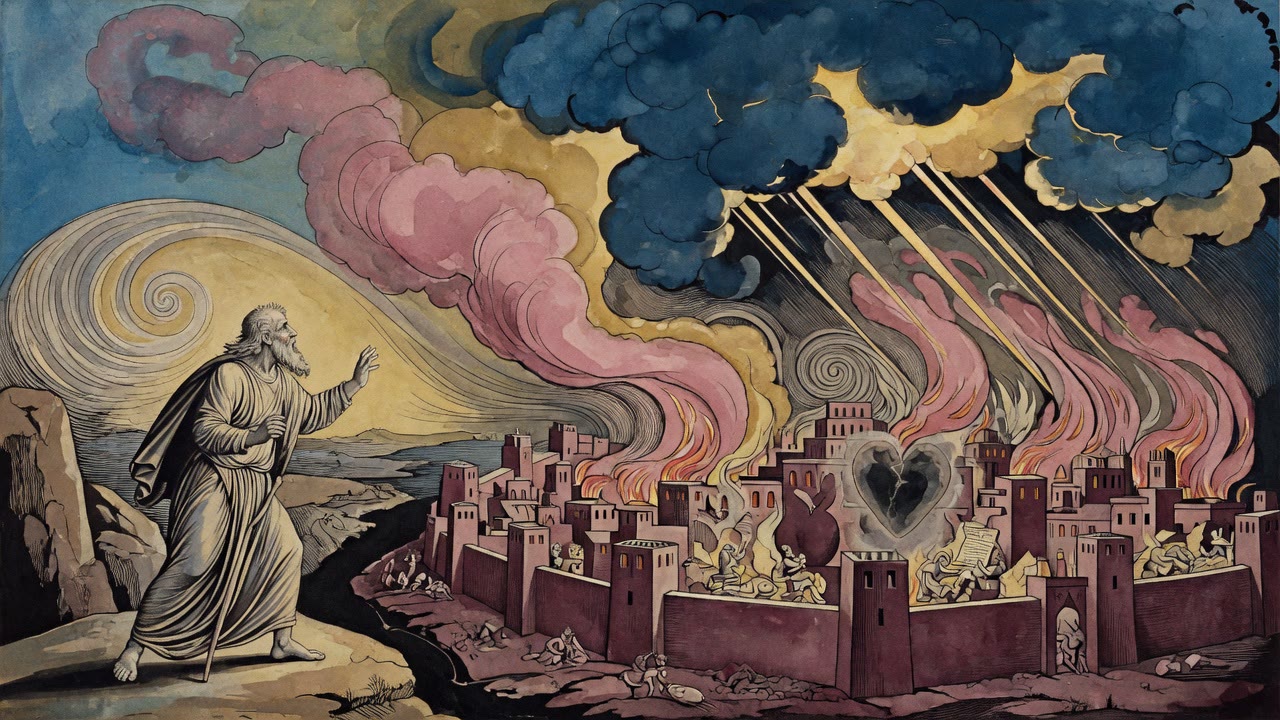
Elsewhere the same book of origins teaches how a gift offered under pressure can feel like standing before a face of judgment. Jacob, facing Esau, spoke of seeing a face like the face of elohim, judges or the dread of heaven itself, and would not approach empty-handed (Genesis 33:10). Samson had no brother to placate with flocks. His face was a Philistine ring and a sky that could still refuse him a drink. He offered nothing but the truth of his thirst. Heaven took the truth and cracked the ground.

Strength without water is a short telling. The jawbone proved what his arms could do. The spring proved who still owned the next breath. He rose with wet lips and a bone still in one hand, unwilling yet to drop the tool that had rewritten the morning.

The Field After Both Miracles

When he finally lowered the bone, the thousand were already a fact the Philistines would have to explain in their own cities. Dan's name had avenged for a day. Judah's measure of outstanding courage had a desert cousin swinging green bone. Samson wiped his mouth with the back of a hand still smelling of donkey and death.

He did not look like a king. He looked like a man who had borrowed heaven's arm for an hour and paid for it with a throat on fire. The foal's age and the thirst stayed because without them the hour is only a boast, and with them it is a body under two pressures, one that kills and one that almost kills the killer. The jawbone lay in the dust, ordinary again. The water still tasted of the rock that had no business opening.


← All myths
From the tradition

Sources

2 sources

The texts behind this telling. Some cards carry a translation of the source; others are our own retelling of it, and each card says which. Every card links out to the original.

Bereshit Rabbah 98:13Bereshit Rabbah

Retold in our words. Read the original at the link below.The Sefaria Midrash Rabbah, 2022 · CC-BY

The Torah gives us stories of such people again and again, and one of the most striking is Samson.

Our text from Bereshit Rabbah (98) explores the strength – and the thirst! – of this legendary figure. The passage begins by quoting (Genesis 49:16): "Dan will avenge his people, as one of the tribes of Israel." But it doesn't stop there. It cleverly interprets the Hebrew word for "one" (ke'aḥad) to mean "like the most outstanding" (kamyuḥad) of the tribes. Who is that? Judah, of course, the tribe of King David. The text then links Samson, from the tribe of Dan, to David, suggesting that Samson, like David, battled against Israel’s enemies.

Rabbi Yehoshua bar Neḥemya adds a fascinating point: if the tribe of Dan hadn't "cleaved to the most outstanding of the tribes," it wouldn't have even produced the one judge it did produce – Samson! It's as if Samson's greatness is somehow dependent on being connected to something even greater.

The text then compares Samson to "the unique One [kiḥido] of the world" – God. Just as God needs no assistance, neither did Samson. Remember the story? "He found a fresh jawbone of a donkey, and he extended his hand and took it, and he smote one thousand men with it" (Judges 15:15).

But what does "fresh [teriya]" really mean? It was from a donkey that was only three days old! Rabbi Avun takes it even further, suggesting that the donkey was a twin, making the jawbone even weaker and more underdeveloped. Talk about a seemingly impossible weapon! Samson’s strength wasn’t just physical; it was rooted in something beyond the natural.

The story takes a turn when Samson, after his incredible feat, becomes incredibly thirsty. "He became very thirsty" (Judges 15:18), and the text explains that "one who prattles becomes thirsty." Interesting connection. Rabbi Ḥunya and Rabbi Azarya, citing Rabbi Yoḥanan, suggest that even if there had been water nearby, Samson wouldn't have been able to reach it, so exhausted was he.

So, what does Samson do? He cries out to God, saying, "You have delivered this great salvation at the hand of Your servant; shall I now die of thirst and fall into the hand of the uncircumcised?" (Judges 15:18). He pleads that even the difference of circumcision should be enough to save him from his enemies.

And God answers. "God split the hollow [hamakhtesh] that was in Leḥi, and water emerged from it" (Judges 15:19). Rabbi Levi says Leḥi was the name of the place, while the Rabbis say Makhtesh was. But Rabbi Abba bar Kahana and Rabbi Berekhya, in the name of Rabbi Eliezer, offer a beautiful image: God brought him a spring between his teeth. What was the merit for this miracle? The text connects it to Moses' blessing: "Leaps from [min] the Bashan" (Deuteronomy 33:22) – interpreted here as "from between his teeth [mibein shinav]."

So, what does this all mean? This passage from Bereshit Rabbah paints a portrait of Samson as more than just a strongman. He's a figure connected to both the strength of Judah and the power of God. His victories, even with a seemingly weak jawbone, are miraculous. And even in his moment of weakness, God provides, literally putting the answer to his prayers right in his mouth. It's a reminder that even when we feel alone and depleted, connection to something greater – to community, to tradition, to the Divine – can bring forth unexpected strength and sustenance.

Full source
Bereshit Rabbah 78:12Bereshit Rabbah

Retold in our words. Read the original at the link below.The Sefaria Midrash Rabbah, 2022 · CC-BY

In (Genesis 33:10), Jacob pleads with Esau, saying, "Please, no, if I have found favor in your eyes, receive my gift from me, for therefore, I have seen your face, as the sight of the face of angels [elohim], and you welcomed me." But what exactly does Jacob mean by comparing Esau's face to that of angels?

Bereshit Rabbah, a classical collection of Rabbinic homilies on the Book of Genesis, dives deep into this very question. It offers a fascinating interpretation of Jacob's words. The text notes the repetition: "Jacob said: Please, no, if I have found favor in your eyes, receive my gift from me, for therefore [I have seen your face], as the sight [kirot] of the face [penei] of elohim" – suggesting that "the face of elohim" implies judgment, and so does "your face." In other words, Jacob may be subtly acknowledging Esau's potential power over him, his ability to judge him for past wrongs.

Who are these elohim? The commentary offers two possibilities. In one sense, elohim could mean judges. Jacob is acknowledging Esau's authority. In another sense, elohim could refer to God. This connects to the idea found in (Exodus 23:15), "They shall not appear before Me [yera’u fanai] empty-handed." Jacob may be suggesting that just as one doesn't approach God without an offering, so too, one shouldn't approach Esau empty-handed. It’s a fascinating play on words, layering meaning upon meaning.

The narrative continues, "Please, take my gift that was brought to you as God has graced me, and because I have everything. He urged him, and he took it" (Genesis 33:11). Bereshit Rabbah highlights Jacob's humility, pointing out that Jacob says, "that was brought," not "that you brought." This implies that the wealth came to Esau "on its own," perhaps suggesting that Esau didn't have to work as hard for it.

But Esau’s acceptance wasn't straightforward. "He urged him, and he took it" – suggesting Esau appeared hesitant, almost withdrawing, while simultaneously reaching out to accept the gift. The text paints a picture of someone trying to maintain appearances while still accepting a benefit.

This leads to a fascinating observation by Yehuda ben Rabbi Simon: "Those who grovel [mitrapes] for pieces [beratzei] of silver" (Psalms 68:31) – he opens his palm [matir et hapas] and is placated [umitratze] with silver. It's a stark commentary on human nature and the power of wealth.

The text then veers into an anecdote about Rabbeinu (often referring to Rabbi Judah HaNasi, the redactor of the Mishnah (the earliest code of rabbinic law)), and Reish Lakish. Reish Lakish advises Rabbeinu, "Do not take anything from anyone, and you will not need to give anything." This is illustrated by a story of a woman offering Rabbeinu a bowl with a knife. Rabbeinu returns the bowl, keeping only the knife. An imperial messenger covets the knife and takes it, proving Reish Lakish's point: accepting gifts can lead to further demands and losses.

Finally, the text concludes with a saying from an "ignoramus" to Rabbi Hoshaya. The ignoramus suggests that all the gifts Jacob gave to Esau will eventually be returned to the messianic king. He bases this on (Psalms 72:10), "The kings of Tarshish and of the islands will return tribute." The use of "return" rather than "bring" is key, implying a restoration of what was once given away. Rabbi Hoshaya acknowledges the wisdom in this, promising to share it publicly.

So, what do we take away from all of this? It seems the story of Jacob and Esau, and the rabbinic interpretations surrounding it, offer us a tradition of insights into human relationships, the complexities of gift-giving, the dangers of greed, and the ultimate hope for redemption.

Full source