Samson Ground Grain While Philistia Harvested Him
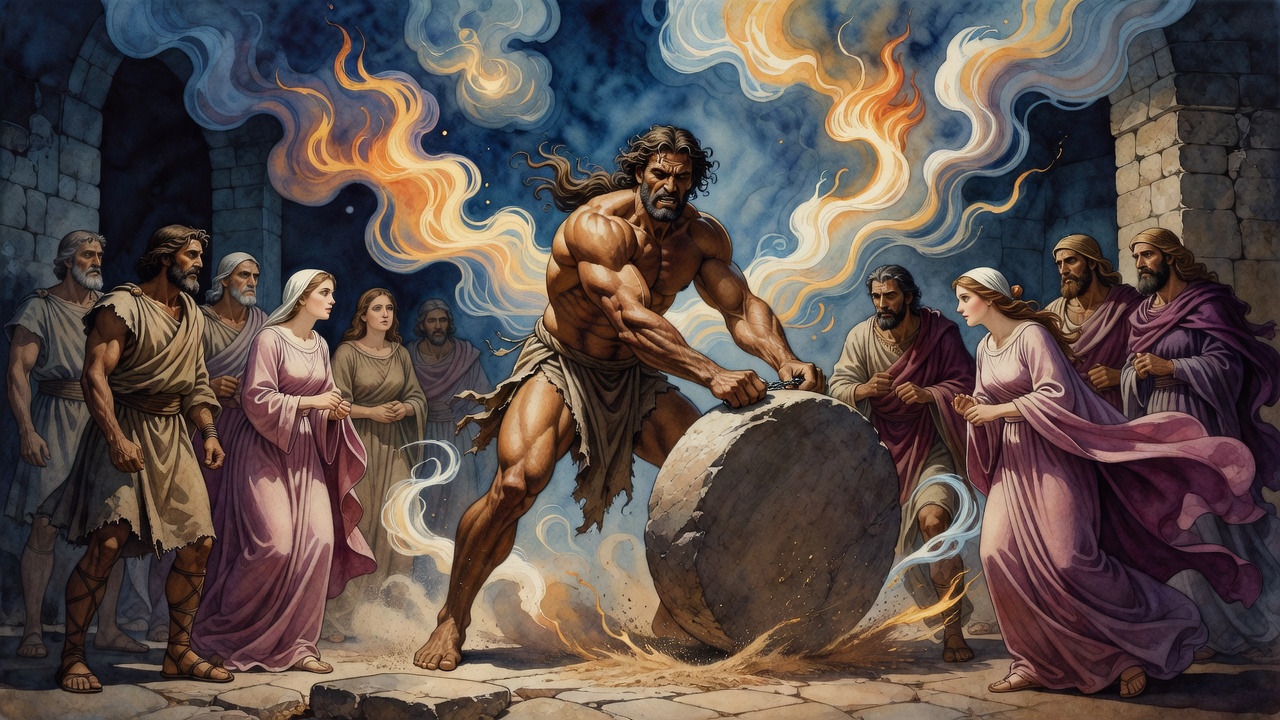
Blind Samson turned the millstone in prison. His captors brought their wives to him, hoping to breed his strength into Philistine sons.
Table of Contents
 Click for full size
The Millstone
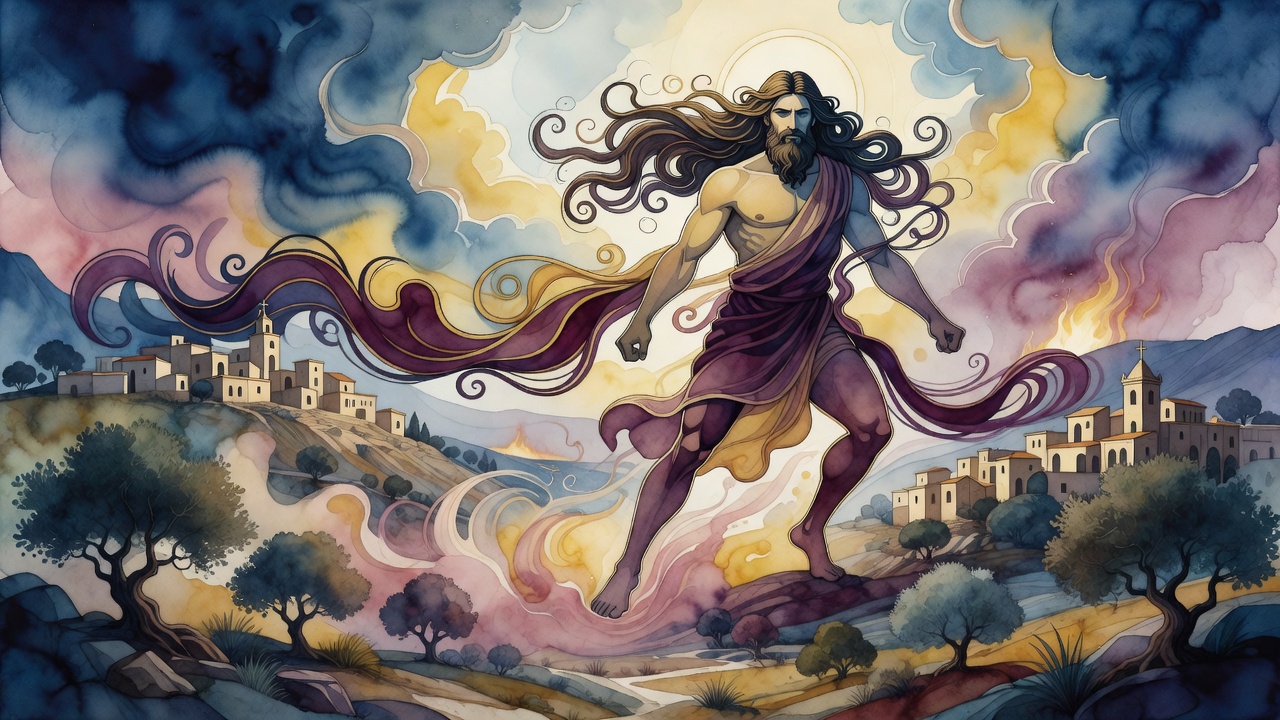
Samson leaned into the beam with both hands and walked the circle until his shoulders burned. The Philistine prison smelled of grain dust and sweat. His eyes were gone. The chains on his ankles sang a short, ugly song with every step. The strong man of Israel had become an ox.
That is the plain picture. Degradation. Labor. A body once filled with the spirit of the Lord reduced to turning stone for the enemy's bread.
What "Grind" Hid
Rabbi Yohanan heard another meaning buried in the verb. In the Book of Job a man swears his innocence by saying that if he has sinned, let his wife grind for another. There the word is a veiled term for marital relations. Read Samson's verse in that light, and the prison becomes darker still.
The Philistines did not only want to humiliate him or work him to death. Each of them brought his own wife to the captive so that she might conceive a child from him. They hoped to breed sons who would carry his legendary strength. The power they had feared and finally chained, they now tried to harvest for themselves. The blind man at the millstone was, to his captors, a stud whose offspring might give Philistia warriors no enemy could stand against.
It is a hard portrait of how the world treats a gift from God once it has the gift in its grip. Not with awe. With greed.
The Road That Went Down
Long before the prison, Scripture had already marked a direction on his map. When Samson went to Timnah, the text says he "went down" (Judges 14:1). The same town appears when Judah goes there, and that verse says he "went up" (Genesis 38:13). One place. Two opposite verbs.
Rabbi Elazar reads the geography as a verdict on the man. Samson was lowered by what happened at Timnah, so his verse speaks of descent. Judah was raised by what happened there, because the line of kings and the Messiah would one day flow from his encounter. The road did not change. The destiny attached to each traveler did.
Slope and Heart
Other sages prefer a plainer answer. Rabbi Shmuel bar Nachmani suggested there were simply two towns named Timnah, one reached by climbing and one by descending. Rav Pappa offered the neatest solution of all. There was only one Timnah, set on a slope, and the direction depended entirely on where you began. Approach from the low side and you go up. Approach from the high side and you go down.
The same place can be a rise or a fall. Which one it becomes may say less about the town than about the heart of the person walking toward it. Samson walked toward Philistine desire and the verse sent him down. Judah walked toward a complicated mercy, and the verse sent him up.
From Slope to Stone
The descent that began on the road ends at the millstone. The man who went down to Timnah for a woman ends grinding in a prison where women are brought to him by force of policy. The gift that should have judged Philistia is mined for Philistine bloodlines. Between the slope and the stone stands a life that never learned how to climb.
When the pillars finally fall, they fall on a body that has already been used as equipment. The last strength is still the Lord's. The long misuse was Philistia's confession of what it valued in a man of God. Not his justice. His muscle.
Before the prison there had been the lion on the road to Timnah, the riddle at the feast, the gates of Gaza carried up the hill. Each exploit thickened the Philistine hunger for his body as a tool. When Delilah finally learned the secret of his hair and the Lord departed from him, the capture was not only revenge. It was acquisition. They put out his eyes so he could not aim his strength. They left his body intact so the strength might still be used.
At the mill he counted circles by the heat of the stone. Sometimes a door opened and laughter entered with a woman pushed forward by her husband's ambition. Samson had once gone down to Timnah for desire of his own. Now desire was done to him on a schedule. The verse that said he ground in the prison house holds both labors at once, the grain and the forced seed, until the stomach turns.
Judah's old road up the same slope had led, through shame and confession, to Perez and to kings. Samson's road down had led to this. The slope did not apologize. It only measured the walker. When Samson finally asked for strength one last time between the pillars, he asked as a blind man who had learned what Philistia wanted from a gift of God. Not justice. Not Torah. Only force that could be owned.
← All myths