5 min read

Samson Told Delilah the Secret Because He Was Tired of Lying

He had lied to her three times and escaped three times. On the fourth asking, he was exhausted and told her everything she needed to destroy him.

Curated by Arthur · Told by Maggid ·
Table of Contents
  1. The Strength That Made Him Monstrous
  2. What His Eyes Had Always Done to Him
  3. Why He Finally Told Her
  4. The Last Prayer

Samson did not lose his strength when Delilah cut his hair. He lost it before that, the moment he gave away the sign that tied him to God.

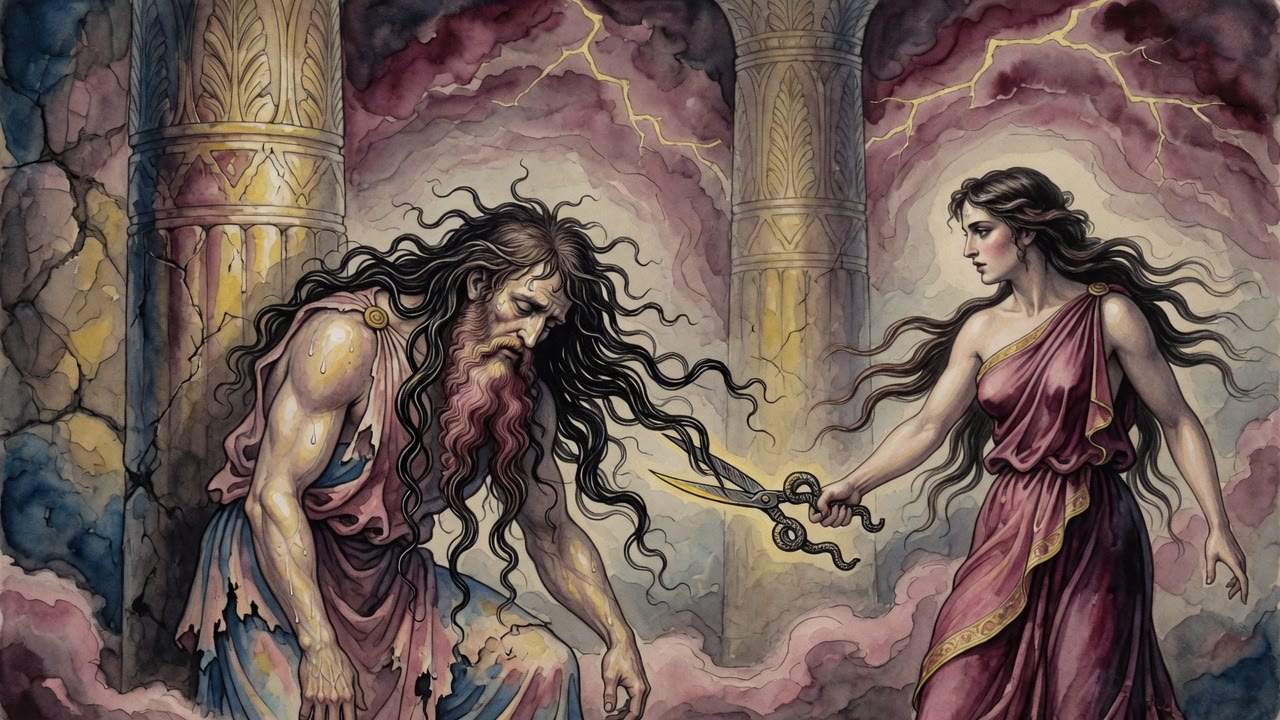
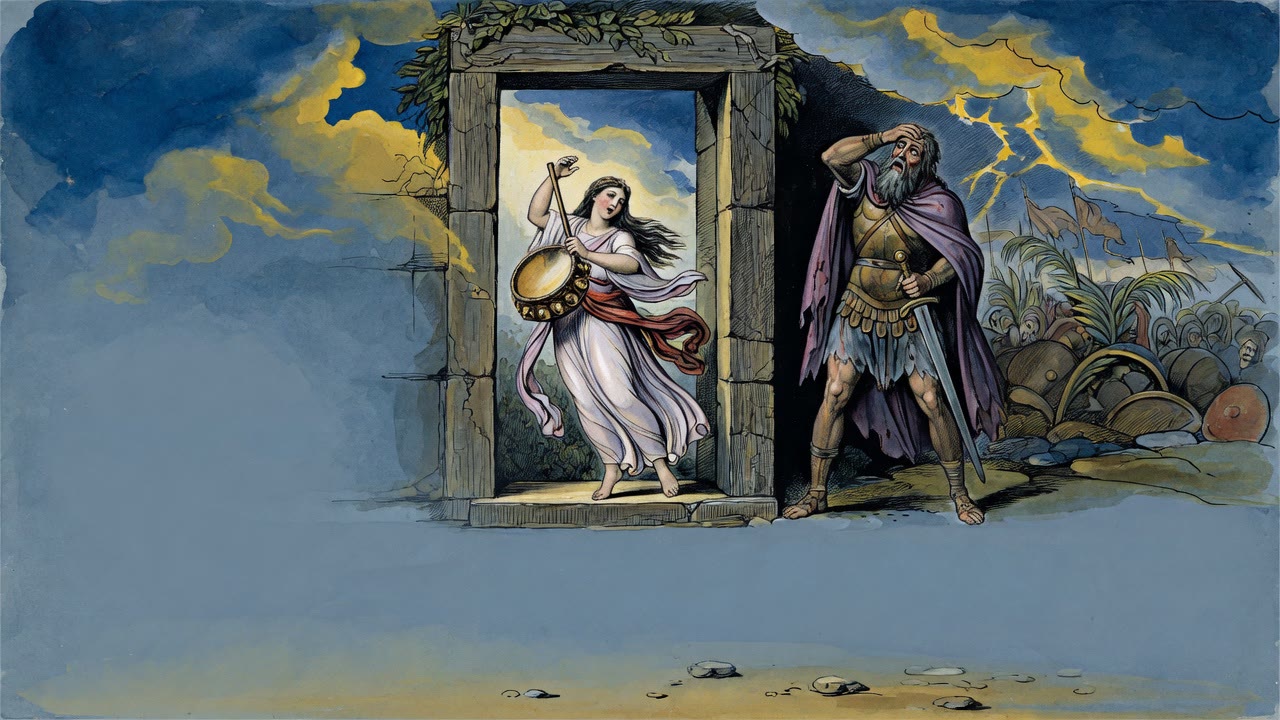
Judges 16 tells the scene with terrible repetition. Delilah asks. Samson lies. The Philistines hide in the room. She binds him with the answer he gave her, cries that the Philistines are upon him, and he breaks free. Fresh bowstrings. New ropes. Hair woven into a loom. Three escapes, each one proving that she will use whatever he tells her. Then he tells her anyway.

The Strength That Made Him Monstrous

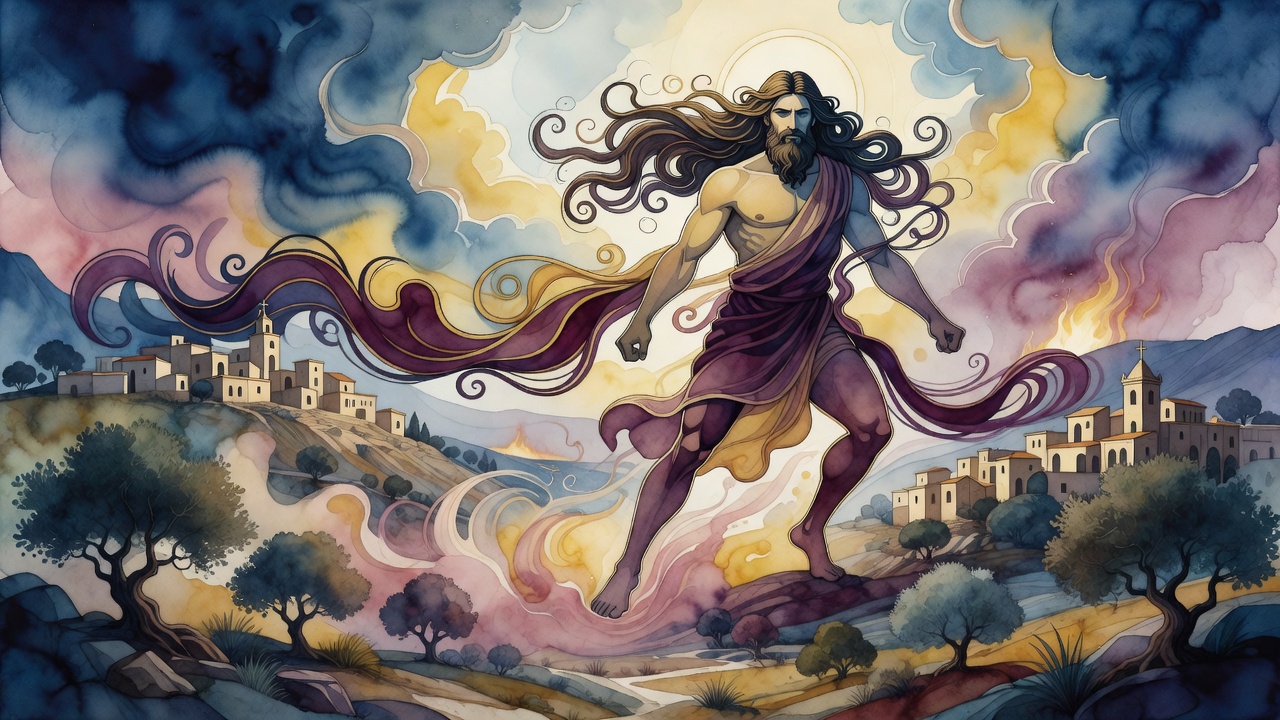
The traditions about Samson's size pushed the description into something inhuman. Sixty ells across the shoulders. When the spirit of God first came on him as a boy, he uprooted two mountains and rubbed them together. His shadow was so large that people thought they were looking at a wall. When he was dying of thirst after a battle, water ran from his own mouth. He carried the gates of Gaza on his back. The exaggeration served a purpose: make the ruin proportional to the scale of what was ruined.

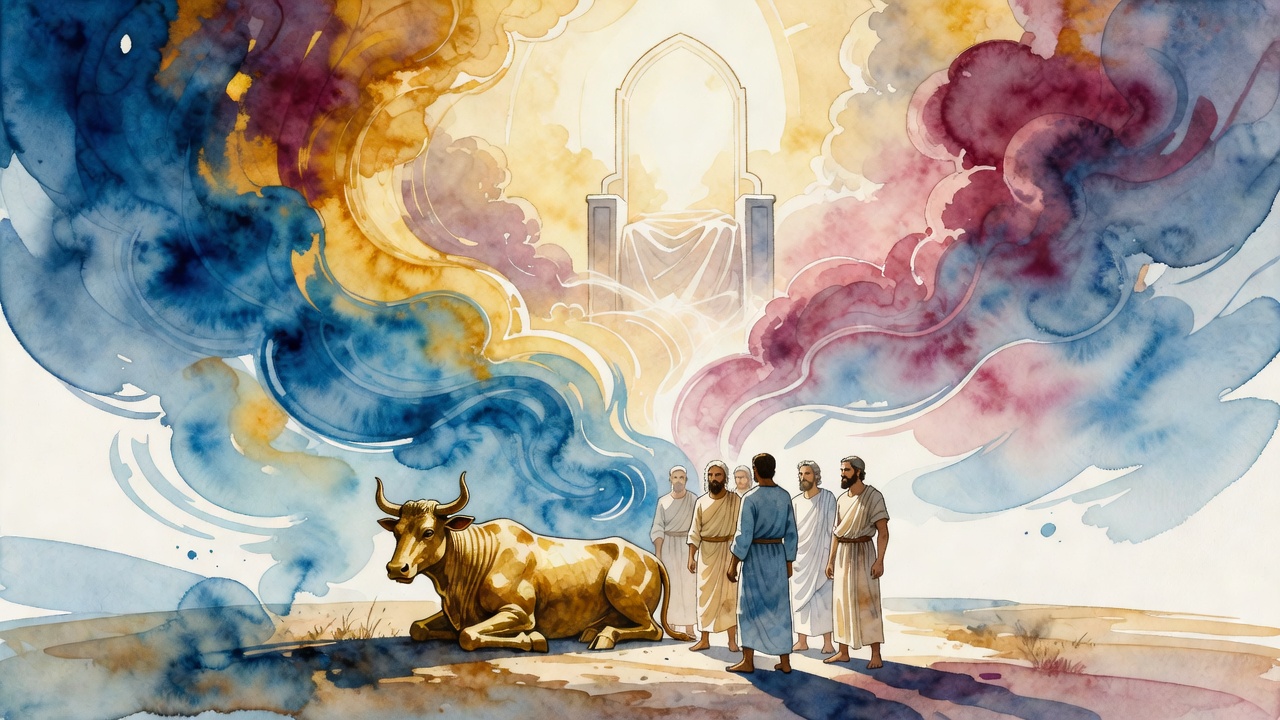
His birth had been a covenant. An angel told his mother before he was born that this child would begin to rescue Israel from the Philistines. His hair was to remain uncut. He was to live as a Nazirite. The strength was not his own. It was a consecration made visible in flesh, and it would stay only as long as the consecration held.

What His Eyes Had Always Done to Him

The sages identified Samson's weakness before Delilah named it. When he demanded that his father find him a Philistine woman to marry, he said: take her for me, for she is just in my eyes. He followed his gaze rather than wisdom. He chose based on what looked appealing rather than what was right. His eyes governed his decisions and led him from one Philistine woman to the next until the pattern was complete.

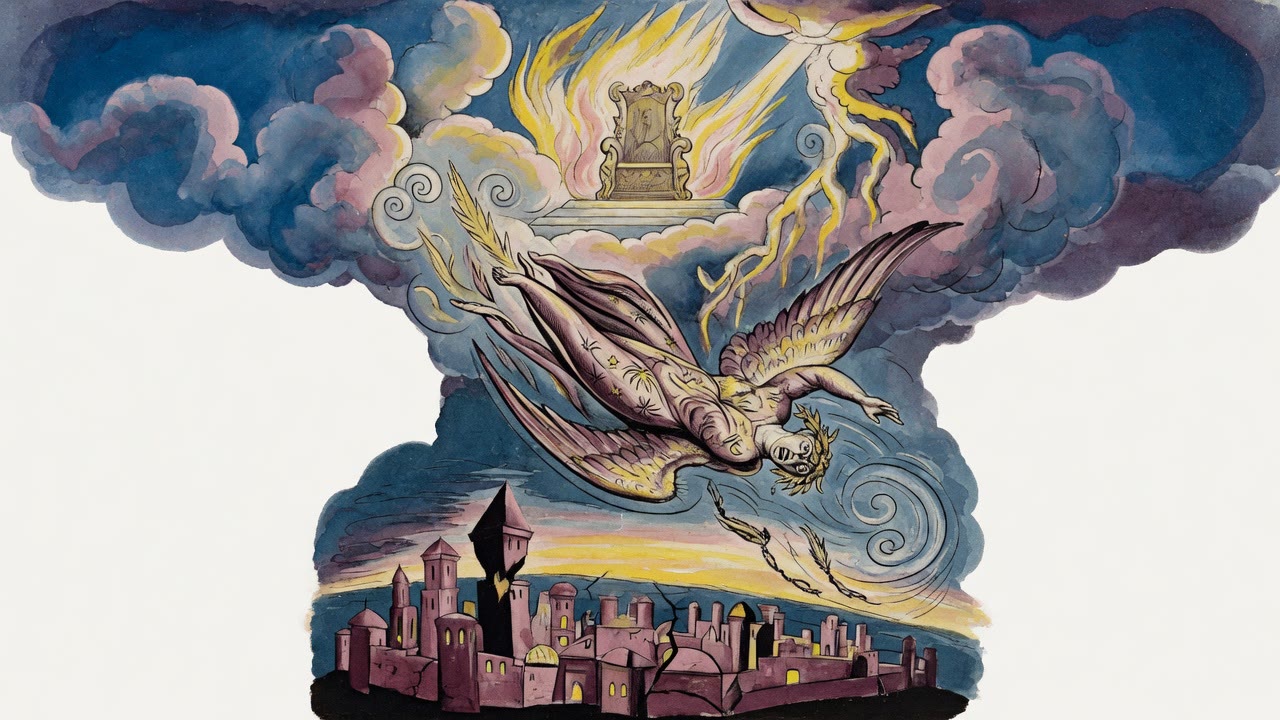
The principle the midrash extracted from this was blunt: whatever a person boasts about or indulges in becomes the exact instrument of their downfall. Samson's downfall was his eyes. And so after Delilah betrayed him and the Philistines seized him, the first thing they did was gouge out his eyes. He was led to Gaza by his eyes. He lost his freedom by his eyes. He lost his eyes to the people whose women his eyes had always sought.

Why He Finally Told Her

Judges says that she pressed him daily with her words and urged him, and his soul was vexed to death. He had not told her because he wanted her to know. He told her because he was exhausted. Three times he had given her a false answer. Three times she had tested it immediately with Philistines waiting in the room. He knew what she was doing. He knew every time. He told her anyway, on the fourth asking, because the gap between what he knew and what he did had always been the largest gap in Samson's story.

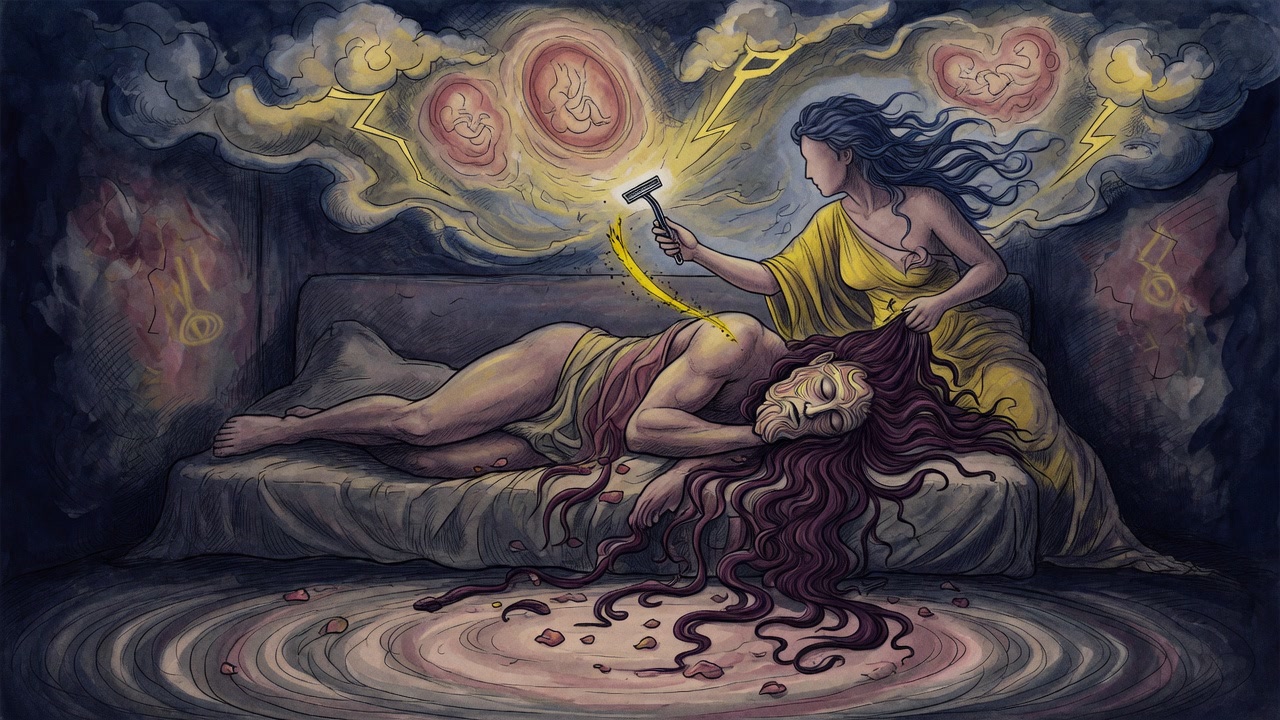
He gave her the full truth. His hair had never been cut because he was a Nazirite to God from birth. If his hair were shaved, his strength would leave him. She sent for the Philistines. She lulled him to sleep on her knees. A man came and shaved seven locks from his head. She woke him the way she always had: the Philistines are upon you. He woke and expected to shake himself free as before. He did not know that God had left him.

The Last Prayer

He was blinded and bound in Gaza, grinding grain in the prison. His hair began to grow back. The Philistines assembled to celebrate his capture with a sacrifice to Dagon and to make sport of him before three thousand people. They brought him out between the two central pillars of the building. He asked the boy leading him to let him feel the pillars so he could lean against them.

He prayed. He named his two eyes specifically. For one eye, he asked for its recompense in this life. For the other, he said he would wait for the world to come. Then he pushed. The building collapsed on the lords of the Philistines and on all the people inside it. The dead he killed at his death were more than the dead he had killed in his life. He had fought Israel's enemies from the moment of his birth with nothing more reliable than the willingness to be in their midst when God chose to act through him.


← All myths

From the tradition

Sources

9 sources

The texts this telling draws on, in full. Open a card to read inline, or expand it for a wider, quieter read.

Antiquities V.8Antiquities of the Jews (Josephus)

Samson killed a lion with his bare hands. No weapons. No armor. Just raw, God-given strength unleashed on a beast that charged him on the road to Timnah (Judges 14:6). He was on his way to court a Philistine woman his parents disapproved of. But this marriage, according to Josephus, was orchestrated by God Himself to create a conflict that would eventually free Israel.

His birth was miraculous. An angel appeared to his mother, the wife of Manoah, from the tribe of Dan. And told her she would bear a son whose hair must never be cut and who must drink nothing but water. Manoah, a jealous man, demanded to see this angel himself. When the angel finally appeared to both of them, he refused to give his name. Manoah offered a sacrifice, and the angel ascended to heaven through the flames. That was the last they saw of him.

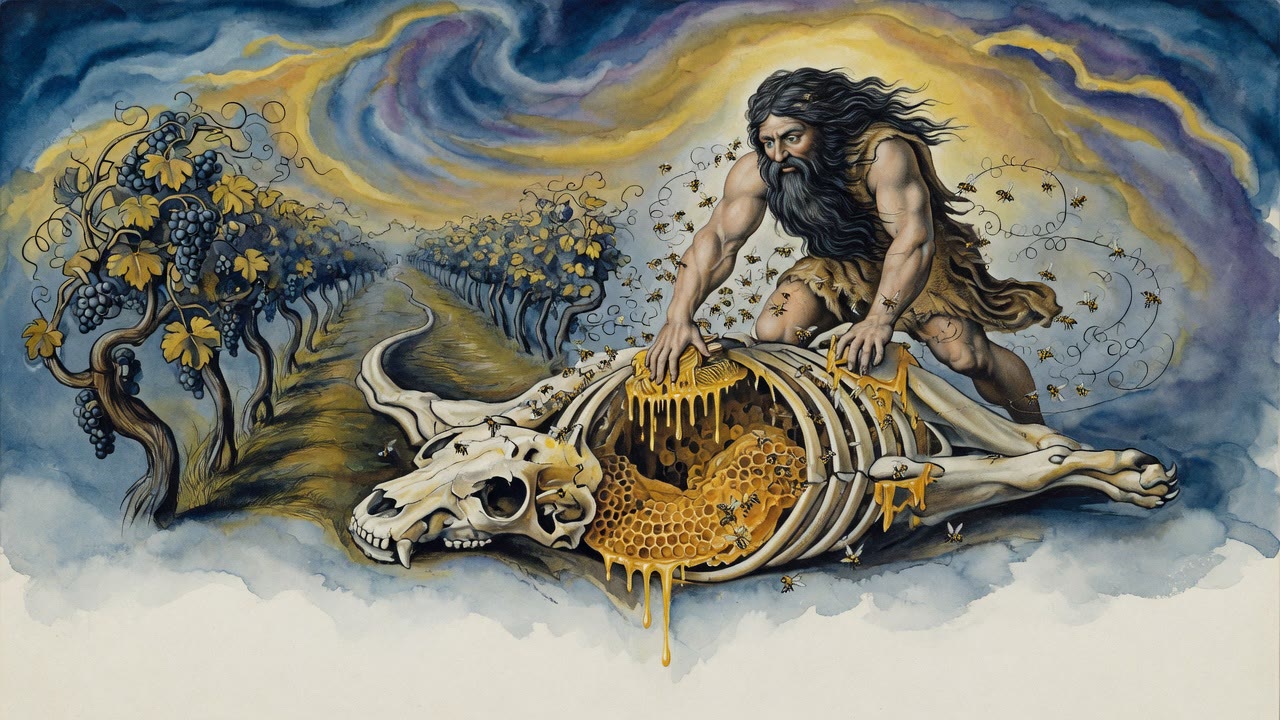
The boy grew into something terrifying. On a return trip to Timnah, he found a swarm of bees nesting inside the lion's carcass and scooped out honeycomb, which became the basis of a riddle he posed at his own wedding feast: "Out of the eater came something sweet" (Judges 14:14). When his Philistine bride betrayed the answer to her countrymen, Samson's rage ignited a one-man war. He tied torches to three hundred foxes and set the Philistine grain fields ablaze. He killed a thousand men with the jawbone of a donkey (Judges 15:15). He ripped the gates off the city of Gaza and carried them to a mountaintop near Hebron.

The same force that made him unstoppable also made him reckless. Delilah, a Philistine woman, seduced the secret of his strength out of him, his uncut hair, the sign of his consecration to God. She shaved his head while he slept. The Philistines blinded him, bound him, and paraded him as a trophy.

His hair grew back. At a Philistine festival, chained between the two pillars holding up the banquet hall, Samson prayed one last time. Then he pushed. The roof collapsed, killing three thousand Philistines. And Samson with them. He killed more enemies in his death than in his entire life (Judges 16:30). He had judged Israel for twenty years.

Full source
Legends of the Jews 2:67Legends of the Jews

The familiar story is this: the long hair, the Philistines, the betrayal by Delilah. But the tales surrounding Samson, as recounted in Ginzberg's Legends of the Jews, go far beyond what you might remember from Sunday school. They paint a picture of a figure whose strength was so immense, so utterly superhuman, it's almost hard to fathom.

When we say superhuman, we really mean it. According to legend, Samson measured a whopping sixty ells between his shoulders. An "ell" is an old measurement, roughly the length of a forearm. Do the math! This guy was huge.

He wasn't just big; he was powerful. The first sign of his incredible strength? He uprooted two massive mountains and rubbed them together! Can you even imagine the earth-shattering force that would take?

Here's a curious detail: Samson wasn't perfect. He had a physical imperfection; he was, the legends say, maimed in both feet. It's a fascinating reminder that even the mightiest heroes can have their flaws.

So, what was the source of Samson's incredible power? It came from the spirit of God, which would be "poured out" over him. And there was a sign. Whenever this divine spirit descended, Samson's hair would begin to move, emitting a sound like a bell that could be heard from afar. It's a striking image, isn't it? A tangible manifestation of divine power.

And his speed? When the spirit rested upon him, Samson could cover the distance between Zorah and Eshtaol in a single stride. That’s some serious ground.

The tales tell us that Jacob himself, upon witnessing such might, thought Samson might actually be the Mashiach – the Messiah. The anticipation must have been palpable. But, alas, when God showed Jacob Samson's ultimate fate, he realized that this hero-judge, mighty as he was, would not be the one to usher in the new era.

It makes you wonder, doesn’t it? Why Samson? Why this man, blessed with incredible strength, yet ultimately brought down by his own flaws and vulnerabilities? Perhaps the story of Samson isn't just about physical strength, but about the complexities of human nature, the burden of expectations, and the elusive search for true redemption. Perhaps that is why we keep telling his story.

Full source
Legends of the Jews 2:69Legends of the Jews

The tale of Samson is definitely one of those. We know him as this incredible strongman, but his story, as the Legends of the Jews retells it, is full of so much more than just brute force.

Take, for instance, his first major victory against the Philistines. He didn't just grab any old weapon. Oh no. He used the jawbone of an ass. But not just any ass! According to the legends, this was the very same jawbone from the very same ass that carried Abraham on his journey to Mount Moriah for the Akeidah, the binding of Isaac! A relic of such significance, preserved miraculously, and used to strike a blow against Israel's enemies.

After that victory? Another miracle! Samson was dying of thirst, parched and weak. But instead of finding a spring, water began to flow directly from his own mouth, like a living fountain. It’s this kind of detail that makes you realize that Samson was more than muscle.

He wasn't just physically strong, though, he was spiritually exceptional, too. The texts tell us he was unselfish, always helping the Israelites, yet never asking for anything in return. He was a Nazarite (or Nazir) "unto God," as he told Delilah. Now, when Samson revealed his secret to her, that his strength was tied to his uncut hair as a Nazarite, Delilah knew he was telling the truth. Why? Because, as the legends tell us, she knew him well enough to know he wouldn’t invoke God’s name to tell a lie. She understood his character in that fundamental way.

But here's the thing: even heroes have their flaws. Samson's Achilles' heel was his weakness for, shall we say, "sensual pleasures." He let his desires lead him astray, and the consequence was devastating: "He who went astray after his eyes, lost his eyes." A powerful, poetic, and tragic consequence.

You'd think such a harsh punishment would change a person. But, according to the legends, even blinded and imprisoned, Samson continued his old ways. And, shockingly, the Philistines actually encouraged it! They cast aside all their own family values, hoping that if Samson fathered children, those children would inherit his incredible strength and stature. Imagine the desperation of a people willing to compromise their own morals for a chance at producing another giant like Samson!

What does it all mean? Samson’s story is a rollercoaster. It's a reminder that even the mightiest among us are complex, flawed individuals. He was chosen, strong, and selfless in many ways, yet ultimately undone by his own desires. It's a cautionary tale, perhaps, but also a evidence of the enduring power of faith, regret, and the messy, complicated nature of being human.

Full source
Mekhilta Tractate Shirah 2:10Mekhilta DeRabbi Yishmael

The Mekhilta highlights Samson as another example of the principle that a person's punishment mirrors their sin. Whatever someone boasts about or indulges in becomes the exact instrument of their downfall.

Samson's weakness was his eyes. When he demanded that his father find him a Philistine woman to marry, he said, "Take her for me, for she is just in my eyes" (Judges 14:3). He followed his gaze rather than wisdom. He chose based on what looked appealing rather than what was right. His eyes governed his decisions, leading him into one disastrous entanglement after another with Philistine women.

The consequence was devastating in its precision. After Delilah betrayed him and the Philistines seized him, the text records: "And the Philistines seized him and gouged out his eyes. And they brought him down to Azzah" (Judges 16:21). The very organs that led him astray were the ones taken from him.

Rabbi Yehudah adds a further geographic detail to sharpen the point. The beginning of Samson's moral lapse took place in Azzah (Gaza), where he first visited a Philistine woman. And his punishment, blinding, imprisonment, and forced labor grinding grain, also occurred in Azzah. The place of the sin became the place of the reckoning.

The Mekhilta's lesson is not that God acts cruelly, but that divine justice operates with extraordinary precision. The punishment is never arbitrary. It is a mirror held up to the transgression itself, measure for measure.

Full source
Legends of the Jews 2:70Legends of the Jews

The familiar story centers on Samson – the strongman betrayed by Delilah, his hair cut, his strength gone, his eyes gouged out by the Philistines. A tragic hero, to say the least. But even in his darkest hour, bound and blinded, Samson wasn't finished.

In Legends of the Jews, Louis Ginzberg tells how Samson made one final plea to God. He asked that God fulfill in him the blessing of Jacob, and imbue him with divine strength. Imagine him there, humiliated and in pain, yet still clinging to faith, still believing in the possibility of redemption.

What were his final words? They are profound. "O Master of the world! Vouchsafe unto me in this life a recompense for the loss of one of my eyes. For the loss of the other I will wait to be rewarded in the world to come." He's not just asking for revenge, but for balance. He acknowledges his suffering, the loss of his sight, but he also looks forward to a future reckoning, a future reward. It speaks to a deep understanding of justice and faith.

Then, in one final act of incredible strength, Samson pulls down the pillars of the temple, crushing himself and the Philistine leaders within. It's a dramatic and devastating end. But here's the thing: even in death, Samson continued to protect his people.

The Philistines were so terrified by Samson’s final act, so utterly cowed by his power, that they didn't dare attack the Israelites for twenty years! Twenty years of peace bought by one man's sacrifice.

So, what do we take away from this? Samson's story is full of contradictions. He was flawed, impulsive, and often made questionable choices. Yet, he was also chosen, endowed with extraordinary strength, and ultimately, a protector of his people.

Perhaps it's a reminder that even in our own imperfections, even when we stumble and fall, we still have the capacity for strength, for resilience, and for making a difference. And maybe, just maybe, our actions can ripple outward, creating a safer, more peaceful world, even long after we are gone.

Full source
Yalkut Shimoni on Nach 70:9Yalkut Shimoni on Nach

"And it came to pass, when she pressed him daily with her words, and urged him [va-tealitzehu]" (Judges 16:16). What is the meaning of va-tealitzehu? Rabbi Yitzhak said in the name of Rabbi Ami: at the moment of the completion of intimacy, she would slip out from under him.

Full source
Yalkut Shimoni on Nach 70:6Yalkut Shimoni on Nach

"And he arose at midnight, and laid hold of the doors of the gate" (Judges 16:3). It was taught: Rabbi Shimon the Pious said, the breadth between Samson's shoulders was sixty cubits, as it is said, "And Samson lay until midnight, and arose at midnight, and laid hold of the doors of the gate of the city, and of the two posts, and plucked them up, bar and all, and put them upon his shoulders, and carried them up to the top of the mountain that is before Hebron" (Judges 16:3). And it is taught: the doors of a city are not less than sixty cubits.

Full source
Yalkut Shimoni on Nach 69:6Yalkut Shimoni on Nach

"And Samson went down to his father, and said: Get her for me, for she is pleasing in my eyes" (Judges 14:2-3). Samson rebelled after his eyes; therefore the Philistines bored out his eyes, as it is said, "And the Philistines seized him and bored out his eyes" (Judges 16:21). But is that so? Is it not written, "But his father and his mother did not know that it was from the LORD, that he was seeking an occasion against the Philistines" (Judges 14:4)? Even so, when he went, he nonetheless went after what pleased him. Rabbi says: Samson's corruption began at Gaza, as it is written, "And Samson went to Gaza, and saw there a harlot, and went in to her" (Judges 16:1); therefore he was first stricken at Gaza, as it is written, "And they brought him down to Gaza" (Judges 16:21). But is it not written, "And Samson went down to Timnah" (Judges 14:1) first? His corruption nonetheless began at Gaza.

Full source
Yalkut Shimoni on Nach 71:4Yalkut Shimoni on Nach

"And Samson prayed to the LORD and said, O LORD God, remember me and strengthen me" (Judges 16:28). Rabbi Acha said: He said before Him, Master of the Universe, may that blessing with which my father blessed me be remembered for me, "And may God give you" (Genesis 27:28) - that is to say, may God grant you divinity [a portion of His power]. When? When he has need of it.

"Remember me and strengthen me" - Rav Amemar said: Samson said before the Holy One, blessed be He, Remember on my behalf the twenty-two years that I judged Israel, in which I never said to a single one of them, Carry my staff for me from one place to another.

Full source