5 min read

Samson Found Honey in a Dead Lion and Built a Riddle From It

A man consecrated to God kills a lion with his bare hands, returns to find bees nesting in the corpse, and turns the secret into a wedding bet.

Curated by Arthur · Told by Maggid ·
Table of Contents
  1. The Lion on the Road to Timnah
  2. A Nazirite Near a Corpse
  3. The Riddle Broken From Inside
  4. What the Spirit Gave and What It Cost

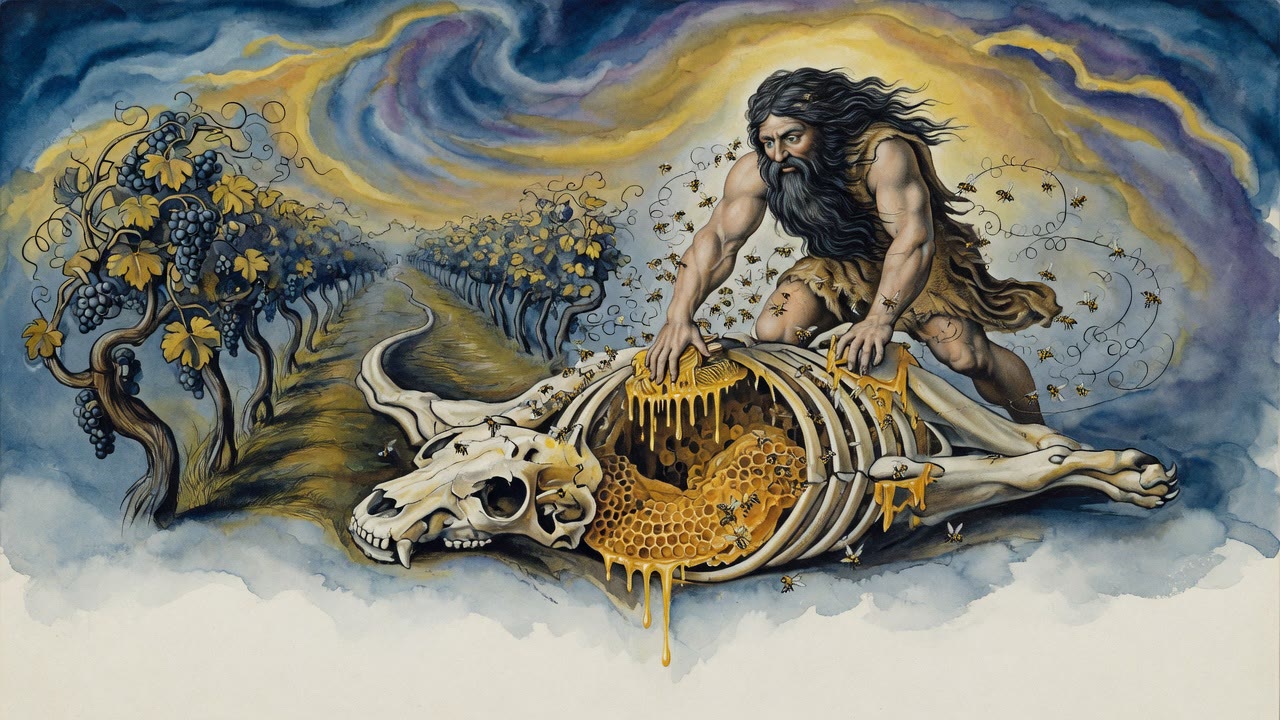
Samson tore the lion apart with his bare hands and told no one. He was on his way to Timnah to court a Philistine woman his parents had argued against, and a young lion came roaring out of the vineyards at him. The spirit of God rushed upon him. He ripped the animal apart as though it were a kid goat. Then he kept walking and said nothing about it to his father or his mother.

The Lion on the Road to Timnah

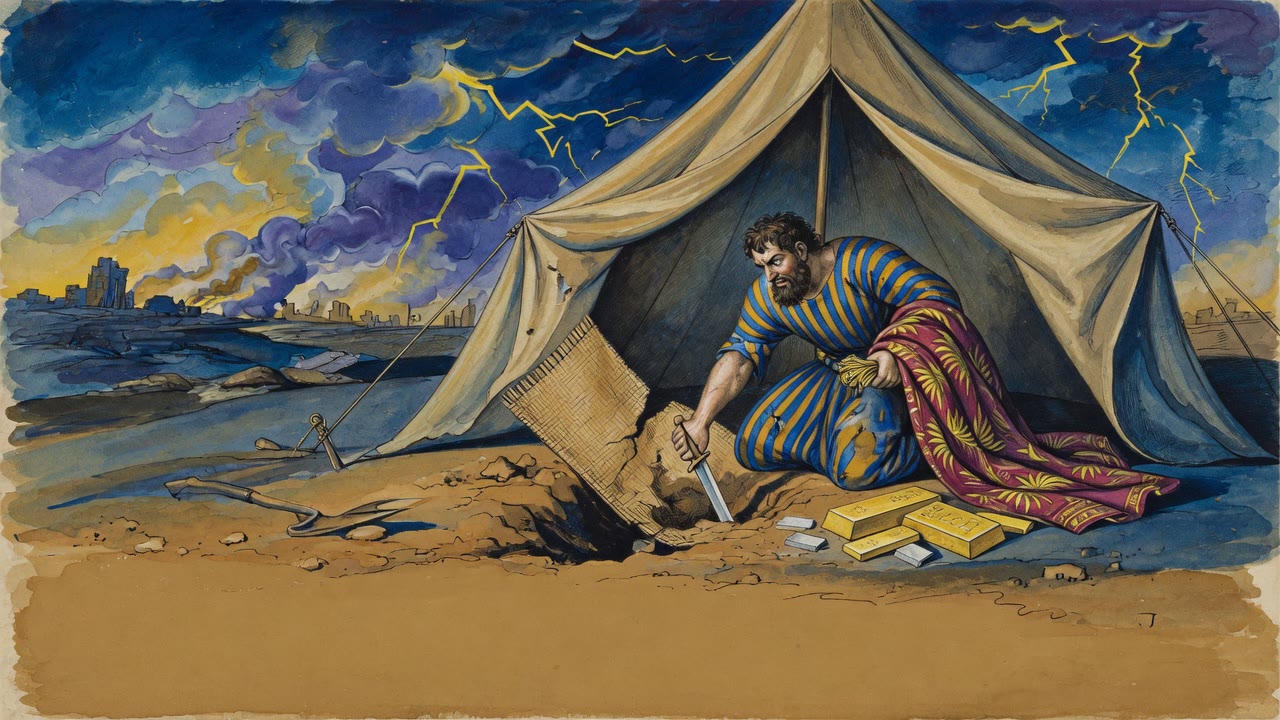
Some time later he passed the carcass again. The lion's body was still there on the road, and bees had moved into it. There was honey in the ribs of the animal, gathered by a colony that had found a cavity in the dead thing and set up their combs inside it. Samson reached in and scooped out the honey. He ate some on the road. He brought some to his parents. He gave it to them and watched them eat it without telling them where it had come from.

The marriage that had started with a lion ended with a riddle. At his wedding feast in Timnah, Samson offered his thirty Philistine companions a wager. He would tell them a riddle. If they solved it within seven days, he would give them thirty linen garments and thirty festal robes. If they could not solve it, they would give him the same. They agreed. Then Samson gave them something constructed entirely from a secret they had no access to: "out of the eater came something to eat, and out of the strong came something sweet."

A Nazirite Near a Corpse

The lion should have been a warning for more than one reason. Samson was consecrated as a Nazirite before birth, an angel had appeared to his mother and given specific requirements: no wine, no strong drink, nothing that comes from the vine, and no contact with the dead. Hair uncut. The spirit of God arrives when it arrives, not when the Nazirite reaches for it, and it departs when violated boundaries make it impossible for holiness to stay.

Reaching into a corpse for honey was a violation. The sages debated exactly how much it mattered, whether the strength continued despite the transgression or whether each touching of the impure was already beginning the slow erosion that would end in a Philistine prison. The honey was sweet. The carcass was forbidden. Samson ate from both at once.

The Riddle Broken From Inside

The Philistine companions could not solve it. By the fourth day they had nothing. On the seventh day they went to Samson's bride and told her to get the answer from her husband or they would burn her father's house down. She wept before Samson for the remaining days of the feast until he gave her the answer, and she gave it to the men. When they answered him before sunset, Samson knew immediately what had happened. He had told the lion story to one person, and that person had told thirty.

The sages noticed something else in the riddle. The image of a creature that devours everything becoming a source of food for others, the eater becoming the eaten, mirrored a mystery inside the Temple service. Aaron and the priests ate from the offerings brought to the altar. The altar consumed everything and the priests ate from its output. Samson stood amazed by what he found in the lion's ribs. The priests lived from what the altar consumed. The same paradox ran through both.

What the Spirit Gave and What It Cost

The rabbis reading Samson's story noticed that the phrase the spirit of God rushed upon him appeared at specific moments and then stopped. It was not a steady state. Rabbi Shmuel bar Nachmani said the spirit began to rattle within him like a bell before it fully took hold, a stirring before the arrival. Samson could not control when it came. He could only be ready when it did. And he could, by his own behavior, make it less likely to return.

On the road to Timnah it came when he needed it and left him holding the torn pieces of a lion he did not know what to do with. He told no one. He returned to the road. He found the honey on his way back and kept that secret too. His whole story runs on secrets: things he had seen, things he had done, things he should not have said when the woman in his house would not stop asking.


← All myths

From the tradition

Sources

3 sources

The texts this telling draws on, in full. Open a card to read inline, or expand it for a wider, quieter read.

Antiquities V.8Antiquities of the Jews (Josephus)

Samson killed a lion with his bare hands. No weapons. No armor. Just raw, God-given strength unleashed on a beast that charged him on the road to Timnah (Judges 14:6). He was on his way to court a Philistine woman his parents disapproved of. But this marriage, according to Josephus, was orchestrated by God Himself to create a conflict that would eventually free Israel.

His birth was miraculous. An angel appeared to his mother, the wife of Manoah, from the tribe of Dan. And told her she would bear a son whose hair must never be cut and who must drink nothing but water. Manoah, a jealous man, demanded to see this angel himself. When the angel finally appeared to both of them, he refused to give his name. Manoah offered a sacrifice, and the angel ascended to heaven through the flames. That was the last they saw of him.

The boy grew into something terrifying. On a return trip to Timnah, he found a swarm of bees nesting inside the lion's carcass and scooped out honeycomb, which became the basis of a riddle he posed at his own wedding feast: "Out of the eater came something sweet" (Judges 14:14). When his Philistine bride betrayed the answer to her countrymen, Samson's rage ignited a one-man war. He tied torches to three hundred foxes and set the Philistine grain fields ablaze. He killed a thousand men with the jawbone of a donkey (Judges 15:15). He ripped the gates off the city of Gaza and carried them to a mountaintop near Hebron.

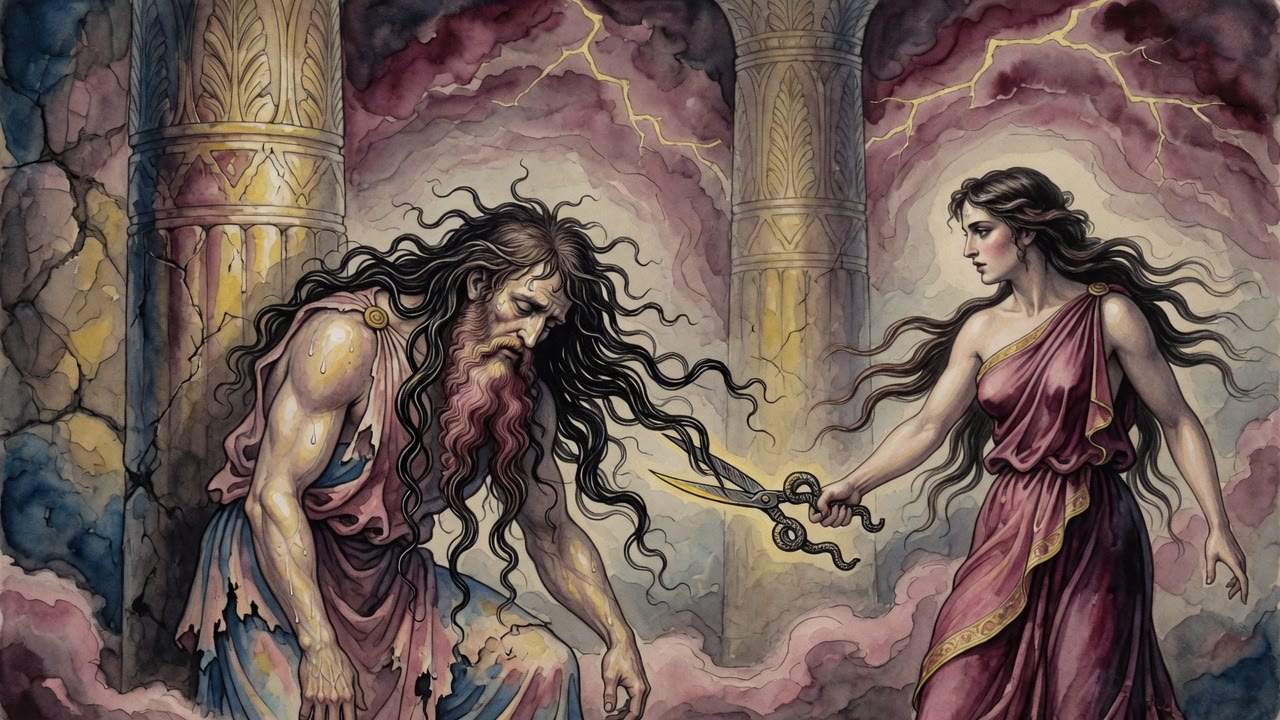
The same force that made him unstoppable also made him reckless. Delilah, a Philistine woman, seduced the secret of his strength out of him, his uncut hair, the sign of his consecration to God. She shaved his head while he slept. The Philistines blinded him, bound him, and paraded him as a trophy.

His hair grew back. At a Philistine festival, chained between the two pillars holding up the banquet hall, Samson prayed one last time. Then he pushed. The roof collapsed, killing three thousand Philistines. And Samson with them. He killed more enemies in his death than in his entire life (Judges 16:30). He had judged Israel for twenty years.

Full source
Yalkut Shimoni on Nach 70:3Yalkut Shimoni on Nach

"And he said to them: Out of the eater came forth food" (Judges 14:14). Rabbi Shmuel bar Nachmani said: When the holy spirit began to rattle within Samson, it began in three places, as it is written, "And the spirit of the LORD began to move him" (Judges 13:25). "Out of the eater came forth food" (Judges 14:14): Samson was astonished, the lion eats all the beasts, and now from it comes forth food. So too Aaron and his sons eat all the offerings, and from them came forth this offering: the offering of Aaron and his sons (Leviticus 6:13).

Full source
Vayikra Rabbah 8:2Vayikra Rabbah

Sometimes, a single verse can unlock a whole new world of understanding, linking tales and teachings in unexpected ways. to one of those connections, found in Vayikra Rabbah (Leviticus Rabbah), a fascinating collection of rabbinic interpretations of the Book of Leviticus.

We begin with the verse, "This is the offering of Aaron" (Leviticus 6:13). But the rabbis in Vayikra Rabbah see something more. They connect this offering to a cryptic riddle from the Book of Judges: "From the eater emerged food" (Judges 14:14), part of the saga of Samson. What on earth could these two things have to do with each other?

The key lies in understanding Samson, the legendary strongman. Rabbi Shmuel bar Naḥman tells us that when the Ruach (spirit) HaKodesh, the Divine Spirit, began to resonate within Samson, it manifested in three specific locations: "in the camp of Dan, between Tzora and Eshtaol" (Judges 13:25). Now, "between Tzora and Eshtaol" is more than just a location. According to Rabbi Shmuel bar Naḥman, it represents Samson's immense power. He says Samson took two mountains and smashed them together, just like someone cracking pebbles.

Rabbi Yehuda offers another interpretation: When the Divine Spirit rested upon Samson, a single stride of his would cover the entire distance from Tzora to Eshtaol! Rabbi Naḥman adds that when the Spirit was upon him, Samson's hair would stand on end, clashing together like a bell, and the sound would echo across that same distance. Can you imagine the sight?

The text then recounts instances of Samson's divinely-empowered feats. When he descended to Timna, a lion roared towards him, but "the spirit of the Lord rested upon him, and he tore it apart as one would tear apart a kid" (Judges 14:5–6). Later, he went to Ashkelon and struck down thirty men (Judges 14:19). And when he was bound with ropes in Lehi, "the spirit of the Lord rested upon him, and the ropes that were on his arms became like flax that was burned with fire, and his bonds dissolved from upon his hands" (Judges 15:14). Each of these acts demonstrates the extraordinary power granted to him by the Divine Spirit.

But here's where the story takes an unexpected turn. After these displays of strength, Samson returns to the scene of his battle with the lion. "After a year, he returned to take her, and he turned aside to see the carcass of the lion; and behold, there was a swarm of bees in the carcass of the lion, and honey, and he scraped it into his hands" (Judges 14:8–9).

This bizarre image, honey emerging from the carcass of a lion, becomes the basis for Samson's riddle: "From the eater emerged food." He was pondering this very paradox. A fearsome predator, now a source of sweetness and nourishment.

So, what's the connection to the offering of Aaron? The rabbis in Vayikra Rabbah suggest that Samson, in his pondering, draws a parallel. Just as food emerged from the eater (the lion), so too does an offering emerge from Aaron, who "eats all the offerings." The offering of Aaron and his sons, therefore, represents something new and sacred arising from something that has already been consumed.

It’s a powerful metaphor, isn’t it? Perhaps it speaks to the idea of transformation, of finding sustenance and holiness even in unexpected places. Just like honey from a lion's carcass, or an offering from the priests, we too can find nourishment and meaning in the most unlikely of circumstances. What "eaters" in your life might hold the potential for unexpected "food?" Something to ponder, perhaps, as we continue our own journeys of discovery.

Full source