Parshat Naso6 min read

Samson's Razor, Delilah's Room, and a Vow From the Womb

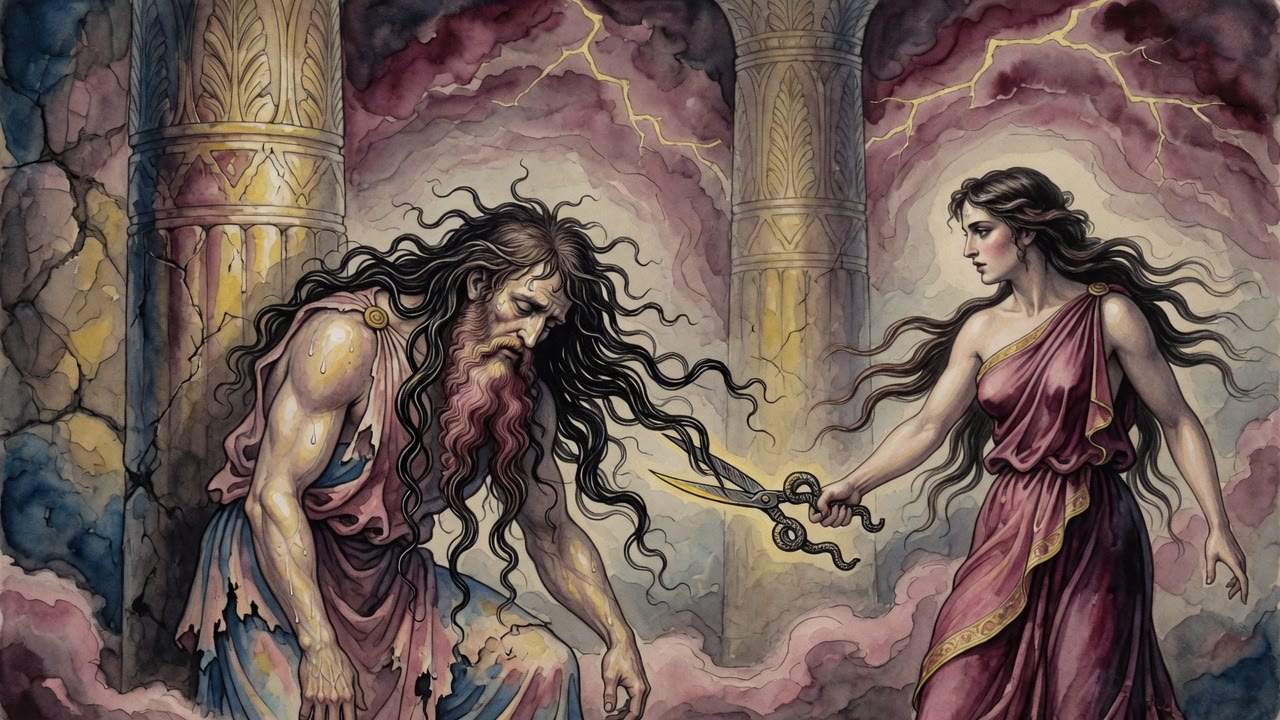
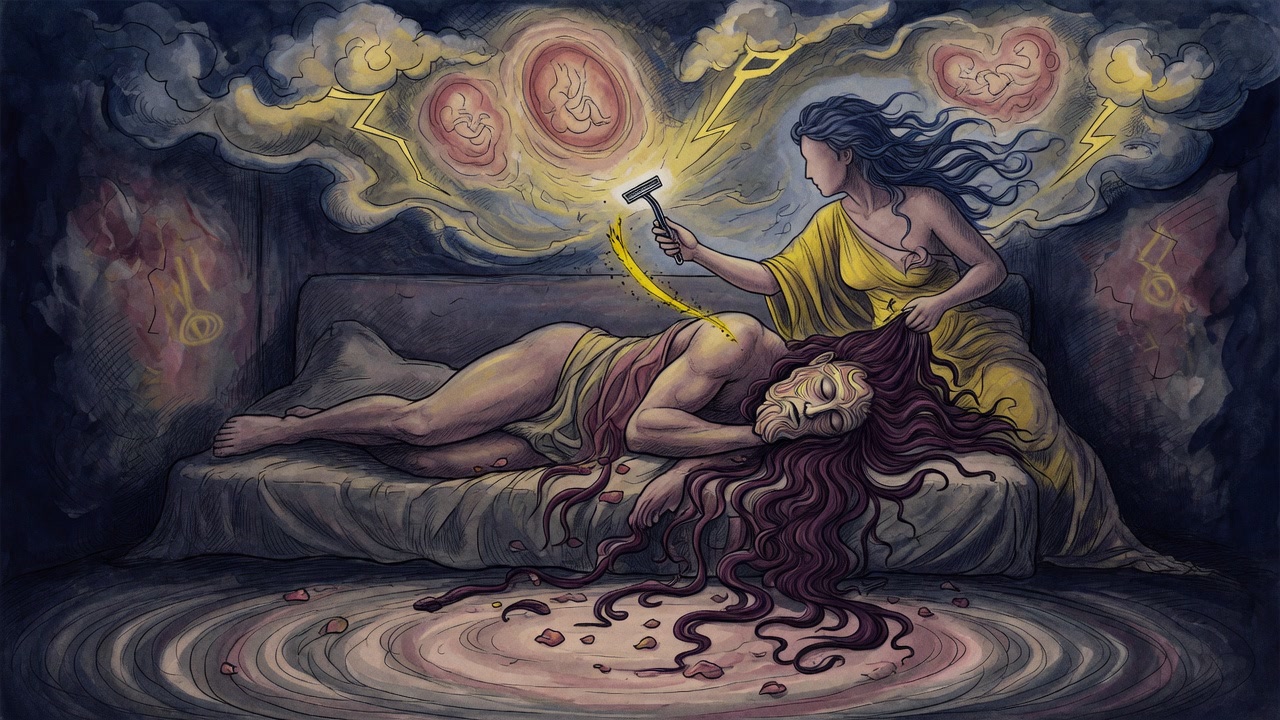
A razor moves toward Samson's hair in Delilah's room, and what falls is not a hairstyle but the visible edge of a vow set on him before birth.

Curated by Arthur · Told by Maggid ·
Table of Contents
  1. The Angel Came Before the Boy Did
  2. Why the Hair Was Never Cut
  3. The Strength Was Never Only Muscle
  4. A Man Among Women, Bound by an Oath
  5. What the Razor Really Severed

The razor came toward his head while he slept, and the seven locks lay heavy against the pillow, dark and unshorn since the day he drew breath. A hand parted them. A blade slid in close to the scalp. What dropped to the floor in Delilah's room was not a hairstyle. It was the visible edge of a claim laid on him before he had a name, before he had a face, before his mother had carried him a single day.
The Angel Came Before the Boy Did

His mother had been barren a long time, the kind of barren that empties a house of its future. Then a messenger stood in her field and told her the impossible: she would carry a son. The child would belong to God from the womb. No razor would touch his head. He would begin to pull Israel free from the Philistines who pressed in on every side.

The vow did not wait for the boy to grow up and choose it. It reached backward into the pregnancy itself. She was to drink no wine, eat nothing forbidden, guard her own body so that the body forming inside her would already be set apart. This is the strange thing about Samson. An ordinary person who takes such a vow steps out of common life into holiness for a season. Samson never stepped out of anything. He was consecrated first, and ordinary life kept reaching for him afterward, year after year, hand after hand.

Why the Hair Was Never Cut

The vow of a nazir (one consecrated to God) has three walls: no wine, no touching the dead, no blade to the head. "A razor shall not pass on his head," the command runs, "the hair of his head shall grow long" (Numbers 6:5). The growing was the heart of it. A shaved man is a handsome man. Sharpened jaw, clean line, the face the world wants to look at. Joseph knew it. Hauled out of the pit of a prison to stand before the most powerful man on earth, he shaved and changed his clothes before he would let Pharaoh see him (Genesis 41:14).

To grow the hair wild was to refuse all that. The long uncut mane was a kind of restraint worn in plain sight, closer to the look of mourning than of vanity. So Samson walked through the towns of the Philistines with the proof of his belonging hanging from his own head. Everyone who saw him saw a man who was not entirely his own.

The Strength Was Never Only Muscle

People remember the strongman and forget the consecration that ran underneath the strength. When the Philistines came for him and he had no sword, he reached down and took up the jawbone of an ass, and the bone in his fist was no scrap from the roadside. It was the jawbone of the very animal that had once carried Abraham up Mount Moriah for the binding of Isaac, the Akedah (the binding), preserved across all those generations to land in the hand of the one man who could swing it. He struck, and the enemies of Israel fell in heaps.

Then the thirst came. He had won and he was dying anyway, throat scorched, body folding. No spring, no well, no mercy in the dry ground. Therefore water came from the only place left. It broke from his own mouth like a living fountain and he drank from himself and lived. The strength in him was never just the breadth of his shoulders. Something holy moved through him, and the unshorn hair was the sign that it was there.

A Man Among Women, Bound by an Oath

There was an old shadow over his line. The tribe of Dan was likened to a serpent by the road, and the serpent lives where it can coil close, lurking among women, struck dumb and harmless only when a charmer holds it under an oath. So it went with Samson. He was a man forever found among women, drawn to them the way the serpent is drawn, dangerous and yet held, because he too was bound by an oath he could not see his way out of. His enemies could not break him with armies. They learned to break him through a woman's room and a whispered question, the same soft place the serpent has always worked.

Delilah asked, and asked again, and wore the secret out of him the way water wears a stone. He told her at last that the strength sat in the hair that had never felt a blade. He laid his head down. The locks were cut. And the part most people miss is what the cutting actually did.

What the Razor Really Severed

The three walls of the vow stood together as one structure. To breach a single wall was never a small adjustment, a bad night, a lapse he could shrug off in the morning. Break one and the whole state of consecration ruptures, and the rupture is not undone by an apology. It demands repair, a guilt offering, an asham (a reparation sacrifice), the kind of bringing-back required when a sacred condition has been torn (Numbers 6:12). The hair on the floor of Delilah's room was the outward sign that the inward thing had been cut.

So the strength left, and it did not leave because his muscles forgot their work overnight. It left because the visible boundary of a life claimed before birth had finally been crossed. The angel had spoken into a barren woman's field. The mother had guarded her body. The hair had grown out long and strange through every year of his life as the proof of all of it. And in one dim room, for the price of a question answered, a blade undid what an oath from heaven had set in place.


← All myths
From the tradition

Sources

4 sources

The texts this telling draws on, in full. Open a card to read inline, or expand it for a wider, quieter read.

Bamidbar Rabbah 10:10Bamidbar Rabbah

Take the case of the nazir, or Nazirite, described in the Book of Numbers. But why the hair? What's the deal with that uncut mane?

Bamidbar Rabbah, a collection of Rabbinic teachings on the Book of Numbers, explores this very question, and what we find is surprisingly insightful. The verse states: “All the days of the vow of his naziriteship, a razor shall not pass on his head; until completion of the days that he will abstain for the Lord, he shall be holy; the hair of his head shall grow long” (Numbers 6:5).

The Rabbis of the Midrash (rabbinic interpretive commentary) ask, why this commandment? Why did God command the nazir not to shave? One explanation offered is that shaving actually accentuates one's features, making them more attractive. Remember Joseph in Genesis? "He shaved and changed his garments" (Genesis 41:14) before appearing before Pharaoh, implying that shaving enhanced his appearance.

Growing hair, on the other hand, is associated with suffering and mourning. The Holy One, blessed be He, says: This nazir is trying to avoid temptation by abstaining from wine. Let him also grow his hair long, making himself less attractive, so that his yetzer hara (the evil inclination), his evil inclination, won't be so aroused. In other words, it's a form of self-imposed aesthetic discomfort, a visual reminder of their commitment.

But there's more to it than just avoiding temptation. "Until completion of the days that he will abstain for the Lord, he shall be holy" – the Midrash understands this to mean that the hair itself becomes holy, like consecrated items. It becomes kadosh (holy), set apart for a sacred purpose. The nazir can't touch it, because they consecrated it for the sake of Heaven.

Now, let's get into some of the nitty-gritty details. What exactly constitutes "not passing a razor"? Does that only apply to razors? What about other methods of hair removal? the verse states: “Shall not pass [yaavor] on his head,” to include all removers [hamaavirim]. The Rabbis deduce that it includes severing near the root, plucking, or trimming, regardless of the amount. If we’re ultimately including everything, why does the verse specifically mention a "razor?" Ah, that's because the final shave, the one at the end of the nazir period, is specifically done with a razor.

Rabbi Yosei offers another interpretation: the mention of "razor" excludes scissors or shears from voiding the nazir's vow. Only a razor will do the trick!

Another important question: how long does someone have to commit to this nazerut, this state of being a nazir? If someone just says "I am a nazir" without specifying a time period, when do they shave? The answer, according to the verse "Until completion of the days that he will abstain for the Lord," is on day thirty-one. Shave on day thirty, and you haven't fulfilled your obligation.

And what about the hair itself after the mitzva is complete? Is it still considered holy? Absolutely! Even if someone else shaves the nazir, or if the shaving occurs before the designated time, the hair remains prohibited, set apart. Bar Pada even connects the Hebrew words "kadosh yihye" ("he shall be holy") to the numerical value of the letters in "yihye," which equals thirty, reinforcing the idea of a thirty-day minimum period.

Rabbi Shmuel bar Naḥman, in the name of Rabbi Yonatan, finds another connection. The words "vow," "nazir," "his naziriteship," "he shall abstain," and "to abstain" appear twenty-nine times in the portion. But wait, they actually appear thirty times! Rabbi Yosei bar Bon explains that one instance is needed to teach the basic law and isn't included in the count.

Finally, the Midrash addresses the connection between shaving and offerings. The verse states, "Then the nazir may drink wine" (Numbers 6:20). But does the nazir just automatically drink wine? No! The Rabbis use a gezerah shavah, a verbal analogy, to connect the prohibition against drinking wine before bringing the offering to the prohibition against shaving before bringing the offering. Just as wine is forbidden until the offering, so too is shaving.

So, what can we take away from this deep dive into the laws of the nazir? It's more than just about hair and wine. It's about the power of commitment, the symbolism of outward appearance, and the intricate ways in which Jewish law seeks to guide us toward a life of holiness. And it reminds us that even seemingly strange practices can hold profound meaning when we take the time to explore them.

Full source
Sifrei Bamidbar 31:1Sifrei Bamidbar

What Happens When a Nazirite Breaks One Restriction is the question behind this passage from Sifrei Bamidbar.

In the Book of Numbers – Bamidbar in Hebrew – Chapter 6 lays out the laws of the Nazirite. A Nazirite is someone who takes a special vow to abstain from wine, cut their hair, and come into contact with the dead. It's a path of heightened holiness, a temporary dedication to G-d. But what happens when life throws a curveball? What if a Nazirite breaks one of their vows? That's where things get interesting.

Our starting point is Bamidbar 6:12: "And he shall devote to the L-rd the days of his Naziritism (and he shall bring a lamb of the first-year as a guilt-offering)." Now, the Sifrei Bamidbar, an ancient Jewish legal text, delves deep into this verse, asking a crucial question: What's the purpose of this guilt offering, this asham?

The text explains that usually, guilt offerings are "categorical," meaning they're essential for a new condition to take effect. The Sifrei Bamidbar anticipates a question: Maybe this guilt offering is also required to start being a Nazirite again. But the verse states, "and he shall devote… and he shall bring," meaning the Nazirite can recommit even before bringing the offering!

But then, Rabbi Yishmael, son of Rabbi Yochanan ben Berokah, offers a different interpretation. He argues that the verse should be understood as, "When shall he devote to the L-rd? When he has brought a lamb of the first year as a guilt-offering." So, is the offering required before recommitting, or not? These are the kinds of questions that keep scholars up at night!

The text then moves on to another tricky scenario: What happens if a Nazirite, nearing the end of their vow, becomes ritually impure – tamei – just before the finish line? The verse says, "and the first days shall fall off." Does that mean they have to start all over?

The Sifrei Bamidbar explores this in detail. If someone declares themselves a Nazirite for, say, 100 days, and they become tamei on the 99th day, do all those previous days count for nothing? The answer, derived from the verse, is yes. "One who has later days voids the first days." But what if they become tamei on the 100th day? Ah, that's different! Since they have no "later days," the previous count stands. What about the very beginning of the 100th day? Nope, no first days to void. Nuance upon nuance!

And what about shaving? A Nazirite isn't allowed to cut their hair. But what if they do? Does that invalidate the entire vow like becoming tamei does? The text argues no. While both are forbidden, becoming tamei voids everything, but shaving only affects the first thirty days. The logic? The verse explicitly states "because his Naziritism was tamei" – impurity voids everything, but shaving doesn't have the same textual basis.

The text uses a fascinating kal v'chomer, or a fortiori argument, a kind of logical inference. If becoming tamei, where the person who caused the impurity isn't held as responsible as the Nazirite who made themself impure, voids the whole thing, then shaving, where both the shaver and the shaved are equally liable, surely shaving should void the whole thing too. Wrong! The verse specifically mentions impurity as the cause for voiding the vow. So, in this case, logic takes a backseat to the explicit text.

Finally, the Sifrei Bamidbar addresses another situation: What if the Nazirite develops a skin disease and is quarantined by a priest? Do those days of quarantine count towards the Nazirite vow?

The text points out that the days of impurity require shaving and an offering, just like the days of confirmation as a leper. So, shouldn't they be treated the same? The text counters that the days of impurity void the preceding days, while the days of confirmation do not. So, maybe the days of confirmation should count!

But, through another kal v'chomer argument, the text concludes that the days of confirmation don't count. If someone who takes the Nazirite vow in a cemetery – an already impure situation – and whose hair can be shaved later for a new vow, doesn't have those initial days counted, then someone confirmed as a leper, whose hair cannot be shaved for a new vow, should certainly not have those days counted! And, the text adds, the same logic applies to the seven days a leper spends outside their tent for purification.

So, what does all this tell us? It reveals the incredible depth and complexity of Jewish law. It demonstrates how ancient scholars meticulously examined every word of the Torah to derive practical guidance for living a life of holiness. It shows us that even vows, promises we make to ourselves and to G-d, are subject to the unpredictable currents of life, and require careful consideration and, sometimes, a little bit of rabbinic debate. It encourages us to consider the weight of our own commitments, and how we work through the inevitable bumps in the road.

Full source
Legends of the Jews 2:69Legends of the Jews

The tale of Samson is definitely one of those. We know him as this incredible strongman, but his story, as the Legends of the Jews retells it, is full of so much more than just brute force.

Take, for instance, his first major victory against the Philistines. He didn't just grab any old weapon. Oh no. He used the jawbone of an ass. But not just any ass! According to the legends, this was the very same jawbone from the very same ass that carried Abraham on his journey to Mount Moriah for the Akeidah, the binding of Isaac! A relic of such significance, preserved miraculously, and used to strike a blow against Israel's enemies.

After that victory? Another miracle! Samson was dying of thirst, parched and weak. But instead of finding a spring, water began to flow directly from his own mouth, like a living fountain. It’s this kind of detail that makes you realize that Samson was more than muscle.

He wasn't just physically strong, though, he was spiritually exceptional, too. The texts tell us he was unselfish, always helping the Israelites, yet never asking for anything in return. He was a Nazarite (or Nazir) "unto God," as he told Delilah. Now, when Samson revealed his secret to her, that his strength was tied to his uncut hair as a Nazarite, Delilah knew he was telling the truth. Why? Because, as the legends tell us, she knew him well enough to know he wouldn’t invoke God’s name to tell a lie. She understood his character in that fundamental way.

But here's the thing: even heroes have their flaws. Samson's Achilles' heel was his weakness for, shall we say, "sensual pleasures." He let his desires lead him astray, and the consequence was devastating: "He who went astray after his eyes, lost his eyes." A powerful, poetic, and tragic consequence.

You'd think such a harsh punishment would change a person. But, according to the legends, even blinded and imprisoned, Samson continued his old ways. And, shockingly, the Philistines actually encouraged it! They cast aside all their own family values, hoping that if Samson fathered children, those children would inherit his incredible strength and stature. Imagine the desperation of a people willing to compromise their own morals for a chance at producing another giant like Samson!

What does it all mean? Samson’s story is a rollercoaster. It's a reminder that even the mightiest among us are complex, flawed individuals. He was chosen, strong, and selfless in many ways, yet ultimately undone by his own desires. It's a cautionary tale, perhaps, but also a evidence of the enduring power of faith, regret, and the messy, complicated nature of being human.

Full source
Bereshit Rabbah 98:14Bereshit Rabbah

In Bereshit Rabbah, a classic collection of rabbinic interpretations of Genesis, they dig deep into this verse, connecting it to the story of Samson, the legendary strongman from the Book of Judges.

The Midrash (rabbinic interpretive commentary), or interpretation, begins by drawing parallels between Dan as a serpent and Samson's interactions with women. "Just as the serpent is found among women," the text notes – a clear reference to the serpent's temptation of Eve – "so, Samson son of Manoaḥ was found among women." It's a provocative comparison. The implication is that both figures, in some way, are entangled with the feminine in ways that lead to both power and vulnerability.

The connections don't stop there. The Midrash continues, "Just as the serpent is restrained by oath...so, Samson was restrained by oath." This alludes to the practice of snake charming, where incantations were used to render snakes harmless. Similarly, Samson allowed himself to be bound by the people of Judah after they swore they wouldn't kill him themselves, as we see in (Judges 15:12). He was, in a sense, "charmed" by their promise.

Then comes a fascinating observation about the serpent's power residing in its head. The Midrash links this to Samson's hair: "Just as this serpent, all its strength is only in its head, so, Samson: 'He told her his whole heart and said to her: If I were shaved, my strength would leave me' (Judges 16:17)." It's a potent reminder of where Samson's strength – and vulnerability – truly lay.

And finally, the Midrash points out that even in death, the serpent's venom persists. Similarly, "the dead whom he put to death in his death [were more than those he put to death during his life]" (Judges 16:30). Samson's final act of destruction, bringing down the temple of Dagon, was arguably his most impactful.

But what about the rest of Jacob's blessing? "That bites a horse's heels, and his rider falls backward." The Midrash connects this to (Judges 16:25), when the Philistines summon Samson to "amuse" them. Rabbi Levi offers a powerful image here. He emphasizes the sheer number of people on the roof during Samson's final moments – so many that it was impossible to know exactly how many there were. And yet, despite the chaos and destruction, Samson's family was able to find his body for burial. How?

The answer, according to the Midrash, is a plea from Jacob himself. "And his rider falls backward – let all these items fall backward." In other words, Jacob prayed that the debris and bodies would miraculously fall in a way that revealed Samson's body, allowing his family to give him a proper burial.

But here's where it gets really interesting. The Midrash suggests that Jacob initially believed Samson might actually be the Mashiach, the Messiah. That's why, upon seeing Samson's death in his prophetic vision, Jacob cries out, "Will this one, too, die? 'For your salvation I hope, Lord' (Genesis 49:18)." It's a moment of profound disappointment and a reaffirmation of faith in a future redemption.

Rabbi Yitzḥak then expands on this idea of hope. He says that "Everything is through hope." Suffering, sanctification of God's name, the merit of the patriarchs, and even the desire for the World to Come – all are connected to hope. It's a powerful reminder that even in the face of disappointment and loss, hope remains a vital force.

So, what can we take away from this intricate Midrash? Perhaps it's a reminder that even flawed heroes like Samson can play a role in the larger story of redemption. Or maybe it's a lesson about the enduring power of hope, even when our initial expectations are shattered. Whatever you take away from it, it's clear that these ancient texts continue to offer us profound insights into the human condition and our relationship with the divine.

Full source