Parshat Vayera5 min read

Abraham Saw the Pillar of Fire Over Mount Moriah

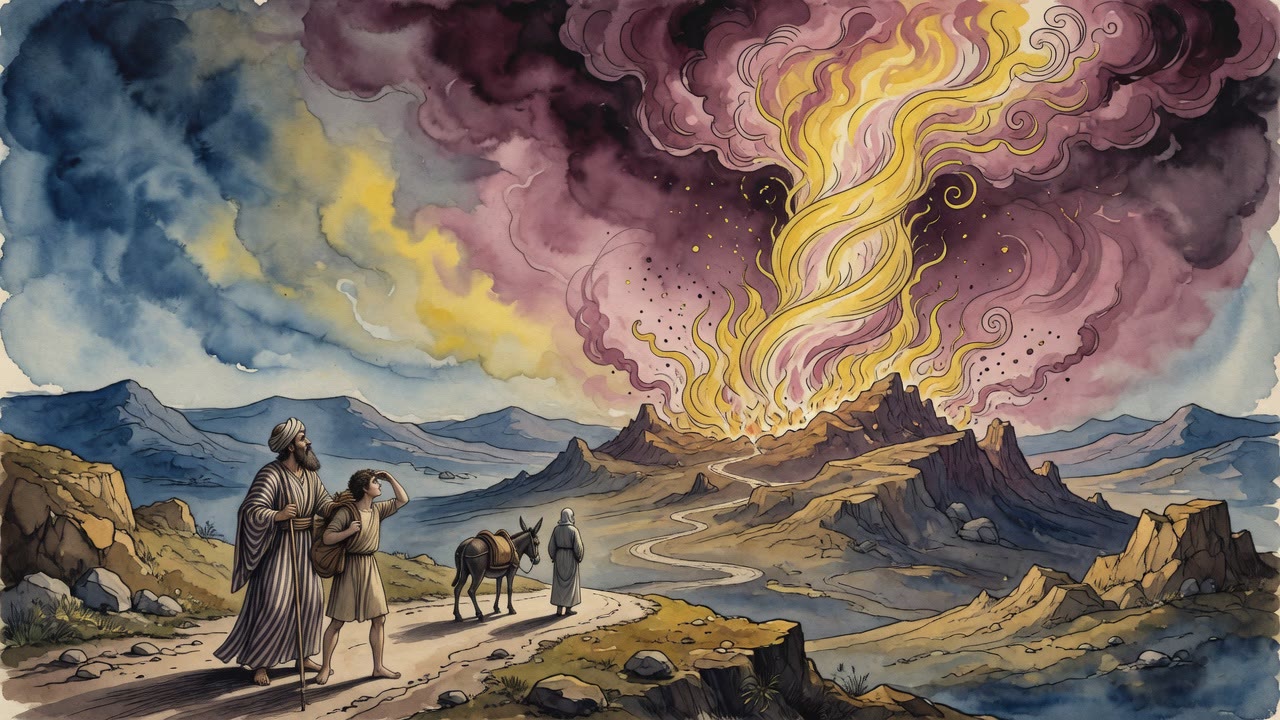
On the third day Abraham lifted his eyes and saw fire from earth to heaven. That was how he found the mountain. Isaac saw it too. The servant saw nothing.

Curated by Arthur · Told by Maggid ·
Table of Contents
  1. Three Days Walking
  2. What Abraham Saw
  3. The Name He Had Already Given It
  4. The Birth He Heard About at the Top
  5. What the Mountain Cost

Three Days Walking

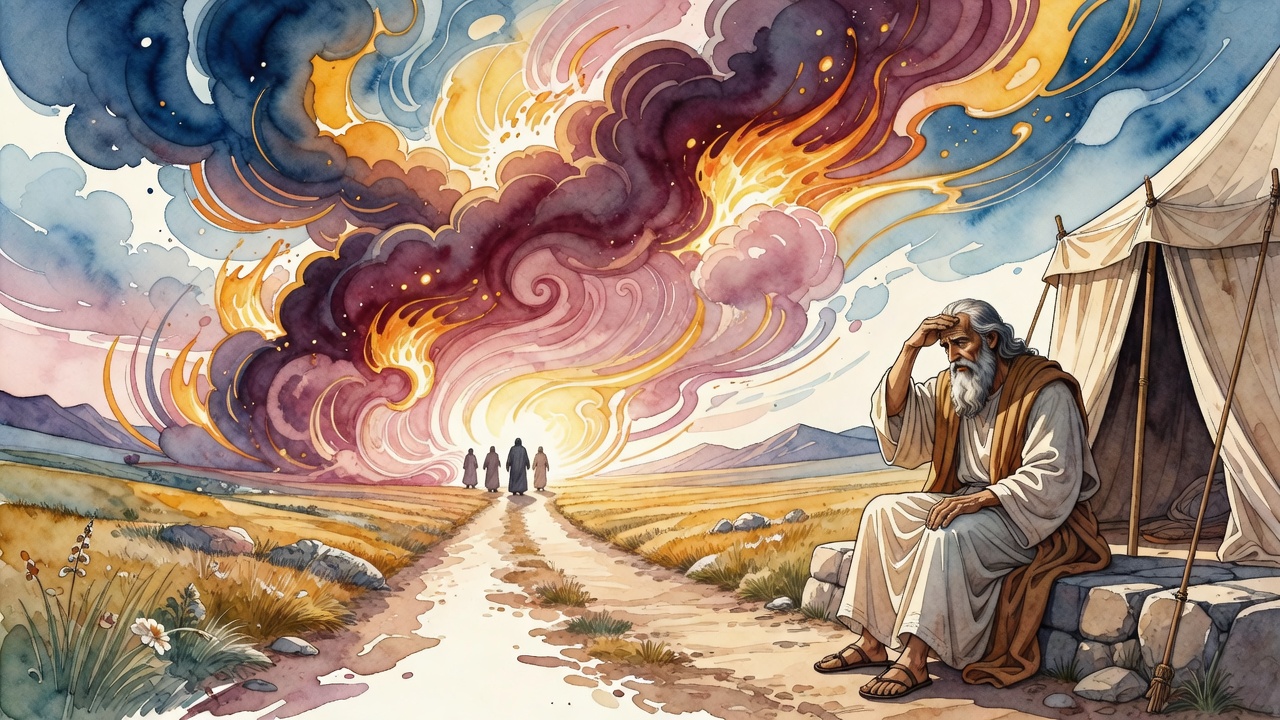
God had said He would show Abraham the place. Three days and He had not shown him anything. They walked north from Beersheba through the hill country, Abraham and Isaac and two servants, with the wood for the burnt offering loaded on the animal. The wood was there. The fire would come. The knife was at Abraham's belt. The ram that would stand in for his son did not exist yet, or if it existed Abraham did not know where, and God had not told him what would happen on the mountain, only that He would point it out.

The third day. They came to a place whose name means watchers, Zophim, and Abraham lifted his eyes.

What Abraham Saw

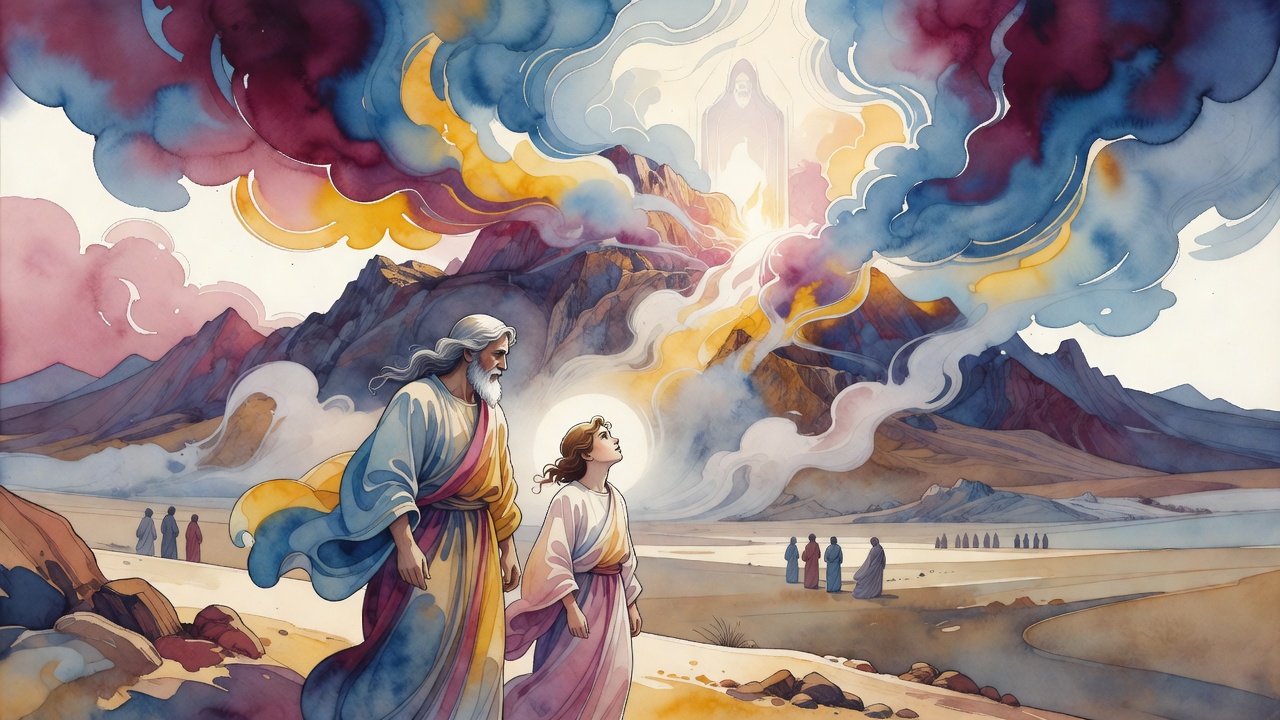
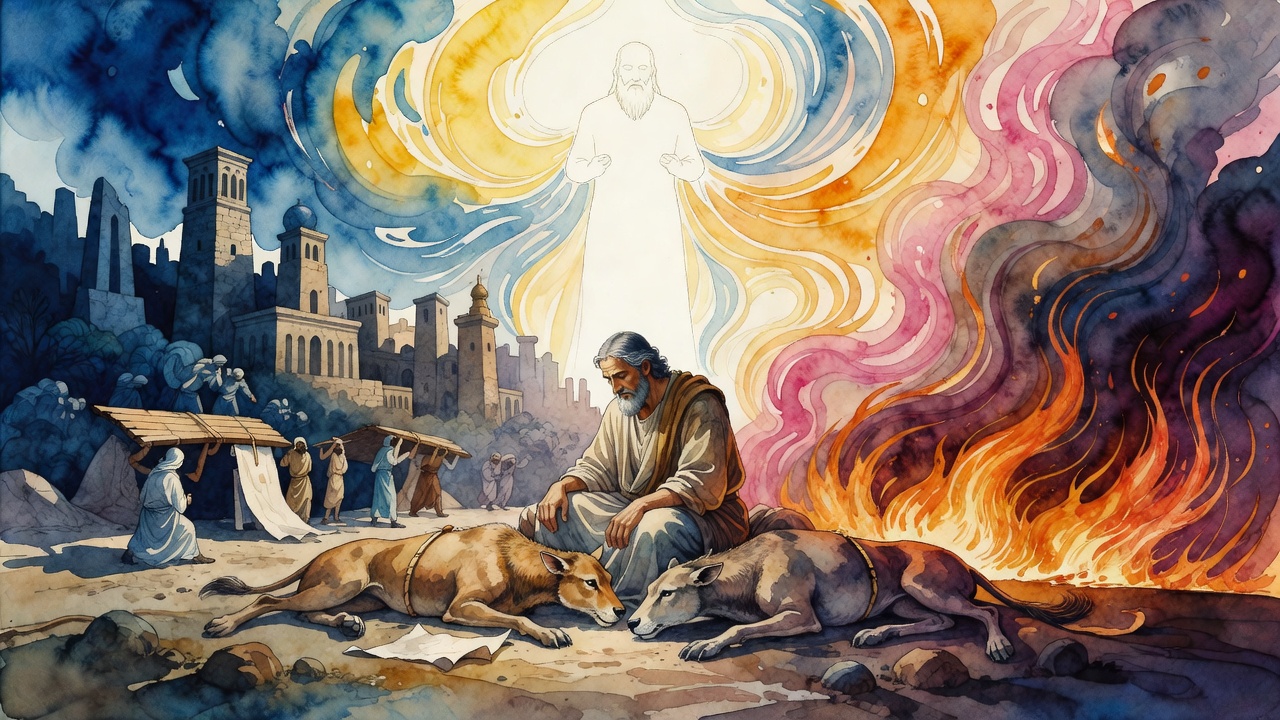
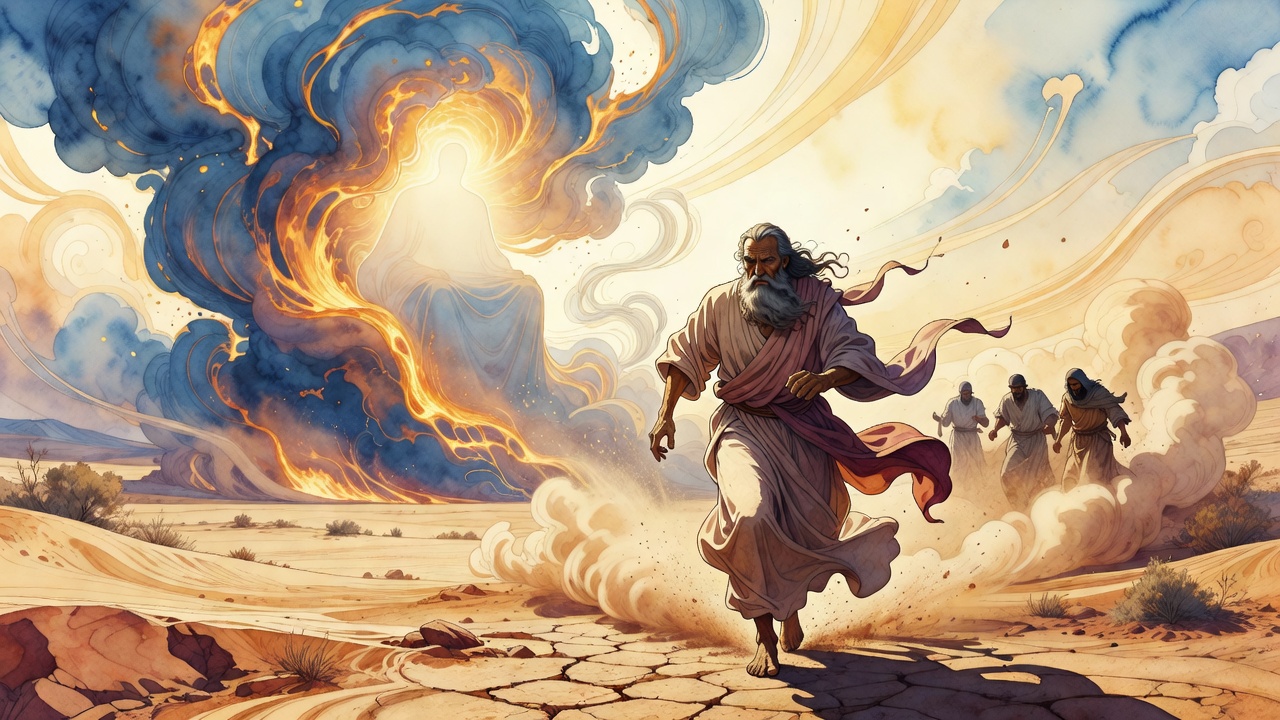
A pillar of fire stretched from the earth to the sky. Above the pillar, a cloud carrying the divine presence rested on a specific mountain. Not on the range. On one mountain, identifiable by what was above it.

Abraham turned to Isaac. My son, do you see what I see?

Isaac looked. Yes, he said. "I see a pillar of fire and a cloud, and the glory of God is visible on the cloud."

Abraham turned to the two servants. Do you see what we see?

They looked. Nothing. They saw a mountain like any other mountain.

Abraham told them to stay with the animal. He and the boy would go up and worship and return. The servants could not go where Abraham and Isaac were going because they could not see what Abraham and Isaac could see. The pillar of fire was the qualification, the thing that marked who was meant for this moment. The servants were not meant for it. They stayed.

The Name He Had Already Given It

Years before, at the beginning of everything, God had shown Abraham the whole land of Canaan from north to south. Among the places he had seen was this mountain. The tradition preserves the detail: Abraham had named it then, long before he was commanded to go there with his son. The name was Adonai Yireh, the Lord will be seen, or the Lord will provide. Both meanings live in the same Hebrew word.

When he arrived on the third day and saw the pillar of fire and recognized the mountain, he understood that the name he had been given at the beginning was the answer to the question he was now living. The Lord will provide. He had named it before he knew what the provision would be, before he had Isaac, before he had received the command that was making his legs carry him up this hill. The name had been waiting for the situation that would make it legible.

The Birth He Heard About at the Top

At some point during the three days of walking, Abraham received news. His brother Nahor, back in Haran, had children. Eight sons, names listed, and among them a daughter: Rebekah, born to Bethuel. The timing is not coincidental in the way the tradition reads it. God announced the birth of Abraham's future daughter-in-law at the moment Abraham was bringing his son up a mountain to offer him. The one who would continue the line through Isaac was born while Isaac was about to be stopped.

Abraham heard the news and kept walking. He was not being told to turn back. He was being told that what he was doing, whatever happened on the mountain, would not end the covenant. The line would continue. The promise was intact. Go up the mountain. The girl who will be your son's wife already exists.

What the Mountain Cost

Sarah died after the binding. The tradition connects the events: the Satan, or in some versions the same quality of terror that tested Abraham, went to Sarah and told her that Abraham had slaughtered Isaac. Her soul departed. When Abraham came down from Moriah with Isaac alive beside him, Sarah was already dead.

He came home and she was not there. He had passed the test that was asked of him, had demonstrated that he would not withhold his son, had heard the angel and stopped the knife and offered the ram that was caught in the thicket. He came back down the mountain with his son and came back to a house that had already paid for the climb.

The rabbis who preserved this detail did not soften it. The mountain that was shown by fire, the mountain he had named before he understood why, the mountain where the divine presence rested in cloud and pillar, was the place that cost Abraham his wife. Sacred ground is not always safe ground. Sometimes the holiness and the loss are the same event, experienced from different angles.


← All myths

From the tradition

Sources

4 sources

The texts this telling draws on, in full. Open a card to read inline, or expand it for a wider, quieter read.

Pirkei DeRabbi Eliezer 31:6Pirkei DeRabbi Eliezer

Our story today, drawn from Pirkei DeRabbi Eliezer, a fascinating collection of stories and interpretations of the Torah, touches on just such a moment in the life of Abraham.

The scene: Abraham, following God's almost incomprehensible command, is leading his son Isaac to Mount Moriah for… well, we know what for. It's a journey fraught with tension, with faith tested to its absolute limit. But it’s what happens on the third day that really grabs us.

The verse reads, "On the third day they reached Zophim." Now, Zophim means "watchers," a fitting name, because as they arrive, something extraordinary happens. They see the Shekhinah (the Divine Presence) – that radiant, palpable presence of God – resting on the mountain. As (Genesis 22:4) says, "On the third day Abraham lifted up his eyes, and saw the place afar off."

What exactly did he see?

Pirkei DeRabbi Eliezer paints a vivid picture: a pillar of fire reaching from earth to heaven. Imagine that for a moment. A blazing connection, a visual confirmation that Abraham is on the right path, that his offering – his willingness – has been accepted. He understands, in that instant, that Isaac has been accepted for the olah temimah, the perfect burnt offering.

This is where it gets interesting. Abraham turns to Ishmael and Eliezer, his companions on this agonizing journey. "Do you see anything upon one of those mountains?" he asks.

And they answer, simply, "No."

Now, Abraham's response might sound harsh to our modern ears. Pirkei DeRabbi Eliezer tells us, "He considered them (as dull) as an ass." He then tells them, "Abide ye here with the ass… with such who are similar to the ass." Ouch.

Strong words. But what’s really going on here? It’s not just about sight, is it? It's about spiritual perception. Abraham, in his unwavering faith, sees the divine presence. Ishmael and Eliezer, for whatever reason, do not. It’s a stark reminder that faith isn’t always shared, that sometimes we walk our paths alone, even when surrounded by others.

Perhaps Ishmael and Eliezer lacked the spiritual preparation, the intense focus, or maybe simply the capacity to perceive what Abraham did. The text doesn't elaborate on their shortcomings, only highlighting the difference in their perception.

What does this story leave us with? Maybe it’s this: the reminder that faith is a deeply personal journey. That sometimes, we will see things that others don’t. And that even in those moments of solitary clarity, we must continue to walk our path, guided by what we believe to be true, even when others remain behind, seeing nothing but the ordinary. Can we find the courage to follow our own "pillars of fire," even when those around us see only mountains?

Full source
Legends of the Jews 5:230Legends of the Jews

Take Abraham's journey to Mount Moriah, the place where he was commanded to sacrifice his son, Isaac. It’s a story we think we know, but the tradition turns to

The Torah tells us that on the third day, Abraham finally saw the place God had appointed. But the midrashim (rabbinic interpretive commentary), those wonderful rabbinic interpretations that fill in the gaps, give us so much more color. Imagine this: Abraham looks up and sees not just a mountain, but a pillar of fire stretching all the way from earth to the heavens, and a heavy cloud shimmering with the very glory of God.

He turns to Isaac. "My son," he asks, "do you see what I see?" And Isaac, blessed and pure, answers, "I see, and, lo, a pillar of fire and a cloud, and the glory of the Lord is seen upon the cloud." What a powerful image! Abraham knows then, in his heart, that Isaac is accepted before the Lord as a potential offering.

The story doesn't stop there. Abraham then turns to Ishmael and Eliezer, his other companions on this fateful journey. "Do you also see what we see on the mountain?" he asks. Their answer? "We see nothing more than like the other mountains." A simple, unremarkable landscape. Nothing special.

Ouch.

Abraham understands. They aren't meant to go further. He tells them, "Abide ye here with the ass, you are like the ass--as little as it sees, so little do you see. I and Isaac my son go to yonder mount, and worship there before the Lord, and this eve we will return to you."

Did you catch that? "We will return." It’s more than just a statement of intent. According to Ginzberg's retelling in Legends of the Jews, this was an unconscious prophecy! Abraham, in that moment, prophesied that both he and Isaac would return from the mountain. A glimmer of hope in the face of unimaginable sacrifice.

So, Eliezer and Ishmael stay behind, and Abraham and Isaac continue onward, towards the mountain, towards the unknown.

What does this little detail – this difference in perception – tell us? Maybe it's about spiritual readiness. Maybe it's about the unique bond between a father and a son facing an impossible test. Or maybe, just maybe, it's a reminder that sometimes, the most profound experiences are only visible to those who are truly open to seeing them. Those who are willing to look beyond the ordinary and perceive the divine spark that’s always, always present.

Full source
Yalkut Shimoni on Torah 99:4Yalkut Shimoni on Torah

On the third day they reached the lookout point and saw the glory of the Divine Presence standing there, as it is said, "On the third day Abraham lifted up his eyes and saw" (Genesis 22:4). He saw a pillar of fire standing from the earth to the heavens. He said to him, "Isaac, my son, do you see what I see?" He said to him, "Yes." Then Abraham understood that the lad was found acceptable for the offering.

Full source
Midrash Tanchuma, Vayera 23Midrash Tanchuma

And he saw the place from afar off (Gen. 22:4). Abraham said to Isaac: “Do you see what I see?” “I behold a glorious mountain encircled by a cloud,” he replied. Then he asked his young men: “Do you see anything at all?” “We see only desert,” they answered. “Then abide with the ass,” he commanded, “for the ass sees nothing and you see nothing.” Abide ye here with the ass (ibid., v. 5), for ye are like unto them.

And I and the lad will go yonder (ibid.). What is meant by the word yonder (Heb. koh, which also means “thus, so”)? It means: “Let us see what will be the final outcome of koh. The Holy One, blessed be He, promised me: So (koh) shall thy seed be (Gen. 15:1).” And we will worship and come back to you (ibid. 22:5). His own mouth foretold him that they would both return in peace. And he took in his hand a fire and a knife (ibid., v. 6). Why was it called a slaughtering knife (ma’akhelet)? Because it made food (okhalin) suitable for eating.

Forthwith, And Isaac spoke unto Abraham, his father, and said: “My father.” And he replied: “Here am I, my son.” Then Isaac asked: “Behold the fire and the wood; but where is the lamb for a burnt-offering?” (ibid., v. 7). Immediately, an overpowering fear and violent trembling seized Isaac, for when he saw nothing to be sacrificed, he realized what was about to transpire. But he asked once again: “Where is the lamb for the burnt-offering?’ And Abraham responded: “Since you ask, the Holy One, blessed be He, has selected you.” “If he has chosen me,” Isaac replied, “I shall willingly surrender my soul to Him, but I am gravely concerned about my mother.” Nevertheless, they went both of them together (ibid., v. 8), of one mind: convinced that one was to slaughter and the other to be slaughtered. Isaac was thirty-seven years old at the time of his binding.

And they came to the place which God had told him of … and bound Isaac, his son (ibid., v. 9). As Abraham was about to slaughter him, Isaac cried out: “Father, bind my hands and feet, for the will to live is strong within me, and when I see the knife descending, I may tremble and the offering may become defective (as a result of the knife slipping). I implore you not to make me a blemished offering.” The Abraham stretched forth his hand and took the knife to slay his son (ibid., v. 10). Isaac said to him: “Father, do not tell my mother about this while she is standing at the edge of a pit or a roof lest she hurl herself down and die.” After they had constructed the altar, Abraham bound Isaac upon it and took the knife in hand to slaughter him until a fourth of a measure of blood would flow from his body, Satan appeared and pushed Abraham’s hand, causing the knife to fall. As he reached out to grasp the knife again, a voice emanated from heaven, saying: Lay not thy hand upon the lad (ibid., w. 13). If this had not happened, Isaac would certainly have been sacrificed.

While all this was transpiring, Satan visited Sarah in the guise of Isaac. When she saw him she asked: “What did your father do to you, my son?” He replied: “My father led me over mountains and through valleys until we finally reached the top of a certain mountain. There he erected an altar, arranged the firewood, bound me upon the altar, and took a knife to slaughter me. If the Holy One, blessed be He, had not called out, Lay not thy hand upon the lad, I would have been slaughtered.” He had hardly completed relating what had transpired when she fainted and died, as it is written: And Abraham came to mourn for Sarah, and to weep for her (ibid. 23:2). From where did he come? From Moriah.

When he was about to slaughter Isaac, an angel of the Lord called out to him from heaven, saying: Abraham, Abraham (ibid. 22:11). Why was his name repeated? Because he was hastening to slaughter him. And He said: Lay not thy hand upon the lad (ibid., v. 12). Abraham asked: “Who are you?” And he replied: “An angel.’ Thereupon Abraham retorted: “When I was commanded, Take now thy son, it was the Holy One, blessed be He, who spoke to me; if He now wishes to stop me, let Him tell me so.”

Thereupon, And the angel of the Lord called unto Abraham out of heaven a second time (ibid., v. 15), for he had refused to heed the first call. Then Abraham cried out to the Holy One, blessed be He: “Master of the Universe, a man tests his companion because he does not know what is in his heart, but You know what is in the heart and the kidneys, the seat of deliberation. Surely, You did not need to test me.” He answered: Now, do I know that thou art a God-fearing man (ibid., v. 12).

Thereupon, the Holy One, blessed be He, opened the sky and the cloud (surrounding Him) and said: “By myself have I sworn,” saith the Lord (ibid., v. 16). “You have sworn.” Abraham replied, “and now I swear that I shall not descend from this altar until I say what I wish to say.” “Speak,” He answered. “Did You not tell me,” said Abraham, “Count all the stars, if thou be able to count them; so shall thy seed be (Gen. 15:5)?” “Yes,” He replied. “But from whom shall my seed descend?” queried Abraham. “From Isaac,” the Holy One answered. “It was in my heart, yesterday, to remind You that You told me that Isaac was my seed, when You said to me: Take him for a burnt-offering. But I restrained myself and did not challenge You. Therefore, when Isaac’s descendants sin and are being oppressed, recall the binding of Isaac, reckon it as if his ashes were piled upon the altar, and pardon them and release them from their anguish.”

The Holy One, blessed be He, answered: “You have spoken what was in you heart, now I will say what I wish to say. In the future Isaac’s descendants will sin against Me, and I will judge them on Rosh Hashanah (the Jewish New Year). If they want Me to discover something to their credit, and to recall for their advantage the binding of Isaac, let them blow upon this shofar.” Abraham asked: “What shofar?” The Holy One, blessed be He, said: “Turn around. Then it was that Abraham lifted up his eyes, and looked, and behold, behind a ram caught in the thicket by his horns (Gen. 22:13). This was one of the ten things that were created at twilight.

A ram caught in the thicket by his horns (ibid.). The Holy One, blessed be He, said to Abraham: “Let them blow upon the ram’s horn to Me, and I will save them and redeem them from their sins.” This is what David meant when he sang: My shield and my horn of salvation, my high tower (Ps. 18:3). Then I shall remove the yoke of exile from them and comfort them in the midst of Zion, as it is said: For the Lord hath comforted Zion (Isa. 51:3). Amen.

Full source