6 min read

Sandalfon, Anafiel, and the Rainbow Above the Highest Heaven

A traveler climbs from heaven to heaven toward the Throne and keeps meeting angels so vast his eyes fail before he ever finds the top.

Curated by Arthur · Told by Maggid ·
Table of Contents
  1. The First Gates and the Weight of the Climb
  2. The Angel Whose Height Takes Five Hundred Years
  3. The Crown That Rises of Its Own Accord
  4. The Prince at the Gate of the Highest Heaven
  5. The Rainbow That Rests on a Cherub's Shoulders
Sandalfon, Anafiel, and the Rainbow Above the Highest Heaven Click for full size

The First Gates and the Weight of the Climb

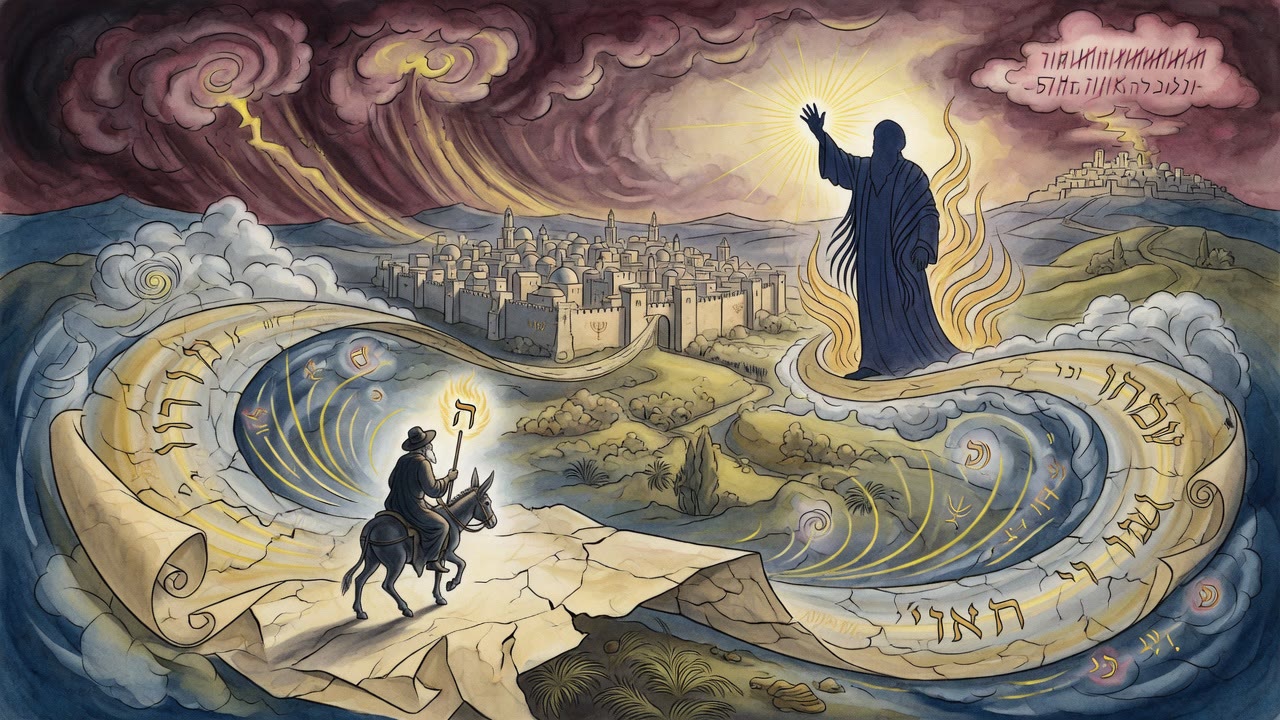
The traveler had passed through more gates than he could number, and still the sky above him refused to end.

Each heaven had its own guards and its own wardens, and none would let him pass until he named them and answered their questions. He had learned the passwords and answered the questions. He had watched armies of angels part before him like reeds bending in a flood. But every time he believed he had come near the top, he lifted his eyes and found another vault stacked above the last, and another above that, and the Throne he climbed toward hung as far off as when he had begun.

So he kept climbing. There was nothing else to do with such a height.

Then, at the rim of the heaven where the great Chariot stood, he saw what he first took for a wall of dark stone rising without a seam.

The Angel Whose Height Takes Five Hundred Years

It was not a wall. It was an angel, standing behind the Chariot with his back to the traveler, and he was so tall that a man walking at speed would need five hundred years to travel from his feet to his crown.

His name was Sandalfon. The traveler could not see where the angel ended. He tilted his head back until his neck ached and still the figure climbed out of sight, up past the ledges of cloud and the places where the light thinned to almost nothing, and vanished into a brightness that hurt to hold.

Sandalfon did not turn. His hands were busy. Out of the prayers that rose from Israel far below, thin as smoke, he was weaving a crown. His fingers moved without pause. He gathered the words of the faithful and bound them into gold, garland upon garland, a thing made entirely of what the earth had whispered upward.

The Crown That Rises of Its Own Accord

When the crown was finished, Sandalfon did not reach up to set it in place. Even he did not know the exact place where his Maker abides. So he spoke to the crown instead, and charmed it, and the crown rose from his hands on its own.

The whole of heaven felt it go.

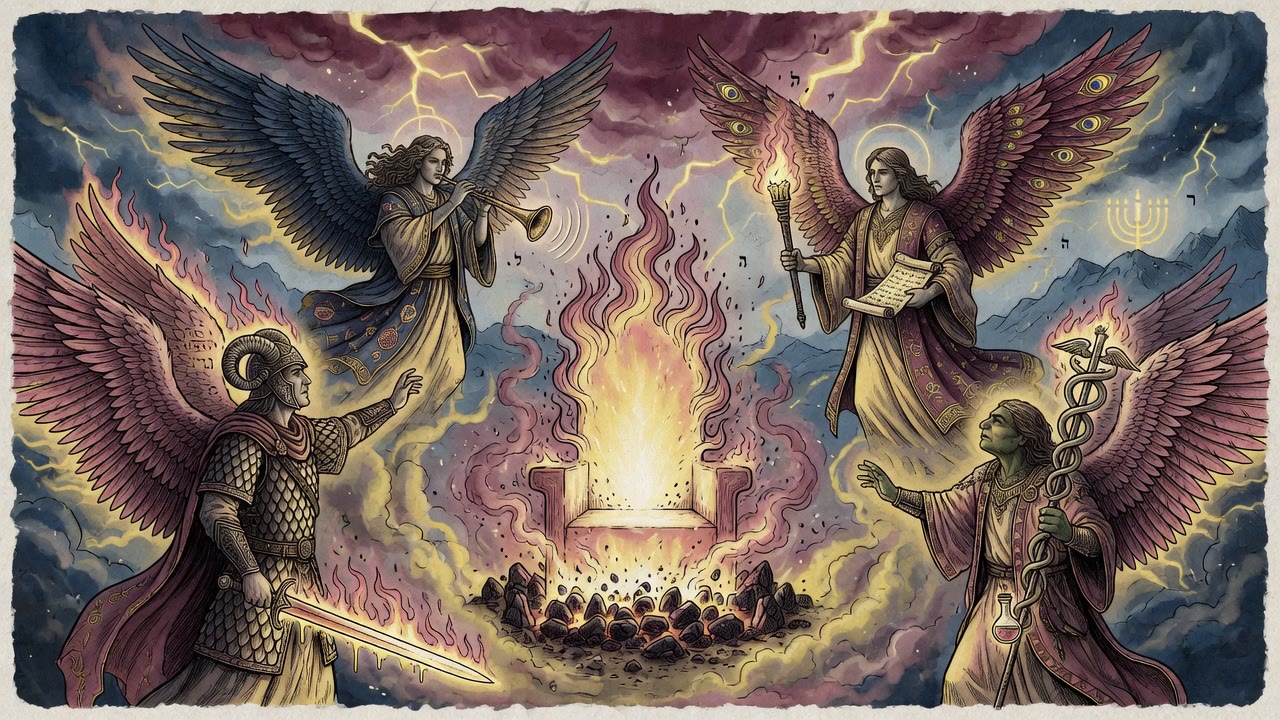
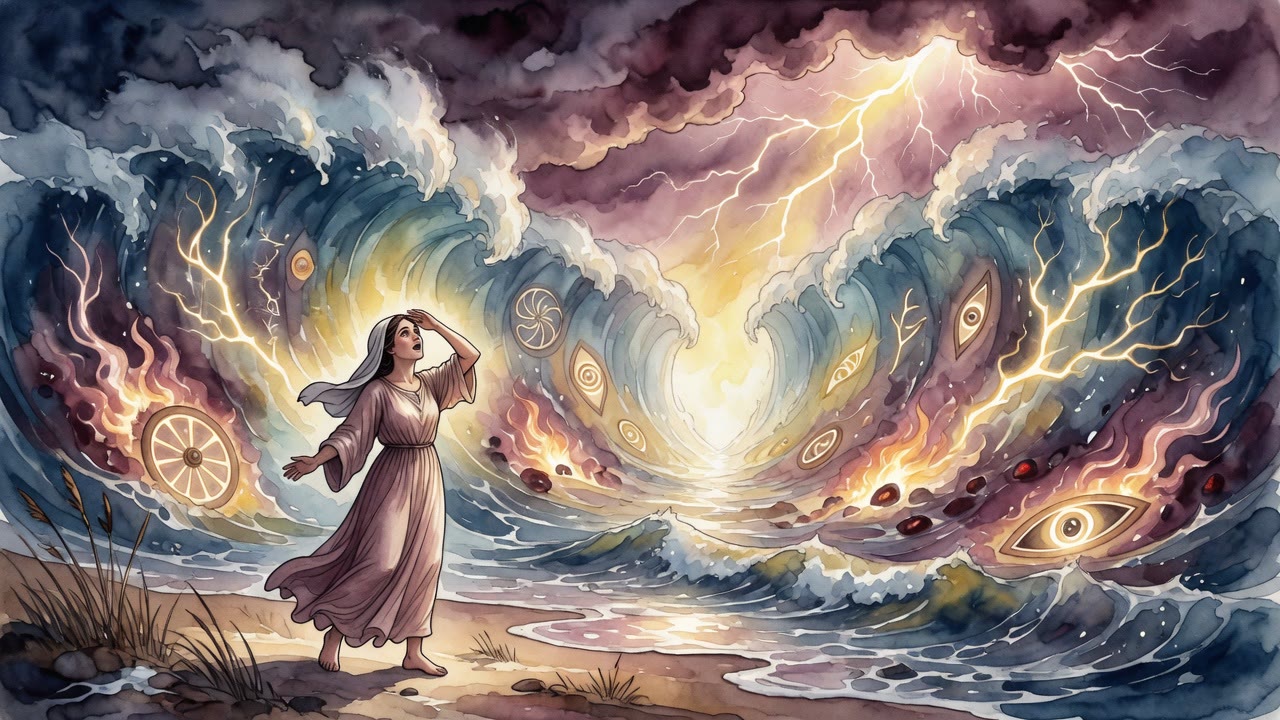
The holy Chayyot, the living creatures who carry the Throne, broke into song. The Seraphim roared like lions, and their roar had words in it. "Holy, holy, holy is the Lord of hosts," they cried, "the whole earth is full of His glory." As the crown drifted past the Throne of Glory, the wheels of the Throne began to turn. The foundations under the footstool shuddered. A wave of fear rolled outward through every heaven at once, and it struck the traveler like wind off a mountain, so that his knees gave beneath him.

Then the crown reached the place he could not see, and settled, and all the hosts spoke together with one voice. "The Eternal is King," they said, "the Eternal was King, the Eternal will be King in all eternity." And it happened not once but again and again, crown after crown, prayer after prayer, forever. He had arrived in the middle of something without beginning or end.

The Prince at the Gate of the Highest Heaven

Above the heaven of the Chariot lay one more, the highest, called Aravot, and its gate was kept by a single prince.

Anafiel stood in the doorway of the highest heaven, and his radiance spilled out and covered the chambers behind him so that the traveler could not tell where the angel stopped and the light began. He ruled over all the other angels. When lesser angels came before him, they lifted the crowns from their own heads and fell on their faces, and did not rise until he permitted it.

The traveler had heard the name whispered in the lower heavens. This was the one who carried the Name of God folded into his own, so that he was called Anafiel and the Name in a single breath. This was the one the oldest tellers called the creator of the beginning, who held the secrets of heaven behind his teeth. This was the hand that had reached down and gathered Enoch up out of the world and carried him through these gates to be remade into an angel of fire. The same hand had once laid sixty lashes of flame across the back of that remade angel when he failed to stand at the proper moment.

The traveler stopped at the threshold and did not dare to ask to pass.

The Rainbow That Rests on a Cherub's Shoulders

Beyond Anafiel, above the roof of Aravot, the traveler saw the last thing his eyes could bear.

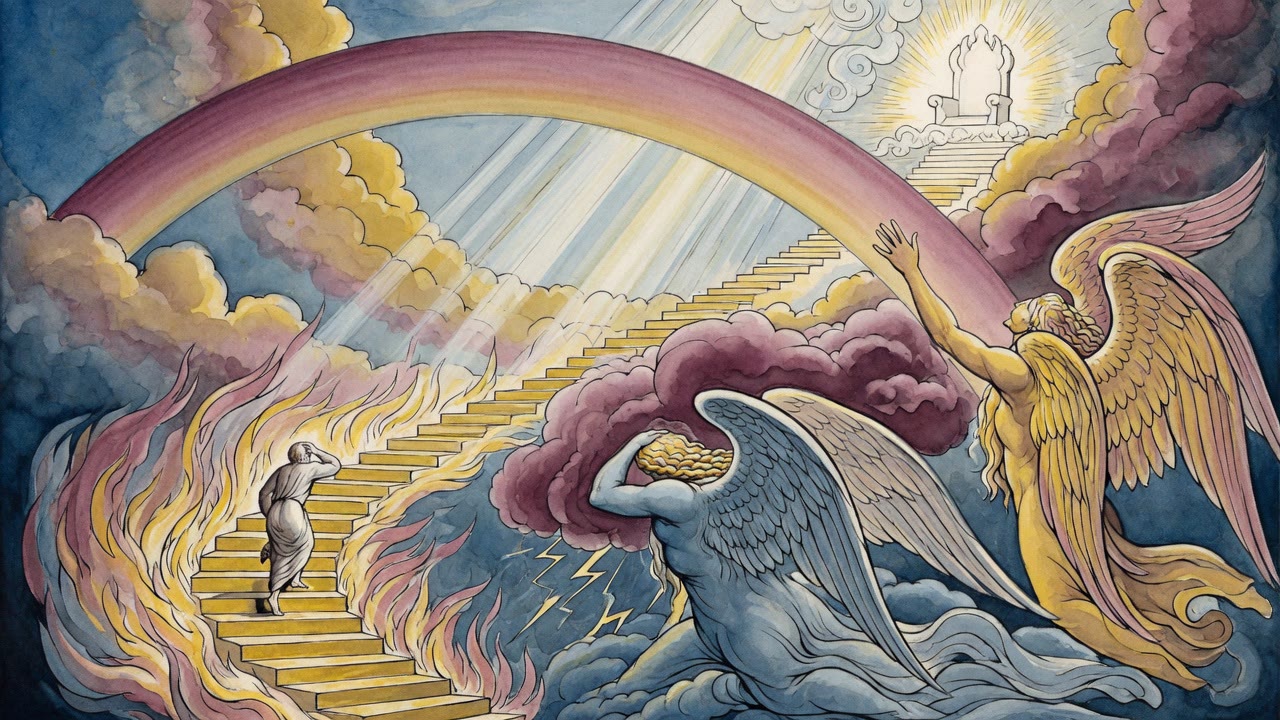
A rainbow arched over the highest heaven, but it was not the bow set in the clouds after rain. It was the bow of the Shekhinah (the Divine Presence), the Presence itself, and its light was the light Ezekiel had once struggled to name. "Like the appearance of the bow that shines in the clouds on a day of rain," the prophet had said, "such was the surrounding radiance." Its clouds wrapped the Throne of Glory. Above its arches turned the wheels of the Chariot, the Ophanim, rimmed and full of motion.

The rainbow did not hang in empty air. It rested across the shoulders of an angel who stood beneath it like a pillar holding a roof of colored fire. His name was Kerubiel, prince of the Cherubim. His mouth was a lamp of fire and his tongue a fire that consumed. His eyebrows were lightning. His eyes were sparks that would not stop throwing light, and on his head sat a crown engraved with the Name. Between his shoulders lay the rainbow of the Shekhinah, and the splendor of the Presence shone full on his face.

The traveler tilted his head back one more time to find the top of it all, the source of the light, the seat of the crown that Sandalfon kept sending up. He did not find it. The rainbow blazed, the crown rose, the hosts sang their endless song, and above every vast thing he had passed there was still another, brighter and farther, with no visible end. He lowered his eyes because he could not do otherwise, and the light went on without him.


← All myths
From the tradition

Sources

3 sources

The texts behind this telling. Some cards carry a translation of the source; others are our own retelling of it, and each card says which. Every card links out to the original.

Legends of the Jews 2:80Legends of the Jews

Retold in our words. Read the original at the link below.The Legends of the Jews by Louis Ginzberg (1909) · Public Domain

The familiar picture has them singing sweetly, but some legends paint a far more dramatic, awe-inspiring picture.

Take the story of SANDALFON, an angel so immense it would take five hundred years to traverse his height! Ginzberg, in Legends of the Jews, recounts this staggering image. It dwarfs our comprehension.

He doesn't just stand around looking pretty, either. Sandalfon has a crucial job: he stands behind the Divine Throne, weaving garlands for God. But here's the thing: even he doesn't know the exact location of God's abiding place. So how does he crown the Almighty?

Sandalfon doesn't physically place the crown on God's head. Instead, he charms it, and it rises of its own accord! Think of it: pure will and divine magic lifting this symbol of sovereignty heavenward.

Now, imagine the scene. As Sandalfon commands the crown to ascend, the entire heavenly host trembles. The holy animals, the Chayyot (the mythical creatures that carry God's throne), erupt in hymns. The Seraphim, those fiery angels, roar like lions, proclaiming, "Kadosh, Kadosh, Kadosh, Adonai Tzva'ot, M'lo chol ha'aretz k'vodo" – "Holy, holy, holy is the Lord of hosts, the whole earth is full of His glory."

This isn't a quiet, reverent moment. It's a cosmic explosion of sound and power.

And it gets even wilder! As the crown passes the Throne of Glory, the very wheels of the Throne begin to spin. The foundations of God's footstool tremble, and a wave of fear and awe sweeps through all the heavens. Talk about a dramatic entrance!

Finally, when the crown reaches its destination, the entire heavenly chorus bursts forth, declaring, "Yevorech et kvod Adonai mimkomo" – "Praised be the glory of the Eternal from His place." the verse says, "all the holy animals, the Seraphim, the wheels of the Throne, and the hosts on high, the Cherubim and the Hashmalim speak with one accord: 'The Eternal is King, the Eternal was King, the Eternal will be King in all eternity.'"

This story, drawn from Jewish mystical traditions, paints a picture of a dynamic, responsive, and utterly overwhelming Divine Presence. What does it mean to serve a God whose crowning provokes such a reaction throughout all of creation?

Full source
3 Enoch 6:1, 18:193 Enoch

Retold in our words. Read the original at the link below.3 Enoch, or The Hebrew Book of Enoch, trans. Hugo Odeberg (1928) · PD-US-pre-1929

Anafiel isn't exactly a household name, even in circles that discuss angels. But, according to some ancient texts, this angel is a big deal. Tree of Souls tells us that Anafiel rules over all the other angels and stands guard at the entrances to the highest heaven, Aravot. Imagine the sheer presence this angel must have, because, as 3 Enoch 6:1 describes, when other angels behold him, they remove their crowns of glory and fall on their faces.

The Zohar 1:108b hints at Anafiel's immense glory, stating that his radiance covers the chambers of the upper heaven. It’s like the verse from (Habakkuk 3:3) made manifest: "His majesty covers the skies, His splendor fills the earth." Is Anafiel just a powerful figure, or something more?

Some traditions even claim that Anafiel is the "creator of the beginning" or even the "creator of the world." What does that even mean?: before time, before space, before… well, everything. Was Anafiel there, somehow instrumental in bringing it all into being? It’s mind-boggling! He also possesses the secrets of heaven, adding to his mystique and power.

Remember Enoch, the human who was taken up to heaven and transformed into the angel Metatron? According to Hekhalot (the heavenly palaces) Rabbati, it was Anafiel who was sent to bring Enoch into heaven for this incredible transformation. So, Anafiel is not only powerful but also plays a crucial role in elevating others.

But here's a twist, a bit of celestial drama. There's a story that when Elisha ben Abuyah, a controversial figure, ascended to heaven, Metatron didn’t rise from his throne. And who do you think was sent to deliver the punishment? Anafiel, who struck Metatron with sixty fiery lashes! (That's in 3 Enoch 18:19). Now, some might find this story problematic, but what it emphasizes is Anafiel's authority. To be able to discipline Metatron suggests a position of considerable power and seniority.

His official name is even more telling: Anafiel YHVH. As Tree of Souls points out, the high archangels often carry YHVH, the Tetragrammaton – the sacred four-letter name of God – as part of their names. This highlights their direct connection to the Divine.

So, why haven’t we heard more about Anafiel? Well, as the role of Metatron grew in importance within Jewish mystical traditions, Anafiel's faded somewhat. Today, the evidence for Anafiel's supreme role is mostly found in fragments of the Hekhalot and Merkavah (the Divine Chariot) literature – the ancient texts describing mystical ascents to heaven. It's like finding pieces of a forgotten patchwork, hinting at a grander picture.

How many other figures, stories, and perspectives have been lost or overshadowed throughout history? The story of Anafiel reminds us to keep digging, to keep asking questions, and to remember that even the most established narratives might have hidden depths and forgotten origins.

Full source
3 Enoch 22:5, 22C:4, 22C:73 Enoch

Retold in our words. Read the original at the link below.3 Enoch, or The Hebrew Book of Enoch, trans. Hugo Odeberg (1928) · PD-US-pre-1929

What we see here is just a reflection of something far grander: the rainbow of the Shekhinah (the Divine Presence).

The Shekhinah, often translated as "Divine Presence," is the aspect of God that dwells among us, that's closest to creation. And the rainbow? (Genesis 9:13) tells us, "I have set My bow in the clouds." It's God's promise, a reminder of the covenant never to destroy the world by flood again.

The mystics take it even further. This earthly rainbow, they say, has a heavenly counterpart. A rainbow of the Shekhinah that arches above Aravot, the highest heaven.

It doesn't stop there. Think about Ezekiel's famous vision (Ezekiel 1:28): "Like the appearance of the bow which shines in the clouds on a day of rain, such was the appearance of the surrounding radiance." That radiance, that celestial light, is intimately tied to the Merkavah, the Divine Chariot. We find that the clouds of the rainbow surround the very Throne of Glory itself! Above the arches of the rainbow, are the wheels of the Merkavah, known as the wheels of the Ophanim.

Now, here's where it gets really interesting. The rainbow itself, this incredible arc of divine light, rests upon the shoulders of an angel: Kerubiel, the Prince of the Cherubim.

As we learn, for instance, in 3 Enoch, he's described in almost the same fiery terms as Metatron, another powerful angel. Kerubiel’s mouth is like a lamp of fire, his tongue a consuming fire, eyebrows like lightning, and eyes like sparks of brilliance. On his head sits a crown of holiness, engraved with God's Name. And between his shoulders? The rainbow of the Shekhinah. And the splendor of the Shekhinah shines on his face.

This gigantic angel, holding the rainbow. The Zohar, that foundational text of Kabbalah, doesn't shy away from these kinds of vivid descriptions.

Why an angel holding the rainbow? Some say Kerubiel represents the sun.: rainbows often appear after the rain, when the sun breaks through the clouds. The rainbow resting on the angel's shoulders becomes a potent symbol of renewal and hope.

As Ginzberg retells it in Legends of the Jews and as we find in Midrash Rabbah, these images aren't just pretty stories. They’re attempts to grasp the ungraspable, to understand the Divine in ways that resonate with our human experience. They link the earthly and the heavenly, reminding us that even in the darkest of times, the light of the Shekhinah, the promise of the rainbow, is always there.

So, next time you see a rainbow, remember Kerubiel, the Prince of the Cherubim, and the rainbow of the Shekhinah. Remember the promise, the connection, and the ever-present Divine light shining through. What does the rainbow symbolize for you?

Full source