5 min read

The Slave Who Chose the Awl at the Doorpost

Six years end, freedom stands open, and a man who loves master, wife, and children asks for the awl that pins his ear to the doorpost until Jubilee.

Curated by Arthur · Told by Maggid ·
Table of Contents
  1. The Gate of the Sixth Year
  2. Love That Must Be Mutual
  3. Daylight, Metal, and the Door
  4. Forever That Is Not Forever
  5. The Ear That Heard Sinai
The Slave Who Chose the Awl at the Doorpost Click for full size

The Gate of the Sixth Year

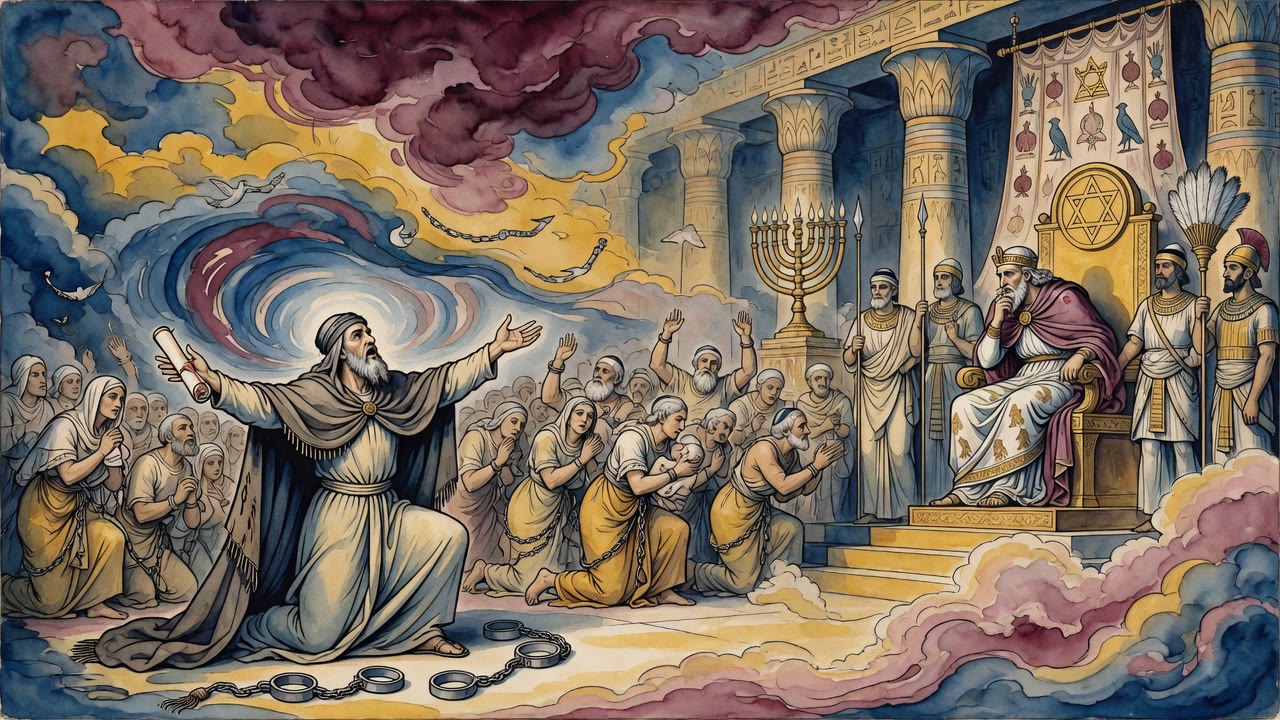
The Hebrew slave stood at the edge of freedom the way a man stands at a door he can either walk through or nail himself to. Six years had measured his body into someone else's fields, someone else's water jar, someone else's children calling for bread at dusk. The law of Moses opened the gate. Dust from the road of free men waited beyond the post. Then he spoke the sentence that changes the metal in the story.

"I will not go out free." He said it, and he said it again. Once is not enough. The midrash hears the doubled verb in Exodus and demands a doubled mouth, a will that does not hide behind a single panicked syllable (Exodus 21:5; Deuteronomy 15:16).

Love That Must Be Mutual

The ear is not bored for a performance of loyalty staged for neighbors. He must love his master. The master must love him. He must have a wife and children, and the master must have a household the slave can love, because the confession in Exodus names master, wife, and children in one breath, and Deuteronomy answers, because he loves you and your household, because it is good for him with you.

If only one side loves, the awl stays in the box. If either man is ill when the moment comes, the ritual waits, because "it is good for him" cannot be spoken over a sickbed bargain or a fever dream of dependence. If he tries to declare lifelong service in the middle of the six years, too early, the law refuses. If he waits until he is already free and then wants the mark as nostalgia, too late. The words must be said while he is still a slave and at the hour of going out. Timing is part of consent. The midrash is ruthless about the calendar of the heart.

Daylight, Metal, and the Door

The boring is done in the daytime, not at night. Freedom refused in the dark looks like coercion dressed in oil light. Freedom refused under the sun looks like a choice the neighbors can witness and the court can later name. Then you shall take the awl. Rabbi Yossi ben Rabbi Yehudah opens the tool chest wider than comfort allows: thorn, glass, reed haulm, anything that can be taken and driven through flesh. Rebbi narrows it hard: as an awl is metal, so only metal. The law argues over the instrument while the ear waits and the door stands patient as wood always is.

"In his ear and the door." Not a nick at the edge of the cartilage for show. The point travels until it meets the door. Flesh and wood share one wound. The midrash places the pierce in the right ear by linking the language to the leper's rite in Leviticus, where the right ear is named with priestly precision. Rabbi Eliezer and Rabbi Meir dispute the exact map of the ear, lap or helix, and a priest's body complicates the geometry, because a blemish that disqualifies service cannot be manufactured lightly for a private vow. The body of Israel is never only private property, even when it is a slave's body choosing a master over the open road.

Forever That Is Not Forever

He shall be unto you a servant forever. The word frightens the room. Does the awl write eternity into blood? The midrash answers with Jubilee. Forever here is the forever of the Yovel, the fiftieth-year release, when each one returns to his holding and the horn undoes what markets built (Leviticus 25:10). Even thirty years. Even forty. Until the sound of return. The bored slave does not serve only another tidy six. His end is heavier than his beginning, and the Torah names that heaviness without calling it endless night under a human name.

A bored slave serves the master, not the master's son and daughter in the same way ordinary Hebrew service can pass through inheritance. The mark isolates him inside a relationship that death cannot simply hand off like a plow. Love chose a doorpost. Law keeps the choice from becoming a dynasty of flesh sold forward through generations that never heard the original "I will not go out."

The Ear That Heard Sinai

Later teachers will press what the tannaitic line only prepares: this ear heard at Sinai, "For unto Me the children of Israel are servants," and then chose a human master when freedom opened like a clean road. Whether or not that full sermon is spoken in every classroom, the scene already carries shame and tenderness in the same blood. The man who stays may be protecting a wife given him in the house, children who would be torn by his exit into a freedom that cannot feed them yet, a master who became family when the world outside had no table for him.

The awl is not romance. It is the price of a love the law allows but does not celebrate with silence. It writes the choice into skin so no one can pretend the gate was never open. When Jubilee finally comes, the doorpost memory remains in the scar. He walks out carrying the history of a no he once said to freedom. Israel is commanded to remember both truths at once: the God who frees, and the human heart that sometimes begs to stay when staying still costs blood.


← All myths
From the tradition

Sources

5 sources

The texts behind this telling. Some cards carry a translation of the source; others are our own retelling of it, and each card says which. Every card links out to the original.

Sifrei Devarim 121:3Sifrei Devarim

Retold in our words. Read the original at the link below.Sifrei by Rabbi Shraga Silverstein · CC-BY

The Hebrew slave who chooses to stay does not enter permanent service by feeling alone. The timing, family, and wording all have to line up, including the declaration in (Exodus 21:5): "I love my master, my wife, and my children."

It doesn't stop there! The text continues, "Whence is it derived (that his ear is not bored) unless his master has a wife and children? From 'because he loves you and your household.'" The master, too, must have a family. Why? Because the verse states, "because he loves you and your household." The slave's love for his own family is intertwined with the master's established family life. It’s all interconnected.

So, what happens if the slave has a family, but the master doesn't? Or vice versa? According to the Sifrei Devarim, "If he had a wife and children and his master did not, or if his master had a wife and children and he did not, his ear is not bored." Meaning, the ear isn't pierced, and he doesn't become a permanent servant. The conditions aren't right. The reciprocal familial environment isn't there.

Finally, the kicker: mutual affection. The verse states, "I love my master," so, naturally, if the master doesn't reciprocate that love, the ear isn't bored. It also says, "because it is good for him with you," implying the master's affection is also necessary. It has to be a two-way street!

This seemingly simple law about a slave's ear reveals something profound about ancient Jewish values. It’s not just about servitude; it’s about love, family, commitment, and the complex relationships that bind people together. It highlights the importance of mutual respect and affection, even within a hierarchical structure. What unspoken "ear piercings" have we committed to, and what are the conditions that make them truly meaningful?

Full source
Sifrei Devarim 122:1Sifrei Devarim

Retold in our words. Read the original at the link below.Sifrei by Rabbi Shraga Silverstein · CC-BY

Sifrei Devarim turns to The Ear-Piercing Ritual of the Slave Who Chose to Stay.

The ritual was… striking. The master would take the slave to the doorpost of his house and pierce his ear with an awl, a sharp, pointed tool. This act symbolized the slave's permanent attachment to the household. As (Deuteronomy 15:17) says, "Then you shall take the awl and place it through his ear into the door, and he shall be your slave forever."

What if things weren't so straightforward? What if the slave, or even the master, fell ill before the ear-piercing ceremony could take place? That’s where Sifrei Devarim 122 steps in. It states that if either the slave or his master became sick, the ear is not bored. Why? Because the verse specifies, "because it is good for him" (Deuteronomy 15:16). The act of becoming a permanent slave is intended to be a willing and beneficial choice. Illness throws that into question. It introduces an element of coercion, or at least compromises the free will aspect of the decision.

It's a fascinating glimpse into the rabbinic mind at work: interpreting the law, ensuring fairness, and prioritizing the well-being of all involved.

And the questioning doesn't stop there. The text continues: what exactly constitutes an "awl"? Does it have to be an awl?

The verse says, "Then you shall take the awl and place it." Sifrei Devarim asks: what else could you "take" and use for this purpose? Rabbi Yossi b. R. Yehudah suggests that a thorn, a piece of glass, or even a reed haulm (a stalk of reed) could also be valid! His reasoning? The phrase "then you shall take" implies anything that can be taken and used to pierce. It’s about the action, the intent, not necessarily the specific tool.

But Rebbi (often referring to Rabbi Judah the Prince, the redactor of the Mishnah (the earliest code of rabbinic law)) disagrees. He argues that just as an awl is specifically made of metal, so too must any substitute be made of metal. He emphasizes the importance of maintaining the integrity of the original symbol.

This difference of opinion highlights a fundamental tension in interpreting Jewish law: Do we focus on the literal meaning of the text, or do we prioritize the underlying principles and intentions? Is the ritual itself paramount, or is it merely a means to an end?

It's these kinds of questions, these deep dives into the details, that make studying these ancient texts so rewarding. It’s not just about understanding the law, but about understanding the thought processes, the debates, the very human effort to create a just and meaningful society. These interpretations remind us that even the most ancient laws are subject to ongoing discussion and reevaluation, ensuring that they remain relevant and responsive to the needs of each generation.

Full source
Sifrei Devarim 121:1Sifrei Devarim

Retold in our words. Read the original at the link below.Sifrei by Rabbi Shraga Silverstein · CC-BY

Specifically,

The Torah outlines that a Hebrew slave is to be freed in the seventh year of their servitude. But what happens if the slave, presented with freedom, refuses it? What if they say, "I love my master, my wife, and my children; I will not go out free?"

That's where things get interesting.

(Deuteronomy 15:16) states, "And it shall be, if he say to you: I shall not leave." But the Rabbis, in their infinite wisdom, never took anything at face value. They delved deeper, asking: How many times must the slave declare their unwillingness to leave? Is it enough to say it once?

Apparently not!

The Rabbis, in Sifrei Devarim, draw a connection to another verse, this one from Exodus (Shemot 21:5): "And if the slave say, will say." The repetition in the Hebrew – "amo yomar" – is key. The doubling of the word "say" teaches us that the slave must express this desire not just once, but repeatedly. "He must say it and repeat it," the text emphasizes.

Why this emphasis on repetition? Perhaps it’s to ensure the slave isn't making a rash decision, a momentary declaration born of fleeting emotion. Maybe it's a safeguard against coercion, ensuring the slave truly desires to remain in servitude. Whatever the reason, the Rabbis, through their careful reading, ensure the gravity of the situation is fully understood.

And once this choice is made? Well, that's when the infamous ear-boring ceremony comes into play. The master takes the slave to the doorpost – a potent symbol of the home, of belonging – and pierces their ear with an awl. This act serves as a permanent mark of their decision, a visible sign of their chosen servitude.

But even this act is subject to specific regulations.

The verse says, "Therefore, I command you in respect to this thing this day.” The phrase "this day" is interpreted by Sifrei Devarim to mean that the ear-boring must be performed during the daytime, and not at night. Night, in Jewish thought, is often associated with uncertainty, with the hidden. Performing the ceremony in the light of day emphasizes its openness, its transparency.

So, what are we left with? A fascinating glimpse into the complexities of ancient Jewish law. It's more than just dry legal code. It's a reflection on freedom, choice, and the often-murky motivations that drive human behavior. What unseen forces might be shaping our own choices, our own perceived limitations, even today?

Full source
Sifrei Devarim 122:8Sifrei Devarim

Retold in our words. Read the original at the link below.Sifrei by Rabbi Shraga Silverstein · CC-BY

The Torah talks about it, but sometimes the details are…sparse. to one fascinating passage from Sifrei Devarim, a legal commentary on the Book of Deuteronomy, and examine the laws surrounding a Hebrew servant who chooses to stay with his master beyond his initial term.

The passage begins with a curious phrase: "in his ear." The Torah (Deuteronomy 15:17) commands us to pierce the ear of a servant who loves his master and doesn't want to leave. But where exactly do you pierce it? Sifrei Devarim anticipates a potential misunderstanding. We might imagine piercing just the side of the ear. To clarify, the text points out that the verse actually says, "in his ear and the door." This means the piercing must go all the way through the ear, right up against the doorpost!

What does "forever" really mean in the context of "and he shall be unto you a servant forever"? Does it truly mean for the rest of his life? We know from Leviticus (Vayikra 25:10) that during the Yovel, or Jubilee year, every person returns to their ancestral land and freedom. So, could "forever" actually mean…forever?

The text raises the possibility that after his ear is pierced, the servant only serves six more years. The reasoning? To ensure the end of his servitude isn't harsher than its beginning! But Sifrei Devarim quickly dismisses this idea. The "forever" in Deuteronomy means exactly that: he serves until the Yovel, even if that's thirty or forty years.

Now, here's where it gets even more nuanced. The text draws a parallel between Deuteronomy and Leviticus, specifically looking at who the servant is obligated to serve. (Deuteronomy 15:17) states "and he shall be unto you a servant forever," and (Leviticus 21:5) states "and he shall serve him forever." This raises a question: does "him" include his descendants? The answer, according to this passage, is no. A Hebrew man-servant serves the son of his master, but not the daughter. It's a patriarchal society, after all.

Someone whose ear has been pierced, or who was sold to a non-Jew, serves neither the son nor the daughter.

How do we know that these rules apply across both verses in Deuteronomy and Leviticus? The text invokes a principle called gezeirah shavah, a method of interpreting the Torah by comparing similar words or phrases in different passages. In this case, the shared word "forever" links the two verses, allowing us to apply the same rules to both. "Forever" here, matches "forever" there. Simple. These details illuminate the complex social structures and legal interpretations of the time. It shows us that even seemingly straightforward commands are subject to layers of interpretation and nuance. The rabbis of the Talmud weren't just blindly following the law; they were actively engaging with it, wrestling with its implications, and ensuring that it remained relevant to the lives of the people.

So, the next time you read the word "forever" in the Torah, remember this passage. Remember the pierced ear, the doorpost, and the ongoing debate about what "forever" truly means in the eyes of Jewish law. It's a reminder that our tradition is a living, breathing thing, constantly being reinterpreted and re-evaluated by each generation.

Full source
Sifrei Devarim 122:6Sifrei Devarim

Retold in our words. Read the original at the link below.Sifrei by Rabbi Shraga Silverstein · CC-BY

Sifrei Devarim turns to Where Exactly on the Ear a Servant Is Pierced.

R. Eliezer Yuden Berebbi, a sage known for his insightful teachings, believed the piercing should be done specifically in the "ear-lap." Think of that soft, fleshy lobe hanging down.

Then R. Meir chimes in with a different take. He suggests the piercing is actually done in the "helix", that's the curved outer rim of your ear. Why the distinction? What's at stake?

Well, R. Meir brings up an important point: a Kohein – a priest – is forbidden from having such a piercing. This is because it would render him "blemished," unfit for his sacred duties. But, R. Meir asks, if the piercing were in the ear-lap, how would that even constitute a blemish serious enough to disqualify a Kohein? His logic: the piercing must be higher up on the ear, on the helix, to be considered a significant enough alteration.

So, what’s the takeaway? "We are hereby taught that boring is only in the height of the ear." It's not just any part of the ear; it's specifically the upper portion.

Now, the Sifrei Devarim doesn’t stop there. It wants to be absolutely clear. The text points out that the Torah specifies "his ear" when discussing the piercing. And it draws a parallel to another verse, this one in Vayikra (Leviticus 14:14), which also mentions "his ear" in the context of a leper undergoing purification.

Here's the clever part. In the case of the leper, the Torah is understood to be talking about the right ear. The Sifrei Devarim uses this connection to infer that when it says "his ear" in the context of the servant, it also means the right ear!: the Rabbis are using textual connections – what's known as a gezerah shavah – to unlock deeper meaning. They aren’t just reading the words on the page; they’re weaving together different parts of the Torah to create a richer understanding.

So, next time you read about this seemingly minor ritual of ear-piercing, remember the debate, the reasoning, and the beautiful way the Rabbis used the text itself to illuminate its hidden depths. It’s a reminder that even the smallest details can hold profound significance, inviting us to delve deeper into the wisdom of our tradition.

Full source