The Three Torah Laws King Solomon Broke on Purpose
The Torah gave kings three specific prohibitions. Solomon knew all three and violated all three. His reasoning was brilliant. His reasoning was wrong.
Table of Contents
 Click for full size
What the Torah Said About Kings
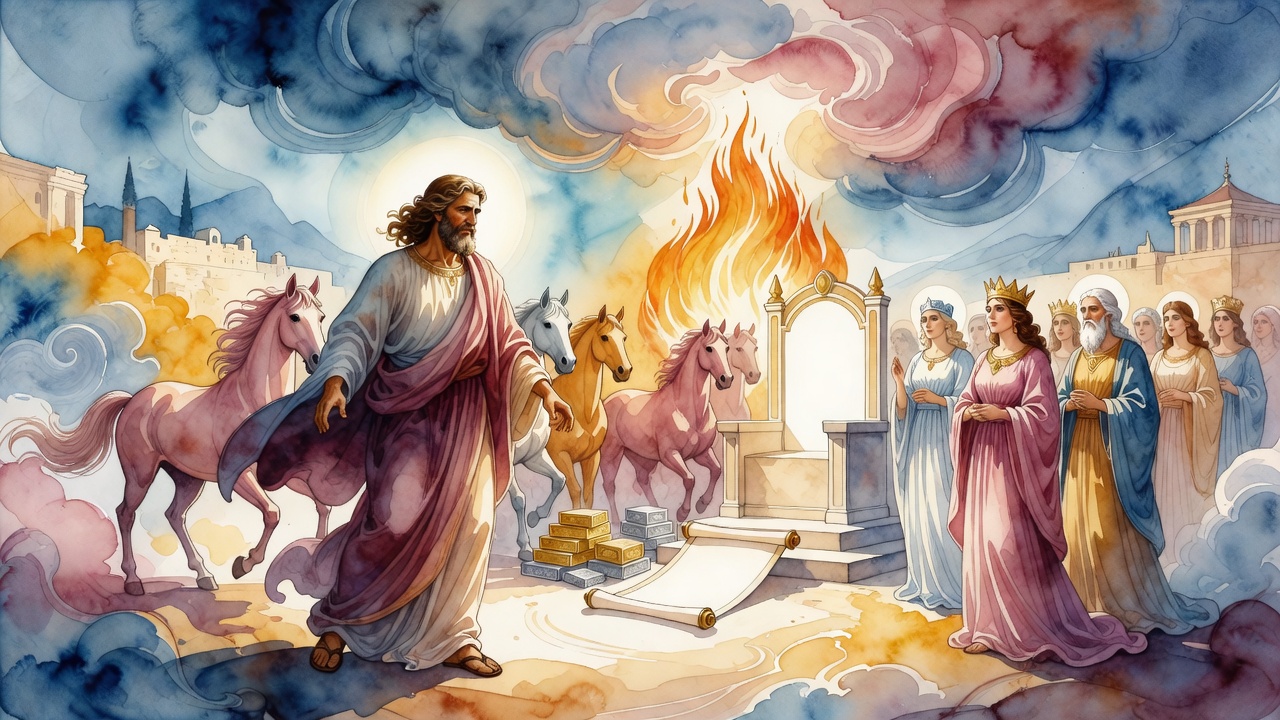
Long before Israel had a king, the Torah anticipated what having one would do to people. Deuteronomy 17 contains a compact set of warnings directed specifically at the future monarch: do not multiply wives, because they will turn your heart toward foreign gods. Do not multiply horses, because that will make you dependent on Egypt for military power. Do not multiply gold and silver, because wealth will corrupt your judgment. Three prohibitions. One for the heart, one for military policy, one for economic ambition. The Torah named the specific failure point of each.
Solomon knew this passage. He knew the entire Torah. He was the wisest man alive, and his wisdom was specifically described as including encyclopedic knowledge of everything that had been written. When he decided to violate all three prohibitions anyway, he was not acting in ignorance. He was acting in the certainty that he was the exception.
The Seven Hundred Wives
The first prohibition fell first. Solomon's reasoning, reconstructed by the rabbis from his own words in Ecclesiastes and from the logic of his actions in Kings, was a piece of exegesis: I will multiply wives, but I will not let my heart turn away. The prohibition was against the turning, not the multiplication. I am wise enough to hold the distinction.
He took seven hundred wives, princesses from every neighboring kingdom, and three hundred concubines. The Book of Kings is explicit about what happened next: in his old age, his wives turned his heart after their gods. He built high places for Chemosh and Molech on the mountain east of Jerusalem. He built altars for the gods of all his foreign wives. The thing the Torah said would happen, happened. The man who believed his wisdom would exempt him from the mechanism discovered that wisdom is not exemption from human psychology. It is, at most, a delay.
The Horses From Egypt
The second prohibition had an explicit geopolitical reason. Egypt was the slave house, the place Israel had escaped from, the paradigm of what dependence on a foreign power produces. Multiplying horses meant building a cavalry, and building a cavalry in that era meant buying horses from Egypt. The Torah was not simply saying: do not spend money on horses. It was saying: do not rebuild a structural dependency on the nation that once owned you.
Solomon imported horses and chariots from Egypt and from Kue, at a fixed price. First Kings records the numbers and the supply chains. He built cities specifically for his horse-drawn forces. The military logic was sound. The symbolism was catastrophic. He had taken the nation that God had led out of slavery and made it dependent on the slave master's exports for its security.
The Gold That Changed the Weights
The third prohibition was the subtlest. Gold and silver are not inherently corrupting. The danger the Torah named was to the king's judgment, to his ability to see his subjects clearly, to maintain the standard of justice that royal power requires. When a king accumulates enough wealth, his frame of reference shifts. What looks like a small bribe to a poor man looks like an ordinary gift to a king. What looks like a crushing tax to a farmer looks like a reasonable revenue stream to someone whose daily provisions included sixty measures of fine flour.
The rabbis of Kohelet Rabbah said Solomon was confounded. Not simply sinful but genuinely confused, each prohibition having done exactly what the Torah said it would do: not just the external damage but the internal one. The wives turned his heart. The horses turned his military calculations toward a dependency he no longer recognized as dependence. The gold turned his perception until he could no longer see what ordinary people saw when they looked at the consequences of his rule.
What Came From the Confounding
The tradition does not simply condemn Solomon. It holds him as the author of Proverbs, of Ecclesiastes, of the Song of Songs, as the builder of the Temple, as the man before whom the Queen of Sheba came from the ends of the earth to test his wisdom and found it exceeded her expectations. The rabbinic portrait of Solomon is of a man who reached farther and fell harder than anyone before or after him, whose wisdom was real and whose failures were exactly as real, and whose acknowledgment at the end of Ecclesiastes, fear God and keep his commandments, reads as a man who had tested every hypothesis and arrived, at last, at the conclusion the Torah had stated in advance.
← All myths